Welcome
NIHR CLAHRC East Midlands Annual Meeting
Growing Momentum – Sharing and Learning
A partnership between
Nottinghamshire Healthcare NHS Foundation Trust
and the Universities of Nottingham and Leicester
24 March 2015, Eastwood Hall Hotel, Nottingham
East Midlands
Prevalance of Long Term Conditions • 15 million with
LTC
• 70% NHS Budget
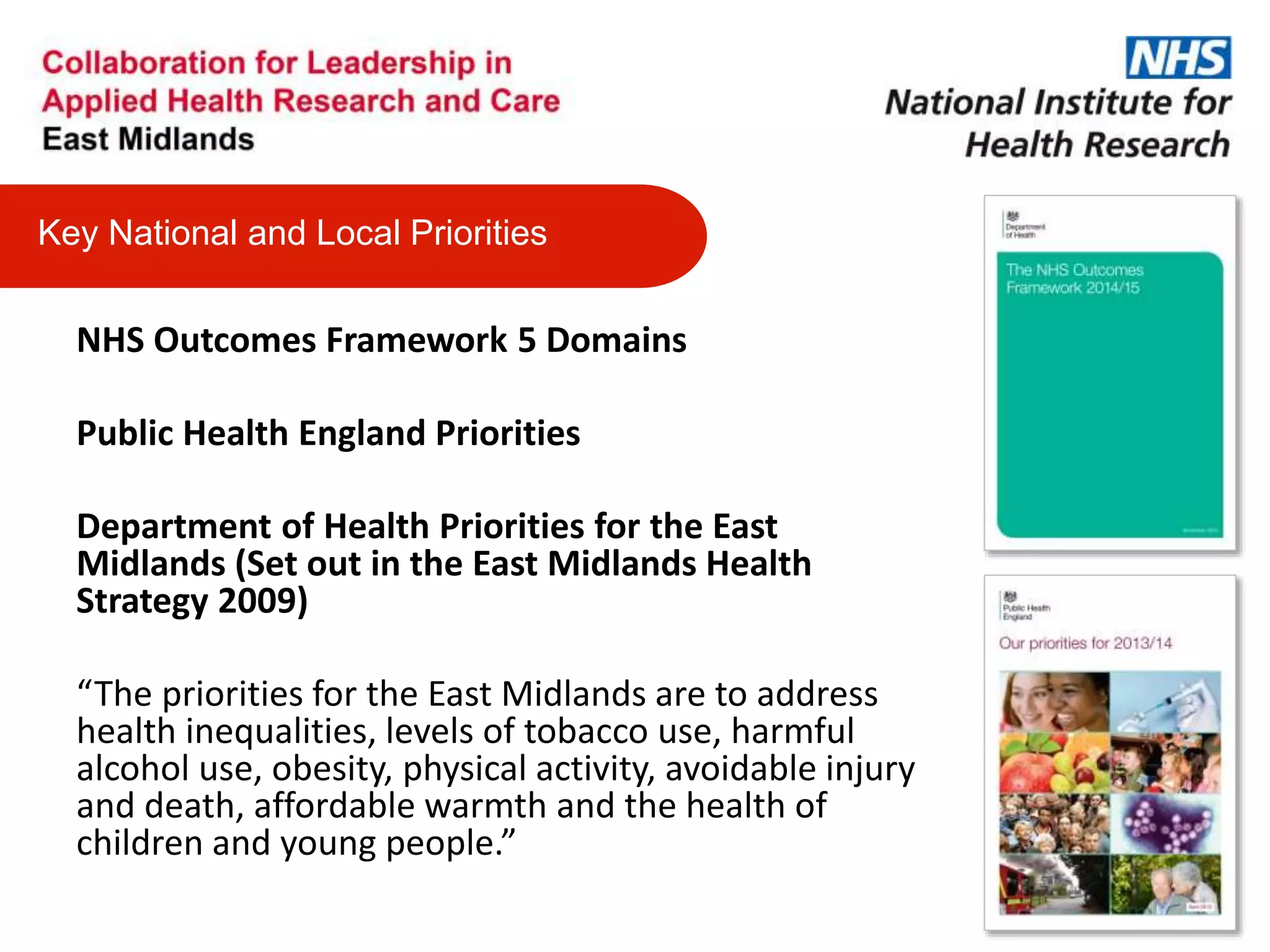
NHS Outcomes Framework 5 Domains
Public Health England Priorities
Department of Health Priorities for the East
Midlands (Set out in the East Midlands Health
Strategy 2009)
“The priorities for the East Midlands are to address
health inequalities, levels of tobacco use, harmful
alcohol use, obesity, physical activity, avoidable injury
and death, affordable warmth and the health of
children and young people.”
Key National and Local Priorities
Contributions from Matched Funding
NIHR CLAHRC East Midlands
Structure
• Improve patient outcomes
• Bring together health stakeholders to support
the NHS to meet locally identified priorities
• Bridge the second gap in translation
• Implement partnership model for (a) research
in public (b) uptake of research evidence into
practice
• Increase capacity in the East Midlands
• Understanding conditions for the uptake of
research
CLAHRC EM Objectives
“Improve patient outcomes
through the conduct and
application of research evidence
of local relevance and
international quality”
Applied Health Research
Year One
• 18 Phase One and Two projects are up
and running across the East Midlands.
• 10 Projects provisionally selected for
Phase Three from an rigorous approach
involving Partners and Public
Bringing People Together
Year One
• Received £591k cash matched funding
• On track to receive £18m overall
• Set up the East Midlands CLAHRC
faculty. We currently have 90
members.
• PARADES Event in December 2014 with
the EM AHSN #StephenFryLiked
• Developed an Industry Strategy which
has been distributed by the NIHR to all
other CLAHRCs
“Build on the achievements of
the LNR and NDL CLAHRCs in
bringing together stake holders
to support the NHS to meet
locally identified priorities”
“Bring about a further step
change in the quality and
quantity of activity taking place
to bridge the second gap in
translation”
Implementing Evidence
Year One
• EM AHSN have pledged funding of
£525,000 to support the
implementation of CLAHRC EM
projects.
• Appointed 34 knowledge
brokers who are playing a key
role in developing research
interest and capability
“Implement and evaluate a
partnership model for (a) co-
producing research in public
health and chronic disease, and
(b) co-producing the rapid
uptake of research evidence
into widespread practice”
Our Partnership Model
Year One
• Knowledge Translation strategy has
been developed and disseminated
amongst project teams and
successful Phase 3 applicants
• All research theme staff have
attended implementation workshops
“Increase capacity in the EM to
conduct high quality health
research and to apply research
evidence”
Capacity Development
Year One
• We have appointed seven PhD
students and three more planned in
September
• Commenced our training programme
presenting short courses for NHS
staff in 2015. Courses were put
forward after consultation with NHS
partners.
“Develop a greater
understanding of the necessary
and desirable conditions for the
uptake of research findings and
spread of evidence-based
practices”
Capacity Development
Year One
• Researchers in the IEI Theme have
commenced 3 studies which covers
PPI, use of technology in
implementation and analysis in the
CLAHRC
• All research teams complete Quarterly
Reports creating a log of
implementation activities and
approaches. This will provide a
valuable resource.
Year One
• PPI strategy completed and being
implemented.
• Partners Council set up and meeting regularly.
• Set up the Centre for BME Health. The Centre
has already delivered 11 community health
information events to raise awareness of
diabetes and safer fasting during Ramadan to
more than 250 individuals from 13 different
ethnic groups.
Public Involvement
“Provide opportunities for
stakeholder engagement and across
all of its structures, themes and
projects so that intended end-users
of research can help to shape its
selection, design, delivery,
dissemination and implementation”
• Overview of our progress including
achievements
• Give a wider perspective on the
relationship between our partners
• Outline our challenges
• Encourage networking
• To thank you for all that you have done
in the last year.
• We could not have achieved this
without your support!
Aims and Objectives of Today
Mission Statement
Thank you for listening and
Enjoy the Day
kk22@le.ac.uk
www.clahrc-em.nihr.ac.uk
@kamleshkhunti
@CLAHRC_EM
This research was funded by the National Institute for Health Research Collaboration for Leadership in Applied
Health Research and Care East Midlands (NIHR CLAHRC EM). The views expressed in this presentation are those of
the speaker(s) and not necessarily those of the NHS, the NIHR or the Department of Health.
NIHR CLAHRC East Midlands - Embedding a
Mature CLAHRC
Chair – Professor Kamlesh Khunti, Director
A partnership between
Nottinghamshire Healthcare NHS Foundation Trust
and the Universities of Nottingham and Leicester
‘Building Partnerships’
Karen Glover
Director of Partner Relations and Operations,
NIHR CLAHRC EM
Head of Clinical Programmes EM AHSN
A partnership between
Nottinghamshire Healthcare and the
Universities of Nottingham and Leicester
• NHS, Industry, Academia
• Voluntary Sector and Local Authorities
• Patients/Public
• Region-wide: BRU, CRN, SCN, Clinical Senate,
HEEM, EMLA, AHSN
• National NIHR CLAHRC
Who are our Partners?
• Improve Population Health
• Increase Capacity and Capability for Research
and Innovation
• Shared Understanding and Ownership
• Translation of Research into Practice
Why Collaborate?
• Communications
• Networks
• Events
• Organisational Presentations - NHS, Academia
• Industry
How Do We Engage?
• Governance Arrangements
• Project Selection
• CLAHRC Faculty
• Networks of Practice
• Knowledge Brokers
How Do We Engage?
Thank you for listening
karen.glover@nottingham.ac.uk
www.clahrc-em.nihr.ac.uk
@CLAHRC_EM
This research was funded by the National Institute for Health Research Collaboration for Leadership in Applied
Health Research and Care East Midlands (NIHR CLAHRC EM). The views expressed in this presentation are those of
the speaker(s) and not necessarily those of the NHS, the NIHR or the Department of Health.
NIHR CLAHRC East Midlands Annual Meeting
Growing Momentum – Sharing and Learning
A partnership between
Nottinghamshire Healthcare NHS Foundation Trust
and the Universities of Nottingham and Leicester
Co-Production & Translation
Justin Waring,
IEI Theme Lead, CLAHRC East Midlands
A partnership between
Nottinghamshire Healthcare and the
Universities of Nottingham and Leicester
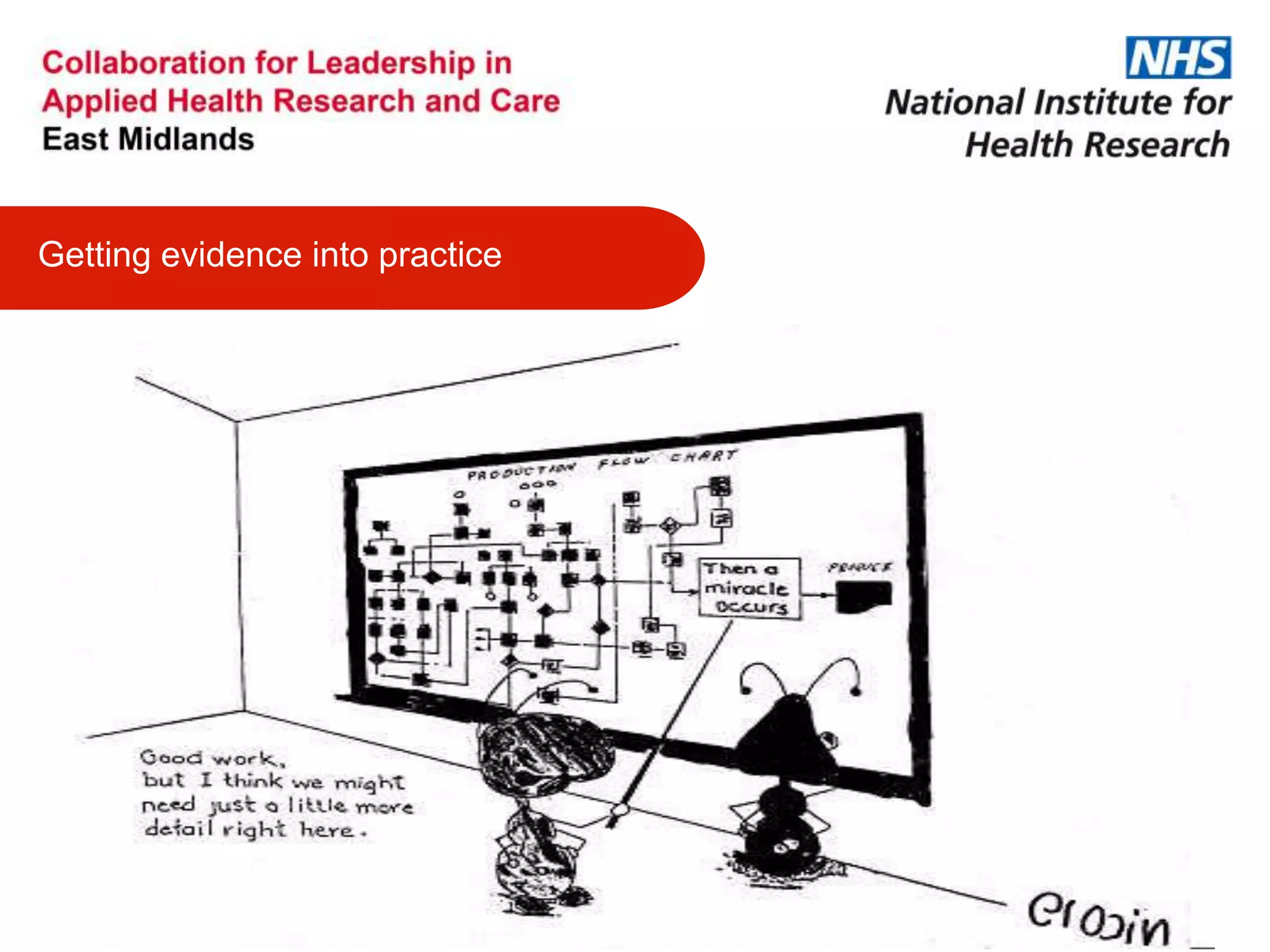
Getting evidence into practice
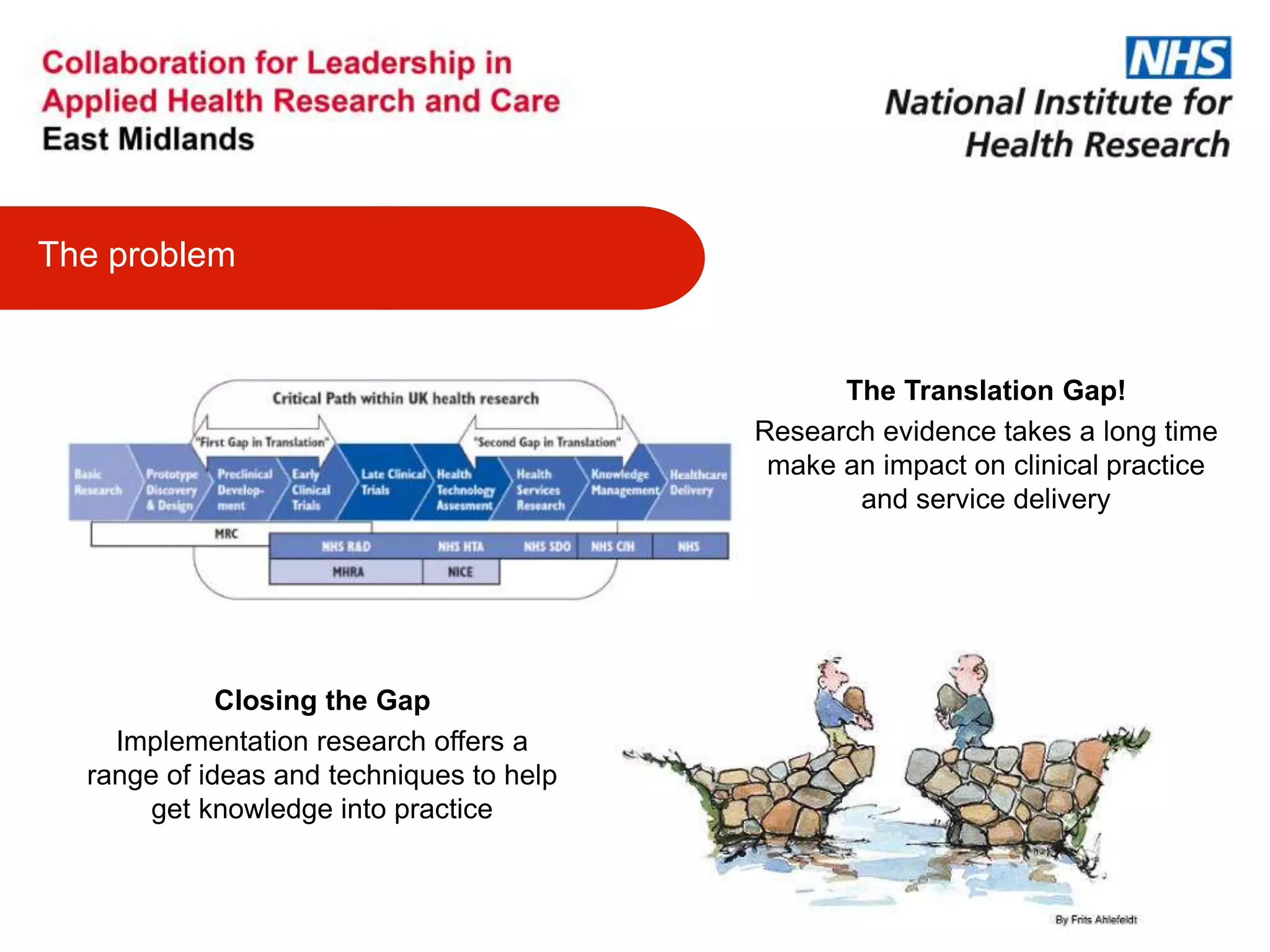
The Translation Gap!
Research evidence takes a long time
make an impact on clinical practice
and service delivery
The problem
Closing the Gap
Implementation research offers a
range of ideas and techniques to help
get knowledge into practice
Understanding the gap
• Clinical Research and Clinical Practice operated in different ways:
– Separated by a common language
– Characterised by different cultures
– Measured and assessed in terms of different performance
– Driven by different pressures and priorities
• Clinical research is often done ‘on’ clinical practice, not ‘with’ clinical
practice
– Research questions reflect the interests of researchers, not needs of practitioners
– Research design does not take into account local operational issues
– Research activities can treat practitioners as ‘subjects’
– Research findings are not valued or recognised by practitioners
– Research does not make a meaningful or lasting impact on practice
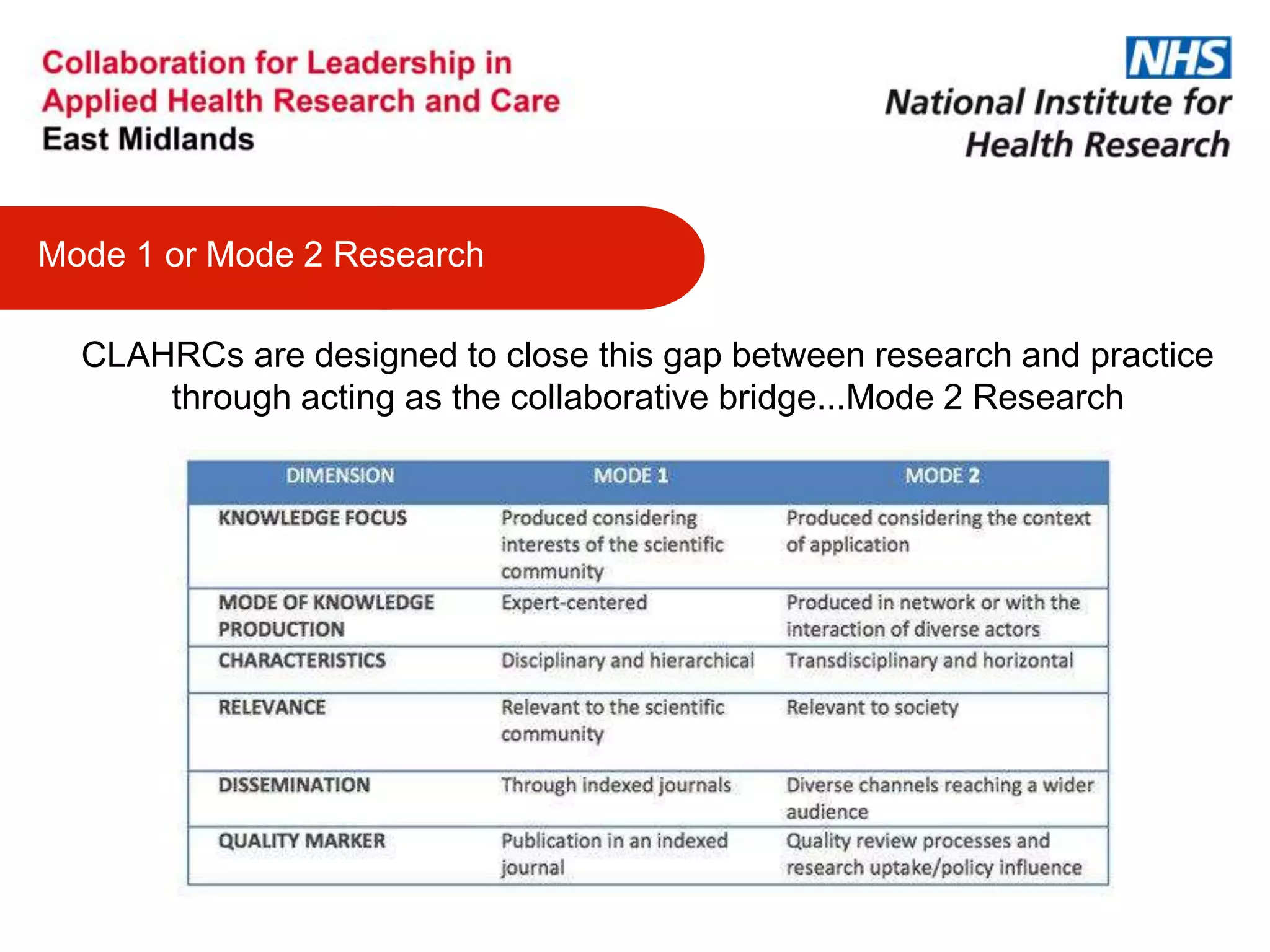
Mode 1 or Mode 2 Research
CLAHRCs are designed to close this gap between research and practice
through acting as the collaborative bridge...Mode 2 Research
NIHR CLAHRC-EM undertakes world-class applied health research that aims to
close the gap between research and practice!
• Applied research – research that tests ‘proven interventions’ in the context of
local care services and needs
• Closing the gap – research that is ‘co-produced’ by research and practice
communities so that it fits with the context of local care services and needs
• Co-production – where research teams and practitioners work together to
design and ‘implement’ applied research
• Implementation research – research that aims to understand how best to co-
produce and implement research
The CLAHRC Approach
We have learnt a lot about what works in closing the gap…
• Communication & Translation
• Engagement
• Teamwork
• Dealing with ‘push-back’
• Timing & Pace
The benefits of a mature CLAHRC
Mapping out the journey
Getting Research Into Practice (GRIP)
• Develop and conduct applied research that is relevant to our NHS partners, and to
translate the research findings into improvement outcomes for patients
• Create a distributed model of implementation and translation that links those who
conduct applied research with those who will use it
• Create and embed approaches to applied research that takes into account the way
care is organised and delivered across our region and aligns with AHSN
• Increase capacity for applied health research and translation
Our approach
• NHS partners should be involved in the initial stages of problem definition and project
specification and all stages of research activity – after all our partners will use the
findings
• Project teams (of researchers and practitioners) need to build implementation and
translation into their research activities – it cannot be ‘done’ by someone else or after
the research findings have been collected (this would recreate the gap)
• By understanding the wider environment research can make a sustained impact and
ideally be spread at scale and pace with relevant partners
• By building capacity within both clinical and practice communities, we can ensure the
long term and sustained generation and use of evidence and its translation into
practice
What does this mean?
Knowledge brokers help ‘get the right information, to the right people, at the right time’
• They are intermediaries or go-betweens who work between research and practice
partners
• They identify insight or information that might be of use to other partners
• They translate insight and information so it is in an appropriate format and language
• They communicate insight between partners
• The can champion change and support the use of insight between communities
Knowledge Brokers
Co-production and translation is based upon the formation of new teams, communities or
networks between research and practice partnership
• Networks help bring together diverse partners around a shared purpose
• Networks coordinate activities and foster cooperation
• Networks help build a critical mass of energy, expertise and experience
• Networks support knowledge sharing and learning
• Networks can become self-sustaining
Networks
1. CLAHRC projects are based on co-production and partnership between research
(knowledge producers) and practice communities (problem owners)
2. Project teams are responsible for developing their own co-production and translation
activities to reflect their specific challenges, but with the support of the CLAHRC team
3. Project teams should look to use knowledge brokers and/or networks as a way of co-
producing and translating research into sustained service improvement
Key points
Thank you for listening
Justin.waring@nottingham.ac.uk
www.clahrc-em.nihr.ac.uk
@CLAHRC_EM
This research was funded by the National Institute for Health Research Collaboration for Leadership in Applied
Health Research and Care East Midlands (NIHR CLAHRC EM). The views expressed in this presentation are those of
the speaker(s) and not necessarily those of the NHS, the NIHR or the Department of Health.
NIHR CLAHRC East Midlands Annual Meeting
Growing Momentum – Sharing and Learning
A partnership between
Nottinghamshire Healthcare NHS Foundation Trust
and the Universities of Nottingham and Leicester
CLAHRC EM Annual Meeting 24th
March 2015
Growing momentum:
Sharing & Learning
Working with the EM AHSN
Professor Rachel Munton
Managing Director, EMAHSN
EM CLAHRC/AHSN have clear and complementary aims
and related clinical foci
Both shaped to ensure the two organisations work
together effectively to deliver signification
improvements
Agreed approach that differentiates between the
academic discipline of implementation/improvement
science and the change activity of evidence-informed
practice improvement
East Midland’s approach
“There is a clear relationship between the
EM CLAHRC and EM AHSN, with the
CLAHRC resources supporting the
generation of high quality and locally
relevant evidence and developing the
science of implementation and the AHSN
supporting the practicalities of “putting
evidence into practice” at a suitable
stage of development.”
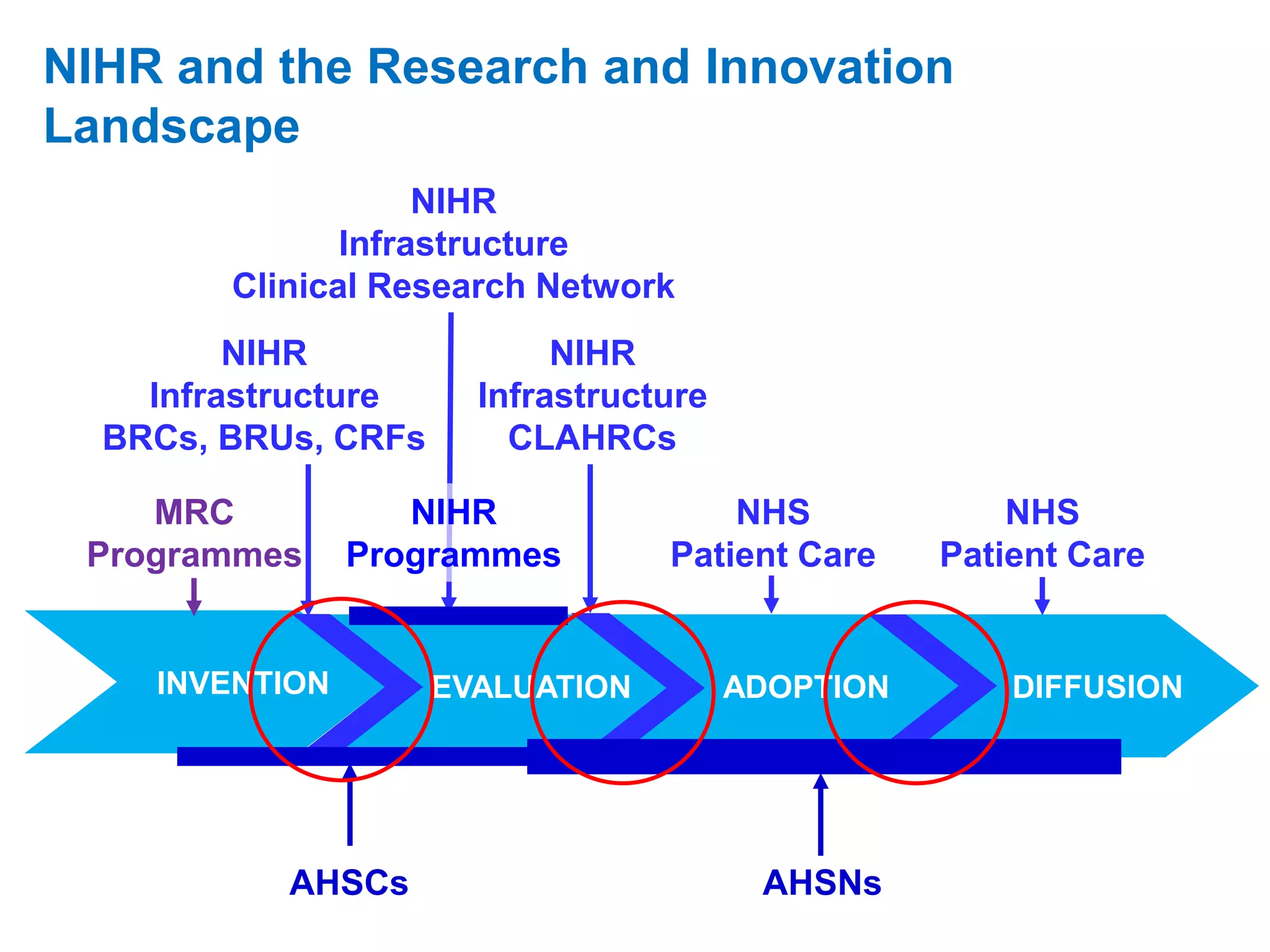
INVENTION EVALUATION ADOPTION DIFFUSION
NIHR
Infrastructure
BRCs , BRUs etc
NIHR
Infrastructure
CLAHRCs
AHSCs AHSNs
NHS
Patient Care
NHS
Patient Care
NIHR
Infrastructure
Clinical Research Network
NIHR
Programmes
MRC
Programmes “improving patient outcomes
through the conduct and
application of applied health
research”
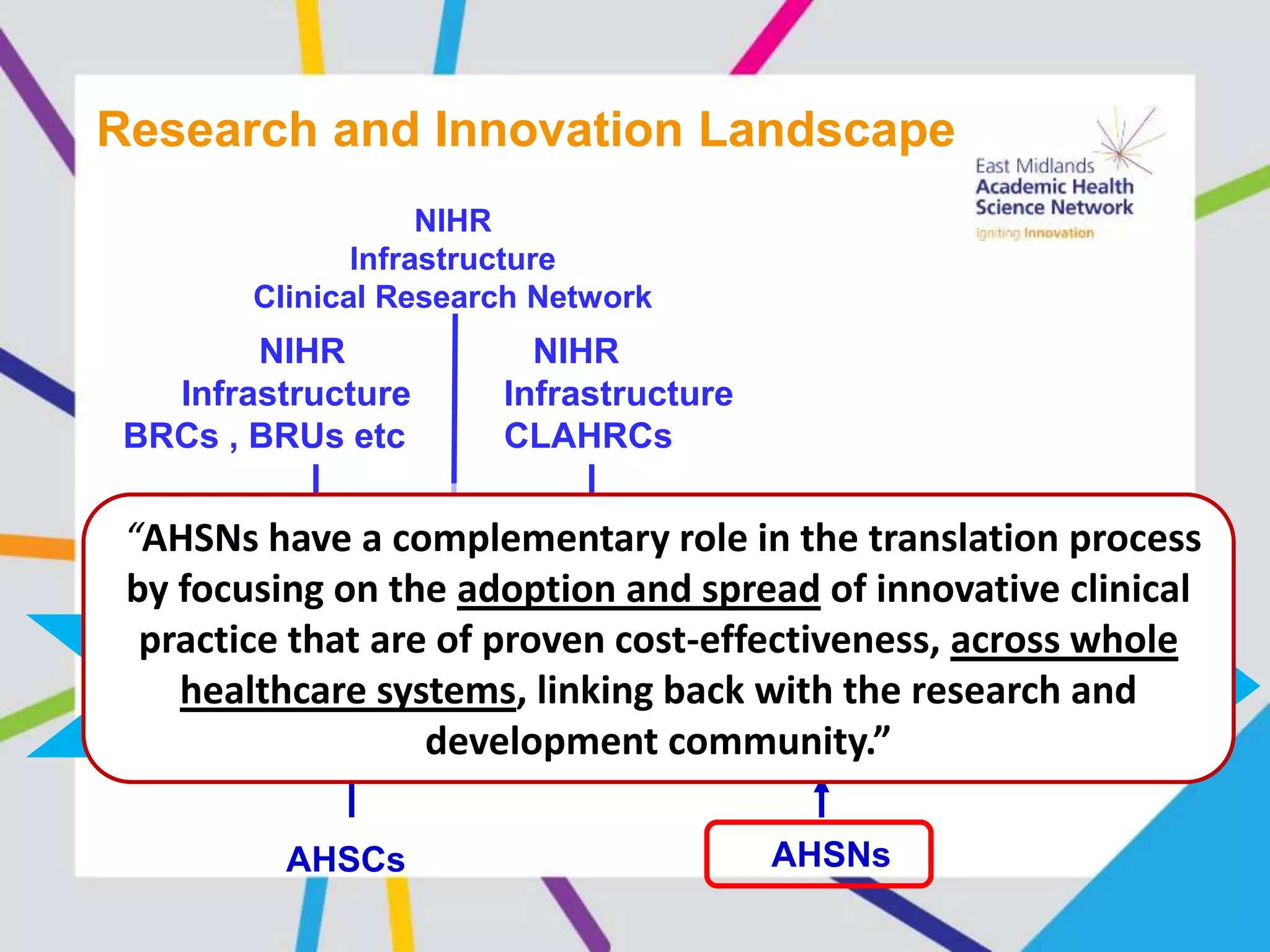
Research and Innovation Landscape
INVENTION EVALUATION ADOPTION DIFFUSION
NIHR
Infrastructure
BRCs , BRUs etc
NIHR
Infrastructure
CLAHRCs
AHSCs AHSNs
NHS
Patient Care
NHS
Patient Care
NIHR
Infrastructure
Clinical Research Network
NIHR
Programmes
MRC
Programmes“AHSNs have a complementary role in the translation process
by focusing on the adoption and spread of innovative clinical
practice that are of proven cost-effectiveness, across whole
healthcare systems, linking back with the research and
development community.”
Research and Innovation Landscape
INVENTION EVALUATION ADOPTION DIFFUSION
NIHR
Infrastructure
BRCs, BRUs, CRFs
NIHR
Infrastructure
CLAHRCs
AHSCs AHSNs
NHS
Patient Care
NHS
Patient Care
NIHR
Infrastructure
Clinical Research Network
NIHR
Programmes
MRC
Programmes
Research and Innovation Landscape
Specific research related activity
–from NHS England AHSN
licence measurements
Measurement 5: summary of research
evidence that has successfully been
implemented and translated into practice, and
provide evidence of working with NIHR
CLAHRCS
Measurement 12:work with their Clinical
Research Networks and demonstrate how they
have supported delivery of their metrics
Specific research related activity –
from NHS England AHSN licence
measurements
Measurement 13: demonstrate how the AHSN has
supported the delivery of NIHRS objectives. AHSNs
may seek to engage in additional research activities
beyond those agreed within NIHR objectives –in this
case the AHSN must demonstrate how the research
aligns with the AHSNs clinical or service priorities,
expenditure, clinical and ROI activities
Measurement 14: reflect the breadth and depth of the
AHSNs academic partnerships ensuring that academic
collaboration is not fixed around a single institution
Contact details
Rachel Munton, Managing Director
rachel.munton@nottingham.ac.uk
0115 82 31300 I 07825 656341
NIHR CLAHRC East Midlands Annual Meeting
Growing Momentum – Sharing and Learning
A partnership between
Nottinghamshire Healthcare NHS Foundation Trust
and the Universities of Nottingham and Leicester
Overview of the NIHR Infrastructure:
providing the facilities and people for a thriving
research environment
Dr Tony Soteriou, Acting Deputy Director
Head of NHS Research Infrastructure and Growth
Research and Development Directorate
CLAHRC East Midlands
24 March 2015
• improve health outcomes through
advances in research
• improve quality of care by NHS
participation in the research process
• strengthen International competitive
position in science
• drive economic growth through
investment by life science industries
Why is the Government committed to
Research in the NHS?
Patients
NHS
Universities
Health Research Challenges, 2005
NHS R&D funding
was allocated on
a historical basis
NHS Trust
management
was seen as the
bureaucratic
block to clinical
research
Few effective
incentives for
research in the
NHS
Dramatic fall in
numbers of
clinical
academics
40% of clinical
academics
funded by NHS
Difficulty in
developing
sustainable
capacity
Problems with
career paths for
all professions in
research
Low “applied”
evidence base
Perception that
NHS research
funding was
second class
Perception that
applied health
research was
second class
Vision
“To improve the health and wealth of
the nation through research.”
January 2006
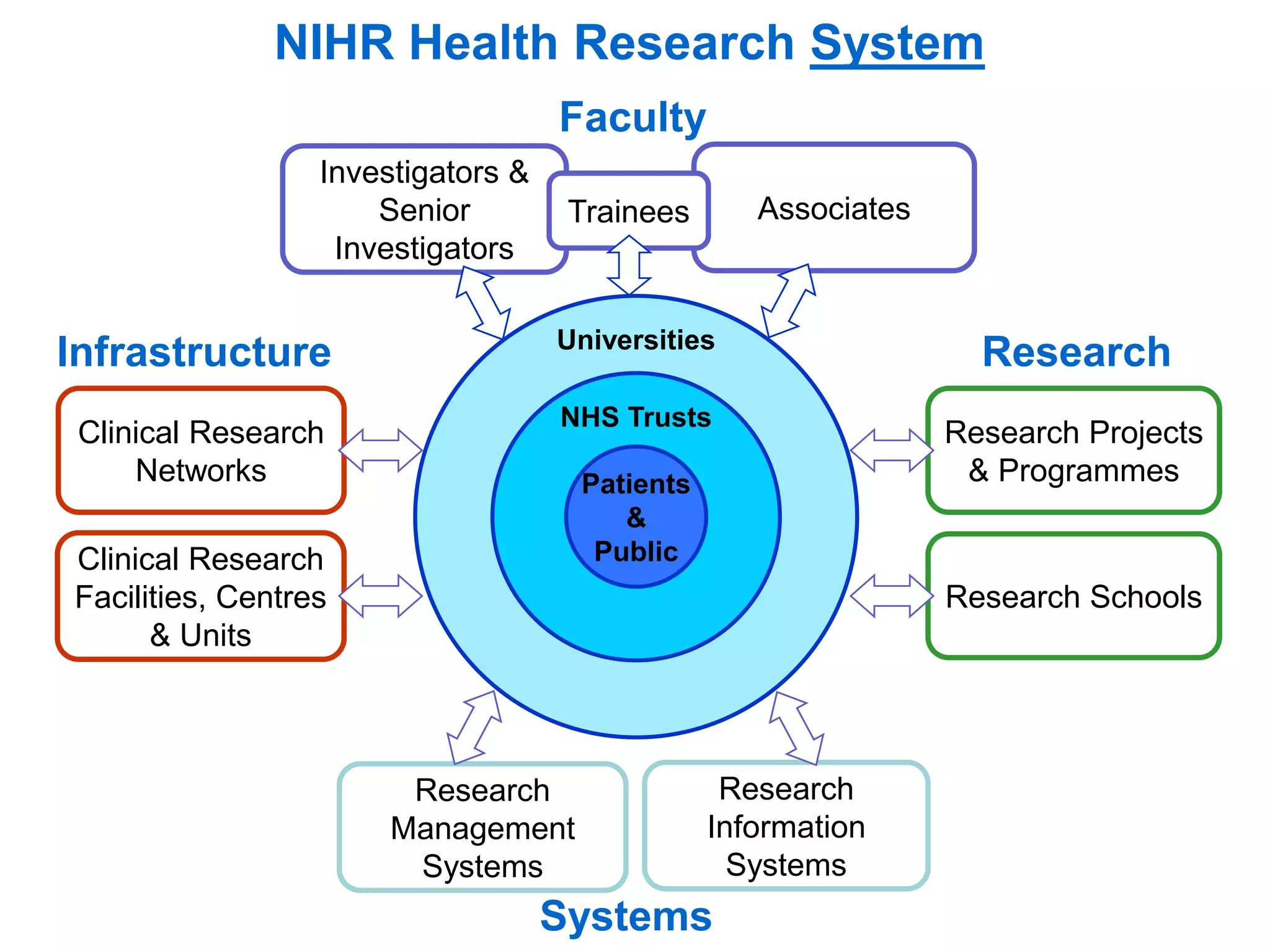
Infrastructure
Clinical Research
Facilities, Centres
& Units
Clinical Research
Networks
Research
Research Projects
& Programmes
Research
Management
Systems
Research
Information
Systems
Systems
Patients
&
Public
Universities
Investigators &
Senior
Investigators
Associates
Faculty
Trainees
Research Schools
NHS Trusts
NIHR Health Research System
National Institute for Health Research
• Between Government, Charity and Industry
• Between NHS and University
• Between research leaders and research facilitators
• Between different health care professions
• Between different research disciplines
• Between researchers and patients
An Integrated Health Research System
Partnership
Biomedical Research Centres
Basic Research
National Institute
for Health Research
This pathway covers the full range of
interventions - pharmaceuticals,
biologicals, biotechnologies, procedures,
therapies and practices - for the full range
of health and health care delivery -
prevention, detection, diagnosis,
prognosis, treatment, care.
Patient Safety Translational
Research Centres
Research for Patient Benefit
Programme Grants for Applied Research
Health Technology Assessment
Invention for Innovation
Collaborations for Leadership in Applied Health
Research and Care
Centre for Reviews & Dissemination, Cochrane, TARs
Development Pathway Funding
Public Health Research
Health Services and Delivery Research
INVENTION EVALUATION ADOPTION DIFFUSION
NHS England Commissioning
National Institute for Health & Care Excellence Guidance on Health & Healthcare
NHS Supply Chain Support for Procurement
NHS Evidence Access to Evidence
InnovationAcademic Health Science Networks
Patient CareProviders of NHS Services
Clinical Research Facilities
Experimental Cancer Medicine Centres
Horizon Scanning Centre
Centre for Surgical Reconstruction & Microbiology
Biomedical Research Units
Medical
Research
Council
The central role of NIHR research in the innovation pathway
Healthcare Technology
Co-operatives
Research Schools
Efficacy Mechanism and Evaluation
Diagnostic Evidence
Co-operatives
Infrastructure
Clinical Research
Networks
Clinical Research
Facilities, Centres &
Units
Aim
Harness the research potential of the NHS to
improve health and deliver competitive
advantage for increased economic growth
“… the support and facilities the NHS needs for
first class research…”
Infrastructure
Clinical Research
Networks
Clinical Research
Facilities, Centres &
Units
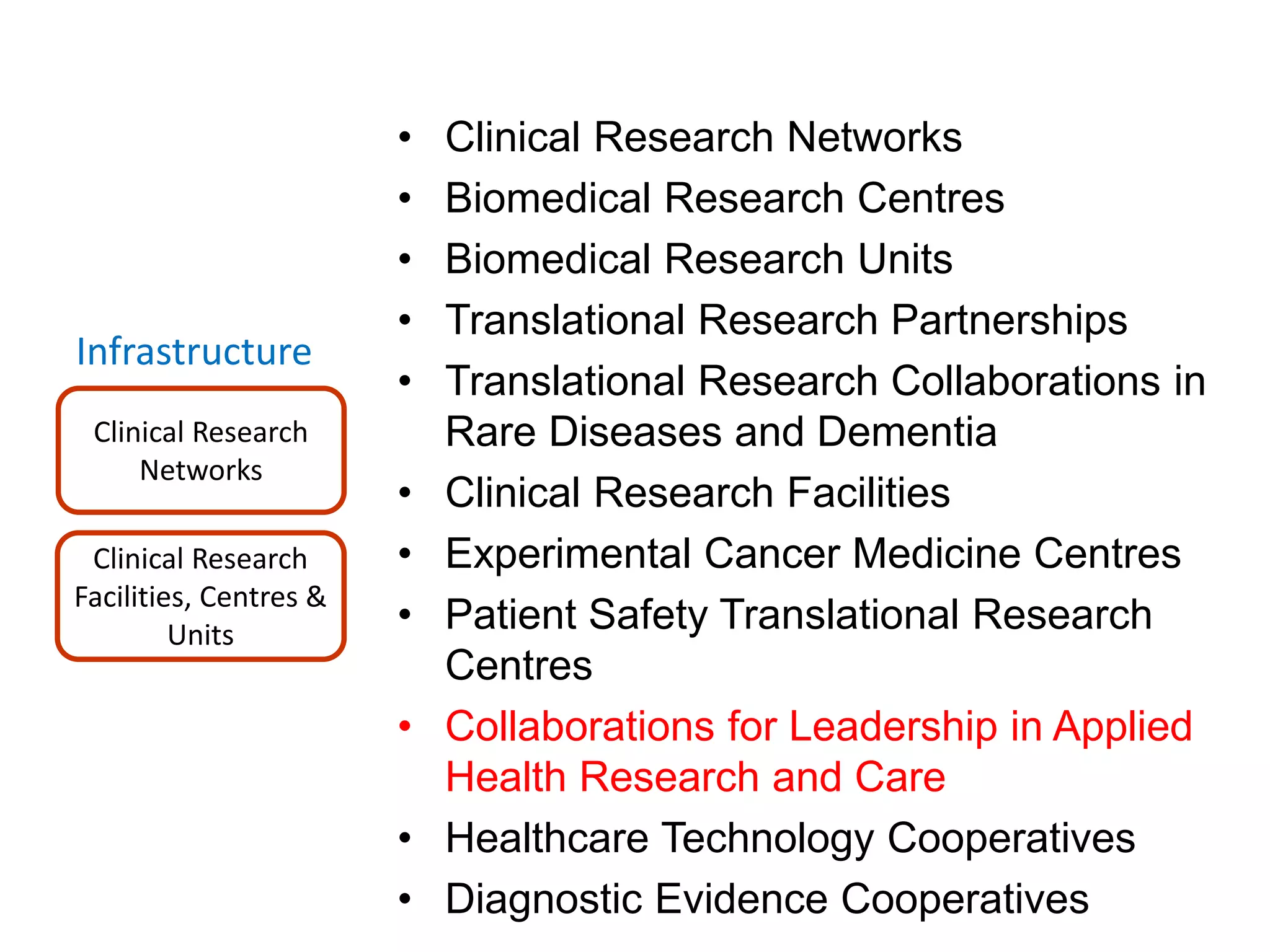
• Clinical Research Networks
• Biomedical Research Centres
• Biomedical Research Units
• Translational Research Partnerships
• Translational Research Collaborations in
Rare Diseases and Dementia
• Clinical Research Facilities
• Experimental Cancer Medicine Centres
• Patient Safety Translational Research
Centres
• Collaborations for Leadership in Applied
Health Research and Care
• Healthcare Technology Cooperatives
• Diagnostic Evidence Cooperatives
NIHR Clinical Research Infrastructure
Biomedical Research Centres
Biomedical Research Units
Clinical Research Facilities
Experimental Cancer Medicine
Centres
Clinical Research Networks
Invention Evaluation Adoption
Healthcare Technology
Co-operatives
Diagnostic Evidence
Co-operatives
Patient Safety Translational
Research Centres
Collaborations for Leadership in
Applied Health Research and Care
Translational Research
Partnerships and
Collaborations
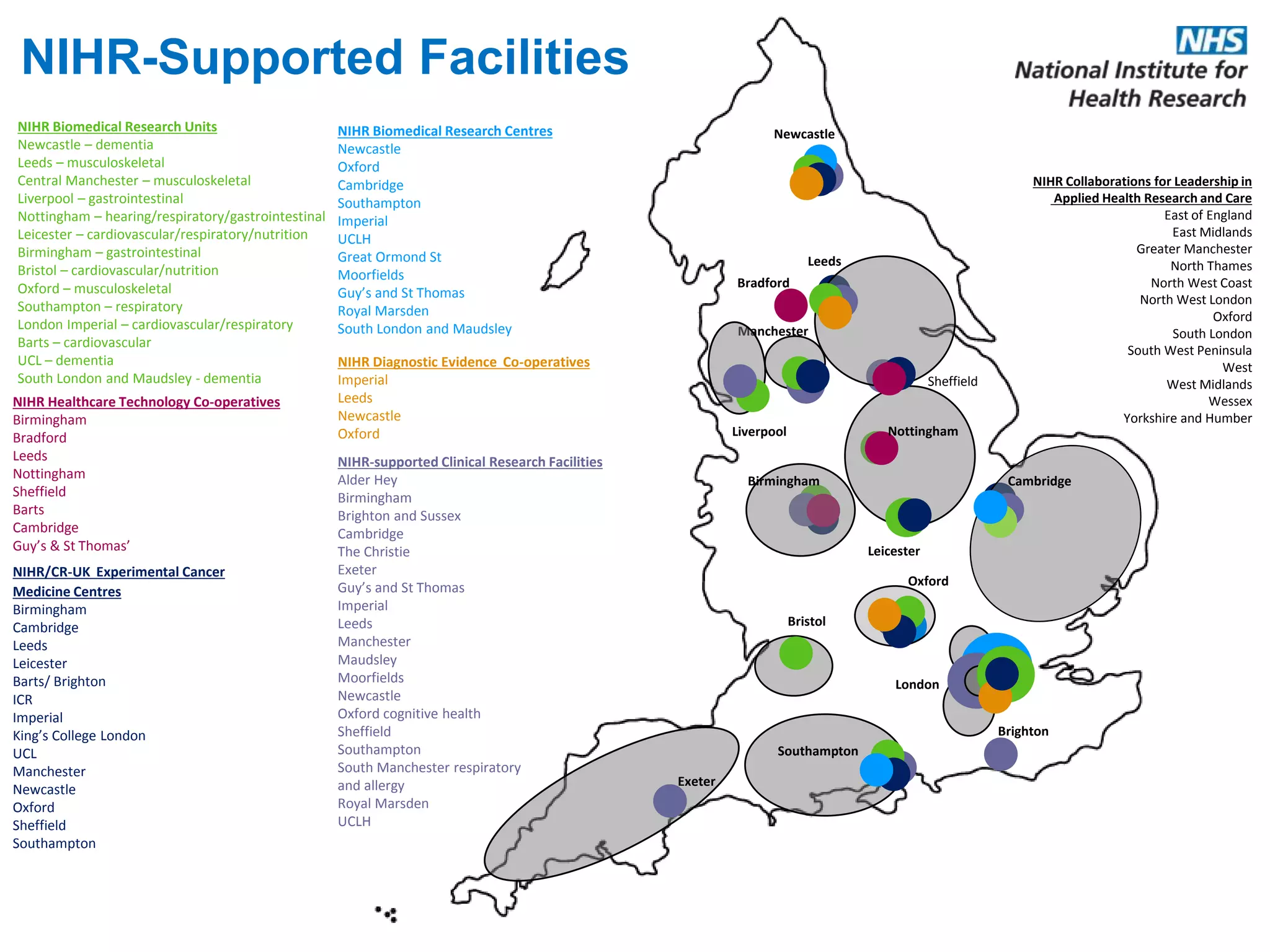
NIHR Biomedical Research Centres
Newcastle
Oxford
Cambridge
Southampton
Imperial
UCLH
Great Ormond St
Moorfields
Guy’s and St Thomas
Royal Marsden
South London and Maudsley
NIHR Healthcare Technology Co-operatives
Birmingham
Bradford
Leeds
Nottingham
Sheffield
Barts
Cambridge
Guy’s & St Thomas’
NIHR Biomedical Research Units
Newcastle – dementia
Leeds – musculoskeletal
Central Manchester – musculoskeletal
Liverpool – gastrointestinal
Nottingham – hearing/respiratory/gastrointestinal
Leicester – cardiovascular/respiratory/nutrition
Birmingham – gastrointestinal
Bristol – cardiovascular/nutrition
Oxford – musculoskeletal
Southampton – respiratory
London Imperial – cardiovascular/respiratory
Barts – cardiovascular
UCL – dementia
South London and Maudsley - dementia
NIHR-supported Clinical Research Facilities
Alder Hey
Birmingham
Brighton and Sussex
Cambridge
The Christie
Exeter
Guy’s and St Thomas
Imperial
Leeds
Manchester
Maudsley
Moorfields
Newcastle
Oxford cognitive health
Sheffield
Southampton
South Manchester respiratory
and allergy
Royal Marsden
UCLH
NIHR-Supported Facilities
Newcastle
Leeds
Sheffield
Leicester
Oxford
Bristol
Brighton
Peninsula
London
Bradford
NIHR Diagnostic Evidence Co-operatives
Imperial
Leeds
Newcastle
Oxford
Manchester
NIHR/CR-UK Experimental Cancer
Medicine Centres
Birmingham
Cambridge
Leeds
Leicester
Barts/ Brighton
ICR
Imperial
King’s College London
UCL
Manchester
Newcastle
Oxford
Sheffield
Southampton
Liverpool
Exeter
Southampton
NIHR Collaborations for Leadership in
Applied Health Research and Care
East of England
East Midlands
Greater Manchester
North Thames
North West Coast
North West London
Oxford
South London
South West Peninsula
West
West Midlands
Wessex
Yorkshire and Humber
Cambridge
Nottingham
Birmingham
NIHR Collaborations for Leadership in
Applied Health Research and Care
• 9 Pilot CLAHRCs created in 2008 for 5 years
• £50m funding awarded (rising to £88m over course
of award)
• Second competition: 13 CLAHRCs funded for 5 years
from January 2014
• Funding increased to £124 million
• Address the “second translational gap”
Aims of the CLAHRCs
• to develop and conduct applied health research relevant across the NHS, and
to translate research findings into improved outcomes for patients;
• to create a distributed model for the conduct and application of applied
health research that links those who conduct applied health research with all
those who use it in practice across the health community;
• to create and embed approaches to research and its dissemination that are
specifically designed to take account of the way that health care is delivered
across the local AHSN;
• to increase the country’s capacity to conduct high quality applied health
research focused on the needs of patients, and particularly research targeted
at chronic disease and public health interventions;
• to improve patient outcomes locally and across the wider NHS; and
• to contribute to the country’s growth by working with the life sciences
industry.
North West London
Greater
Manchester
West Midlands
South West
Peninsula
Yorkshire & Humber
13 NEW Collaborations from January 2014
East of England
NIHR Centres for Leadership in Applied Health
Research and Care (CLAHRCs)
East Midlands
South London
North West
Coast
North Thames
Oxford
West Country
Wessex
Pilot scheme to 2014
CLAHRC Themes, 2014
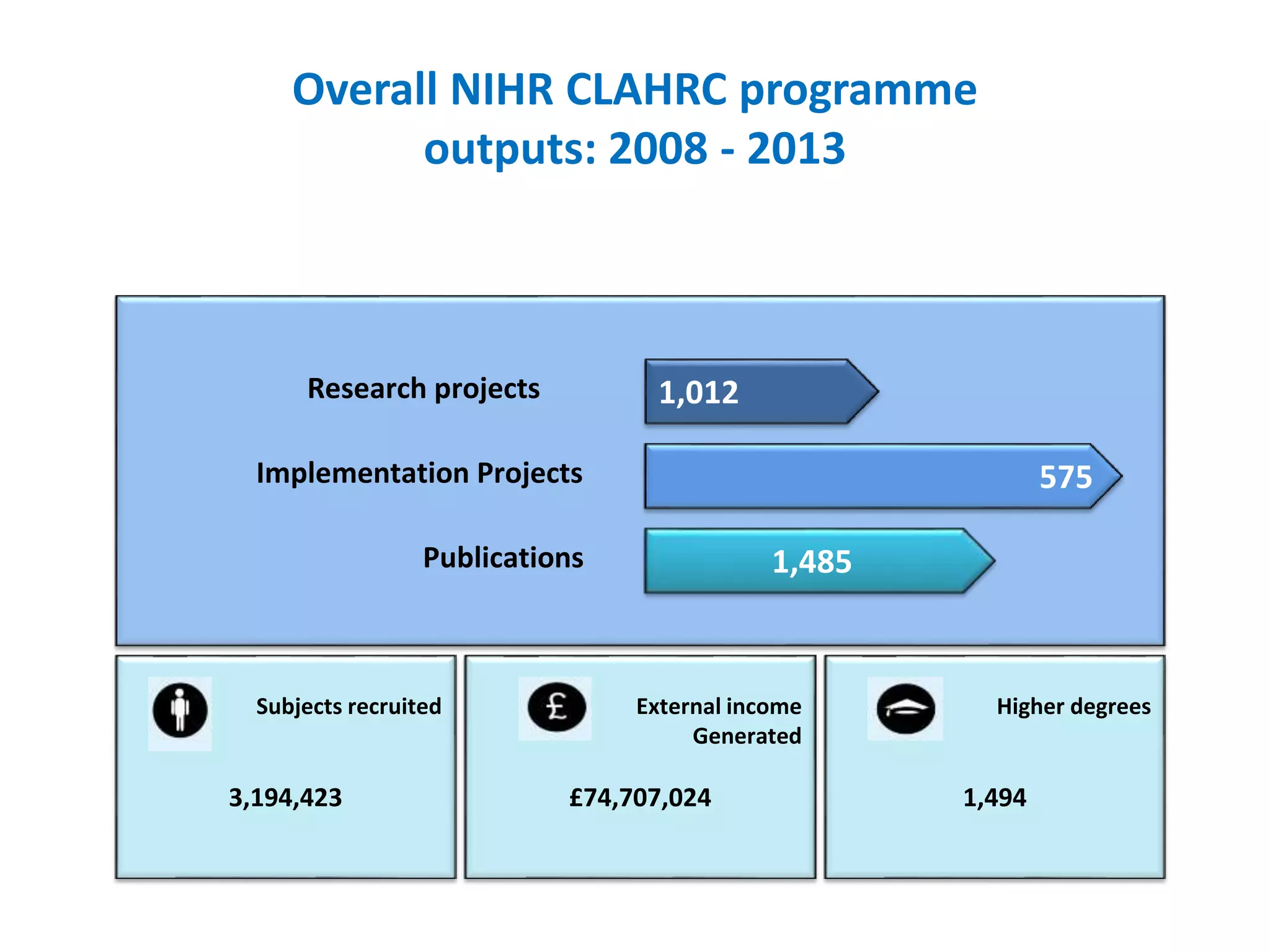
Overall NIHR CLAHRC programme
outputs: 2008 - 2013
Research projects
Implementation Projects
Publications
1,012
575
1,485
Subjects recruited
3,194,423
External income
Generated
£74,707,024
Higher degrees
1,494
£0
£2
£4
£6
£8
£10
£12
£14
£16
2009/10 2010/11 2011/12 2012/13 2013/14
Millions
DH/NIHR
Research council
Research Charity
Other non-commerical
Industry Funding
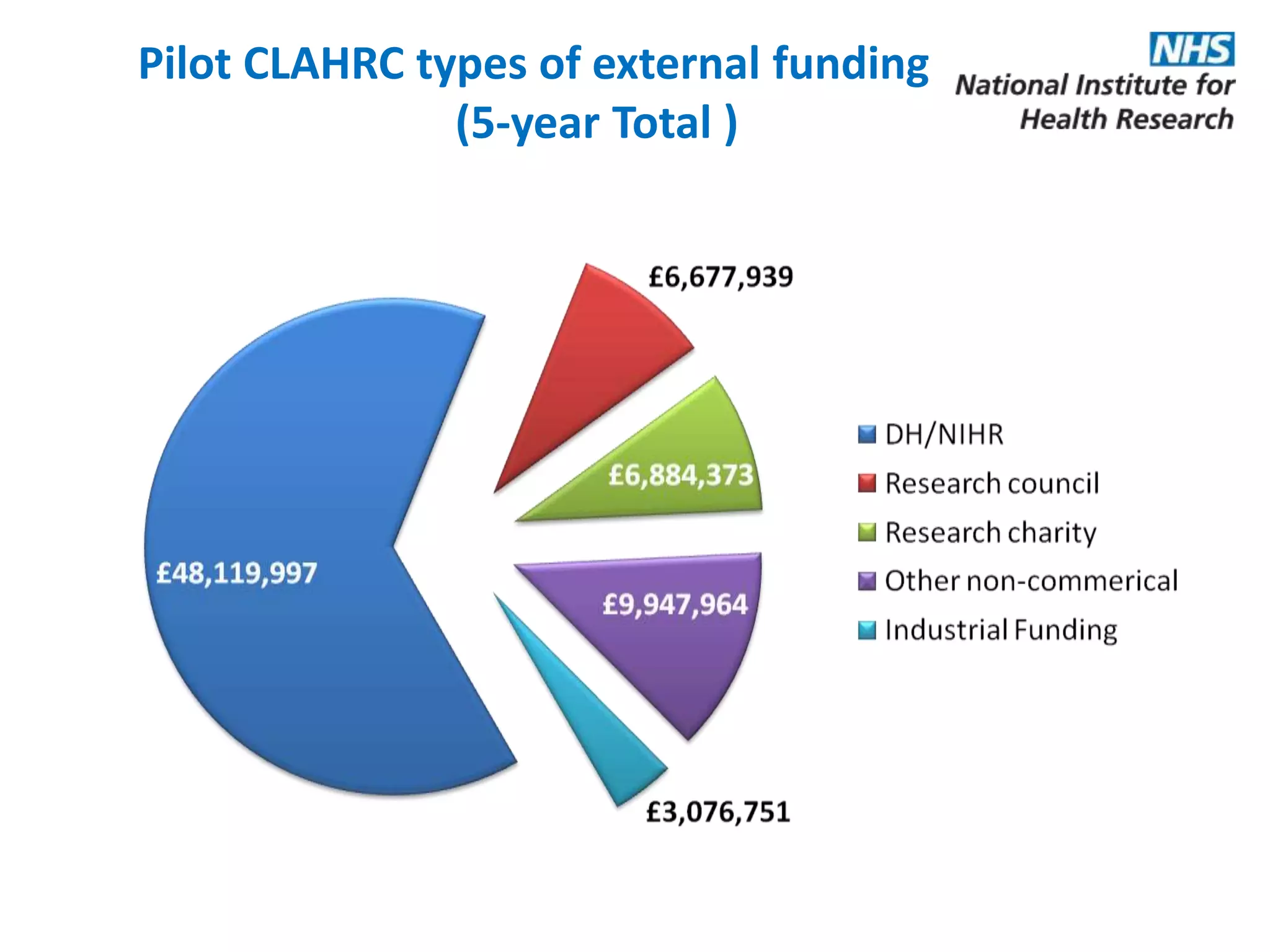
Pilot CLAHRC types of external funding
(5-year Total )
CLAHRC Impacts – East Midlands
• IMPAKT (IMProving Patient Care and
Awareness of Kidney disease progression
Together) software tool can identify Practice
patients at risk from CKD:
- being implemented across the country in a number of CCGs and
AHSNs including the whole of Wales.
- adopted by Manchester’s AHSN and the East Midlands Strategic
Clinical Network.
- used by HQIP to describe QI requirements for the national CKD
audit.
The tool continues to identify patients at risk from CKD enabling early
intervention and potentially saving the NHS £millions.
CLAHRC Impacts – East Midlands
• Diabetes education and Self-
Management for Ongoing and
Newly Diagnosed (DESMOND)
programme:
- Offered by more than 60% of providers within the UK
- Significant increase in the number of people with type 2 diabetes
using DESMOND as a consequence of the programme acquiring
QOF points in March 2013.
- Utilised in a number of international settings
CLAHRC Impacts – East Midlands
• Walking Away from Diabetes - a
structured education programme
encouraging and supporting
physical activity in those at risk
from diabetes:
- recommended for use in the NICE Guidelines for Early Intervention
and Prevention of Diabetes.
- commissioned by 9 CCGs in England as well being used in health
services in Ireland, Gibraltar and Western Australia.
CLAHRC Impacts - East Midlands
• The Individual Placement and Support (IPS) which aims to help
people with mental health problems achieve paid
employment:
- Study led to 34% of participants
finding employment within a year
of undertaking the programme.
- A further 26% went into
education, training or voluntary
work.
- When comparing the results with the Department of Work and
Pension’s own Work Programme using the DWP’s own outcome
measure, IPS programme was 9% more effective.
CLAHRC Impacts - East Midlands
• Return to Work After Stroke
study aims to address the
problems of getting stroke
survivors back to work and to
design a vocational
rehabilitation (VR) service for
people who have had a stroke:
- Stroke survivors were twice as likely to be in work compared to
usual care at 12 months after stroke
- Intervention found to be cost effective, saving £3,000 per case
(total of health and social costs).
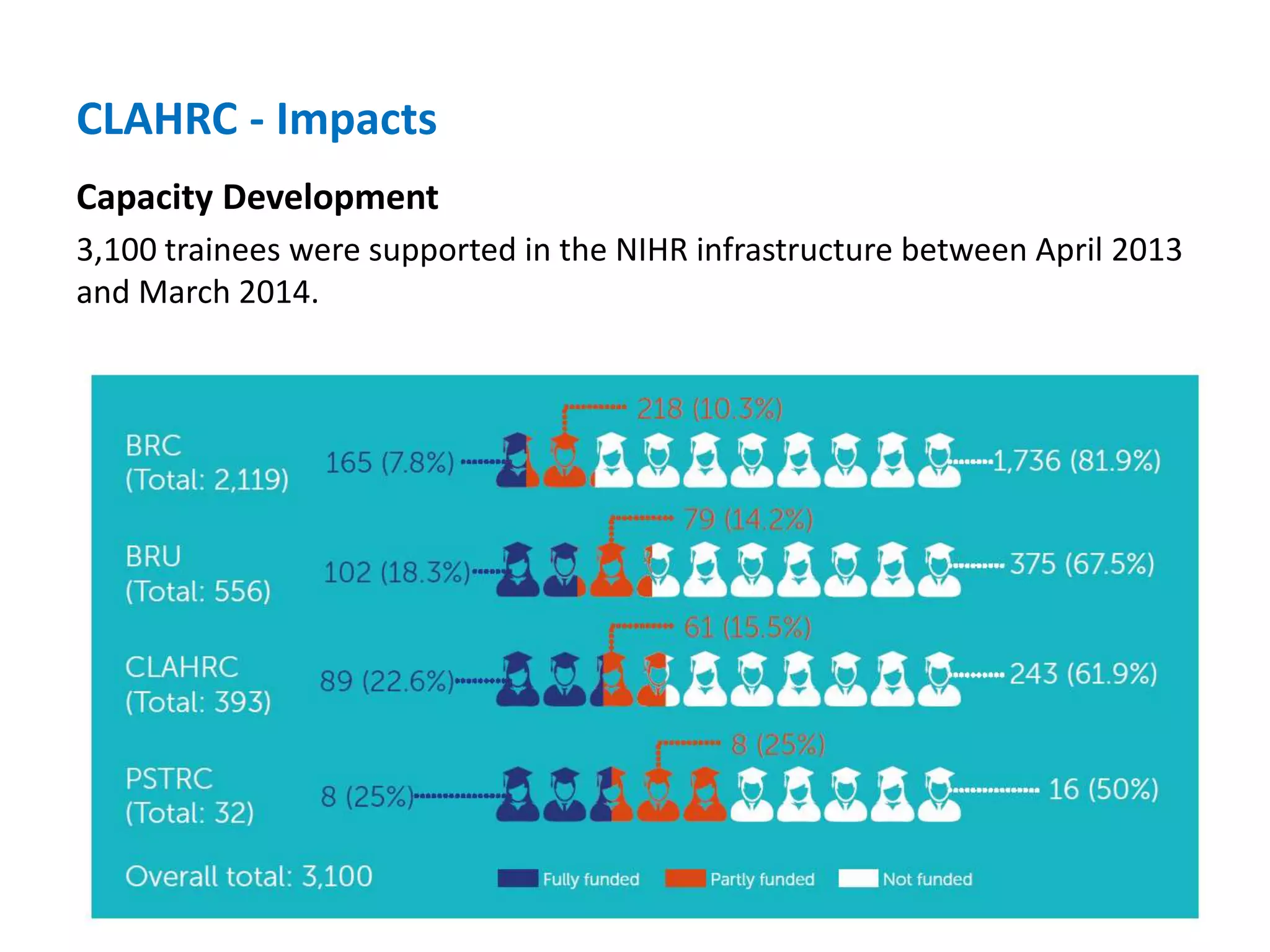
CLAHRC - Impacts
Capacity Development
3,100 trainees were supported in the NIHR infrastructure between April 2013
and March 2014.
INVENTION EVALUATION ADOPTION DIFFUSION
NIHR
Infrastructure
BRCs, BRUs, CRFs
NIHR
Infrastructure
CLAHRCs
AHSCs AHSNs
NHS
Patient Care
NHS
Patient Care
NIHR
Infrastructure
Clinical Research Network
NIHR
Programmes
MRC
Programmes
NIHR and the Research and Innovation
Landscape
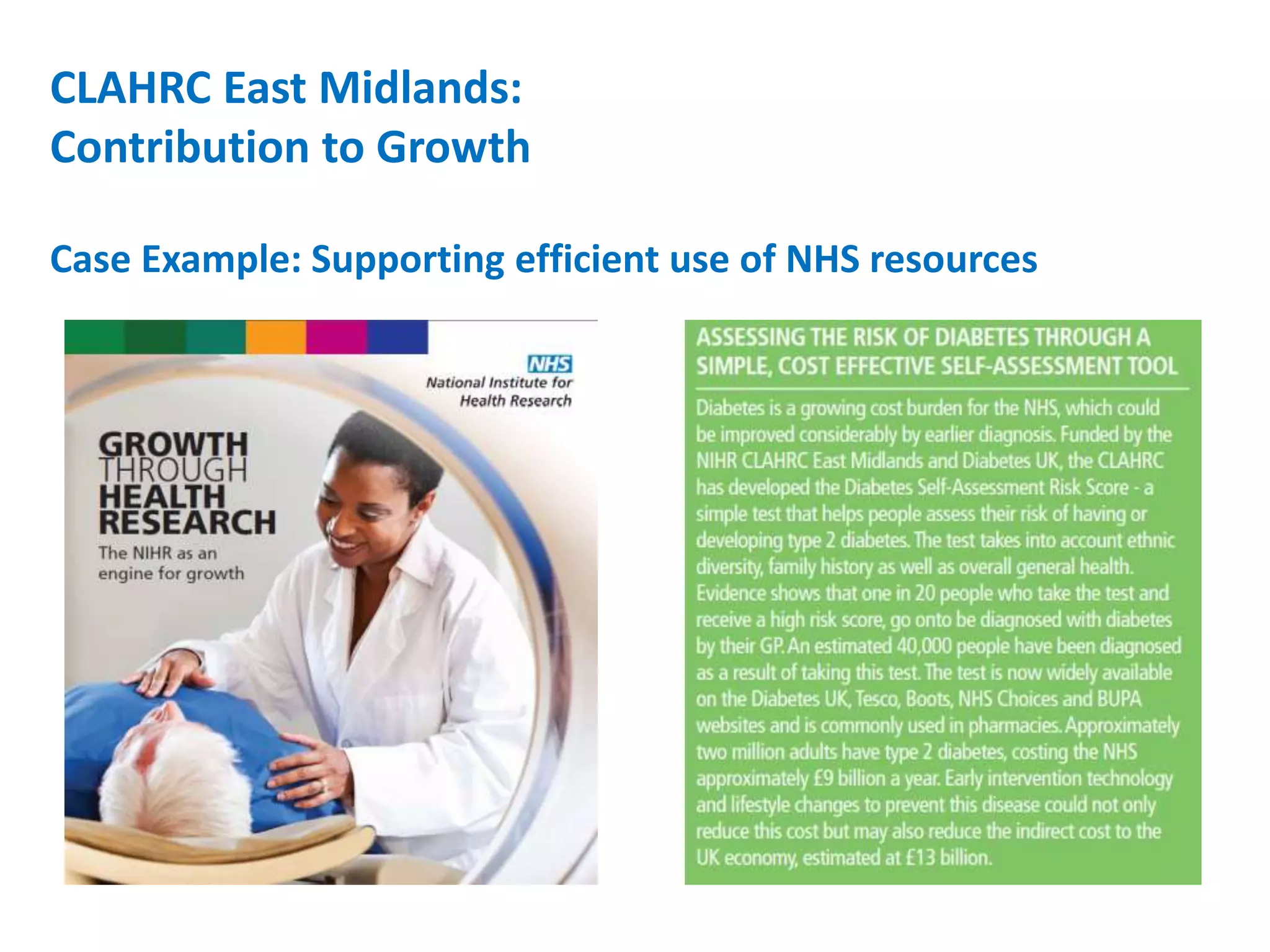
CLAHRC East Midlands:
Contribution to Growth
Case Example: Supporting efficient use of NHS resources
The NIHR’s Key Contributions to Growth
• Supporting collaborations and contract research with the life
sciences industry
• Creating the research environment that supports the nation’s
international competitiveness
• Attracting, developing and retaining a highly skilled health research
workforce
• Providing the clinical evidence to help the NHS and public sector to
make efficient use of resources
• Providing the research evidence that contributes to establishing a
healthier workforce and wider population
Major focus on Life Sciences
• Establish Health Research Authority
• NIHR funding conditional on 70 day
benchmark for trial start-up
• More information about clinical trials to
enable greater public involvement
• Build consensus on using e-health
record data
• Establish Translational Research
Partnerships
• Encourage innovation in NHS
procurement
• NHS Chief Executive to report on
accelerating adoption and diffusion of
innovation in the NHS
Research and the NHS:
Plan for Growth
BIS & DH Prime Minister
Strategy for UK Life Sciences
“Life science - and the UK’s role
in it - is at a crossroads.
Behind us lies a great history of
discovery, from the unravelling
of DNA to MRI scanning and
genetic sequencing.
We can be proud of our past,
but this government is acutely
aware that we cannot be
complacent about the future.”
David Cameron
December 2011
Research and Growth:
Strategy for UK Life Sciences
Summary
• NIHR is a health research system in the NHS
• Health and Wealth of the nation through health research
• NIHR CLAHRCs an important part of NIHR Research
Infrastructure – focussed on closing the gap between
evidence and practice
• CLAHRC impacts have led to increased funding
• New NIHR CLAHRC East Midlands
• CLAHRCs contribute to NIHR’s mission to improve the health
and wealth of the nation through research.
The NIHR in numbers
Overview of the NIHR Infrastructure:
providing the facilities and people for a thriving
research environment
Dr Tony Soteriou, Acting Deputy Director
Head of NHS Research Infrastructure and Growth
Research and Development Directorate
CLAHRC East Midlands
24 March 2015
NIHR CLAHRC East Midlands Annual Meeting
Growing Momentum – Sharing and Learning
A partnership between
Nottinghamshire Healthcare NHS Foundation Trust
and the Universities of Nottingham and Leicester
Join the conversation
If you hear something you like, or want to
challenge, or simply want to share an
observation, join the Twitter conversation using
@CLAHRC_EM and #clahrc in your tweet.
#clahrc
@CLAHRC_EM
NIHR CLAHRC East Midlands related Twitter accounts
@EMRAN_ageing
East Midlands Research into Ageing Network
@EMCBMEH
East Midlands Centre for Black and Minority Ethnic Health
Connecting to venue WiFi
• Load web browser
• Click “conference” on homepage
• Enter Username diabetes1, Password diabetes1
Username:
diabetes1
Password:
diabetes1
What Success Looks Like: Reflecting from
CLAHRC
Chair – Beth Allen, Infrastructure Manager, Department of
Health
A partnership between
Nottinghamshire Healthcare NHS Foundation Trust
and the Universities of Nottingham and Leicester
CLAHRC EM Scientific Committee
Richard Morriss
Director of Research CLAHRC EM
A partnership between
Nottinghamshire Healthcare and the
Universities of Nottingham and Leicester
• To ensure that all CLAHRC funded research projects above £50,000
are of high scientific quality compatible with world class applied
healthcare research
• Fit with the overall principles of CLAHRC EM –
– Active PPI involvement
– Implementation plan in East Midlands
– value for money
• Assurance of money well spent to partners, including NIHR, through
CLAHRC Board
Purpose
1. External peer review (3 subject reviewers), PPI review, AHSN review,
methods review (statistics, health services research,
qualitative/organisation science) 1 month before Scientific Committee
2. Scientific Committee, externally chaired, and all voting members
independent but familiar with CLAHRC:
primary care chair
statistician
health services research
PPI
sociologist
Stages
1. Scientific Committee meets when required according to anticipated submission
of projects (chief investigator, CLAHRC and theme managers)
2. Considers all reviews, discusses, makes recommendations to CLAHRC EM
Director and CLAHRC EM Board
3. 4 decisions:
Pass - no further recommendations, consider reviewer’s comments
Minor amendment - project can start, expect reply, SC and reviewer
comments optional to address
Major amendment - project cannot start until SC and reviewer comments
are addressed
Reject and resubmit
Process
1. Chief investigator and theme manager
2. Summary reported as standing item to CLAHRC EM Executive and
CLAHRC EM Board
Reporting
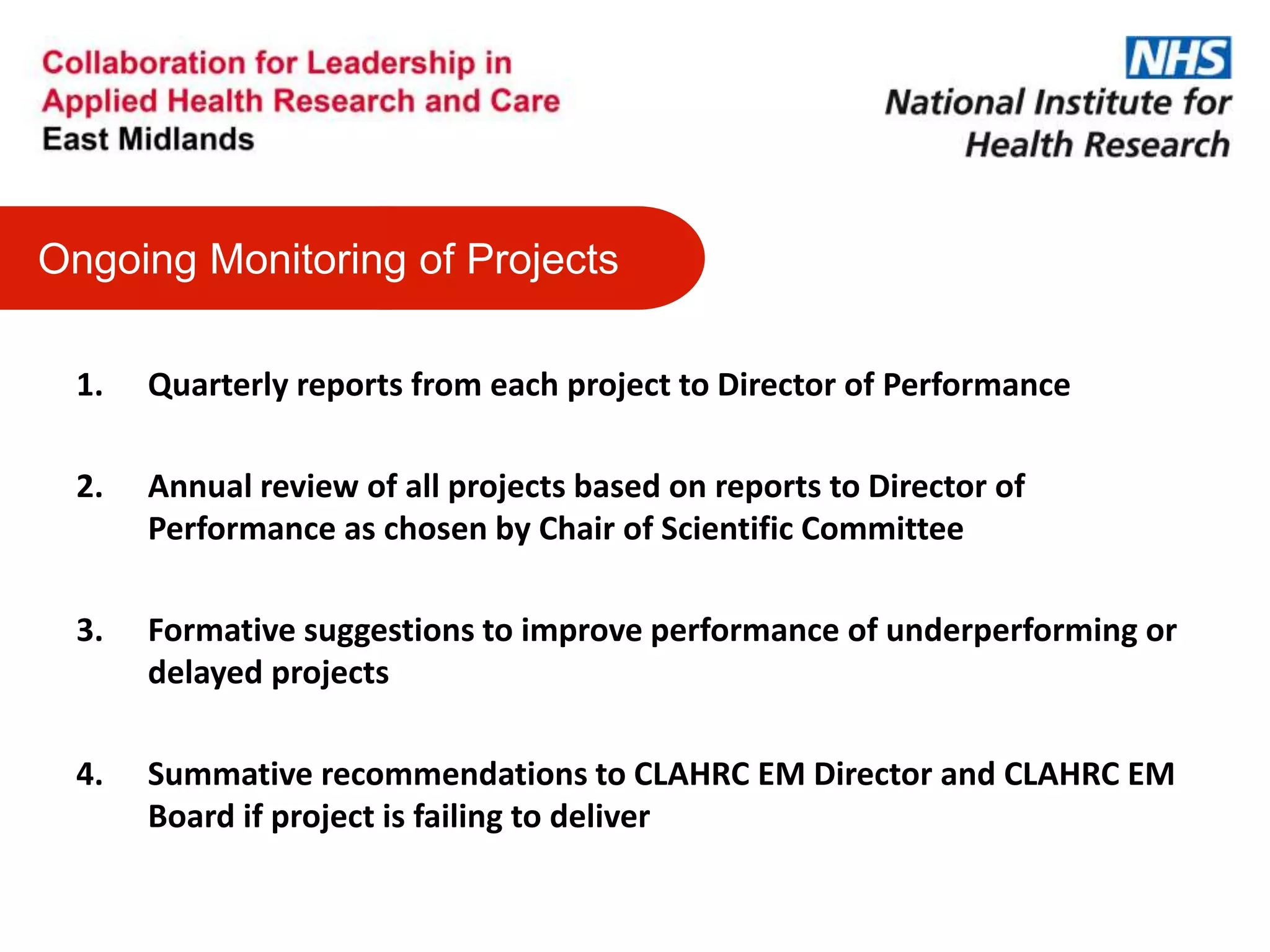
1. Quarterly reports from each project to Director of Performance
2. Annual review of all projects based on reports to Director of
Performance as chosen by Chair of Scientific Committee
3. Formative suggestions to improve performance of underperforming or
delayed projects
4. Summative recommendations to CLAHRC EM Director and CLAHRC EM
Board if project is failing to deliver
Ongoing Monitoring of Projects
19 projects have been reviewed:
1 passed
4 minor amendment
10 major amendment - 9 then passed,
- 1 redesigned & passed.
4 rejected - 3 redesigned & passed
1 to be redesigned
Results
Weakness:
Delay in starting project
Benefits:
Increased PPI, implementation, better quality design,
meets ethics peer and statistics review, value for money,
assurance for partners with receipt of matched funding
Benefits and Weaknesses
NIHR CLAHRC East Midlands Annual Meeting
Growing Momentum – Sharing and Learning
A partnership between
Nottinghamshire Healthcare NHS Foundation Trust
and the Universities of Nottingham and Leicester
Individual Placement & Support
Eric Wodke
IPS Development Manager
The Positive Impact of Individual Placement and Support (IPS) on
People with Severe Mental Health Problems in Nottingham: An
Implementation Approach
AIMS
1. Implement IPS into secondary mental health service in
Nottingham
2. Support service users into work and related vocational
activities
3. Compare IPS alone with IPS work focused psychological
support
Results
• 74 people recruited into study
• 59% of sample attained paid work and related
opportunities
• Colocation of employment specialist into
clinical teams – key to implementation
• Establish Steering group to drive change
management process – key to implementation
Evidence base
• Vocational rehabilitation for people with severe mental illness, Cochrane
database of systematic reviews (Marshall et al 2001):
• An update on randomised controlled trials of evidence based supported
employment – IPS. Psychiatric Rehabilitation Journal 31, 280-290 (Bond
et al 2008):
• The IPS approach to vocational rehabilitation for young people with first
episode psychosis in the UK. Journal of Mental Health 19(6): 483-491
naturalistic evaluation
• First episode psychosis and employment. International Review Of
Psychiatry Literature review, April 2010:22(2): 148-162 (Rinaldi et al
2010)
Evidence base
• Client characteristics little impact on vocational outcomes
• (Bond et al, 1995, 1997, 2001; Grove, 2000; Meuser et 2004, Catty et al,
2007)
• • No relationship between psychiatric symptomatology /
• disability outcomes of vocational rehabilitation (Anthony, 1984,
• 1995)
• • Most studies show no relationship between employment
• outcomes and diagnosis, severity of impairment and social
• skills (Drake et al, 1994, 1996, 1999; Bond et al, 1995, 1997, 1999, 2001;
• Meuser et al, 2004; Latimer et al, 2006; Burns et al, 2007)
• • Employment history is a robust predictor of work outcomes,
but motivation and self-efficacy appear to be more important
(Tsang et al, 2000; McDonald-Wilson et al, 2001)
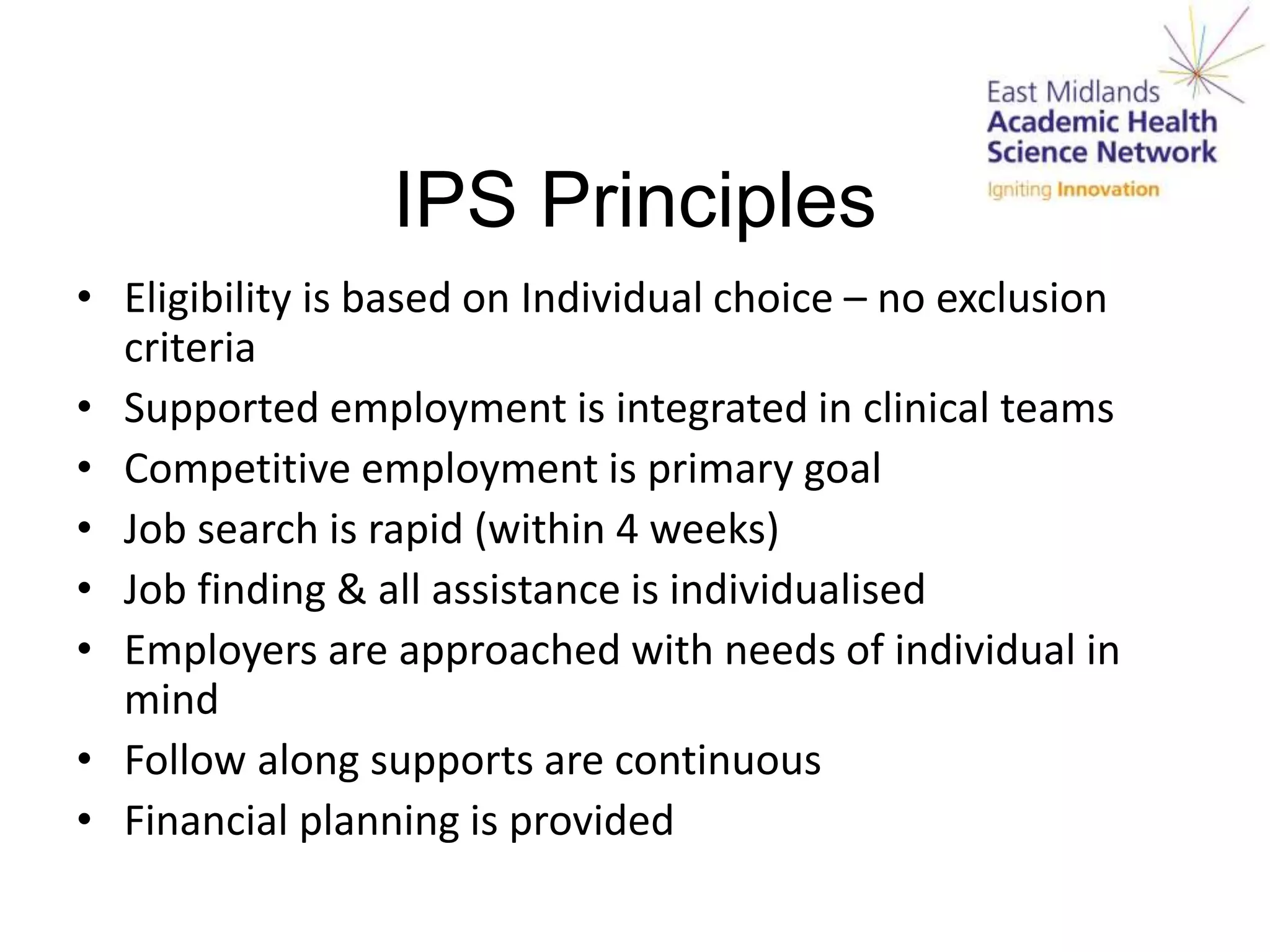
IPS Principles
• Eligibility is based on Individual choice – no exclusion
criteria
• Supported employment is integrated in clinical teams
• Competitive employment is primary goal
• Job search is rapid (within 4 weeks)
• Job finding & all assistance is individualised
• Employers are approached with needs of individual in
mind
• Follow along supports are continuous
• Financial planning is provided
Measuring adherence
Effects of intervention depend on how it is delivered
Adherence to fidelity is key
• • Programmes that faithfully implement the key
elements of an IPS service have better outcomes
• • For supported employment, this means higher
competitive employment rates (see Becker et al.
01, 06; McGrewet al. 05; Burns et al. 07)
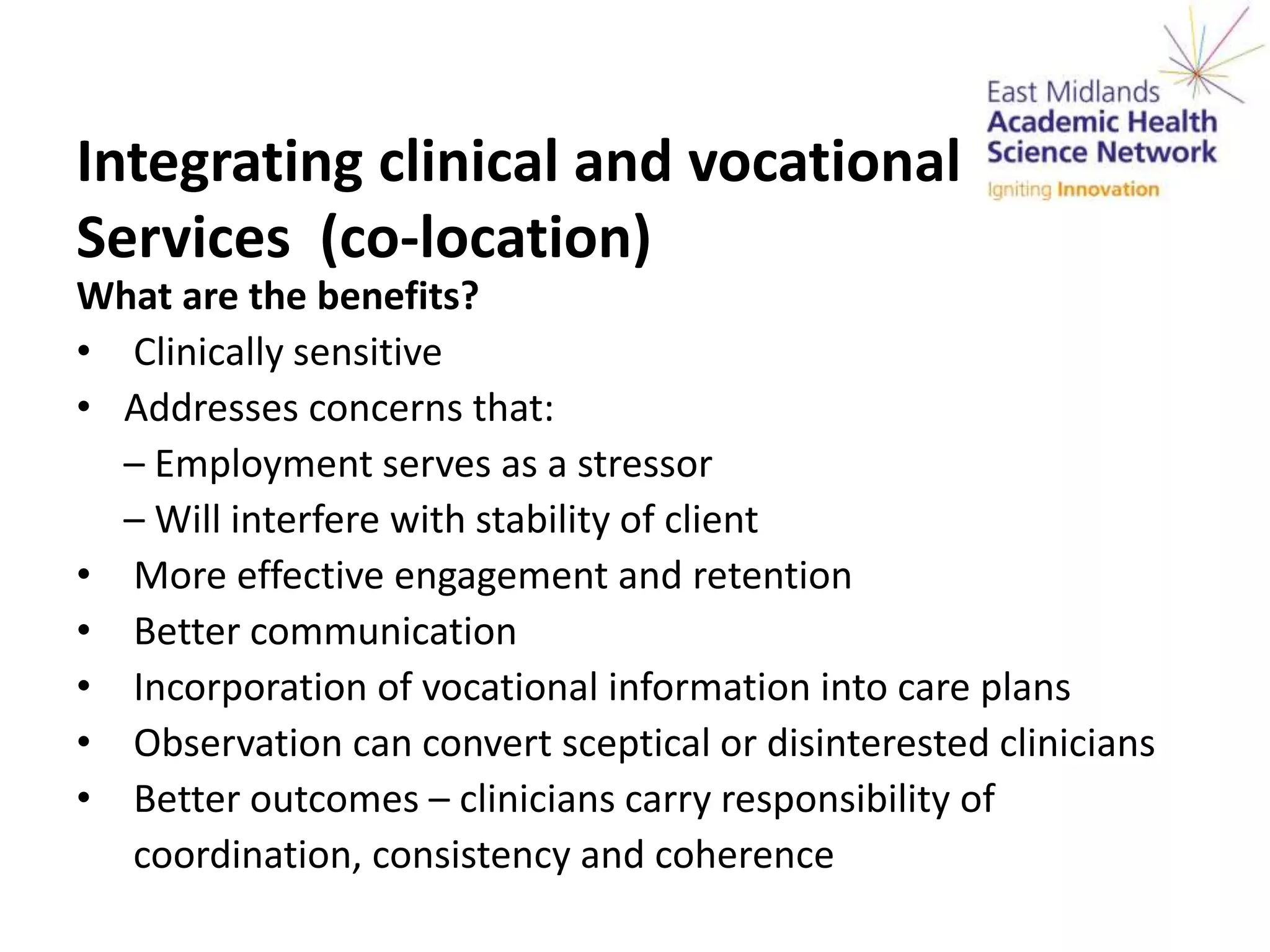
Integrating clinical and vocational
Services (co-location)
What are the benefits?
• Clinically sensitive
• Addresses concerns that:
– Employment serves as a stressor
– Will interfere with stability of client
• More effective engagement and retention
• Better communication
• Incorporation of vocational information into care plans
• Observation can convert sceptical or disinterested clinicians
• Better outcomes – clinicians carry responsibility of
coordination, consistency and coherence
IPS STEEERING GROUP
• Build consensus
• Plan and monitor IPS implementation
• Track and process outcomes
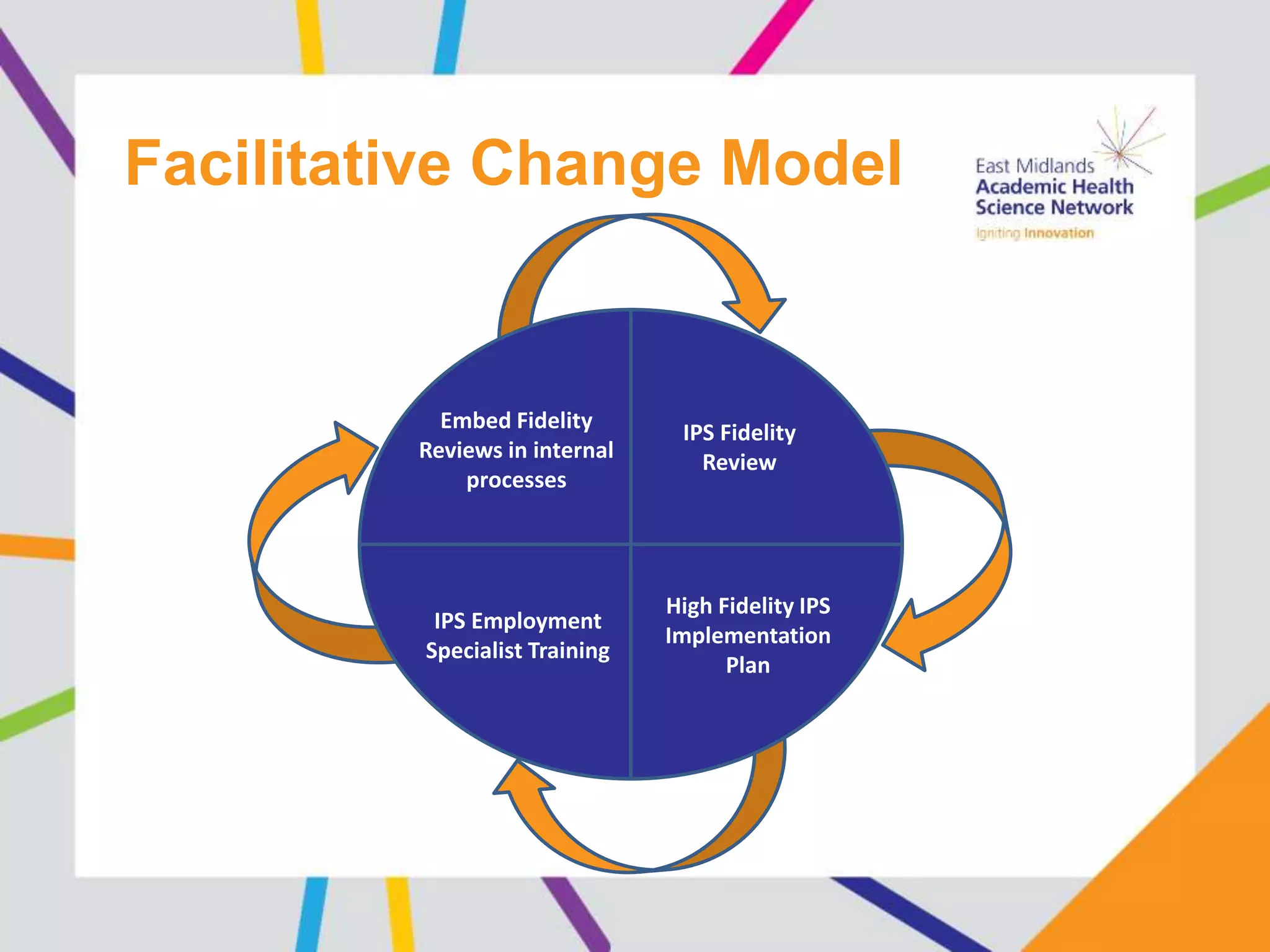
Facilitative Change Model
IPS Fidelity
Review
High Fidelity IPS
Implementation
Plan
IPS Employment
Specialist Training
Embed Fidelity
Reviews in internal
processes
Embedding what works
The East Midlands Academic Health Science Network
(EM-AHSN) is further supporting the implementation
of IPS within Nottinghamshire, Northamptonshire and
Derbyshire NHS Trusts
For more information and to access the advice and
support available please contact:
eric.wodke@nottshc.nhs.uk
NIHR CLAHRC East Midlands Annual Meeting
Growing Momentum – Sharing and Learning
A partnership between
Nottinghamshire Healthcare NHS Foundation Trust
and the Universities of Nottingham and Leicester
The Leicester Diabetes
Risk Scores
Shaun Barber
PhD student
University of Leicester
A partnership between
Nottinghamshire Healthcare NHS Foundation Trust
and the Universities of Nottingham and Leicester
Title Arial
NICE algorithm
Preventing type 2 diabetes: risk
identification and interventions for
individuals at high risk
Methods of identification
One stage - Invasive Two stage - Non invasive
• Cheaper – saving £350 per case
• Engages people with their risk factors
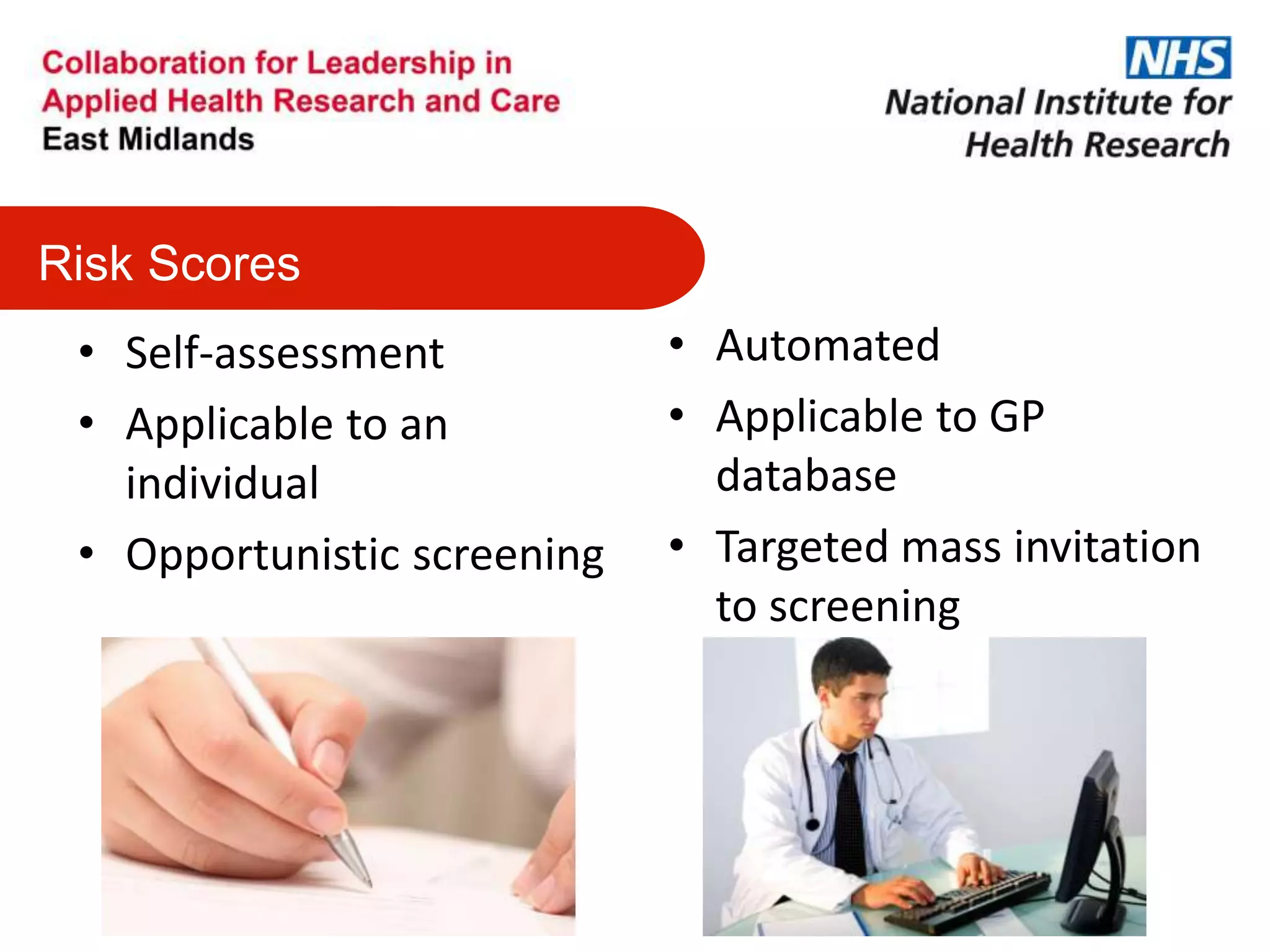
Risk Scores
• Self-assessment
• Applicable to an
individual
• Opportunistic screening
• Automated
• Applicable to GP
database
• Targeted mass invitation
to screening
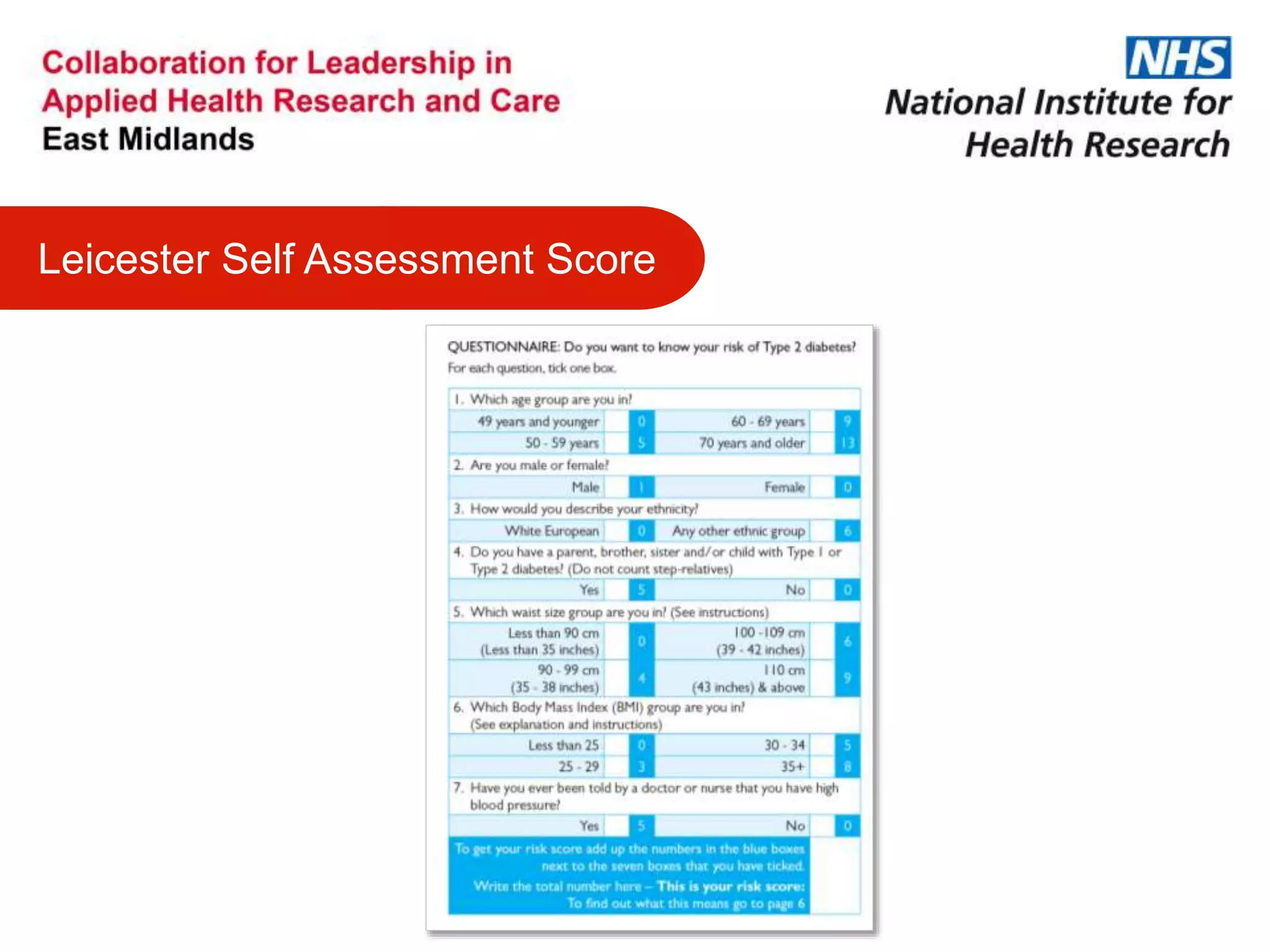
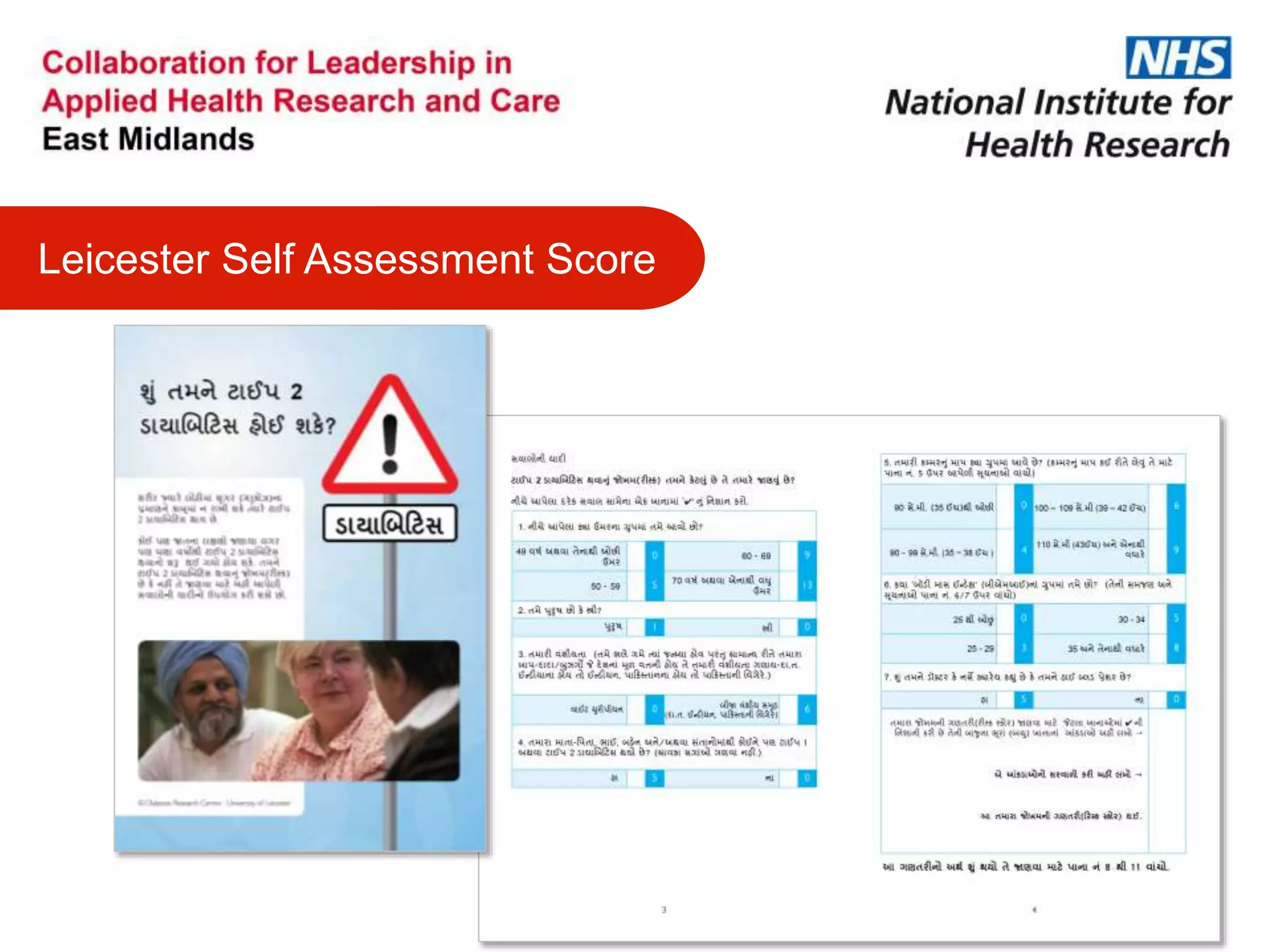
Leicester Self Assessment Score
Text here
Title Arial
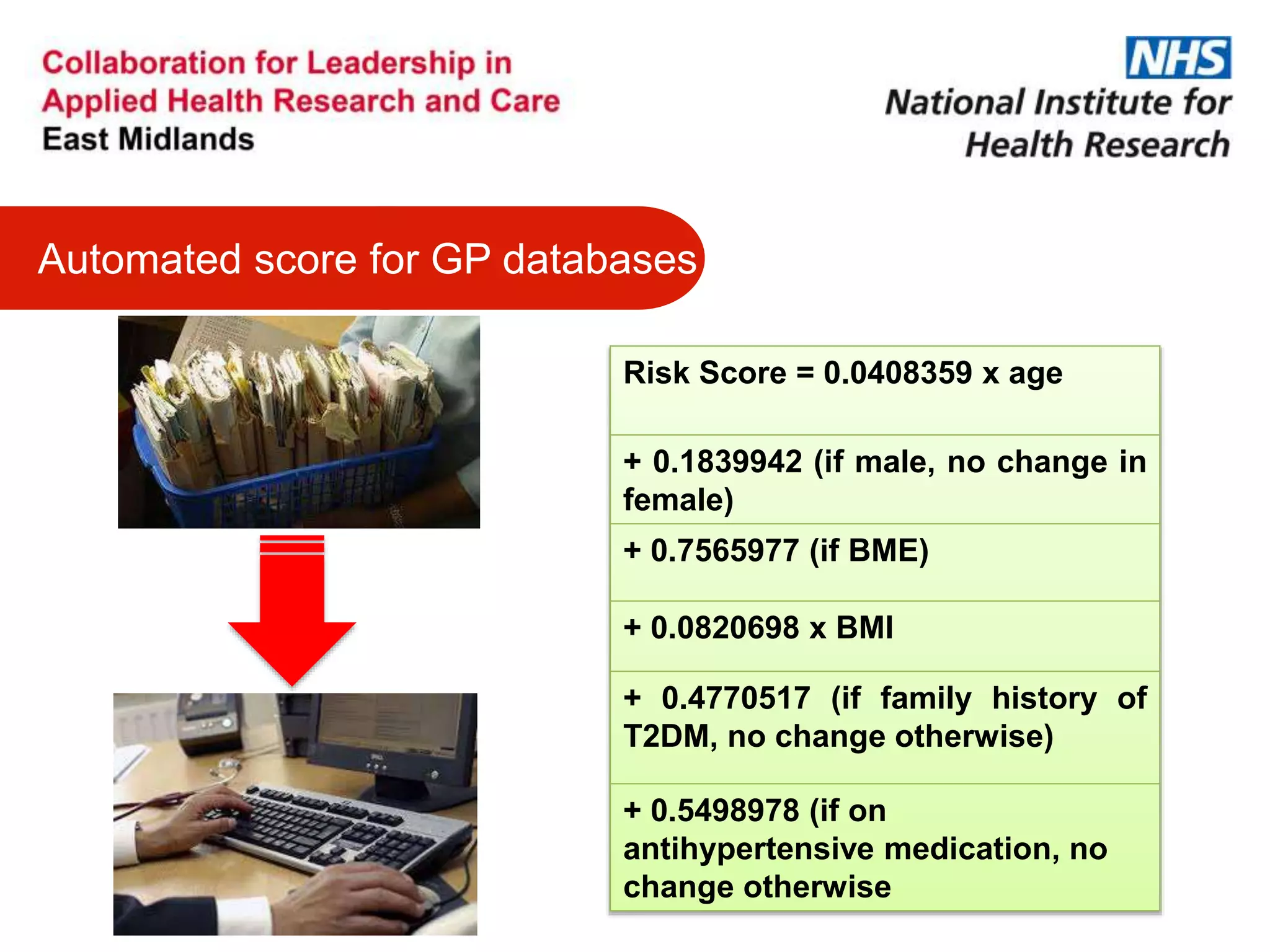
Automated score for GP databases
Risk Score = 0.0408359 x age
+ 0.1839942 (if male, no change in
female)
+ 0.7565977 (if BME)
+ 0.0820698 x BMI
+ 0.4770517 (if family history of
T2DM, no change otherwise)
+ 0.5498978 (if on
antihypertensive medication, no
change otherwise
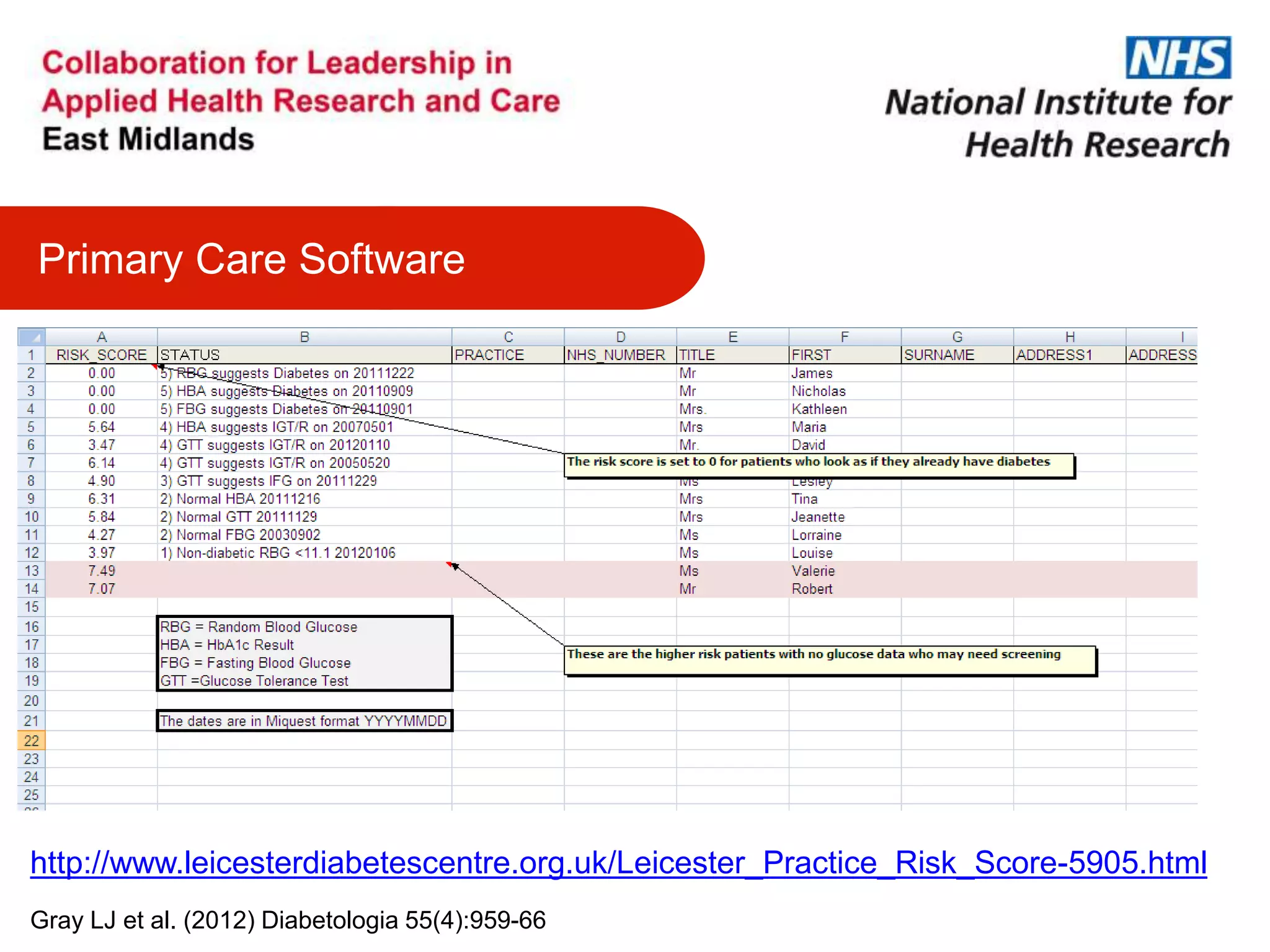
• Developed software which integrates the risk score and
electronic medical records
• Calculates score everyone 40-75 years excluding
– Known Diabetes
– Terminally ill
– Coded Gestational diabetes
• Also analyses existing OGTT/glucose/HbA1c data
– Identifies ‘missed’ diabetes
– Gives precedence to fasting over random results (if unclear random assumed)
– 2 glucose results on same day - assumes OGTT
– Random blood glucose can only rule in diabetes if only result or latest data
– HbA1c ≥6.5% T2DM, 6.0%-6.4% IGR, <6.0% normal
Primary Care Software
• Target screening
– Choosing a specific level of
risk (e.g. top 10%)
– Choosing a specific level of
sensitivity (e.g. 80%)
• First risk score to include
HbA1c in outcome
Primary Care Software
– http://www.leicesterdiabetescentre.org.uk/Leicest
er_Practice_Risk_Score-5905.html
Primary Care Software
http://www.leicesterdiabetescentre.org.uk/Leicester_Practice_Risk_Score-5905.html
Gray LJ et al. (2012) Diabetologia 55(4):959-66
• GPs and other primary healthcare
professionals should use a validated
computer-based risk-assessment tool
to identify people on their practice
register who may be at high risk of type
2 diabetes. The tool should use routinely
available data from patients' electronic
health records. If a computer-based risk-
assessment tool is not available, they
should provide a validated self-
assessment questionnaire, for example,
the Diabetes Risk Score assessment
tool. This is available to health
professionals on request from Diabetes
UK.
NICE - Identification of those at risk
 Leicester Practice Risk Score
 Leicester Self Assessment Score
NICE. Preventing type 2 diabetes: risk identification and interventions for individuals at high risk.
PHG38. 2012. http://guidance.nice.org.uk/PH38
Thank you for listening
Ian.kingsbury@nottingham.ac.uk
www.clahrc-em.nihr.ac.uk
@CLAHRC_EM
This research was funded by the National Institute for Health Research (NIHR) Collaboration for Leadership in
Applied Health Research and Care East Midlands (CLAHRC EM). The views expressed in this presentation are those
of the speaker(s) and not necessarily those of the NHS, the NIHR or the Department of Health.
NIHR CLAHRC East Midlands Annual Meeting
Growing Momentum – Sharing and Learning
A partnership between
Nottinghamshire Healthcare NHS Foundation Trust
and the Universities of Nottingham and Leicester
Naina Patel- Research Associate
Diabetes Research Centre, Leicester
A partnership between
Nottinghamshire Healthcare NHS Foundation Trust
and the Universities of Nottingham and Leicester
Outline
• East Midlands Centre for BME health
• Vision and strategic objectives
• Achievements and future plans
• Leicester Self-Assessment Score (LSA)
• Translation Journey
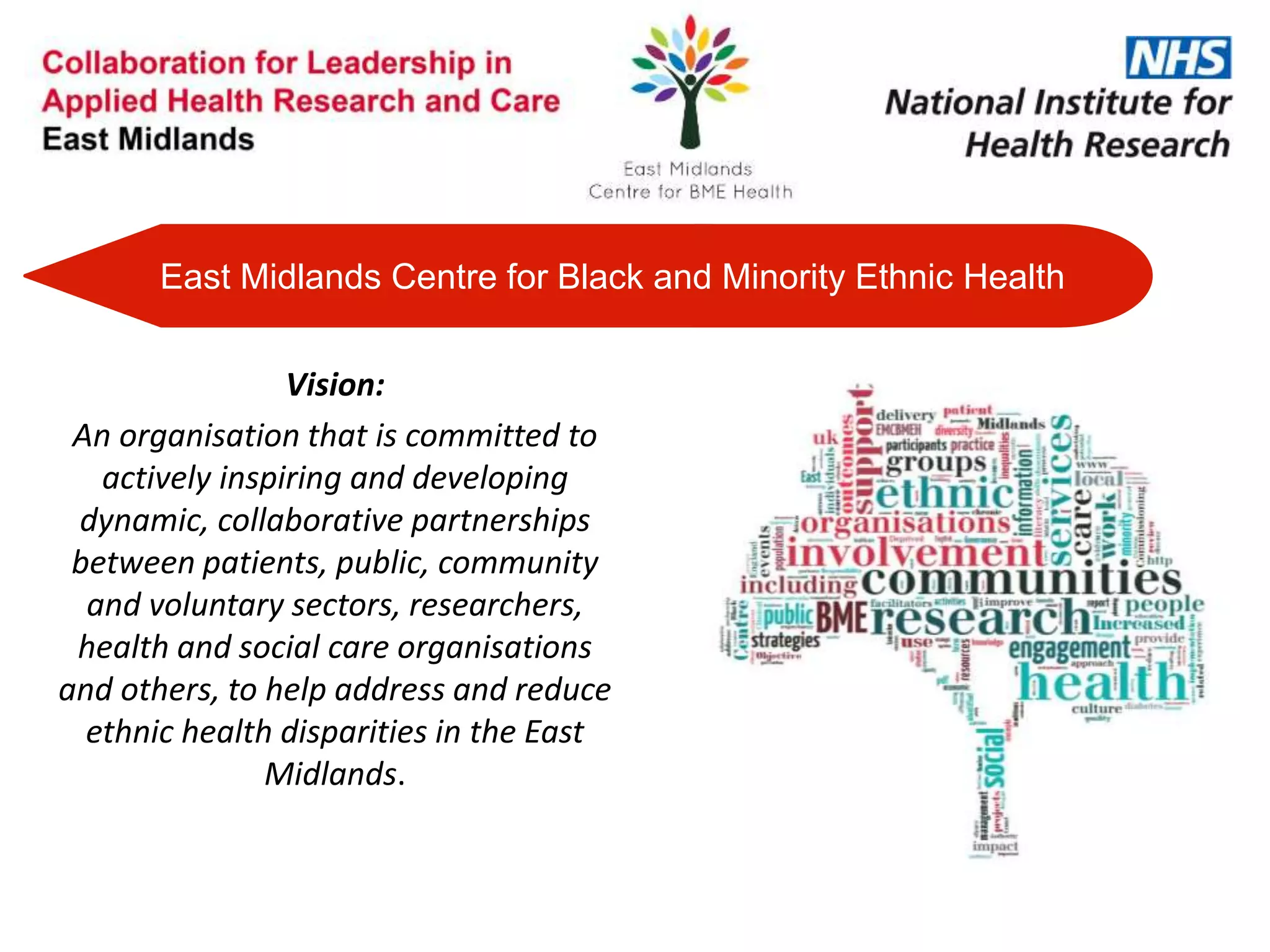
Vision:
An organisation that is committed to
actively inspiring and developing
dynamic, collaborative partnerships
between patients, public, community
and voluntary sectors, researchers,
health and social care organisations
and others, to help address and reduce
ethnic health disparities in the East
Midlands.
East Midlands Centre for Black and Minority Ethnic Health
• Develop and implement capacity building programmes for researchers and staff
from healthcare organisations
• Actively influence a culture of practice in which BME PPI informs and supports
research, service planning and commissioning
• Undertake community engagement strategies that foster the trust and buy-in of
BME communities to take part in joint working in health and research
• To develop and provide a centralised repository of resources and information for
organisations and individuals to share and disseminate
Strategic objectives
• Over 310 people have attended our events
• Conceptualising ethnicity in health and research workshop
• Collaboration with researchers
• 2 Current CLAHRC projects engaged with the Centre.
• Full facilitation and support to one project
• 7 prospective CLAHRC Phase 3 sought and named involvement of the Centre
• Website development –content and marketing strategy currently being developed
Key Achievements
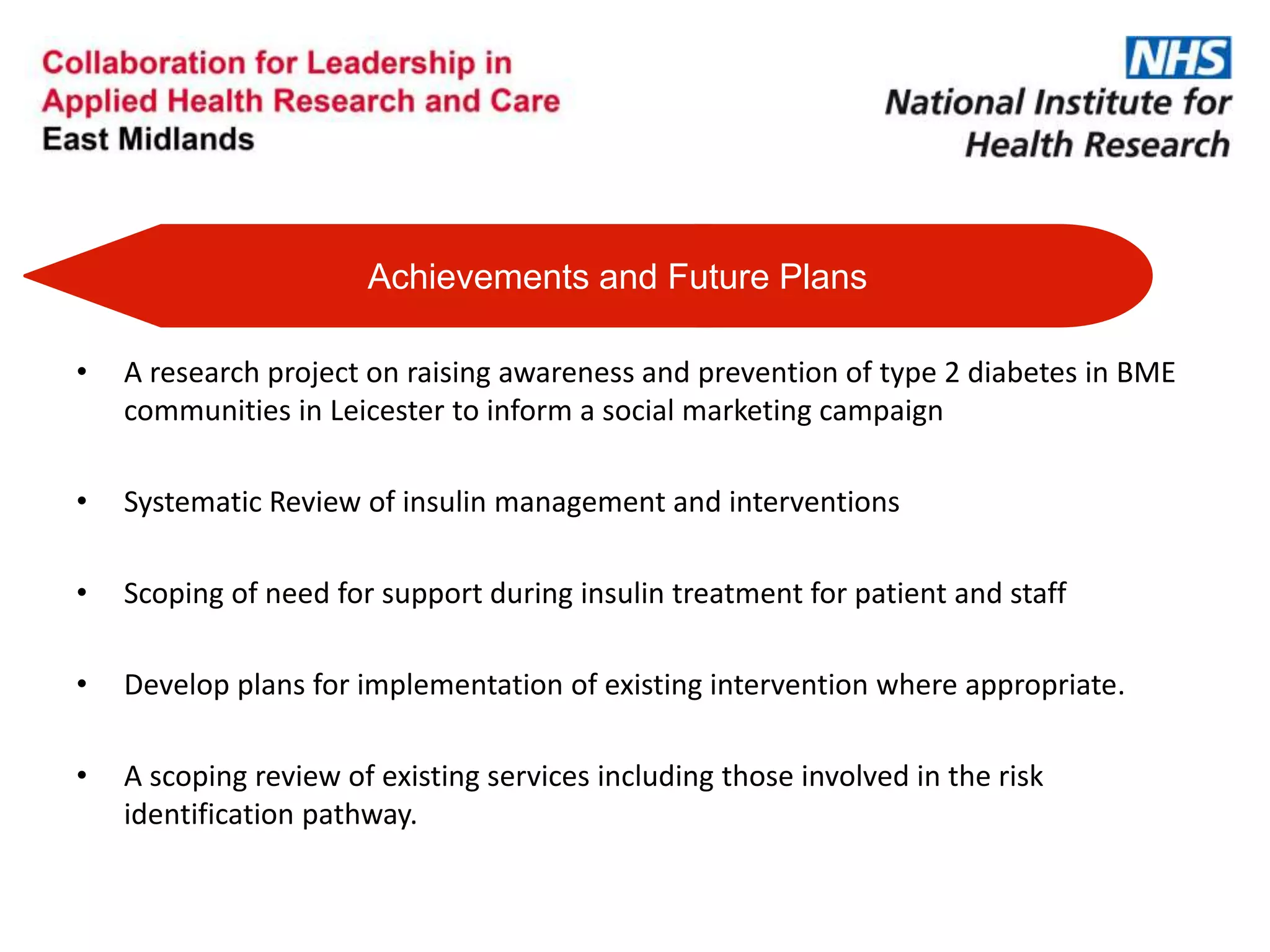
Achievements and Future Plans
• A research project on raising awareness and prevention of type 2 diabetes in BME
communities in Leicester to inform a social marketing campaign
• Systematic Review of insulin management and interventions
• Scoping of need for support during insulin treatment for patient and staff
• Develop plans for implementation of existing intervention where appropriate.
• A scoping review of existing services including those involved in the risk
identification pathway.
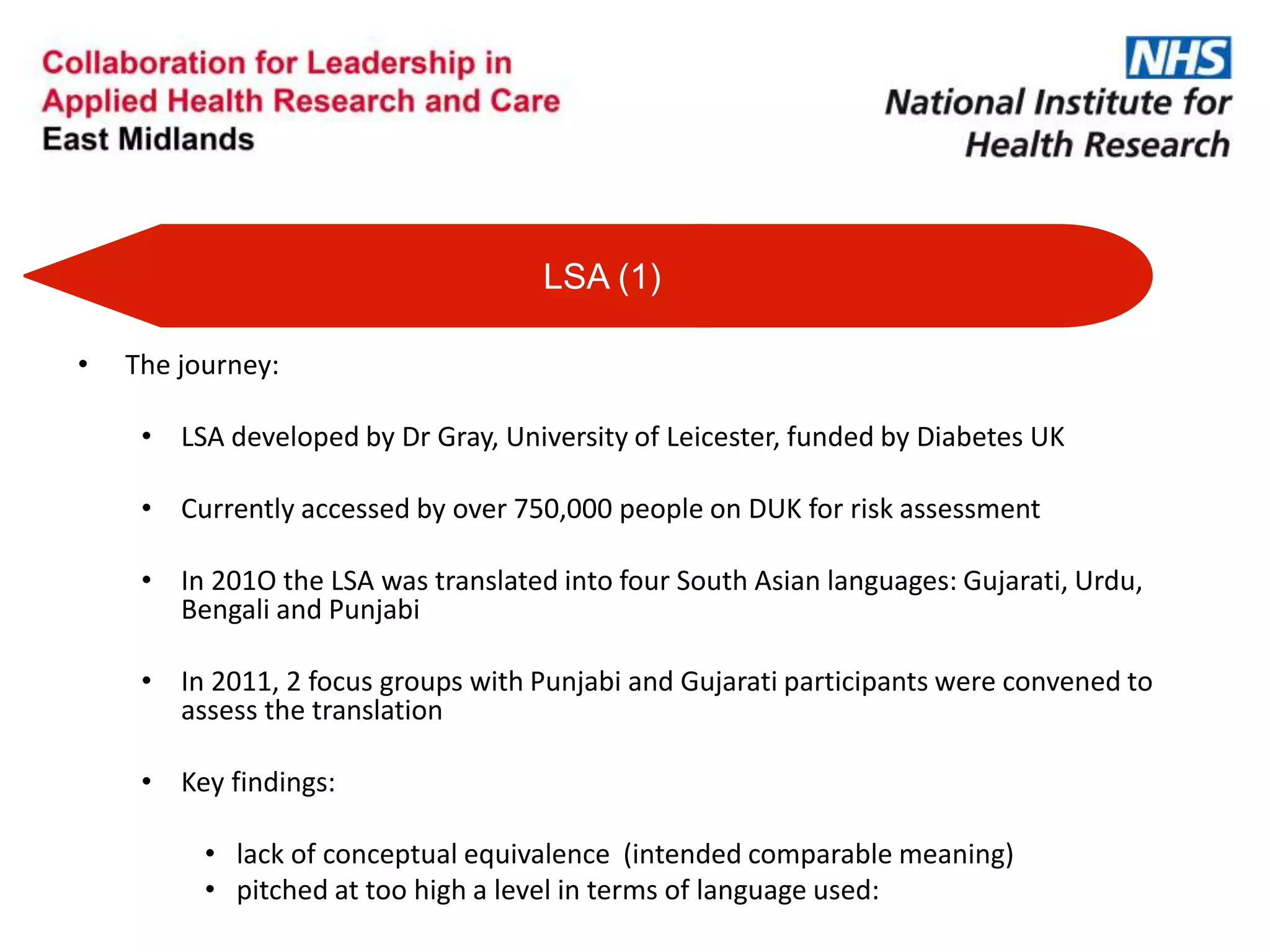
• The journey:
• LSA developed by Dr Gray, University of Leicester, funded by Diabetes UK
• Currently accessed by over 750,000 people on DUK for risk assessment
• In 201O the LSA was translated into four South Asian languages: Gujarati, Urdu,
Bengali and Punjabi
• In 2011, 2 focus groups with Punjabi and Gujarati participants were convened to
assess the translation
• Key findings:
• lack of conceptual equivalence (intended comparable meaning)
• pitched at too high a level in terms of language used:
LSA (1)
Dr R – question on ethnicity ..number 3 how did you find it ? easy or difficult?
AK – ‘Nasel ‘ the word used is a rude word….
RSF- it’s like what breed are you (laughs)…….nasel is the wrong word…..
DN- (..).when you first read the question what was the first thing that came into your
head?
RSF – Alsatian (all laugh)
CS – surely, the person who translated this must have read it and realised what it
means……
Qualitative findings from focus groups
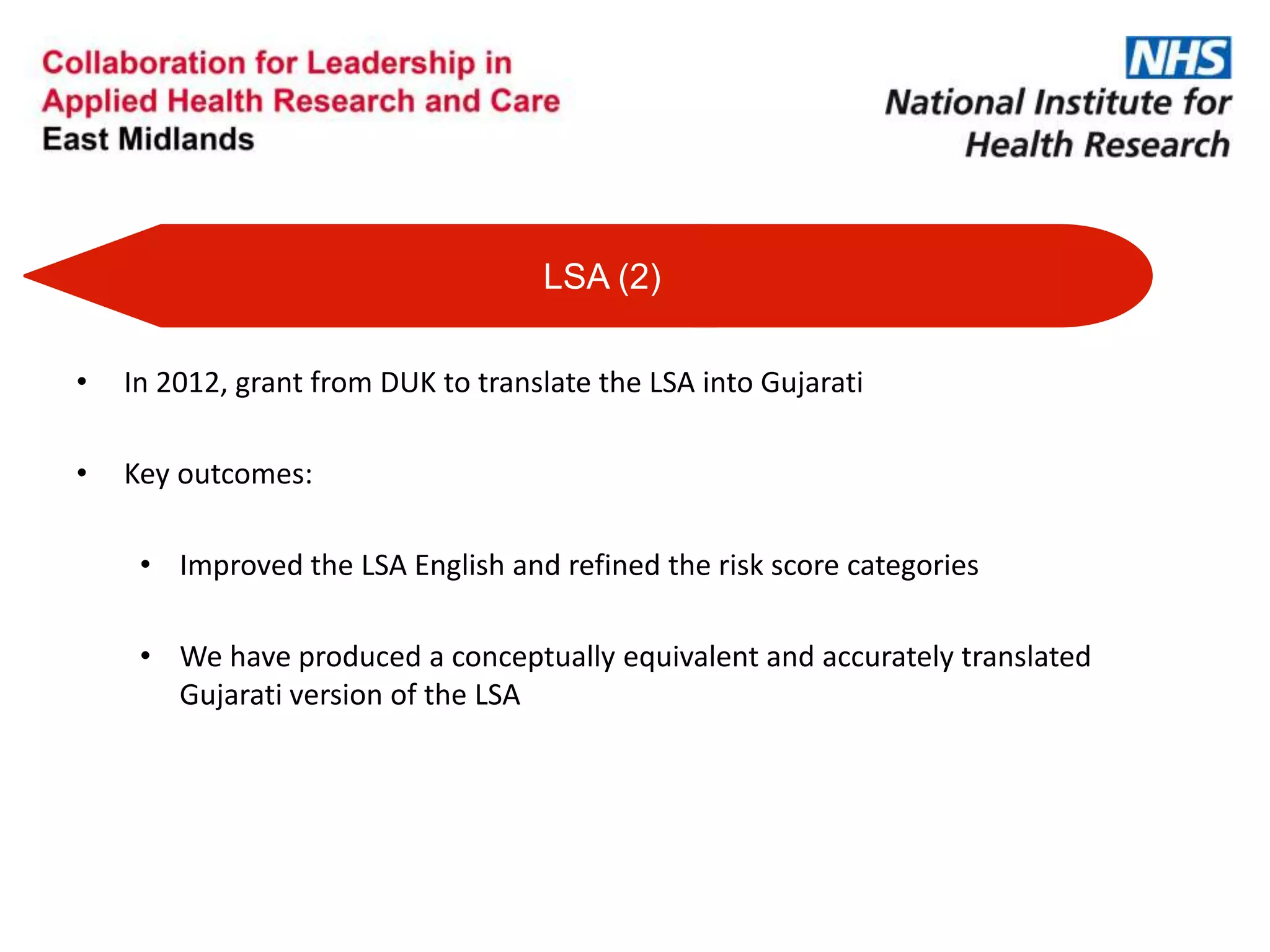
• In 2012, grant from DUK to translate the LSA into Gujarati
• Key outcomes:
• Improved the LSA English and refined the risk score categories
• We have produced a conceptually equivalent and accurately translated
Gujarati version of the LSA
LSA (2)
• Concept of risk and future risk and its translation was easily understood:
“ risk is you know jokem which I think any Gujarati people can understand. It could
happen to them or they are already having that illness.”
• The LSA helps by personalising risk:
“I was shocked, I was shocked with the results..”(…….) Mainly for myself by working
out the tables that makes that me feel that I should do something for myself so its
that per..personal risk yeah.”
Findings from the qualitative stage of the LSA translation
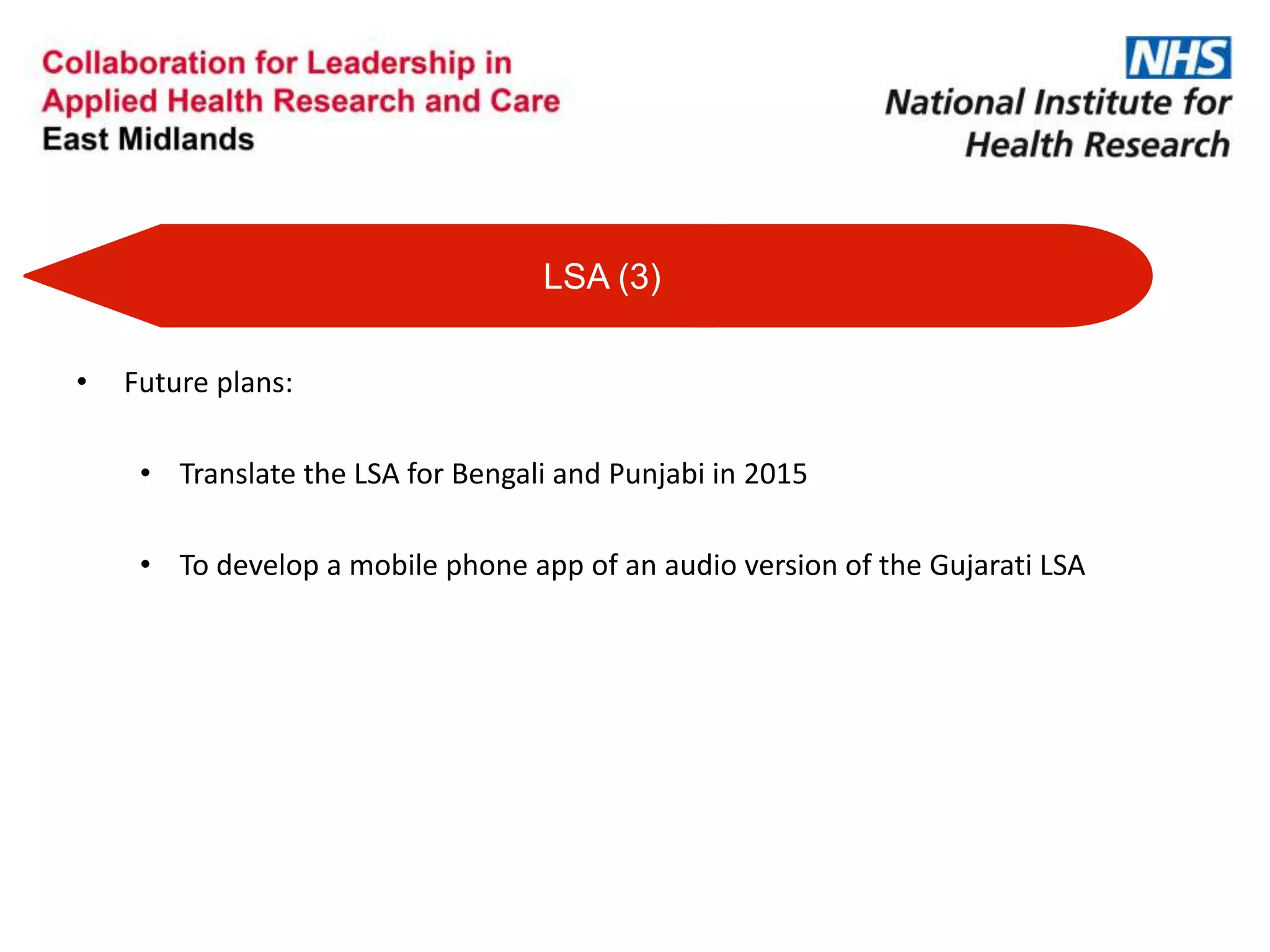
• Future plans:
• Translate the LSA for Bengali and Punjabi in 2015
• To develop a mobile phone app of an audio version of the Gujarati LSA
LSA (3)
Joint event with RNIB on BME eye
health and diabetes on 19/03/15
Thank you for listening
np89@le.ac.uk
N
This research was funded by the National Institute for Health Research (NIHR) Collaboration for Leadership in
Applied Health Research and Care East Midlands (CLAHRC EM). The views expressed in this presentation are those
of the speaker(s) and not necessarily those of the NHS, the NIHR or the Department of Health.
NIHR CLAHRC East Midlands Annual Meeting
Growing Momentum – Sharing and Learning
A partnership between
Nottinghamshire Healthcare NHS Foundation Trust
and the Universities of Nottingham and Leicester
PARADES Mental Capacity Act Booklet.
Richard Morriss
Enhancing Mental Health Theme CLAHRC EM
A partnership between
Nottinghamshire Healthcare and the
Universities of Nottingham and Leicester
• Mental Capacity Act 2005 allows people who temporarily or permanently
lose their ability to understand or communicate decisions about their
personal affairs including health in advance
Advanced Directive to Refuse Treatment (legally binding)
Advanced Statement of Wishes and Feelings (treatment, personal
and financial affairs)
Lasting Power of Attorney (who will act for you)
• Not restricted to mental health
• House of Lords Select Committee 2013 evidence that the MCA has been
poorly implemented in England
Background
• Serious mental illness with periods of mania – excitement, elation,
over-activity, lack of sleep, disinhibited, reckless behaviour, excessive
confidence; periods of depression
• 1.4% lifelong prevalence, onset 13-30 yrs
• Suicide rate 20x SMR general population
• Lose capacity in mania and depression for days to months, then regain
capacity fully
Bipolar Disorder
Link with creativity
• Mark Twain, Edgar Allen Poe, Walt Whitman, Sylvia Plath,
Tennessee Williams, Ernest Hemingway, Virginia Woolf, Ezra
Pound, Charles Mingus, Gustav Mahler, Paul Gauguin, Georgia
O'Keeffe, Jackson Pollack, Vincent van Gogh.
• Ozzy Osbourne, Jean-Claude Van Damme, Axl Rose, Sinéad
O'Conner, Peter Gabriel, Kurt Cobain, Stephen Fry, Russell
Brand, Catherine Zeta Jones, John Cleese, Spike Milligan etc.
Years lived lost due to disability in the world in 2010
Vos T et al Lancet 2012
Rank order
1. Low back pain 11. Osteoarthrosis
2. Major depressive disorder 12. Drug use disorders
3. Iron deficiency anaemia 13. Hearing loss
4. Neck pain 14. Asthma
5. COPD 15. Alcohol use disorders
6. Other musculoskeletal 16. Schizophrenia
7. Anxiety 17. Road injury
8. Migraine 18. Bipolar disorder
9. Diabetes mellitus 19. Dysthymia
10.Falls 20. Epilepsy
• Part of NIHR PARADES Programme Grant (leads for
stream: Peter Bartlett, Richard Morriss, UoN)
• Aim to review uptake and use by service users with
bipolar disorder and training of psychiatrists
• National survey of 549 service users, 650
psychiatrists, qualitative interviews
PARADES MCA study
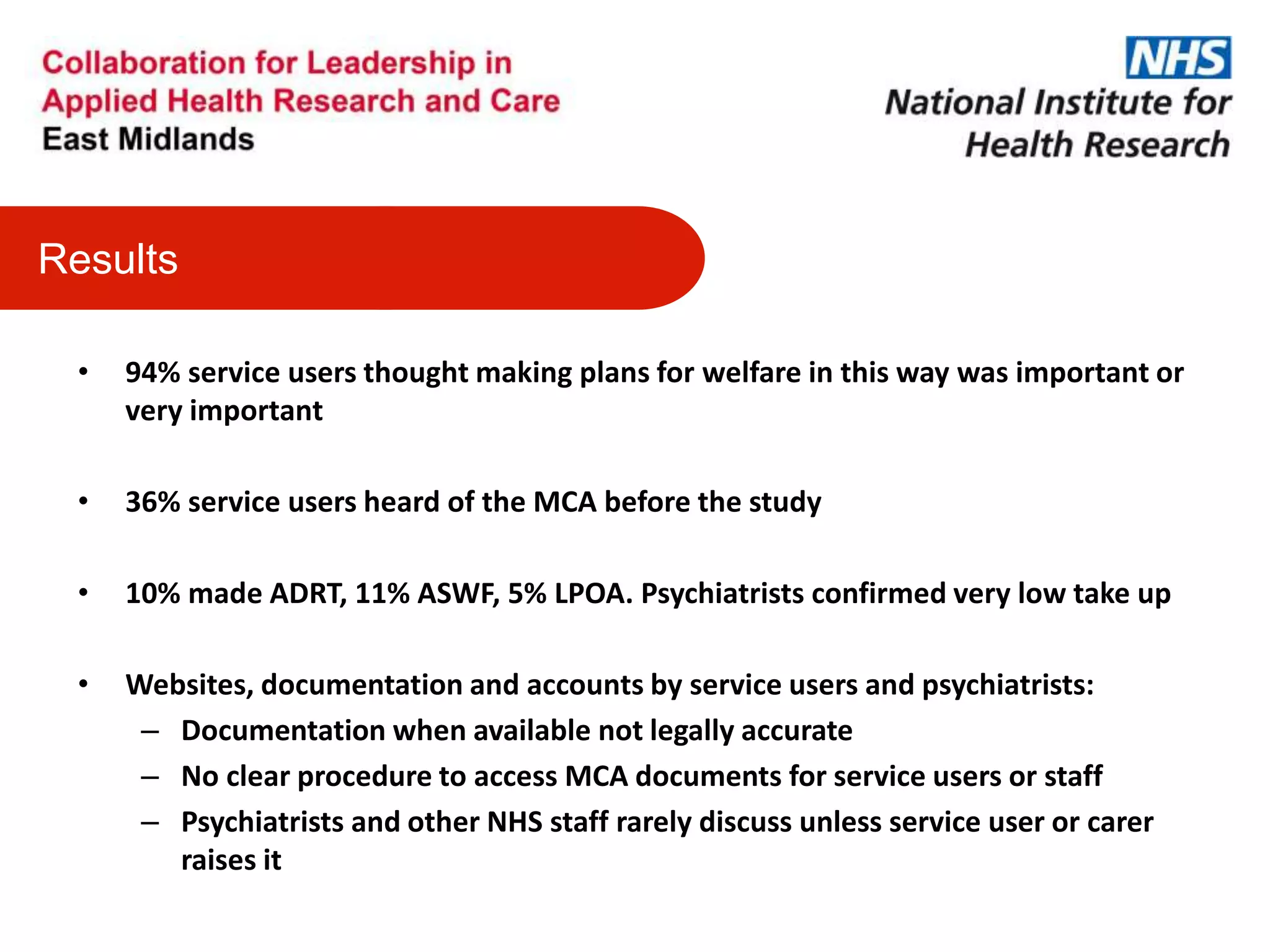
• 94% service users thought making plans for welfare in this way was important or
very important
• 36% service users heard of the MCA before the study
• 10% made ADRT, 11% ASWF, 5% LPOA. Psychiatrists confirmed very low take up
• Websites, documentation and accounts by service users and psychiatrists:
– Documentation when available not legally accurate
– No clear procedure to access MCA documents for service users or staff
– Psychiatrists and other NHS staff rarely discuss unless service user or carer
raises it
Results
1. Chief investigator and theme manager
2. Summary reported as standing item to CLAHRC EM Executive and
CLAHRC EM Board
Reporting
• Service users liked the written content – legally accurate
• Service users did not like images and layout so work with CLAHRC EM PPI to improve
it
• CLAHRC EM PPI - MCA cards to let staff know of presence of MCA documents
• No plan to disseminate booklet beyond participants in survey
• Devised dissemination and implementation plan:
– Dissemination events and publicity campaign – Bipolar UK, celebrity, political endorsement, social
media
– Print run of paper copies and distribute to NHS organisations, bipolar UK, recovery college
– Downloadable booklet, card and now survey from AHSN EM website.
CLAHRC and AHSN EM role
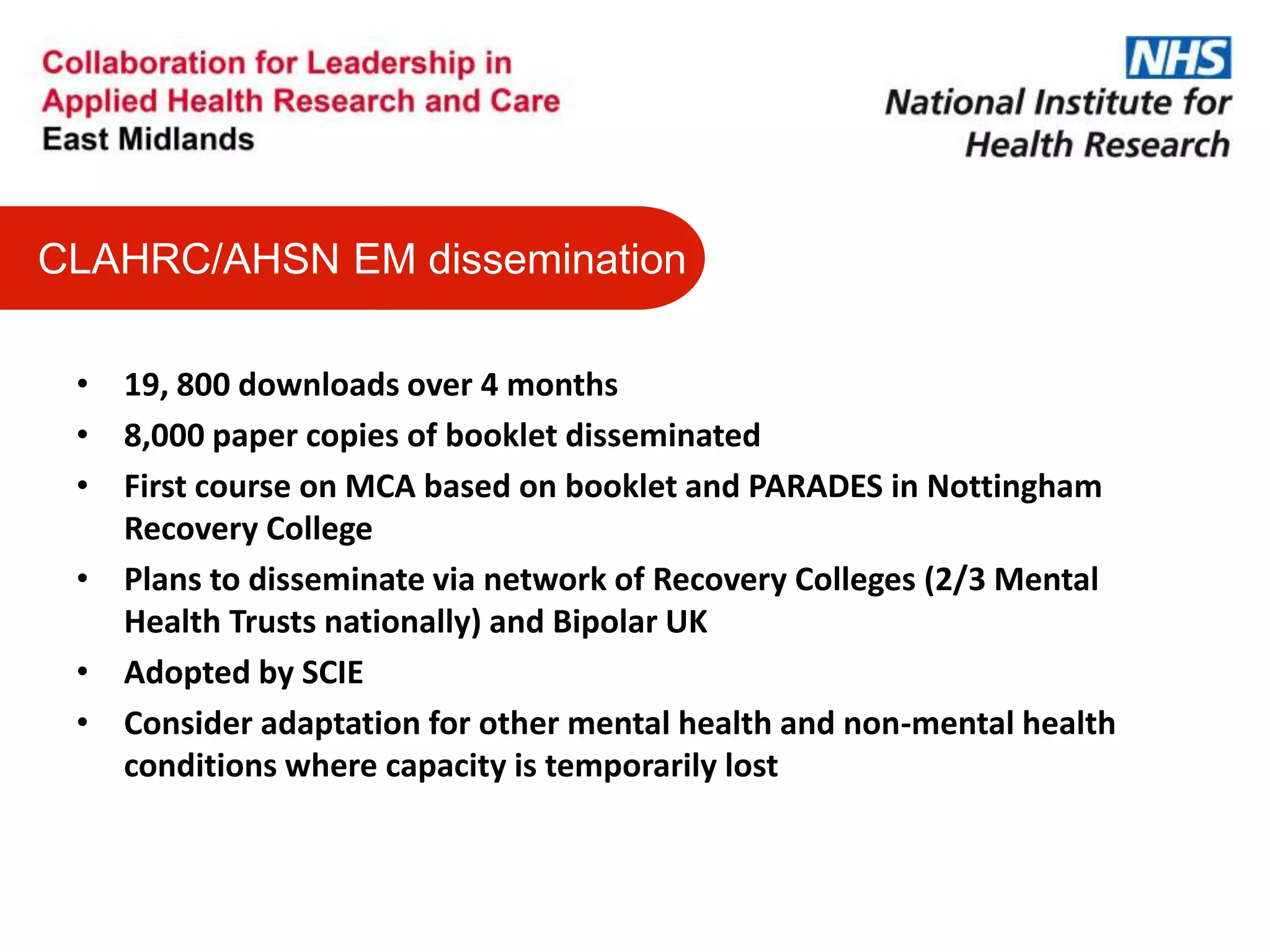
• 19, 800 downloads over 4 months
• 8,000 paper copies of booklet disseminated
• First course on MCA based on booklet and PARADES in Nottingham
Recovery College
• Plans to disseminate via network of Recovery Colleges (2/3 Mental
Health Trusts nationally) and Bipolar UK
• Adopted by SCIE
• Consider adaptation for other mental health and non-mental health
conditions where capacity is temporarily lost
CLAHRC/AHSN EM dissemination
NIHR CLAHRC East Midlands Annual Meeting
Growing Momentum – Sharing and Learning
A partnership between
Nottinghamshire Healthcare NHS Foundation Trust
and the Universities of Nottingham and Leicester
The IMPAKT Programme
IMproving Patient care and Awareness of
Kidney disease progression Together
Research, Implementation, QI, and Commissioning
• Rare to common
• Complex to routine
• Secondary to primary care
A Paradigm Shift in Thinking About Kidney Care
Big changes in kidney medicine since 2006
- new nomenclature - CKD
- a new way of measuring kidney function
- a new way of grading severity
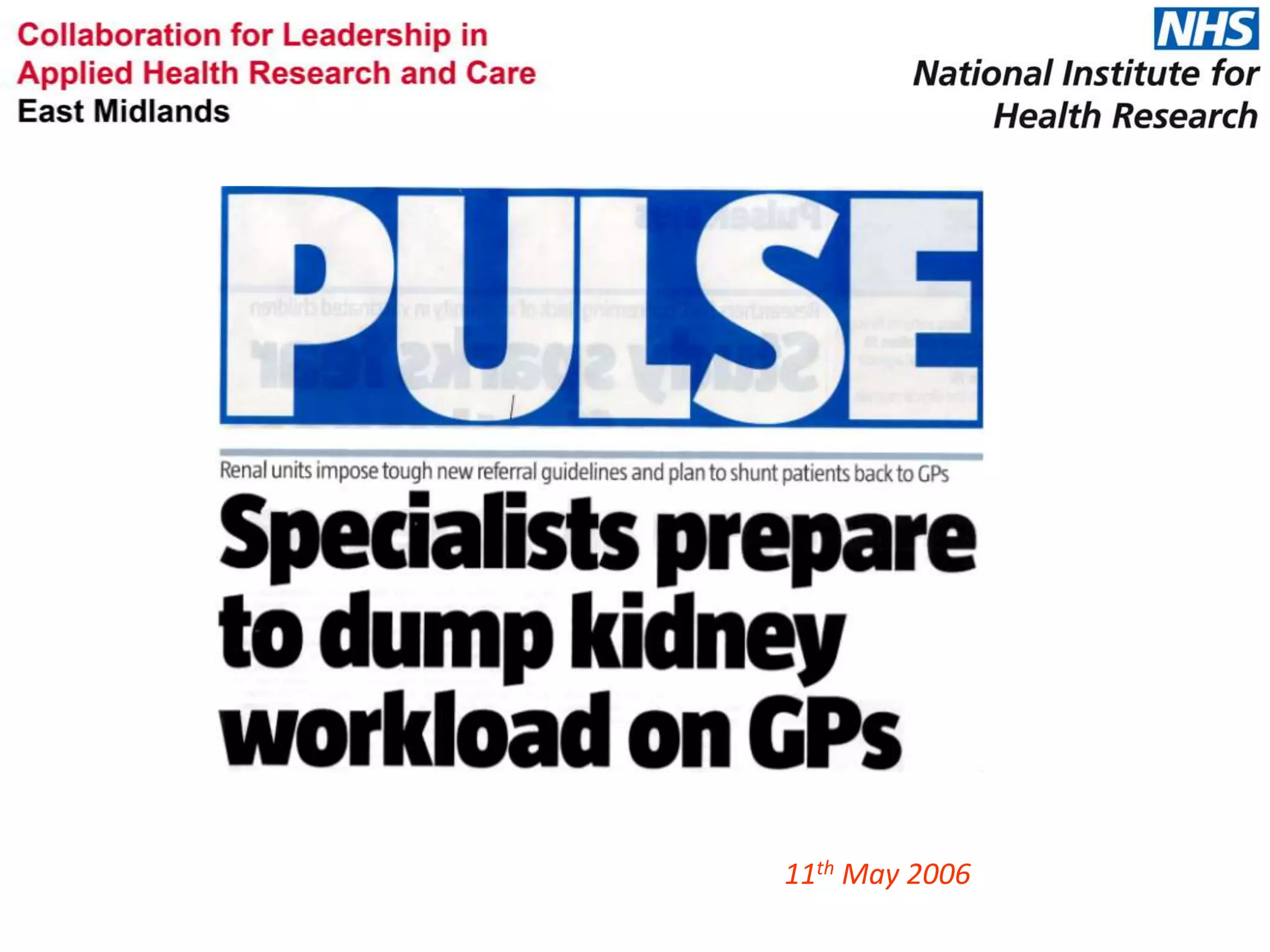
11th May 2006
• A primary-secondary care
partnership to prevent
adverse outcomes in CKD
• Nigel Brunskill Principal Investigator
CKD
“Intensive CKD disease management in primary care, supported
by secondary care, will improve outcomes”
Hypothesis
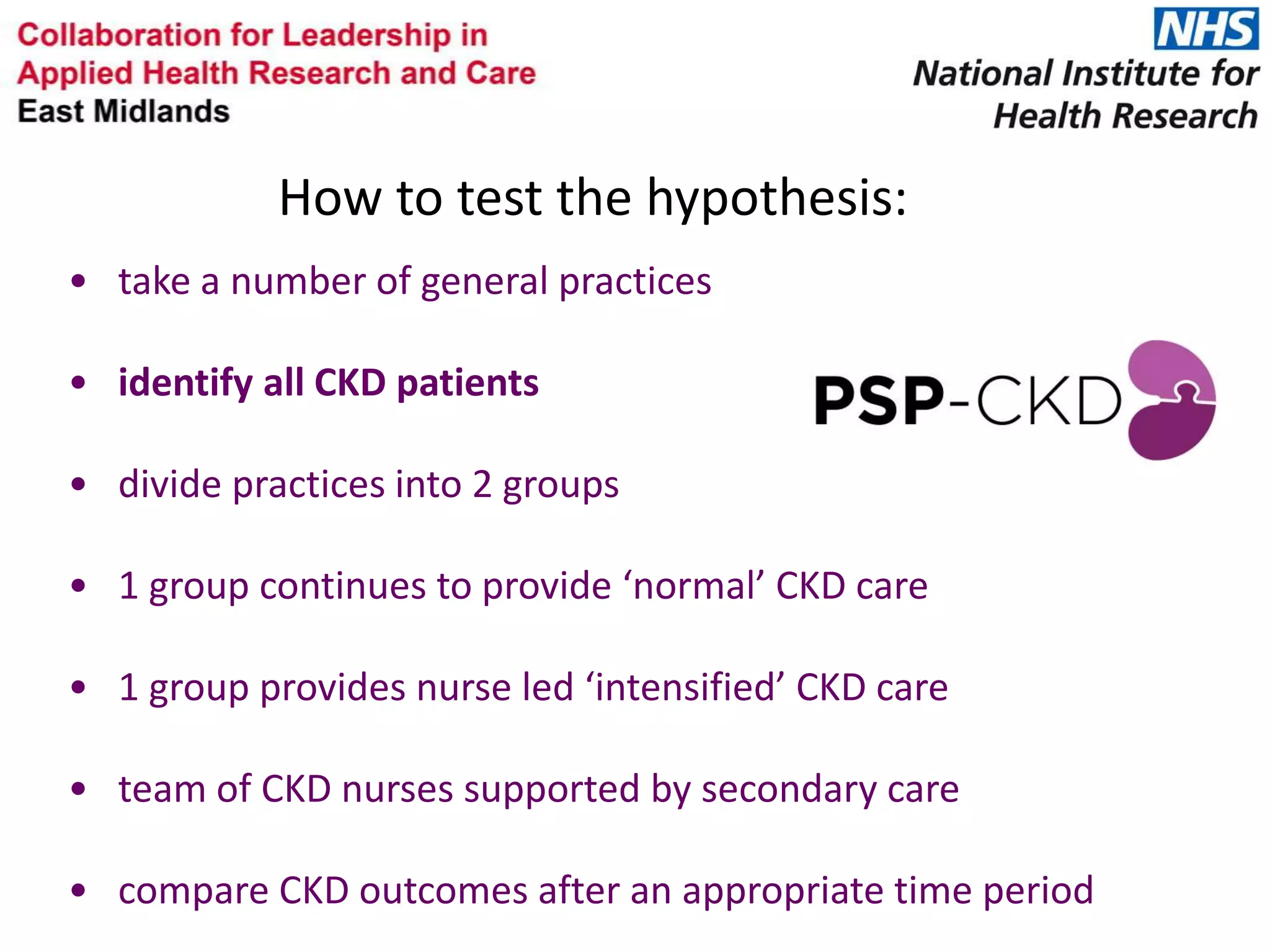
• take a number of general practices
• identify all CKD patients
• divide practices into 2 groups
• 1 group continues to provide ‘normal’ CKD care
• 1 group provides nurse led ‘intensified’ CKD care
• team of CKD nurses supported by secondary care
• compare CKD outcomes after an appropriate time period
How to test the hypothesis:
A robust data extraction tool applicable
to all GP computer systems
What do we need to do this?
www.impakt.org.uk
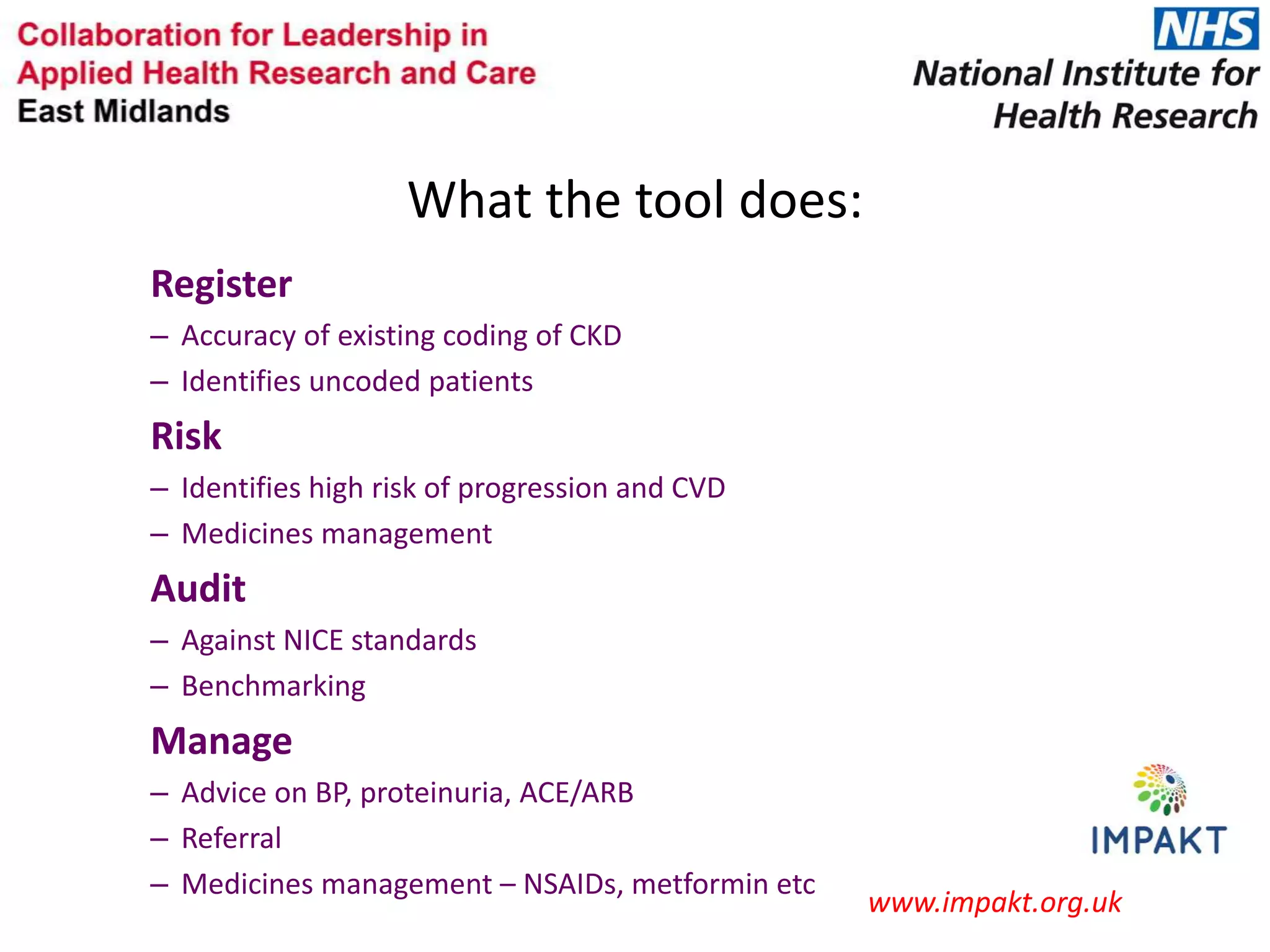
What the tool does:
Register
– Accuracy of existing coding of CKD
– Identifies uncoded patients
Risk
– Identifies high risk of progression and CVD
– Medicines management
Audit
– Against NICE standards
– Benchmarking
Manage
– Advice on BP, proteinuria, ACE/ARB
– Referral
– Medicines management – NSAIDs, metformin etc
www.impakt.org.uk
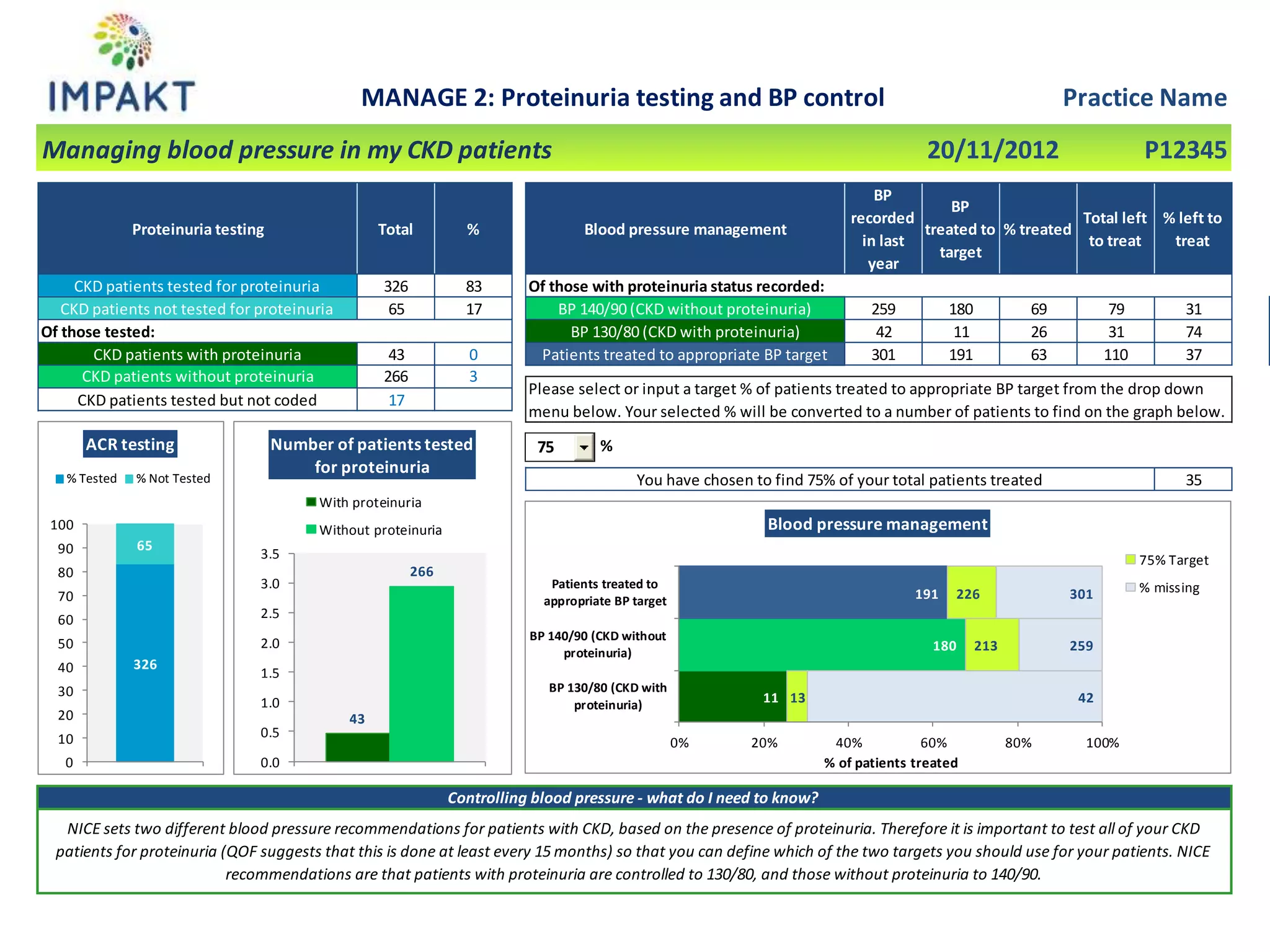
MANAGE 2: Proteinuria testing and BP control Practice Name
Managing blood pressure in my CKD patients 20/11/2012 P12345
Proteinuria testing Total % Blood pressure management
BP
recorded
in last
year
BP
treated to
target
% treated
Total left
to treat
% left to
treat
CKD patients tested for proteinuria 326 83 Of those with proteinuria status recorded:
CKD patients not tested for proteinuria 65 17 BP 140/90 (CKD without proteinuria) 259 180 69 79 31
Of those tested: BP 130/80 (CKD with proteinuria) 42 11 26 31 74
CKD patients with proteinuria 43 0 Patients treated to appropriate BP target 301 191 63 110 37
CKD patients tested but not coded 17
%
35

NICE sets two different blood pressure recommendations for patients with CKD, based on the presence of proteinuria. Therefore it is important to test all of your CKD
patients for proteinuria (QOF suggests that this is done at least every 15 months) so that you can define which of the two targets you should use for your patients. NICE
recommendations are that patients with proteinuria are controlled to 130/80, and those without proteinuria to 140/90.
CKD patients without proteinuria 266 3
Please select or input a target % of patients treated to appropriate BP target from the drop down
menu below. Your selected % will be converted to a number of patients to find on the graph below.
Controlling blood pressure - what do I need to know?
You have chosen to find 75% of your total patients treated
326
65
0
10
20
30
40
50
60
70
80
90
100
ACR testing
% Tested % Not Tested
43
266
0.0
0.5
1.0
1.5
2.0
2.5
3.0
3.5
Number of patients tested
for proteinuria
With proteinuria
Without proteinuria
11
180
191
13
213
226
42
259
301
0% 20% 40% 60% 80% 100%
BP 130/80 (CKD with
proteinuria)
BP 140/90 (CKD without
proteinuria)
Patients treated to
appropriate BP target
% of patients treated
Blood pressure management
75% Target
% missing
75
MANAGE 1: Stratifying risk of progressive CKD Practice Name
Controlling risk factors for my CKD patients
Albuminura stages, description and range (mg/mmol) Risk factor stratification
A1 A2 A3 Score
10 or more 0
9 0
<10 10-29 30-299 300-2000 >2000 8 0
7 1
6 4
5 9
4 29
CKD3a Mild-moderate 204 15 13 1 3 68
CKD3b Moderate-severe 64 4 6 2 2 120
CKD4 Severe 12 1 2 1 160
CKD5 Kidney failure 1 1 391
Some medication
Proteinuria heat map - what does it mean?
IMPAKT reads how many of your CKD patients have been
tested for proteinuria and plots them on the above heat
map. The more severe grouping represents a higher risk of
the patient suffering from progressive CKD. Use IMPAKT to
find the patients at highest risk so that you can control
their risk factors.
Low risk
Mild risk
Moderate risk
Severe risk
Very severe risk
Total patients
Risk groups
Use this page to stratify risk factors for your CKD patients and make adjustments
to how they are managed to reduce the risk of progressive CKD. This report
contains details on what risk each of your patients' readings for proteinuria
represents against their latest eGFR evidence, a breakdown of the number of risk
factors per CKD patient on your register, CKD patients that are prescribed
nephrotoxic drugs, and CKD patients that may meet the criteria for referral to
secondary care specialists.You can find each category of patient within IMPAKT on
your practice system.
How do I use the information on this page?
IMPAKT analyses 12 unweighted risk factors for
progressive CKD and calculates how many risk factor
categories each of your CKD patients fall into. Use
IMPAKT to investigate those patients appearing most
frequently to manage their risk factors.
No. of patients with referral advice markers
IMPAKT has identified this as the number of your CKD patients that may meet NICE CKD guidelines (2008) criteria
for referral to specialist renal services.
20
0
233
76
15
2
326
Total patients
Stratifying risk factors
GFR stages,
description and
range
(ml/min/1.73m2
)
CKD1
CKD2
Optimal
Low-normal
30-44
15-29
<15
Total patients
>105
90-104
75-89
60-74
45-59
20/11/2012 P12345
Composite ranking for relative risks by GFR and
albuminuria (KDIGO 2009)
Optimal to high-
normal
High Very high to
nephrotic
No. of
patients
Ranked by combined
risk score
150
0 50 100 150 200
Patientswith advice markers for prescribeddrugs
Number of patients
coded with CKD
IMPAKT PSP CKD Database
• 48 practices in Northants
• >30,000 patients with CKD
• 6 years data
• Detailed data:
- demographics
- co-morbidity
- prescribed medications
- lab results
• Millions of data points
• Rich resource for further study
IMPAKT Implementation:
- EM AHSN
- Greater Manchester AHSN
- West Yorks
- North Wales
- West Midlands
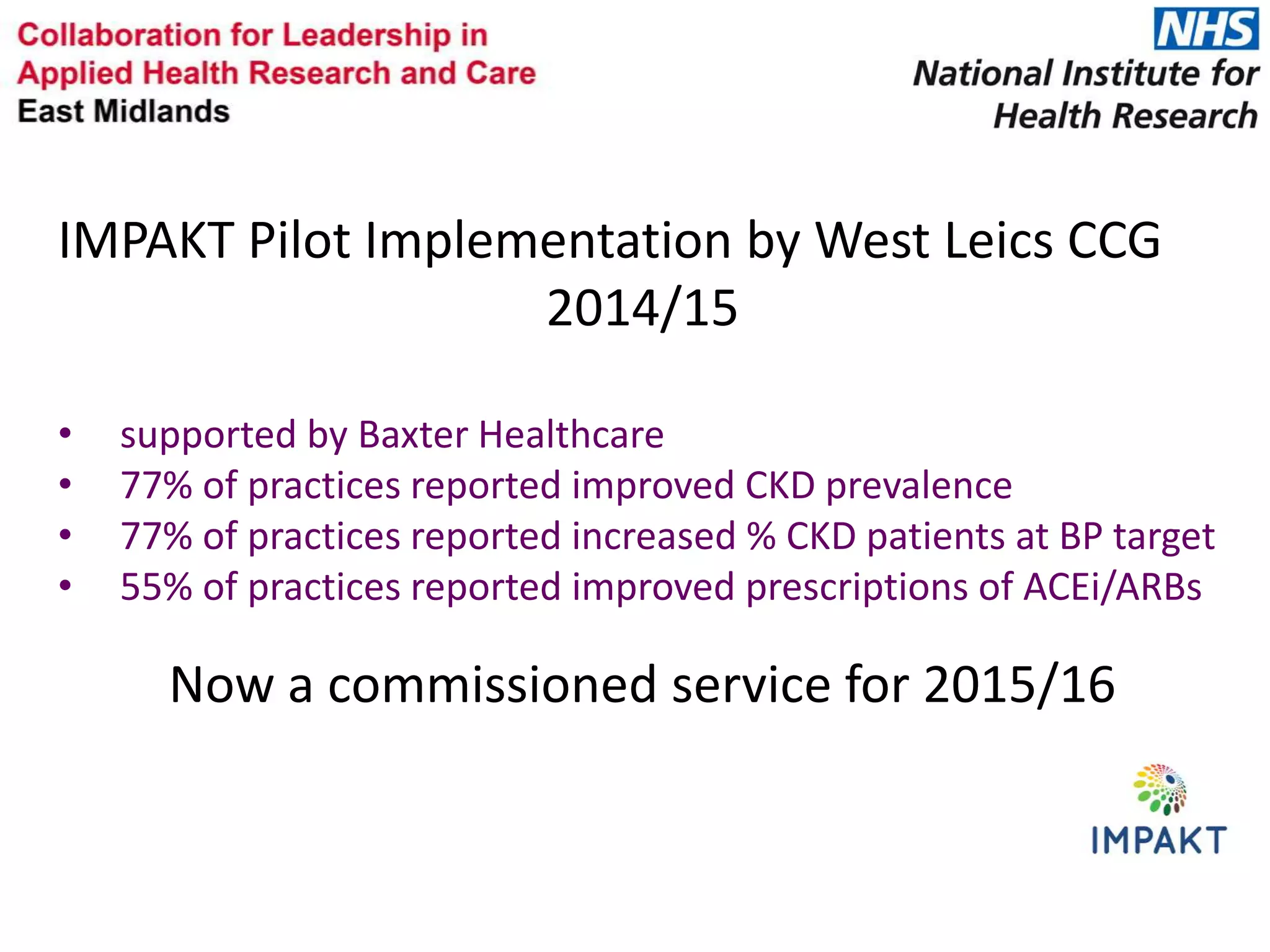
IMPAKT Pilot Implementation by West Leics CCG
2014/15
• supported by Baxter Healthcare
• 77% of practices reported improved CKD prevalence
• 77% of practices reported increased % CKD patients at BP target
• 55% of practices reported improved prescriptions of ACEi/ARBs
Now a commissioned service for 2015/16
IMPAKT
NIHR new media competition winner 2013
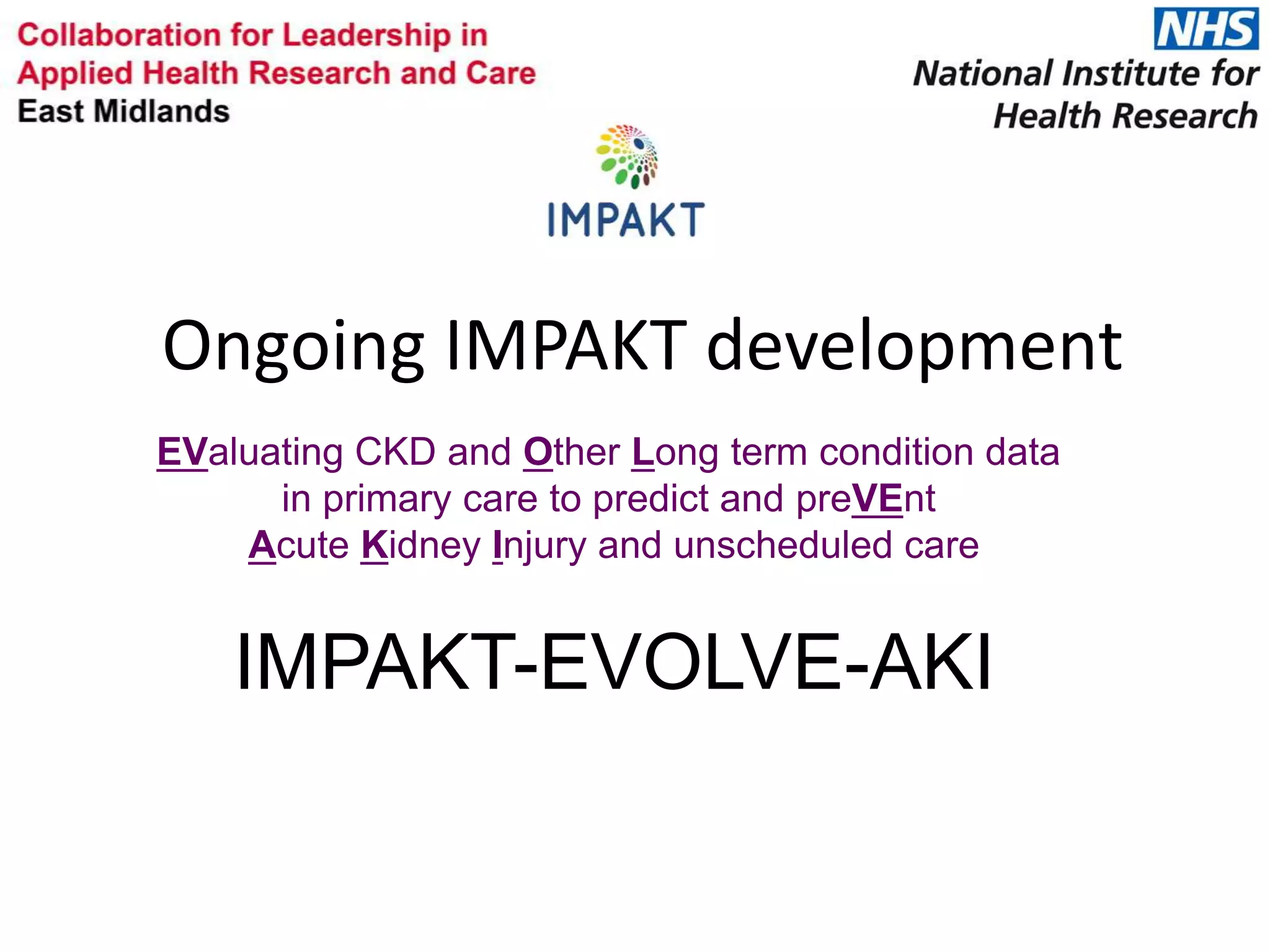
Ongoing IMPAKT development
EValuating CKD and Other Long term condition data
in primary care to predict and preVEnt
Acute Kidney Injury and unscheduled care
IMPAKT-EVOLVE-AKI
IMPAKT-EVOLVE-AKI
• Combines practice data and hospital lab data
• First informatics solution to study community AKI
• Data on associated causal AKI risk factors
• Provides ability to measure efficacy of AKI interventions
IMPAKT provides comprehensive suite of tools for
management of both acute and chronic kidney
disease
NIHR CLAHRC East Midlands Annual Meeting
Growing Momentum – Sharing and Learning
A partnership between
Nottinghamshire Healthcare NHS Foundation Trust
and the Universities of Nottingham and Leicester
BITEs
Brokering Innovation Through Evidence
Kamlesh Khunti, Director, CLAHRC East Midlands
A partnership between
Nottinghamshire Healthcare NHS Foundation Trust
and the Universities of Nottingham and Leicester
BITEs & Evidence summaries
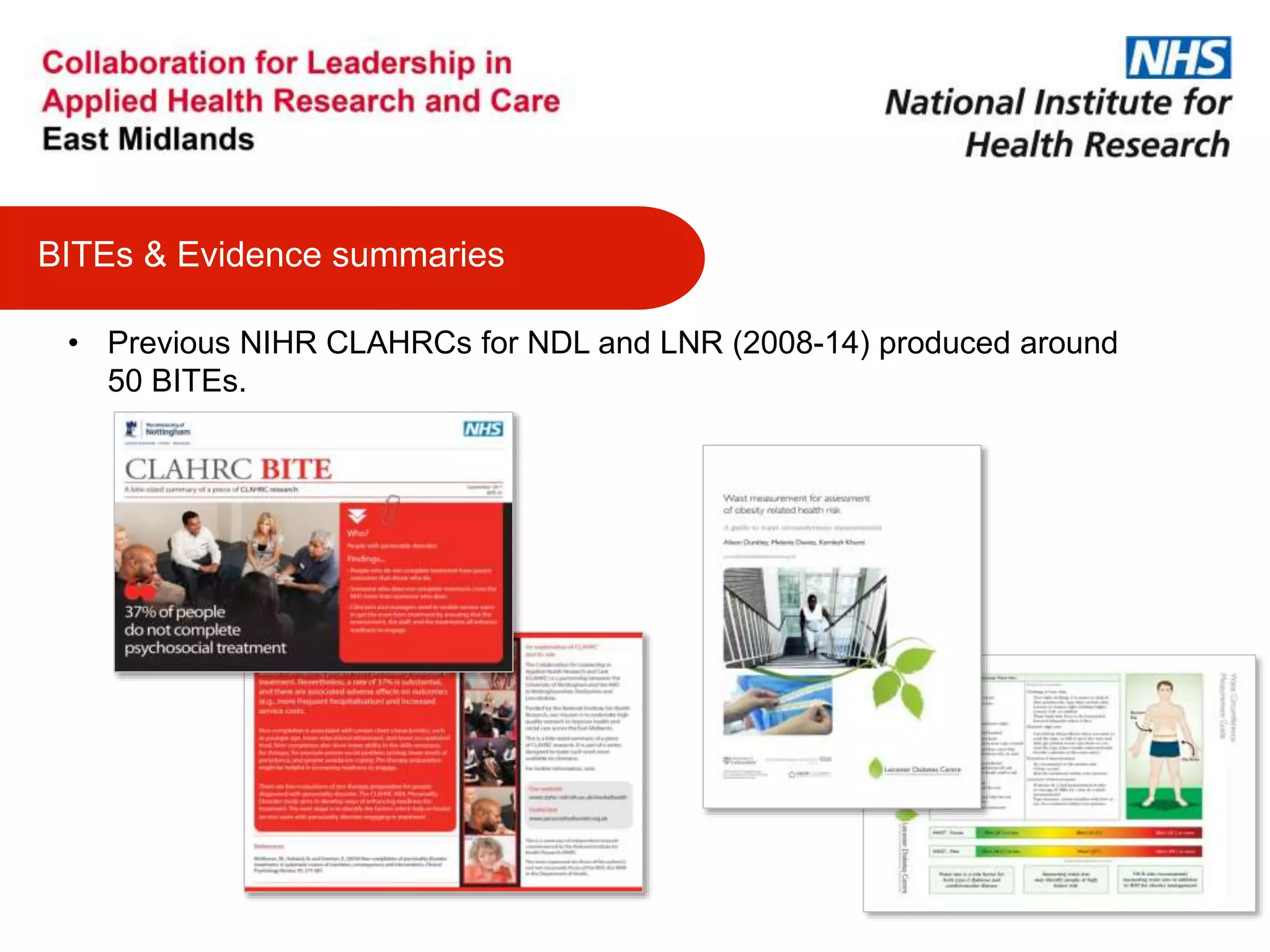
• Previous NIHR CLAHRCs for NDL and LNR (2008-14) produced around
50 BITEs.
CLAHRC East Midlands BITEs
• CLAHRC East Midlands has produced 18 BITEs since January
2015.
• BITEs from all previous and current NIHR CLAHRCs can be found
on the National Institute for Health and Care Excellence (NICE)
website.
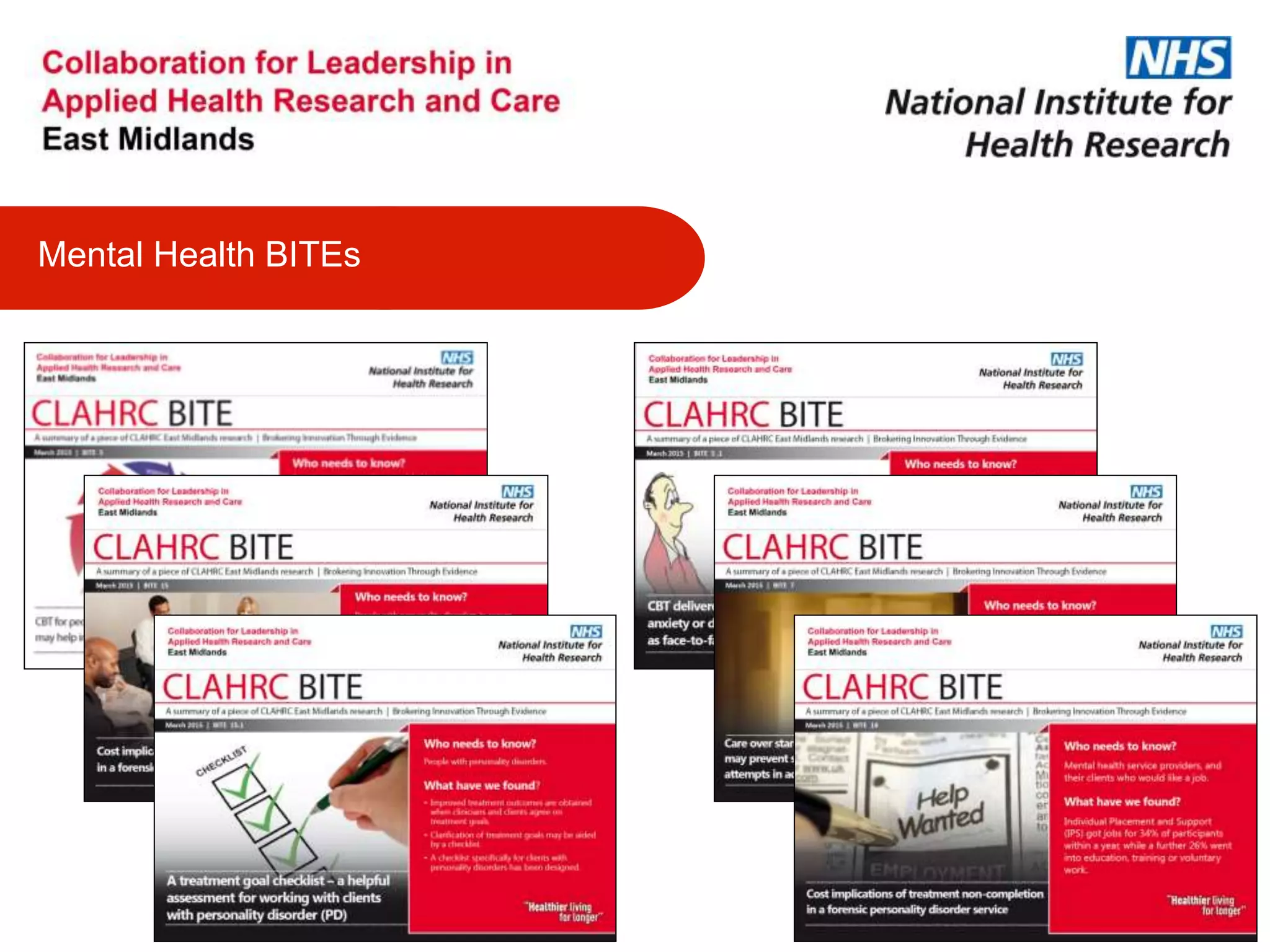
Mental Health BITEs
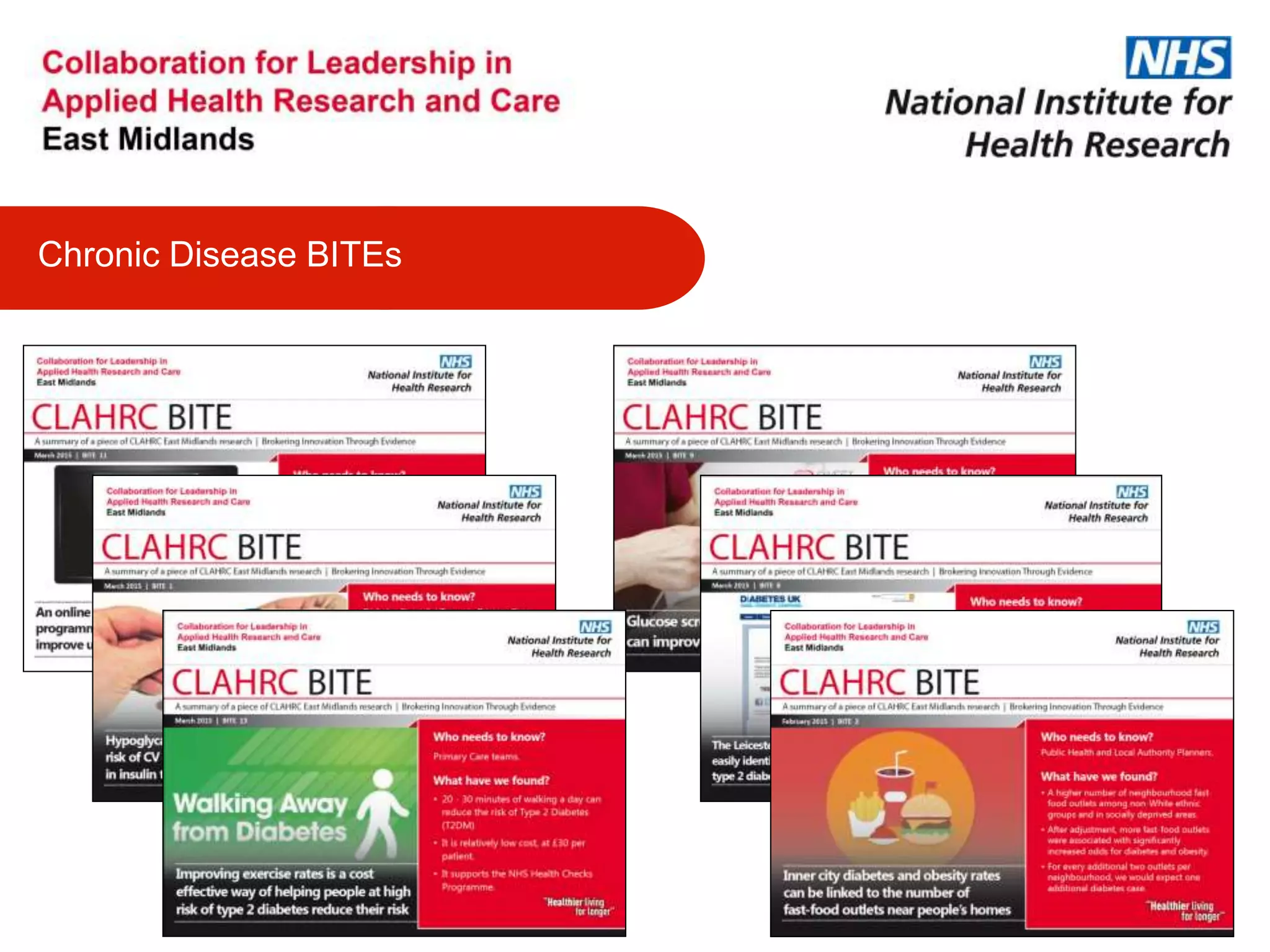
Chronic Disease BITEs
Primary Care BITEs
Older People and Stroke BITEs
Implementation and PPI BITEs
• CLAHRC EM is committed to
producing at least 30 BITEs and
we expect to produce a BITE for
every significant publication,
finding or activity
• We are committed to publicising
our achievements and the
impacts our work can have on
health to all relevant people and
bodies.
BITEs Future
Thank you for listening
kk22@le.ac.uk
www.clahrc-em.nihr.ac.uk
@CLAHRC_EM
@kamleshkhunti
This research was funded by the National Institute for Health Research (NIHR) Collaboration for Leadership in
Applied Health Research and Care East Midlands (CLAHRC EM). The views expressed in this presentation are those
of the speaker(s) and not necessarily those of the NHS, the NIHR or the Department of Health.
NIHR CLAHRC East Midlands Annual Meeting
Growing Momentum – Sharing and Learning
A partnership between
Nottinghamshire Healthcare NHS Foundation Trust
and the Universities of Nottingham and Leicester
Join the conversation
If you hear something you like, or want to
challenge, or simply want to share an
observation, join the Twitter conversation using
@CLAHRC_EM and #clahrc in your tweet.
#clahrc
@CLAHRC_EM
NIHR CLAHRC East Midlands related Twitter accounts
@EMRAN_ageing
East Midlands Research into Ageing Network
@EMCBMEH
East Midlands Centre for Black and Minority Ethnic Health
Connecting to venue WiFi
• Load web browser
• Click “conference” on homepage
• Enter Username diabetes1, Password diabetes1
Username:
diabetes1
Password:
diabetes1
NIHR CLAHRC East Midlands Showcase
Chair – Professor John Gladman, Theme Lead, Caring for
Older People and Stroke Survivors
A partnership between
Nottinghamshire Healthcare NHS Foundation Trust
and the Universities of Nottingham and Leicester
Charlotte Hall Shireen Patel
Enhancing Mental Health Theme
Co-production in the Enhancing Mental
Health Theme
What Works?
AQUA -Trial Helping Urgent
Care Users Cope
with Distress
about Physical
Complaints
Study
A partnership between
Nottinghamshire Healthcare NHS Foundation Trust
and the Universities of Nottingham and Leicester
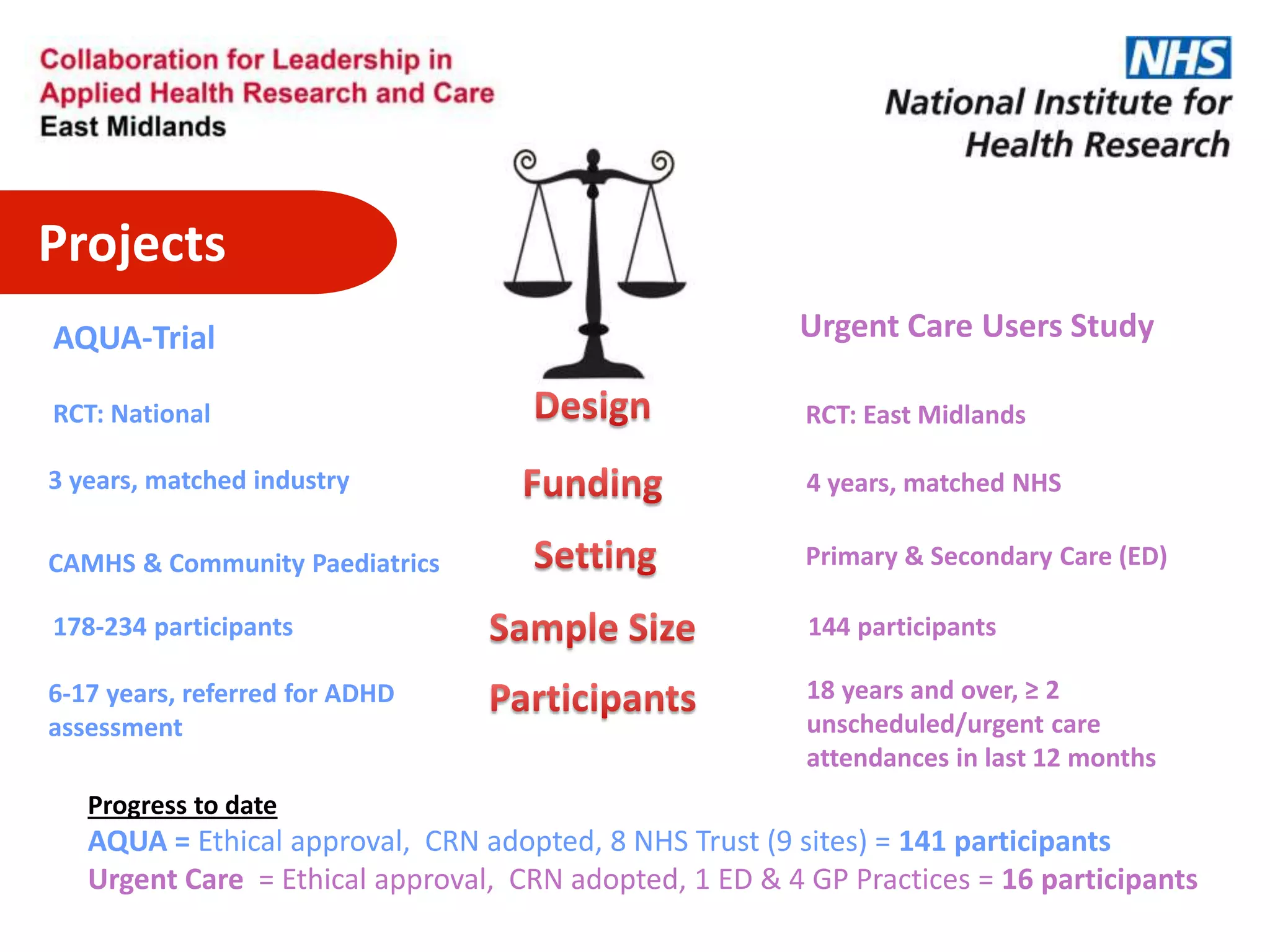
Projects
Urgent Care Users StudyAQUA-Trial
RCT: National
3 years, matched industry
CAMHS & Community Paediatrics
178-234 participants
6-17 years, referred for ADHD
assessment
RCT: East Midlands
4 years, matched NHS
Primary & Secondary Care (ED)
144 participants
18 years and over, ≥ 2
unscheduled/urgent care
attendances in last 12 months
Progress to date
AQUA = Ethical approval, CRN adopted, 8 NHS Trust (9 sites) = 141 participants
Urgent Care = Ethical approval, CRN adopted, 1 ED & 4 GP Practices = 16 participants
Network of Practice
Brings together research partners, patients, service commissioners and service
providers to maintain strong links with those who can benefit from the study
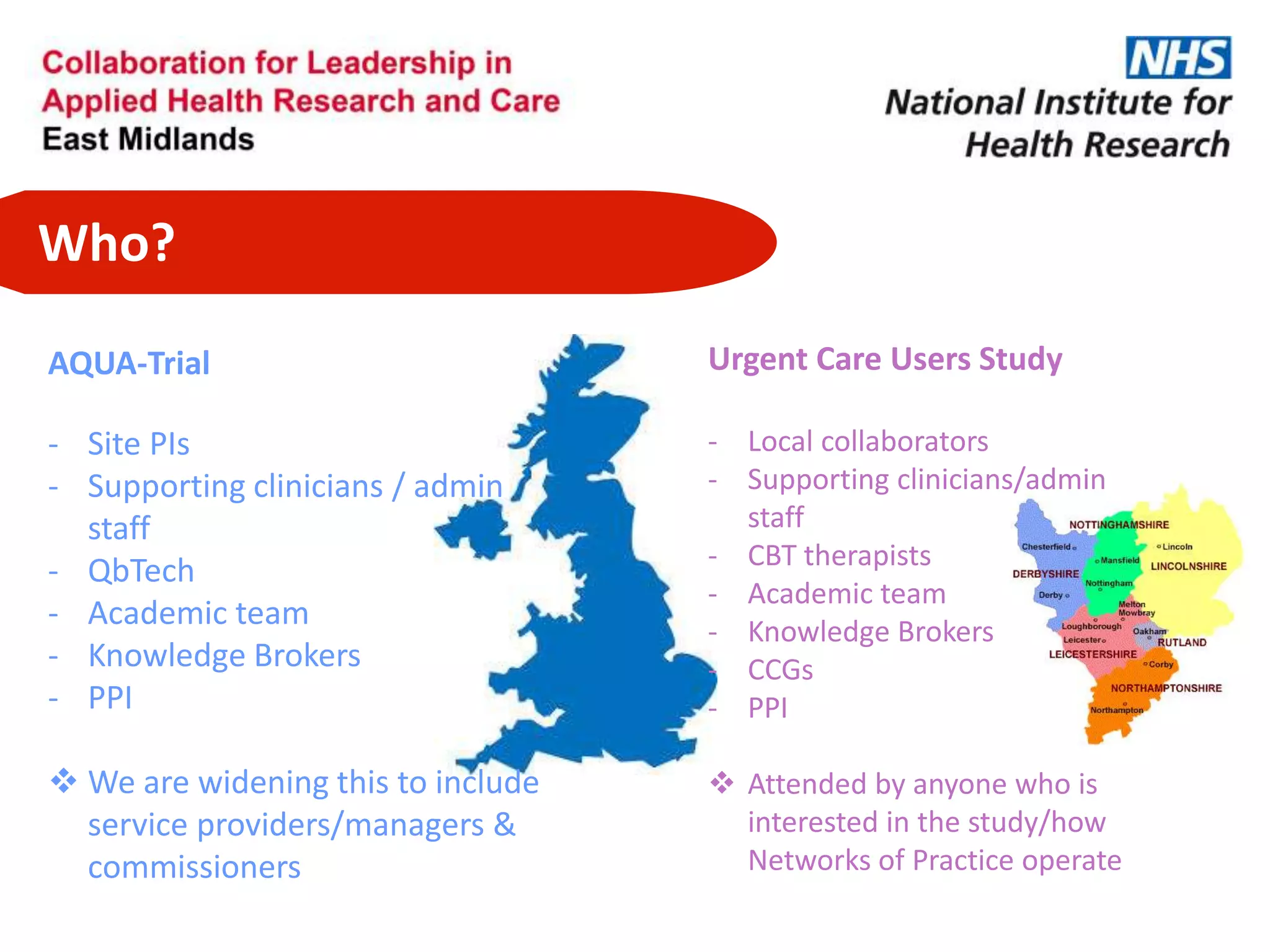
Who?
AQUA-Trial
- Site PIs
- Supporting clinicians / admin
staff
- QbTech
- Academic team
- Knowledge Brokers
- PPI
 We are widening this to include
service providers/managers &
commissioners
Urgent Care Users Study
- Local collaborators
- Supporting clinicians/admin
staff
- CBT therapists
- Academic team
- Knowledge Brokers
- CCGs
- PPI
 Attended by anyone who is
interested in the study/how
Networks of Practice operate
How?
Urgent Care Users Study
- Weekly email contact
with local collaborators
- Telephone or face to
face contact
- Network of Practice
meetings (every 3/4
months)
AQUA-Trial
- Weekly contact with
Site PIs
- Monthly newsletters
- Monthly dial-in
sessions
- AQUA-Forums (approx
3/4mths)
PPI
Urgent Care Users Study
- Fred Higton & David
Waldram
AQUA-Trial
- ADHD Solutions, Nikki
Brown, David Waldram
Thank you for listening
www.clahrc-em.nihr.ac.uk
@CLAHRC_EM
This research was funded by the National Institute for Health Research (NIHR) Collaboration for Leadership in
Applied Health Research and Care East Midlands (CLAHRC EM). The views expressed in this presentation are those
of the speaker(s) and not necessarily those of the NHS, the NIHR or the Department of Health.
NIHR CLAHRC East Midlands Annual Meeting
Growing Momentum – Sharing and Learning
A partnership between
Nottinghamshire Healthcare NHS Foundation Trust
and the Universities of Nottingham and Leicester
The Prevention Theme
Kamlesh Khunti, Theme Lead
Carol Akroyd, Theme Manager
A partnership between
Nottinghamshire Healthcare NHS
Foundation Trust
and the Universities of Nottingham and
Leicester
EM CLAHRC ThemesThe Research
Implementation of a diabetes prevention pathway in a
multi-ethnic population
Let’s Prevent Diabetes is evidence-based and soon to be made available nationally to
commissioners.
This project aims to develop a model of implementation to meet the needs of local
communities
Nicotine Replacement Therapy
• To develop and evaluate evidence-based, smoking cessation
behaviour change techniques (BCTs) which are specifically tailored
for use in pregnancy.
• As appropriate, to embed newly-developed BCTs, into routine NHS
care using the National Centre for Smoking Cessation Training’s
online learning environment and face-to-face training courses.
CVD PREVENTION
A randomised controlled trial to investigate the effect of structured education on
preventing heart disease and other vascular conditions in people at high risk
Move to Teach: Move to Learn
• Young children today are increasingly driven to
school and learning means sitting at a desk.
• Children engage in considerable sitting time in the
school classroom and thus the potential for reducing
this holds promise.
• However, few interventions have focused on
reducing or breaking up sitting in the primary school
classroom.
Move to Teach: Move to Learn
The project will be delivered over 4 phases
1. Development of an intervention ‘toolbox’
2. Implementation of ‘toolbox’ & short term evaluation
3. Evaluation of sustained ‘toolbox’ use
4. Dissemination
The ‘toolbox’ will be delivered in a total of 6 schools for (up
to) one academic year, to Year 5 pupils (9-10 years)
Move to Teach: Move to Learn
• Ash Routen, Research Associate, Move to teach:
Move to learn, Loughborough University
• A collaborative project to develop and implement an
intervention ‘toolbox’ to reduce sitting in the primary
school classroom
NIHR CLAHRC East Midlands Annual Meeting
Growing Momentum – Sharing and Learning
A partnership between
Nottinghamshire Healthcare NHS Foundation Trust
and the Universities of Nottingham and Leicester
Caring for Older People and Stroke
Survivors
Yvonne R Simpson
COPSS Theme Manager
A partnership between
Nottinghamshire Healthcare NHS Foundation Trust
and the Universities of Nottingham and Leicester
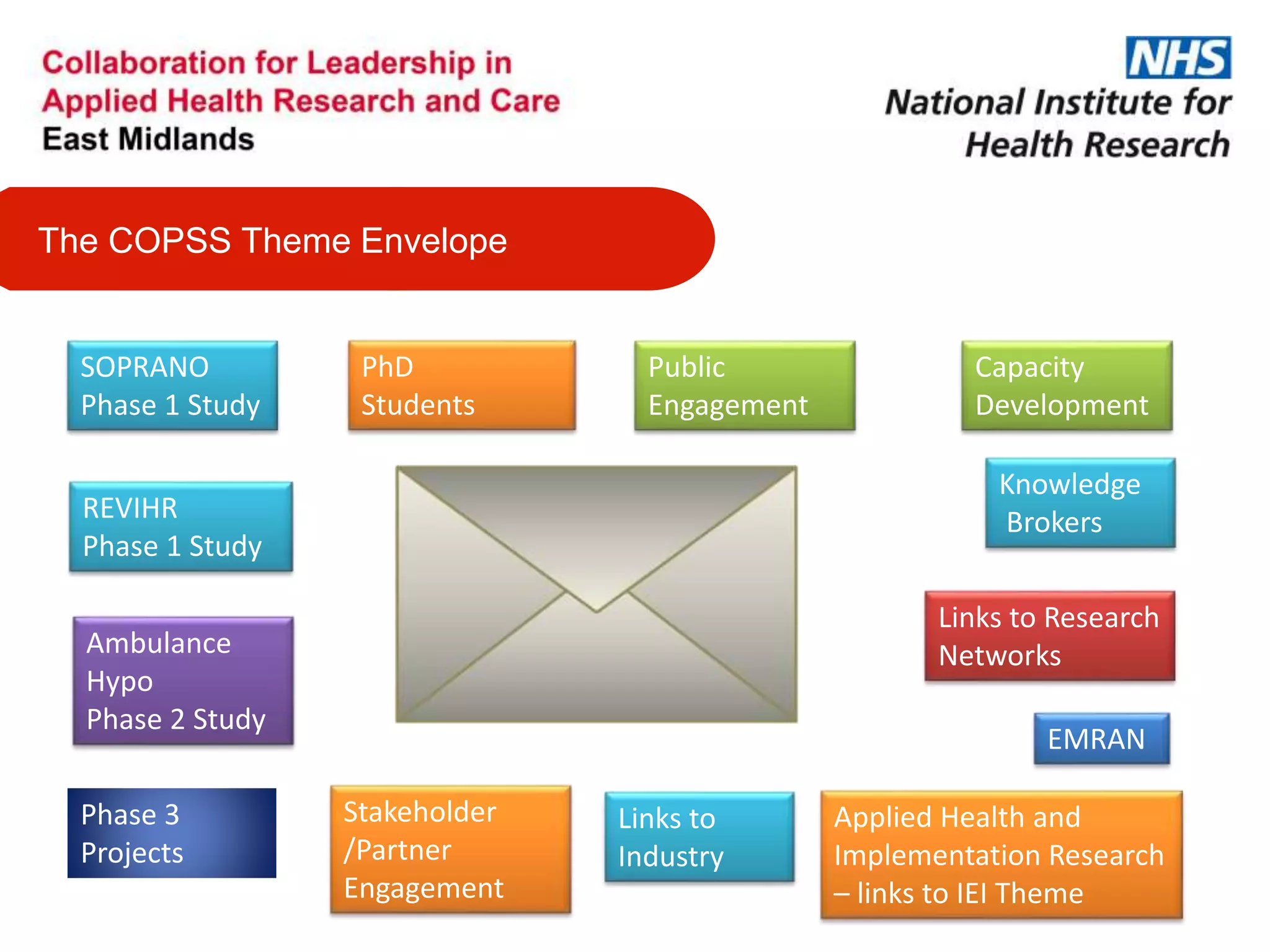
The COPSS Theme Envelope
EMRAN
PhD
Students
Knowledge
Brokers
Links to Research
Networks
Stakeholder
/Partner
Engagement
Public
Engagement
Capacity
Development
Applied Health and
Implementation Research
– links to IEI Theme
Links to
Industry
SOPRANO
Phase 1 Study
REVIHR
Phase 1 Study
Ambulance
Hypo
Phase 2 Study
Phase 3
Projects
SOPRANO (Phase 1 Study)
Study Lead – Professor John Gladman
Supporting Older People’s Resilience through Assessing Needs and Outcomes
REVIHR (Phase 1 Study)
Study Lead – Professor Marion Walker MBE
Evidence based in-hospital stroke rehabilitation
Ambulance Hypo Study (Phase 2 Study)
Study Lead – Professor Kamlesh Khunti
Enhanced care pathway for people receiving an ambulance call out for
hypoglycaemia
COPSS Theme Studies
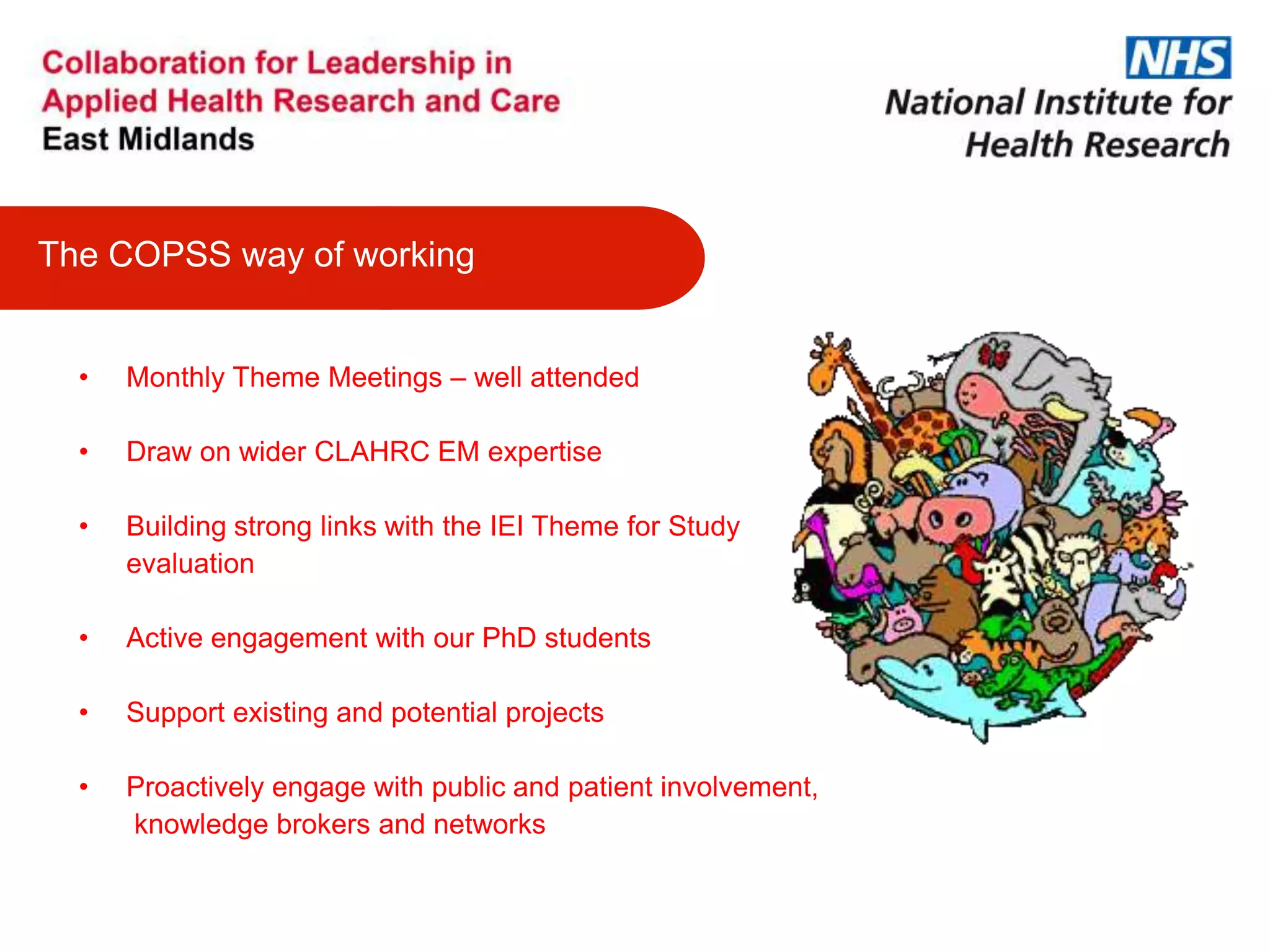
• Monthly Theme Meetings – well attended
• Draw on wider CLAHRC EM expertise
• Building strong links with the IEI Theme for Study
evaluation
• Active engagement with our PhD students
• Support existing and potential projects
• Proactively engage with public and patient involvement,
knowledge brokers and networks
The COPSS way of working
• Challenges within studies have been met and overcome
• Draw on resources within CLAHRC EM
• Committed Researchers
• Focussed COPSS team with positive ethos to get things done
• Structured ways of working – supporting one another
• EMRAN
Being positive – credit to the team
Filling the gap in the East Midlands
EMRAN
the story so far ….
Title Arial
NIHR CLAHRC East Midlands Annual Meeting
Growing Momentum – Sharing and Learning
A partnership between
Nottinghamshire Healthcare NHS Foundation Trust
and the Universities of Nottingham and Leicester
Implementing Evidence &
Improvements
Professor Justin Waring
IEI Theme Lead, NIHR CLAHRC East Midlands
A partnership between
Nottinghamshire Healthcare NHS Foundation Trust
and the Universities of Nottingham and Leicester
NIHR CLAHRC-EM undertakes world-class applied health research that aims to
close the gap between research and practice!
• Applied research – research that tests ‘proven interventions’ in the context of
local care services and needs
• Closing the gap – research that is ‘co-produced’ by research and practice
communities so that it fits with the context of local care services and needs
• Co-production – where research teams and practitioners work together to
design and ‘implement’ applied research
• Implementation research – research that aims to understand how best to co-
produce and implement research
The CLAHRC Approach
• What is our purpose?
– To understand about how world-class applied health research can be co-produced
by researchers, commissioners, care providers and public stakeholders
– To appraise the specific co-production approaches developed and used by
CLAHRC-EM, especially PPI, networks and knowledge brokers
– To advance knowledge about co-production and implementation of service
improvements
• What is our Philosophy
– To co-produce research on co-produced research – working in partnership with
study teams and communities
– To provide formative learning and feedback on the learning process
The IEI Theme
EMH COPSS
IEI
MCDPCD
Partners
/ AHSN
Investigate different implementation activities
from across projects to develop formative &
comparative learning
Provide
formative
learning to
projects &
partners
Managing and
conducting applied
research
Putting the Implementing
Evidence & Improvement
Theme in Context
• Public Involvement
• Knowledge Brokers
• Networks of Practice
• Dissemination
• Capacity Building
The CLAHRC Approach
1. Thematic Review of the CLAHRC-EM portfolio
2. A Stronger Voice: the role of PPI in the commissioning and
provision of evidence-based interventions
3. Clinical Interventions as Networks: the role of social interaction
within networks of practice
4. Practices of Knowledge Brokering in the co-production and
translation process
Our Projects
• Why was this research is needed?
– CLAHRC-EM is organised around 4 clinic themes, but the individual projects
reflect a diverse range of interventions, co-production techniques, research
methods and patient groups
– A new way of analysing the CLAHRC was needed to better understand how it
worked to co-produce world-class applied research
• What did the research involve?
– Desk-based review of all CLAHRC projects to identify different approaches to
co-production
• Who led this research?
– Lewis Hyland & Jenelle Clarke, University of Nottingham
Thematic Review of CLAHRC
Why is this research needed?
Project Theme PI Aims Implementation
Strategy
Implementation
partners
Implementation process
measures
REVIHR Networking,
Education,
Assessment
PI- Marion
Walker
1) Use current stroke audit
data (SSNAP) to identify
high/low scores in achieving
highest standards of stroke
care
2) Develop theory of change
model to inform intervention
3) behavioural and
qualitative mapping of
delivery, identify key issues
as to whether delivery is
evidence based
4) Identify
barriers/facilitators of
delivering evidence based
care
Early PPI,
ongoing
integration of
change
programme.
Pilot change
programme run in
collaboration with
EMAHSN and
Strategic Clinical
Network. PPI
involvement
through the
Nottingham Stroke
Research
Consumer Group.
This is accounted for through
the use of behavioural
mapping in Phase 2 of the
process
HYPOGL Education,
Evaluation,
Brokering
PI - Kamlesh
Khunti
Adjust prescribed diabetes
medication through nurse
referral after ambulance call
out.
Implement/evaluate an
hypoglycaemia pathway for
patients receiving
ambulance call out.
PPI involvement
has been
extensive at the
Leicester site
with further
discussion
planned in
setting up the
pathway at tow
further sites.
Integrated Care
Diabetes Service
(ICDS) Leicester.
DSNs (Diabetes
Specialist Nurses)
in the delivery of
the care pathway.
EMAS (East
Midlands
Ambulance
Service) are
closely involved.
A number of DSN's were
involved in the design and
delivery process. Meetings
will be organised with primary
care practitioners and
individuals in the field of
hypoglycaemia. Knowledge
brokers are connected to
Leicester City CCG and the
further two sites. Routes of
information dissemination
include Pre-Hospital
Emergency Services Cuttent
Awareness Update,
Association of Ambulance
Chief Executives, and to the
National Ambulance Service
Medical Directors group.
• Why this research is needed?
– PPI can help services to efficiently and effectively meet the needs of stakeholders,
but, it can be time consuming and seen as ‘tokenistic’!
– Evidence is needed on how best PPI can ensure patient and public voices influence
decision-making in the commissioning and provision of evidence-based interventions
• What does the research involve?
– Confidential interviews with key decision-making agencies to understand their views
about and approaches for PPI, including the role of PPI in applied research
– Observations and documentary analysis of key decision-making processes to
understand the role and influence of PPI
• Who is leading the research?
– Pam Carter & Graham Martin, University of Leicester
A Stronger Voice!
• Why this research is needed?
– CLAHRC-EM projects bring together different people in the form of a new
‘community’ or ‘network’ to co-produce and implement research
– Evidence is needed on how these ‘networks’ can create a shared sense of
purpose, vision and energy to co-produce research
• What does the research involve?
– Observations of 6 different CLAHRC project networks (e.g. meetings, training
etc) to understand how a shared purpose can emerge
– Interviews with study teams and network members to understand the extent of
shared purpose
• Who is leading the research?
– Jenelle Clarke, Stephen Timmons & Justin Waring, University of Nottingham
Clinical Interventions as Networks
• Why this research is needed?
– EM-CLAHRC projects use a variety of ‘knowledge brokers’ to ensure research
reflects the local experiences and needs of service providers
– Evidence is needed on the activities or ‘practices’ that facilitate the translation of
knowledge between research and practice groups
• What does the research involve?
– Observations of 6 different CLAHRC project teams to understand the roles
played by different knowledge brokers
– Interviews with study teams and brokers to understand how knowledge is
translated and share
• Who is leading the research?
– Lewis Hyland, Justin Waring & Stephen Timmons, University of Nottingham
The Practices of Knowledge Brokering
• Identifying key strategic needs for Phase 3 studies:
– The implementation and adoption of national guidelines
– Working collaboratively with business and industry
• Evaluating and appraising our CLAHRC approach
– How do our different co-production and translation approaches compare?
– What types of evidence and co-production to commissioners value?
– To what extent has change been sustained in practice?
Future Plans
Thank you for listening
Justin.Waring@nottingham.ac.uk
www.clahrc-em.nihr.ac.uk
@CLAHRC_EM
This research was funded by the National Institute for Health Research (NIHR) Collaboration for Leadership in
Applied Health Research and Care East Midlands (CLAHRC EM). The views expressed in this presentation are those
of the speaker(s) and not necessarily those of the NHS, the NIHR or the Department of Health.
NIHR CLAHRC East Midlands Annual Meeting
Growing Momentum – Sharing and Learning
A partnership between
Nottinghamshire Healthcare NHS Foundation Trust
and the Universities of Nottingham and Leicester
Open Space: NIHR CLAHRC East Midlands
Sharing Best Practice
A partnership between
Nottinghamshire Healthcare NHS Foundation Trust
and the Universities of Nottingham and Leicester
Thank you for attending
www.clahrc-em.nihr.ac.uk
@CLAHRC_EM

NIHR CLAHRC East Midlands Annual Meeting 2015 presentations - Day 1

  • 1.
    Welcome NIHR CLAHRC EastMidlands Annual Meeting Growing Momentum – Sharing and Learning A partnership between Nottinghamshire Healthcare NHS Foundation Trust and the Universities of Nottingham and Leicester 24 March 2015, Eastwood Hall Hotel, Nottingham
  • 2.
  • 3.
    Prevalance of LongTerm Conditions • 15 million with LTC • 70% NHS Budget
  • 4.
    NHS Outcomes Framework5 Domains Public Health England Priorities Department of Health Priorities for the East Midlands (Set out in the East Midlands Health Strategy 2009) “The priorities for the East Midlands are to address health inequalities, levels of tobacco use, harmful alcohol use, obesity, physical activity, avoidable injury and death, affordable warmth and the health of children and young people.” Key National and Local Priorities
  • 5.
  • 6.
    NIHR CLAHRC EastMidlands Structure
  • 7.
    • Improve patientoutcomes • Bring together health stakeholders to support the NHS to meet locally identified priorities • Bridge the second gap in translation • Implement partnership model for (a) research in public (b) uptake of research evidence into practice • Increase capacity in the East Midlands • Understanding conditions for the uptake of research CLAHRC EM Objectives
  • 8.
    “Improve patient outcomes throughthe conduct and application of research evidence of local relevance and international quality” Applied Health Research Year One • 18 Phase One and Two projects are up and running across the East Midlands. • 10 Projects provisionally selected for Phase Three from an rigorous approach involving Partners and Public
  • 9.
    Bringing People Together YearOne • Received £591k cash matched funding • On track to receive £18m overall • Set up the East Midlands CLAHRC faculty. We currently have 90 members. • PARADES Event in December 2014 with the EM AHSN #StephenFryLiked • Developed an Industry Strategy which has been distributed by the NIHR to all other CLAHRCs “Build on the achievements of the LNR and NDL CLAHRCs in bringing together stake holders to support the NHS to meet locally identified priorities”
  • 10.
    “Bring about afurther step change in the quality and quantity of activity taking place to bridge the second gap in translation” Implementing Evidence Year One • EM AHSN have pledged funding of £525,000 to support the implementation of CLAHRC EM projects. • Appointed 34 knowledge brokers who are playing a key role in developing research interest and capability
  • 11.
    “Implement and evaluatea partnership model for (a) co- producing research in public health and chronic disease, and (b) co-producing the rapid uptake of research evidence into widespread practice” Our Partnership Model Year One • Knowledge Translation strategy has been developed and disseminated amongst project teams and successful Phase 3 applicants • All research theme staff have attended implementation workshops
  • 12.
    “Increase capacity inthe EM to conduct high quality health research and to apply research evidence” Capacity Development Year One • We have appointed seven PhD students and three more planned in September • Commenced our training programme presenting short courses for NHS staff in 2015. Courses were put forward after consultation with NHS partners.
  • 13.
    “Develop a greater understandingof the necessary and desirable conditions for the uptake of research findings and spread of evidence-based practices” Capacity Development Year One • Researchers in the IEI Theme have commenced 3 studies which covers PPI, use of technology in implementation and analysis in the CLAHRC • All research teams complete Quarterly Reports creating a log of implementation activities and approaches. This will provide a valuable resource.
  • 14.
    Year One • PPIstrategy completed and being implemented. • Partners Council set up and meeting regularly. • Set up the Centre for BME Health. The Centre has already delivered 11 community health information events to raise awareness of diabetes and safer fasting during Ramadan to more than 250 individuals from 13 different ethnic groups. Public Involvement “Provide opportunities for stakeholder engagement and across all of its structures, themes and projects so that intended end-users of research can help to shape its selection, design, delivery, dissemination and implementation”
  • 15.
    • Overview ofour progress including achievements • Give a wider perspective on the relationship between our partners • Outline our challenges • Encourage networking • To thank you for all that you have done in the last year. • We could not have achieved this without your support! Aims and Objectives of Today
  • 16.
  • 17.
    Thank you forlistening and Enjoy the Day kk22@le.ac.uk www.clahrc-em.nihr.ac.uk @kamleshkhunti @CLAHRC_EM This research was funded by the National Institute for Health Research Collaboration for Leadership in Applied Health Research and Care East Midlands (NIHR CLAHRC EM). The views expressed in this presentation are those of the speaker(s) and not necessarily those of the NHS, the NIHR or the Department of Health.
  • 18.
    NIHR CLAHRC EastMidlands - Embedding a Mature CLAHRC Chair – Professor Kamlesh Khunti, Director A partnership between Nottinghamshire Healthcare NHS Foundation Trust and the Universities of Nottingham and Leicester
  • 19.
    ‘Building Partnerships’ Karen Glover Directorof Partner Relations and Operations, NIHR CLAHRC EM Head of Clinical Programmes EM AHSN A partnership between Nottinghamshire Healthcare and the Universities of Nottingham and Leicester
  • 20.
    • NHS, Industry,Academia • Voluntary Sector and Local Authorities • Patients/Public • Region-wide: BRU, CRN, SCN, Clinical Senate, HEEM, EMLA, AHSN • National NIHR CLAHRC Who are our Partners?
  • 21.
    • Improve PopulationHealth • Increase Capacity and Capability for Research and Innovation • Shared Understanding and Ownership • Translation of Research into Practice Why Collaborate?
  • 22.
    • Communications • Networks •Events • Organisational Presentations - NHS, Academia • Industry How Do We Engage?
  • 23.
    • Governance Arrangements •Project Selection • CLAHRC Faculty • Networks of Practice • Knowledge Brokers How Do We Engage?
  • 24.
    Thank you forlistening karen.glover@nottingham.ac.uk www.clahrc-em.nihr.ac.uk @CLAHRC_EM This research was funded by the National Institute for Health Research Collaboration for Leadership in Applied Health Research and Care East Midlands (NIHR CLAHRC EM). The views expressed in this presentation are those of the speaker(s) and not necessarily those of the NHS, the NIHR or the Department of Health.
  • 25.
    NIHR CLAHRC EastMidlands Annual Meeting Growing Momentum – Sharing and Learning A partnership between Nottinghamshire Healthcare NHS Foundation Trust and the Universities of Nottingham and Leicester
  • 26.
    Co-Production & Translation JustinWaring, IEI Theme Lead, CLAHRC East Midlands A partnership between Nottinghamshire Healthcare and the Universities of Nottingham and Leicester
  • 27.
  • 28.
    The Translation Gap! Researchevidence takes a long time make an impact on clinical practice and service delivery The problem Closing the Gap Implementation research offers a range of ideas and techniques to help get knowledge into practice
  • 29.
    Understanding the gap •Clinical Research and Clinical Practice operated in different ways: – Separated by a common language – Characterised by different cultures – Measured and assessed in terms of different performance – Driven by different pressures and priorities • Clinical research is often done ‘on’ clinical practice, not ‘with’ clinical practice – Research questions reflect the interests of researchers, not needs of practitioners – Research design does not take into account local operational issues – Research activities can treat practitioners as ‘subjects’ – Research findings are not valued or recognised by practitioners – Research does not make a meaningful or lasting impact on practice
  • 30.
    Mode 1 orMode 2 Research CLAHRCs are designed to close this gap between research and practice through acting as the collaborative bridge...Mode 2 Research
  • 31.
    NIHR CLAHRC-EM undertakesworld-class applied health research that aims to close the gap between research and practice! • Applied research – research that tests ‘proven interventions’ in the context of local care services and needs • Closing the gap – research that is ‘co-produced’ by research and practice communities so that it fits with the context of local care services and needs • Co-production – where research teams and practitioners work together to design and ‘implement’ applied research • Implementation research – research that aims to understand how best to co- produce and implement research The CLAHRC Approach
  • 32.
    We have learnta lot about what works in closing the gap… • Communication & Translation • Engagement • Teamwork • Dealing with ‘push-back’ • Timing & Pace The benefits of a mature CLAHRC
  • 33.
  • 34.
    Getting Research IntoPractice (GRIP) • Develop and conduct applied research that is relevant to our NHS partners, and to translate the research findings into improvement outcomes for patients • Create a distributed model of implementation and translation that links those who conduct applied research with those who will use it • Create and embed approaches to applied research that takes into account the way care is organised and delivered across our region and aligns with AHSN • Increase capacity for applied health research and translation Our approach
  • 35.
    • NHS partnersshould be involved in the initial stages of problem definition and project specification and all stages of research activity – after all our partners will use the findings • Project teams (of researchers and practitioners) need to build implementation and translation into their research activities – it cannot be ‘done’ by someone else or after the research findings have been collected (this would recreate the gap) • By understanding the wider environment research can make a sustained impact and ideally be spread at scale and pace with relevant partners • By building capacity within both clinical and practice communities, we can ensure the long term and sustained generation and use of evidence and its translation into practice What does this mean?
  • 36.
    Knowledge brokers help‘get the right information, to the right people, at the right time’ • They are intermediaries or go-betweens who work between research and practice partners • They identify insight or information that might be of use to other partners • They translate insight and information so it is in an appropriate format and language • They communicate insight between partners • The can champion change and support the use of insight between communities Knowledge Brokers
  • 37.
    Co-production and translationis based upon the formation of new teams, communities or networks between research and practice partnership • Networks help bring together diverse partners around a shared purpose • Networks coordinate activities and foster cooperation • Networks help build a critical mass of energy, expertise and experience • Networks support knowledge sharing and learning • Networks can become self-sustaining Networks
  • 38.
    1. CLAHRC projectsare based on co-production and partnership between research (knowledge producers) and practice communities (problem owners) 2. Project teams are responsible for developing their own co-production and translation activities to reflect their specific challenges, but with the support of the CLAHRC team 3. Project teams should look to use knowledge brokers and/or networks as a way of co- producing and translating research into sustained service improvement Key points
  • 39.
    Thank you forlistening Justin.waring@nottingham.ac.uk www.clahrc-em.nihr.ac.uk @CLAHRC_EM This research was funded by the National Institute for Health Research Collaboration for Leadership in Applied Health Research and Care East Midlands (NIHR CLAHRC EM). The views expressed in this presentation are those of the speaker(s) and not necessarily those of the NHS, the NIHR or the Department of Health.
  • 40.
    NIHR CLAHRC EastMidlands Annual Meeting Growing Momentum – Sharing and Learning A partnership between Nottinghamshire Healthcare NHS Foundation Trust and the Universities of Nottingham and Leicester
  • 41.
    CLAHRC EM AnnualMeeting 24th March 2015 Growing momentum: Sharing & Learning Working with the EM AHSN Professor Rachel Munton Managing Director, EMAHSN
  • 42.
    EM CLAHRC/AHSN haveclear and complementary aims and related clinical foci Both shaped to ensure the two organisations work together effectively to deliver signification improvements Agreed approach that differentiates between the academic discipline of implementation/improvement science and the change activity of evidence-informed practice improvement East Midland’s approach
  • 43.
    “There is aclear relationship between the EM CLAHRC and EM AHSN, with the CLAHRC resources supporting the generation of high quality and locally relevant evidence and developing the science of implementation and the AHSN supporting the practicalities of “putting evidence into practice” at a suitable stage of development.”
  • 44.
    INVENTION EVALUATION ADOPTIONDIFFUSION NIHR Infrastructure BRCs , BRUs etc NIHR Infrastructure CLAHRCs AHSCs AHSNs NHS Patient Care NHS Patient Care NIHR Infrastructure Clinical Research Network NIHR Programmes MRC Programmes “improving patient outcomes through the conduct and application of applied health research” Research and Innovation Landscape
  • 45.
    INVENTION EVALUATION ADOPTIONDIFFUSION NIHR Infrastructure BRCs , BRUs etc NIHR Infrastructure CLAHRCs AHSCs AHSNs NHS Patient Care NHS Patient Care NIHR Infrastructure Clinical Research Network NIHR Programmes MRC Programmes“AHSNs have a complementary role in the translation process by focusing on the adoption and spread of innovative clinical practice that are of proven cost-effectiveness, across whole healthcare systems, linking back with the research and development community.” Research and Innovation Landscape
  • 46.
    INVENTION EVALUATION ADOPTIONDIFFUSION NIHR Infrastructure BRCs, BRUs, CRFs NIHR Infrastructure CLAHRCs AHSCs AHSNs NHS Patient Care NHS Patient Care NIHR Infrastructure Clinical Research Network NIHR Programmes MRC Programmes Research and Innovation Landscape
  • 47.
    Specific research relatedactivity –from NHS England AHSN licence measurements Measurement 5: summary of research evidence that has successfully been implemented and translated into practice, and provide evidence of working with NIHR CLAHRCS Measurement 12:work with their Clinical Research Networks and demonstrate how they have supported delivery of their metrics
  • 48.
    Specific research relatedactivity – from NHS England AHSN licence measurements Measurement 13: demonstrate how the AHSN has supported the delivery of NIHRS objectives. AHSNs may seek to engage in additional research activities beyond those agreed within NIHR objectives –in this case the AHSN must demonstrate how the research aligns with the AHSNs clinical or service priorities, expenditure, clinical and ROI activities Measurement 14: reflect the breadth and depth of the AHSNs academic partnerships ensuring that academic collaboration is not fixed around a single institution
  • 49.
    Contact details Rachel Munton,Managing Director rachel.munton@nottingham.ac.uk 0115 82 31300 I 07825 656341
  • 50.
    NIHR CLAHRC EastMidlands Annual Meeting Growing Momentum – Sharing and Learning A partnership between Nottinghamshire Healthcare NHS Foundation Trust and the Universities of Nottingham and Leicester
  • 51.
    Overview of theNIHR Infrastructure: providing the facilities and people for a thriving research environment Dr Tony Soteriou, Acting Deputy Director Head of NHS Research Infrastructure and Growth Research and Development Directorate CLAHRC East Midlands 24 March 2015
  • 52.
    • improve healthoutcomes through advances in research • improve quality of care by NHS participation in the research process • strengthen International competitive position in science • drive economic growth through investment by life science industries Why is the Government committed to Research in the NHS?
  • 53.
    Patients NHS Universities Health Research Challenges,2005 NHS R&D funding was allocated on a historical basis NHS Trust management was seen as the bureaucratic block to clinical research Few effective incentives for research in the NHS Dramatic fall in numbers of clinical academics 40% of clinical academics funded by NHS Difficulty in developing sustainable capacity Problems with career paths for all professions in research Low “applied” evidence base Perception that NHS research funding was second class Perception that applied health research was second class
  • 54.
    Vision “To improve thehealth and wealth of the nation through research.” January 2006
  • 55.
    Infrastructure Clinical Research Facilities, Centres &Units Clinical Research Networks Research Research Projects & Programmes Research Management Systems Research Information Systems Systems Patients & Public Universities Investigators & Senior Investigators Associates Faculty Trainees Research Schools NHS Trusts NIHR Health Research System
  • 56.
    National Institute forHealth Research • Between Government, Charity and Industry • Between NHS and University • Between research leaders and research facilitators • Between different health care professions • Between different research disciplines • Between researchers and patients An Integrated Health Research System Partnership
  • 57.
    Biomedical Research Centres BasicResearch National Institute for Health Research This pathway covers the full range of interventions - pharmaceuticals, biologicals, biotechnologies, procedures, therapies and practices - for the full range of health and health care delivery - prevention, detection, diagnosis, prognosis, treatment, care. Patient Safety Translational Research Centres Research for Patient Benefit Programme Grants for Applied Research Health Technology Assessment Invention for Innovation Collaborations for Leadership in Applied Health Research and Care Centre for Reviews & Dissemination, Cochrane, TARs Development Pathway Funding Public Health Research Health Services and Delivery Research INVENTION EVALUATION ADOPTION DIFFUSION NHS England Commissioning National Institute for Health & Care Excellence Guidance on Health & Healthcare NHS Supply Chain Support for Procurement NHS Evidence Access to Evidence InnovationAcademic Health Science Networks Patient CareProviders of NHS Services Clinical Research Facilities Experimental Cancer Medicine Centres Horizon Scanning Centre Centre for Surgical Reconstruction & Microbiology Biomedical Research Units Medical Research Council The central role of NIHR research in the innovation pathway Healthcare Technology Co-operatives Research Schools Efficacy Mechanism and Evaluation Diagnostic Evidence Co-operatives
  • 58.
    Infrastructure Clinical Research Networks Clinical Research Facilities,Centres & Units Aim Harness the research potential of the NHS to improve health and deliver competitive advantage for increased economic growth “… the support and facilities the NHS needs for first class research…”
  • 59.
    Infrastructure Clinical Research Networks Clinical Research Facilities,Centres & Units • Clinical Research Networks • Biomedical Research Centres • Biomedical Research Units • Translational Research Partnerships • Translational Research Collaborations in Rare Diseases and Dementia • Clinical Research Facilities • Experimental Cancer Medicine Centres • Patient Safety Translational Research Centres • Collaborations for Leadership in Applied Health Research and Care • Healthcare Technology Cooperatives • Diagnostic Evidence Cooperatives
  • 60.
    NIHR Clinical ResearchInfrastructure Biomedical Research Centres Biomedical Research Units Clinical Research Facilities Experimental Cancer Medicine Centres Clinical Research Networks Invention Evaluation Adoption Healthcare Technology Co-operatives Diagnostic Evidence Co-operatives Patient Safety Translational Research Centres Collaborations for Leadership in Applied Health Research and Care Translational Research Partnerships and Collaborations
  • 61.
    NIHR Biomedical ResearchCentres Newcastle Oxford Cambridge Southampton Imperial UCLH Great Ormond St Moorfields Guy’s and St Thomas Royal Marsden South London and Maudsley NIHR Healthcare Technology Co-operatives Birmingham Bradford Leeds Nottingham Sheffield Barts Cambridge Guy’s & St Thomas’ NIHR Biomedical Research Units Newcastle – dementia Leeds – musculoskeletal Central Manchester – musculoskeletal Liverpool – gastrointestinal Nottingham – hearing/respiratory/gastrointestinal Leicester – cardiovascular/respiratory/nutrition Birmingham – gastrointestinal Bristol – cardiovascular/nutrition Oxford – musculoskeletal Southampton – respiratory London Imperial – cardiovascular/respiratory Barts – cardiovascular UCL – dementia South London and Maudsley - dementia NIHR-supported Clinical Research Facilities Alder Hey Birmingham Brighton and Sussex Cambridge The Christie Exeter Guy’s and St Thomas Imperial Leeds Manchester Maudsley Moorfields Newcastle Oxford cognitive health Sheffield Southampton South Manchester respiratory and allergy Royal Marsden UCLH NIHR-Supported Facilities Newcastle Leeds Sheffield Leicester Oxford Bristol Brighton Peninsula London Bradford NIHR Diagnostic Evidence Co-operatives Imperial Leeds Newcastle Oxford Manchester NIHR/CR-UK Experimental Cancer Medicine Centres Birmingham Cambridge Leeds Leicester Barts/ Brighton ICR Imperial King’s College London UCL Manchester Newcastle Oxford Sheffield Southampton Liverpool Exeter Southampton NIHR Collaborations for Leadership in Applied Health Research and Care East of England East Midlands Greater Manchester North Thames North West Coast North West London Oxford South London South West Peninsula West West Midlands Wessex Yorkshire and Humber Cambridge Nottingham Birmingham
  • 62.
    NIHR Collaborations forLeadership in Applied Health Research and Care • 9 Pilot CLAHRCs created in 2008 for 5 years • £50m funding awarded (rising to £88m over course of award) • Second competition: 13 CLAHRCs funded for 5 years from January 2014 • Funding increased to £124 million • Address the “second translational gap”
  • 63.
    Aims of theCLAHRCs • to develop and conduct applied health research relevant across the NHS, and to translate research findings into improved outcomes for patients; • to create a distributed model for the conduct and application of applied health research that links those who conduct applied health research with all those who use it in practice across the health community; • to create and embed approaches to research and its dissemination that are specifically designed to take account of the way that health care is delivered across the local AHSN; • to increase the country’s capacity to conduct high quality applied health research focused on the needs of patients, and particularly research targeted at chronic disease and public health interventions; • to improve patient outcomes locally and across the wider NHS; and • to contribute to the country’s growth by working with the life sciences industry.
  • 64.
    North West London Greater Manchester WestMidlands South West Peninsula Yorkshire & Humber 13 NEW Collaborations from January 2014 East of England NIHR Centres for Leadership in Applied Health Research and Care (CLAHRCs) East Midlands South London North West Coast North Thames Oxford West Country Wessex Pilot scheme to 2014
  • 65.
  • 66.
    Overall NIHR CLAHRCprogramme outputs: 2008 - 2013 Research projects Implementation Projects Publications 1,012 575 1,485 Subjects recruited 3,194,423 External income Generated £74,707,024 Higher degrees 1,494
  • 67.
    £0 £2 £4 £6 £8 £10 £12 £14 £16 2009/10 2010/11 2011/122012/13 2013/14 Millions DH/NIHR Research council Research Charity Other non-commerical Industry Funding Pilot CLAHRC types of external funding
  • 68.
    Pilot CLAHRC typesof external funding (5-year Total )
  • 69.
    CLAHRC Impacts –East Midlands • IMPAKT (IMProving Patient Care and Awareness of Kidney disease progression Together) software tool can identify Practice patients at risk from CKD: - being implemented across the country in a number of CCGs and AHSNs including the whole of Wales. - adopted by Manchester’s AHSN and the East Midlands Strategic Clinical Network. - used by HQIP to describe QI requirements for the national CKD audit. The tool continues to identify patients at risk from CKD enabling early intervention and potentially saving the NHS £millions.
  • 70.
    CLAHRC Impacts –East Midlands • Diabetes education and Self- Management for Ongoing and Newly Diagnosed (DESMOND) programme: - Offered by more than 60% of providers within the UK - Significant increase in the number of people with type 2 diabetes using DESMOND as a consequence of the programme acquiring QOF points in March 2013. - Utilised in a number of international settings
  • 71.
    CLAHRC Impacts –East Midlands • Walking Away from Diabetes - a structured education programme encouraging and supporting physical activity in those at risk from diabetes: - recommended for use in the NICE Guidelines for Early Intervention and Prevention of Diabetes. - commissioned by 9 CCGs in England as well being used in health services in Ireland, Gibraltar and Western Australia.
  • 72.
    CLAHRC Impacts -East Midlands • The Individual Placement and Support (IPS) which aims to help people with mental health problems achieve paid employment: - Study led to 34% of participants finding employment within a year of undertaking the programme. - A further 26% went into education, training or voluntary work. - When comparing the results with the Department of Work and Pension’s own Work Programme using the DWP’s own outcome measure, IPS programme was 9% more effective.
  • 73.
    CLAHRC Impacts -East Midlands • Return to Work After Stroke study aims to address the problems of getting stroke survivors back to work and to design a vocational rehabilitation (VR) service for people who have had a stroke: - Stroke survivors were twice as likely to be in work compared to usual care at 12 months after stroke - Intervention found to be cost effective, saving £3,000 per case (total of health and social costs).
  • 74.
    CLAHRC - Impacts CapacityDevelopment 3,100 trainees were supported in the NIHR infrastructure between April 2013 and March 2014.
  • 75.
    INVENTION EVALUATION ADOPTIONDIFFUSION NIHR Infrastructure BRCs, BRUs, CRFs NIHR Infrastructure CLAHRCs AHSCs AHSNs NHS Patient Care NHS Patient Care NIHR Infrastructure Clinical Research Network NIHR Programmes MRC Programmes NIHR and the Research and Innovation Landscape
  • 76.
    CLAHRC East Midlands: Contributionto Growth Case Example: Supporting efficient use of NHS resources
  • 77.
    The NIHR’s KeyContributions to Growth • Supporting collaborations and contract research with the life sciences industry • Creating the research environment that supports the nation’s international competitiveness • Attracting, developing and retaining a highly skilled health research workforce • Providing the clinical evidence to help the NHS and public sector to make efficient use of resources • Providing the research evidence that contributes to establishing a healthier workforce and wider population
  • 78.
    Major focus onLife Sciences • Establish Health Research Authority • NIHR funding conditional on 70 day benchmark for trial start-up • More information about clinical trials to enable greater public involvement • Build consensus on using e-health record data • Establish Translational Research Partnerships • Encourage innovation in NHS procurement • NHS Chief Executive to report on accelerating adoption and diffusion of innovation in the NHS Research and the NHS: Plan for Growth
  • 79.
    BIS & DHPrime Minister Strategy for UK Life Sciences
  • 80.
    “Life science -and the UK’s role in it - is at a crossroads. Behind us lies a great history of discovery, from the unravelling of DNA to MRI scanning and genetic sequencing. We can be proud of our past, but this government is acutely aware that we cannot be complacent about the future.” David Cameron December 2011 Research and Growth: Strategy for UK Life Sciences
  • 81.
    Summary • NIHR isa health research system in the NHS • Health and Wealth of the nation through health research • NIHR CLAHRCs an important part of NIHR Research Infrastructure – focussed on closing the gap between evidence and practice • CLAHRC impacts have led to increased funding • New NIHR CLAHRC East Midlands • CLAHRCs contribute to NIHR’s mission to improve the health and wealth of the nation through research.
  • 82.
    The NIHR innumbers
  • 83.
    Overview of theNIHR Infrastructure: providing the facilities and people for a thriving research environment Dr Tony Soteriou, Acting Deputy Director Head of NHS Research Infrastructure and Growth Research and Development Directorate CLAHRC East Midlands 24 March 2015
  • 84.
    NIHR CLAHRC EastMidlands Annual Meeting Growing Momentum – Sharing and Learning A partnership between Nottinghamshire Healthcare NHS Foundation Trust and the Universities of Nottingham and Leicester
  • 85.
    Join the conversation Ifyou hear something you like, or want to challenge, or simply want to share an observation, join the Twitter conversation using @CLAHRC_EM and #clahrc in your tweet. #clahrc @CLAHRC_EM NIHR CLAHRC East Midlands related Twitter accounts @EMRAN_ageing East Midlands Research into Ageing Network @EMCBMEH East Midlands Centre for Black and Minority Ethnic Health Connecting to venue WiFi • Load web browser • Click “conference” on homepage • Enter Username diabetes1, Password diabetes1 Username: diabetes1 Password: diabetes1
  • 86.
    What Success LooksLike: Reflecting from CLAHRC Chair – Beth Allen, Infrastructure Manager, Department of Health A partnership between Nottinghamshire Healthcare NHS Foundation Trust and the Universities of Nottingham and Leicester
  • 87.
    CLAHRC EM ScientificCommittee Richard Morriss Director of Research CLAHRC EM A partnership between Nottinghamshire Healthcare and the Universities of Nottingham and Leicester
  • 88.
    • To ensurethat all CLAHRC funded research projects above £50,000 are of high scientific quality compatible with world class applied healthcare research • Fit with the overall principles of CLAHRC EM – – Active PPI involvement – Implementation plan in East Midlands – value for money • Assurance of money well spent to partners, including NIHR, through CLAHRC Board Purpose
  • 89.
    1. External peerreview (3 subject reviewers), PPI review, AHSN review, methods review (statistics, health services research, qualitative/organisation science) 1 month before Scientific Committee 2. Scientific Committee, externally chaired, and all voting members independent but familiar with CLAHRC: primary care chair statistician health services research PPI sociologist Stages
  • 90.
    1. Scientific Committeemeets when required according to anticipated submission of projects (chief investigator, CLAHRC and theme managers) 2. Considers all reviews, discusses, makes recommendations to CLAHRC EM Director and CLAHRC EM Board 3. 4 decisions: Pass - no further recommendations, consider reviewer’s comments Minor amendment - project can start, expect reply, SC and reviewer comments optional to address Major amendment - project cannot start until SC and reviewer comments are addressed Reject and resubmit Process
  • 91.
    1. Chief investigatorand theme manager 2. Summary reported as standing item to CLAHRC EM Executive and CLAHRC EM Board Reporting
  • 92.
    1. Quarterly reportsfrom each project to Director of Performance 2. Annual review of all projects based on reports to Director of Performance as chosen by Chair of Scientific Committee 3. Formative suggestions to improve performance of underperforming or delayed projects 4. Summative recommendations to CLAHRC EM Director and CLAHRC EM Board if project is failing to deliver Ongoing Monitoring of Projects
  • 93.
    19 projects havebeen reviewed: 1 passed 4 minor amendment 10 major amendment - 9 then passed, - 1 redesigned & passed. 4 rejected - 3 redesigned & passed 1 to be redesigned Results
  • 94.
    Weakness: Delay in startingproject Benefits: Increased PPI, implementation, better quality design, meets ethics peer and statistics review, value for money, assurance for partners with receipt of matched funding Benefits and Weaknesses
  • 95.
    NIHR CLAHRC EastMidlands Annual Meeting Growing Momentum – Sharing and Learning A partnership between Nottinghamshire Healthcare NHS Foundation Trust and the Universities of Nottingham and Leicester
  • 96.
    Individual Placement &Support Eric Wodke IPS Development Manager
  • 97.
    The Positive Impactof Individual Placement and Support (IPS) on People with Severe Mental Health Problems in Nottingham: An Implementation Approach AIMS 1. Implement IPS into secondary mental health service in Nottingham 2. Support service users into work and related vocational activities 3. Compare IPS alone with IPS work focused psychological support
  • 98.
    Results • 74 peoplerecruited into study • 59% of sample attained paid work and related opportunities • Colocation of employment specialist into clinical teams – key to implementation • Establish Steering group to drive change management process – key to implementation
  • 99.
    Evidence base • Vocationalrehabilitation for people with severe mental illness, Cochrane database of systematic reviews (Marshall et al 2001): • An update on randomised controlled trials of evidence based supported employment – IPS. Psychiatric Rehabilitation Journal 31, 280-290 (Bond et al 2008): • The IPS approach to vocational rehabilitation for young people with first episode psychosis in the UK. Journal of Mental Health 19(6): 483-491 naturalistic evaluation • First episode psychosis and employment. International Review Of Psychiatry Literature review, April 2010:22(2): 148-162 (Rinaldi et al 2010)
  • 100.
    Evidence base • Clientcharacteristics little impact on vocational outcomes • (Bond et al, 1995, 1997, 2001; Grove, 2000; Meuser et 2004, Catty et al, 2007) • • No relationship between psychiatric symptomatology / • disability outcomes of vocational rehabilitation (Anthony, 1984, • 1995) • • Most studies show no relationship between employment • outcomes and diagnosis, severity of impairment and social • skills (Drake et al, 1994, 1996, 1999; Bond et al, 1995, 1997, 1999, 2001; • Meuser et al, 2004; Latimer et al, 2006; Burns et al, 2007) • • Employment history is a robust predictor of work outcomes, but motivation and self-efficacy appear to be more important (Tsang et al, 2000; McDonald-Wilson et al, 2001)
  • 101.
    IPS Principles • Eligibilityis based on Individual choice – no exclusion criteria • Supported employment is integrated in clinical teams • Competitive employment is primary goal • Job search is rapid (within 4 weeks) • Job finding & all assistance is individualised • Employers are approached with needs of individual in mind • Follow along supports are continuous • Financial planning is provided
  • 102.
    Measuring adherence Effects ofintervention depend on how it is delivered Adherence to fidelity is key • • Programmes that faithfully implement the key elements of an IPS service have better outcomes • • For supported employment, this means higher competitive employment rates (see Becker et al. 01, 06; McGrewet al. 05; Burns et al. 07)
  • 103.
    Integrating clinical andvocational Services (co-location) What are the benefits? • Clinically sensitive • Addresses concerns that: – Employment serves as a stressor – Will interfere with stability of client • More effective engagement and retention • Better communication • Incorporation of vocational information into care plans • Observation can convert sceptical or disinterested clinicians • Better outcomes – clinicians carry responsibility of coordination, consistency and coherence
  • 104.
    IPS STEEERING GROUP •Build consensus • Plan and monitor IPS implementation • Track and process outcomes
  • 105.
    Facilitative Change Model IPSFidelity Review High Fidelity IPS Implementation Plan IPS Employment Specialist Training Embed Fidelity Reviews in internal processes
  • 106.
    Embedding what works TheEast Midlands Academic Health Science Network (EM-AHSN) is further supporting the implementation of IPS within Nottinghamshire, Northamptonshire and Derbyshire NHS Trusts For more information and to access the advice and support available please contact: eric.wodke@nottshc.nhs.uk
  • 107.
    NIHR CLAHRC EastMidlands Annual Meeting Growing Momentum – Sharing and Learning A partnership between Nottinghamshire Healthcare NHS Foundation Trust and the Universities of Nottingham and Leicester
  • 108.
    The Leicester Diabetes RiskScores Shaun Barber PhD student University of Leicester A partnership between Nottinghamshire Healthcare NHS Foundation Trust and the Universities of Nottingham and Leicester
  • 109.
    Title Arial NICE algorithm Preventingtype 2 diabetes: risk identification and interventions for individuals at high risk
  • 110.
    Methods of identification Onestage - Invasive Two stage - Non invasive • Cheaper – saving £350 per case • Engages people with their risk factors
  • 111.
    Risk Scores • Self-assessment •Applicable to an individual • Opportunistic screening • Automated • Applicable to GP database • Targeted mass invitation to screening
  • 112.
  • 113.
  • 114.
  • 115.
  • 116.
    Automated score forGP databases Risk Score = 0.0408359 x age + 0.1839942 (if male, no change in female) + 0.7565977 (if BME) + 0.0820698 x BMI + 0.4770517 (if family history of T2DM, no change otherwise) + 0.5498978 (if on antihypertensive medication, no change otherwise
  • 117.
    • Developed softwarewhich integrates the risk score and electronic medical records • Calculates score everyone 40-75 years excluding – Known Diabetes – Terminally ill – Coded Gestational diabetes • Also analyses existing OGTT/glucose/HbA1c data – Identifies ‘missed’ diabetes – Gives precedence to fasting over random results (if unclear random assumed) – 2 glucose results on same day - assumes OGTT – Random blood glucose can only rule in diabetes if only result or latest data – HbA1c ≥6.5% T2DM, 6.0%-6.4% IGR, <6.0% normal Primary Care Software
  • 118.
    • Target screening –Choosing a specific level of risk (e.g. top 10%) – Choosing a specific level of sensitivity (e.g. 80%) • First risk score to include HbA1c in outcome Primary Care Software
  • 119.
    – http://www.leicesterdiabetescentre.org.uk/Leicest er_Practice_Risk_Score-5905.html Primary CareSoftware http://www.leicesterdiabetescentre.org.uk/Leicester_Practice_Risk_Score-5905.html Gray LJ et al. (2012) Diabetologia 55(4):959-66
  • 120.
    • GPs andother primary healthcare professionals should use a validated computer-based risk-assessment tool to identify people on their practice register who may be at high risk of type 2 diabetes. The tool should use routinely available data from patients' electronic health records. If a computer-based risk- assessment tool is not available, they should provide a validated self- assessment questionnaire, for example, the Diabetes Risk Score assessment tool. This is available to health professionals on request from Diabetes UK. NICE - Identification of those at risk  Leicester Practice Risk Score  Leicester Self Assessment Score NICE. Preventing type 2 diabetes: risk identification and interventions for individuals at high risk. PHG38. 2012. http://guidance.nice.org.uk/PH38
  • 121.
    Thank you forlistening Ian.kingsbury@nottingham.ac.uk www.clahrc-em.nihr.ac.uk @CLAHRC_EM This research was funded by the National Institute for Health Research (NIHR) Collaboration for Leadership in Applied Health Research and Care East Midlands (CLAHRC EM). The views expressed in this presentation are those of the speaker(s) and not necessarily those of the NHS, the NIHR or the Department of Health.
  • 122.
    NIHR CLAHRC EastMidlands Annual Meeting Growing Momentum – Sharing and Learning A partnership between Nottinghamshire Healthcare NHS Foundation Trust and the Universities of Nottingham and Leicester
  • 123.
    Naina Patel- ResearchAssociate Diabetes Research Centre, Leicester A partnership between Nottinghamshire Healthcare NHS Foundation Trust and the Universities of Nottingham and Leicester
  • 124.
    Outline • East MidlandsCentre for BME health • Vision and strategic objectives • Achievements and future plans • Leicester Self-Assessment Score (LSA) • Translation Journey
  • 125.
    Vision: An organisation thatis committed to actively inspiring and developing dynamic, collaborative partnerships between patients, public, community and voluntary sectors, researchers, health and social care organisations and others, to help address and reduce ethnic health disparities in the East Midlands. East Midlands Centre for Black and Minority Ethnic Health
  • 126.
    • Develop andimplement capacity building programmes for researchers and staff from healthcare organisations • Actively influence a culture of practice in which BME PPI informs and supports research, service planning and commissioning • Undertake community engagement strategies that foster the trust and buy-in of BME communities to take part in joint working in health and research • To develop and provide a centralised repository of resources and information for organisations and individuals to share and disseminate Strategic objectives
  • 127.
    • Over 310people have attended our events • Conceptualising ethnicity in health and research workshop • Collaboration with researchers • 2 Current CLAHRC projects engaged with the Centre. • Full facilitation and support to one project • 7 prospective CLAHRC Phase 3 sought and named involvement of the Centre • Website development –content and marketing strategy currently being developed Key Achievements
  • 128.
    Achievements and FuturePlans • A research project on raising awareness and prevention of type 2 diabetes in BME communities in Leicester to inform a social marketing campaign • Systematic Review of insulin management and interventions • Scoping of need for support during insulin treatment for patient and staff • Develop plans for implementation of existing intervention where appropriate. • A scoping review of existing services including those involved in the risk identification pathway.
  • 129.
    • The journey: •LSA developed by Dr Gray, University of Leicester, funded by Diabetes UK • Currently accessed by over 750,000 people on DUK for risk assessment • In 201O the LSA was translated into four South Asian languages: Gujarati, Urdu, Bengali and Punjabi • In 2011, 2 focus groups with Punjabi and Gujarati participants were convened to assess the translation • Key findings: • lack of conceptual equivalence (intended comparable meaning) • pitched at too high a level in terms of language used: LSA (1)
  • 130.
    Dr R –question on ethnicity ..number 3 how did you find it ? easy or difficult? AK – ‘Nasel ‘ the word used is a rude word…. RSF- it’s like what breed are you (laughs)…….nasel is the wrong word….. DN- (..).when you first read the question what was the first thing that came into your head? RSF – Alsatian (all laugh) CS – surely, the person who translated this must have read it and realised what it means…… Qualitative findings from focus groups
  • 131.
    • In 2012,grant from DUK to translate the LSA into Gujarati • Key outcomes: • Improved the LSA English and refined the risk score categories • We have produced a conceptually equivalent and accurately translated Gujarati version of the LSA LSA (2)
  • 132.
    • Concept ofrisk and future risk and its translation was easily understood: “ risk is you know jokem which I think any Gujarati people can understand. It could happen to them or they are already having that illness.” • The LSA helps by personalising risk: “I was shocked, I was shocked with the results..”(…….) Mainly for myself by working out the tables that makes that me feel that I should do something for myself so its that per..personal risk yeah.” Findings from the qualitative stage of the LSA translation
  • 133.
    • Future plans: •Translate the LSA for Bengali and Punjabi in 2015 • To develop a mobile phone app of an audio version of the Gujarati LSA LSA (3)
  • 134.
    Joint event withRNIB on BME eye health and diabetes on 19/03/15
  • 135.
    Thank you forlistening np89@le.ac.uk N This research was funded by the National Institute for Health Research (NIHR) Collaboration for Leadership in Applied Health Research and Care East Midlands (CLAHRC EM). The views expressed in this presentation are those of the speaker(s) and not necessarily those of the NHS, the NIHR or the Department of Health.
  • 136.
    NIHR CLAHRC EastMidlands Annual Meeting Growing Momentum – Sharing and Learning A partnership between Nottinghamshire Healthcare NHS Foundation Trust and the Universities of Nottingham and Leicester
  • 137.
    PARADES Mental CapacityAct Booklet. Richard Morriss Enhancing Mental Health Theme CLAHRC EM A partnership between Nottinghamshire Healthcare and the Universities of Nottingham and Leicester
  • 138.
    • Mental CapacityAct 2005 allows people who temporarily or permanently lose their ability to understand or communicate decisions about their personal affairs including health in advance Advanced Directive to Refuse Treatment (legally binding) Advanced Statement of Wishes and Feelings (treatment, personal and financial affairs) Lasting Power of Attorney (who will act for you) • Not restricted to mental health • House of Lords Select Committee 2013 evidence that the MCA has been poorly implemented in England Background
  • 139.
    • Serious mentalillness with periods of mania – excitement, elation, over-activity, lack of sleep, disinhibited, reckless behaviour, excessive confidence; periods of depression • 1.4% lifelong prevalence, onset 13-30 yrs • Suicide rate 20x SMR general population • Lose capacity in mania and depression for days to months, then regain capacity fully Bipolar Disorder
  • 140.
    Link with creativity •Mark Twain, Edgar Allen Poe, Walt Whitman, Sylvia Plath, Tennessee Williams, Ernest Hemingway, Virginia Woolf, Ezra Pound, Charles Mingus, Gustav Mahler, Paul Gauguin, Georgia O'Keeffe, Jackson Pollack, Vincent van Gogh. • Ozzy Osbourne, Jean-Claude Van Damme, Axl Rose, Sinéad O'Conner, Peter Gabriel, Kurt Cobain, Stephen Fry, Russell Brand, Catherine Zeta Jones, John Cleese, Spike Milligan etc.
  • 141.
    Years lived lostdue to disability in the world in 2010 Vos T et al Lancet 2012 Rank order 1. Low back pain 11. Osteoarthrosis 2. Major depressive disorder 12. Drug use disorders 3. Iron deficiency anaemia 13. Hearing loss 4. Neck pain 14. Asthma 5. COPD 15. Alcohol use disorders 6. Other musculoskeletal 16. Schizophrenia 7. Anxiety 17. Road injury 8. Migraine 18. Bipolar disorder 9. Diabetes mellitus 19. Dysthymia 10.Falls 20. Epilepsy
  • 142.
    • Part ofNIHR PARADES Programme Grant (leads for stream: Peter Bartlett, Richard Morriss, UoN) • Aim to review uptake and use by service users with bipolar disorder and training of psychiatrists • National survey of 549 service users, 650 psychiatrists, qualitative interviews PARADES MCA study
  • 143.
    • 94% serviceusers thought making plans for welfare in this way was important or very important • 36% service users heard of the MCA before the study • 10% made ADRT, 11% ASWF, 5% LPOA. Psychiatrists confirmed very low take up • Websites, documentation and accounts by service users and psychiatrists: – Documentation when available not legally accurate – No clear procedure to access MCA documents for service users or staff – Psychiatrists and other NHS staff rarely discuss unless service user or carer raises it Results
  • 144.
    1. Chief investigatorand theme manager 2. Summary reported as standing item to CLAHRC EM Executive and CLAHRC EM Board Reporting
  • 145.
    • Service usersliked the written content – legally accurate • Service users did not like images and layout so work with CLAHRC EM PPI to improve it • CLAHRC EM PPI - MCA cards to let staff know of presence of MCA documents • No plan to disseminate booklet beyond participants in survey • Devised dissemination and implementation plan: – Dissemination events and publicity campaign – Bipolar UK, celebrity, political endorsement, social media – Print run of paper copies and distribute to NHS organisations, bipolar UK, recovery college – Downloadable booklet, card and now survey from AHSN EM website. CLAHRC and AHSN EM role
  • 146.
    • 19, 800downloads over 4 months • 8,000 paper copies of booklet disseminated • First course on MCA based on booklet and PARADES in Nottingham Recovery College • Plans to disseminate via network of Recovery Colleges (2/3 Mental Health Trusts nationally) and Bipolar UK • Adopted by SCIE • Consider adaptation for other mental health and non-mental health conditions where capacity is temporarily lost CLAHRC/AHSN EM dissemination
  • 147.
    NIHR CLAHRC EastMidlands Annual Meeting Growing Momentum – Sharing and Learning A partnership between Nottinghamshire Healthcare NHS Foundation Trust and the Universities of Nottingham and Leicester
  • 148.
    The IMPAKT Programme IMprovingPatient care and Awareness of Kidney disease progression Together Research, Implementation, QI, and Commissioning
  • 149.
    • Rare tocommon • Complex to routine • Secondary to primary care A Paradigm Shift in Thinking About Kidney Care
  • 150.
    Big changes inkidney medicine since 2006 - new nomenclature - CKD - a new way of measuring kidney function - a new way of grading severity
  • 151.
  • 152.
    • A primary-secondarycare partnership to prevent adverse outcomes in CKD • Nigel Brunskill Principal Investigator CKD
  • 153.
    “Intensive CKD diseasemanagement in primary care, supported by secondary care, will improve outcomes” Hypothesis
  • 154.
    • take anumber of general practices • identify all CKD patients • divide practices into 2 groups • 1 group continues to provide ‘normal’ CKD care • 1 group provides nurse led ‘intensified’ CKD care • team of CKD nurses supported by secondary care • compare CKD outcomes after an appropriate time period How to test the hypothesis:
  • 155.
    A robust dataextraction tool applicable to all GP computer systems What do we need to do this?
  • 156.
  • 157.
    What the tooldoes: Register – Accuracy of existing coding of CKD – Identifies uncoded patients Risk – Identifies high risk of progression and CVD – Medicines management Audit – Against NICE standards – Benchmarking Manage – Advice on BP, proteinuria, ACE/ARB – Referral – Medicines management – NSAIDs, metformin etc www.impakt.org.uk
  • 161.
    MANAGE 2: Proteinuriatesting and BP control Practice Name Managing blood pressure in my CKD patients 20/11/2012 P12345 Proteinuria testing Total % Blood pressure management BP recorded in last year BP treated to target % treated Total left to treat % left to treat CKD patients tested for proteinuria 326 83 Of those with proteinuria status recorded: CKD patients not tested for proteinuria 65 17 BP 140/90 (CKD without proteinuria) 259 180 69 79 31 Of those tested: BP 130/80 (CKD with proteinuria) 42 11 26 31 74 CKD patients with proteinuria 43 0 Patients treated to appropriate BP target 301 191 63 110 37 CKD patients tested but not coded 17 % 35 NICE sets two different blood pressure recommendations for patients with CKD, based on the presence of proteinuria. Therefore it is important to test all of your CKD patients for proteinuria (QOF suggests that this is done at least every 15 months) so that you can define which of the two targets you should use for your patients. NICE recommendations are that patients with proteinuria are controlled to 130/80, and those without proteinuria to 140/90. CKD patients without proteinuria 266 3 Please select or input a target % of patients treated to appropriate BP target from the drop down menu below. Your selected % will be converted to a number of patients to find on the graph below. Controlling blood pressure - what do I need to know? You have chosen to find 75% of your total patients treated 326 65 0 10 20 30 40 50 60 70 80 90 100 ACR testing % Tested % Not Tested 43 266 0.0 0.5 1.0 1.5 2.0 2.5 3.0 3.5 Number of patients tested for proteinuria With proteinuria Without proteinuria 11 180 191 13 213 226 42 259 301 0% 20% 40% 60% 80% 100% BP 130/80 (CKD with proteinuria) BP 140/90 (CKD without proteinuria) Patients treated to appropriate BP target % of patients treated Blood pressure management 75% Target % missing 75
  • 162.
    MANAGE 1: Stratifyingrisk of progressive CKD Practice Name Controlling risk factors for my CKD patients Albuminura stages, description and range (mg/mmol) Risk factor stratification A1 A2 A3 Score 10 or more 0 9 0 <10 10-29 30-299 300-2000 >2000 8 0 7 1 6 4 5 9 4 29 CKD3a Mild-moderate 204 15 13 1 3 68 CKD3b Moderate-severe 64 4 6 2 2 120 CKD4 Severe 12 1 2 1 160 CKD5 Kidney failure 1 1 391 Some medication Proteinuria heat map - what does it mean? IMPAKT reads how many of your CKD patients have been tested for proteinuria and plots them on the above heat map. The more severe grouping represents a higher risk of the patient suffering from progressive CKD. Use IMPAKT to find the patients at highest risk so that you can control their risk factors. Low risk Mild risk Moderate risk Severe risk Very severe risk Total patients Risk groups Use this page to stratify risk factors for your CKD patients and make adjustments to how they are managed to reduce the risk of progressive CKD. This report contains details on what risk each of your patients' readings for proteinuria represents against their latest eGFR evidence, a breakdown of the number of risk factors per CKD patient on your register, CKD patients that are prescribed nephrotoxic drugs, and CKD patients that may meet the criteria for referral to secondary care specialists.You can find each category of patient within IMPAKT on your practice system. How do I use the information on this page? IMPAKT analyses 12 unweighted risk factors for progressive CKD and calculates how many risk factor categories each of your CKD patients fall into. Use IMPAKT to investigate those patients appearing most frequently to manage their risk factors. No. of patients with referral advice markers IMPAKT has identified this as the number of your CKD patients that may meet NICE CKD guidelines (2008) criteria for referral to specialist renal services. 20 0 233 76 15 2 326 Total patients Stratifying risk factors GFR stages, description and range (ml/min/1.73m2 ) CKD1 CKD2 Optimal Low-normal 30-44 15-29 <15 Total patients >105 90-104 75-89 60-74 45-59 20/11/2012 P12345 Composite ranking for relative risks by GFR and albuminuria (KDIGO 2009) Optimal to high- normal High Very high to nephrotic No. of patients Ranked by combined risk score 150 0 50 100 150 200 Patientswith advice markers for prescribeddrugs Number of patients coded with CKD
  • 164.
    IMPAKT PSP CKDDatabase • 48 practices in Northants • >30,000 patients with CKD • 6 years data • Detailed data: - demographics - co-morbidity - prescribed medications - lab results • Millions of data points • Rich resource for further study
  • 165.
    IMPAKT Implementation: - EMAHSN - Greater Manchester AHSN - West Yorks - North Wales - West Midlands
  • 166.
    IMPAKT Pilot Implementationby West Leics CCG 2014/15 • supported by Baxter Healthcare • 77% of practices reported improved CKD prevalence • 77% of practices reported increased % CKD patients at BP target • 55% of practices reported improved prescriptions of ACEi/ARBs Now a commissioned service for 2015/16
  • 167.
    IMPAKT NIHR new mediacompetition winner 2013
  • 168.
    Ongoing IMPAKT development EValuatingCKD and Other Long term condition data in primary care to predict and preVEnt Acute Kidney Injury and unscheduled care IMPAKT-EVOLVE-AKI
  • 169.
    IMPAKT-EVOLVE-AKI • Combines practicedata and hospital lab data • First informatics solution to study community AKI • Data on associated causal AKI risk factors • Provides ability to measure efficacy of AKI interventions IMPAKT provides comprehensive suite of tools for management of both acute and chronic kidney disease
  • 170.
    NIHR CLAHRC EastMidlands Annual Meeting Growing Momentum – Sharing and Learning A partnership between Nottinghamshire Healthcare NHS Foundation Trust and the Universities of Nottingham and Leicester
  • 171.
    BITEs Brokering Innovation ThroughEvidence Kamlesh Khunti, Director, CLAHRC East Midlands A partnership between Nottinghamshire Healthcare NHS Foundation Trust and the Universities of Nottingham and Leicester
  • 172.
    BITEs & Evidencesummaries • Previous NIHR CLAHRCs for NDL and LNR (2008-14) produced around 50 BITEs.
  • 173.
    CLAHRC East MidlandsBITEs • CLAHRC East Midlands has produced 18 BITEs since January 2015. • BITEs from all previous and current NIHR CLAHRCs can be found on the National Institute for Health and Care Excellence (NICE) website.
  • 174.
  • 175.
  • 176.
  • 177.
    Older People andStroke BITEs
  • 178.
  • 179.
    • CLAHRC EMis committed to producing at least 30 BITEs and we expect to produce a BITE for every significant publication, finding or activity • We are committed to publicising our achievements and the impacts our work can have on health to all relevant people and bodies. BITEs Future
  • 180.
    Thank you forlistening kk22@le.ac.uk www.clahrc-em.nihr.ac.uk @CLAHRC_EM @kamleshkhunti This research was funded by the National Institute for Health Research (NIHR) Collaboration for Leadership in Applied Health Research and Care East Midlands (CLAHRC EM). The views expressed in this presentation are those of the speaker(s) and not necessarily those of the NHS, the NIHR or the Department of Health.
  • 181.
    NIHR CLAHRC EastMidlands Annual Meeting Growing Momentum – Sharing and Learning A partnership between Nottinghamshire Healthcare NHS Foundation Trust and the Universities of Nottingham and Leicester
  • 182.
    Join the conversation Ifyou hear something you like, or want to challenge, or simply want to share an observation, join the Twitter conversation using @CLAHRC_EM and #clahrc in your tweet. #clahrc @CLAHRC_EM NIHR CLAHRC East Midlands related Twitter accounts @EMRAN_ageing East Midlands Research into Ageing Network @EMCBMEH East Midlands Centre for Black and Minority Ethnic Health Connecting to venue WiFi • Load web browser • Click “conference” on homepage • Enter Username diabetes1, Password diabetes1 Username: diabetes1 Password: diabetes1
  • 183.
    NIHR CLAHRC EastMidlands Showcase Chair – Professor John Gladman, Theme Lead, Caring for Older People and Stroke Survivors A partnership between Nottinghamshire Healthcare NHS Foundation Trust and the Universities of Nottingham and Leicester
  • 184.
    Charlotte Hall ShireenPatel Enhancing Mental Health Theme Co-production in the Enhancing Mental Health Theme What Works? AQUA -Trial Helping Urgent Care Users Cope with Distress about Physical Complaints Study A partnership between Nottinghamshire Healthcare NHS Foundation Trust and the Universities of Nottingham and Leicester
  • 185.
    Projects Urgent Care UsersStudyAQUA-Trial RCT: National 3 years, matched industry CAMHS & Community Paediatrics 178-234 participants 6-17 years, referred for ADHD assessment RCT: East Midlands 4 years, matched NHS Primary & Secondary Care (ED) 144 participants 18 years and over, ≥ 2 unscheduled/urgent care attendances in last 12 months Progress to date AQUA = Ethical approval, CRN adopted, 8 NHS Trust (9 sites) = 141 participants Urgent Care = Ethical approval, CRN adopted, 1 ED & 4 GP Practices = 16 participants
  • 186.
    Network of Practice Bringstogether research partners, patients, service commissioners and service providers to maintain strong links with those who can benefit from the study
  • 187.
    Who? AQUA-Trial - Site PIs -Supporting clinicians / admin staff - QbTech - Academic team - Knowledge Brokers - PPI  We are widening this to include service providers/managers & commissioners Urgent Care Users Study - Local collaborators - Supporting clinicians/admin staff - CBT therapists - Academic team - Knowledge Brokers - CCGs - PPI  Attended by anyone who is interested in the study/how Networks of Practice operate
  • 188.
    How? Urgent Care UsersStudy - Weekly email contact with local collaborators - Telephone or face to face contact - Network of Practice meetings (every 3/4 months) AQUA-Trial - Weekly contact with Site PIs - Monthly newsletters - Monthly dial-in sessions - AQUA-Forums (approx 3/4mths)
  • 189.
    PPI Urgent Care UsersStudy - Fred Higton & David Waldram AQUA-Trial - ADHD Solutions, Nikki Brown, David Waldram
  • 190.
    Thank you forlistening www.clahrc-em.nihr.ac.uk @CLAHRC_EM This research was funded by the National Institute for Health Research (NIHR) Collaboration for Leadership in Applied Health Research and Care East Midlands (CLAHRC EM). The views expressed in this presentation are those of the speaker(s) and not necessarily those of the NHS, the NIHR or the Department of Health.
  • 191.
    NIHR CLAHRC EastMidlands Annual Meeting Growing Momentum – Sharing and Learning A partnership between Nottinghamshire Healthcare NHS Foundation Trust and the Universities of Nottingham and Leicester
  • 192.
    The Prevention Theme KamleshKhunti, Theme Lead Carol Akroyd, Theme Manager A partnership between Nottinghamshire Healthcare NHS Foundation Trust and the Universities of Nottingham and Leicester
  • 193.
    EM CLAHRC ThemesTheResearch Implementation of a diabetes prevention pathway in a multi-ethnic population Let’s Prevent Diabetes is evidence-based and soon to be made available nationally to commissioners. This project aims to develop a model of implementation to meet the needs of local communities
  • 194.
    Nicotine Replacement Therapy •To develop and evaluate evidence-based, smoking cessation behaviour change techniques (BCTs) which are specifically tailored for use in pregnancy. • As appropriate, to embed newly-developed BCTs, into routine NHS care using the National Centre for Smoking Cessation Training’s online learning environment and face-to-face training courses.
  • 195.
    CVD PREVENTION A randomisedcontrolled trial to investigate the effect of structured education on preventing heart disease and other vascular conditions in people at high risk
  • 196.
    Move to Teach:Move to Learn • Young children today are increasingly driven to school and learning means sitting at a desk. • Children engage in considerable sitting time in the school classroom and thus the potential for reducing this holds promise. • However, few interventions have focused on reducing or breaking up sitting in the primary school classroom.
  • 197.
    Move to Teach:Move to Learn The project will be delivered over 4 phases 1. Development of an intervention ‘toolbox’ 2. Implementation of ‘toolbox’ & short term evaluation 3. Evaluation of sustained ‘toolbox’ use 4. Dissemination The ‘toolbox’ will be delivered in a total of 6 schools for (up to) one academic year, to Year 5 pupils (9-10 years)
  • 198.
    Move to Teach:Move to Learn • Ash Routen, Research Associate, Move to teach: Move to learn, Loughborough University • A collaborative project to develop and implement an intervention ‘toolbox’ to reduce sitting in the primary school classroom
  • 199.
    NIHR CLAHRC EastMidlands Annual Meeting Growing Momentum – Sharing and Learning A partnership between Nottinghamshire Healthcare NHS Foundation Trust and the Universities of Nottingham and Leicester
  • 200.
    Caring for OlderPeople and Stroke Survivors Yvonne R Simpson COPSS Theme Manager A partnership between Nottinghamshire Healthcare NHS Foundation Trust and the Universities of Nottingham and Leicester
  • 201.
    The COPSS ThemeEnvelope EMRAN PhD Students Knowledge Brokers Links to Research Networks Stakeholder /Partner Engagement Public Engagement Capacity Development Applied Health and Implementation Research – links to IEI Theme Links to Industry SOPRANO Phase 1 Study REVIHR Phase 1 Study Ambulance Hypo Phase 2 Study Phase 3 Projects
  • 202.
    SOPRANO (Phase 1Study) Study Lead – Professor John Gladman Supporting Older People’s Resilience through Assessing Needs and Outcomes REVIHR (Phase 1 Study) Study Lead – Professor Marion Walker MBE Evidence based in-hospital stroke rehabilitation Ambulance Hypo Study (Phase 2 Study) Study Lead – Professor Kamlesh Khunti Enhanced care pathway for people receiving an ambulance call out for hypoglycaemia COPSS Theme Studies
  • 203.
    • Monthly ThemeMeetings – well attended • Draw on wider CLAHRC EM expertise • Building strong links with the IEI Theme for Study evaluation • Active engagement with our PhD students • Support existing and potential projects • Proactively engage with public and patient involvement, knowledge brokers and networks The COPSS way of working
  • 204.
    • Challenges withinstudies have been met and overcome • Draw on resources within CLAHRC EM • Committed Researchers • Focussed COPSS team with positive ethos to get things done • Structured ways of working – supporting one another • EMRAN Being positive – credit to the team
  • 205.
    Filling the gapin the East Midlands EMRAN the story so far ….
  • 206.
  • 207.
    NIHR CLAHRC EastMidlands Annual Meeting Growing Momentum – Sharing and Learning A partnership between Nottinghamshire Healthcare NHS Foundation Trust and the Universities of Nottingham and Leicester
  • 208.
    Implementing Evidence & Improvements ProfessorJustin Waring IEI Theme Lead, NIHR CLAHRC East Midlands A partnership between Nottinghamshire Healthcare NHS Foundation Trust and the Universities of Nottingham and Leicester
  • 209.
    NIHR CLAHRC-EM undertakesworld-class applied health research that aims to close the gap between research and practice! • Applied research – research that tests ‘proven interventions’ in the context of local care services and needs • Closing the gap – research that is ‘co-produced’ by research and practice communities so that it fits with the context of local care services and needs • Co-production – where research teams and practitioners work together to design and ‘implement’ applied research • Implementation research – research that aims to understand how best to co- produce and implement research The CLAHRC Approach
  • 210.
    • What isour purpose? – To understand about how world-class applied health research can be co-produced by researchers, commissioners, care providers and public stakeholders – To appraise the specific co-production approaches developed and used by CLAHRC-EM, especially PPI, networks and knowledge brokers – To advance knowledge about co-production and implementation of service improvements • What is our Philosophy – To co-produce research on co-produced research – working in partnership with study teams and communities – To provide formative learning and feedback on the learning process The IEI Theme
  • 211.
    EMH COPSS IEI MCDPCD Partners / AHSN Investigatedifferent implementation activities from across projects to develop formative & comparative learning Provide formative learning to projects & partners Managing and conducting applied research Putting the Implementing Evidence & Improvement Theme in Context
  • 212.
    • Public Involvement •Knowledge Brokers • Networks of Practice • Dissemination • Capacity Building The CLAHRC Approach
  • 213.
    1. Thematic Reviewof the CLAHRC-EM portfolio 2. A Stronger Voice: the role of PPI in the commissioning and provision of evidence-based interventions 3. Clinical Interventions as Networks: the role of social interaction within networks of practice 4. Practices of Knowledge Brokering in the co-production and translation process Our Projects
  • 214.
    • Why wasthis research is needed? – CLAHRC-EM is organised around 4 clinic themes, but the individual projects reflect a diverse range of interventions, co-production techniques, research methods and patient groups – A new way of analysing the CLAHRC was needed to better understand how it worked to co-produce world-class applied research • What did the research involve? – Desk-based review of all CLAHRC projects to identify different approaches to co-production • Who led this research? – Lewis Hyland & Jenelle Clarke, University of Nottingham Thematic Review of CLAHRC
  • 215.
    Why is thisresearch needed? Project Theme PI Aims Implementation Strategy Implementation partners Implementation process measures REVIHR Networking, Education, Assessment PI- Marion Walker 1) Use current stroke audit data (SSNAP) to identify high/low scores in achieving highest standards of stroke care 2) Develop theory of change model to inform intervention 3) behavioural and qualitative mapping of delivery, identify key issues as to whether delivery is evidence based 4) Identify barriers/facilitators of delivering evidence based care Early PPI, ongoing integration of change programme. Pilot change programme run in collaboration with EMAHSN and Strategic Clinical Network. PPI involvement through the Nottingham Stroke Research Consumer Group. This is accounted for through the use of behavioural mapping in Phase 2 of the process HYPOGL Education, Evaluation, Brokering PI - Kamlesh Khunti Adjust prescribed diabetes medication through nurse referral after ambulance call out. Implement/evaluate an hypoglycaemia pathway for patients receiving ambulance call out. PPI involvement has been extensive at the Leicester site with further discussion planned in setting up the pathway at tow further sites. Integrated Care Diabetes Service (ICDS) Leicester. DSNs (Diabetes Specialist Nurses) in the delivery of the care pathway. EMAS (East Midlands Ambulance Service) are closely involved. A number of DSN's were involved in the design and delivery process. Meetings will be organised with primary care practitioners and individuals in the field of hypoglycaemia. Knowledge brokers are connected to Leicester City CCG and the further two sites. Routes of information dissemination include Pre-Hospital Emergency Services Cuttent Awareness Update, Association of Ambulance Chief Executives, and to the National Ambulance Service Medical Directors group.
  • 216.
    • Why thisresearch is needed? – PPI can help services to efficiently and effectively meet the needs of stakeholders, but, it can be time consuming and seen as ‘tokenistic’! – Evidence is needed on how best PPI can ensure patient and public voices influence decision-making in the commissioning and provision of evidence-based interventions • What does the research involve? – Confidential interviews with key decision-making agencies to understand their views about and approaches for PPI, including the role of PPI in applied research – Observations and documentary analysis of key decision-making processes to understand the role and influence of PPI • Who is leading the research? – Pam Carter & Graham Martin, University of Leicester A Stronger Voice!
  • 217.
    • Why thisresearch is needed? – CLAHRC-EM projects bring together different people in the form of a new ‘community’ or ‘network’ to co-produce and implement research – Evidence is needed on how these ‘networks’ can create a shared sense of purpose, vision and energy to co-produce research • What does the research involve? – Observations of 6 different CLAHRC project networks (e.g. meetings, training etc) to understand how a shared purpose can emerge – Interviews with study teams and network members to understand the extent of shared purpose • Who is leading the research? – Jenelle Clarke, Stephen Timmons & Justin Waring, University of Nottingham Clinical Interventions as Networks
  • 218.
    • Why thisresearch is needed? – EM-CLAHRC projects use a variety of ‘knowledge brokers’ to ensure research reflects the local experiences and needs of service providers – Evidence is needed on the activities or ‘practices’ that facilitate the translation of knowledge between research and practice groups • What does the research involve? – Observations of 6 different CLAHRC project teams to understand the roles played by different knowledge brokers – Interviews with study teams and brokers to understand how knowledge is translated and share • Who is leading the research? – Lewis Hyland, Justin Waring & Stephen Timmons, University of Nottingham The Practices of Knowledge Brokering
  • 219.
    • Identifying keystrategic needs for Phase 3 studies: – The implementation and adoption of national guidelines – Working collaboratively with business and industry • Evaluating and appraising our CLAHRC approach – How do our different co-production and translation approaches compare? – What types of evidence and co-production to commissioners value? – To what extent has change been sustained in practice? Future Plans
  • 220.
    Thank you forlistening Justin.Waring@nottingham.ac.uk www.clahrc-em.nihr.ac.uk @CLAHRC_EM This research was funded by the National Institute for Health Research (NIHR) Collaboration for Leadership in Applied Health Research and Care East Midlands (CLAHRC EM). The views expressed in this presentation are those of the speaker(s) and not necessarily those of the NHS, the NIHR or the Department of Health.
  • 221.
    NIHR CLAHRC EastMidlands Annual Meeting Growing Momentum – Sharing and Learning A partnership between Nottinghamshire Healthcare NHS Foundation Trust and the Universities of Nottingham and Leicester
  • 222.
    Open Space: NIHRCLAHRC East Midlands Sharing Best Practice A partnership between Nottinghamshire Healthcare NHS Foundation Trust and the Universities of Nottingham and Leicester
  • 223.
    Thank you forattending www.clahrc-em.nihr.ac.uk @CLAHRC_EM