“Communicating in Ageing Societies:
Diversity and Dementia Looking to 2050”
Authors
Hamish Robertson, Postgraduate Student, FoM, UNSW
Associate Professor Tuly Rosenfeld MBBS, FRACP, FoM, UNSW
Dr Joanne Travaglia, PhD, Senior Lecturer, FoM, UNSW
Introduction
• Changing global conditions, ageing and
vulnerability
• Implications of population ageing for
communication theory and practice
• Issues associated with the clinical aspects of
ageing societies
• Social and societal changes have
communication consequences – diversity
matters
• Issues associated with globalisation, immigration
and emigration
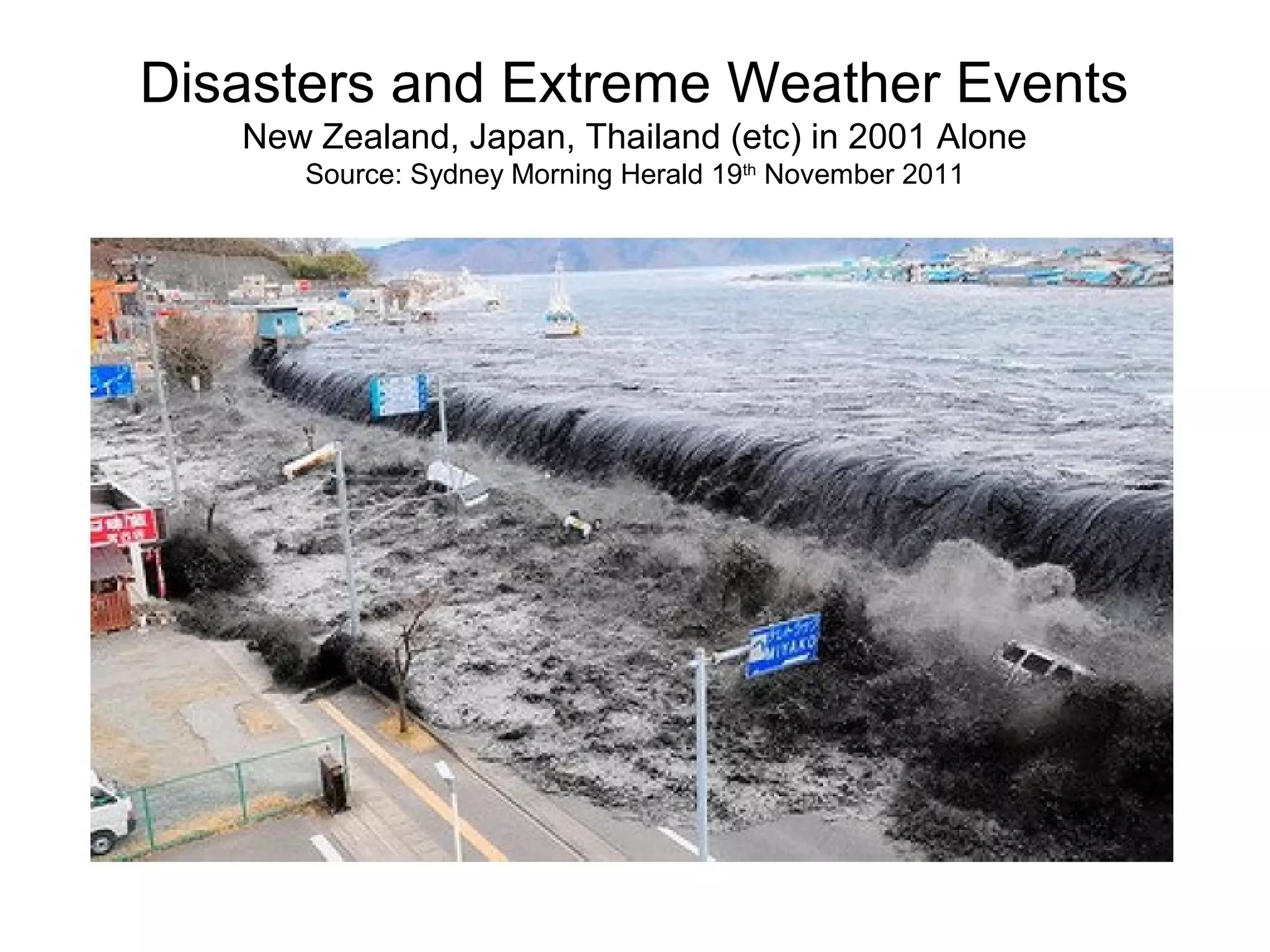
Disasters and Extreme Weather Events
New Zealand, Japan, Thailand (etc) in 2001 Alone
Source: Sydney Morning Herald 19th
November 2011
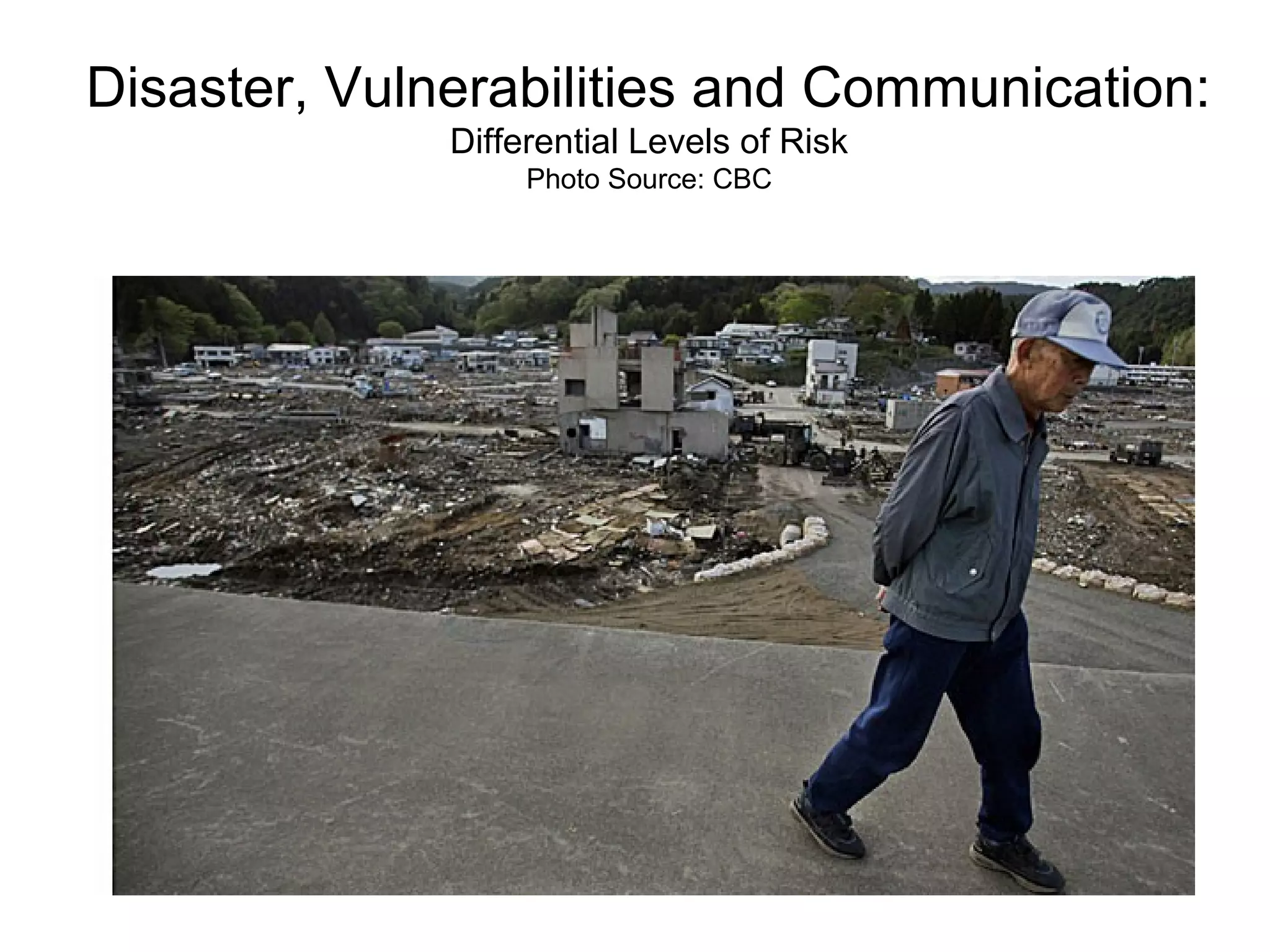
Disaster, Vulnerabilities and Communication:
Differential Levels of Risk
Photo Source: CBC
Future Issues for the Asia-Pacific Region
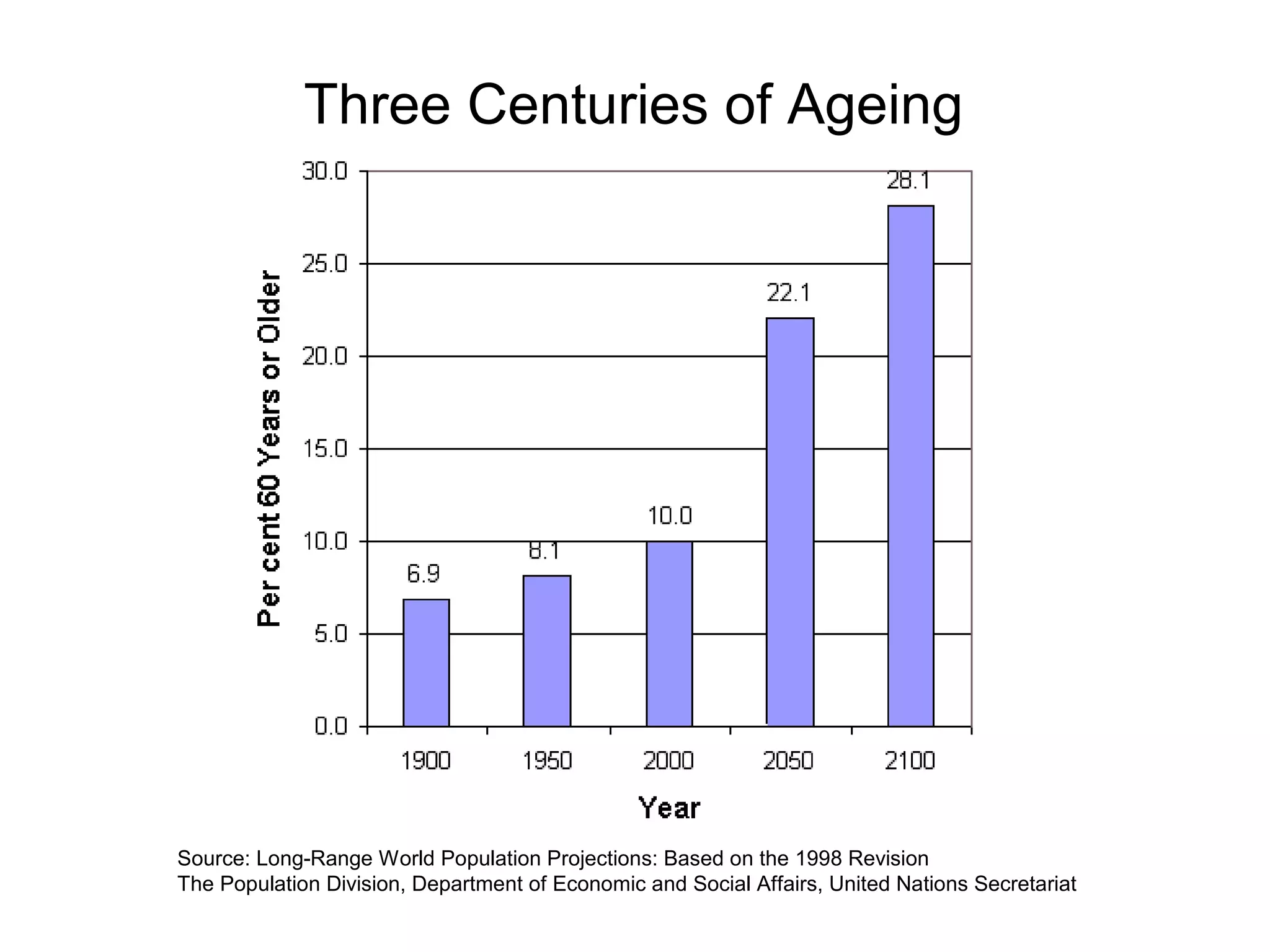
Three Centuries of Ageing
% Aged 60+
Source: Long-Range World Population Projections: Based on the 1998 Revision
The Population Division, Department of Economic and Social Affairs, United Nations Secretariat
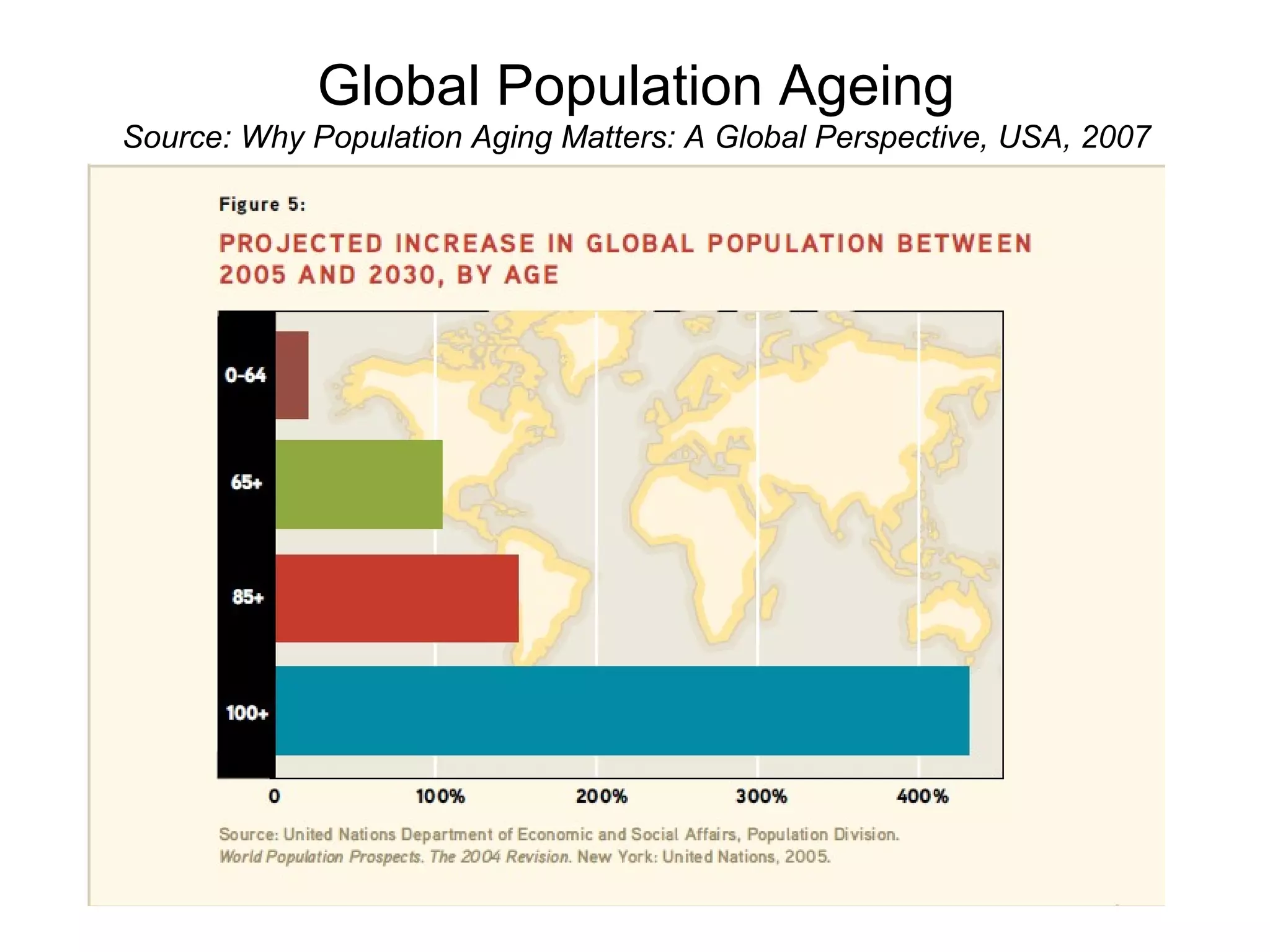
Global Population Ageing
Source: Why Population Aging Matters: A Global Perspective, USA, 2007
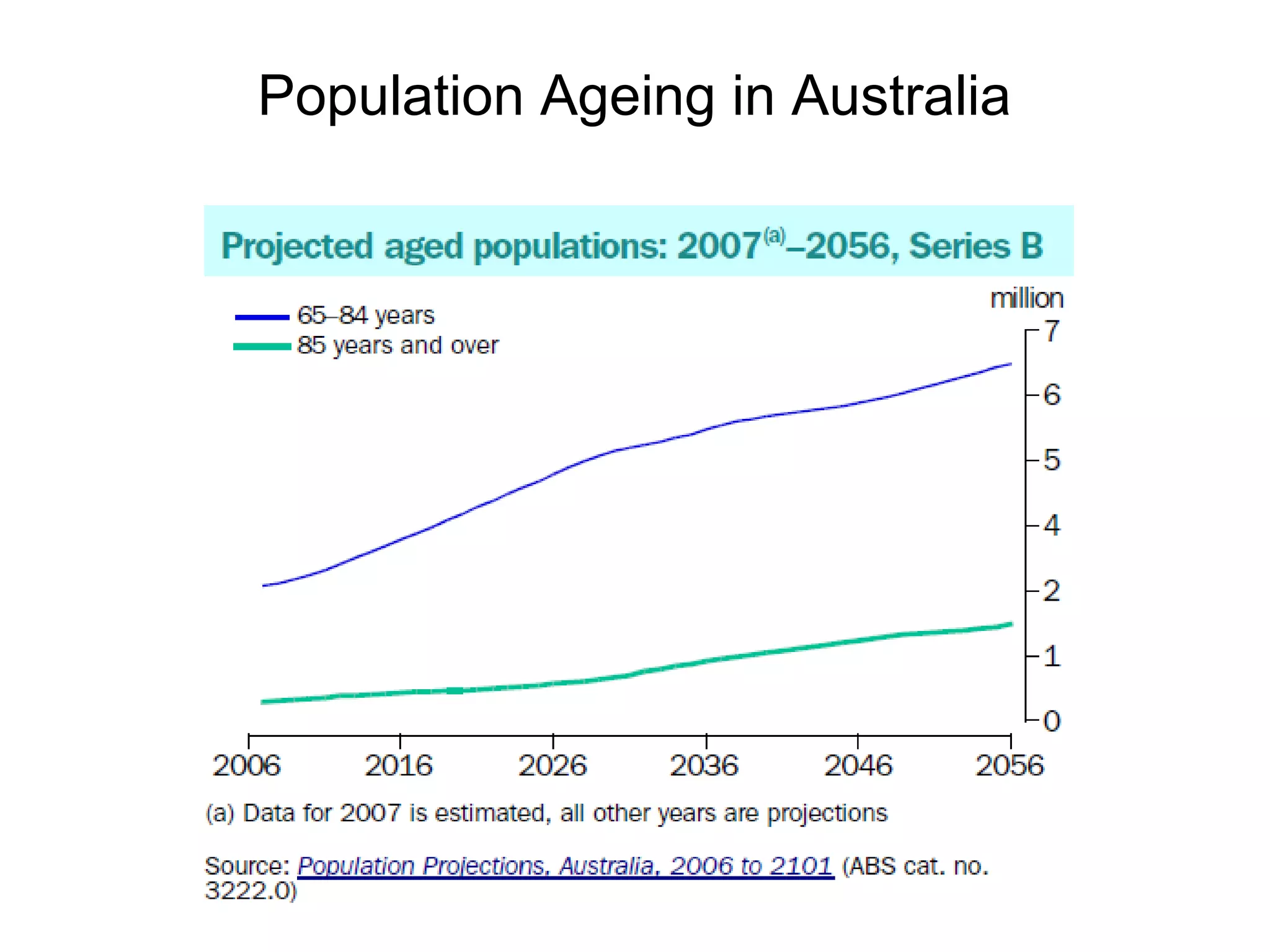
Population Ageing in Australia
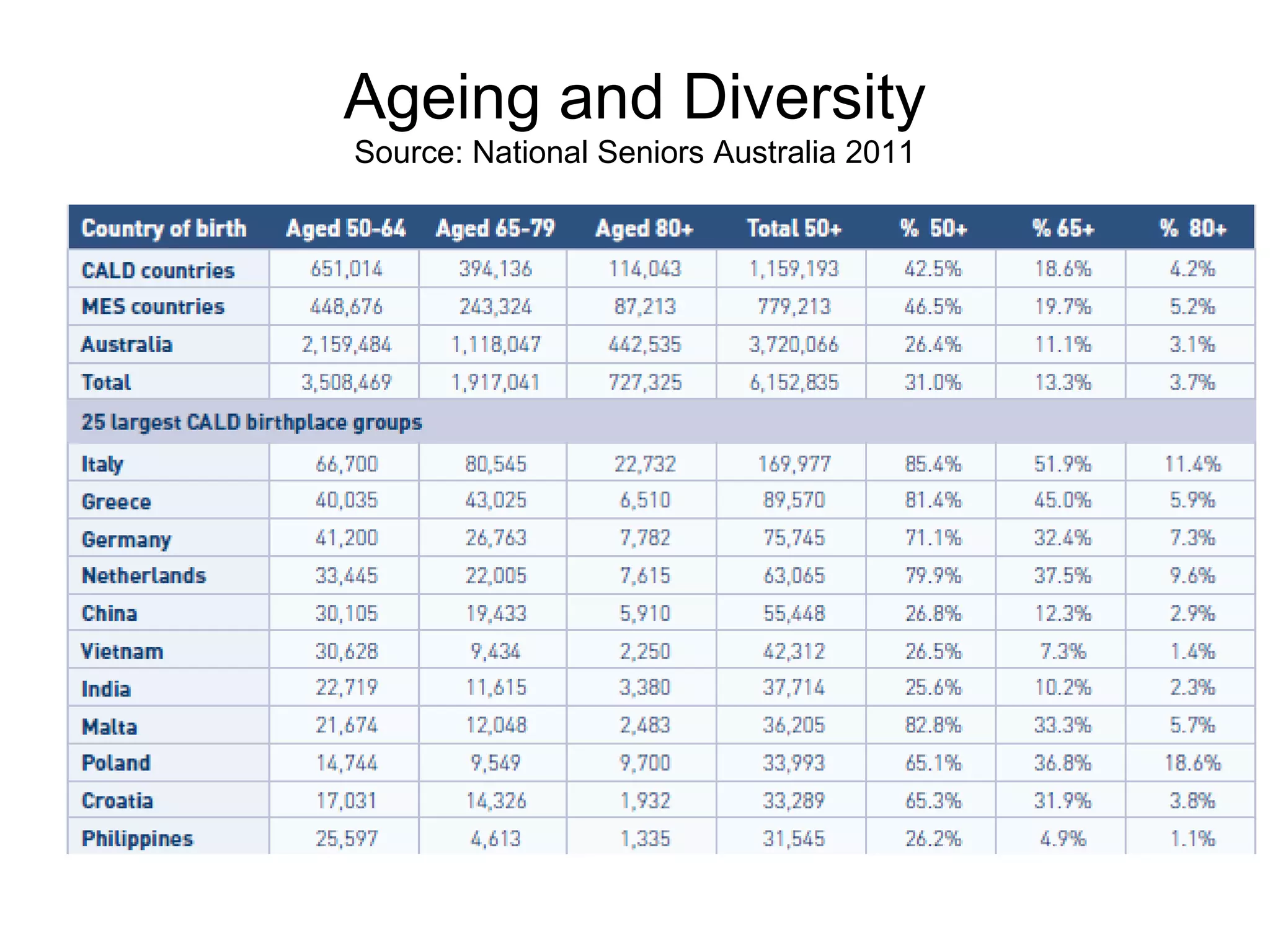
Ageing and Diversity
Source: National Seniors Australia 2011
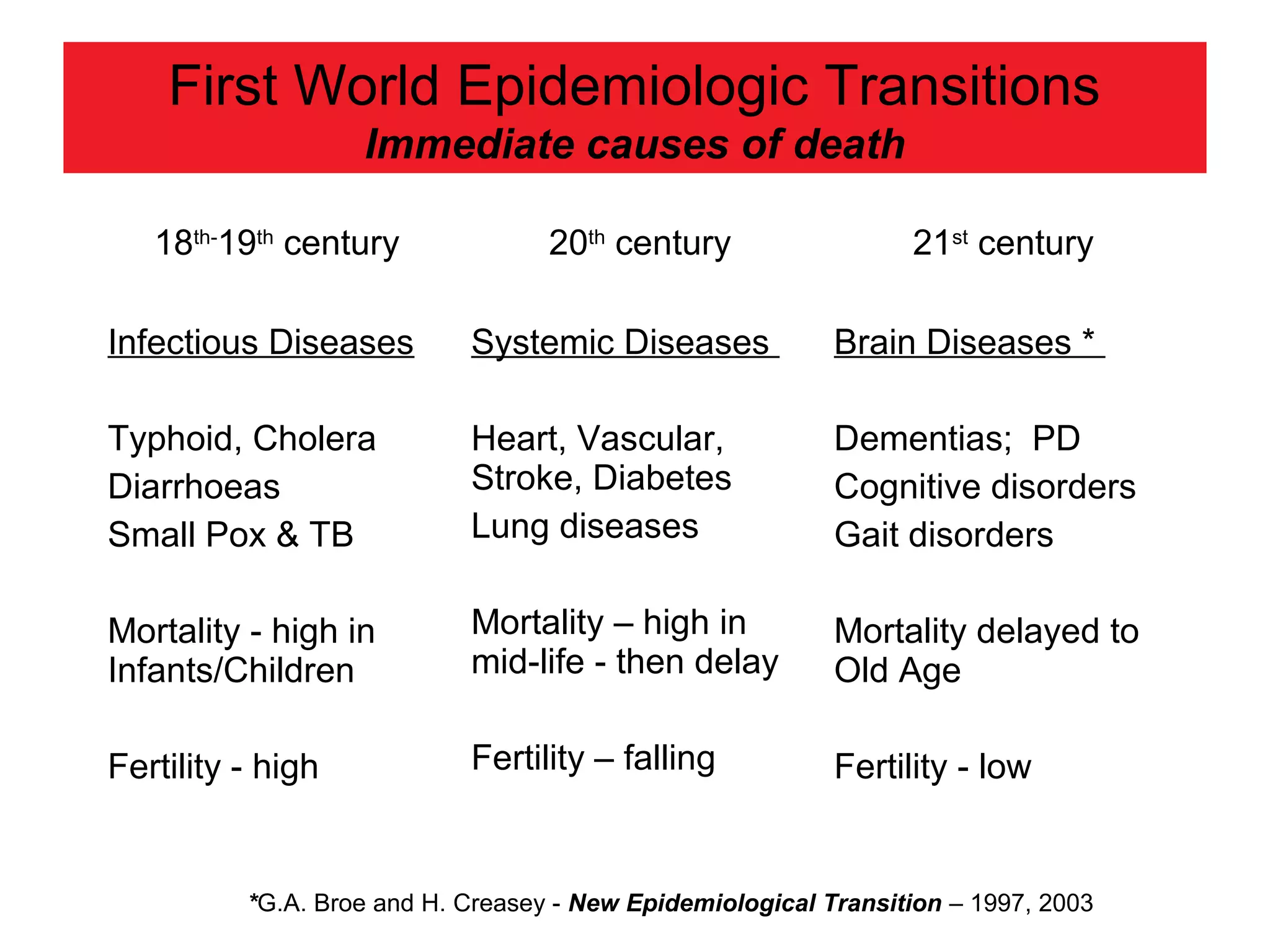
First World Epidemiologic Transitions
Immediate causes of death
18th-
19th
century 20th
century 21st
century
Infectious Diseases
Typhoid, Cholera
Diarrhoeas
Small Pox & TB
Mortality - high in
Infants/Children
Fertility - high
Systemic Diseases
Heart, Vascular,
Stroke, Diabetes
Lung diseases
Mortality – high in
mid-life - then delay
Fertility – falling
Brain Diseases *
Dementias; PD
Cognitive disorders
Gait disorders
Mortality delayed to
Old Age
Fertility - low
*G.A. Broe and H. Creasey - New Epidemiological Transition – 1997, 2003
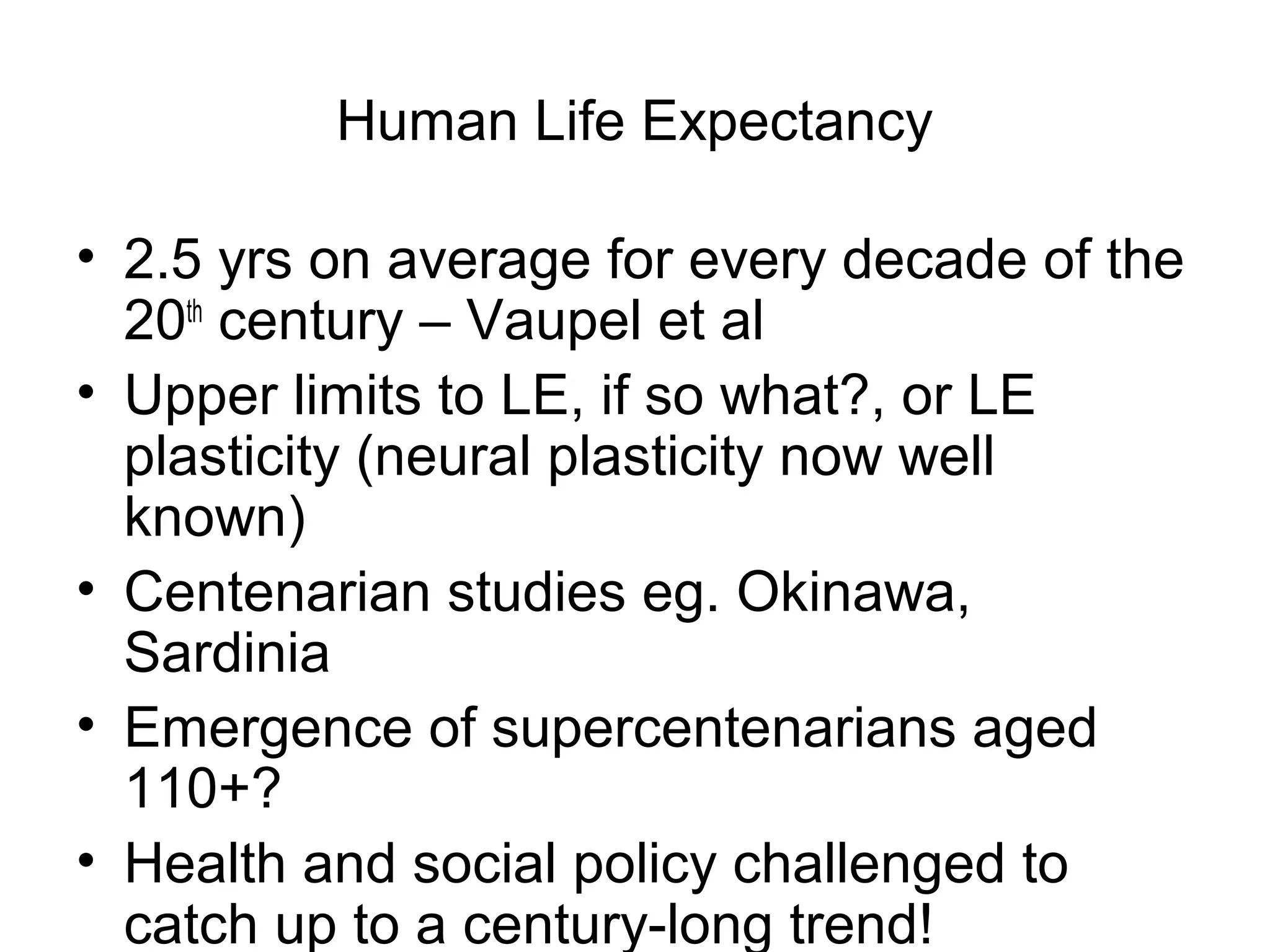
Human Life Expectancy
• 2.5 yrs on average for every decade of the
20th
century – Vaupel et al
• Upper limits to LE, if so what?, or LE
plasticity (neural plasticity now well
known)
• Centenarian studies eg. Okinawa,
Sardinia
• Emergence of supercentenarians aged
110+?
• Health and social policy challenged to
catch up to a century-long trend!
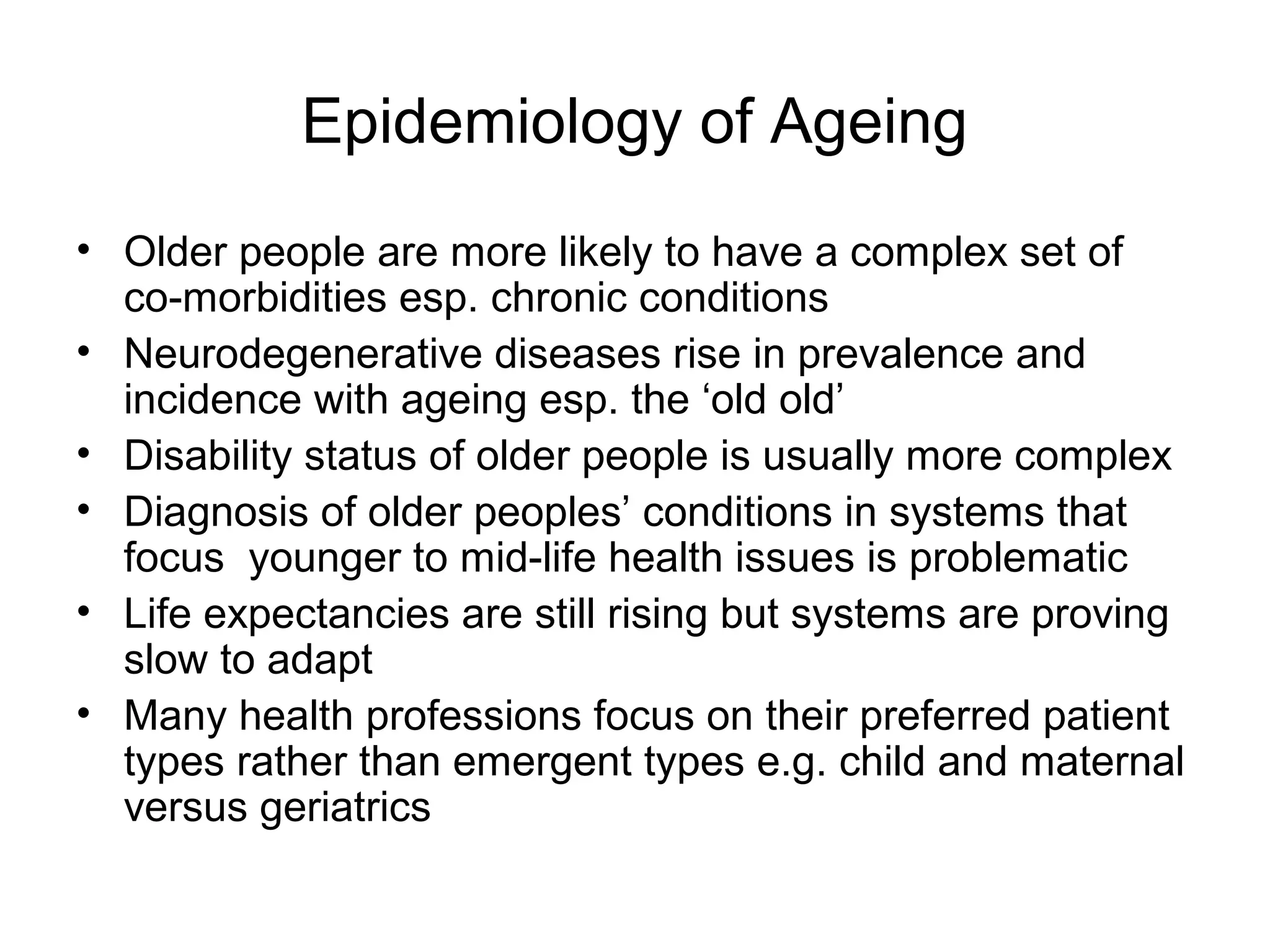
Epidemiology of Ageing
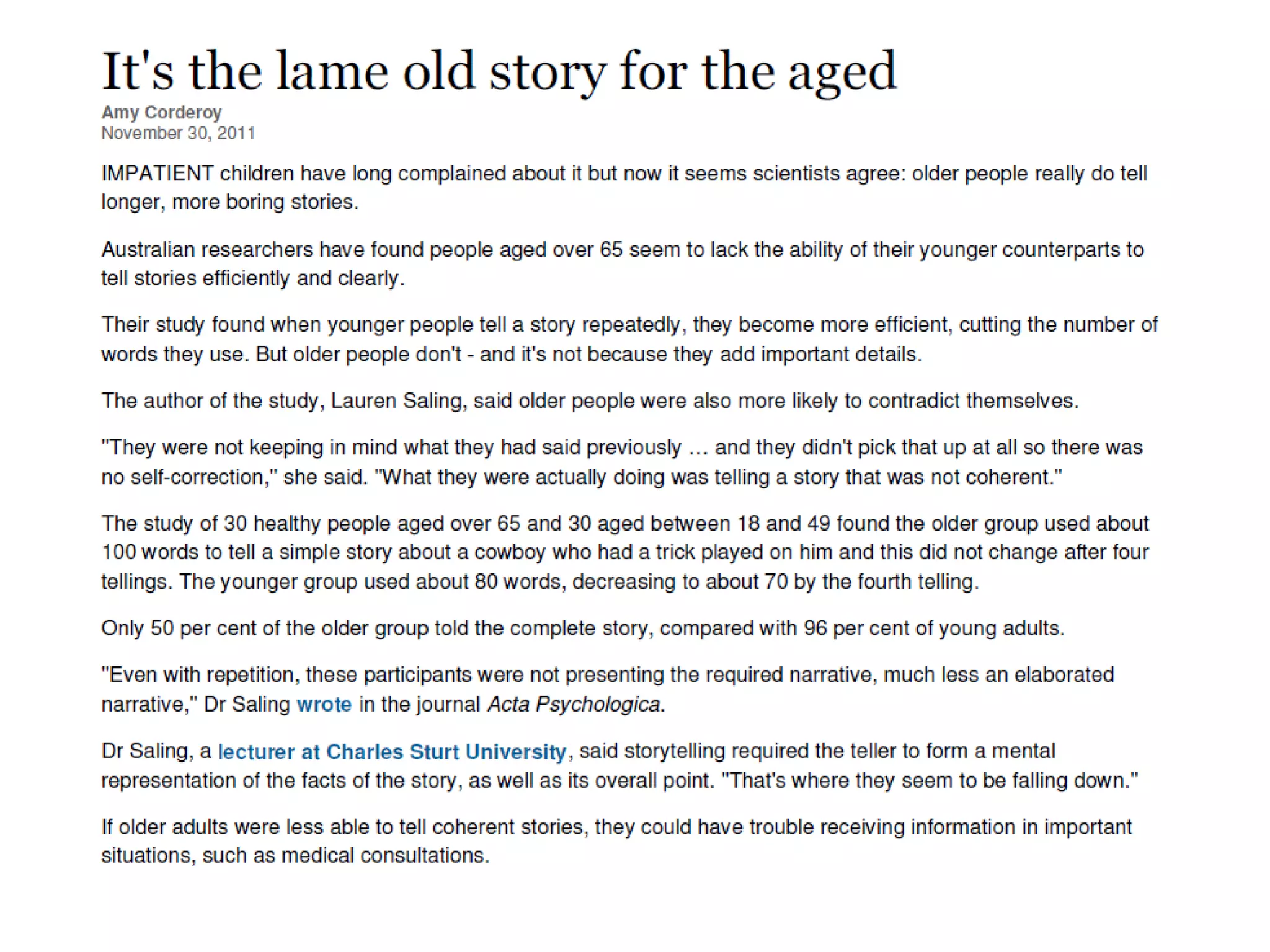
• Older people are more likely to have a complex set of
co-morbidities esp. chronic conditions
• Neurodegenerative diseases rise in prevalence and
incidence with ageing esp. the ‘old old’
• Disability status of older people is usually more complex
• Diagnosis of older peoples’ conditions in systems that
focus younger to mid-life health issues is problematic
• Life expectancies are still rising but systems are proving
slow to adapt
• Many health professions focus on their preferred patient
types rather than emergent types e.g. child and maternal
versus geriatrics
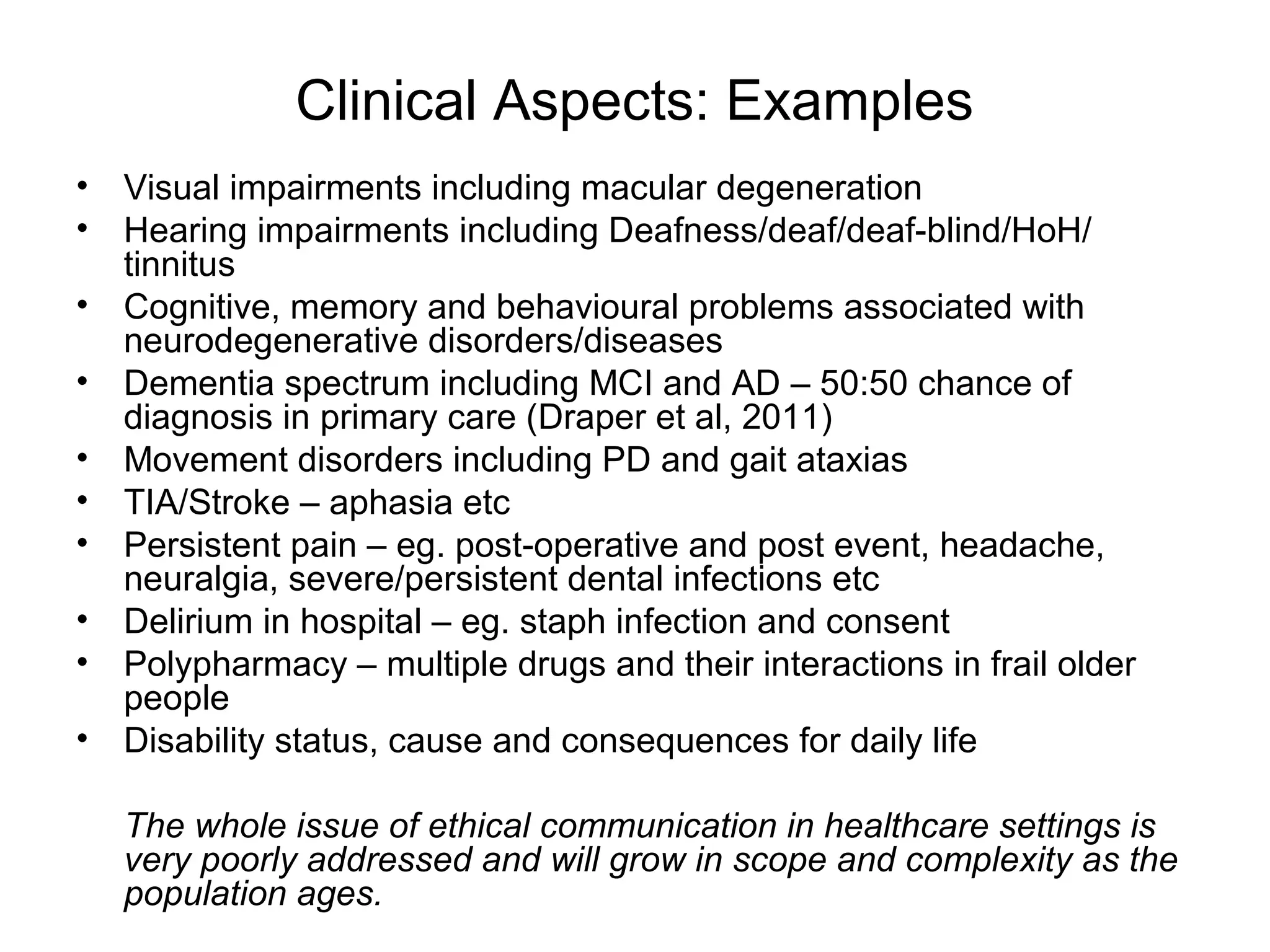
Clinical Aspects: Examples
• Visual impairments including macular degeneration
• Hearing impairments including Deafness/deaf/deaf-blind/HoH/
tinnitus
• Cognitive, memory and behavioural problems associated with
neurodegenerative disorders/diseases
• Dementia spectrum including MCI and AD – 50:50 chance of
diagnosis in primary care (Draper et al, 2011)
• Movement disorders including PD and gait ataxias
• TIA/Stroke – aphasia etc
• Persistent pain – eg. post-operative and post event, headache,
neuralgia, severe/persistent dental infections etc
• Delirium in hospital – eg. staph infection and consent
• Polypharmacy – multiple drugs and their interactions in frail older
people
• Disability status, cause and consequences for daily life
The whole issue of ethical communication in healthcare settings is
very poorly addressed and will grow in scope and complexity as the
population ages.
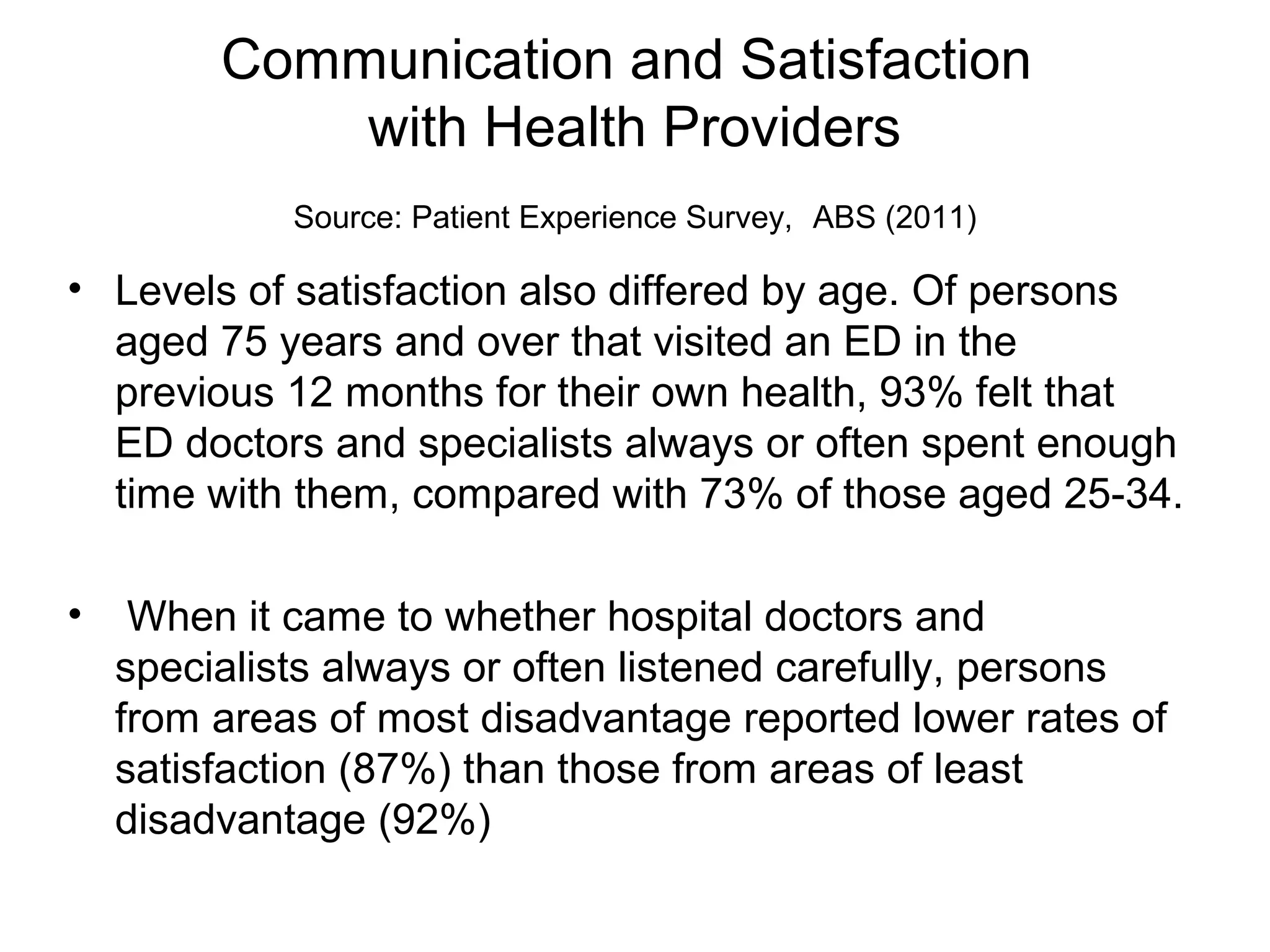
Communication and Satisfaction
with Health Providers
Source: Patient Experience Survey, ABS (2011)
• Levels of satisfaction also differed by age. Of persons
aged 75 years and over that visited an ED in the
previous 12 months for their own health, 93% felt that
ED doctors and specialists always or often spent enough
time with them, compared with 73% of those aged 25-34.
• When it came to whether hospital doctors and
specialists always or often listened carefully, persons
from areas of most disadvantage reported lower rates of
satisfaction (87%) than those from areas of least
disadvantage (92%)
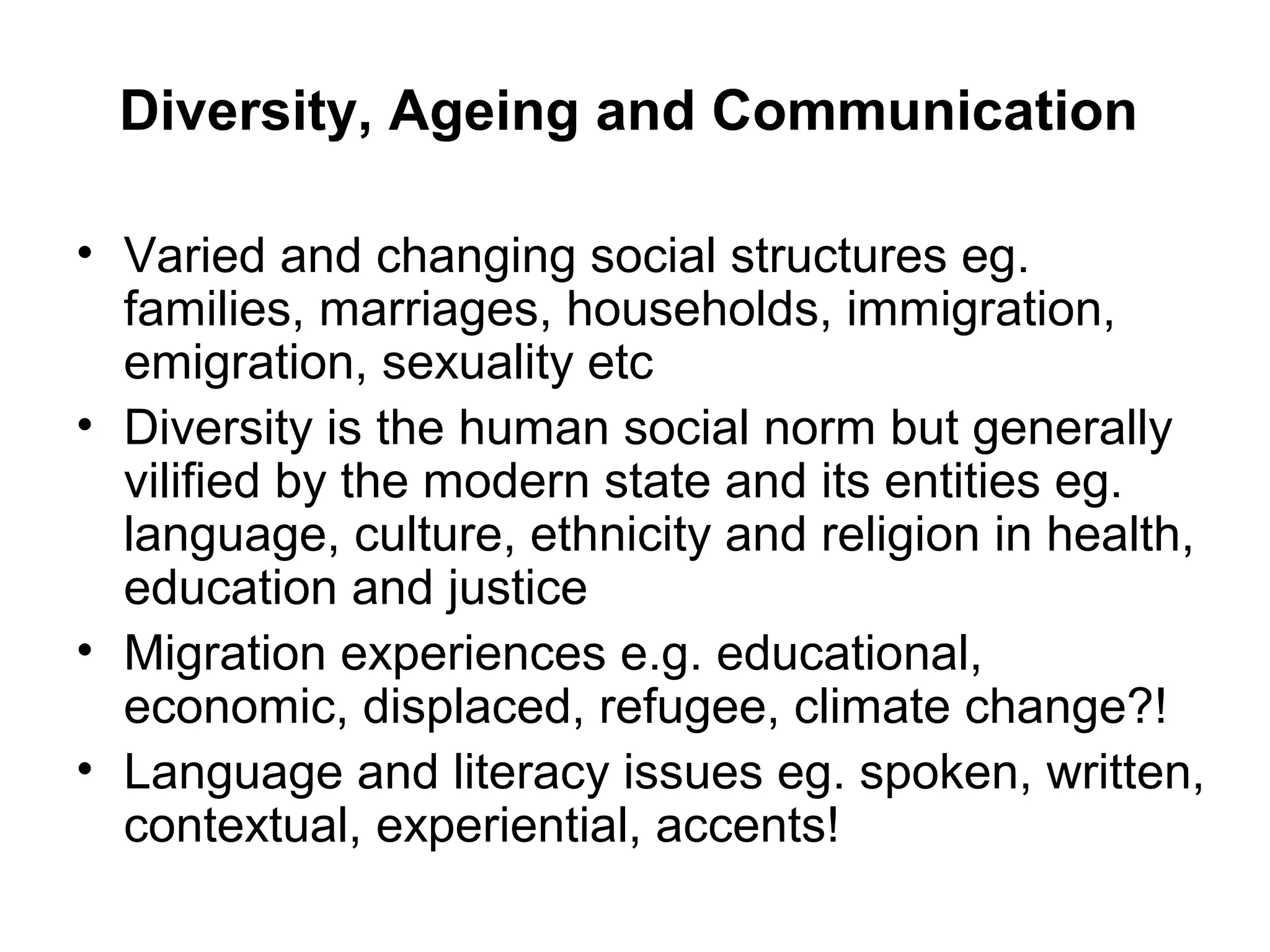
Diversity, Ageing and Communication
• Varied and changing social structures eg.
families, marriages, households, immigration,
emigration, sexuality etc
• Diversity is the human social norm but generally
vilified by the modern state and its entities eg.
language, culture, ethnicity and religion in health,
education and justice
• Migration experiences e.g. educational,
economic, displaced, refugee, climate change?!
• Language and literacy issues eg. spoken, written,
contextual, experiential, accents!
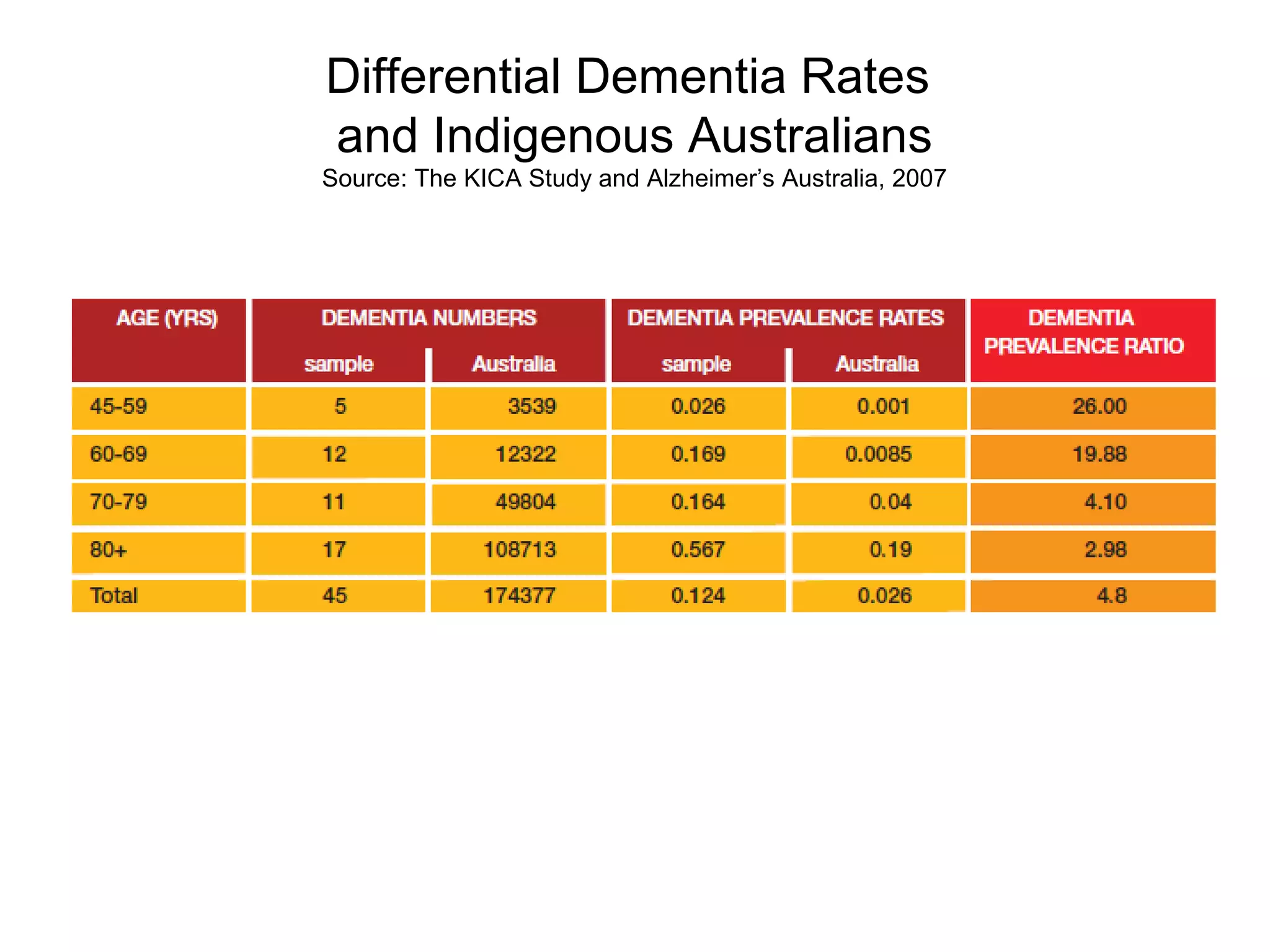
Differential Dementia Rates
and Indigenous Australians
Source: The KICA Study and Alzheimer’s Australia, 2007
Social Aspects
• Social changes have important implications for
communications theory and practice – old norms easily
superseded and institutions usually shaped around
these, not emerging norms (lag effects)
• Diversity has major implications for care in ageing
societies eg. disability groups, gay and lesbian issues,
ethnic and linguistic minorities, refugee groups, isolated
individuals, religious minorities => bioethics
• Capacity of monolingual systems to adapt to diversity of
needs eg. health care systems, education etc
• Contextual factors eg. individual, educational, financial,
social supports etc
• The persistence of racialised thought and language as
independent knowledge in situations requiring
knowledge about diversity, migration, communication
and ageing
Societal Aspects
• Broader social, economic, environmental and
climatic changes – vulnerabilities are man-made
• Globalisation of population and population
movements, skills, labour, educational and even
health markets
• Globalisation of media including linguistic
minority media in many countries eg. cable, TV,
newspapers, radio and internet in Australia –
transnational consumption
• Changes in knowledge production and
underlying assumptions about the world ie.
epistemic shifts (epistemic modesty needed)
Conclusion
• Ethical issues are substantial, persistent, growing
and poorly addressed – delirium scenario typical,
TB, consent, patient safety etc
• Health professionals need to be educated in
diversity not just about diversity (practice over
concepts over ideology)
• Communication professionals need to address
the ideology-practice divide and
broaden/contribute to these issues
• Theory and knowledge base need to expand in
the face of these major and inevitable changes

Communicating in ageing societies

  • 1.
    “Communicating in AgeingSocieties: Diversity and Dementia Looking to 2050” Authors Hamish Robertson, Postgraduate Student, FoM, UNSW Associate Professor Tuly Rosenfeld MBBS, FRACP, FoM, UNSW Dr Joanne Travaglia, PhD, Senior Lecturer, FoM, UNSW
  • 2.
    Introduction • Changing globalconditions, ageing and vulnerability • Implications of population ageing for communication theory and practice • Issues associated with the clinical aspects of ageing societies • Social and societal changes have communication consequences – diversity matters • Issues associated with globalisation, immigration and emigration
  • 3.
    Disasters and ExtremeWeather Events New Zealand, Japan, Thailand (etc) in 2001 Alone Source: Sydney Morning Herald 19th November 2011
  • 4.
    Disaster, Vulnerabilities andCommunication: Differential Levels of Risk Photo Source: CBC
  • 5.
    Future Issues forthe Asia-Pacific Region
  • 6.
    Three Centuries ofAgeing % Aged 60+ Source: Long-Range World Population Projections: Based on the 1998 Revision The Population Division, Department of Economic and Social Affairs, United Nations Secretariat
  • 7.
    Global Population Ageing Source:Why Population Aging Matters: A Global Perspective, USA, 2007
  • 8.
  • 9.
    Ageing and Diversity Source:National Seniors Australia 2011
  • 10.
    First World EpidemiologicTransitions Immediate causes of death 18th- 19th century 20th century 21st century Infectious Diseases Typhoid, Cholera Diarrhoeas Small Pox & TB Mortality - high in Infants/Children Fertility - high Systemic Diseases Heart, Vascular, Stroke, Diabetes Lung diseases Mortality – high in mid-life - then delay Fertility – falling Brain Diseases * Dementias; PD Cognitive disorders Gait disorders Mortality delayed to Old Age Fertility - low *G.A. Broe and H. Creasey - New Epidemiological Transition – 1997, 2003
  • 11.
    Human Life Expectancy •2.5 yrs on average for every decade of the 20th century – Vaupel et al • Upper limits to LE, if so what?, or LE plasticity (neural plasticity now well known) • Centenarian studies eg. Okinawa, Sardinia • Emergence of supercentenarians aged 110+? • Health and social policy challenged to catch up to a century-long trend!
  • 12.
    Epidemiology of Ageing •Older people are more likely to have a complex set of co-morbidities esp. chronic conditions • Neurodegenerative diseases rise in prevalence and incidence with ageing esp. the ‘old old’ • Disability status of older people is usually more complex • Diagnosis of older peoples’ conditions in systems that focus younger to mid-life health issues is problematic • Life expectancies are still rising but systems are proving slow to adapt • Many health professions focus on their preferred patient types rather than emergent types e.g. child and maternal versus geriatrics
  • 13.
    Clinical Aspects: Examples •Visual impairments including macular degeneration • Hearing impairments including Deafness/deaf/deaf-blind/HoH/ tinnitus • Cognitive, memory and behavioural problems associated with neurodegenerative disorders/diseases • Dementia spectrum including MCI and AD – 50:50 chance of diagnosis in primary care (Draper et al, 2011) • Movement disorders including PD and gait ataxias • TIA/Stroke – aphasia etc • Persistent pain – eg. post-operative and post event, headache, neuralgia, severe/persistent dental infections etc • Delirium in hospital – eg. staph infection and consent • Polypharmacy – multiple drugs and their interactions in frail older people • Disability status, cause and consequences for daily life The whole issue of ethical communication in healthcare settings is very poorly addressed and will grow in scope and complexity as the population ages.
  • 14.
    Communication and Satisfaction withHealth Providers Source: Patient Experience Survey, ABS (2011) • Levels of satisfaction also differed by age. Of persons aged 75 years and over that visited an ED in the previous 12 months for their own health, 93% felt that ED doctors and specialists always or often spent enough time with them, compared with 73% of those aged 25-34. • When it came to whether hospital doctors and specialists always or often listened carefully, persons from areas of most disadvantage reported lower rates of satisfaction (87%) than those from areas of least disadvantage (92%)
  • 16.
    Diversity, Ageing andCommunication • Varied and changing social structures eg. families, marriages, households, immigration, emigration, sexuality etc • Diversity is the human social norm but generally vilified by the modern state and its entities eg. language, culture, ethnicity and religion in health, education and justice • Migration experiences e.g. educational, economic, displaced, refugee, climate change?! • Language and literacy issues eg. spoken, written, contextual, experiential, accents!
  • 17.
    Differential Dementia Rates andIndigenous Australians Source: The KICA Study and Alzheimer’s Australia, 2007
  • 18.
    Social Aspects • Socialchanges have important implications for communications theory and practice – old norms easily superseded and institutions usually shaped around these, not emerging norms (lag effects) • Diversity has major implications for care in ageing societies eg. disability groups, gay and lesbian issues, ethnic and linguistic minorities, refugee groups, isolated individuals, religious minorities => bioethics • Capacity of monolingual systems to adapt to diversity of needs eg. health care systems, education etc • Contextual factors eg. individual, educational, financial, social supports etc • The persistence of racialised thought and language as independent knowledge in situations requiring knowledge about diversity, migration, communication and ageing
  • 19.
    Societal Aspects • Broadersocial, economic, environmental and climatic changes – vulnerabilities are man-made • Globalisation of population and population movements, skills, labour, educational and even health markets • Globalisation of media including linguistic minority media in many countries eg. cable, TV, newspapers, radio and internet in Australia – transnational consumption • Changes in knowledge production and underlying assumptions about the world ie. epistemic shifts (epistemic modesty needed)
  • 20.
    Conclusion • Ethical issuesare substantial, persistent, growing and poorly addressed – delirium scenario typical, TB, consent, patient safety etc • Health professionals need to be educated in diversity not just about diversity (practice over concepts over ideology) • Communication professionals need to address the ideology-practice divide and broaden/contribute to these issues • Theory and knowledge base need to expand in the face of these major and inevitable changes