Human Factors: Bridging the gap between
theory and practice in health care
Bronwyn Shumack
CLINICAL EXCELLENCE COMMISSION
2011-2012 HARC Scholarship Recipient
16 April 2015
Firstly - what is meant by
“human factors”?
Human factors concerns people
An area of study (and practice) about people (abilities,
characteristics, and limitations), the design of equipment they
use, environments in which they function, jobs they perform,
and their relationships with other people.
Modified from Definitions of Human Factors and Ergonomics.
Educational Resources. Human Factors and Ergonomics Society.
http://www.hfes.org/Web/EducationalResources/HFEdefinitionsmain.html
Professor Jan Davies
Why was this important to me/CEC
• “Human Factors” (HF) are evident or implicated in clinical incidents
• Health system “fixes”, including RCA recommendations, redesign
projects or new processes, which don’t consider human factors
often fail to achieve expected outcomes and benefits
• Conferences and other forums identified that there is very limited
identifiable translation of HF knowledge into health care in NSW
• Get evidence to help dispel the myth that Human Factors = Human
Error
So…
• Keen to identify how other health jurisdictions tackle this – so we
get it right in NSW
Key questions
• What training and/or expertise did they use to improve the
application of HF principles?
• What difference did the inclusion of HF principles/experts make to
the outcome and effectiveness of your project/program?
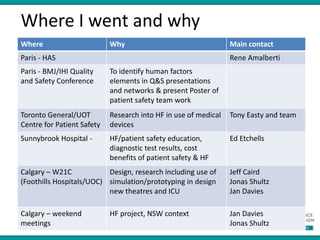
Where I went and why
Where Why Main contact
Paris - HAS Rene Amalberti
Paris - BMJ/IHI Quality
and Safety Conference
To identify human factors
elements in Q&S presentations
and networks & present Poster of
patient safety team work
Toronto General/UOT
Centre for Patient Safety
Research into HF in use of medical
devices
Tony Easty and team
Sunnybrook Hospital - HF/patient safety education,
diagnostic test results, cost
benefits of patient safety & HF
Ed Etchells
Calgary – W21C
(Foothills Hospitals/UOC)
Design, research including use of
simulation/prototyping in design
new theatres and ICU
Jeff Caird
Jonas Shultz
Jan Davies
Calgary – weekend
meetings
HF project, NSW context Jan Davies
Jonas Shultz
Where I went and why
(still looking in haystacks…)
Where Why Main contact
Vancouver Island Health
Authority/Royal Jubilee
Hospital
Hospital built with HF principles –
standardised design, including
patient, medication, utilities rooms
Howard Waldner
Vancouver General
Hospital
HF staff on Q&S team, private
public partnerships
Patient based care
Linda Dempster
Allie Muniak
British Columbia Quality
Council
Education in safety, quality and HF
State-wide initiatives
Doug Cochrane
Christina Krause
Fraser Health, Surrey, BC Invited to speak, met with Q&S
department
Cathy Weir
AAvPA Conference Sydney
2012
Identifying HF in safety incidents in
other industries
Various
Key learnings
• Human factors were referred to, but few conference
presentations or organisations visited demonstrated a
thorough understanding of HF concepts, or how to apply them
to heath care. Formal usability assessment, prototyping rare
• Specialist skills are required to:
• Raise awareness of the benefits of considering HF
• Establish frameworks for inclusion of HF in formal
processes (e.g., medical device procurement, clinical
redesign, form and website development)
• Train staff in basic HF principles and approaches
Best work being done in Canada
PRESENTATION NAME – MONTH YYYY
PRESENTER NAME
7
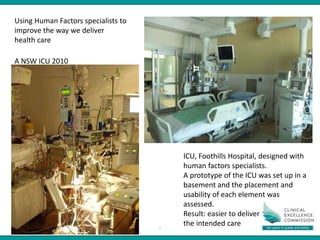
A NSW ICU 2010
ICU, Foothills Hospital, designed with
human factors specialists.
A prototype of the ICU was set up in a
basement and the placement and
usability of each element was
assessed.
Result: easier to deliver
the intended care
Using Human Factors specialists to
improve the way we deliver
health care
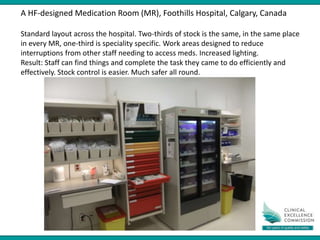
A HF-designed Medication Room (MR), Foothills Hospital, Calgary, Canada
Standard layout across the hospital. Two-thirds of stock is the same, in the same place
in every MR, one-third is speciality specific. Work areas designed to reduce
interruptions from other staff needing to access meds. Increased lighting.
Result: Staff can find things and complete the task they came to do efficiently and
effectively. Stock control is easier. Much safer all round.
Immediate outcomes of the trip
• Strong links with international leaders, including
engagement and support for ongoing work here.
These are continuing
• Strengthened case for a HF position in NSW
Health
• Provided evidence of benefits of value of formal
HF assessment +/- prototyping
• Presentations following scholarship helped to
raise awareness of relevance and importance of
HF in all components of health care in NSW
PRESENTATION NAME – MONTH YYYY
PRESENTER NAME
10
The best outcome …
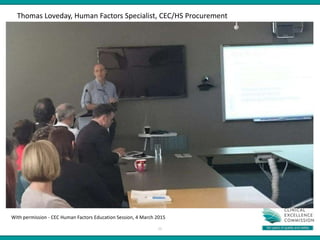
With permission - CEC Human Factors Education Session, 4 March 2015
11
Thomas Loveday, Human Factors Specialist, CEC/HS Procurement
PRESENTATION NAME – MONTH YYYY
PRESENTER NAME
Current activities – HF Specialist
• In high demand!
• Assisting with design and usability testing of new
incident management system
• Providing input to serious clinical incident
investigation models
• Providing input into medical device procurement
• Assisting other CEC Programs (e.g., VTE form
design)
• Established a Human Factors Advisory Committee
• eHealth are also planning to recruit a HF
specialist, following discussions with Thom
12
Thank you HARC
bronwyn.shumack@health.nsw.gov.au

Bronwyn Shumack, Clinical Excellence Commission

  • 1.
    Human Factors: Bridgingthe gap between theory and practice in health care Bronwyn Shumack CLINICAL EXCELLENCE COMMISSION 2011-2012 HARC Scholarship Recipient 16 April 2015
  • 2.
    Firstly - whatis meant by “human factors”? Human factors concerns people An area of study (and practice) about people (abilities, characteristics, and limitations), the design of equipment they use, environments in which they function, jobs they perform, and their relationships with other people. Modified from Definitions of Human Factors and Ergonomics. Educational Resources. Human Factors and Ergonomics Society. http://www.hfes.org/Web/EducationalResources/HFEdefinitionsmain.html Professor Jan Davies
  • 3.
    Why was thisimportant to me/CEC • “Human Factors” (HF) are evident or implicated in clinical incidents • Health system “fixes”, including RCA recommendations, redesign projects or new processes, which don’t consider human factors often fail to achieve expected outcomes and benefits • Conferences and other forums identified that there is very limited identifiable translation of HF knowledge into health care in NSW • Get evidence to help dispel the myth that Human Factors = Human Error So… • Keen to identify how other health jurisdictions tackle this – so we get it right in NSW Key questions • What training and/or expertise did they use to improve the application of HF principles? • What difference did the inclusion of HF principles/experts make to the outcome and effectiveness of your project/program?
  • 4.
    Where I wentand why Where Why Main contact Paris - HAS Rene Amalberti Paris - BMJ/IHI Quality and Safety Conference To identify human factors elements in Q&S presentations and networks & present Poster of patient safety team work Toronto General/UOT Centre for Patient Safety Research into HF in use of medical devices Tony Easty and team Sunnybrook Hospital - HF/patient safety education, diagnostic test results, cost benefits of patient safety & HF Ed Etchells Calgary – W21C (Foothills Hospitals/UOC) Design, research including use of simulation/prototyping in design new theatres and ICU Jeff Caird Jonas Shultz Jan Davies Calgary – weekend meetings HF project, NSW context Jan Davies Jonas Shultz
  • 5.
    Where I wentand why (still looking in haystacks…) Where Why Main contact Vancouver Island Health Authority/Royal Jubilee Hospital Hospital built with HF principles – standardised design, including patient, medication, utilities rooms Howard Waldner Vancouver General Hospital HF staff on Q&S team, private public partnerships Patient based care Linda Dempster Allie Muniak British Columbia Quality Council Education in safety, quality and HF State-wide initiatives Doug Cochrane Christina Krause Fraser Health, Surrey, BC Invited to speak, met with Q&S department Cathy Weir AAvPA Conference Sydney 2012 Identifying HF in safety incidents in other industries Various
  • 6.
    Key learnings • Humanfactors were referred to, but few conference presentations or organisations visited demonstrated a thorough understanding of HF concepts, or how to apply them to heath care. Formal usability assessment, prototyping rare • Specialist skills are required to: • Raise awareness of the benefits of considering HF • Establish frameworks for inclusion of HF in formal processes (e.g., medical device procurement, clinical redesign, form and website development) • Train staff in basic HF principles and approaches Best work being done in Canada
  • 7.
    PRESENTATION NAME –MONTH YYYY PRESENTER NAME 7 A NSW ICU 2010 ICU, Foothills Hospital, designed with human factors specialists. A prototype of the ICU was set up in a basement and the placement and usability of each element was assessed. Result: easier to deliver the intended care Using Human Factors specialists to improve the way we deliver health care
  • 8.
    A HF-designed MedicationRoom (MR), Foothills Hospital, Calgary, Canada Standard layout across the hospital. Two-thirds of stock is the same, in the same place in every MR, one-third is speciality specific. Work areas designed to reduce interruptions from other staff needing to access meds. Increased lighting. Result: Staff can find things and complete the task they came to do efficiently and effectively. Stock control is easier. Much safer all round.
  • 9.
    Immediate outcomes ofthe trip • Strong links with international leaders, including engagement and support for ongoing work here. These are continuing • Strengthened case for a HF position in NSW Health • Provided evidence of benefits of value of formal HF assessment +/- prototyping • Presentations following scholarship helped to raise awareness of relevance and importance of HF in all components of health care in NSW
  • 10.
    PRESENTATION NAME –MONTH YYYY PRESENTER NAME 10 The best outcome …
  • 11.
    With permission -CEC Human Factors Education Session, 4 March 2015 11 Thomas Loveday, Human Factors Specialist, CEC/HS Procurement
  • 12.
    PRESENTATION NAME –MONTH YYYY PRESENTER NAME Current activities – HF Specialist • In high demand! • Assisting with design and usability testing of new incident management system • Providing input to serious clinical incident investigation models • Providing input into medical device procurement • Assisting other CEC Programs (e.g., VTE form design) • Established a Human Factors Advisory Committee • eHealth are also planning to recruit a HF specialist, following discussions with Thom 12
  • 13.