Virtual Lesson Course Design and
Teaching Online

Nghi Nguyen
November 12, 2013
EDTC 650
Assignment 3
Third Grade English
Lesson Plan

PRONOUNS
Lesson Outline
We have been learning about Parts of Speech this past few weeks
and have covered Noun and Verb. This week, our focus turns to
Pronoun.
Similar to other weeks, there are activity worksheets that you must
complete at the end of this lesson.
What are Pronouns?
OBJECTIVES
- Students will learn about pronouns

- Students will complete activities to get a better understanding of
how to use pronouns in sentences
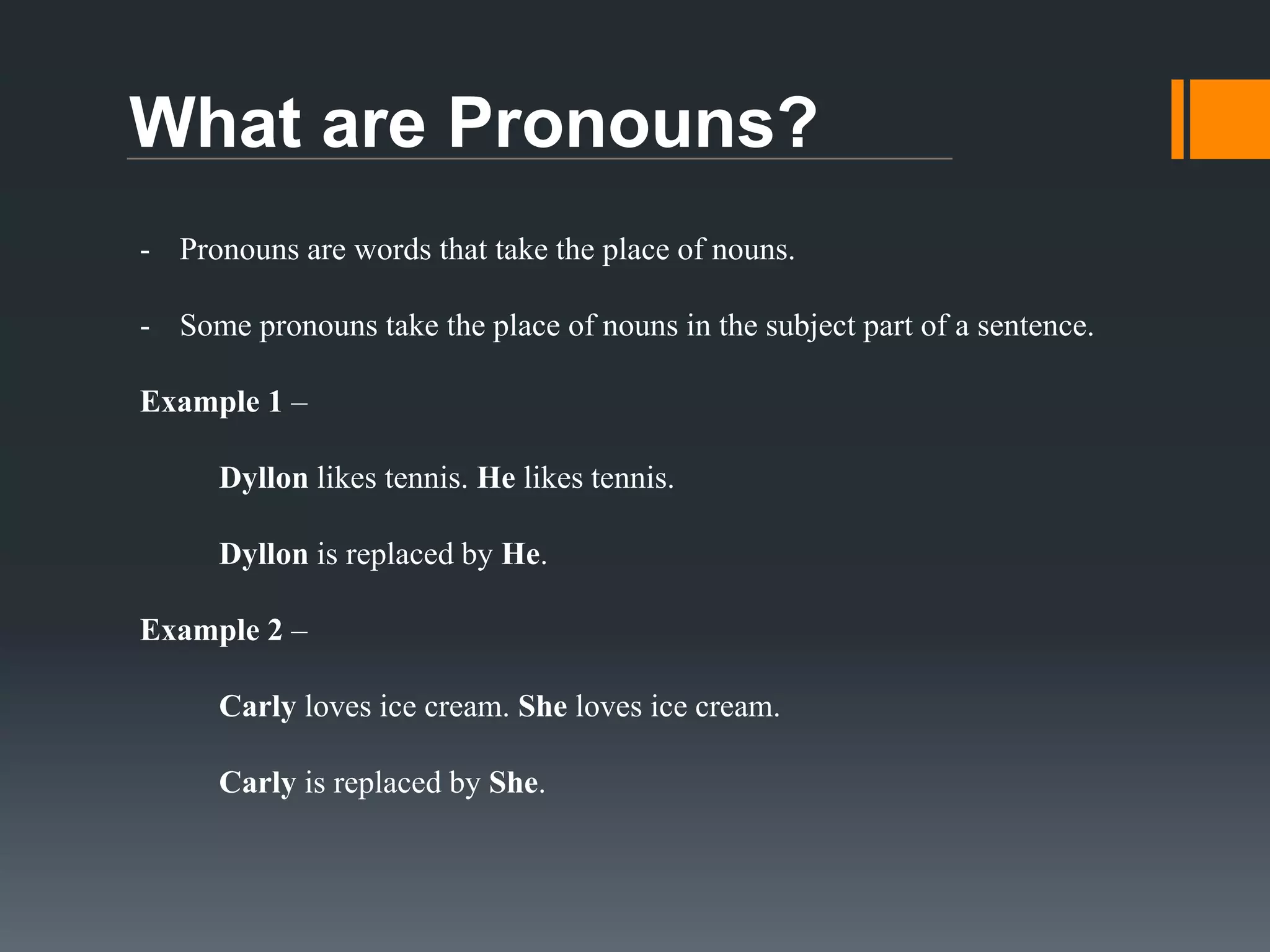
What are Pronouns?
- Pronouns are words that take the place of nouns.

- Some pronouns take the place of nouns in the subject part of a sentence.
Example 1 –
Dyllon likes tennis. He likes tennis.
Dyllon is replaced by He.
Example 2 –
Carly loves ice cream. She loves ice cream.
Carly is replaced by She.
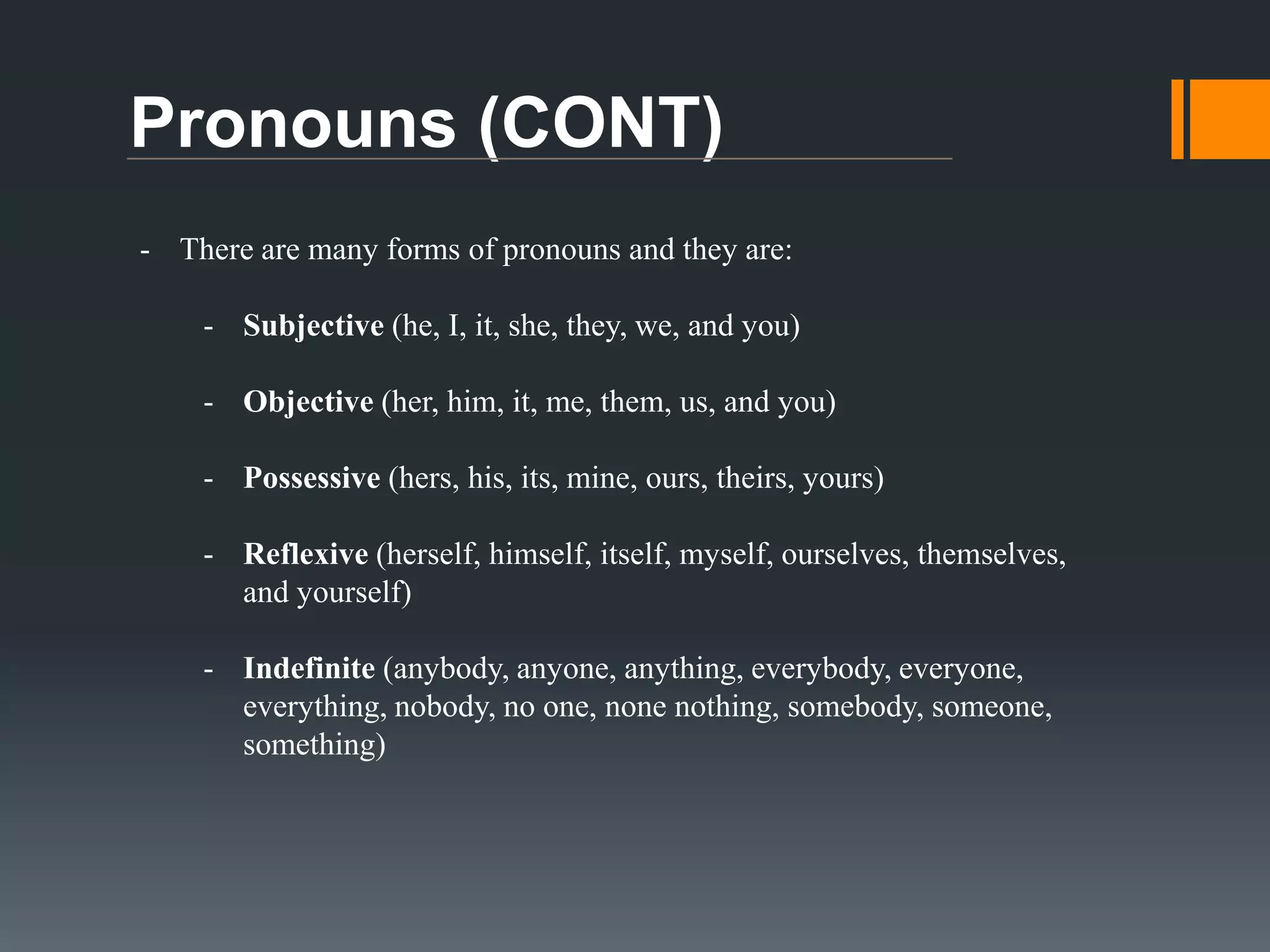
Pronouns (CONT)
- There are many forms of pronouns and they are:

- Subjective ( he, I, it, she, they, we, and you )
- Objective ( her, him, it, me, them, us, and you )
- Possessive ( hers, his, its, mine, ours, theirs, yours )
- Reflexive ( herself, himself, itself, myself, ourselves, themselves,
and yourself )
- Indefinite ( anybody, anyone, anything, everybody, everyone,
everything, nobody, no one, none nothing, somebody, someone,
something )
Pronouns (CONT)
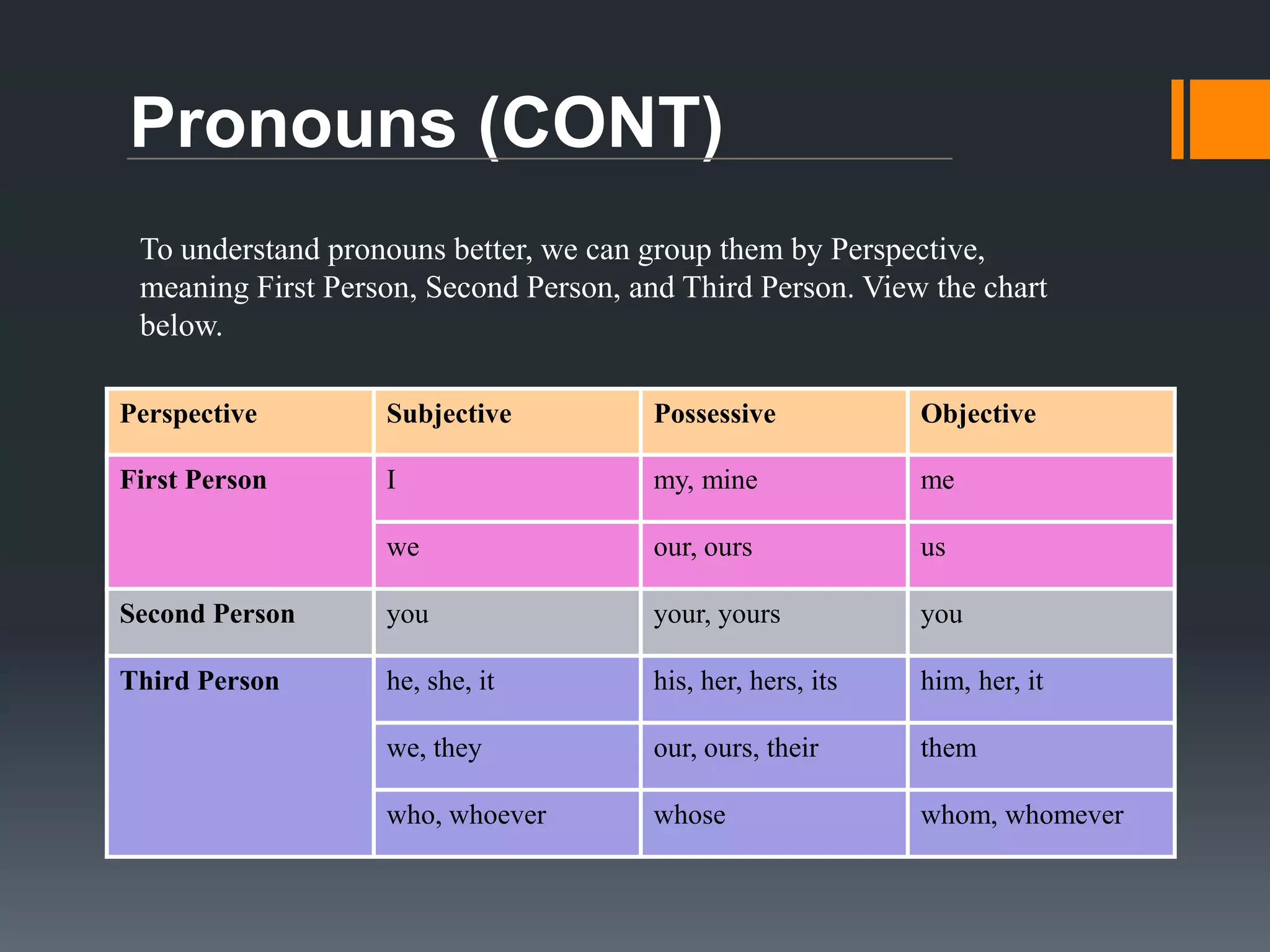
To better understand pronouns, we can group them by Perspective,
meaning First Person, Second Person, and Third Person. View the chart
below.
Perspective

Subjective

Possessive

Objective

First Person

I

my, mine

me

we

our, ours

us

Second Person

you

your, yours

you

Third Person

he, she, it

his, her, hers, its

him, her, it

we, they

our, ours, their

them

who, whoever

whose

whom, whomever
Using Pronouns in Sentences
Subjective Pronouns
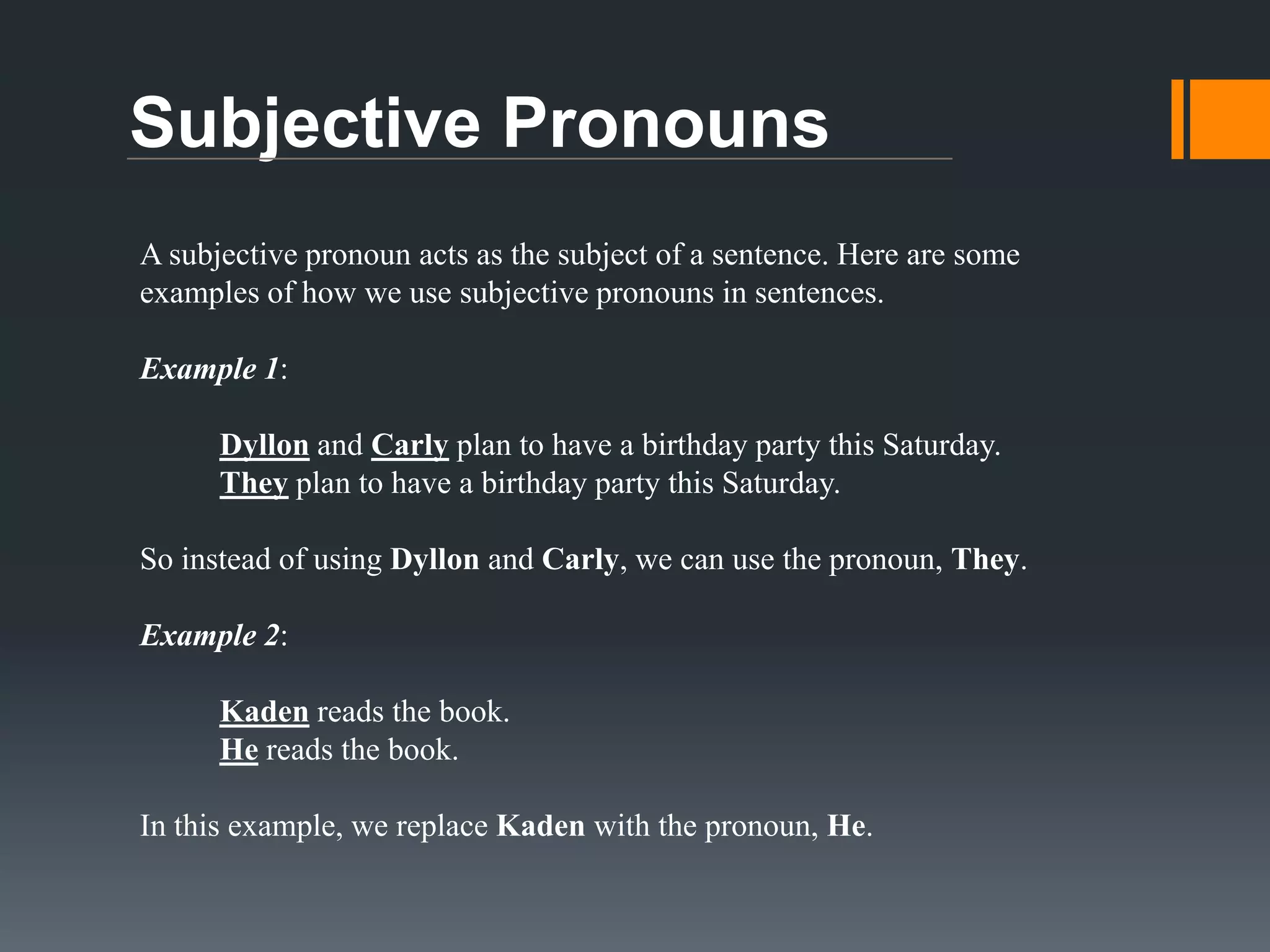
A subjective pronoun acts as the subject of a sentence. Here are some
examples of how we use subjective pronouns in sentences.
Example 1:
Dyllon and Carly plan to have a birthday party this Saturday.
They plan to have a birthday party this Saturday.

So instead of using Dyllon and Carly, we can use the subjective third person
pronoun, They.
Example 2:
Kaden reads the book.
He reads the book.
In this example, we replace Kaden with the subjective third person pronoun,
He.
Subjective Pronouns (CONT)
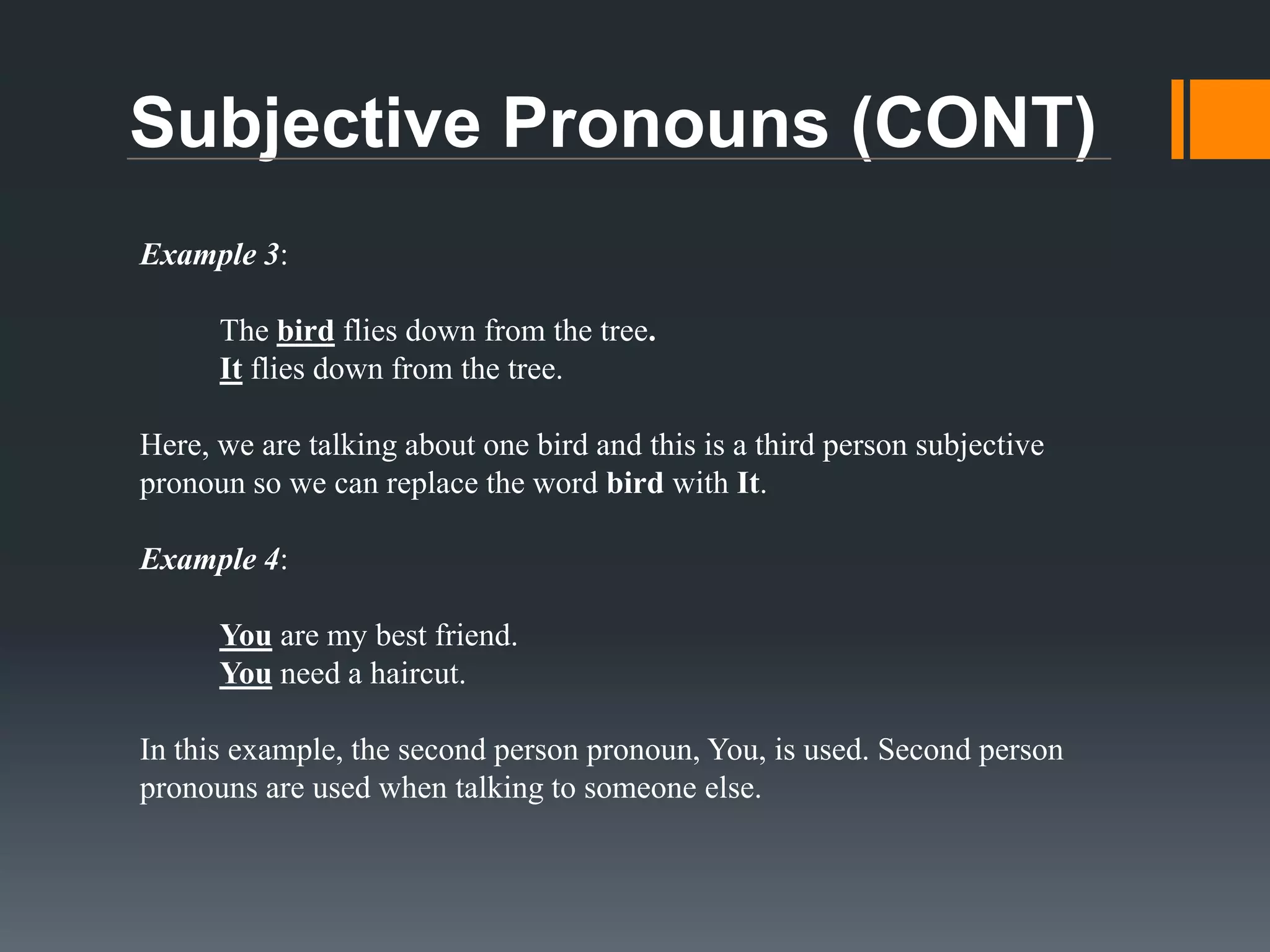
Example 3:
The bird flies down from the tree.
It flies down from the tree.
Here, we are talking about one bird and this is a third person subjective
pronoun so we can replace the word bird with It.
Example 4:
You are my best friend.
You need a haircut.
In this example, the second person pronoun, You, is used. Second person
pronouns are used when talking to someone else.
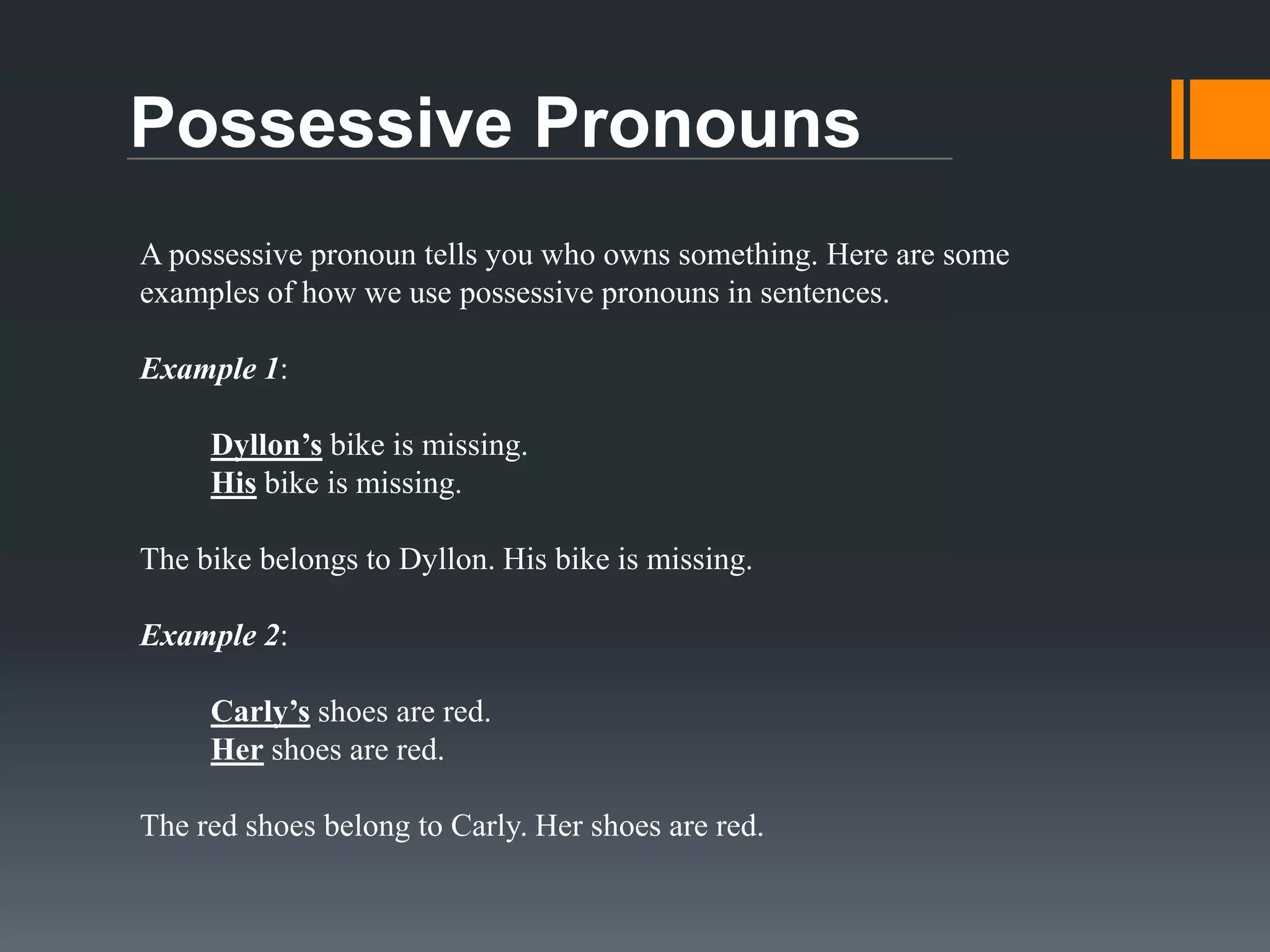
Possessive Pronouns
A possessive pronoun tells you who owns something. Here are some
examples of how we use possessive pronouns in sentences.
Example 1:
Dyllon’s bike is missing.
His bike is missing.
The bike belongs to Dyllon. His bike is missing.
Example 2:
Carly’s shoes are red.
Her shoes are red.
The red shoes belong to Carly. Her shoes are red.
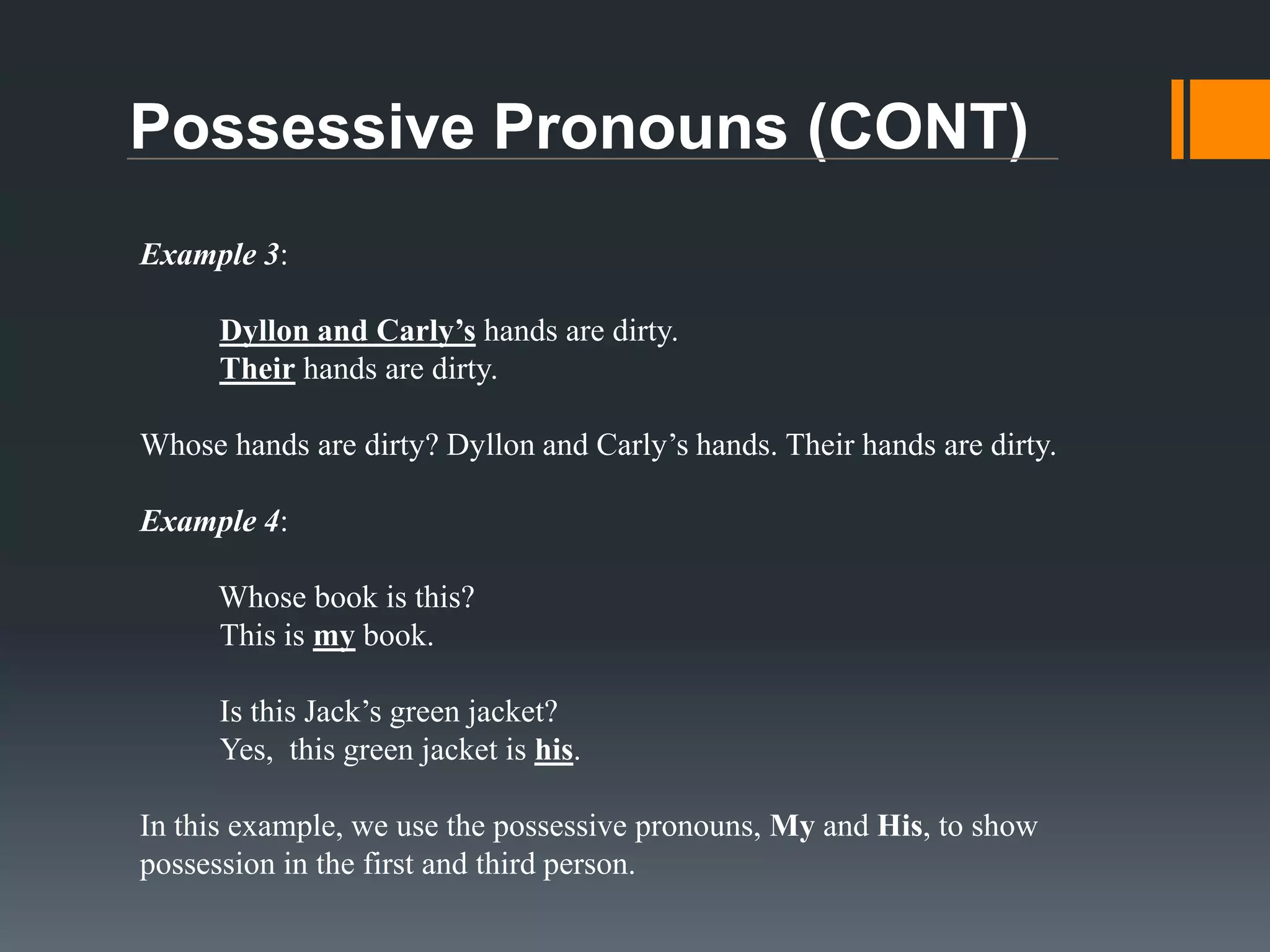
Possessive Pronouns (CONT)
Example 3:
Dyllon and Carly’s hands are dirty.
Their hands are dirty.
Whose hands are dirty? Dyllon and Carly’s. Their hands are dirty.

Example 4:
Whose book is this?
This is my book.
Is this Jack’s green jacket?
Yes, this green jacket is his.
In the two examples above we use the possessive pronouns, My and His,
to show possession in the first and third person.
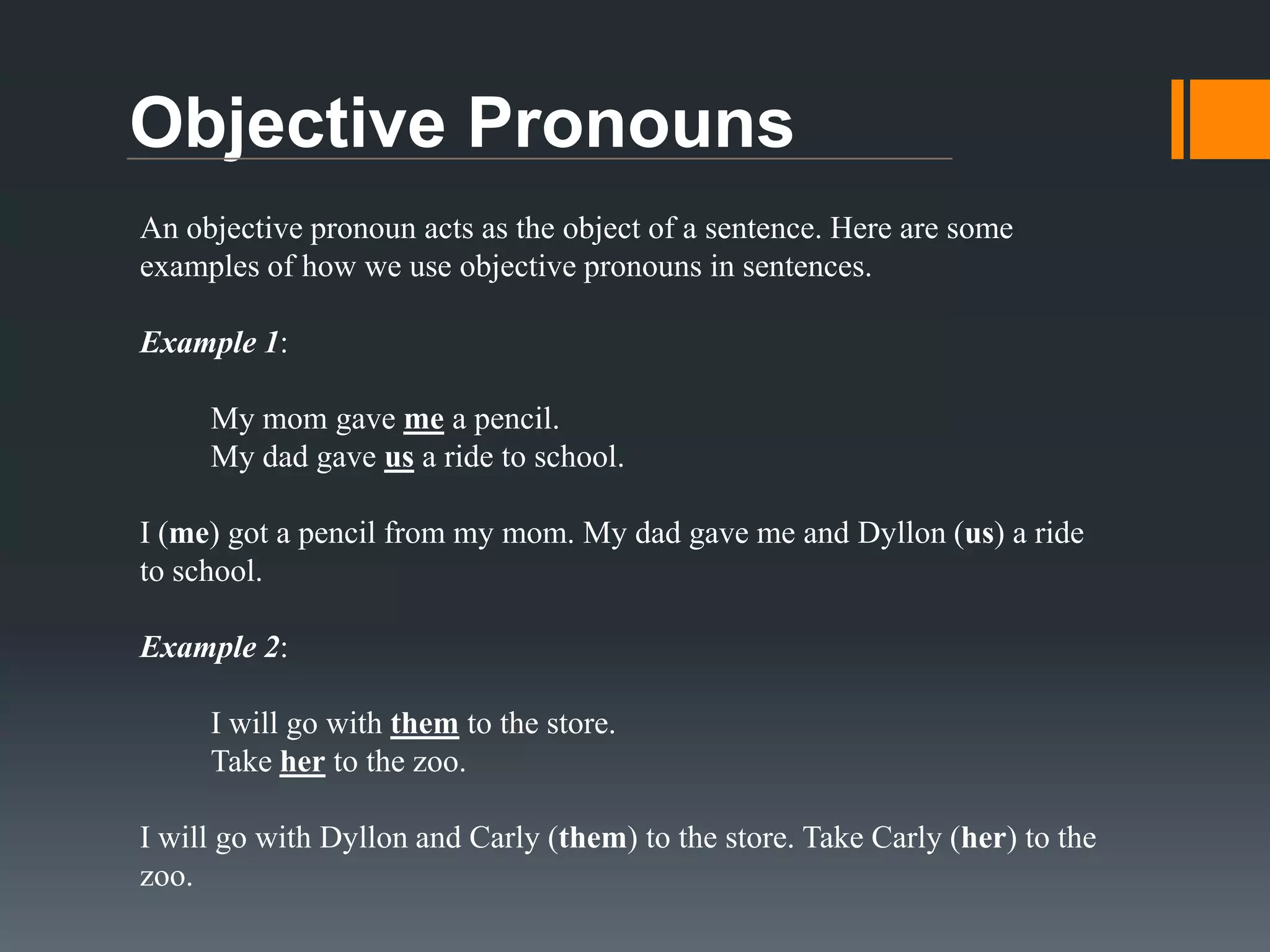
Objective Pronouns
An objective pronoun acts as the object of a sentence. Here are some
examples of how we use objective pronouns in sentences.
Example 1:
My mom gave me a pencil.
My dad gave us a ride to school.

I (me) got a pencil from my mom. My dad gave me and Dyllon (us) a ride
to school.
Example 2:
I will go with them to the store.
Take her to the zoo.
I will go with Dyllon and Carly (them) to the store. Take Carly (her) to the
zoo.
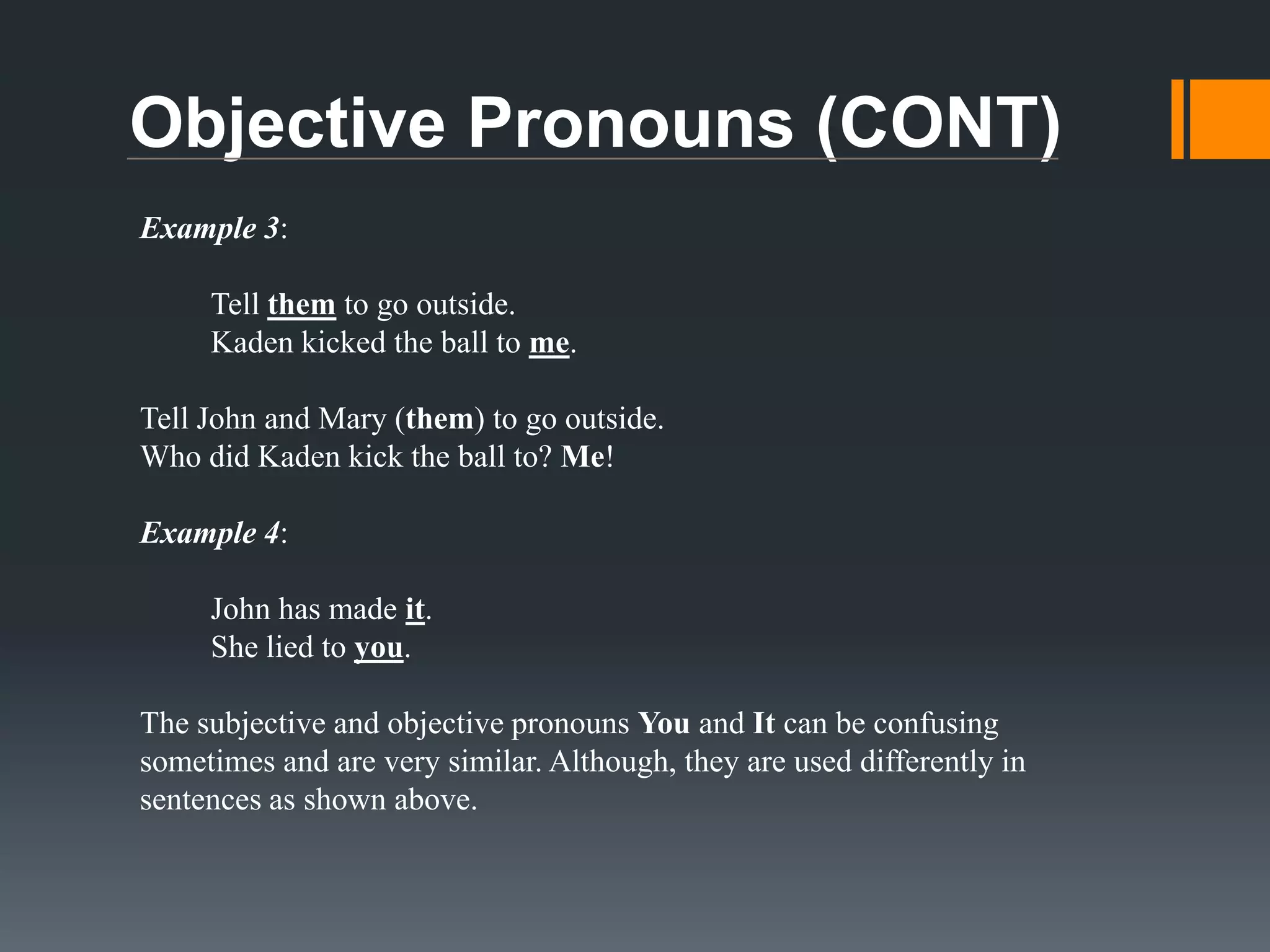
Objective Pronouns (CONT)
Example 3:
Tell them to go outside.
Kaden kicked the ball to me.
Tell John and Mary (them) to go outside.
Who did Kaden kick the ball to? Me!

Example 4:
John made it.
She lied to you.

You eat it.
That is so you.

You don’t get it at all.
I’ll see you later.

The subjective and objective pronouns You and It can be confusing
sometimes. Subjective pronouns (It, You) usually come first in the
sentence. On the other hand, objective pronouns (It, You) always appear in
the middle or end of a sentence.
Quick Review
What are Pronouns?
- Pronouns are words that take the place of nouns.

- Some pronouns take the place of nouns in the subject part of a sentence.
- There are many forms of pronouns and they are:
- Subjective ( he, I, it, she, they, we, and you ), Objective ( her,
him, it, me, them, us, and you ), Possessive ( hers, his, its, mine,
ours, theirs, yours ), Reflexive ( herself, himself, itself, myself,
ourselves, themselves, and yourself ), and Indefinite ( anybody,
anyone, anything, everybody, everyone, everything, nobody, no
one, none nothing, somebody, someone, something )

- We can use pronouns in the First, Second, and Third Person.
Worksheet Activities
Pronouns Activities
Now that you have learned about pronouns and
some of their forms. It is time for you to
practice. The next few pages have activity
worksheets that you can do to practice using
pronouns in sentences.
Complete the activity worksheets and compare
your answers to the answer sheets at the end.
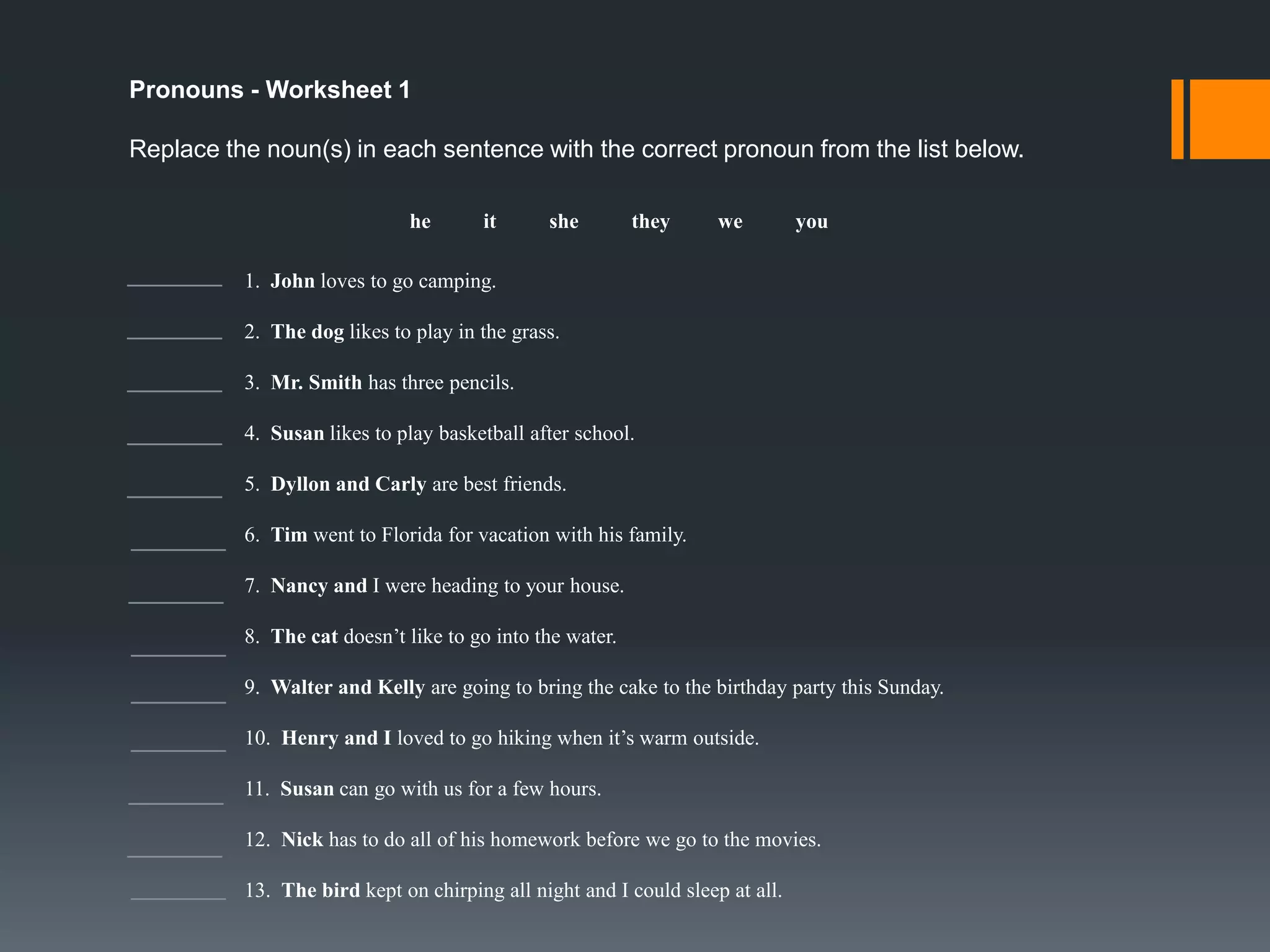
Pronouns - Worksheet 1
Replace the noun(s) in each sentence with the correct pronoun from the list below.
he

it

she

they

we

you

1. John loves to go camping.
2. The dog likes to play in the grass.
3. Mr. Smith has three pencils.
4. Susan likes to play basketball after school.
5. Dyllon and Carly are best friends.
6. Tim went to Florida for vacation with his family.

7. Nancy and I were heading to your house.
8. The cat doesn’t like to go into the water.
9. Walter and Kelly are going to bring the cake to the birthday party this Sunday.
10. Henry and I loved to go hiking when it’s warm outside.
11. Susan can go with us for a few hours.
12. Nick has to do all of his homework before we go to the movies.
13. The bird kept on chirping all night and I could sleep at all.
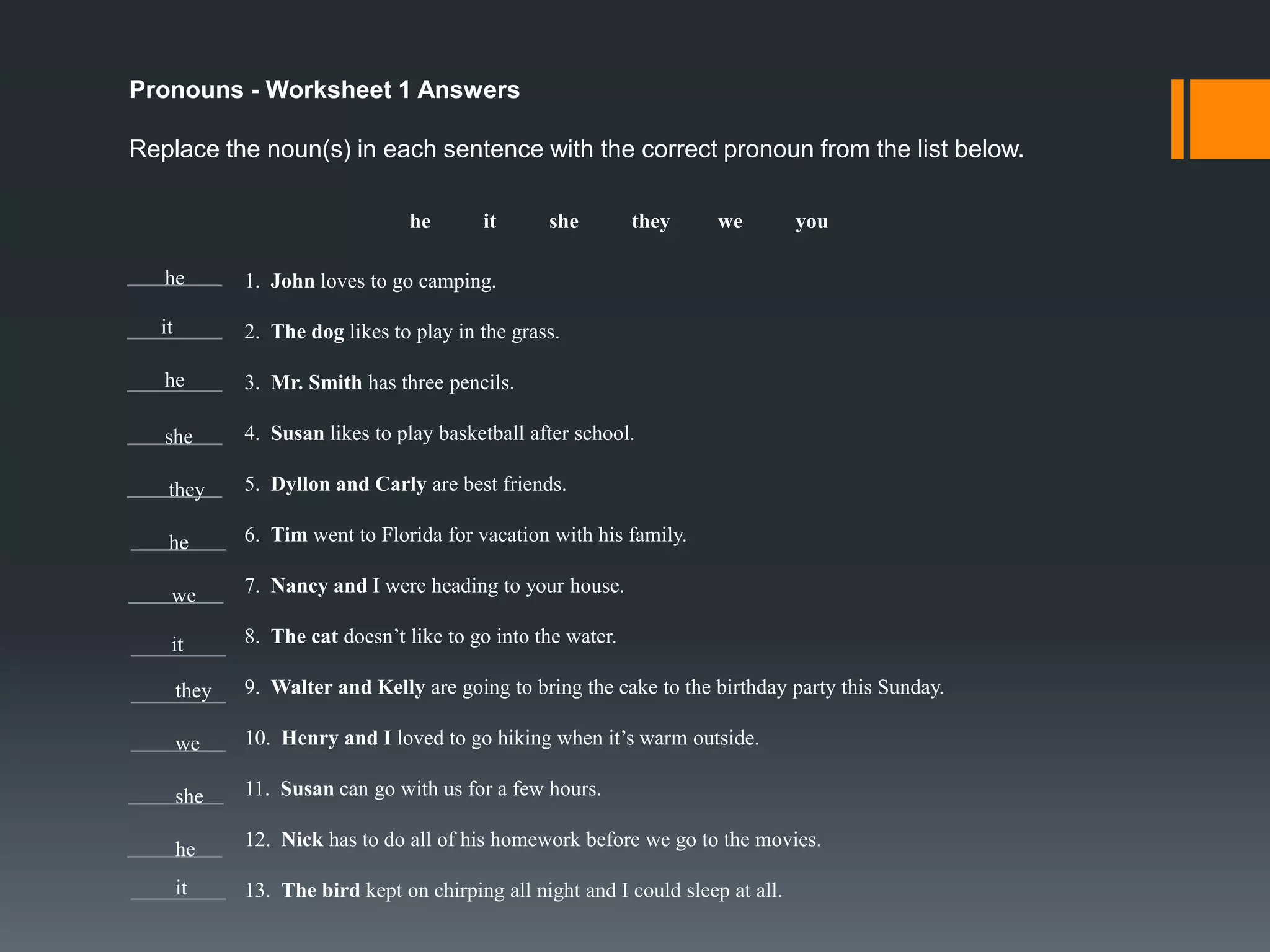
Pronouns - Worksheet 1 Answers
Replace the noun(s) in each sentence with the correct pronoun from the list below.
he

it

she

they

we

you

he

1. John loves to go camping.

it

2. The dog likes to play in the grass.

he

3. Mr. Smith has three pencils.

she

4. Susan likes to play basketball after school.

they

5. Dyllon and Carly are best friends.

he

6. Tim went to Florida for vacation with his family.

we

7. Nancy and I were heading to your house.

it

8. The cat doesn’t like to go into the water.

they

9. Walter and Kelly are going to bring the cake to the birthday party this Sunday.

we

10. Henry and I loved to go hiking when it’s warm outside.

she

11. Susan can go with us for a few hours.

he

12. Nick has to do all of his homework before we go to the movies.

it

13. The bird kept on chirping all night and I could sleep at all.
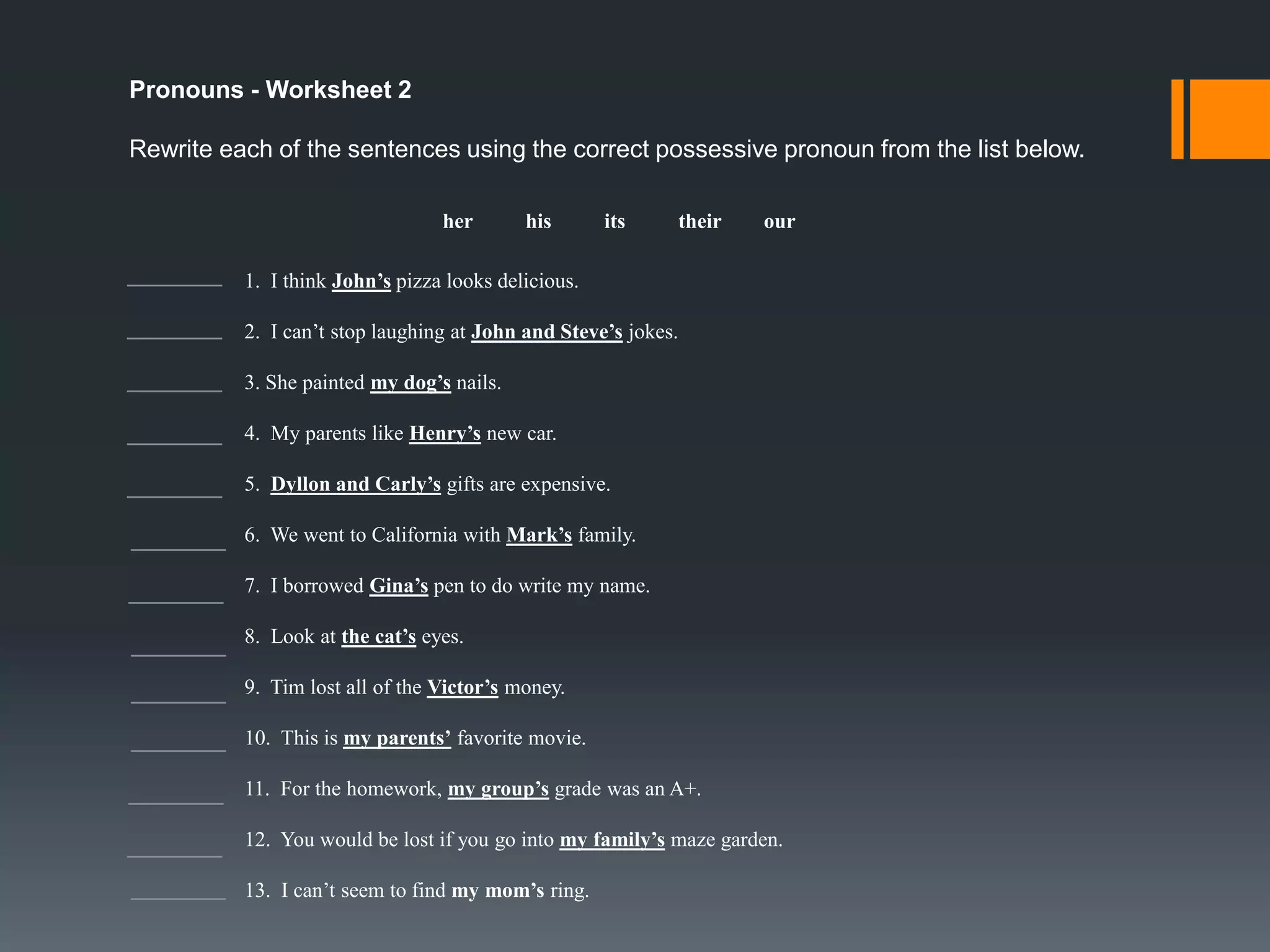
Pronouns - Worksheet 2
Rewrite each of the sentences using the correct possessive pronoun from the list below.
her

his

its

their

our

1. I think John’s pizza looks delicious.
2. I can’t stop laughing at John and Steve’s jokes.
3. She painted my dog’s nails.
4. My parents like Henry’s new car.
5. Dyllon and Carly’s gifts are expensive.
6. We went to California with Mark’s family.

7. I borrowed Gina’s pen to do write my name.
8. Look at the cat’s eyes.
9. Tim lost all of the Victor’s money.
10. This is my parents’ favorite movie.
11. For the homework, my group’s grade was an A+.
12. You would be lost if you go into my family’s maze garden.
13. I can’t seem to find my mom’s ring.
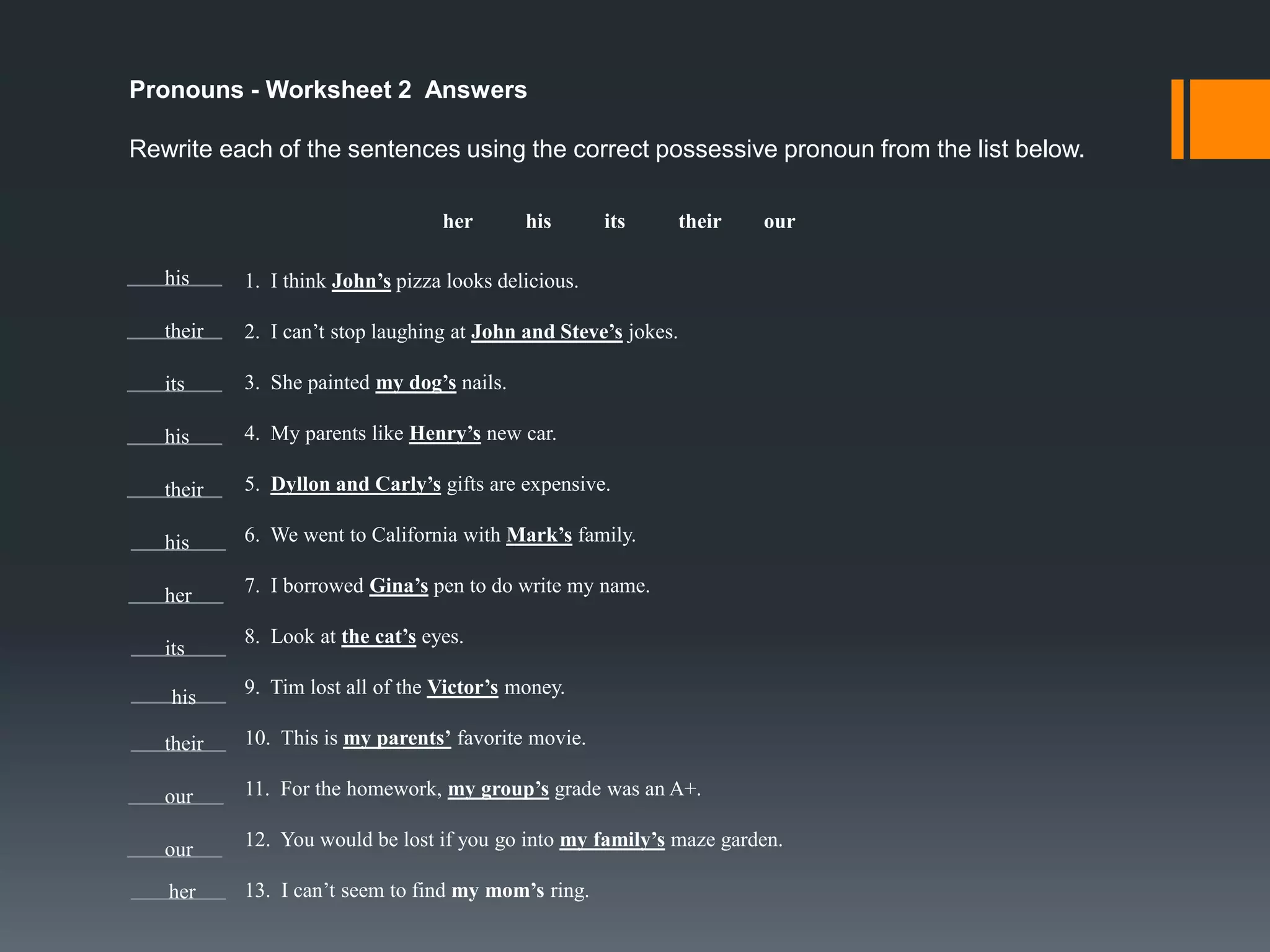
Pronouns - Worksheet 2 Answers
Rewrite each of the sentences using the correct possessive pronoun from the list below.
her

his

its

their

his

1. I think John’s pizza looks delicious.

their

2. I can’t stop laughing at John and Steve’s jokes.

its

3. She painted my dog’s nails.

his

4. My parents like Henry’s new car.

their

5. Dyllon and Carly’s gifts are expensive.

his

6. We went to California with Mark’s family.

her

our

7. I borrowed Gina’s pen to do write my name.

its
his

8. Look at the cat’s eyes.
9. Tim lost all of the Victor’s money.

their

10. This is my parents’ favorite movie.

our

11. For the homework, my group’s grade was an A+.

our

12. You would be lost if you go into my family’s maze garden.

her

13. I can’t seem to find my mom’s ring.
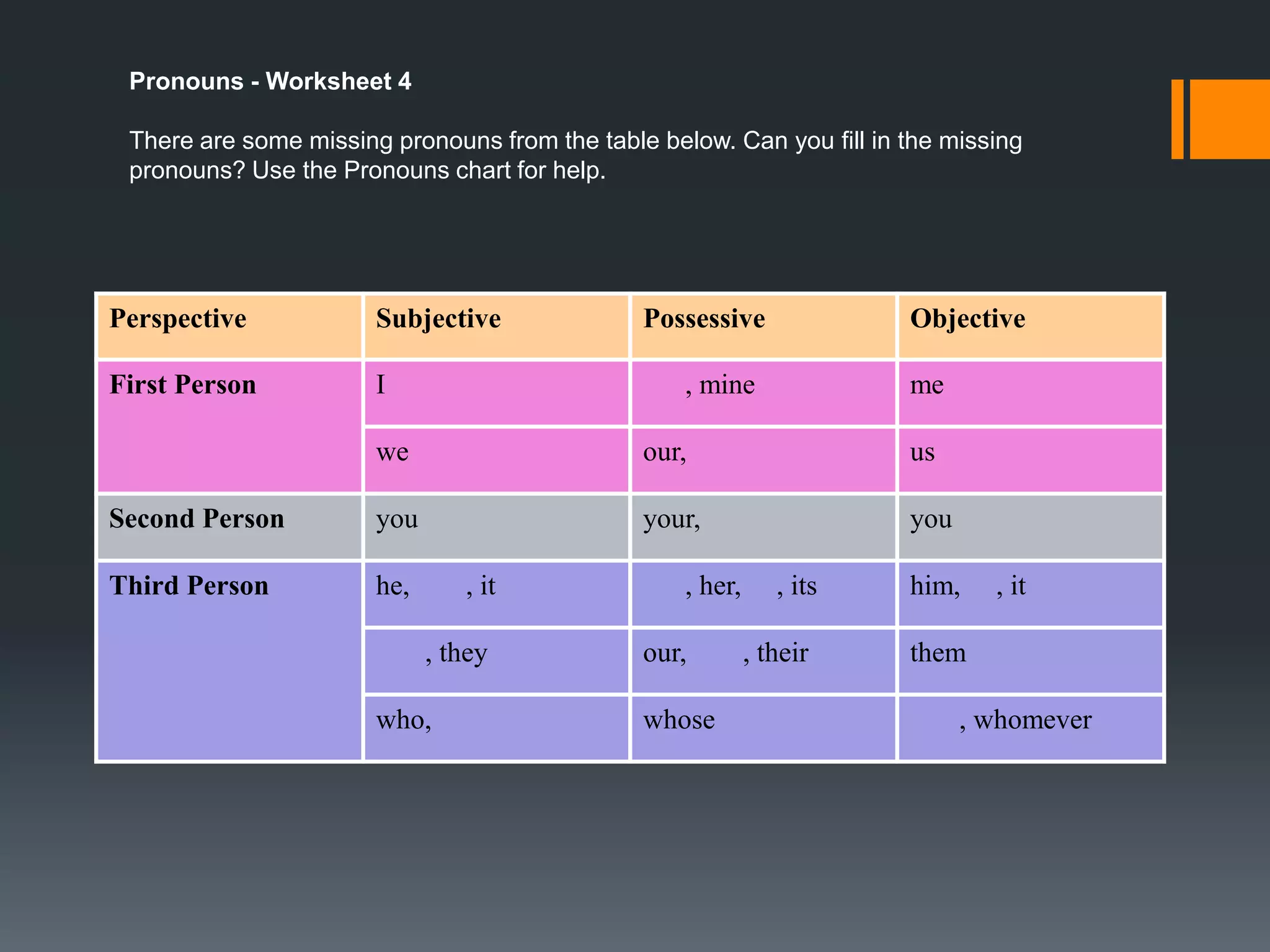
Pronouns - Worksheet 4
There are some missing pronouns from the table below. Can you fill in the missing
pronouns? Use the Pronouns chart for help.

Perspective

Subjective

Possessive

Objective

First Person

I

____ , mine

me

we

our, ____

us

Second Person

you

your, ____

you

Third Person

he, ____ , it

____ , her, ____ , its

him, ____ , it

____ , they

our, ____ , their

them

who, ____

whose

____ , whomever
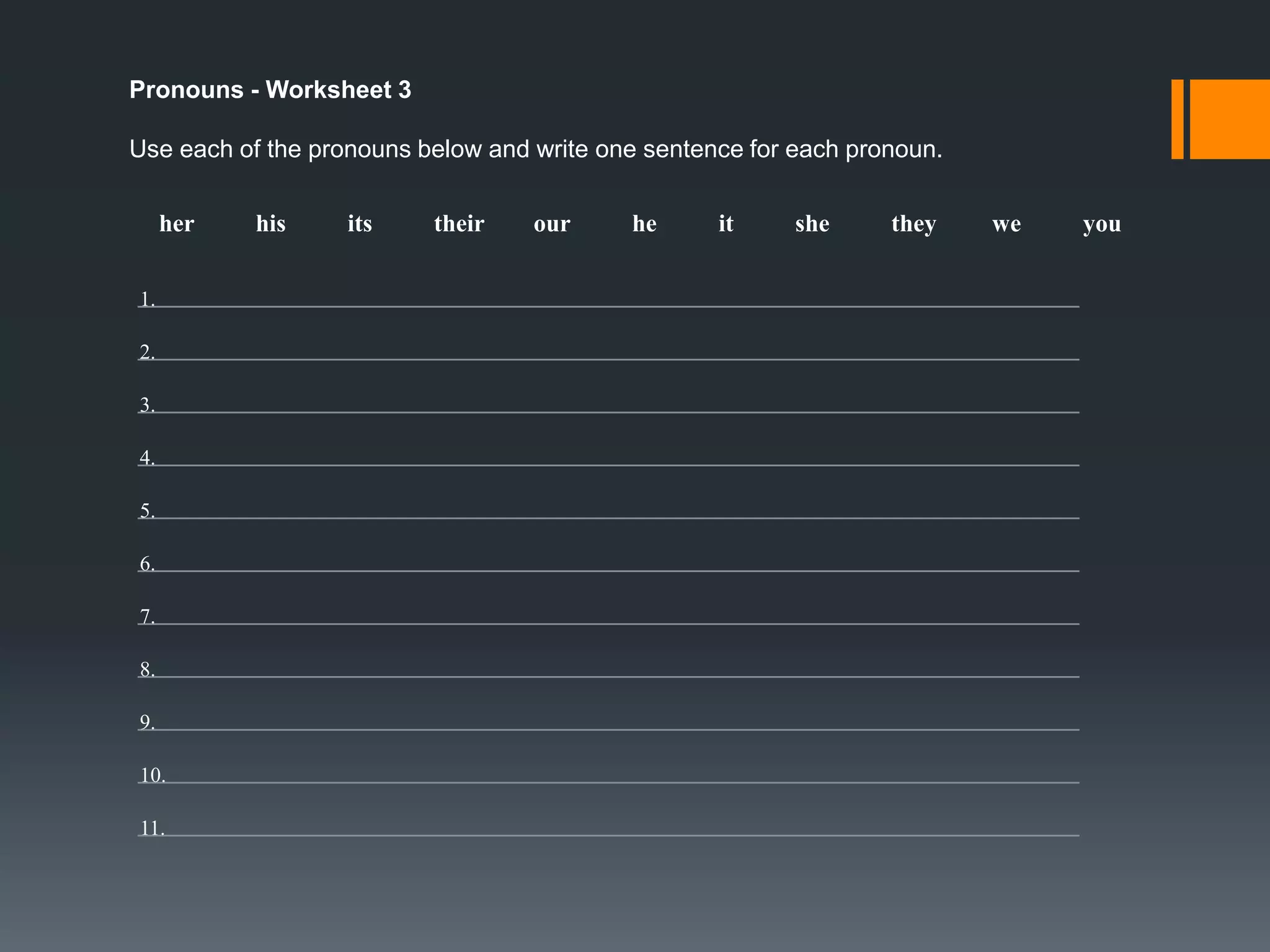
Pronouns - Worksheet 3
Use each of the pronouns below and write one sentence for each pronoun.
her
1.
2.
3.
4.
5.
6.
7.
8.
9.
10.
11.

his

its

their

our

he

it

she

they

we

you
Pronouns - Worksheet 4
Circle or underline the correct pronoun in each sentence.
1. Sarah said she can finish baking the cake by ( himself, herself ).
2. Mr. Johnson loves to teach math class because it’s ( her, his ) favorite subject.
3. My dog likes to run around and chase ( it, its ) tail.
4. Mom and dad don’t like ( they, their ) breakfast cold.
5. ( She, He ) likes to wear the purple dress to the dance with Mike.
6. Molly loves to go fishing with ( his, her ) father.

7. Can you fix the bicycle ( myself, yourself )?
8. Jack and Jill are going to ( they, their ) favorite playground.
9. The cat doesn’t like to eat ( it, its ) food.
10. Mrs. Weaver has 10 students in ( her, hers ) class.
11. Dyllon’s shoes are missing and ( his, he ) doesn’t know where they are.
12. Carly and I need to finish ( us, our ) homework before we go.
13. Please give ( me, my ) three minutes to read this question.
Pronouns - Worksheet 4 Answers
Circle or underline the correct pronoun in each sentence.
1. Sarah said she can finish baking the cake by ( himself, herself ).
2. Mr. Johnson loves to teach math class because it’s ( her, his ) favorite subject.
3. My dog likes to run around and chase ( it, its ) tail.
4. Mom and dad don’t like ( they, their ) breakfast cold.
5. ( She, He ) likes to wear the purple dress to the dance with Mike.
6. Molly loves to go fishing with ( his, her ) father.

7. Can you fix the bicycle ( myself, yourself )?
8. Jack and Jill are going to ( they, their ) favorite playground.
9. The cat doesn’t like to eat ( it, its ) food.
10. Mrs. Weaver has 10 students in ( her, hers ) class.
11. Dyllon’s shoes are missing and ( his, he ) doesn’t know where they are.
12. Carly and I need to finish ( us, our ) homework before we go.
13. Please give ( me, my ) three minutes to read this question.

Nghi Nguyen Assignment 3

  • 1.
    Virtual Lesson CourseDesign and Teaching Online Nghi Nguyen November 12, 2013 EDTC 650 Assignment 3
  • 2.
  • 3.
    Lesson Outline We havebeen learning about Parts of Speech this past few weeks and have covered Noun and Verb. This week, our focus turns to Pronoun. Similar to other weeks, there are activity worksheets that you must complete at the end of this lesson.
  • 4.
  • 5.
    OBJECTIVES - Students willlearn about pronouns - Students will complete activities to get a better understanding of how to use pronouns in sentences
  • 6.
    What are Pronouns? -Pronouns are words that take the place of nouns. - Some pronouns take the place of nouns in the subject part of a sentence. Example 1 – Dyllon likes tennis. He likes tennis. Dyllon is replaced by He. Example 2 – Carly loves ice cream. She loves ice cream. Carly is replaced by She.
  • 7.
    Pronouns (CONT) - Thereare many forms of pronouns and they are: - Subjective ( he, I, it, she, they, we, and you ) - Objective ( her, him, it, me, them, us, and you ) - Possessive ( hers, his, its, mine, ours, theirs, yours ) - Reflexive ( herself, himself, itself, myself, ourselves, themselves, and yourself ) - Indefinite ( anybody, anyone, anything, everybody, everyone, everything, nobody, no one, none nothing, somebody, someone, something )
  • 8.
    Pronouns (CONT) To betterunderstand pronouns, we can group them by Perspective, meaning First Person, Second Person, and Third Person. View the chart below. Perspective Subjective Possessive Objective First Person I my, mine me we our, ours us Second Person you your, yours you Third Person he, she, it his, her, hers, its him, her, it we, they our, ours, their them who, whoever whose whom, whomever
  • 9.
  • 10.
    Subjective Pronouns A subjectivepronoun acts as the subject of a sentence. Here are some examples of how we use subjective pronouns in sentences. Example 1: Dyllon and Carly plan to have a birthday party this Saturday. They plan to have a birthday party this Saturday. So instead of using Dyllon and Carly, we can use the subjective third person pronoun, They. Example 2: Kaden reads the book. He reads the book. In this example, we replace Kaden with the subjective third person pronoun, He.
  • 11.
    Subjective Pronouns (CONT) Example3: The bird flies down from the tree. It flies down from the tree. Here, we are talking about one bird and this is a third person subjective pronoun so we can replace the word bird with It. Example 4: You are my best friend. You need a haircut. In this example, the second person pronoun, You, is used. Second person pronouns are used when talking to someone else.
  • 12.
    Possessive Pronouns A possessivepronoun tells you who owns something. Here are some examples of how we use possessive pronouns in sentences. Example 1: Dyllon’s bike is missing. His bike is missing. The bike belongs to Dyllon. His bike is missing. Example 2: Carly’s shoes are red. Her shoes are red. The red shoes belong to Carly. Her shoes are red.
  • 13.
    Possessive Pronouns (CONT) Example3: Dyllon and Carly’s hands are dirty. Their hands are dirty. Whose hands are dirty? Dyllon and Carly’s. Their hands are dirty. Example 4: Whose book is this? This is my book. Is this Jack’s green jacket? Yes, this green jacket is his. In the two examples above we use the possessive pronouns, My and His, to show possession in the first and third person.
  • 14.
    Objective Pronouns An objectivepronoun acts as the object of a sentence. Here are some examples of how we use objective pronouns in sentences. Example 1: My mom gave me a pencil. My dad gave us a ride to school. I (me) got a pencil from my mom. My dad gave me and Dyllon (us) a ride to school. Example 2: I will go with them to the store. Take her to the zoo. I will go with Dyllon and Carly (them) to the store. Take Carly (her) to the zoo.
  • 15.
    Objective Pronouns (CONT) Example3: Tell them to go outside. Kaden kicked the ball to me. Tell John and Mary (them) to go outside. Who did Kaden kick the ball to? Me! Example 4: John made it. She lied to you. You eat it. That is so you. You don’t get it at all. I’ll see you later. The subjective and objective pronouns You and It can be confusing sometimes. Subjective pronouns (It, You) usually come first in the sentence. On the other hand, objective pronouns (It, You) always appear in the middle or end of a sentence.
  • 16.
  • 17.
    What are Pronouns? -Pronouns are words that take the place of nouns. - Some pronouns take the place of nouns in the subject part of a sentence. - There are many forms of pronouns and they are: - Subjective ( he, I, it, she, they, we, and you ), Objective ( her, him, it, me, them, us, and you ), Possessive ( hers, his, its, mine, ours, theirs, yours ), Reflexive ( herself, himself, itself, myself, ourselves, themselves, and yourself ), and Indefinite ( anybody, anyone, anything, everybody, everyone, everything, nobody, no one, none nothing, somebody, someone, something ) - We can use pronouns in the First, Second, and Third Person.
  • 18.
  • 19.
    Pronouns Activities Now thatyou have learned about pronouns and some of their forms. It is time for you to practice. The next few pages have activity worksheets that you can do to practice using pronouns in sentences. Complete the activity worksheets and compare your answers to the answer sheets at the end.
  • 20.
    Pronouns - Worksheet1 Replace the noun(s) in each sentence with the correct pronoun from the list below. he it she they we you 1. John loves to go camping. 2. The dog likes to play in the grass. 3. Mr. Smith has three pencils. 4. Susan likes to play basketball after school. 5. Dyllon and Carly are best friends. 6. Tim went to Florida for vacation with his family. 7. Nancy and I were heading to your house. 8. The cat doesn’t like to go into the water. 9. Walter and Kelly are going to bring the cake to the birthday party this Sunday. 10. Henry and I loved to go hiking when it’s warm outside. 11. Susan can go with us for a few hours. 12. Nick has to do all of his homework before we go to the movies. 13. The bird kept on chirping all night and I could sleep at all.
  • 21.
    Pronouns - Worksheet1 Answers Replace the noun(s) in each sentence with the correct pronoun from the list below. he it she they we you he 1. John loves to go camping. it 2. The dog likes to play in the grass. he 3. Mr. Smith has three pencils. she 4. Susan likes to play basketball after school. they 5. Dyllon and Carly are best friends. he 6. Tim went to Florida for vacation with his family. we 7. Nancy and I were heading to your house. it 8. The cat doesn’t like to go into the water. they 9. Walter and Kelly are going to bring the cake to the birthday party this Sunday. we 10. Henry and I loved to go hiking when it’s warm outside. she 11. Susan can go with us for a few hours. he 12. Nick has to do all of his homework before we go to the movies. it 13. The bird kept on chirping all night and I could sleep at all.
  • 22.
    Pronouns - Worksheet2 Rewrite each of the sentences using the correct possessive pronoun from the list below. her his its their our 1. I think John’s pizza looks delicious. 2. I can’t stop laughing at John and Steve’s jokes. 3. She painted my dog’s nails. 4. My parents like Henry’s new car. 5. Dyllon and Carly’s gifts are expensive. 6. We went to California with Mark’s family. 7. I borrowed Gina’s pen to do write my name. 8. Look at the cat’s eyes. 9. Tim lost all of the Victor’s money. 10. This is my parents’ favorite movie. 11. For the homework, my group’s grade was an A+. 12. You would be lost if you go into my family’s maze garden. 13. I can’t seem to find my mom’s ring.
  • 23.
    Pronouns - Worksheet2 Answers Rewrite each of the sentences using the correct possessive pronoun from the list below. her his its their his 1. I think John’s pizza looks delicious. their 2. I can’t stop laughing at John and Steve’s jokes. its 3. She painted my dog’s nails. his 4. My parents like Henry’s new car. their 5. Dyllon and Carly’s gifts are expensive. his 6. We went to California with Mark’s family. her our 7. I borrowed Gina’s pen to do write my name. its his 8. Look at the cat’s eyes. 9. Tim lost all of the Victor’s money. their 10. This is my parents’ favorite movie. our 11. For the homework, my group’s grade was an A+. our 12. You would be lost if you go into my family’s maze garden. her 13. I can’t seem to find my mom’s ring.
  • 24.
    Pronouns - Worksheet4 There are some missing pronouns from the table below. Can you fill in the missing pronouns? Use the Pronouns chart for help. Perspective Subjective Possessive Objective First Person I ____ , mine me we our, ____ us Second Person you your, ____ you Third Person he, ____ , it ____ , her, ____ , its him, ____ , it ____ , they our, ____ , their them who, ____ whose ____ , whomever
  • 25.
    Pronouns - Worksheet3 Use each of the pronouns below and write one sentence for each pronoun. her 1. 2. 3. 4. 5. 6. 7. 8. 9. 10. 11. his its their our he it she they we you
  • 26.
    Pronouns - Worksheet4 Circle or underline the correct pronoun in each sentence. 1. Sarah said she can finish baking the cake by ( himself, herself ). 2. Mr. Johnson loves to teach math class because it’s ( her, his ) favorite subject. 3. My dog likes to run around and chase ( it, its ) tail. 4. Mom and dad don’t like ( they, their ) breakfast cold. 5. ( She, He ) likes to wear the purple dress to the dance with Mike. 6. Molly loves to go fishing with ( his, her ) father. 7. Can you fix the bicycle ( myself, yourself )? 8. Jack and Jill are going to ( they, their ) favorite playground. 9. The cat doesn’t like to eat ( it, its ) food. 10. Mrs. Weaver has 10 students in ( her, hers ) class. 11. Dyllon’s shoes are missing and ( his, he ) doesn’t know where they are. 12. Carly and I need to finish ( us, our ) homework before we go. 13. Please give ( me, my ) three minutes to read this question.
  • 27.
    Pronouns - Worksheet4 Answers Circle or underline the correct pronoun in each sentence. 1. Sarah said she can finish baking the cake by ( himself, herself ). 2. Mr. Johnson loves to teach math class because it’s ( her, his ) favorite subject. 3. My dog likes to run around and chase ( it, its ) tail. 4. Mom and dad don’t like ( they, their ) breakfast cold. 5. ( She, He ) likes to wear the purple dress to the dance with Mike. 6. Molly loves to go fishing with ( his, her ) father. 7. Can you fix the bicycle ( myself, yourself )? 8. Jack and Jill are going to ( they, their ) favorite playground. 9. The cat doesn’t like to eat ( it, its ) food. 10. Mrs. Weaver has 10 students in ( her, hers ) class. 11. Dyllon’s shoes are missing and ( his, he ) doesn’t know where they are. 12. Carly and I need to finish ( us, our ) homework before we go. 13. Please give ( me, my ) three minutes to read this question.