Credible or Click bait?
NCSMI, June 21, 2017
Stephanie Willen Brown
Director, Park Library @ UNC’s
School of Media & Journalism
Image from https://thenounproject.com/term/journalist/813630/
Writing Prompt
• Do you think you could spot fake stories?
• Why or why not?
• Have you ever been factually fooled by a social
media post?
Image from: https://thenounproject.com/term/write/774211/
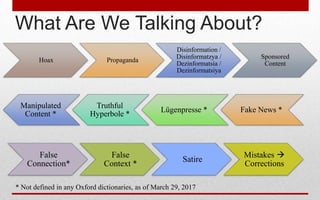
What Are We Talking About?
Hoax Propaganda
Disinformation /
Disinformatzya /
Dezinformatsia /
Dezinformatsiya
Sponsored
Content
Fake News *Lügenpresse *
Truthful
Hyperbole *
Manipulated
Content *
False
Connection*
False
Context *
Satire
Mistakes 
Corrections
* Not defined in any Oxford dictionaries, as of March 29, 2017
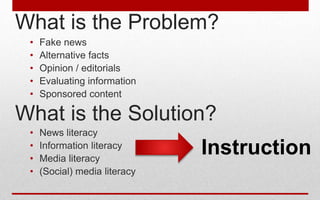
What is the Problem?
• Fake news
• Alternative facts
• Opinion / editorials
• Evaluating information
• Sponsored content
• News literacy
• Information literacy
• Media literacy
• (Social) media literacy
What is the Solution?
Instruction
What is the Solution?
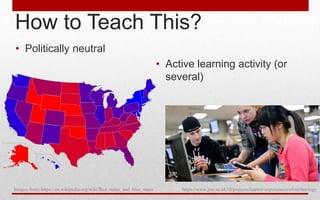
How to Teach This?
• Politically neutral
• Active learning activity (or
several)
Images from: https://en.wikipedia.org/wiki/Red_states_and_blue_states https://www.jisc.ac.uk/rd/projects/learner-experiences-of-technology
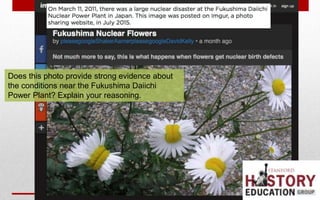
Does this photo provide strong evidence about
the conditions near the Fukushima Daiichi
Power Plant? Explain your reasoning.
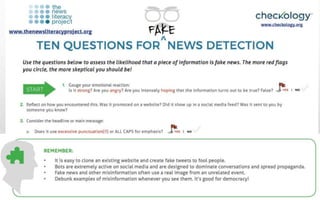
10 Questions for Fake News
Detection
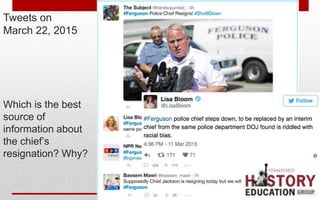
Tweets on
March 22, 2015
Which is the best
source of
information about
the chief’s
resignation? Why?
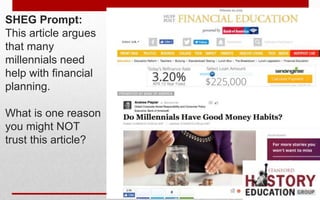
SHEG Prompt:
This article argues
that many
millennials need
help with financial
planning.
What is one reason
you might NOT
trust this article?
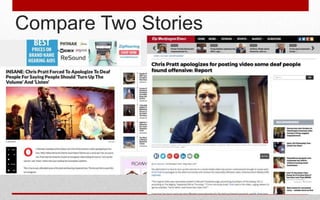
Compare Two Stories
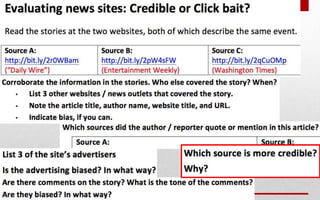
3-page Checklist
Resources
• Brown, Stephanie W. “Checking Facts.” UNC School of
Media & Journalism, April 5, 2017.
http://guides.lib.unc.edu/mejo153/checkingFacts
• Further resources on overcoming fake news
• Lesson plans
• Recommended fact checking sites
• Sources for this presentation
• Articles & podcasts about News Literacy:
https://pinboard.in/u:CogSciLibrarian/t:NewsLiteracy/

News: Credible or Click-bait?

  • 1.
    Credible or Clickbait? NCSMI, June 21, 2017 Stephanie Willen Brown Director, Park Library @ UNC’s School of Media & Journalism Image from https://thenounproject.com/term/journalist/813630/
  • 2.
    Writing Prompt • Doyou think you could spot fake stories? • Why or why not? • Have you ever been factually fooled by a social media post? Image from: https://thenounproject.com/term/write/774211/
  • 3.
    What Are WeTalking About? Hoax Propaganda Disinformation / Disinformatzya / Dezinformatsia / Dezinformatsiya Sponsored Content Fake News *Lügenpresse * Truthful Hyperbole * Manipulated Content * False Connection* False Context * Satire Mistakes  Corrections * Not defined in any Oxford dictionaries, as of March 29, 2017
  • 4.
    What is theProblem? • Fake news • Alternative facts • Opinion / editorials • Evaluating information • Sponsored content • News literacy • Information literacy • Media literacy • (Social) media literacy What is the Solution? Instruction
  • 5.
    What is theSolution?
  • 6.
    How to TeachThis? • Politically neutral • Active learning activity (or several) Images from: https://en.wikipedia.org/wiki/Red_states_and_blue_states https://www.jisc.ac.uk/rd/projects/learner-experiences-of-technology
  • 7.
    Does this photoprovide strong evidence about the conditions near the Fukushima Daiichi Power Plant? Explain your reasoning.
  • 11.
    10 Questions forFake News Detection
  • 12.
    Tweets on March 22,2015 Which is the best source of information about the chief’s resignation? Why?
  • 13.
    SHEG Prompt: This articleargues that many millennials need help with financial planning. What is one reason you might NOT trust this article?
  • 14.
  • 15.
  • 16.
    Resources • Brown, StephanieW. “Checking Facts.” UNC School of Media & Journalism, April 5, 2017. http://guides.lib.unc.edu/mejo153/checkingFacts • Further resources on overcoming fake news • Lesson plans • Recommended fact checking sites • Sources for this presentation • Articles & podcasts about News Literacy: https://pinboard.in/u:CogSciLibrarian/t:NewsLiteracy/

Editor's Notes

  • #2 Activities & discussion Activities  discussion How you can think about issues, How you can teach students to think about issues
  • #4 conspiracy - definition of conspiracy in English | Oxford Dictionaries https://en.oxforddictionaries.com/definition/conspiracy A secret plan by a group to do something unlawful or harmful.
  • #8 Are ‘Mutated’ Daisies Really Caused by Fukushima Radiation? http://news.nationalgeographic.com/2015/07/150723-fukushima-mutated-daisies-flowers-radiation-science/ “plant scientists aren’t so sure. It’s possible the radiation could be involved, but there are a number of other explanations as well, they say. “Twitter user @san_kaido first shared the picture in late May, from Nasushiobara City. That’s about 108 miles (173 kilometers) southwest of the Fukushima Daiichi power plant, which was disabled by the March 2011 tsunami and leaked radiation into the environment.” … “It’s possible the flower deformity could have been induced by radiation, says Jeffrey J. Doyle, a professor of plant biology at Cornell University. However, “this is a pretty common mutation in daisies that I’ve seen sporadically in various places not associated with radioactivity,” he says. “There are many factors that can cause the oddity, Doyle says, from chemicals to diseases, a hormone imbalance, or random mutations to inherited genes. This particular malformation has been seen in numerous species of the world’s 20,000 members of the daisy family, from Holland to Idaho. “He's not ruling out a role for Fukushima: “It wouldn’t surprise me to find mutations of all types, including this one, in places that have higher than average levels of mutagenic agents, such as a radioactive site or toxic waste dump.”” … “Beth Krizek, a plant biologist at the University of South Carolina, agrees that radiation is a possible cause of the flower oddity, but says there are many other possible explanations. ““It’s not that rare,” Krizek says of the odd daisies. “You could occasionally see this just in plants growing in your garden.” “
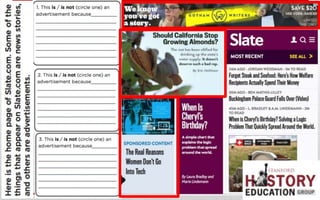
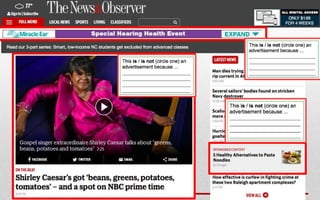
  • #9 Middle school students could not tell that the third box was sponsored content. Even when they did, they didn’t realize it didn’t count as a news article because it was sponsored.
  • #10 News & Observer 06/18/17 @ 10 am http://www.newsobserver.com
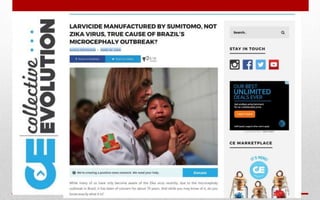
  • #11 http://www.collective-evolution.com/2016/06/29/larvicide-manufactured-by-sumitomo-not-zika-virus-true-cause-of-brazils-microcephaly-outbreak/
  • #13 As part of Stanford University’s study of students and online news, it asked middle schoolers which of the four tweets, above, were the most trustworthy. More than half of the 204 students responding trusted Lisa Bloom’s tweet more the one from NPR, noting it had the most information. A sample student response: ‘The best tweet for information is the first one because it actually shows him resigning in a picture, and it gives a caption saying that he is resigning.’ PHOTO: STANFORD HISTORY EDUCATION GROUP Who Is Lisa Bloom? Donald Trump's Accuser Is Being Represented By A Powerful Attorney Bloom is the daughter of legendary women's rights attorney Gloria Allred, who is representing several of the other women who have accused Trump of sexually assaulting them over the years. https://www.bustle.com/articles/192971-who-is-lisa-bloom-donald-trumps-accuser-is-being-represented-by-a-powerful-attorney https://www.wsj.com/articles/most-students-dont-know-when-news-is-fake-stanford-study-finds-1479752576#livefyre-toggle-SB11094844722466913615704582450552794350544
  • #14 Quoted in Wall Street Journal. As part of Stanford University’s study of students and online news, it asked middle schoolers to give reasons they might not trust the article by a Bank of America executive on financial planning. Almost 70% of 200 students responding didn't highlight the authorship as a reason for mistrust. A sample response: ‘I wouldn’t trust it because some millennials do have good money habits.’ PHOTO: STANFORD HISTORY EDUCATION GROUP https://www.wsj.com/articles/most-students-dont-know-when-news-is-fake-stanford-study-finds-1479752576#livefyre-toggle-SB11094844722466913615704582450552794350544 Stanford Used this site – objectivity of author? PRESENTED BY BANK OF AMERICA Do Millennials Have Good Money Habits? http://web.archive.org/web/20150220072156/http://www.huffingtonpost.com/andrew-plepler/millennial-money-habits_b_6350612.html? Andrew Plepler Become a fan  Global Corporate Social Responsibility and Consumer Policy Executive, Bank of America®
  • #15 http://www.dailywire.com/news/16157/insane-chris-pratt-forced-apologize-deaf-people-ben-shapiro# http://www.washingtontimes.com/news/2017/may/5/chris-pratt-apologizes-for-posting-video-that-some/ (found by Sara Salinas, 05/11/17)
  • #17 Stop worrying about fake news. What comes next will be much worse | Jonathan Albright | Opinion | The Guardian https://www.theguardian.com/commentisfree/2016/dec/09/fake-news-technology-filters