Lesson plan –
Fake News
10-12 years
Media Literacy for All
What is fake news?
Fake News: Made-up stories or information that may look
like real news but is not true.
Fake news is created to trick people into believing things
that are not real.
What is fake news?
Misinformation: Wrong or false information that is shared
by mistake.
Sometimes, people don't check the facts before sharing
something, and it can lead to misinformation.
What is fake news?
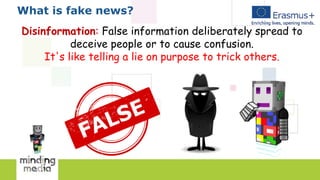
Disinformation: False information deliberately spread to
deceive people or to cause confusion.
It's like telling a lie on purpose to trick others.
What is fake news?
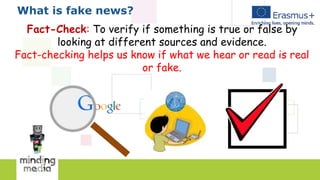
Fact-Check: To verify if something is true or false by
looking at different sources and evidence.
Fact-checking helps us know if what we hear or read is real
or fake.
What is fake news?
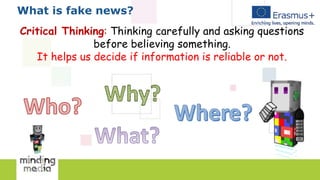
Critical Thinking: Thinking carefully and asking questions
before believing something.
It helps us decide if information is reliable or not.
Vocabulary
What does each term mean?
• Hoax
• Media Literacy
• Source
• Internet Safety
• Clickbait
What is fake news?
Let’s play Fact or Fiction Telephone!
What is fake news?
How did the facts change from the original one
as they went around the circle?
Reality or imagination?
There is a saying that a
picture speaks more than a
thousand words, but those
thousand words can
sometimes deceive us!
Reality or imagination?
Take a look at the following
photographs.
Do you think they are “real”?
Reality or imagination?
What is fake news?
Not all media message want to deceive us
BUT…
All media messages compete for our attention, therefore
sometimes people create interesting messages that are not
necessarily true.
We should think
twice before we
believe in something
and share it!
Fact or Opinion?
Do you know what facts
are?
How would you define
them?
Fact or Opinion?
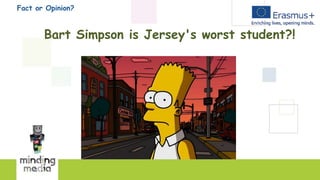
Bart Simpson is Jersey's worst student?!
Fact or Opinion?
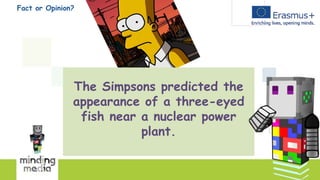
The Simpsons predicted the
appearance of a three-eyed
fish near a nuclear power
plant.
Fact or Opinion?
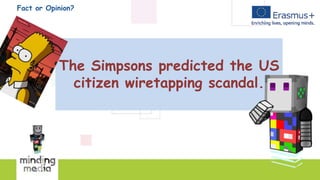
The Simpsons predicted the US
citizen wiretapping scandal.
Fact or Opinion?
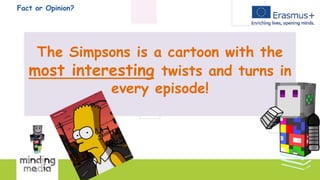
The Simpsons is a cartoon with the
most interesting twists and turns in
every episode!
Fact or Opinion?
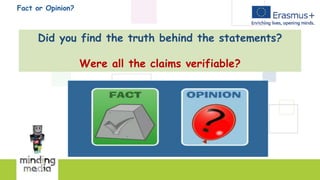
Did you find the truth behind the statements?
Were all the claims verifiable?
Debunking fake news
1.Who created/published that media
message?
2.What is the purpose of the message?
3.Are there actual facts, or someone's
personal attitude or opinion?
4.Who is this media message intended for?
Debunking fake news
Act like Sherlock Holmes!
Which of the following are True?
Debunking fake news
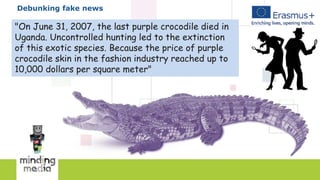
"On June 31, 2007, the last purple crocodile died in
Uganda. Uncontrolled hunting led to the extinction
of this exotic species. Because the price of purple
crocodile skin in the fashion industry reached up to
10,000 dollars per square meter"
Debunking fake news
In 2013, Dalibor J. from Serbia (near Paracin)
broke the Guinness record for unrolling a roll
of toilet paper with one hand. He unrolled a
roll of toilet paper in 9.8 seconds.
Debunking fake news
Although we all know about Caesar salad, there is
information that indicates that Caesar liked potato
soup the most. Which he prepared for himself every
day. In addition to potatoes, in the soup he also put
some carrots, ginger, onion and pepper.
Debunking fake news
Did you discover the true
statement?
Was it easy?
What is fake news?
Untrustworthy information is very common in
media because nowadays almost everyone can
create their own media messages.
Remeber how to spot the difference
between fakes and facts!
Clipart: https://clipart-library.com/

Fake News 10-12.pptx

  • 1.
    Lesson plan – FakeNews 10-12 years Media Literacy for All
  • 2.
    What is fakenews? Fake News: Made-up stories or information that may look like real news but is not true. Fake news is created to trick people into believing things that are not real.
  • 3.
    What is fakenews? Misinformation: Wrong or false information that is shared by mistake. Sometimes, people don't check the facts before sharing something, and it can lead to misinformation.
  • 4.
    What is fakenews? Disinformation: False information deliberately spread to deceive people or to cause confusion. It's like telling a lie on purpose to trick others.
  • 5.
    What is fakenews? Fact-Check: To verify if something is true or false by looking at different sources and evidence. Fact-checking helps us know if what we hear or read is real or fake.
  • 6.
    What is fakenews? Critical Thinking: Thinking carefully and asking questions before believing something. It helps us decide if information is reliable or not.
  • 7.
    Vocabulary What does eachterm mean? • Hoax • Media Literacy • Source • Internet Safety • Clickbait
  • 8.
    What is fakenews? Let’s play Fact or Fiction Telephone!
  • 9.
    What is fakenews? How did the facts change from the original one as they went around the circle?
  • 10.
    Reality or imagination? Thereis a saying that a picture speaks more than a thousand words, but those thousand words can sometimes deceive us!
  • 11.
    Reality or imagination? Takea look at the following photographs. Do you think they are “real”?
  • 12.
  • 13.
  • 14.
  • 15.
  • 16.
  • 17.
  • 18.
    What is fakenews? Not all media message want to deceive us BUT… All media messages compete for our attention, therefore sometimes people create interesting messages that are not necessarily true. We should think twice before we believe in something and share it!
  • 19.
    Fact or Opinion? Doyou know what facts are? How would you define them?
  • 20.
    Fact or Opinion? BartSimpson is Jersey's worst student?!
  • 21.
    Fact or Opinion? TheSimpsons predicted the appearance of a three-eyed fish near a nuclear power plant.
  • 22.
    Fact or Opinion? TheSimpsons predicted the US citizen wiretapping scandal.
  • 23.
    Fact or Opinion? TheSimpsons is a cartoon with the most interesting twists and turns in every episode!
  • 24.
    Fact or Opinion? Didyou find the truth behind the statements? Were all the claims verifiable?
  • 25.
    Debunking fake news 1.Whocreated/published that media message? 2.What is the purpose of the message? 3.Are there actual facts, or someone's personal attitude or opinion? 4.Who is this media message intended for?
  • 26.
    Debunking fake news Actlike Sherlock Holmes! Which of the following are True?
  • 27.
    Debunking fake news "OnJune 31, 2007, the last purple crocodile died in Uganda. Uncontrolled hunting led to the extinction of this exotic species. Because the price of purple crocodile skin in the fashion industry reached up to 10,000 dollars per square meter"
  • 28.
    Debunking fake news In2013, Dalibor J. from Serbia (near Paracin) broke the Guinness record for unrolling a roll of toilet paper with one hand. He unrolled a roll of toilet paper in 9.8 seconds.
  • 29.
    Debunking fake news Althoughwe all know about Caesar salad, there is information that indicates that Caesar liked potato soup the most. Which he prepared for himself every day. In addition to potatoes, in the soup he also put some carrots, ginger, onion and pepper.
  • 30.
    Debunking fake news Didyou discover the true statement? Was it easy?
  • 31.
    What is fakenews? Untrustworthy information is very common in media because nowadays almost everyone can create their own media messages. Remeber how to spot the difference between fakes and facts! Clipart: https://clipart-library.com/