Fighting HAI’s with
Environmental Hygiene
Rémi Charlebois, M.Sc., Mcb.A., RMCCM
Objectives
• Review the burden of HAI’s
• Understand the importance of disinfection
• Get to know the best practices in environmental hygiene
• Investigate what makes a good disinfectant
• Overview validation procedures
The Burden of HAI’s
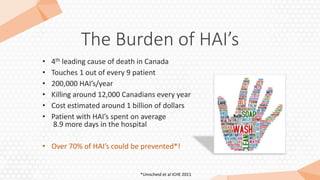
• 4th leading cause of death in Canada
• Touches 1 out of every 9 patient
• 200,000 HAI’s/year
• Killing around 12,000 Canadians every year
• Cost estimated around 1 billion of dollars
• Patient with HAI’s spent on average
8.9 more days in the hospital
• Over 70% of HAI’s could be prevented*!
*Umscheid et al ICHE 2011
Infection route
• Contact transmission
• Droplet transmission
• Airborne transmission
• Common vehicle transmission
• Vector-borne transmission
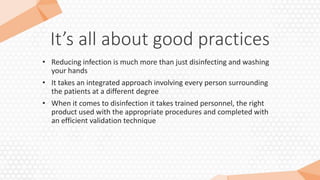
It’s all about good practices
• Reducing infection is much more than just disinfecting and washing
your hands
• It takes an integrated approach involving every person surrounding
the patients at a different degree
• When it comes to disinfection it takes trained personnel, the right
product used with the appropriate procedures and completed with
an efficient validation technique
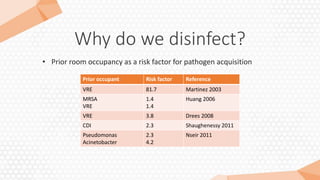
Why do we disinfect?
• Prior room occupancy as a risk factor for pathogen acquisition
Prior occupant Risk factor Reference
VRE 81.7 Martinez 2003
MRSA
VRE
1.4
1.4
Huang 2006
VRE 3.8 Drees 2008
CDI 2.3 Shaughenessy 2011
Pseudomonas
Acinetobacter
2.3
4.2
Nseir 2011
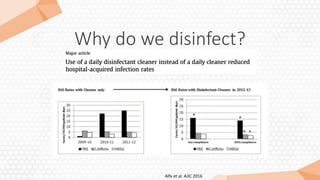
Why do we disinfect?
Alfa et al. AJIC 2016
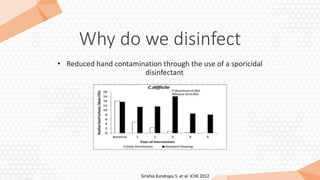
Why do we disinfect
• Reduced hand contamination through the use of a sporicidal
disinfectant
Sirishia Kundrapu S. et al. ICHE 2012
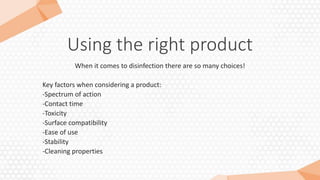
Using the right product
When it comes to disinfection there are so many choices!
Key factors when considering a product:
-Spectrum of action
-Contact time
-Toxicity
-Surface compatibility
-Ease of use
-Stability
-Cleaning properties
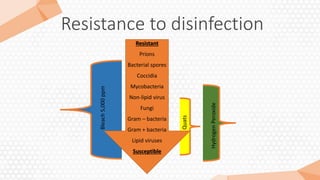
Resistance to disinfection
Resistant
Prions
Bacterial spores
Coccidia
Mycobacteria
Non-lipid virus
Fungi
Gram – bacteria
Gram + bacteria
Lipid viruses
Susceptible
HydrogenPeroxide
Bleach5,000ppm
Quats
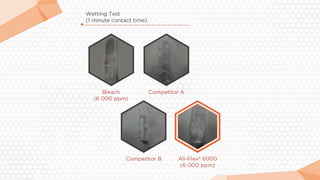
Contact time
• Time for which the surface has to remain in contact with the
disinfectant
• Sometimes it is necessary to re-wet the surface
• Mandatory 10 min unless efficacy data was submitted to HC
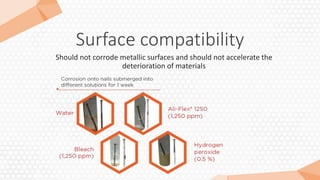
Surface compatibility
Should not corrode metallic surfaces and should not accelerate the
deterioration of materials
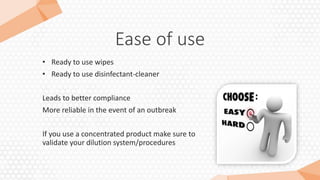
Ease of use
• Ready to use wipes
• Ready to use disinfectant-cleaner
Leads to better compliance
More reliable in the event of an outbreak
If you use a concentrated product make sure to
validate your dilution system/procedures
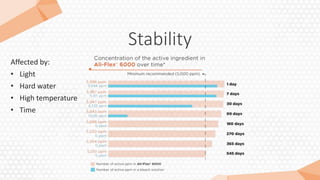
Stability
Affected by:
• Light
• Hard water
• High temperature
• Time
Cleaning properties
• Cleaning is achieved through the use of a tension active agent
• Quats are by definition surfactants
• Other disinfectant needs to be supplemented in surfactants
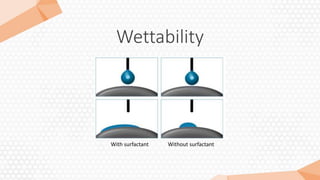
• Surfactants help the disinfection process by better wetting the
surface, facilitating the achievement of the contact time.
• Good tensioactive agent might help in the removal of biofilm and
stubborn dirt/stain
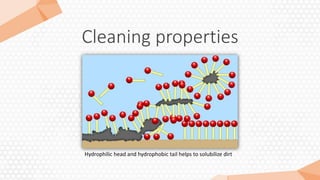
Cleaning properties
Hydrophilic head and hydrophobic tail helps to solubilize dirt
Wettability
With surfactant Without surfactant
Using the right tool
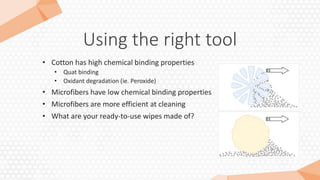
• Cotton has high chemical binding properties
• Quat binding
• Oxidant degradation (ie. Peroxide)
• Microfibers have low chemical binding properties
• Microfibers are more efficient at cleaning
• What are your ready-to-use wipes made of?
High-touch, low-touch, no-touch
• Most common high-touch surfaces include bed rail, bed surface,
supply carts, overbed table and intravenous pump
• Low-touch would be everything that is reachable and can be touch
• Daily disinfection of high touch surface is associated with a reduction
in infection
The challenge
• Clostridium difficile is one of the toughest challenge faced in
environmental hygiene
• Spores are one of the most resistant biological structure
• Some bacillus spores are known to be 250 million years old and still
viable
• Bleach at 0.5% (5,000 ppm) or product with a claim such has 4.5%
hydrogen peroxide are the most efficient technology to get rid of
C.diff
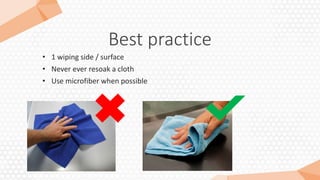
Best practice
• 1 wiping side / surface
• Never ever resoak a cloth
• Use microfiber when possible
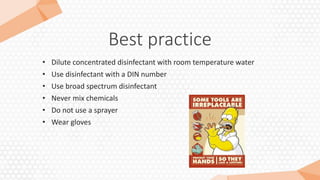
Best practice
• Dilute concentrated disinfectant with room temperature water
• Use disinfectant with a DIN number
• Use broad spectrum disinfectant
• Never mix chemicals
• Do not use a sprayer
• Wear gloves
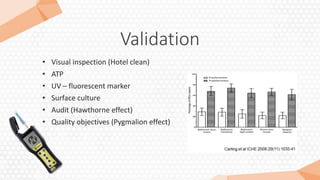
Validation
• Visual inspection (Hotel clean)
• ATP
• UV – fluorescent marker
• Surface culture
• Audit (Hawthorne effect)
• Quality objectives (Pygmalion effect)
www.ramblingsaboutdisinfection.com
Questions?
''Let’s declare war
on infectious diseases!'‘
Contact info: rcharlebois@lalema.com

FigthingHAI’s with environmental hygiene

  • 1.
    Fighting HAI’s with EnvironmentalHygiene Rémi Charlebois, M.Sc., Mcb.A., RMCCM
  • 2.
    Objectives • Review theburden of HAI’s • Understand the importance of disinfection • Get to know the best practices in environmental hygiene • Investigate what makes a good disinfectant • Overview validation procedures
  • 3.
    The Burden ofHAI’s • 4th leading cause of death in Canada • Touches 1 out of every 9 patient • 200,000 HAI’s/year • Killing around 12,000 Canadians every year • Cost estimated around 1 billion of dollars • Patient with HAI’s spent on average 8.9 more days in the hospital • Over 70% of HAI’s could be prevented*! *Umscheid et al ICHE 2011
  • 4.
    Infection route • Contacttransmission • Droplet transmission • Airborne transmission • Common vehicle transmission • Vector-borne transmission
  • 5.
    It’s all aboutgood practices • Reducing infection is much more than just disinfecting and washing your hands • It takes an integrated approach involving every person surrounding the patients at a different degree • When it comes to disinfection it takes trained personnel, the right product used with the appropriate procedures and completed with an efficient validation technique
  • 6.
    Why do wedisinfect? • Prior room occupancy as a risk factor for pathogen acquisition Prior occupant Risk factor Reference VRE 81.7 Martinez 2003 MRSA VRE 1.4 1.4 Huang 2006 VRE 3.8 Drees 2008 CDI 2.3 Shaughenessy 2011 Pseudomonas Acinetobacter 2.3 4.2 Nseir 2011
  • 7.
    Why do wedisinfect? Alfa et al. AJIC 2016
  • 8.
    Why do wedisinfect • Reduced hand contamination through the use of a sporicidal disinfectant Sirishia Kundrapu S. et al. ICHE 2012
  • 9.
    Using the rightproduct When it comes to disinfection there are so many choices! Key factors when considering a product: -Spectrum of action -Contact time -Toxicity -Surface compatibility -Ease of use -Stability -Cleaning properties
  • 10.
    Resistance to disinfection Resistant Prions Bacterialspores Coccidia Mycobacteria Non-lipid virus Fungi Gram – bacteria Gram + bacteria Lipid viruses Susceptible HydrogenPeroxide Bleach5,000ppm Quats
  • 11.
    Contact time • Timefor which the surface has to remain in contact with the disinfectant • Sometimes it is necessary to re-wet the surface • Mandatory 10 min unless efficacy data was submitted to HC
  • 12.
    Surface compatibility Should notcorrode metallic surfaces and should not accelerate the deterioration of materials
  • 13.
    Ease of use •Ready to use wipes • Ready to use disinfectant-cleaner Leads to better compliance More reliable in the event of an outbreak If you use a concentrated product make sure to validate your dilution system/procedures
  • 14.
    Stability Affected by: • Light •Hard water • High temperature • Time
  • 15.
    Cleaning properties • Cleaningis achieved through the use of a tension active agent • Quats are by definition surfactants • Other disinfectant needs to be supplemented in surfactants • Surfactants help the disinfection process by better wetting the surface, facilitating the achievement of the contact time. • Good tensioactive agent might help in the removal of biofilm and stubborn dirt/stain
  • 16.
    Cleaning properties Hydrophilic headand hydrophobic tail helps to solubilize dirt
  • 17.
  • 19.
    Using the righttool • Cotton has high chemical binding properties • Quat binding • Oxidant degradation (ie. Peroxide) • Microfibers have low chemical binding properties • Microfibers are more efficient at cleaning • What are your ready-to-use wipes made of?
  • 20.
    High-touch, low-touch, no-touch •Most common high-touch surfaces include bed rail, bed surface, supply carts, overbed table and intravenous pump • Low-touch would be everything that is reachable and can be touch • Daily disinfection of high touch surface is associated with a reduction in infection
  • 21.
    The challenge • Clostridiumdifficile is one of the toughest challenge faced in environmental hygiene • Spores are one of the most resistant biological structure • Some bacillus spores are known to be 250 million years old and still viable • Bleach at 0.5% (5,000 ppm) or product with a claim such has 4.5% hydrogen peroxide are the most efficient technology to get rid of C.diff
  • 22.
    Best practice • 1wiping side / surface • Never ever resoak a cloth • Use microfiber when possible
  • 23.
    Best practice • Diluteconcentrated disinfectant with room temperature water • Use disinfectant with a DIN number • Use broad spectrum disinfectant • Never mix chemicals • Do not use a sprayer • Wear gloves
  • 24.
    Validation • Visual inspection(Hotel clean) • ATP • UV – fluorescent marker • Surface culture • Audit (Hawthorne effect) • Quality objectives (Pygmalion effect)
  • 25.
  • 26.
    Questions? ''Let’s declare war oninfectious diseases!'‘ Contact info: rcharlebois@lalema.com

Editor's Notes

  • #9 …daily disinfection of high-touch surfaces in rooms of patients with Clostridium difficile infection and methicillin-resistant Staphylococcus aureus colonization reduced acquisition of the pathogens on hands after contacting high-touch surfaces and reduced contamination of hands of healthcare workers caring for the patients.