Performance Management
Introduction to Public Administration
Introduction
• Approaches to Public Administration:
• New Public Management – trend that surfaced in Europe, Australia, and New Zealand during the 1990s that had
significant influence on the Clinton Administration’s market-based, customer-focused, quality-driven reinvention effort.
• Notice how this matches with what we discussed before with regard to NPM
• Values:
• Concern with outcomes/outputs, not behavior
• Outcomes success measured by policy analysis
• Decision Making:
• Very business like
• Results oriented (GPRA)
• Stakeholders
• Customer focus
• Outsourcing (non-profit)
• Efficiency
• Purpose:
• Maximize the ability to act like firms.
• Serve customers.
• Borrows heavily from business practices.
• National Performance Review (Al Gore)
• Reinventing Government: How the Entrepreneurial Spirit is Transforming the Public Sector by David Osbourne and Ted Gaebler.
• Organizational Structure:
• More flat, less hierarchical
• For example: Total Quality Management
• View of the Individual:
• Customer
• Served not processed
GOVERNMENT PRODUCTIVITY
The Results Oriented Approach
• The focus would shift from inputs to outputs:
• Results oriented – government programs that focus on performance in exchange for granting greater
discretionary decision-making power to managers.
• Scientific management:
• Frederick Taylor - “the one best way”
• Productivity – measureable relationship between results produced and the resources required for production; quantitative
measure of the efficiency of the organization.
• Shift to efficiency and effectiveness.
• Difficulties:
• Not all public programs and projects are not as easily quantifiable as in the private sector (profit/loss).
• Easily quantifiable:
• Remember “Don’t Mess with Texas?”
• Difficult to quantify
• Academic achievement
• Credit hour production
• Student retention
• Graduation rates
• GPA
The Results Oriented Approach
• Improving Productivity
• Improving efficiency of organizational and processing procedures
• Streamlining
• Paperwork reduction
• Information communication technology
• Information systems
• Reducing costs of organizational and processing procedures
• Technology has been particularly beneficial in reducing costs for government.
• E-government
• Computer and statistical packages
• Geographic Information Systems – technological software tools that diagram special information visually.
• Summary
• The focus on productivity resulted in:
• Focus on the quality of execution of programs
• Less emphasis on the type of policy analysis previously discussed.
• A movement called…
REINVENTING GOVERNMENT (OR THE
PRODUCTIVITY MOVEMENT)
Reinventing Government:
Introduction
• Reinventing government – the Clinton-Gore
administration initiative based on the 1992 book
Reinventing Government: How the Entrepreneurial
Spirit is Transforming the Public Sector.
• The main thrust of the book was to push for business
standards to be applied in government:
• Customers
• Market forces
• Customer service
• Productivity
• Al Gore was fascinated with these ideas and brought
these ideas into the Clinton administration.
• The appeal:
• Politicians liked the idea of “reinventing government” as
it served to pose as a motivation to improve government
and make it more efficient and effective.
• Administrators liked the idea because it replaced
externally established goals, decision making, and
program evaluation with more discretion to make these
decisions internally.
Reinventing Government: GPRA
• The Government Performance and Results Act of 1993 (GPRA)
• Requirements:
• Define long-term goals
• Setting annual targets derived from goals
• Annual reporting of agency performance relative to goals
• Creates:
• More accountability for managers
• Measureable results of performance
• A new managerial objective:
• Performance management – results-driven decision making that attempts to link goal
achievement with budgetary allocations.
Reinventing Government:
Customers and Customer Service
• Executive Order 12862 (Clinton 1993) and “Customers”
• Reinventing government as suggested by the New Public Management had a “customer” focus.
• Focus on:
• Customer-service standards – explicit standards of service quality published by federal agencies and
part of the reinvention of government initiative.
• Executive Order 12862 mandated that agencies:
• Identify customers
• Identify customers’ needs
• Identify customers’ satisfaction levels (with services and post service)
• Comparison of customer satisfaction with the private sector.
• Benchmarking – quality and productivity improvement methodology that examines those organizations (in this
case private sector) that are best at performing a certain process or set of processes and then transplanting the
methods into one’s own organization.
• Problem:
• Cost control
Reinventing Government: Agency
Improvement Officers
• Executive Order 13450 (George W. Bush, 2007)
• Sec. 5.Duties of Agency Performance Improvement Officers.
• Subject to the direction of the head of the agency, each agency Performance Improvement Officer shall:
• (a) supervise the performance management activities of the agency, including:
• (i) development of the goals, specific plans, and estimates for which section 3 of this order provides; and
• (ii) development of the agency’s strategic plans, annual performance plans, and annual performance reports as required
by law;
• (b) advise the head of the agency, with respect to a program administered in whole or in part by the agency, whether:
• (i) goals proposed for the approval of the head of the agency under section 3(a)(i) of this order are:
• (A) sufficiently aggressive toward full achievement of the purposes of the program; and
• (B) realistic in light of authority and resources assigned to the specified agency personnel referred to in section 3(a)(ii)(A) of this
order with respect to that program; and
• (ii) means for measurement of progress toward achievement of the goals are sufficiently rigorous and accurate;
• (c) convene the specified agency personnel referred to in section 3(a)(ii)(A) of this order, or appropriate subgroups
thereof, regularly throughout each year to:
• (i) assess performance of each program administered in whole or in part by the agency; and
• (ii) consider means to improve the performance and efficiency of such program;
• (d) assist the head of the agency in the development and use within the agency of performance measures in personnel
performance appraisals, and, as appropriate, other agency personnel and planning processes; and
• (e) report to the head of the agency on the implementation within the agency of the policy set forth in section 1 of this
order.
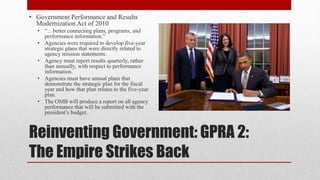
Reinventing Government: GPRA 2:
The Empire Strikes Back
• Government Performance and Results
Modernization Act of 2010
• “…better connecting plans, programs, and
performance information.”
• Agencies were required to develop five-year
strategic plans that were directly related to
agency mission statements.
• Agency must report results quarterly, rather
than annually, with respect to performance
information.
• Agencies must have annual plans that
demonstrate the strategic plan for the fiscal
year and how that plan relates to the five-year
plan.
• The OMB will produce a report on all agency
performance that will be submitted with the
president’s budget.
Reinventing Government:
Evaluating Performance
• National Performance Review (National Partnership for Reinventing Government) (1993 – 2001) – a national
committee responsible for studying and monitoring strategies to reinvent government.
• Focus:
• Smaller government:
• Reductions-in-force
• Elimination of regulations
• Customer-service focus
• Greater citizen access
• E-government
• Social media
• The Real Results:
• Elimination roughly 250 government programs
• Elimination of 16,000 pages of regulations from the Code of Federal Regulations (CFR)
• Budget cuts amounting to $137 billion dollars
• Reduction of the federal government workforce by 317,000 employees (13%)
• The “Results”
• 2000 presidential election (Gore vs. Bush)
• 60% believed the number of federal employees increased
• ~50% were even familiar with reinventing
• Gore, who supported NPR, lost.
Reinventing Government
• Rewarding Entrepreneurial Spirit
• Awards
• Sharing of strategies for learning
The New Public Service: Public
Administration Pushes Back
• The New Public Service – government service based upon the view that democratic theory and definitions of
public interest should result from a dialogue and deliberation about shared values. Public servants are
motivated by a desire to contribute to society and to respect law, community values, political norms,
professional standards, and citizen interests.
• Denhardt and Denhardt, The New Public Service
• Values:
• Democracy
• Citizenship
• Pride
• Administrators who are motivated by a value of public service.
• The public interest
• Devalues:
• Market-driven
• Competitive
• Customer-focused
• Administrators who are motivated by an “entrepreneurial spirit.”
Discussion
• Which method, reinventing government or the new public service, do you
think is the more advantageous approach to public administration and why?
• What are the advantages and disadvantages of a customer-service based
approach to public administration?
• Is there any advantage or disadvantage to the adoption of business values in
public administration?
Topics Not Covered
• Politics of Performance Management
• Comparing Alternative Performance Management Strategies
• Citizen Relationship Management and Electronic Government

Performance management

  • 1.
  • 2.
    Introduction • Approaches toPublic Administration: • New Public Management – trend that surfaced in Europe, Australia, and New Zealand during the 1990s that had significant influence on the Clinton Administration’s market-based, customer-focused, quality-driven reinvention effort. • Notice how this matches with what we discussed before with regard to NPM • Values: • Concern with outcomes/outputs, not behavior • Outcomes success measured by policy analysis • Decision Making: • Very business like • Results oriented (GPRA) • Stakeholders • Customer focus • Outsourcing (non-profit) • Efficiency • Purpose: • Maximize the ability to act like firms. • Serve customers. • Borrows heavily from business practices. • National Performance Review (Al Gore) • Reinventing Government: How the Entrepreneurial Spirit is Transforming the Public Sector by David Osbourne and Ted Gaebler. • Organizational Structure: • More flat, less hierarchical • For example: Total Quality Management • View of the Individual: • Customer • Served not processed
  • 3.
  • 4.
    The Results OrientedApproach • The focus would shift from inputs to outputs: • Results oriented – government programs that focus on performance in exchange for granting greater discretionary decision-making power to managers. • Scientific management: • Frederick Taylor - “the one best way” • Productivity – measureable relationship between results produced and the resources required for production; quantitative measure of the efficiency of the organization. • Shift to efficiency and effectiveness. • Difficulties: • Not all public programs and projects are not as easily quantifiable as in the private sector (profit/loss). • Easily quantifiable: • Remember “Don’t Mess with Texas?” • Difficult to quantify • Academic achievement • Credit hour production • Student retention • Graduation rates • GPA
  • 5.
    The Results OrientedApproach • Improving Productivity • Improving efficiency of organizational and processing procedures • Streamlining • Paperwork reduction • Information communication technology • Information systems • Reducing costs of organizational and processing procedures • Technology has been particularly beneficial in reducing costs for government. • E-government • Computer and statistical packages • Geographic Information Systems – technological software tools that diagram special information visually. • Summary • The focus on productivity resulted in: • Focus on the quality of execution of programs • Less emphasis on the type of policy analysis previously discussed. • A movement called…
  • 6.
    REINVENTING GOVERNMENT (ORTHE PRODUCTIVITY MOVEMENT)
  • 7.
    Reinventing Government: Introduction • Reinventinggovernment – the Clinton-Gore administration initiative based on the 1992 book Reinventing Government: How the Entrepreneurial Spirit is Transforming the Public Sector. • The main thrust of the book was to push for business standards to be applied in government: • Customers • Market forces • Customer service • Productivity • Al Gore was fascinated with these ideas and brought these ideas into the Clinton administration. • The appeal: • Politicians liked the idea of “reinventing government” as it served to pose as a motivation to improve government and make it more efficient and effective. • Administrators liked the idea because it replaced externally established goals, decision making, and program evaluation with more discretion to make these decisions internally.
  • 8.
    Reinventing Government: GPRA •The Government Performance and Results Act of 1993 (GPRA) • Requirements: • Define long-term goals • Setting annual targets derived from goals • Annual reporting of agency performance relative to goals • Creates: • More accountability for managers • Measureable results of performance • A new managerial objective: • Performance management – results-driven decision making that attempts to link goal achievement with budgetary allocations.
  • 9.
    Reinventing Government: Customers andCustomer Service • Executive Order 12862 (Clinton 1993) and “Customers” • Reinventing government as suggested by the New Public Management had a “customer” focus. • Focus on: • Customer-service standards – explicit standards of service quality published by federal agencies and part of the reinvention of government initiative. • Executive Order 12862 mandated that agencies: • Identify customers • Identify customers’ needs • Identify customers’ satisfaction levels (with services and post service) • Comparison of customer satisfaction with the private sector. • Benchmarking – quality and productivity improvement methodology that examines those organizations (in this case private sector) that are best at performing a certain process or set of processes and then transplanting the methods into one’s own organization. • Problem: • Cost control
  • 10.
    Reinventing Government: Agency ImprovementOfficers • Executive Order 13450 (George W. Bush, 2007) • Sec. 5.Duties of Agency Performance Improvement Officers. • Subject to the direction of the head of the agency, each agency Performance Improvement Officer shall: • (a) supervise the performance management activities of the agency, including: • (i) development of the goals, specific plans, and estimates for which section 3 of this order provides; and • (ii) development of the agency’s strategic plans, annual performance plans, and annual performance reports as required by law; • (b) advise the head of the agency, with respect to a program administered in whole or in part by the agency, whether: • (i) goals proposed for the approval of the head of the agency under section 3(a)(i) of this order are: • (A) sufficiently aggressive toward full achievement of the purposes of the program; and • (B) realistic in light of authority and resources assigned to the specified agency personnel referred to in section 3(a)(ii)(A) of this order with respect to that program; and • (ii) means for measurement of progress toward achievement of the goals are sufficiently rigorous and accurate; • (c) convene the specified agency personnel referred to in section 3(a)(ii)(A) of this order, or appropriate subgroups thereof, regularly throughout each year to: • (i) assess performance of each program administered in whole or in part by the agency; and • (ii) consider means to improve the performance and efficiency of such program; • (d) assist the head of the agency in the development and use within the agency of performance measures in personnel performance appraisals, and, as appropriate, other agency personnel and planning processes; and • (e) report to the head of the agency on the implementation within the agency of the policy set forth in section 1 of this order.
  • 11.
    Reinventing Government: GPRA2: The Empire Strikes Back • Government Performance and Results Modernization Act of 2010 • “…better connecting plans, programs, and performance information.” • Agencies were required to develop five-year strategic plans that were directly related to agency mission statements. • Agency must report results quarterly, rather than annually, with respect to performance information. • Agencies must have annual plans that demonstrate the strategic plan for the fiscal year and how that plan relates to the five-year plan. • The OMB will produce a report on all agency performance that will be submitted with the president’s budget.
  • 12.
    Reinventing Government: Evaluating Performance •National Performance Review (National Partnership for Reinventing Government) (1993 – 2001) – a national committee responsible for studying and monitoring strategies to reinvent government. • Focus: • Smaller government: • Reductions-in-force • Elimination of regulations • Customer-service focus • Greater citizen access • E-government • Social media • The Real Results: • Elimination roughly 250 government programs • Elimination of 16,000 pages of regulations from the Code of Federal Regulations (CFR) • Budget cuts amounting to $137 billion dollars • Reduction of the federal government workforce by 317,000 employees (13%) • The “Results” • 2000 presidential election (Gore vs. Bush) • 60% believed the number of federal employees increased • ~50% were even familiar with reinventing • Gore, who supported NPR, lost.
  • 13.
    Reinventing Government • RewardingEntrepreneurial Spirit • Awards • Sharing of strategies for learning
  • 14.
    The New PublicService: Public Administration Pushes Back • The New Public Service – government service based upon the view that democratic theory and definitions of public interest should result from a dialogue and deliberation about shared values. Public servants are motivated by a desire to contribute to society and to respect law, community values, political norms, professional standards, and citizen interests. • Denhardt and Denhardt, The New Public Service • Values: • Democracy • Citizenship • Pride • Administrators who are motivated by a value of public service. • The public interest • Devalues: • Market-driven • Competitive • Customer-focused • Administrators who are motivated by an “entrepreneurial spirit.”
  • 15.
    Discussion • Which method,reinventing government or the new public service, do you think is the more advantageous approach to public administration and why? • What are the advantages and disadvantages of a customer-service based approach to public administration? • Is there any advantage or disadvantage to the adoption of business values in public administration?
  • 16.
    Topics Not Covered •Politics of Performance Management • Comparing Alternative Performance Management Strategies • Citizen Relationship Management and Electronic Government