PROCESS
OF
PRODUCT
DEVELOPMENT
PRESENTED BY
Asna Sherin
IUI8FNOO4
 The new product development process
is the cycle that a new product has to
undergo from conceptualization to the
final introduction into the market.
 The enterprise undertakes research to
find out the potential costs, revenues
and profits arising from the product.
 The business conducts a SWOT analysis
in the market
S : Strength
W: Weakness
O: Opportunities
T: Threats
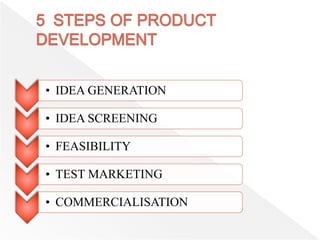
• IDEA GENERATION
• IDEA SCREENING
• FEASIBILITY
• TEST MARKETING
• COMMERCIALISATION
 The new product development process
starts with idea generation.
 Idea generation refers to the systematic
search for new-product ideas
 The initial stage of NPD
 This stage is crucial as it lays the
foundation for all the other phases, the
ideas generated shall guide the overall
process of product development
 Typically, a company generates hundreds
of ideas, maybe even thousands, to find a
handful of good ones in the end.
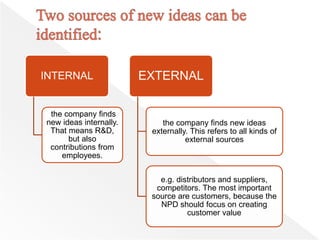
INTERNAL
the company finds
new ideas internally.
That means R&D,
but also
contributions from
employees.
EXTERNAL
the company finds new ideas
externally. This refers to all kinds of
external sources
e.g. distributors and suppliers,
competitors. The most important
source are customers, because the
NPD should focus on creating
customer value
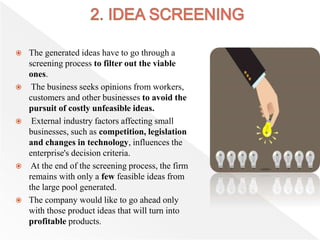
 The generated ideas have to go through a
screening process to filter out the viable
ones.
 The business seeks opinions from workers,
customers and other businesses to avoid the
pursuit of costly unfeasible ideas.
 External industry factors affecting small
businesses, such as competition, legislation
and changes in technology, influences the
enterprise's decision criteria.
 At the end of the screening process, the firm
remains with only a few feasible ideas from
the large pool generated.
 The company would like to go ahead only
with those product ideas that will turn into
profitable products.
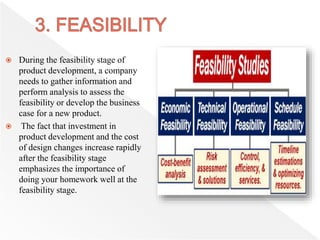
 During the feasibility stage of
product development, a company
needs to gather information and
perform analysis to assess the
feasibility or develop the business
case for a new product.
 The fact that investment in
product development and the cost
of design changes increase rapidly
after the feasibility stage
emphasizes the importance of
doing your homework well at the
feasibility stage.
 Test marketing has given management
the information needed to make the final
decision: launch or do not launch the
new product.
 The product and its proposed marketing
programme are tested in realistic market
settings. Therefore, test marketing gives
the marketer experience with marketing
the product before going to the great
expense of full introduction. In fact, it
allows the company to test the product
and its entire marketing programme,
including targeting and positioning
strategy, advertising, distributions,
packaging etc. before the full investment
is made.
 Introducing a new product into the market.
 At this point, the highest costs are incurred:
the company may need to build or rent a
manufacturing facility.
 Large amounts may be spent on advertising
sales promotion and other marketing efforts
in the first year.
 Some factors should be considered before
the product is commercialized:
 Introduction time
 Introduction place
NEW PRODUCT DEVELOPMENT

NEW PRODUCT DEVELOPMENT

  • 1.
  • 2.
     The newproduct development process is the cycle that a new product has to undergo from conceptualization to the final introduction into the market.  The enterprise undertakes research to find out the potential costs, revenues and profits arising from the product.  The business conducts a SWOT analysis in the market S : Strength W: Weakness O: Opportunities T: Threats
  • 3.
    • IDEA GENERATION •IDEA SCREENING • FEASIBILITY • TEST MARKETING • COMMERCIALISATION
  • 4.
     The newproduct development process starts with idea generation.  Idea generation refers to the systematic search for new-product ideas  The initial stage of NPD  This stage is crucial as it lays the foundation for all the other phases, the ideas generated shall guide the overall process of product development  Typically, a company generates hundreds of ideas, maybe even thousands, to find a handful of good ones in the end.
  • 5.
    INTERNAL the company finds newideas internally. That means R&D, but also contributions from employees. EXTERNAL the company finds new ideas externally. This refers to all kinds of external sources e.g. distributors and suppliers, competitors. The most important source are customers, because the NPD should focus on creating customer value
  • 6.
     The generatedideas have to go through a screening process to filter out the viable ones.  The business seeks opinions from workers, customers and other businesses to avoid the pursuit of costly unfeasible ideas.  External industry factors affecting small businesses, such as competition, legislation and changes in technology, influences the enterprise's decision criteria.  At the end of the screening process, the firm remains with only a few feasible ideas from the large pool generated.  The company would like to go ahead only with those product ideas that will turn into profitable products.
  • 7.
     During thefeasibility stage of product development, a company needs to gather information and perform analysis to assess the feasibility or develop the business case for a new product.  The fact that investment in product development and the cost of design changes increase rapidly after the feasibility stage emphasizes the importance of doing your homework well at the feasibility stage.
  • 8.
     Test marketinghas given management the information needed to make the final decision: launch or do not launch the new product.  The product and its proposed marketing programme are tested in realistic market settings. Therefore, test marketing gives the marketer experience with marketing the product before going to the great expense of full introduction. In fact, it allows the company to test the product and its entire marketing programme, including targeting and positioning strategy, advertising, distributions, packaging etc. before the full investment is made.
  • 9.
     Introducing anew product into the market.  At this point, the highest costs are incurred: the company may need to build or rent a manufacturing facility.  Large amounts may be spent on advertising sales promotion and other marketing efforts in the first year.  Some factors should be considered before the product is commercialized:  Introduction time  Introduction place