New Product Development

 Strategy, Tactics & Process


    Anand Subramaniam
“Knowledge speaks, but wisdom listens."

                           - Jimi Hendrix


                                            2
Highlights

NPD - Strategy
NPD - Design
NPD - Types
NPD – Process
NPD - Levers


                          3
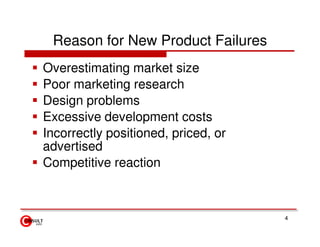
Reason for New Product Failures
Overestimating market size
Poor marketing research
Design problems
Excessive development costs
Incorrectly positioned, priced, or
advertised
Competitive reaction


                                     4
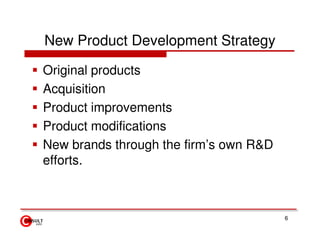
New Product Development Strategy

Original products
Acquisition
Product improvements
Product modifications
New brands through the firm’s own R&D
efforts.


                                        6
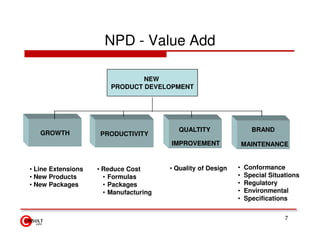
NPD - Value Add

                                NEW
                        PRODUCT DEVELOPMENT


                                           QUALTITY                 BRAND
   GROWTH            PRODUCTIVITY
                                        IMPROVEMENT               MAINTENANCE


• Line Extensions   • Reduce Cost       • Quality of Design   •   Conformance
• New Products        • Formulas                              •   Special Situations
• New Packages        • Packages                              •   Regulatory
                      • Manufacturing                         •   Environmental
                                                              •   Specifications


                                                                               7
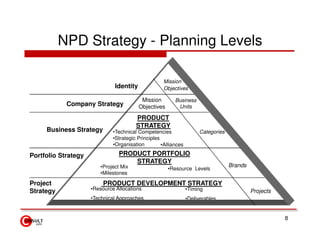
NPD Strategy - Planning Levels

                                                    Mission
                               Identity             Objectives

                                           Mission        Business
            Company Strategy              Objectives       Units

                                        PRODUCT
                                        STRATEGY
     Business Strategy        •Technical Competencies                 Categories
                              •Strategic Principles
                              •Organisation         •Alliances

Portfolio Strategy              PRODUCT PORTFOLIO
                                    STRATEGY
                         •Project Mix                                              Brands
                                                       •Resource Levels
                         •Milestones

Project                   PRODUCT DEVELOPMENT STRATEGY
                     •Resource Allocations                       •Timing
Strategy                                                                                    Projects
                     •Technical Approaches                       •Deliverables


                                                                                                       8
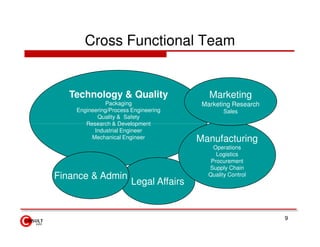
Cross Functional Team


   Technology & Quality                    Marketing
              Packaging                  Marketing Research
    Engineering/Process Engineering              Sales
           Quality & Safety
       Research & Development
          Industrial Engineer
         Mechanical Engineer            Manufacturing
                                             Operations
                                              Logistics
                                            Procurement
                                           Supply Chain
Finance & Admin                            Quality Control
                        Legal Affairs


                                                              9
New Product Development Design
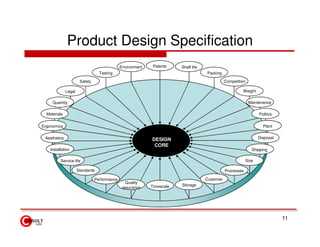
Product Design Specification
                                              Environment    Patents    Shelf life
                                  Testing                                            Packing

                       Safety                                                                   Competition

              Legal                                                                                      Weight

     Quantity                                                                                                 Maintenance

  Materials                                                                                                        Politics

Ergonomics                                                                                                           Plant

 Aesthetics                                                 DESIGN                                                 Disposal
                                                             CORE
    Installation                                                                                               Shipping

          Service life                                                                                      Size

                      Standards                                                                 Processes

                                Performance                                          Customer
                                                Quality
                                                            Timescale   Storage
                                               assurance


                                                                                                                              11
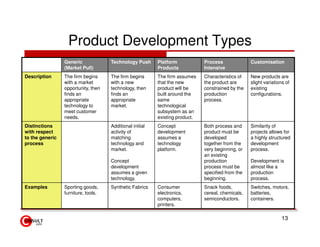
New Product Development Types
Product Development Types
                 Generic             Technology Push      Platform            Process              Customisation
                 (Market Pull)                            Products            Intensive
Description      The firm begins     The firm begins      The firm assumes    Characteristics of   New products are
                 with a market       with a new           that the new        the product are      slight variations of
                 opportunity, then   technology, then     product will be     constrained by the   existing
                 finds an            finds an             built around the    production           configurations.
                 appropriate         appropriate          same                process.
                 technology to       market.              technological
                 meet customer                            subsystem as an
                 needs.                                   existing product.
Distinctions                         Additional initial   Concept             Both process and     Similarity of
with respect                         activity of          development         product must be      projects allows for
to the generic                       matching             assumes a           developed            a highly structured
process                              technology and       technology          together from the    development
                                     market.              platform.           very beginning, or   process.
                                                                              an existing
                                     Concept                                  production           Development is
                                     development                              process must be      almost like a
                                     assumes a given                          specified from the   production
                                     technology.                              beginning.           process.
Examples         Sporting goods,     Synthetic Fabrics    Consumer            Snack foods,         Switches, motors,
                 furniture, tools.                        electronics,        cereal, chemicals,   batteries,
                                                          computers,          semiconductors.      containers.
                                                          printers.

                                                                                                                  13
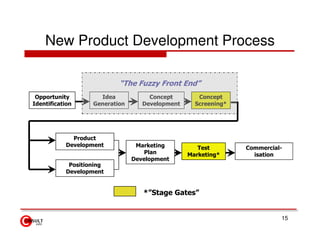
New Product Development Process

                           “The Fuzzy Front End”
 Opportunity         Idea            Concept        Concept
Identification     Generation      Development     Screening*


             Product
           Development           Marketing          Test        Commercial-
                                    Plan         Marketing*       isation
                                Development
            Positioning
           Development


                                   *”Stage Gates”


                                                                          15
Opportunity Identification

Internal sources
  Company employees at all levels


External sources
  Customers
  Competitors
  Distributors
  Suppliers
  Outsourcing
                                    16
Idea Generation (Ideation)
Cross Functional Team

Generate Ideas
    • Brainstorming
    • Suspend judgment
    • Encourage creativity


Identify Opportunity Areas
    • Problem solving to bring new ideas to the table
    • Sketching or prototype
    • Idea prioritisation


Generate New Product Concepts and evaluate against a
set of company criteria for new products.
                                                        17
Concept Development
Done by Marketing and/or Advertising Agency

Conducting “Focus Groups”

Objectives
  Judge whether the concept fits the opportunity area,
  and constraints
  Refine and / or describe the product concept
   • What it is :
   • What benefit(s) will it deliver to the user
   • Key information – size, varieties, package, price
                                                         18
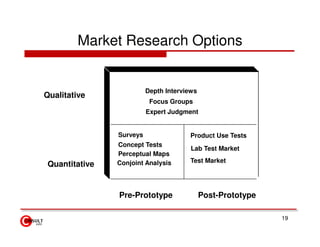
Market Research Options


                         Depth Interviews
Qualitative
                          Focus Groups
                         Expert Judgment


               Surveys                Product Use Tests
               Concept Tests
                                       Lab Test Market
               Perceptual Maps
               Conjoint Analysis      Test Market
Quantitative


               Pre-Prototype                Post-Prototype

                                                             19
Concept Screening / Testing
Produce a Concept Board

Conduct a survey
   Representative sample of end users via Internet, Panel
   Show concept and ask buying intent, uniqueness, value

Analyse the results
   Compare scores to internal criteria, benchmarks, norms
   Forecast “Trial”

If end user shows interest in trying the product during the trial
forecast, then the concept qualifies for development – It clears the
first stage gate.


                                                                       20
Product Development
Initial stages with broad design parameters
  Produce early prototypes
  Show and obtain feedback from end users
  Refine design


Fine tune & finalise design
  Vary formulations on key ingredients
  Conduct product testing amongst end users
  Experimental designs offer most powerful learning
  Optimise final design and packaging
                                                      21
Position Development
Develop positioning
  Target : Benefit(s) : Frame of Reference : Support

Develop communications strategies
  Media strategy

Test & refine copy
  Qualitative research – “Communications Check”
  Produce, test and refine the advertisements

Conduct final test (Stage Gate Review)
                                                       22
Marketing Plan Development
Final Positioning Statement
   Target : Benefit(s) : Frame of Reference : Support

Sales Plan
   Who will sell it? : Where will it be sold?

Advertising Media Plan
   How will we advertise it?

Promotion Plan
   Consumer promotion (coupons), Trade promotion (on-sale)

Production Plan
   How will we make it? (make / buy analysis)

Financial Plan
   How do we make the profit necessary to satisfy our share holders?
   Fixed Costs : Variable Costs : Breakeven : Targeted ROI

                                                                       23
Test Marketing

Two Stages:
 Simulated Test Market
 Live Test Market


                            24
Test Marketing (Contd.)
Simulated Test Market (STM)
  Similar to Concept Test but with product
  Provide samples to consumers who are
  interested in the concept
  Measure both trial potential and reaction to
  product
  Reaction to product is used to forecast repeat
  rate
  Volume is forecasted on basis of both the trial
  forecast and the repeat forecast.
                                                25
Test Marketing (Contd.)
Live Test Market (LTM)
  To measure actual sales volume
   • Controlled – Behavior Scan
   • Conventional –normal channels.


Track sales rate, trial, repeat

Compare to goals and identify gaps

Investigate and close gaps
                                      26
Commercialisation
National expansion of product
  Develop market rollout plan


Can involve significant capital investment
  Brick & Mortar : Equipment

Can involve distribution costs
  Slotting fees : Sales incentives

Build product into a “Platform”
  Maintain growth and sustain competitive advantage
                                                      27
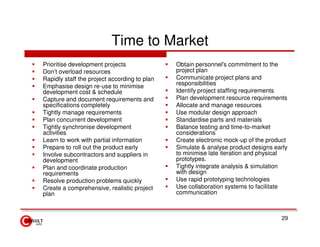
New Product Development Levers
Time to Market
Prioritise development projects               Obtain personnel's commitment to the
Don’t overload resources                      project plan
Rapidly staff the project according to plan   Communicate project plans and
Emphasise design re-use to minimise           responsibilities
development cost & schedule                   Identify project staffing requirements
Capture and document requirements and         Plan development resource requirements
specifications completely                     Allocate and manage resources
Tightly manage requirements                   Use modular design approach
Plan concurrent development                   Standardise parts and materials
Tightly synchronise development               Balance testing and time-to-market
activities                                    considerations
Learn to work with partial information        Create electronic mock-up of the product
Prepare to roll out the product early         Simulate & analyse product designs early
Involve subcontractors and suppliers in       to minimise late iteration and physical
development                                   prototypes.
Plan and coordinate production                Tightly integrate analysis & simulation
requirements                                  with design
Resolve production problems quickly           Use rapid prototyping technologies
Create a comprehensive, realistic project     Use collaboration systems to facilitate
plan                                          communication


                                                                                   29
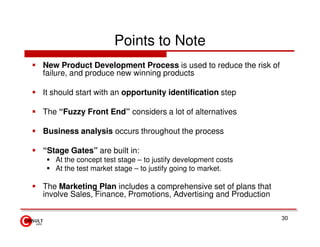
Points to Note
New Product Development Process is used to reduce the risk of
failure, and produce new winning products

It should start with an opportunity identification step

The “Fuzzy Front End” considers a lot of alternatives

Business analysis occurs throughout the process

“Stage Gates” are built in:
   At the concept test stage – to justify development costs
   At the test market stage – to justify going to market.

The Marketing Plan includes a comprehensive set of plans that
involve Sales, Finance, Promotions, Advertising and Production

                                                                 30
“Opportunities multiply as they are seized."


                                   - Sun Tzu


                                               31
Good Luck
http://www.linkedin.com/in/anandsubramaniam


                                              32

New product development

  • 1.
    New Product Development Strategy, Tactics & Process Anand Subramaniam
  • 2.
    “Knowledge speaks, butwisdom listens." - Jimi Hendrix 2
  • 3.
    Highlights NPD - Strategy NPD- Design NPD - Types NPD – Process NPD - Levers 3
  • 4.
    Reason for NewProduct Failures Overestimating market size Poor marketing research Design problems Excessive development costs Incorrectly positioned, priced, or advertised Competitive reaction 4
  • 5.
  • 6.
    New Product DevelopmentStrategy Original products Acquisition Product improvements Product modifications New brands through the firm’s own R&D efforts. 6
  • 7.
    NPD - ValueAdd NEW PRODUCT DEVELOPMENT QUALTITY BRAND GROWTH PRODUCTIVITY IMPROVEMENT MAINTENANCE • Line Extensions • Reduce Cost • Quality of Design • Conformance • New Products • Formulas • Special Situations • New Packages • Packages • Regulatory • Manufacturing • Environmental • Specifications 7
  • 8.
    NPD Strategy -Planning Levels Mission Identity Objectives Mission Business Company Strategy Objectives Units PRODUCT STRATEGY Business Strategy •Technical Competencies Categories •Strategic Principles •Organisation •Alliances Portfolio Strategy PRODUCT PORTFOLIO STRATEGY •Project Mix Brands •Resource Levels •Milestones Project PRODUCT DEVELOPMENT STRATEGY •Resource Allocations •Timing Strategy Projects •Technical Approaches •Deliverables 8
  • 9.
    Cross Functional Team Technology & Quality Marketing Packaging Marketing Research Engineering/Process Engineering Sales Quality & Safety Research & Development Industrial Engineer Mechanical Engineer Manufacturing Operations Logistics Procurement Supply Chain Finance & Admin Quality Control Legal Affairs 9
  • 10.
  • 11.
    Product Design Specification Environment Patents Shelf life Testing Packing Safety Competition Legal Weight Quantity Maintenance Materials Politics Ergonomics Plant Aesthetics DESIGN Disposal CORE Installation Shipping Service life Size Standards Processes Performance Customer Quality Timescale Storage assurance 11
  • 12.
  • 13.
    Product Development Types Generic Technology Push Platform Process Customisation (Market Pull) Products Intensive Description The firm begins The firm begins The firm assumes Characteristics of New products are with a market with a new that the new the product are slight variations of opportunity, then technology, then product will be constrained by the existing finds an finds an built around the production configurations. appropriate appropriate same process. technology to market. technological meet customer subsystem as an needs. existing product. Distinctions Additional initial Concept Both process and Similarity of with respect activity of development product must be projects allows for to the generic matching assumes a developed a highly structured process technology and technology together from the development market. platform. very beginning, or process. an existing Concept production Development is development process must be almost like a assumes a given specified from the production technology. beginning. process. Examples Sporting goods, Synthetic Fabrics Consumer Snack foods, Switches, motors, furniture, tools. electronics, cereal, chemicals, batteries, computers, semiconductors. containers. printers. 13
  • 14.
  • 15.
    New Product DevelopmentProcess “The Fuzzy Front End” Opportunity Idea Concept Concept Identification Generation Development Screening* Product Development Marketing Test Commercial- Plan Marketing* isation Development Positioning Development *”Stage Gates” 15
  • 16.
    Opportunity Identification Internal sources Company employees at all levels External sources Customers Competitors Distributors Suppliers Outsourcing 16
  • 17.
    Idea Generation (Ideation) CrossFunctional Team Generate Ideas • Brainstorming • Suspend judgment • Encourage creativity Identify Opportunity Areas • Problem solving to bring new ideas to the table • Sketching or prototype • Idea prioritisation Generate New Product Concepts and evaluate against a set of company criteria for new products. 17
  • 18.
    Concept Development Done byMarketing and/or Advertising Agency Conducting “Focus Groups” Objectives Judge whether the concept fits the opportunity area, and constraints Refine and / or describe the product concept • What it is : • What benefit(s) will it deliver to the user • Key information – size, varieties, package, price 18
  • 19.
    Market Research Options Depth Interviews Qualitative Focus Groups Expert Judgment Surveys Product Use Tests Concept Tests Lab Test Market Perceptual Maps Conjoint Analysis Test Market Quantitative Pre-Prototype Post-Prototype 19
  • 20.
    Concept Screening /Testing Produce a Concept Board Conduct a survey Representative sample of end users via Internet, Panel Show concept and ask buying intent, uniqueness, value Analyse the results Compare scores to internal criteria, benchmarks, norms Forecast “Trial” If end user shows interest in trying the product during the trial forecast, then the concept qualifies for development – It clears the first stage gate. 20
  • 21.
    Product Development Initial stageswith broad design parameters Produce early prototypes Show and obtain feedback from end users Refine design Fine tune & finalise design Vary formulations on key ingredients Conduct product testing amongst end users Experimental designs offer most powerful learning Optimise final design and packaging 21
  • 22.
    Position Development Develop positioning Target : Benefit(s) : Frame of Reference : Support Develop communications strategies Media strategy Test & refine copy Qualitative research – “Communications Check” Produce, test and refine the advertisements Conduct final test (Stage Gate Review) 22
  • 23.
    Marketing Plan Development FinalPositioning Statement Target : Benefit(s) : Frame of Reference : Support Sales Plan Who will sell it? : Where will it be sold? Advertising Media Plan How will we advertise it? Promotion Plan Consumer promotion (coupons), Trade promotion (on-sale) Production Plan How will we make it? (make / buy analysis) Financial Plan How do we make the profit necessary to satisfy our share holders? Fixed Costs : Variable Costs : Breakeven : Targeted ROI 23
  • 24.
    Test Marketing Two Stages: Simulated Test Market Live Test Market 24
  • 25.
    Test Marketing (Contd.) SimulatedTest Market (STM) Similar to Concept Test but with product Provide samples to consumers who are interested in the concept Measure both trial potential and reaction to product Reaction to product is used to forecast repeat rate Volume is forecasted on basis of both the trial forecast and the repeat forecast. 25
  • 26.
    Test Marketing (Contd.) LiveTest Market (LTM) To measure actual sales volume • Controlled – Behavior Scan • Conventional –normal channels. Track sales rate, trial, repeat Compare to goals and identify gaps Investigate and close gaps 26
  • 27.
    Commercialisation National expansion ofproduct Develop market rollout plan Can involve significant capital investment Brick & Mortar : Equipment Can involve distribution costs Slotting fees : Sales incentives Build product into a “Platform” Maintain growth and sustain competitive advantage 27
  • 28.
  • 29.
    Time to Market Prioritisedevelopment projects Obtain personnel's commitment to the Don’t overload resources project plan Rapidly staff the project according to plan Communicate project plans and Emphasise design re-use to minimise responsibilities development cost & schedule Identify project staffing requirements Capture and document requirements and Plan development resource requirements specifications completely Allocate and manage resources Tightly manage requirements Use modular design approach Plan concurrent development Standardise parts and materials Tightly synchronise development Balance testing and time-to-market activities considerations Learn to work with partial information Create electronic mock-up of the product Prepare to roll out the product early Simulate & analyse product designs early Involve subcontractors and suppliers in to minimise late iteration and physical development prototypes. Plan and coordinate production Tightly integrate analysis & simulation requirements with design Resolve production problems quickly Use rapid prototyping technologies Create a comprehensive, realistic project Use collaboration systems to facilitate plan communication 29
  • 30.
    Points to Note NewProduct Development Process is used to reduce the risk of failure, and produce new winning products It should start with an opportunity identification step The “Fuzzy Front End” considers a lot of alternatives Business analysis occurs throughout the process “Stage Gates” are built in: At the concept test stage – to justify development costs At the test market stage – to justify going to market. The Marketing Plan includes a comprehensive set of plans that involve Sales, Finance, Promotions, Advertising and Production 30
  • 31.
    “Opportunities multiply asthey are seized." - Sun Tzu 31
  • 32.