Dr.DY PATIL INSTITUTE OF ENGINEERING
MANAGEMENT & RESEARCH
Akurdi, Pune -411044
Department of chemical engineering
Presentation On Project Phase-I
“Modeling & Simulation of Membrane Assisted Distillation Process”
Prepared By
Yogeshwar Nighojkar Anjali Gupta
Under the Guidance of
Prof. Pankaj Vardhe
1
INTRODUCTION
 “Distillation is an unit operation which involves separation of a
vaporizable component from a multi-component system and
subsequent condensation of vapours.”
 Distillation is a process of separating the component
substances from a liquid mixture by selective evaporation and
condensation.”
 “Distillation is defined as the separation of the components of
a liquid mixture by a process involving vaporization and
subsequent condensation at another place.”
2
Membrane Assisted Distillation
Membrane-assisted distillation is the integration of
a membrane with a distillation process, which complement each
other to achieve a defined separation task.
Hybrid separation processes combine two or more unit operation,
which contribute to given separation task by means of different
physical phenomena.
Membrane-assisted distillation processes constitute one type of
hybrid separation process.
In a membrane separation, a feed mixture flows over a membrane,
which allows to molecules to pass through membrane and some
are rejected.
3
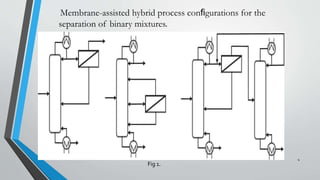
Membrane-assisted hybrid process configurations for the
separation of binary mixtures.
Fig 1.
4
Advantages of membrane assisted distillation
 Membrane assisted distillation offers significant potential for
the separation of close boiling or azeotropic mixture.
 In contrast to distillation, membrane separation is not limited
by vapour liquid equilibrium(VLE) and thus overcome
azeotropes and distillation boundaries.
 High selectivity, low energy consumption and compact
modular design .
5
Selected examples of recent developments in membrane-assisted
distillation-
 Design tools for polymeric organic solvent nanofiltration
 Investigation of the necessary modeling depth for an OSN-
assisted distillation that separates wide-boiling mixtures
 Integrated Optimization and comparison of hybrid processes
that dehydrate ethanol
 Experimental investigation and optimization of membrane-
assisted reactive distillation using a hydrophilic membrane
 Optimization of membrane-assisted reactive distillation
using an organophilic membrane
6
Literature Survey
SR.
NO
PaperTile Year Of
Publication
Authers
1. Reactive & membrane assist distillation :
recent development & prospective
2016 Philip Lutze, Andrezj Gorak
2. Efficient optimization-based design of
membrane assist distillation process
2014 Mirko Skiborowski,
Johannes Wessel,
Wolfgang Marquardt
3. Methodology for design of vapour
permeation membrane assisted distillation
process
2019 Hong Li,
Chunkai Guo,
Hichao Guo,
Xin Gao
4. Efficient optimization-based design of
membrane assist distillation
2017 Mirko Skiborowski, Johannes
Wessel,Wolfgang Marquardt
5. Membrane assisted reactive distillation for
bioethanol purification
2020 Massimiliano Errico, Claudio
Madeddu ,Mathilde Flemming
Bindseil , Signe Dall Madsen
Sylvie Braekevelt , Maria Salud
Camilleri-Rumbau,
7
SR. NO PaperTile Year Of
Publication
Authers
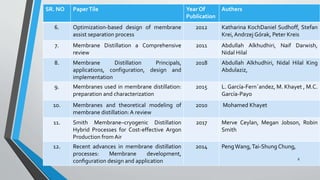
6. Optimization-based design of membrane
assist separation process
2012 Katharina KochDaniel Sudhoff, Stefan
Krei,Andrzej Górak, Peter Kreis
7. Membrane Distillation a Comprehensive
review
2011 Abdullah Alkhudhiri, Naif Darwish,
Nidal Hilal
8. Membrane Distillation Principals,
applications, configuration, design and
implementation
2018 Abdullah Alkhudhiri, Nidal Hilal King
Abdulaziz,
9. Membranes used in membrane distillation:
preparation and characterization
2015 L. García-Fern´andez, M. Khayet , M.C.
García-Payo
10. Membranes and theoretical modeling of
membrane distillation:A review
2010 Mohamed Khayet
11. Smith Membrane–cryogenic Distillation
Hybrid Processes for Cost-effective Argon
Production from Air
2017 Merve Ceylan, Megan Jobson, Robin
Smith
12. Recent advances in membrane distillation
processes: Membrane development,
configuration design and application
2014 PengWang,Tai-Shung Chung,
8
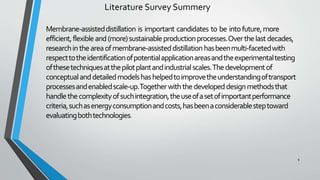
Literature Survey Summery
Membrane-assisteddistillation is important candidates to be intofuture,more
efficient,flexibleand(more)sustainableproductionprocesses.Overthelastdecades,
researchintheareaofmembrane-assisteddistillationhasbeenmulti-facetedwith
respecttotheidentificationofpotentialapplicationareasandtheexperimentaltesting
ofthesetechniquesatthepilotplantandindustrialscales.Thedevelopmentof
conceptualanddetailedmodelshashelpedtoimprovetheunderstandingoftransport
processesandenabledscale-up.Togetherwiththedevelopeddesignmethodsthat
handlethecomplexityofsuchintegration,theuseofasetofimportantperformance
criteria,suchasenergyconsumptionandcosts,hasbeenaconsiderablesteptoward
evaluatingbothtechnologies.
9
Membrane Configuration
 Direct Contact Membrane Distillation[DCMD]
 Air Gap Membrane Distillation.[AGMD]
 Sweeping Gas Membrane Distillation[SGMD]
 Vacuum Membrane Distillation[VMD]
10
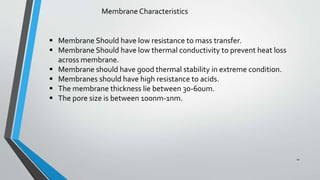
Membrane Characteristics
 Membrane Should have low resistance to mass transfer.
 Membrane Should have low thermal conductivity to prevent heat loss
across membrane.
 Membrane should have good thermal stability in extreme condition.
 Membranes should have high resistance to acids.
 The membrane thickness lie between 30-60um.
 The pore size is between 100nm-1nm.
11
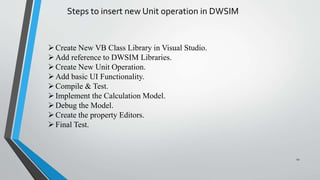
Steps to insert new Unit operation in DWSIM
Create New VB Class Library in Visual Studio.
Add reference to DWSIM Libraries.
Create New Unit Operation.
Add basic UI Functionality.
Compile & Test.
Implement the Calculation Model.
Debug the Model.
Create the property Editors.
Final Test.
12
REFERENCES
Reactive & membrane assist distillation : recent development &
prospective by Philip Lutze, Andrezj Gorak, department of
biochemical & chemical Engineering ,Technical University of
Dortmund, Germany
Efficient optimization-based design of membrane assist distillation
process by Mirko Skiborowski, JohannesWessel, Wolfgang Marquardt,
Aachen University.
 Methodology for design of vapour permeation membrane assisted
distillation process by Hong Li, Chunkai Guo, Hichao Guo, Xin Gao
Tianjin University
 Membrane distillation principal and applications by Mohamad Khayet
&Takeshi Matsurra
13
Thank
You
14

New Microsoft PowerPoint Presentation.pptx

  • 1.
    Dr.DY PATIL INSTITUTEOF ENGINEERING MANAGEMENT & RESEARCH Akurdi, Pune -411044 Department of chemical engineering Presentation On Project Phase-I “Modeling & Simulation of Membrane Assisted Distillation Process” Prepared By Yogeshwar Nighojkar Anjali Gupta Under the Guidance of Prof. Pankaj Vardhe 1
  • 2.
    INTRODUCTION  “Distillation isan unit operation which involves separation of a vaporizable component from a multi-component system and subsequent condensation of vapours.”  Distillation is a process of separating the component substances from a liquid mixture by selective evaporation and condensation.”  “Distillation is defined as the separation of the components of a liquid mixture by a process involving vaporization and subsequent condensation at another place.” 2
  • 3.
    Membrane Assisted Distillation Membrane-assisteddistillation is the integration of a membrane with a distillation process, which complement each other to achieve a defined separation task. Hybrid separation processes combine two or more unit operation, which contribute to given separation task by means of different physical phenomena. Membrane-assisted distillation processes constitute one type of hybrid separation process. In a membrane separation, a feed mixture flows over a membrane, which allows to molecules to pass through membrane and some are rejected. 3
  • 4.
    Membrane-assisted hybrid processconfigurations for the separation of binary mixtures. Fig 1. 4
  • 5.
    Advantages of membraneassisted distillation  Membrane assisted distillation offers significant potential for the separation of close boiling or azeotropic mixture.  In contrast to distillation, membrane separation is not limited by vapour liquid equilibrium(VLE) and thus overcome azeotropes and distillation boundaries.  High selectivity, low energy consumption and compact modular design . 5
  • 6.
    Selected examples ofrecent developments in membrane-assisted distillation-  Design tools for polymeric organic solvent nanofiltration  Investigation of the necessary modeling depth for an OSN- assisted distillation that separates wide-boiling mixtures  Integrated Optimization and comparison of hybrid processes that dehydrate ethanol  Experimental investigation and optimization of membrane- assisted reactive distillation using a hydrophilic membrane  Optimization of membrane-assisted reactive distillation using an organophilic membrane 6
  • 7.
    Literature Survey SR. NO PaperTile YearOf Publication Authers 1. Reactive & membrane assist distillation : recent development & prospective 2016 Philip Lutze, Andrezj Gorak 2. Efficient optimization-based design of membrane assist distillation process 2014 Mirko Skiborowski, Johannes Wessel, Wolfgang Marquardt 3. Methodology for design of vapour permeation membrane assisted distillation process 2019 Hong Li, Chunkai Guo, Hichao Guo, Xin Gao 4. Efficient optimization-based design of membrane assist distillation 2017 Mirko Skiborowski, Johannes Wessel,Wolfgang Marquardt 5. Membrane assisted reactive distillation for bioethanol purification 2020 Massimiliano Errico, Claudio Madeddu ,Mathilde Flemming Bindseil , Signe Dall Madsen Sylvie Braekevelt , Maria Salud Camilleri-Rumbau, 7
  • 8.
    SR. NO PaperTileYear Of Publication Authers 6. Optimization-based design of membrane assist separation process 2012 Katharina KochDaniel Sudhoff, Stefan Krei,Andrzej Górak, Peter Kreis 7. Membrane Distillation a Comprehensive review 2011 Abdullah Alkhudhiri, Naif Darwish, Nidal Hilal 8. Membrane Distillation Principals, applications, configuration, design and implementation 2018 Abdullah Alkhudhiri, Nidal Hilal King Abdulaziz, 9. Membranes used in membrane distillation: preparation and characterization 2015 L. García-Fern´andez, M. Khayet , M.C. García-Payo 10. Membranes and theoretical modeling of membrane distillation:A review 2010 Mohamed Khayet 11. Smith Membrane–cryogenic Distillation Hybrid Processes for Cost-effective Argon Production from Air 2017 Merve Ceylan, Megan Jobson, Robin Smith 12. Recent advances in membrane distillation processes: Membrane development, configuration design and application 2014 PengWang,Tai-Shung Chung, 8
  • 9.
    Literature Survey Summery Membrane-assisteddistillationis important candidates to be intofuture,more efficient,flexibleand(more)sustainableproductionprocesses.Overthelastdecades, researchintheareaofmembrane-assisteddistillationhasbeenmulti-facetedwith respecttotheidentificationofpotentialapplicationareasandtheexperimentaltesting ofthesetechniquesatthepilotplantandindustrialscales.Thedevelopmentof conceptualanddetailedmodelshashelpedtoimprovetheunderstandingoftransport processesandenabledscale-up.Togetherwiththedevelopeddesignmethodsthat handlethecomplexityofsuchintegration,theuseofasetofimportantperformance criteria,suchasenergyconsumptionandcosts,hasbeenaconsiderablesteptoward evaluatingbothtechnologies. 9
  • 10.
    Membrane Configuration  DirectContact Membrane Distillation[DCMD]  Air Gap Membrane Distillation.[AGMD]  Sweeping Gas Membrane Distillation[SGMD]  Vacuum Membrane Distillation[VMD] 10
  • 11.
    Membrane Characteristics  MembraneShould have low resistance to mass transfer.  Membrane Should have low thermal conductivity to prevent heat loss across membrane.  Membrane should have good thermal stability in extreme condition.  Membranes should have high resistance to acids.  The membrane thickness lie between 30-60um.  The pore size is between 100nm-1nm. 11
  • 12.
    Steps to insertnew Unit operation in DWSIM Create New VB Class Library in Visual Studio. Add reference to DWSIM Libraries. Create New Unit Operation. Add basic UI Functionality. Compile & Test. Implement the Calculation Model. Debug the Model. Create the property Editors. Final Test. 12
  • 13.
    REFERENCES Reactive & membraneassist distillation : recent development & prospective by Philip Lutze, Andrezj Gorak, department of biochemical & chemical Engineering ,Technical University of Dortmund, Germany Efficient optimization-based design of membrane assist distillation process by Mirko Skiborowski, JohannesWessel, Wolfgang Marquardt, Aachen University.  Methodology for design of vapour permeation membrane assisted distillation process by Hong Li, Chunkai Guo, Hichao Guo, Xin Gao Tianjin University  Membrane distillation principal and applications by Mohamad Khayet &Takeshi Matsurra 13
  • 14.