1Management Resource Teacher - Lisa Mc Carthy
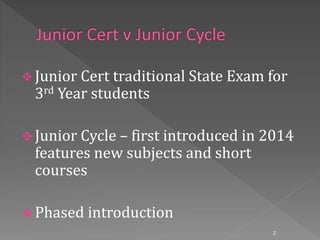
 Junior Cert traditional State Exam for
3rd Year students
 Junior Cycle – first introduced in 2014
features new subjects and short
courses
 Phased introduction
2
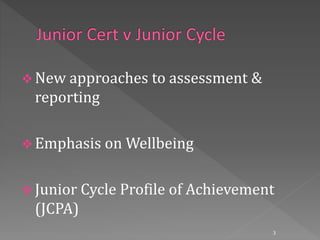
 New approaches to assessment &
reporting
 Emphasis on Wellbeing
 Junior Cycle Profile of Achievement
(JCPA)
3
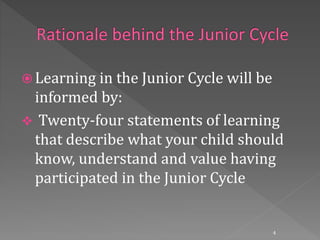
 Learning in the Junior Cycle will be
informed by:
 Twenty-four statements of learning
that describe what your child should
know, understand and value having
participated in the Junior Cycle
4
 Eight principles that underpin the entire
Framework for Junior Cycle
 Eight key skills that are required for
successful learning by all students
 Further details relating to these or any of
tonight’s presentation can be found on
www.jct.ie
5
 Creativity and Innovation
 Learning to Learn
 Choice and Flexibility
 Quality
 Engagement & Participation
 Continuity and Development
 Inclusive Education
 Wellbeing
6
 Being Literate
 Being numerate
 Managing Information and Thinking
 Being Creative
 Working with Others
 Managing Myself
 Staying Well
 Communicating
7
1. State Examination Commission (SEC)
examinations of subjects
2. Classroom Based Assessments (CBA)
including subjects and short courses
3. Other Areas of Learning (OAL’s)
4. Priority Learning Units (PLU’s) – Those
Students doing a reduced curriculum 8
Undertaken by students on a reduced
curriculum with specific learning needs
1. Communication & Literacy
2. Numeracy
3. Personal Care
4. Living in a Community
5. Preparing for Work
9
 JCPA-Sample
10
 10 subjects for examination in 2019–
combination of Junior Cycle and Junior Cert
 Other Areas of Learning (OAL’s) e.g.
 membership of school council
 participation on school team
 membership of school club
11
Junior Cycle Exams
 English -compulsory
 Science
 Business Studies
Junior Cert Exams
 Home Economics
 Music
 History - compulsory
 Geography - compulsory
 Maths – compulsory
 Visual Arts/Art Craft &
Design
 Irish - compulsory
 French
 German
 CSPE - compulsory
12
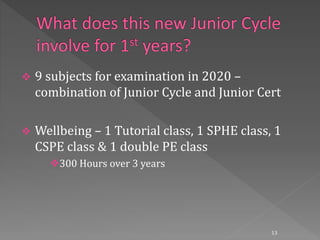
 9 subjects for examination in 2020 –
combination of Junior Cycle and Junior Cert
 Wellbeing – 1 Tutorial class, 1 SPHE class, 1
CSPE class & 1 double PE class
300 Hours over 3 years
13
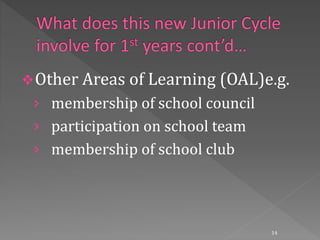
Other Areas of Learning (OAL)e.g.
› membership of school council
› participation on school team
› membership of school club
14
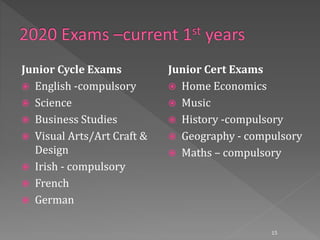
Junior Cycle Exams
 English -compulsory
 Science
 Business Studies
 Visual Arts/Art Craft &
Design
 Irish - compulsory
 French
 German
Junior Cert Exams
 Home Economics
 Music
 History -compulsory
 Geography - compulsory
 Maths – compulsory
15
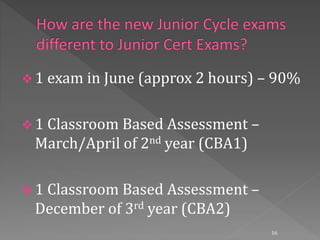
 1 exam in June (approx 2 hours) – 90%
 1 Classroom Based Assessment –
March/April of 2nd year (CBA1)
 1 Classroom Based Assessment –
December of 3rd year (CBA2)
16
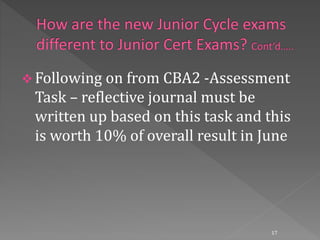
 Following on from CBA2 -Assessment
Task – reflective journal must be
written up based on this task and this
is worth 10% of overall result in June
17
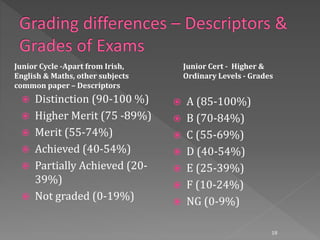
 Distinction (90-100 %)
 Higher Merit (75 -89%)
 Merit (55-74%)
 Achieved (40-54%)
 Partially Achieved (20-
39%)
 Not graded (0-19%)
 A (85-100%)
 B (70-84%)
 C (55-69%)
 D (40-54%)
 E (25-39%)
 F (10-24%)
 NG (0-9%)
Junior Cycle -Apart from Irish,
English & Maths, other subjects
common paper – Descriptors
Junior Cert - Higher &
Ordinary Levels - Grades
18
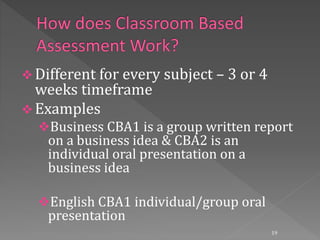
 Different for every subject – 3 or 4
weeks timeframe
 Examples
Business CBA1 is a group written report
on a business idea & CBA2 is an
individual oral presentation on a
business idea
English CBA1 individual/group oral
presentation
19
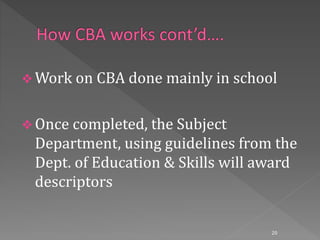
 Work on CBA done mainly in school
 Once completed, the Subject
Department, using guidelines from the
Dept. of Education & Skills will award
descriptors
20
 These are then reported in Summer
Report (CBA1) & Christmas Report
(CBA2)
 The Assessment Task (AT) Booklet
kept by school and sent off with final
exam in June (10%)
21
Features of quality – guidelines to
follow when awarding descriptor
 Exceptional
 Above Expectations
 In line with Expectations
 Yet to meet Expectations
22
 Schools will organise ‘Subject Learning &
Assessment Review’ meetings
 Schools will be supported by a team of
assessment associates from the Junior Cycle
for Teachers
 Continuous Professional Development
(CPD) will be provided for teachers to
ensure CBAs align to a national standard
23
Thank You!
24

New Junior Cycle Parents

  • 1.
  • 2.
     Junior Certtraditional State Exam for 3rd Year students  Junior Cycle – first introduced in 2014 features new subjects and short courses  Phased introduction 2
  • 3.
     New approachesto assessment & reporting  Emphasis on Wellbeing  Junior Cycle Profile of Achievement (JCPA) 3
  • 4.
     Learning inthe Junior Cycle will be informed by:  Twenty-four statements of learning that describe what your child should know, understand and value having participated in the Junior Cycle 4
  • 5.
     Eight principlesthat underpin the entire Framework for Junior Cycle  Eight key skills that are required for successful learning by all students  Further details relating to these or any of tonight’s presentation can be found on www.jct.ie 5
  • 6.
     Creativity andInnovation  Learning to Learn  Choice and Flexibility  Quality  Engagement & Participation  Continuity and Development  Inclusive Education  Wellbeing 6
  • 7.
     Being Literate Being numerate  Managing Information and Thinking  Being Creative  Working with Others  Managing Myself  Staying Well  Communicating 7
  • 8.
    1. State ExaminationCommission (SEC) examinations of subjects 2. Classroom Based Assessments (CBA) including subjects and short courses 3. Other Areas of Learning (OAL’s) 4. Priority Learning Units (PLU’s) – Those Students doing a reduced curriculum 8
  • 9.
    Undertaken by studentson a reduced curriculum with specific learning needs 1. Communication & Literacy 2. Numeracy 3. Personal Care 4. Living in a Community 5. Preparing for Work 9
  • 10.
  • 11.
     10 subjectsfor examination in 2019– combination of Junior Cycle and Junior Cert  Other Areas of Learning (OAL’s) e.g.  membership of school council  participation on school team  membership of school club 11
  • 12.
    Junior Cycle Exams English -compulsory  Science  Business Studies Junior Cert Exams  Home Economics  Music  History - compulsory  Geography - compulsory  Maths – compulsory  Visual Arts/Art Craft & Design  Irish - compulsory  French  German  CSPE - compulsory 12
  • 13.
     9 subjectsfor examination in 2020 – combination of Junior Cycle and Junior Cert  Wellbeing – 1 Tutorial class, 1 SPHE class, 1 CSPE class & 1 double PE class 300 Hours over 3 years 13
  • 14.
    Other Areas ofLearning (OAL)e.g. › membership of school council › participation on school team › membership of school club 14
  • 15.
    Junior Cycle Exams English -compulsory  Science  Business Studies  Visual Arts/Art Craft & Design  Irish - compulsory  French  German Junior Cert Exams  Home Economics  Music  History -compulsory  Geography - compulsory  Maths – compulsory 15
  • 16.
     1 examin June (approx 2 hours) – 90%  1 Classroom Based Assessment – March/April of 2nd year (CBA1)  1 Classroom Based Assessment – December of 3rd year (CBA2) 16
  • 17.
     Following onfrom CBA2 -Assessment Task – reflective journal must be written up based on this task and this is worth 10% of overall result in June 17
  • 18.
     Distinction (90-100%)  Higher Merit (75 -89%)  Merit (55-74%)  Achieved (40-54%)  Partially Achieved (20- 39%)  Not graded (0-19%)  A (85-100%)  B (70-84%)  C (55-69%)  D (40-54%)  E (25-39%)  F (10-24%)  NG (0-9%) Junior Cycle -Apart from Irish, English & Maths, other subjects common paper – Descriptors Junior Cert - Higher & Ordinary Levels - Grades 18
  • 19.
     Different forevery subject – 3 or 4 weeks timeframe  Examples Business CBA1 is a group written report on a business idea & CBA2 is an individual oral presentation on a business idea English CBA1 individual/group oral presentation 19
  • 20.
     Work onCBA done mainly in school  Once completed, the Subject Department, using guidelines from the Dept. of Education & Skills will award descriptors 20
  • 21.
     These arethen reported in Summer Report (CBA1) & Christmas Report (CBA2)  The Assessment Task (AT) Booklet kept by school and sent off with final exam in June (10%) 21
  • 22.
    Features of quality– guidelines to follow when awarding descriptor  Exceptional  Above Expectations  In line with Expectations  Yet to meet Expectations 22
  • 23.
     Schools willorganise ‘Subject Learning & Assessment Review’ meetings  Schools will be supported by a team of assessment associates from the Junior Cycle for Teachers  Continuous Professional Development (CPD) will be provided for teachers to ensure CBAs align to a national standard 23
  • 24.