Junior Cycle Education

A new curriculum
Opportunities and Challenges
Aims of the module
• Reflect on the “why” of the new
proposals
• Examine the required curriculum
changes
• Plan a new curriculum with particular
emphasis on “Short Courses”
School Matters
Research tells us that students who
risk disaffection at school respond best
to a curriculum that is holistic, that
actively engages them, that is
responsive to their needs, interests and
learning styles, that combines
integrated academic, social skills, and
vocational education with career
development and work-based learning.
Improving the Curriculum and Learning
Experience

All learners should also have regular opportunity
to engage with those learning approaches,
including
cooperative learning differentiated learning
active learning
problem-solving activity
which we know not only contribute to more
effective learning but increase learners’
participation and enjoyment of the learning
process
L&N Strategy p.43
Present Junior Cycle
Year
First year

Learning Challenge
Progress

Second year

Purpose

Third year

Product
The New Junior Cycle
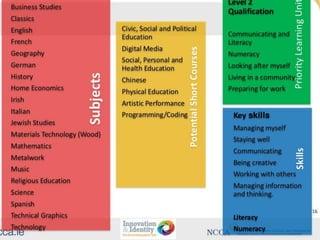
• Innovation

• Identity

teachers and school
leaders as agents of
change
continuation from
primary school and
preparation for senior
cycle
Values
•
•
•
•
•

Equality and inclusion
Justice and fairness
Freedom and democracy
Respect for human dignity
Identity
Vision
“Junior cycle places students at the
centre of the educational experience,
enabling them to actively participate in
their communities and in society and to
be resourceful and confident learners in
all aspects and stages of their lives.”
Leaders of Learning
How, as a Leader of
Learning, can I influence
changes to the curriculum
and timetable?
Group Discussion 1
Challenges
Number of periods in the week
Teacher allocation and class size
Existing arrangements
A. Ps. On 18 hours
Room availability
Teacher with a single subject
Lack of teachers for a specific subject
Issues for Schools
 Reduced allocation - guidance?
 Changing to a 28 hour week
 Prior use of resource hours
 Class viability – what size? Eg 26 students opt
H.Ecs.
 PLC late uptake
 Lack of qualified SEN teachers
 Can school afford to drop a minority subject
 Smaller intake in first year
 More time for maths, 140 points!
 SPHE at senior cycle
 PE for all yeargroups
 Other ???
Curriculum ……Principles
Breadth
Challenge
Coherent
Depth
Personalisation
Progression
Relevance

covering a range of experiences
engage and motivate
draws different strands together
develop learner’s full capacity
allows for aptitudes and talents
builds on previous learning
present and future
NCCA…..Key Principles
•
•
•
•
•
•

Quality
Creativity and innovation
Choice and flexibility
Continuity
Engagement, relevance and enjoyment
Lifelong learning
Group Discussion 2
More of the same
or
improved teaching
and learning etc.
Framework Premise
• All schools moving at the same time
• All schools moving in the same direction
• All schools arriving at the same end point
Reduced Content
•
•
•
•
•
•
•

Time for deeper understanding
Active learning and research
Varied teaching methodologies
Interdisciplinary themed learning
Emphasise literacy and numeracy
Practical relevant focus
Real linkage with Primary school
Question

What is the most useful
thing you ever learned ?
Student Answers
•
•
•
•
•
•

How to
How to
How to
How to
How to
How to

communicate
listen
stand up for myself
cope in different situations
mix with people
cook
The 1680 minute week
42 periods v 45 periods
42 x 40 minutes
or
15 x 38mins. + 30 x 37mins.
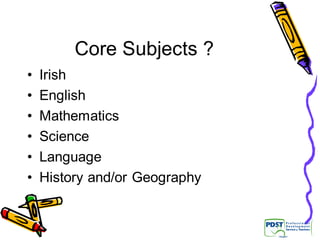
Core Subjects ?
•
•
•
•
•
•

Irish
English
Mathematics
Science
Language
History and/or Geography
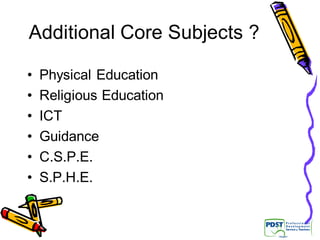
Additional Core Subjects ?
•
•
•
•
•
•

Physical Education
Religious Education
ICT
Guidance
C.S.P.E.
S.P.H.E.
Core Subjects
Time Allocation
• Irish, English, Mathematics a minimum of
240 hours over 3 years,(say 96 weeks)

240 / 96 = 2.5 hours = 150 minutes
5 x 40 mins. = 200 minutes (320 hrs.)
5 x 37 mins. = 185 minutes (299 hrs.)
Other Subjects
Time Allocation
• 200 hour subjects
4 x 40 mins. = 160 mins.(256 hours)
4 x 37 mins. = 148 mins. (238 hours)
Short Courses……why?
• Open up a new area of learning
• Deepen students learning in areas
associated with existing subjects
• Develop the skills and capacities of
students
• Frame learning in specific activities, ie
Young Scientist
Short Courses…examples
•
•
•
•
•
•

Information and Communication Tech.
Physical and Health Education
Coastal Studies
The Arts
D. I. Y.
Entrepreneurial Studies
Short Courses
Time Allocation
100 hours
Over 3 years….....2 weekly periods
Over 2 years……..3 weekly periods
First Year

A general introduction to
second level education ?
Group Discussion 3
Option Subjects
• Normal subjects offered by the school
• New short courses, replacing or derived
from an existing option subject
• Retain the same number of option lines
• 2 short courses equal 1 subject
• If 2 option lines then students could
choose 0 or 2 or 4 short courses
Sample Curriculum (1) ?
Irish
English
Mathematics
Language
Science
History/Geography
Total

5
5
5
4
4
5?
28
Sample Curriculum(2)
R.E.
P.E.
S.P.H.E.
C.S.P.E.
I.C.T.
Rotation/Option1
Rotation/Option 2
Rotation in 1st year allows students to sample all option subjects
TIMETABLE SAMPLE 1

1

• DO 3 OPTION
SUBJECTS IN 1ST
YEAR

2

• PICK 2 OPTION
SUBJECTS OUT OF
THOSE 3 IN 2ND AND
3RD YEAR

3

• CHOOSE BETWEEN
HIST OR GEOG AT
END 1ST YR.
No. of
periods per
week

No. of
periods per
week

No. of
periods per
week

Yr 1

Yr 2

Yr 3

English

5

5

5

15

Irish

5

5

5

15

Maths

5

5

5

15

Religion

3

3

3

9

French / German
Science

4
4

4
4

4
4

12
12

History

3

3

3

9

Geog

3

SPHE/ CSPE

2

2

3

7

P.E.

2

2

2

6

SAMPLE 1
CORE SUBJECTS

Total periods
over 3 years

3

0
TOTAL CORE

36

33

34

OPT1

2

4

4

10

OPT2

2

4

4

10

Opt3

2

TUTORIAL ???
TOTAL PERIODS

OPT1, OPT2 & OPT3 IN FIRST YEAR
BUT PICK 2 OUT OF
THESE THREE AT THE END OF 1ST
YEAR

1
42

42

42
TIMETABLE SAMPLE 2

1

• DO 4 OPTION
SUBJECTS IN 1ST
YEAR

2

• PICK 2 OUT OF
THESE 4 OPTION
SUBJECTS IN 2ND
AND 3RD YEAR

3

• CHOOSE BETWEEN
HIST OR GEOG AT
END 1ST YR.
No. of
periods per
week

No. of
periods per
week

No. of
periods per
week

Yr 1

Yr 2

Yr 3

English

5

5

5

15

Irish

4

4

5

13

Maths

5

5

5

15

Religion

2

2

2

6

French / German
Science

4
4

4
4

4
4

12
12

History

2

4

4

10

Geog

2

ICT

2

2

1

5

P.E.

2

2

2

6

SPHE/ CSPE

2

2

2

6

TOTAL CORE

34

34

34

Opt1

2

4

4

10

OPT2

2

4

4

10

Opt3

2

Opt4

2

42

42

SAMPLE 2
CORE SUBJECTS

TOTAL PERIODS

42

Total periods
over 3 years

2
References
•

School Matters : The Report of the Task Force on Student Behaviour
2006 Department of Education and Science

•

Moving Up : The Experiences of First-Year Students in Post-Primary
Education 2004
Smyth, Emer / McCoy, Selina / Darmody, Merike
Liffey Press in association with the ESRI

•

Pathways through the Junior Cycle : The Experience of Second
Year
Students 2006
Smyth, Emer / Dunne, Allison / McCoy, Selina
/ Darmody Merike The Liffey Press in
association with the ESRI
– Towards a Framework for Junior Cycle : NCCA 2012
– Slides 33 to 36 : Ms. Rita McCabe

The junior certificate curriculum

  • 1.
    Junior Cycle Education Anew curriculum Opportunities and Challenges
  • 2.
    Aims of themodule • Reflect on the “why” of the new proposals • Examine the required curriculum changes • Plan a new curriculum with particular emphasis on “Short Courses”
  • 3.
    School Matters Research tellsus that students who risk disaffection at school respond best to a curriculum that is holistic, that actively engages them, that is responsive to their needs, interests and learning styles, that combines integrated academic, social skills, and vocational education with career development and work-based learning.
  • 4.
    Improving the Curriculumand Learning Experience All learners should also have regular opportunity to engage with those learning approaches, including cooperative learning differentiated learning active learning problem-solving activity which we know not only contribute to more effective learning but increase learners’ participation and enjoyment of the learning process L&N Strategy p.43
  • 5.
    Present Junior Cycle Year Firstyear Learning Challenge Progress Second year Purpose Third year Product
  • 6.
    The New JuniorCycle • Innovation • Identity teachers and school leaders as agents of change continuation from primary school and preparation for senior cycle
  • 7.
    Values • • • • • Equality and inclusion Justiceand fairness Freedom and democracy Respect for human dignity Identity
  • 8.
    Vision “Junior cycle placesstudents at the centre of the educational experience, enabling them to actively participate in their communities and in society and to be resourceful and confident learners in all aspects and stages of their lives.”
  • 10.
    Leaders of Learning How,as a Leader of Learning, can I influence changes to the curriculum and timetable? Group Discussion 1
  • 11.
    Challenges Number of periodsin the week Teacher allocation and class size Existing arrangements A. Ps. On 18 hours Room availability Teacher with a single subject Lack of teachers for a specific subject
  • 12.
    Issues for Schools Reduced allocation - guidance?  Changing to a 28 hour week  Prior use of resource hours  Class viability – what size? Eg 26 students opt H.Ecs.  PLC late uptake  Lack of qualified SEN teachers  Can school afford to drop a minority subject  Smaller intake in first year  More time for maths, 140 points!  SPHE at senior cycle  PE for all yeargroups  Other ???
  • 13.
    Curriculum ……Principles Breadth Challenge Coherent Depth Personalisation Progression Relevance covering arange of experiences engage and motivate draws different strands together develop learner’s full capacity allows for aptitudes and talents builds on previous learning present and future
  • 14.
    NCCA…..Key Principles • • • • • • Quality Creativity andinnovation Choice and flexibility Continuity Engagement, relevance and enjoyment Lifelong learning
  • 16.
    Group Discussion 2 Moreof the same or improved teaching and learning etc.
  • 17.
    Framework Premise • Allschools moving at the same time • All schools moving in the same direction • All schools arriving at the same end point
  • 18.
    Reduced Content • • • • • • • Time fordeeper understanding Active learning and research Varied teaching methodologies Interdisciplinary themed learning Emphasise literacy and numeracy Practical relevant focus Real linkage with Primary school
  • 19.
    Question What is themost useful thing you ever learned ?
  • 20.
    Student Answers • • • • • • How to Howto How to How to How to How to communicate listen stand up for myself cope in different situations mix with people cook
  • 21.
    The 1680 minuteweek 42 periods v 45 periods 42 x 40 minutes or 15 x 38mins. + 30 x 37mins.
  • 22.
  • 23.
    Additional Core Subjects? • • • • • • Physical Education Religious Education ICT Guidance C.S.P.E. S.P.H.E.
  • 24.
    Core Subjects Time Allocation •Irish, English, Mathematics a minimum of 240 hours over 3 years,(say 96 weeks) 240 / 96 = 2.5 hours = 150 minutes 5 x 40 mins. = 200 minutes (320 hrs.) 5 x 37 mins. = 185 minutes (299 hrs.)
  • 25.
    Other Subjects Time Allocation •200 hour subjects 4 x 40 mins. = 160 mins.(256 hours) 4 x 37 mins. = 148 mins. (238 hours)
  • 26.
    Short Courses……why? • Openup a new area of learning • Deepen students learning in areas associated with existing subjects • Develop the skills and capacities of students • Frame learning in specific activities, ie Young Scientist
  • 27.
    Short Courses…examples • • • • • • Information andCommunication Tech. Physical and Health Education Coastal Studies The Arts D. I. Y. Entrepreneurial Studies
  • 28.
    Short Courses Time Allocation 100hours Over 3 years….....2 weekly periods Over 2 years……..3 weekly periods
  • 29.
    First Year A generalintroduction to second level education ? Group Discussion 3
  • 30.
    Option Subjects • Normalsubjects offered by the school • New short courses, replacing or derived from an existing option subject • Retain the same number of option lines • 2 short courses equal 1 subject • If 2 option lines then students could choose 0 or 2 or 4 short courses
  • 31.
    Sample Curriculum (1)? Irish English Mathematics Language Science History/Geography Total 5 5 5 4 4 5? 28
  • 32.
  • 33.
    TIMETABLE SAMPLE 1 1 •DO 3 OPTION SUBJECTS IN 1ST YEAR 2 • PICK 2 OPTION SUBJECTS OUT OF THOSE 3 IN 2ND AND 3RD YEAR 3 • CHOOSE BETWEEN HIST OR GEOG AT END 1ST YR.
  • 34.
    No. of periods per week No.of periods per week No. of periods per week Yr 1 Yr 2 Yr 3 English 5 5 5 15 Irish 5 5 5 15 Maths 5 5 5 15 Religion 3 3 3 9 French / German Science 4 4 4 4 4 4 12 12 History 3 3 3 9 Geog 3 SPHE/ CSPE 2 2 3 7 P.E. 2 2 2 6 SAMPLE 1 CORE SUBJECTS Total periods over 3 years 3 0 TOTAL CORE 36 33 34 OPT1 2 4 4 10 OPT2 2 4 4 10 Opt3 2 TUTORIAL ??? TOTAL PERIODS OPT1, OPT2 & OPT3 IN FIRST YEAR BUT PICK 2 OUT OF THESE THREE AT THE END OF 1ST YEAR 1 42 42 42
  • 35.
    TIMETABLE SAMPLE 2 1 •DO 4 OPTION SUBJECTS IN 1ST YEAR 2 • PICK 2 OUT OF THESE 4 OPTION SUBJECTS IN 2ND AND 3RD YEAR 3 • CHOOSE BETWEEN HIST OR GEOG AT END 1ST YR.
  • 36.
    No. of periods per week No.of periods per week No. of periods per week Yr 1 Yr 2 Yr 3 English 5 5 5 15 Irish 4 4 5 13 Maths 5 5 5 15 Religion 2 2 2 6 French / German Science 4 4 4 4 4 4 12 12 History 2 4 4 10 Geog 2 ICT 2 2 1 5 P.E. 2 2 2 6 SPHE/ CSPE 2 2 2 6 TOTAL CORE 34 34 34 Opt1 2 4 4 10 OPT2 2 4 4 10 Opt3 2 Opt4 2 42 42 SAMPLE 2 CORE SUBJECTS TOTAL PERIODS 42 Total periods over 3 years 2
  • 37.
    References • School Matters :The Report of the Task Force on Student Behaviour 2006 Department of Education and Science • Moving Up : The Experiences of First-Year Students in Post-Primary Education 2004 Smyth, Emer / McCoy, Selina / Darmody, Merike Liffey Press in association with the ESRI • Pathways through the Junior Cycle : The Experience of Second Year Students 2006 Smyth, Emer / Dunne, Allison / McCoy, Selina / Darmody Merike The Liffey Press in association with the ESRI – Towards a Framework for Junior Cycle : NCCA 2012 – Slides 33 to 36 : Ms. Rita McCabe