Study Skills
What is study?
Dictionary Definition
Ostudy verb (LEARN): to ​learn
about a ​subject, ​especially in
an educational course or
by ​reading books:
Ostudy verb (EXAMINE):
to ​examine something
very ​carefully
Difference between
Homework and Study
Homework is to reinforce the work
done in class.
Turn into study by introducing REVIEW
After Homework in each
subject
OClose book/copy
OAsk “What did I learn today
in….?”
OMake a link between
homework and learning.
Using Review for
Remembering
O Review technique can be used on daily
basis e.g. What did I learn today…?
O It can also be used on a weekly basis.
O E.g. What did I learn this week in…?
O By asking the brain to recall and recap on
what it has seen, you are getting the brain
to store the information in a way that can
be recalled easily.
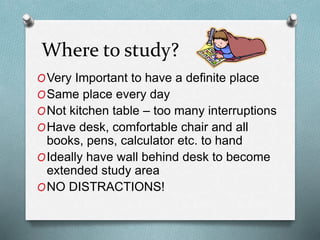
Where to study?
OVery Important to have a definite place
OSame place every day
ONot kitchen table – too many interruptions
OHave desk, comfortable chair and all
books, pens, calculator etc. to hand
OIdeally have wall behind desk to become
extended study area
ONO DISTRACTIONS!
Practical Study Tips
O When you are doing homework and are
doing something you have to think about,
what do you do?
O Usually look up. What do you see?
O Use the wall behind desk to help study.
O Put any diagrams/quotes/Poems that are
difficult to remember on the wall. This is
what you will see when you look up
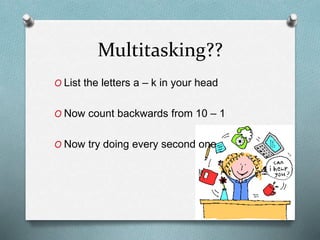
Multitasking??
O List the letters a – k in your head
O Now count backwards from 10 – 1
O Now try doing every second one
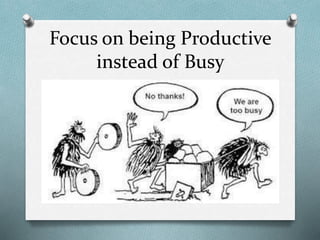
Focus on being Productive
instead of Busy
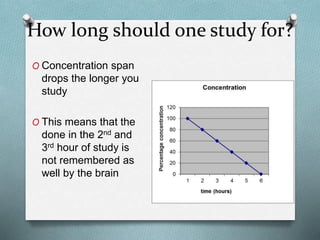
How long should one study for?
O Concentration span
drops the longer you
study
O This means that the
done in the 2nd and
3rd hour of study is
not remembered as
well by the brain
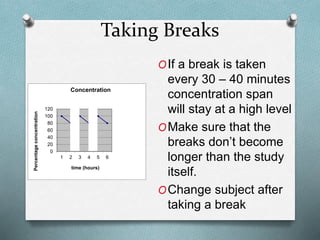
Taking Breaks
0
20
40
60
80
100
120
1 2 3 4 5 6
Percentageconcentration
time (hours)
Concentration
OIf a break is taken
every 30 – 40 minutes
concentration span
will stay at a high level
OMake sure that the
breaks don’t become
longer than the study
itself.
OChange subject after
taking a break
Knowing Own Learning Style
OWhat is your learning style?
ODo you like to read? Solve problems?
Memorise? Recite? Interpret? Speak to
others?
ODo you like to study alone or in a
group?
OWhat are your study habits?
OWhat works best for you? And worst?
Cat
Cat is a favourite pet of people around the world. Cats are intelligent and
have an independent nature. These small animals can also be playful and
entertaining. Many cats make affectionate, loyal pets, providing
companionship for people of all ages. About 55 million cats are kept as
pets in the United States. About 4 million pet cats live in Canada.
The word cat also refers to a family of meat-eating animals that includes
tigers, lions, leopards, and panthers. This family also includes domestic
cats--that is, those that people keep as pets. Domestic cats and their wild
relatives share many characteristics. All these animals have long,
powerful bodies and somewhat rounded heads. They have short, strong
jaws and 30 sharp teeth. Cats are also skilful hunters. They are able to
catch other animals by approaching them swiftly and quietly on padded
feet. Or they may wait motionless until an animal comes close and then
spring upon it suddenly.
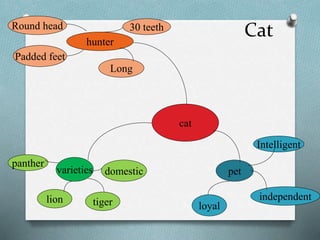
Cat
cat
domestic
Intelligent
independent
loyal
petvarieties
panther
lion tiger
Round head
Long
hunter
30 teeth
Padded feet
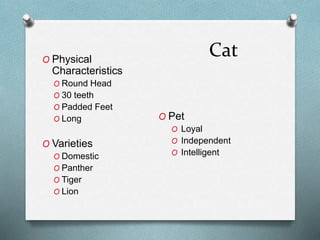
CatO Physical
Characteristics
O Round Head
O 30 teeth
O Padded Feet
O Long
O Varieties
O Domestic
O Panther
O Tiger
O Lion
O Pet
O Loyal
O Independent
O Intelligent
5 Minute Study Trick
ODecide what you need to learn.
OGives yourself 5 minutes to learn
everything you can about the topic. Close
the book.
OSpend 5 minutes writing out everything you
can remember from what you have
learned, including any diagrams.
OOpen the book. Takes 5 minutes with a
different colour pen to add in anything you
forgot.
Explanation of the 5 minute trick
OIt feels like you are only working for 5
minutes – the first five when you are trying to
remember as much as you can.
OThe five minutes you spend writing forces
your brain to recall what you learned and
makes your brain store it more securely.
OThe five minutes with a different colour
highlights the information your brain had a
problem with, and makes her brain make a
special effort to remember it.
Exam Tips
OKnow layout of exam, and calculate amount
of time to spend on each question based on
the marks for the question.
OIf there is a Short Question/Multiple Choice
section start with this. Write in answers you
are definite about. Pencil answers you are
unsure of.
More exam tips
OQuickly read through exam paper.
OStart with question you like – this will put
you in a positive frame for rest of paper
ONext do toughest question.
OTry to save a good question for last – you
will leave the exam on a more positive
note – important if there are more exams
to come.
Subject Choice
O After Christmas, students will receive a
presentation on Subject Choices
O They will then have to choose four from
seven choice subjects to continue for their
Junior Certificate
O Form needs to be filled in and signed by
student and parent
O Aim to keep a wide variety of career
options open for as long as possible

Study Skills 1st year 2017

  • 1.
  • 2.
    Dictionary Definition Ostudy verb(LEARN): to ​learn about a ​subject, ​especially in an educational course or by ​reading books: Ostudy verb (EXAMINE): to ​examine something very ​carefully
  • 3.
    Difference between Homework andStudy Homework is to reinforce the work done in class. Turn into study by introducing REVIEW
  • 4.
    After Homework ineach subject OClose book/copy OAsk “What did I learn today in….?” OMake a link between homework and learning.
  • 5.
    Using Review for Remembering OReview technique can be used on daily basis e.g. What did I learn today…? O It can also be used on a weekly basis. O E.g. What did I learn this week in…? O By asking the brain to recall and recap on what it has seen, you are getting the brain to store the information in a way that can be recalled easily.
  • 6.
    Where to study? OVeryImportant to have a definite place OSame place every day ONot kitchen table – too many interruptions OHave desk, comfortable chair and all books, pens, calculator etc. to hand OIdeally have wall behind desk to become extended study area ONO DISTRACTIONS!
  • 7.
    Practical Study Tips OWhen you are doing homework and are doing something you have to think about, what do you do? O Usually look up. What do you see? O Use the wall behind desk to help study. O Put any diagrams/quotes/Poems that are difficult to remember on the wall. This is what you will see when you look up
  • 8.
    Multitasking?? O List theletters a – k in your head O Now count backwards from 10 – 1 O Now try doing every second one
  • 9.
    Focus on beingProductive instead of Busy
  • 10.
    How long shouldone study for? O Concentration span drops the longer you study O This means that the done in the 2nd and 3rd hour of study is not remembered as well by the brain
  • 11.
    Taking Breaks 0 20 40 60 80 100 120 1 23 4 5 6 Percentageconcentration time (hours) Concentration OIf a break is taken every 30 – 40 minutes concentration span will stay at a high level OMake sure that the breaks don’t become longer than the study itself. OChange subject after taking a break
  • 12.
    Knowing Own LearningStyle OWhat is your learning style? ODo you like to read? Solve problems? Memorise? Recite? Interpret? Speak to others? ODo you like to study alone or in a group? OWhat are your study habits? OWhat works best for you? And worst?
  • 13.
    Cat Cat is afavourite pet of people around the world. Cats are intelligent and have an independent nature. These small animals can also be playful and entertaining. Many cats make affectionate, loyal pets, providing companionship for people of all ages. About 55 million cats are kept as pets in the United States. About 4 million pet cats live in Canada. The word cat also refers to a family of meat-eating animals that includes tigers, lions, leopards, and panthers. This family also includes domestic cats--that is, those that people keep as pets. Domestic cats and their wild relatives share many characteristics. All these animals have long, powerful bodies and somewhat rounded heads. They have short, strong jaws and 30 sharp teeth. Cats are also skilful hunters. They are able to catch other animals by approaching them swiftly and quietly on padded feet. Or they may wait motionless until an animal comes close and then spring upon it suddenly.
  • 14.
  • 15.
    CatO Physical Characteristics O RoundHead O 30 teeth O Padded Feet O Long O Varieties O Domestic O Panther O Tiger O Lion O Pet O Loyal O Independent O Intelligent
  • 16.
    5 Minute StudyTrick ODecide what you need to learn. OGives yourself 5 minutes to learn everything you can about the topic. Close the book. OSpend 5 minutes writing out everything you can remember from what you have learned, including any diagrams. OOpen the book. Takes 5 minutes with a different colour pen to add in anything you forgot.
  • 17.
    Explanation of the5 minute trick OIt feels like you are only working for 5 minutes – the first five when you are trying to remember as much as you can. OThe five minutes you spend writing forces your brain to recall what you learned and makes your brain store it more securely. OThe five minutes with a different colour highlights the information your brain had a problem with, and makes her brain make a special effort to remember it.
  • 18.
    Exam Tips OKnow layoutof exam, and calculate amount of time to spend on each question based on the marks for the question. OIf there is a Short Question/Multiple Choice section start with this. Write in answers you are definite about. Pencil answers you are unsure of.
  • 19.
    More exam tips OQuicklyread through exam paper. OStart with question you like – this will put you in a positive frame for rest of paper ONext do toughest question. OTry to save a good question for last – you will leave the exam on a more positive note – important if there are more exams to come.
  • 20.
    Subject Choice O AfterChristmas, students will receive a presentation on Subject Choices O They will then have to choose four from seven choice subjects to continue for their Junior Certificate O Form needs to be filled in and signed by student and parent O Aim to keep a wide variety of career options open for as long as possible