APPLIED
ECONOMICS
CHARLENE MAE G. PADIN
Subject Teacher
ECONOMICS
BASED ON THE VIDEO
PRESENTATION,
WHAT IS ECONOMICS?
ECONOMICS
It comes from the Greek word “oikos” meaning “”household”
and “Nomos” meaning management.
According to Fajardo, economics is the proper allocation and
efficient use of available resources for the maximum
satisfaction of human wants.
Samuelson states that economics is the study of how
societies use scarce resources to produce valuable
commodities and distribute them among different people.
Ultimately, economics is dedicated
to figuring out how society manages
its limited resources.
Why "limited"? Because we can't
have everything we want!
BRANCHES OF
ECONOMICS
 from the Greek word mikros, meaning “small”)
 It zooms in on the behavior of individual parts of the economy. It
focuses on how individual households, firms and industries
make their choices, and the interaction of such decisions in the
particular market.
SCOPE OF ECONOMICS
SCOPE OF ECONOMICS
 How households (like your family) make decisions about what
to buy.
 How firms (businesses) decide what to produce and at what
price.
  How industries (like the rice industry or the tech industry)
operate in specific markets.
Example: If we're studying the price of rice in a local
market – how much it costs, how much is produced,
and how government rules or taxes affect it – we're
looking at microeconomics.
SCOPE OF ECONOMICS
 from the Greek word makros, meaning, “Large”
 Deals with the problem of the economy as a whole. It looks at
aggregate prices, production, and income.
SCOPE OF ECONOMICS
Example: Studying the
Philippine economy's
total income (Gross
National Income) or
total employment
levels.
SCOPE OF ECONOMICS
 Looking at
economy-wide issues
like inflation (prices
going up),
unemployment rates, or
how fast the economy
is growing (GDP).
CONCERNS OF ECONOMICS
It is the use of inputs for generating output.
This is all about creating goods and services.
U T O N R O C I P D
PRODUCTION
PRODUCTION
o Inputs: These are the "ingredients" or resources (like labor,
land, materials) used to make something.
o Outputs: These are the final goods and services that come
out of the production process.
o The Big Question: Society has to decide what to produce (Do
we make more phones or more food?) and how much of it.
CONCERNS OF ECONOMICS
Once goods and services are produced,
how are they shared among the people in society?
I T R I D T U N O I S
B
DISTRIBUTION
DISTRIBUTION
o This is linked to the question: For whom are these goods
and services being produced? Is it for everyone, or just a few?
CONCERNS OF ECONOMICS
It is the use of products or services.
It is also the final conclusion of economic operation.
N O C M S U P N O I T
CONSUMPTION
CONSUMPTION
o It's the "end game" of the economic
process – when someone finally uses what
was produced.
CONCERNS OF ECONOMICS
It is concerned with government spending and revenue.
This focuses on the government's role in the economy.
C L U B P I
A N N E C I F
PUBLIC FINANCE
PUBLIC FINANCE
o It studies how the government collects
money (through taxes, borrowing) and how it
spends it (on roads, schools, healthcare,
etc.).
CONCERNS OF ECONOMICS
TYPES OF ECONOMICS
1. Household Economics
o Focus: How individual families and households
make economic choices.
o What it looks at: How families manage their limited
money, time, and skills to buy what they need and want,
and to improve their well-being.
TYPES OF ECONOMICS
2. Business Economics
o Focus: How businesses use economic principles to
make smart decisions
o What it looks at: Analyzing problems, improving
efficiency, and maximizing profits for companies.
TYPES OF ECONOMICS
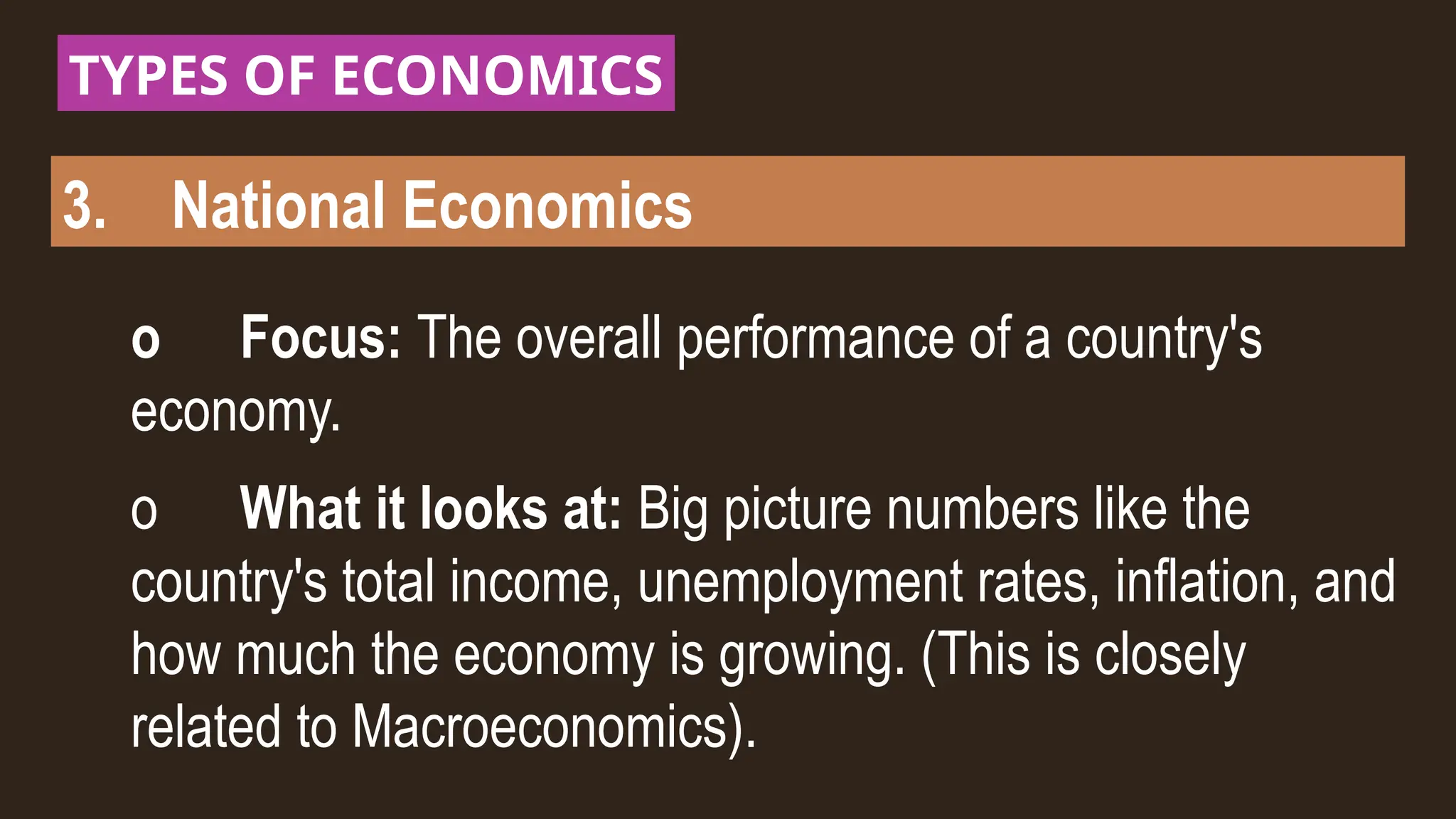
3. National Economics
o Focus: The overall performance of a country's
economy.
o What it looks at: Big picture numbers like the
country's total income, unemployment rates, inflation, and
how much the economy is growing. (This is closely
related to Macroeconomics).
TYPES OF ECONOMICS
4. International Economics
o Focus: How one country's economy interacts with
others.
o What it looks at: Things like international trade
(buying and selling goods between countries), tourism,
and exchange rates (how much one country's money is
worth compared to another's).
THE ECONOMIC
AGENTS/STAKEHOLDERS:
THE ECONOMIC AGENTS/ STAKEHOLDERS:
1. CONSUMERS
o These are the individuals or companies who buy and
use goods or services.
o They don't sell the item they purchased; they use it to
satisfy their needs or wants. (That's you when you buy a
new phone or a snack!)
THE ECONOMIC AGENTS/ STAKEHOLDERS:
2. PRODUCERS:
o These are the firms or individuals who create and
sell goods and services.
o They can be self-employed people (like a baker
who owns their own shop) or huge multinational
companies.
THE ECONOMIC AGENTS/ STAKEHOLDERS:
3. GOVERNMENT / PUBLIC
SECTOR:
o This group tries to maximize the well-being of
society as a whole.
o They interact with consumers and producers
within a specific location, culture, and environment,
shaping the rules of the market.
Key Terms to
Understand Economics
Better
GOODS
anything used to satisfy your needs and wants.
Intangible Goods
Tangible Goods
a physical object
or product that
can be touch
a product that
cannot be touch, like
insurance policy
1. Consumer Goods:
o These directly satisfy the needs and
wants
of consumers.
o Example: A slice of pizza, a pair of
shoes, a
CLASSIFICATION OF GOODS
2. Capital / Industrial Goods:
o These goods help to produce other
goods or services. They indirectly meet
consumer needs.
o Example: The oven in a bakery (helps
produce bread), a machine in a factory, a
delivery truck.
CLASSIFICATION OF GOODS
3. Essential Goods:
o These are goods consumed to
satisfy the basic needs of people.
o Example: Food, basic clothing,
shelter, clean water.
CLASSIFICATION OF GOODS
4. Economic Goods:
o These goods are useful AND
scarce. Because they are scarce, you
need to pay for them. They have a
"value" and a "price."
CLASSIFICATION OF GOODS
4. Economic Goods:
o Think: If something is so abundant that
everyone can have it without paying (like
fresh air in the countryside), it's "free." But
air-conditioned air is an economic good
because it's limited and costs money to
produce.
CLASSIFICATION OF GOODS
5. Luxury Goods:
o These goods are not necessary for
survival but are highly valued, often by
wealthy individuals.
o Reason for purchase: To show status,
for their high quality, or for their
craftsmanship.
o Example: A designer handbag, a
CLASSIFICATION OF GOODS
PICTURE ANALYSIS
THE ECONOMIC
RESOURCES
LAND
LABOR
CAPITAL
ENTREPRENEURSHIP
FACTORS OF PRODUCTION
1. LAND
2. LABOR
3. CAPITAL
4. ENTREPRENEURSHIP
LAND
FACTORS OF PRODUCTION
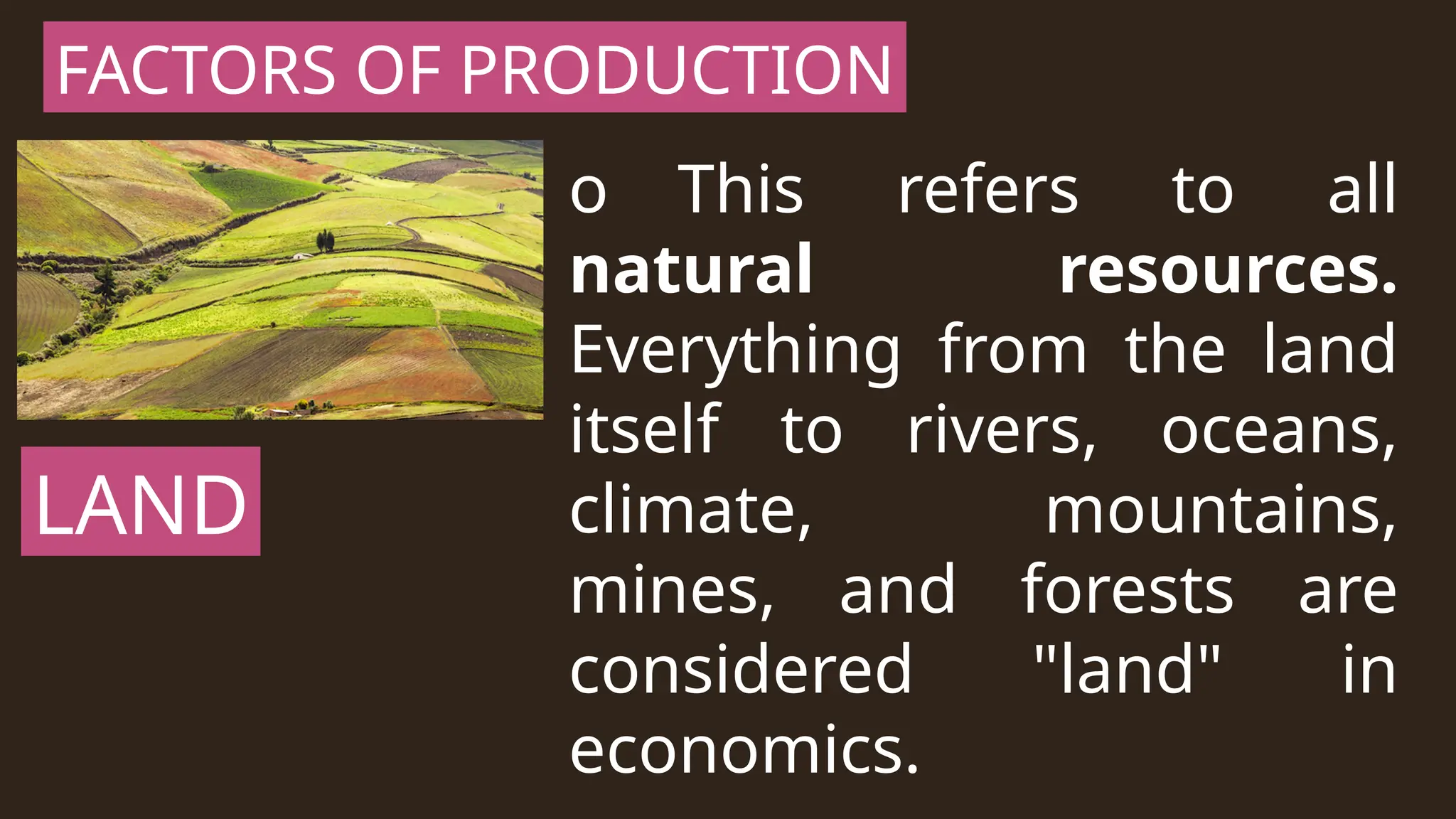
o This refers to all
natural resources.
Everything from the land
itself to rivers, oceans,
climate, mountains,
mines, and forests are
considered "land" in
economics.
LAND
FACTORS OF PRODUCTION
o It's the primary and
natural factor of
production – gifts from
nature.
o Payment for Land:
Rent.
LABOR
FACTORS OF PRODUCTION
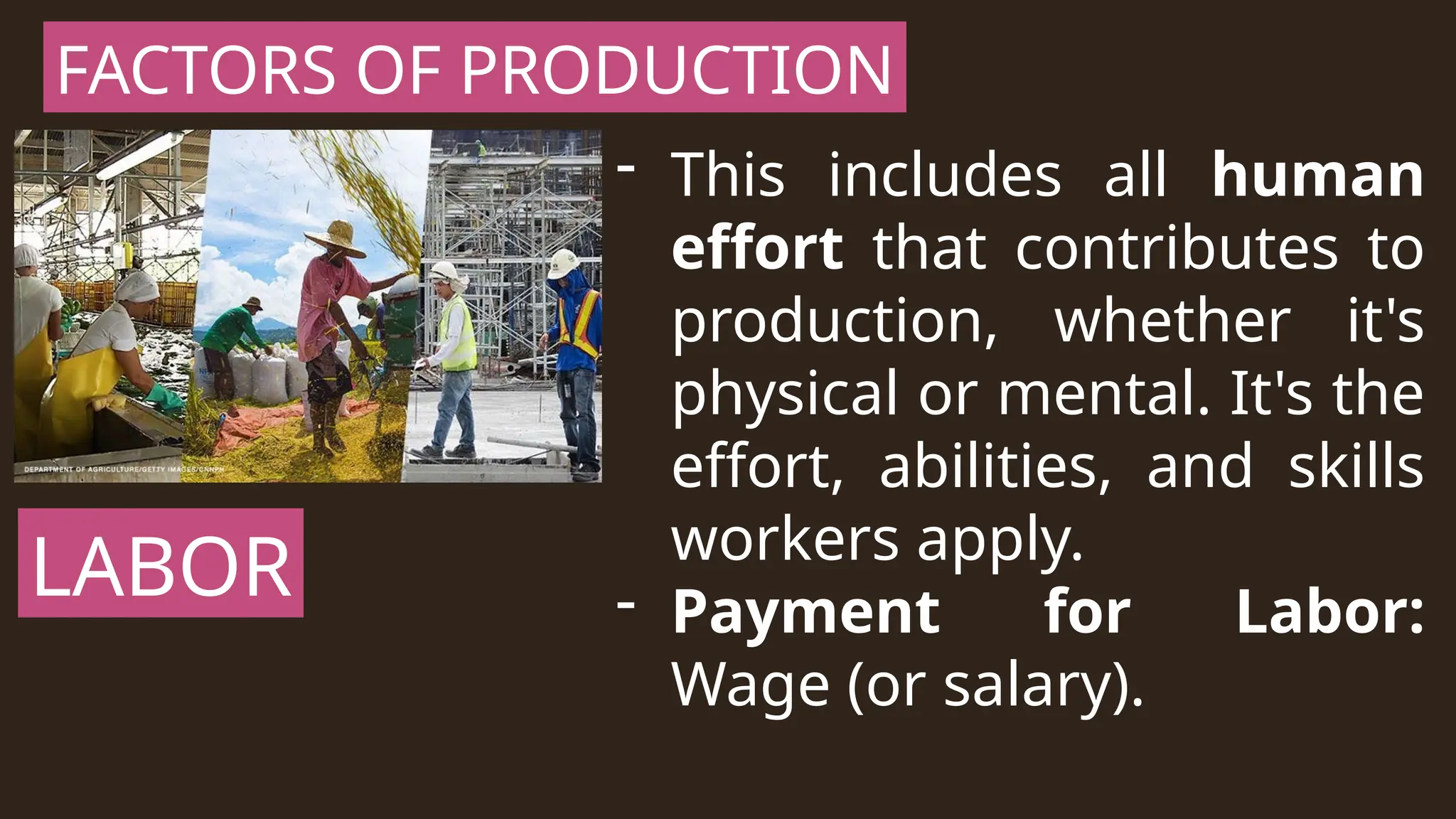
- This includes all human
effort that contributes to
production, whether it's
physical or mental. It's the
effort, abilities, and skills
workers apply.
- Payment for Labor:
Wage (or salary).
CAPITAL
FACTORS OF PRODUCTION
- These are man-made items
used to produce other goods
and services.
- It's a "produced" factor of
production because it's
something we create to help
us create more.
CAPITAL
FACTORS OF PRODUCTION
- o Examples: Factories,
machinery, tools, equipment,
raw materials, and even
money used for investment.
- Payment for Capital:
Interest.
ENTREPRENEURSHIP
FACTORS OF PRODUCTION
- This is the special ability
to combine the other
three factors (land,
labor, capital) to create
something new or to
transform an idea into a
business.
ENTREPRENEURSHIP
FACTORS OF PRODUCTION
- Entrepreneurs are often
innovative and willing to
take risks. They are the
ones who organize and
manage the production
process.
- Payment for
Entrepreneurship:
The Big
Challenges:
Scarcity, Choice,
and Opportunity
Cost
1. SCARCITY
Characteristics of Resources
This is the fundamental problem in economics: there's
simply not enough of everything to satisfy all human
wants. Our desires are unlimited, but our resources are
limited.
1. PROBLEMS BECAUSE OF SCARCITY
Characteristics of Resources
Land: Not enough land, natural resources, pollution,
overcrowding.
Labor: Not enough skilled workers, insufficient overall workforce.
Capital: Lack of good equipment/machines, not enough funds.
Entrepreneurship: Not enough training for entrepreneurs,
limited opportunities,
fierce competition for
good ideas.
2. MULTIPLE USAGE
Characteristics of Resources
o Many resources can be used for more than one
purpose.
o Example: A piece of land can be used to grow
coffee, or you could build a factory on it. This forces
us to make a choice!
3. PARTIALLY REPLACEABLE
(SUBSTITUTABLE)
Characteristics of Resources
o Sometimes, one resource can be substituted for
another in production.
o Example: You can replace manual labor with
technology (machines) to do a task.
Choice and Decision-Making
Because of scarcity, we are constantly
forced to make choices. We have to decide
how to use our limited resources in the
best possible way to satisfy as many wants
as we can.
Opportunity cost
the value of the next best alternative that you give
up when you make a choice.
• Since resources are scarce, choosing one
thing means you can't have something else. The
opportunity cost is that "something else" you
missed out on.
Opportunity cost
It helps us make the smartest decisions by
understanding the true cost of our choices.
Example: If a mother decides to be a full-time
mother instead of returning to her job, the
opportunity cost is the salary she could have
earned. She chose the benefits of full-time
motherhood over the financial benefits of a salary.
Importance of Economics in our daily lives
It helps us understand:
How to earn a living
and manage our
personal finances.
How to earn a living
and manage our
personal finances.
o How businesses
make decisions and
maximize profits.
How societies
distribute resources
fairly.
Economics: A Social
Science AND an
Applied Science
Economics: A Social Science AND an Applied Science
Economics as a Social Science
Focus: It aims to understand human
behavior – how people, families, businesses, and
governments make choices about scarce
resources.
Approach: It uses theories (like supply and
demand) to analyze how economies work.
Economics: A Social Science AND an Applied Science
Economics as an Applied Science
Focus: This is about the practical use of economic
theories and tools to solve real-world problems.
• Role: Economists use their knowledge to address
issues like:
o How to reduce unemployment.
o How to stabilize prices (preventing inflation or
deflation).
o How to promote economic growth.
o How to reduce inequality.

Applied Economics Module 1 Grade 12.pptx

  • 1.
    APPLIED ECONOMICS CHARLENE MAE G.PADIN Subject Teacher
  • 2.
  • 4.
    BASED ON THEVIDEO PRESENTATION, WHAT IS ECONOMICS?
  • 5.
    ECONOMICS It comes fromthe Greek word “oikos” meaning “”household” and “Nomos” meaning management. According to Fajardo, economics is the proper allocation and efficient use of available resources for the maximum satisfaction of human wants. Samuelson states that economics is the study of how societies use scarce resources to produce valuable commodities and distribute them among different people.
  • 6.
    Ultimately, economics isdedicated to figuring out how society manages its limited resources. Why "limited"? Because we can't have everything we want!
  • 7.
  • 8.
     from theGreek word mikros, meaning “small”)  It zooms in on the behavior of individual parts of the economy. It focuses on how individual households, firms and industries make their choices, and the interaction of such decisions in the particular market. SCOPE OF ECONOMICS
  • 9.
    SCOPE OF ECONOMICS How households (like your family) make decisions about what to buy.  How firms (businesses) decide what to produce and at what price.   How industries (like the rice industry or the tech industry) operate in specific markets.
  • 10.
    Example: If we'restudying the price of rice in a local market – how much it costs, how much is produced, and how government rules or taxes affect it – we're looking at microeconomics. SCOPE OF ECONOMICS
  • 11.
     from theGreek word makros, meaning, “Large”  Deals with the problem of the economy as a whole. It looks at aggregate prices, production, and income. SCOPE OF ECONOMICS
  • 12.
    Example: Studying the Philippineeconomy's total income (Gross National Income) or total employment levels. SCOPE OF ECONOMICS  Looking at economy-wide issues like inflation (prices going up), unemployment rates, or how fast the economy is growing (GDP).
  • 14.
  • 15.
    It is theuse of inputs for generating output. This is all about creating goods and services. U T O N R O C I P D PRODUCTION
  • 16.
    PRODUCTION o Inputs: Theseare the "ingredients" or resources (like labor, land, materials) used to make something. o Outputs: These are the final goods and services that come out of the production process. o The Big Question: Society has to decide what to produce (Do we make more phones or more food?) and how much of it. CONCERNS OF ECONOMICS
  • 17.
    Once goods andservices are produced, how are they shared among the people in society? I T R I D T U N O I S B DISTRIBUTION
  • 18.
    DISTRIBUTION o This islinked to the question: For whom are these goods and services being produced? Is it for everyone, or just a few? CONCERNS OF ECONOMICS
  • 19.
    It is theuse of products or services. It is also the final conclusion of economic operation. N O C M S U P N O I T CONSUMPTION
  • 20.
    CONSUMPTION o It's the"end game" of the economic process – when someone finally uses what was produced. CONCERNS OF ECONOMICS
  • 21.
    It is concernedwith government spending and revenue. This focuses on the government's role in the economy. C L U B P I A N N E C I F PUBLIC FINANCE
  • 22.
    PUBLIC FINANCE o Itstudies how the government collects money (through taxes, borrowing) and how it spends it (on roads, schools, healthcare, etc.). CONCERNS OF ECONOMICS
  • 24.
    TYPES OF ECONOMICS 1.Household Economics o Focus: How individual families and households make economic choices. o What it looks at: How families manage their limited money, time, and skills to buy what they need and want, and to improve their well-being.
  • 25.
    TYPES OF ECONOMICS 2.Business Economics o Focus: How businesses use economic principles to make smart decisions o What it looks at: Analyzing problems, improving efficiency, and maximizing profits for companies.
  • 26.
    TYPES OF ECONOMICS 3.National Economics o Focus: The overall performance of a country's economy. o What it looks at: Big picture numbers like the country's total income, unemployment rates, inflation, and how much the economy is growing. (This is closely related to Macroeconomics).
  • 27.
    TYPES OF ECONOMICS 4.International Economics o Focus: How one country's economy interacts with others. o What it looks at: Things like international trade (buying and selling goods between countries), tourism, and exchange rates (how much one country's money is worth compared to another's).
  • 28.
  • 30.
    THE ECONOMIC AGENTS/STAKEHOLDERS: 1. CONSUMERS o These are the individuals or companies who buy and use goods or services. o They don't sell the item they purchased; they use it to satisfy their needs or wants. (That's you when you buy a new phone or a snack!)
  • 31.
    THE ECONOMIC AGENTS/STAKEHOLDERS: 2. PRODUCERS: o These are the firms or individuals who create and sell goods and services. o They can be self-employed people (like a baker who owns their own shop) or huge multinational companies.
  • 32.
    THE ECONOMIC AGENTS/STAKEHOLDERS: 3. GOVERNMENT / PUBLIC SECTOR: o This group tries to maximize the well-being of society as a whole. o They interact with consumers and producers within a specific location, culture, and environment, shaping the rules of the market.
  • 33.
    Key Terms to UnderstandEconomics Better
  • 34.
    GOODS anything used tosatisfy your needs and wants. Intangible Goods Tangible Goods a physical object or product that can be touch a product that cannot be touch, like insurance policy
  • 35.
    1. Consumer Goods: oThese directly satisfy the needs and wants of consumers. o Example: A slice of pizza, a pair of shoes, a CLASSIFICATION OF GOODS
  • 36.
    2. Capital /Industrial Goods: o These goods help to produce other goods or services. They indirectly meet consumer needs. o Example: The oven in a bakery (helps produce bread), a machine in a factory, a delivery truck. CLASSIFICATION OF GOODS
  • 37.
    3. Essential Goods: oThese are goods consumed to satisfy the basic needs of people. o Example: Food, basic clothing, shelter, clean water. CLASSIFICATION OF GOODS
  • 38.
    4. Economic Goods: oThese goods are useful AND scarce. Because they are scarce, you need to pay for them. They have a "value" and a "price." CLASSIFICATION OF GOODS
  • 39.
    4. Economic Goods: oThink: If something is so abundant that everyone can have it without paying (like fresh air in the countryside), it's "free." But air-conditioned air is an economic good because it's limited and costs money to produce. CLASSIFICATION OF GOODS
  • 40.
    5. Luxury Goods: oThese goods are not necessary for survival but are highly valued, often by wealthy individuals. o Reason for purchase: To show status, for their high quality, or for their craftsmanship. o Example: A designer handbag, a CLASSIFICATION OF GOODS
  • 42.
  • 43.
  • 44.
  • 45.
  • 46.
  • 47.
    FACTORS OF PRODUCTION 1.LAND 2. LABOR 3. CAPITAL 4. ENTREPRENEURSHIP
  • 48.
    LAND FACTORS OF PRODUCTION oThis refers to all natural resources. Everything from the land itself to rivers, oceans, climate, mountains, mines, and forests are considered "land" in economics.
  • 49.
    LAND FACTORS OF PRODUCTION oIt's the primary and natural factor of production – gifts from nature. o Payment for Land: Rent.
  • 50.
    LABOR FACTORS OF PRODUCTION -This includes all human effort that contributes to production, whether it's physical or mental. It's the effort, abilities, and skills workers apply. - Payment for Labor: Wage (or salary).
  • 51.
    CAPITAL FACTORS OF PRODUCTION -These are man-made items used to produce other goods and services. - It's a "produced" factor of production because it's something we create to help us create more.
  • 52.
    CAPITAL FACTORS OF PRODUCTION -o Examples: Factories, machinery, tools, equipment, raw materials, and even money used for investment. - Payment for Capital: Interest.
  • 53.
    ENTREPRENEURSHIP FACTORS OF PRODUCTION -This is the special ability to combine the other three factors (land, labor, capital) to create something new or to transform an idea into a business.
  • 54.
    ENTREPRENEURSHIP FACTORS OF PRODUCTION -Entrepreneurs are often innovative and willing to take risks. They are the ones who organize and manage the production process. - Payment for Entrepreneurship:
  • 55.
  • 56.
    1. SCARCITY Characteristics ofResources This is the fundamental problem in economics: there's simply not enough of everything to satisfy all human wants. Our desires are unlimited, but our resources are limited.
  • 57.
    1. PROBLEMS BECAUSEOF SCARCITY Characteristics of Resources Land: Not enough land, natural resources, pollution, overcrowding. Labor: Not enough skilled workers, insufficient overall workforce. Capital: Lack of good equipment/machines, not enough funds. Entrepreneurship: Not enough training for entrepreneurs, limited opportunities, fierce competition for good ideas.
  • 58.
    2. MULTIPLE USAGE Characteristicsof Resources o Many resources can be used for more than one purpose. o Example: A piece of land can be used to grow coffee, or you could build a factory on it. This forces us to make a choice!
  • 59.
    3. PARTIALLY REPLACEABLE (SUBSTITUTABLE) Characteristicsof Resources o Sometimes, one resource can be substituted for another in production. o Example: You can replace manual labor with technology (machines) to do a task.
  • 60.
  • 61.
    Choice and Decision-Making Becauseof scarcity, we are constantly forced to make choices. We have to decide how to use our limited resources in the best possible way to satisfy as many wants as we can.
  • 62.
    Opportunity cost the valueof the next best alternative that you give up when you make a choice. • Since resources are scarce, choosing one thing means you can't have something else. The opportunity cost is that "something else" you missed out on.
  • 63.
    Opportunity cost It helpsus make the smartest decisions by understanding the true cost of our choices. Example: If a mother decides to be a full-time mother instead of returning to her job, the opportunity cost is the salary she could have earned. She chose the benefits of full-time motherhood over the financial benefits of a salary.
  • 64.
    Importance of Economicsin our daily lives It helps us understand: How to earn a living and manage our personal finances. How to earn a living and manage our personal finances. o How businesses make decisions and maximize profits. How societies distribute resources fairly.
  • 65.
    Economics: A Social ScienceAND an Applied Science
  • 66.
    Economics: A SocialScience AND an Applied Science Economics as a Social Science Focus: It aims to understand human behavior – how people, families, businesses, and governments make choices about scarce resources. Approach: It uses theories (like supply and demand) to analyze how economies work.
  • 67.
    Economics: A SocialScience AND an Applied Science Economics as an Applied Science Focus: This is about the practical use of economic theories and tools to solve real-world problems. • Role: Economists use their knowledge to address issues like: o How to reduce unemployment. o How to stabilize prices (preventing inflation or deflation). o How to promote economic growth. o How to reduce inequality.

Editor's Notes

  • #5 economics is about managing our limited resources to meet our unlimited wants.