Copyright
&
your research


                ERF2011
My name is Claire

   I am not a lawyer
   I am a librarian, I study copyright
Digital Collections department


Free digitization services & equipment for faculty/grad
                                  2East, University Library, 8:30-5, M-F
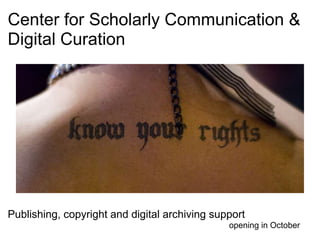
Center for Scholarly Communication &
Digital Curation


Publishing, copyright and digital archiving support
                                               opening in October
What will you create and produce?

          What is copyright?

 How do you know when you can use
      someone else's work?

   What copyrights will you control?


What are your options for managing and
          sharing your work?

  A bit about data and open access...
A tale of three author agreements
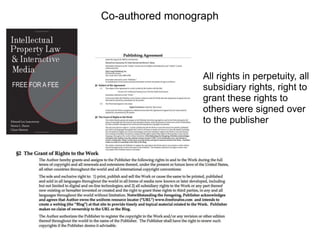
Co-authored monograph


                  All rights in perpetuity, all
                  subsidiary rights, right to
                  grant these rights to
                  others were signed over
                  to the publisher
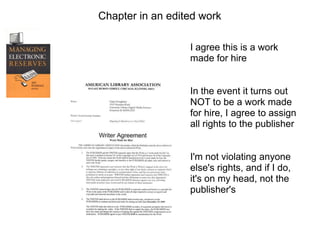
Chapter in an edited work

                  I agree this is a work
                  made for hire


                  In the event it turns out
                  NOT to be a work made
                  for hire, I agree to assign
                  all rights to the publisher


                  I'm not violating anyone
                  else's rights, and if I do,
                  it's on my head, not the
                  publisher's
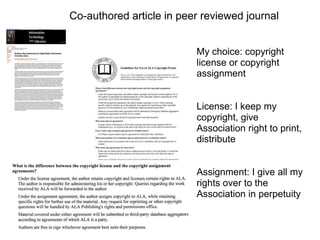
Co-authored article in peer reviewed journal


                          My choice: copyright
                          license or copyright
                          assignment


                          License: I keep my
                          copyright, give
                          Association right to print,
                          distribute


                          Assignment: I give all my
                          rights over to the
                          Association in perpetuity
Why do we agree to these terms?
What is copyright?

•   What qualifies for protection and when?
•   What are these "copy" "rights" ?
•   How long do they last?
•   Limitations and exceptions
What qualifies and when?
                • Copyright protects creative
                  expression of an idea, not the
                  idea itself
                • Factual information does not
                  qualify (historical facts, statistics,
                  telephone numbers, etc.)
                • Must be fixed in some medium;
                  electronic media qualifies: email,
                  PowerPoint, MSWord, etc.
                • As soon as it's fixed, it is
                  copyrighted (by the creator)
What are these “copy” “rights”?
Exclusive rights to …       In plan English
Reproduce                   Make copies
Distribute                  Sell, give away at conferences, give to
                            your students, make available for
                            downloading on your web site
Create derivative works     Make new work from an existing work,
                            screenplay from novel, new presentation
                            based on an old presentation, translation
Display the work publicly   Hang a painting in a gallery
Perform the work publicly   Theatrical performance, musical
                            performance
Web of Science


Which rights were
exercised to create
these graphs?


              Google Books
A few basic things to remember

• Copyright lasts for life of the author + 70 years
  (but it was not always thus ... rules have changed over the years)
• If you create it, you own the copyright. You do not have to
  include a notice or register your copyright, but for more
  formal works, this is not a bad idea.
  (U.S. Copyright Office help ... here again, rules have changed over the years)
• You can unbundle your rights, you can transfer your rights
• You can share copyright: works of joint authorship
• Works for hire: things you produce as part of your regular
  employment
Northwestern's copyright policy
"the members of the Northwestern University Academic
Community shall own in their individual capacity the copyright
to all copyrightable works they create at the University resulting
from their research, teaching, artistic creativity, or writing."


• Required to make best effort to grant NU a license to use the material for
  "reasonable academic or research purposes of the University"
• Stronger claim for instructional materials, University retains right to use
• Specific rules about software, patent-related copyrights, things in which the
  university has invested extraordinary resources
• Classifies administrative documents as works for hire

                                     http://www.invo.northwestern.edu/policies/copyright-policy
(back to U.S. Copyright Law)

Limitations and exceptions

 • Only the first sale of a copy
   is under copyright holder's
   control (109)
 • Exception for classroom
   teaching (110)
 • Exceptions for libraries to
   make copies (108)
 • Fair use (107)
Fair use, four factors

• Nature of the use
  for profit or non? educational use? criticism?
• Nature of the work
  highly creative? published or unpublished?
• Amount and substantiality of the use
  the heart of the work? the entire work?
• Market effect
  displacing sales?
What are the rules about incorporating
works created by others?
1. Is it still under copyright?

   if yes then...
2. Does an exception (fair use?) apply?

   if no, then ... you need to request permission
Nightmare scenario: your publisher won't include scans in your
book without a signed copyright agreement form ... what do you
do?
Your dissertation
                                             ProQuest provides a list of
                                             things for which they like to see
                                             permissions:
                                              • Very long quotations
                                              • Reproduced publications
                                                (survey instruments, journal
                                                articles, etc.)
                                              • Unpublished works
                                              • Substantial chunks of
                                                o   Poetry & lyrics
                                                o   Dialogue from dramatic work
http://dissertations.umi.com/northwestern/
                                                o   Music
                                                o   Graphical works
                                             • Software developed by
                                               someone else
Your dissertation

  Standard agreement with ProQuest is a license
Open Access:
Open-access (OA) literature is digital, online, free of charge, and free
of most copyright and licensing restrictions.
                                                            -Peter Suber
                     http://www.earlham.edu/~peters/fos/brief.htm
Contracts: terms you may encounter

 • Transfer of all rights in perpetuity
 • License of certain rights on a nonexclusive basis
 • Self-archiving restrictions*
    o only the pre-peer review copy
    o you have to wait X months before you can use the
      publisher PDF
    o only if mandated by a funder
 • You can participate in our open access program if you pay
   an additional author fee

*self-archiving: posting your work on your web page or depositing it in an institutional or a
disciplinary repository
Making sense of it all, alternatives, substitutions,
etc.

• Creative Commons licenses
• SHERPA/RoMEO
• Author addenda: CIC, SPARC
Creative Commons


creative commons -Franz Patzig-
(http://www.flickr.com/photos/21572939@N03/2090542246/) / A. Diez Herrero
(http://www.flickr.com/photos/21572939@N03/) / CC BY-NC-SA 2.0
(http://creativecommons.org/licenses/by-nc-sa/2.0/)
American Historical Review
Author addenda
• CIC Author Addendum
  http://www.northwestern.edu/provost/about/announcements/cic.html
   o Unanimously adopted by CIC provosts in 2006, endorsed by Northwestern
      Faculty
   o Key features:
         Author has non-exclusive rights to his/her work for academic purposes
         After 6 months, can make full use of publisher's copy
         Author has right to grant employing institution rights of reproduction,
          distribution, display, etc.
• Other addenda:
  o   Scholarly Publishing & Academic Resources Coalition (SPARC)
  o   Science Commons addenda generator
  o   Directory of addenda, Open Access Directory
What about data?
Data sharing: rules and norms are different

           Emerging policy area

Mandates from NSF, NIH, NEH-ODH for Data
  Management Plans, data preservation

               (what is data?)
Data sharing (& safekeeping) options
• Your school, department
• Vault (NUIT)
• Institutional repository (NUL)
  under development
• Your disciplinary repository
   o ICPSR (Poli Sci)
   o OpenContext (Arch)
• Google Dataset Publishing
  Language
• Insert_your_solution
  (DropBox, Box.net, Amazon,
  CrashPlan, etc.)
                                   http://oad.simmons.edu/oadwiki/Data_repositories
Final bits of advice

• Get in the habit of putting a copyright statement
  (Copyright © 2011, Claire Stewart) on your work, or, even
  better, a Creative Commons license
• You control your copyright, don't hesitate to ask for terms
  that will let you keep the rights you want
• Keep copies of authors agreements/contracts
• If you plan to use someone else's work in your work,
  document where you got your copy, when you got it, and the
  rights as you understand them
• Give some thought to organization of content ahead of time
• Keep your data safe: make. lots. of. copies.
You will probably forget
everything I've just talked about...


    the only thing you need to
          remember is...
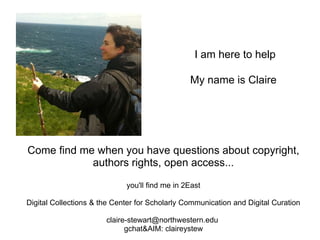
I am here to help

                                                My name is Claire


Come find me when you have questions about copyright,
            authors rights, open access...

                             you'll find me in 2East

Digital Collections & the Center for Scholarly Communication and Digital Curation

                       claire-stewart@northwestern.edu
                             gchat&AIM: claireystew
Photo credits
Slide: Center for Scholarly Communication & Digital Curation
know your rights (http://www.flickr.com/photos/keoshi/1336264417/) / Filipe Varela
(http://www.flickr.com/photos/keoshi/) / CC BY-NC-SA 2.0 (http://creativecommons.org/licenses/by-nc-
sa/2.0/)

Slide: Why?
Frustration (http://www.flickr.com/photos/14511253@N04/4411497087/) / Andrew Mccluskey
(http://www.flickr.com/photos/14511253@N04/) / CC BY 2.0 (http://creativecommons.org/licenses/by/2.0/)

Slide: What qualifies and when?
Writing (http://www.flickr.com/photos/anotherphotograph/2276607037/) / Tony Hall
(http://www.flickr.com/photos/anotherphotograph/) / CC BY-NC-SA 2.0
(http://creativecommons.org/licenses/by-nc-sa/2.0/)

Slide: A thought experiment
Rosvall, M., & Bergstrom, C.T. (2010). Mapping Change in Large Networks. PLoS ONE, 5(1), e8694. doi:
10.1371/journal.pone.0008694

Slide: Limitations and exceptions
Limit velomobile (http://www.flickr.com/photos/velomobiling/308274953/) / Mary
(http://www.flickr.com/photos/velomobiling/) / CC BY-NC-SA 2.0 (http://creativecommons.org/licenses/by-nc-
sa/2.0/)
Photo credits (continued)
Slide: Fair use
fair use classroom poster draft
(http://www.flickr.com/photos/sixteenmilesofstring/2596569134/in/photostream/) / Timothy Vollmer
(http://www.flickr.com/photos/sixteenmilesofstring/) / CC BY 2.0
(http://creativecommons.org/licenses/by/2.0/)
Slide: Creative Commons
creative commons -Franz Patzig- (http://www.flickr.com/photos/21572939@N03/2090542246/) / A. Diez
Herrero (http://www.flickr.com/photos/21572939@N03/) / CC BY-NC-SA 2.0
(http://creativecommons.org/licenses/by-nc-sa/2.0/)
Copyright © 2011, Claire Stewart

Copyright & your research

  • 1.
  • 2.
    My name isClaire I am not a lawyer I am a librarian, I study copyright
  • 3.
    Digital Collections department Freedigitization services & equipment for faculty/grad 2East, University Library, 8:30-5, M-F
  • 4.
    Center for ScholarlyCommunication & Digital Curation Publishing, copyright and digital archiving support opening in October
  • 5.
    What will youcreate and produce? What is copyright? How do you know when you can use someone else's work? What copyrights will you control? What are your options for managing and sharing your work? A bit about data and open access...
  • 6.
    A tale ofthree author agreements
  • 7.
    Co-authored monograph All rights in perpetuity, all subsidiary rights, right to grant these rights to others were signed over to the publisher
  • 8.
    Chapter in anedited work I agree this is a work made for hire In the event it turns out NOT to be a work made for hire, I agree to assign all rights to the publisher I'm not violating anyone else's rights, and if I do, it's on my head, not the publisher's
  • 9.
    Co-authored article inpeer reviewed journal My choice: copyright license or copyright assignment License: I keep my copyright, give Association right to print, distribute Assignment: I give all my rights over to the Association in perpetuity
  • 10.
    Why do weagree to these terms?
  • 11.
    What is copyright? • What qualifies for protection and when? • What are these "copy" "rights" ? • How long do they last? • Limitations and exceptions
  • 12.
    What qualifies andwhen? • Copyright protects creative expression of an idea, not the idea itself • Factual information does not qualify (historical facts, statistics, telephone numbers, etc.) • Must be fixed in some medium; electronic media qualifies: email, PowerPoint, MSWord, etc. • As soon as it's fixed, it is copyrighted (by the creator)
  • 13.
    What are these“copy” “rights”? Exclusive rights to … In plan English Reproduce Make copies Distribute Sell, give away at conferences, give to your students, make available for downloading on your web site Create derivative works Make new work from an existing work, screenplay from novel, new presentation based on an old presentation, translation Display the work publicly Hang a painting in a gallery Perform the work publicly Theatrical performance, musical performance
  • 14.
    Web of Science Whichrights were exercised to create these graphs? Google Books
  • 15.
    A few basicthings to remember • Copyright lasts for life of the author + 70 years (but it was not always thus ... rules have changed over the years) • If you create it, you own the copyright. You do not have to include a notice or register your copyright, but for more formal works, this is not a bad idea. (U.S. Copyright Office help ... here again, rules have changed over the years) • You can unbundle your rights, you can transfer your rights • You can share copyright: works of joint authorship • Works for hire: things you produce as part of your regular employment
  • 16.
    Northwestern's copyright policy "themembers of the Northwestern University Academic Community shall own in their individual capacity the copyright to all copyrightable works they create at the University resulting from their research, teaching, artistic creativity, or writing." • Required to make best effort to grant NU a license to use the material for "reasonable academic or research purposes of the University" • Stronger claim for instructional materials, University retains right to use • Specific rules about software, patent-related copyrights, things in which the university has invested extraordinary resources • Classifies administrative documents as works for hire http://www.invo.northwestern.edu/policies/copyright-policy
  • 17.
    (back to U.S.Copyright Law) Limitations and exceptions • Only the first sale of a copy is under copyright holder's control (109) • Exception for classroom teaching (110) • Exceptions for libraries to make copies (108) • Fair use (107)
  • 18.
    Fair use, fourfactors • Nature of the use for profit or non? educational use? criticism? • Nature of the work highly creative? published or unpublished? • Amount and substantiality of the use the heart of the work? the entire work? • Market effect displacing sales?
  • 19.
    What are therules about incorporating works created by others? 1. Is it still under copyright? if yes then... 2. Does an exception (fair use?) apply? if no, then ... you need to request permission Nightmare scenario: your publisher won't include scans in your book without a signed copyright agreement form ... what do you do?
  • 20.
    Your dissertation ProQuest provides a list of things for which they like to see permissions: • Very long quotations • Reproduced publications (survey instruments, journal articles, etc.) • Unpublished works • Substantial chunks of o Poetry & lyrics o Dialogue from dramatic work http://dissertations.umi.com/northwestern/ o Music o Graphical works • Software developed by someone else
  • 21.
    Your dissertation Standard agreement with ProQuest is a license
  • 22.
    Open Access: Open-access (OA)literature is digital, online, free of charge, and free of most copyright and licensing restrictions. -Peter Suber http://www.earlham.edu/~peters/fos/brief.htm
  • 23.
    Contracts: terms youmay encounter • Transfer of all rights in perpetuity • License of certain rights on a nonexclusive basis • Self-archiving restrictions* o only the pre-peer review copy o you have to wait X months before you can use the publisher PDF o only if mandated by a funder • You can participate in our open access program if you pay an additional author fee *self-archiving: posting your work on your web page or depositing it in an institutional or a disciplinary repository
  • 24.
    Making sense ofit all, alternatives, substitutions, etc. • Creative Commons licenses • SHERPA/RoMEO • Author addenda: CIC, SPARC
  • 25.
    Creative Commons creative commons-Franz Patzig- (http://www.flickr.com/photos/21572939@N03/2090542246/) / A. Diez Herrero (http://www.flickr.com/photos/21572939@N03/) / CC BY-NC-SA 2.0 (http://creativecommons.org/licenses/by-nc-sa/2.0/)
  • 26.
  • 27.
    Author addenda • CICAuthor Addendum http://www.northwestern.edu/provost/about/announcements/cic.html o Unanimously adopted by CIC provosts in 2006, endorsed by Northwestern Faculty o Key features:  Author has non-exclusive rights to his/her work for academic purposes  After 6 months, can make full use of publisher's copy  Author has right to grant employing institution rights of reproduction, distribution, display, etc. • Other addenda: o Scholarly Publishing & Academic Resources Coalition (SPARC) o Science Commons addenda generator o Directory of addenda, Open Access Directory
  • 28.
  • 29.
    Data sharing: rulesand norms are different Emerging policy area Mandates from NSF, NIH, NEH-ODH for Data Management Plans, data preservation (what is data?)
  • 30.
    Data sharing (&safekeeping) options • Your school, department • Vault (NUIT) • Institutional repository (NUL) under development • Your disciplinary repository o ICPSR (Poli Sci) o OpenContext (Arch) • Google Dataset Publishing Language • Insert_your_solution (DropBox, Box.net, Amazon, CrashPlan, etc.) http://oad.simmons.edu/oadwiki/Data_repositories
  • 31.
    Final bits ofadvice • Get in the habit of putting a copyright statement (Copyright © 2011, Claire Stewart) on your work, or, even better, a Creative Commons license • You control your copyright, don't hesitate to ask for terms that will let you keep the rights you want • Keep copies of authors agreements/contracts • If you plan to use someone else's work in your work, document where you got your copy, when you got it, and the rights as you understand them • Give some thought to organization of content ahead of time • Keep your data safe: make. lots. of. copies.
  • 32.
    You will probablyforget everything I've just talked about... the only thing you need to remember is...
  • 33.
    I am hereto help My name is Claire Come find me when you have questions about copyright, authors rights, open access... you'll find me in 2East Digital Collections & the Center for Scholarly Communication and Digital Curation claire-stewart@northwestern.edu gchat&AIM: claireystew
  • 34.
    Photo credits Slide: Centerfor Scholarly Communication & Digital Curation know your rights (http://www.flickr.com/photos/keoshi/1336264417/) / Filipe Varela (http://www.flickr.com/photos/keoshi/) / CC BY-NC-SA 2.0 (http://creativecommons.org/licenses/by-nc- sa/2.0/) Slide: Why? Frustration (http://www.flickr.com/photos/14511253@N04/4411497087/) / Andrew Mccluskey (http://www.flickr.com/photos/14511253@N04/) / CC BY 2.0 (http://creativecommons.org/licenses/by/2.0/) Slide: What qualifies and when? Writing (http://www.flickr.com/photos/anotherphotograph/2276607037/) / Tony Hall (http://www.flickr.com/photos/anotherphotograph/) / CC BY-NC-SA 2.0 (http://creativecommons.org/licenses/by-nc-sa/2.0/) Slide: A thought experiment Rosvall, M., & Bergstrom, C.T. (2010). Mapping Change in Large Networks. PLoS ONE, 5(1), e8694. doi: 10.1371/journal.pone.0008694 Slide: Limitations and exceptions Limit velomobile (http://www.flickr.com/photos/velomobiling/308274953/) / Mary (http://www.flickr.com/photos/velomobiling/) / CC BY-NC-SA 2.0 (http://creativecommons.org/licenses/by-nc- sa/2.0/)
  • 35.
    Photo credits (continued) Slide:Fair use fair use classroom poster draft (http://www.flickr.com/photos/sixteenmilesofstring/2596569134/in/photostream/) / Timothy Vollmer (http://www.flickr.com/photos/sixteenmilesofstring/) / CC BY 2.0 (http://creativecommons.org/licenses/by/2.0/) Slide: Creative Commons creative commons -Franz Patzig- (http://www.flickr.com/photos/21572939@N03/2090542246/) / A. Diez Herrero (http://www.flickr.com/photos/21572939@N03/) / CC BY-NC-SA 2.0 (http://creativecommons.org/licenses/by-nc-sa/2.0/)
  • 36.
    Copyright © 2011,Claire Stewart