ቡና፣ሻይና ቅመማ ቅመም ባለስልጣን
አዲስ የቡና ምርት አዘገጃጀት ተግባራዊ ስልጠና እና የቀእቅድ አፈጻጸም
የመስክ ግበወረ-መልስ
0
አብርሃም አስታጥቄ
Emil: fisum1959@gmail.com
I.የቀእቅድ አፈጻጸም የመስክ ግበወረ-መልስ
1
1. Introduction
The Global Coffee trade and Production Processing
is become more challenged and competitive due to:
The popular of honey coffee in the world market
The rise of ‘”anaerobic” fermentation and carbonic
maceration(winning international coffee
competition, barista& brewers, competition, Cup of
excellence, National competition, etc..)
The rise of experimental coffee processing rather
than the usual(high-end MICRO lots Consumer
behavior is changing)
Emergence of infused coffees
Shift in global market place from the usual
2
2. MARKET ORIENTED PROCESSING
Why Processing is very IMPORTANT in coffee?
Different coffee processing method make a big difference
in both the aroma and taste of coffee beans/ a major
impact on flavor, body, aroma, and acidity
power to release the flavor and aroma power of the bean.
Better processed coffee has better command on price
Any coffee processor who wants to raise the quality (and
subsequently the price) of their coffee really only has three options:
they can change the tree varietal they grow, change the Micro-
climate (terror) or change the processing method.
3
MARKET ORIENTED PROCESSING/ገበያ ተኮር አመራረት…
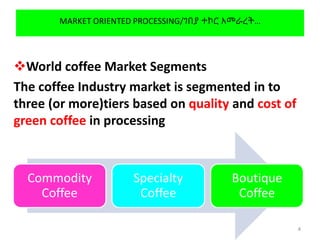
World coffee Market Segments
The coffee Industry market is segmented in to
three (or more)tiers based on quality and cost of
green coffee in processing
4
Commodity
Coffee
Specialty
Coffee
Boutique
Coffee
Commodity Coffee
 Sometimes call conventional or regular coffee.
 It’s low cost, low quality, but high volume market.
 The largest tier is commodity coffee with an estimated
production of 18+ billion pounds per year purchased
around the world
 trading price, in recent years, has averaged between $0.5 to
$2 USD per pound.
 The sales price usually set using NY “C” pricing as a bench
price.
 These coffees are often different varieties that are blended
and
 roasted for sale in the mass consumer market
5
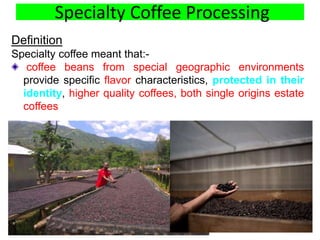
Specialty Coffee Processing
Definition
Specialty coffee meant that:-
coffee beans from special geographic environments
provide specific flavor characteristics, protected in their
identity, higher quality coffees, both single origins estate
coffees
6
Continue…
The second tier of the total worldwide
production is a higher quality coffee
designated “Specialty Coffee,” which is traded
at $2-$4 per pound with an estimated market
size of 3.5 billion pounds.
Specialty Coffee is the category that started in
the 1980s,by companies such as Starbucks.
Coffee scoring 86 and above with SCA scoring
scale (or 88 point and above in some market),
mostly designated as Grade 1 and 2 coffee.
7
Boutique Coffee
The highest quality, and most distinctly
favorable coffee, is further classified by the
industry into a third tier designated “Boutique
or high-end
Coffee” and traded at $4-$1,000 per pound.
It was sold in 2019 at the price of $1,029
It also sold per pound, and at $10,000/kg.
This market segment is estimated to be
approaching 500 million pounds or
approximately 1-2% of the overall global coffee
market. 8
Continue…
This coffee industry's fastest growing sector at
an estimated 25% growth in 2017-2020.
This coffee is positioned almost exclusively in
prestige Cafes and featured on menus
prepared by special techniques and
experienced baristas.
The sales in this market is highly dependent
on credibility and relationship with the final
buyer
Engaging with “Third Wave” movement is the key
Knowing baristas around the world is a key in
engaging with Boutique Coffee Market 9
Continue…
Who are the “Third Wave”?
• The Third Wave is a movement within the coffee
world that seeks to elevate the drink from the
status of a simple commodity to the level of
something like wine.
• Third Wave is as much a mind set as anything else.
• A “Third Waver” is just as interested in the precise
farm where the coffee was grown, the precise
processing method, the precise varietal of bean
etc. as in the
• flavor in the cup – in very much the same way a
wine connoisseur is interested. 10
3. COFFEE PROCESSING FUNDAMENTS
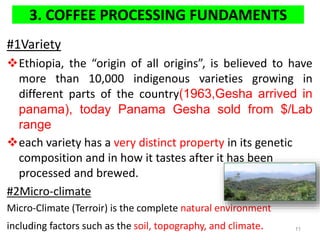
#1Variety
Ethiopia, the “origin of all origins”, is believed to have
more than 10,000 indigenous varieties growing in
different parts of the country(1963,Gesha arrived in
panama), today Panama Gesha sold from $/Lab
range
each variety has a very distinct property in its genetic
composition and in how it tastes after it has been
processed and brewed.
#2Micro-climate
Micro-Climate (Terroir) is the complete natural environment
including factors such as the soil, topography, and climate. 11
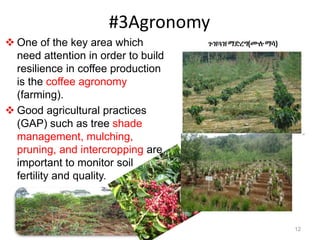
#3Agronomy
 One of the key area which
need attention in order to build
resilience in coffee production
is the coffee agronomy
(farming).
 Good agricultural practices
(GAP) such as tree shade
management, mulching,
pruning, and intercropping are
important to monitor soil
fertility and quality.
12
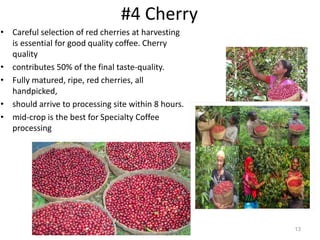
#4 Cherry
• Careful selection of red cherries at harvesting
is essential for good quality coffee. Cherry
quality
• contributes 50% of the final taste-quality.
• Fully matured, ripe, red cherries, all
handpicked,
• should arrive to processing site within 8 hours.
• mid-crop is the best for Specialty Coffee
processing
13
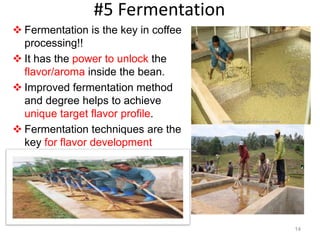
#5 Fermentation
 Fermentation is the key in coffee
processing!!
 It has the power to unlock the
flavor/aroma inside the bean.
 Improved fermentation method
and degree helps to achieve
unique target flavor profile.
 Fermentation techniques are the
key for flavor development
14
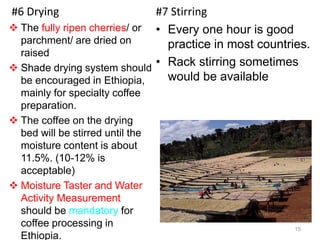
#6 Drying
 The fully ripen cherries/ or
parchment/ are dried on
raised
 Shade drying system should
be encouraged in Ethiopia,
mainly for specialty coffee
preparation.
 The coffee on the drying
bed will be stirred until the
moisture content is about
11.5%. (10-12% is
acceptable)
 Moisture Taster and Water
Activity Measurement
should be mandatory for
coffee processing in
Ethiopia.
#7 Stirring
• Every one hour is good
practice in most countries.
• Rack stirring sometimes
would be available
15
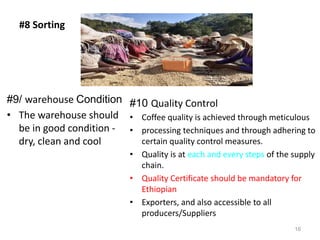
#8 Sorting
#9/ warehouse Condition
• The warehouse should
be in good condition -
dry, clean and cool
#10 Quality Control
• Coffee quality is achieved through meticulous
• processing techniques and through adhering to
certain quality control measures.
• Quality is at each and every steps of the supply
chain.
• Quality Certificate should be mandatory for
Ethiopian
• Exporters, and also accessible to all
producers/Suppliers
16
4.THE SCIENCE OF COFFEE PROCESSING
The Secrete of Fermentation
17
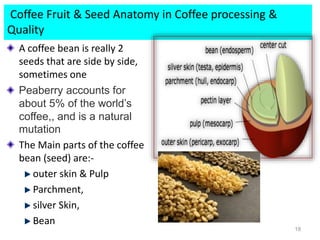
A coffee bean is really 2
seeds that are side by side,
sometimes one
Peaberry accounts for
about 5% of the world’s
coffee,, and is a natural
mutation
The Main parts of the coffee
bean (seed) are:-
outer skin & Pulp
Parchment,
silver Skin,
Bean
18
Coffee Fruit & Seed Anatomy in Coffee processing &
Quality
Continue…
Bean or seed
Comprises a silver skin, an endosperm, and an embryo
Coffee seed (bean) sizes vary; however, they average
10mm long and 6mm wide
Parchment or endocarp
The “flesh” part of coffee fruit- during cherry maturation
This layer is rich in sugars & has a huge influence on the
taste of the coffee bean
In Arabica coffee, the average weight of the parchment
with 11% moisture content is around 3.8% of total coffee
fruit weight
19
Continue…
Mucilage or mesocarp
the term usually refers to a combination of the exocarp
and part of the mesocarp removed during pulping
coffee fruit- during cherry maturation contains pectolytic
enzymes which break down pectic chains, resulting in an
insoluble hydrogel that is rich in sugars and pectins
This layer is left on to dry for our Semi-Washed process
Outer Skin or Exocarp
At the beginning of fruit development, the skin is green,
it turns yellow, then orange and then a ripe red
the outermost layer of the coffee fruit
It is important for the coffee process
20
Continue…
Silver Skin
The silver skin, is the perisperm or spermoderm,
The presence of a large amount of silver skin on milled coffee is
a sign of coffee picked before its ideal ripeness
Endosperm
the exterior & interior portion of the endosperm vary in oil
content and cell wall thickness
the precursor(main) to the flavor and aroma of roasted coffee
The chemical compounds found can be classified as soluble or
insoluble in water
water-soluble compounds are caffeine, trigonelline, nicotinic
acid (niacin),
insoluble in water include cellulose, polysaccharides, lignin, and
hemicullulose, as well as some proteins, minerals, and lipids
21
Continue…
Natural Compounds of Coffee Bean/seeds
Amino Acids
Carbohydrates
 Carbohydrates make up about 50% of a coffee bean and the
soluble sugars of roasted coffee contain glucose, sucrose, and
fructose.
Fiber:- nutritious indigestible dietary fibers
Minerals:-include calcium, magnesium, phosphorous,
potassium and zinc and vitamins like folate, vitamin B-6, thiamin,
riboflavin, and niacin.
Antioxidants:-which can reduce the effects of type 2
diabetes, colon cancer,
Caffeine:-depends upon the coffee bean size & weight of
coffee beans determine the amounts of caffeine present
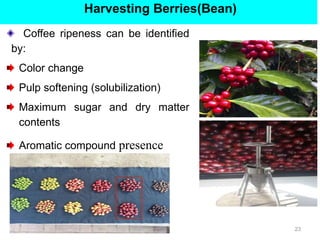
Harvesting Berries(Bean)
Coffee ripeness can be identified
by:
Color change
Pulp softening (solubilization)
Maximum sugar and dry matter
contents
Aromatic compound presence
23
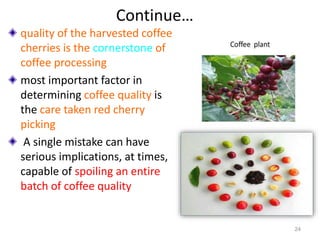
Continue…
quality of the harvested coffee
cherries is the cornerstone of
coffee processing
most important factor in
determining coffee quality is
the care taken red cherry
picking
A single mistake can have
serious implications, at times,
capable of spoiling an entire
batch of coffee quality
24
Continue…
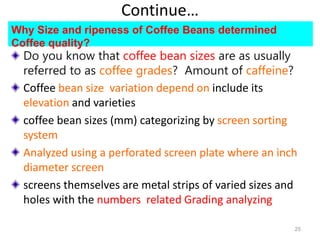
Why Size and ripeness of Coffee Beans determined
Coffee quality?
Do you know that coffee bean sizes are as usually
referred to as coffee grades? Amount of caffeine?
Coffee bean size variation depend on include its
elevation and varieties
coffee bean sizes (mm) categorizing by screen sorting
system
Analyzed using a perforated screen plate where an inch
diameter screen
screens themselves are metal strips of varied sizes and
holes with the numbers related Grading analyzing
25
Science of Coffee Processing - Fermentation
 Fermentation is a key part of post-harvest coffee
processing.
 It’s the central part of coffee processing.
 Fermentation will begin as soon as a coffee is picked from
the tree
 due to the presence of water, sugar, bacteria, and yeast.
 The sugars and acids in the coffee’s mucilage are then
converted into different acids, CO2, ethyl alcohol, and other
compounds.
Contn….. Fermentation
 These different fermentation types can be applied the three major coffee
processing types (Washed, Honey, Natural). Therefore, we can have such
different type of coffees fermentation process
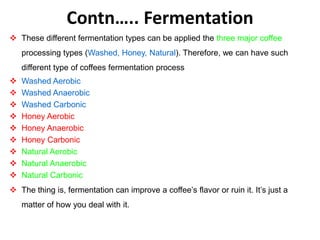
 Washed Aerobic
 Washed Anaerobic
 Washed Carbonic
 Honey Aerobic
 Honey Anaerobic
 Honey Carbonic
 Natural Aerobic
 Natural Anaerobic
 Natural Carbonic
 The thing is, fermentation can improve a coffee’s flavor or ruin it. It’s just a
matter of how you deal with it.
Contn…
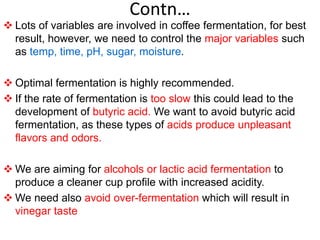
 Lots of variables are involved in coffee fermentation, for best
result, however, we need to control the major variables such
as temp, time, pH, sugar, moisture.
 Optimal fermentation is highly recommended.
 If the rate of fermentation is too slow this could lead to the
development of butyric acid. We want to avoid butyric acid
fermentation, as these types of acids produce unpleasant
flavors and odors.
 We are aiming for alcohols or lactic acid fermentation to
produce a cleaner cup profile with increased acidity.
 We need also avoid over-fermentation which will result in
vinegar taste
COFFEE PROCESSING TYPES
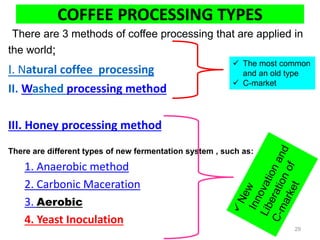
There are 3 methods of coffee processing that are applied in
the world;
I. Natural coffee processing
II. Washed processing method
III. Honey processing method
There are different types of new fermentation system , such as:
1. Anaerobic method
2. Carbonic Maceration
3. Aerobic
4. Yeast Inoculation
29
 The most common
and an old type
 C-market
Washed Coffee - at glance
 Washed coffees focus solely on the bean.
 They let you taste you what’s on the inside, not the
outside.
 Washed coffees depend almost 100% on the bean having
absorbed enough natural sugars and nutrients during its
growing cycle.
 This means the varietal, soil, weather, ripeness,
fermentation, washing, and drying are key.
 This means that the washed process highlights the true
character of a single origin bean like no other process.
 But the process can consume over 40 gallons to produce
one cup of coffee.
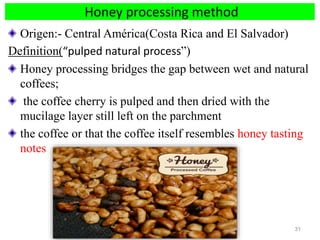
Honey processing method
Origen:- Central América(Costa Rica and El Salvador)
Definition(“pulped natural process”)
Honey processing bridges the gap between wet and natural
coffees;
the coffee cherry is pulped and then dried with the
mucilage layer still left on the parchment
the coffee or that the coffee itself resembles honey tasting
notes
31
Continue…
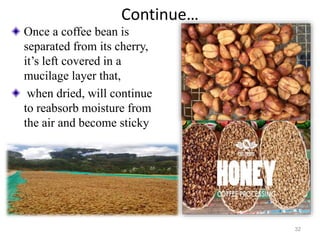
Once a coffee bean is
separated from its cherry,
it’s left covered in a
mucilage layer that,
when dried, will continue
to reabsorb moisture from
the air and become sticky
32
Continue…
Why Is Honey Coffee Processing Become popular
Honey process is a combination of washed and dry
processing
great sweetness and a balanced acidity with fruity
undertones
The flavours are typically powerful than natural processed
coffee
high sugars and acidity in the mucilage
Over the drying period, the sugars in the mucilage become
more and more concentrated and
then these sugars begin to soak through to the coffee bean
33
Continue…
Honey Processing Procedures
it takes a long time
A very careful task to keep quality
Stapes
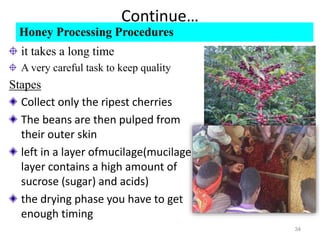
Collect only the ripest cherries
The beans are then pulped from
their outer skin
left in a layer ofmucilage(mucilage
layer contains a high amount of
sucrose (sugar) and acids)
the drying phase you have to get
enough timing
34
Continue…
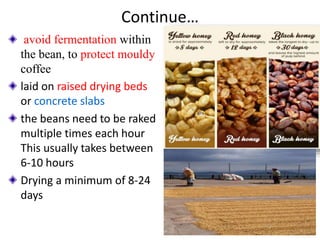
avoid fermentation within
the bean, to protect mouldy
coffee
laid on raised drying beds
or concrete slabs
the beans need to be raked
multiple times each hour
This usually takes between
6-10 hours
Drying a minimum of 8-24
days
35
Continue…
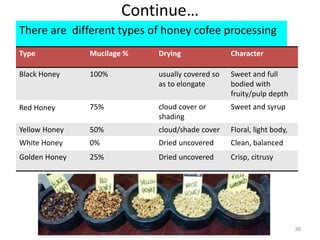
There are different types of honey cofee processing
Type Mucilage % Drying Character
Black Honey 100% usually covered so
as to elongate
Sweet and full
bodied with
fruity/pulp depth
Red Honey 75% cloud cover or
shading
Sweet and syrup
Yellow Honey 50% cloud/shade cover Floral, light body,
White Honey 0% Dried uncovered Clean, balanced
Golden Honey 25% Dried uncovered Crisp, citrusy
36
General Characteristic of Honey Coffee
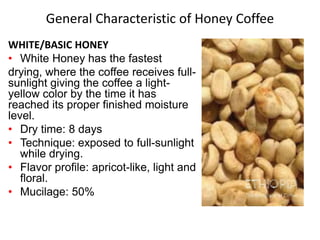
WHITE/BASIC HONEY
• White Honey has the fastest
drying, where the coffee receives full-
sunlight giving the coffee a light-
yellow color by the time it has
reached its proper finished moisture
level.
• Dry time: 8 days
• Technique: exposed to full-sunlight
while drying.
• Flavor profile: apricot-like, light and
floral.
• Mucilage: 50%
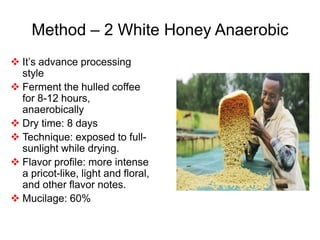
Method – 2 White Honey Anaerobic
 It’s advance processing
style
 Ferment the hulled coffee
for 8-12 hours,
anaerobically
 Dry time: 8 days
 Technique: exposed to full-
sunlight while drying.
 Flavor profile: more intense
a pricot-like, light and floral,
and other flavor notes.
 Mucilage: 60%
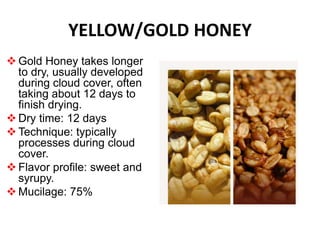
YELLOW/GOLD HONEY
 Gold Honey takes longer
to dry, usually developed
during cloud cover, often
taking about 12 days to
finish drying.
 Dry time: 12 days
 Technique: typically
processes during cloud
cover.
 Flavor profile: sweet and
syrupy.
 Mucilage: 75%
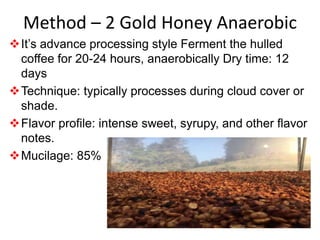
Method – 2 Gold Honey Anaerobic
It’s advance processing style Ferment the hulled
coffee for 20-24 hours, anaerobically Dry time: 12
days
Technique: typically processes during cloud cover or
shade.
Flavor profile: intense sweet, syrupy, and other flavor
notes.
Mucilage: 85%
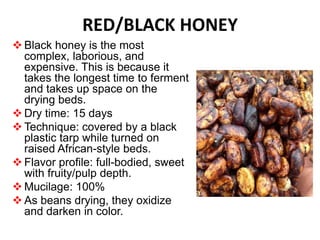
RED/BLACK HONEY
 Black honey is the most
complex, laborious, and
expensive. This is because it
takes the longest time to ferment
and takes up space on the
drying beds.
 Dry time: 15 days
 Technique: covered by a black
plastic tarp while turned on
raised African-style beds.
 Flavor profile: full-bodied, sweet
with fruity/pulp depth.
 Mucilage: 100%
 As beans drying, they oxidize
and darken in color.
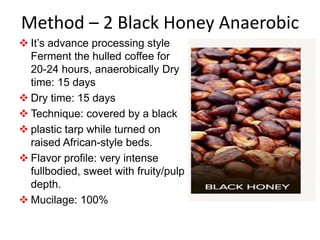
Method – 2 Black Honey Anaerobic
 It’s advance processing style
Ferment the hulled coffee for
20-24 hours, anaerobically Dry
time: 15 days
 Dry time: 15 days
 Technique: covered by a black
 plastic tarp while turned on
raised African-style beds.
 Flavor profile: very intense
fullbodied, sweet with fruity/pulp
depth.
 Mucilage: 100%
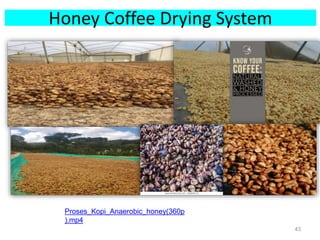
Honey Coffee Drying System
43
Proses_Kopi_Anaerobic_honey(360p
).mp4
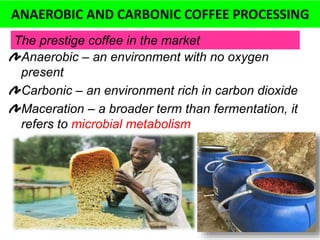
ANAEROBIC AND CARBONIC COFFEE PROCESSING
Anaerobic – an environment with no oxygen
present
Carbonic – an environment rich in carbon dioxide
Maceration – a broader term than fermentation, it
refers to microbial metabolism
44
The prestige coffee in the market
Anaerobic Coffee
Anaerobic ( = oxygen-free) fermentation is one of the
newest
methods to process coffee and has gotten popularity
especially among really high end coffee such as
competition coffees.
In Anaerobic processing the fermentation is done in fully
sealed and oxygen deprived tanks.
The methods is still quite new but anaerobic processed
coffees have often wild, unexpected and complex
flavors.
You can have anaerobic naturals, honeys, and washed
coffees. The fermentation can take place in cherry or de-
pulped in the mucilage.
In anaerobic fermentation, it is important to control
temperature,
pH and sugar levels (Brix).
With anaerobic fermentation, the aim is to
improve the coffee by enhancing aromas,
improving sweetness and acidity and
obtaining a coffee with more body.
when oxygen is removed, the coffee is
allowed to ferment slowly. It’s given space and
time to develop a more complex flavor profile,
resulting in a punchy explosion of fruity flavors
There are different types of fermentation
resulting from the action of yeast and other
microorganisms such as lactic acid bacteria.
The principal type of fermentation is the action
of the yeast on sugars (mucilage) to produce
carbon dioxide (CO2), ethanol,and some
aromatic and flavor compounds
Continue…
Recently, innovative coffee
processing method
Fermentation without oxygen
or limited O2
Anaerobic fermentation in
coffee may refer both cherry
and mucilage-covered seeds
are added to a sealed
tank(Sealed environment)
48
Some country use different spices or fruit example, like
Cinnamon or Bananas added & mixed into the tank to impart
their flavor onto the coffee.
Anaerobic Fermentation(With out oxygne)
Continue…
sugars and acids in the coffee’s mucilage are then converted
into different acids, CO2, ethyl alcohol, and other
compounds
(C6H12O6 bacteria 2C5H5OH +2CO2)
As fermentation progresses, the drum becomes
increasingly carbon rich with minimal oxygen
You can use for both anaerobic naturals, honeys, and
washed coffees
During this process, pressurized from CO2 buildup,
and then remaining pressure in side and oxygen are
let out using release valves
49
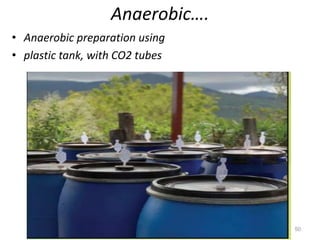
Anaerobic….
• Anaerobic preparation using
• plastic tank, with CO2 tubes
50
Continue…
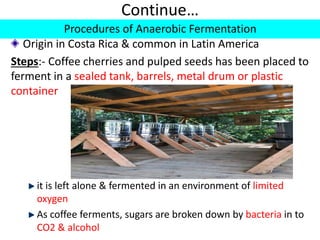
Procedures of Anaerobic Fermentation
Origin in Costa Rica & common in Latin America
Steps:- Coffee cherries and pulped seeds has been placed to
ferment in a sealed tank, barrels, metal drum or plastic
container
it is left alone & fermented in an environment of limited
oxygen
As coffee ferments, sugars are broken down by bacteria in to
CO2 & alcohol
Continue…
tanks are best kept in a cool area to breakdown of
the mucilage generates heat that accelerate the
fermentation
microorganisms start to produce different aromatic
compounds while breaking down the mucilage &
those compounds are largely responsible for the final
flavor
increased pressure will also affect the migration of
compounds into the seed,
affect yielding more intense flavor
This fermentation can create bright, crisp, and
clean coffee with more traditional flavor notes
52
Continue…
the process control by managing the Ph, Brix readings
(indications of the sugar content) and controlling the
temperature inside the tank
Time left fermenting can range from 12-100 hours
depending on the producer’s objective (acid &
sweetness)
lengthening the fermentation of coffee results
Exaple:- a too-long fermentation can have the
opposite effect, acidity, body and aroma are loss
alteration of its chemical composition, and therefore
its organoleptic profile too, distinct acids, like lactic
acids, that give the final product a striking flavor
53
Continue…
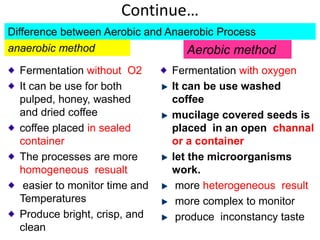
Fermentation without O2
It can be use for both
pulped, honey, washed
and dried coffee
coffee placed in sealed
container
The processes are more
homogeneous resualt
easier to monitor time and
Temperatures
Produce bright, crisp, and
clean
Fermentation with oxygen
It can be use washed
coffee
mucilage covered seeds is
placed in an open channal
or a container
let the microorganisms
work.
more heterogeneous result
more complex to monitor
produce inconstancy taste
Difference between Aerobic and Anaerobic Process
anaerobic method Aerobic method
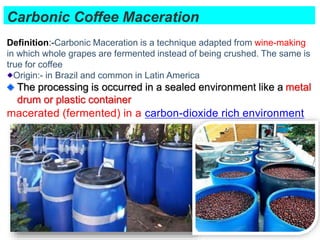
Carbonic Coffee Maceration
55
Definition:-Carbonic Maceration is a technique adapted from wine-making
in which whole grapes are fermented instead of being crushed. The same is
true for coffee
Origin:- in Brazil and common in Latin America
The processing is occurred in a sealed environment like a metal
drum or plastic container
macerated (fermented) in a carbon-dioxide rich environment
Continue…
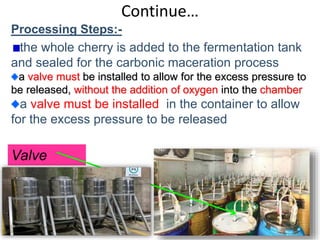
Processing Steps:-
the whole cherry is added to the fermentation tank
and sealed for the carbonic maceration process
a valve must be installed to allow for the excess pressure to
be released, without the addition of oxygen into the chamber
a valve must be installed in the container to allow
for the excess pressure to be released
56
Valve
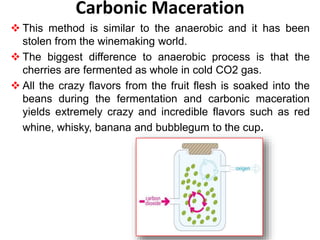
Carbonic Maceration
 This method is similar to the anaerobic and it has been
stolen from the winemaking world.
 The biggest difference to anaerobic process is that the
cherries are fermented as whole in cold CO2 gas.
 All the crazy flavors from the fruit flesh is soaked into the
beans during the fermentation and carbonic maceration
yields extremely crazy and incredible flavors such as red
whine, whisky, banana and bubblegum to the cup.
Continue…
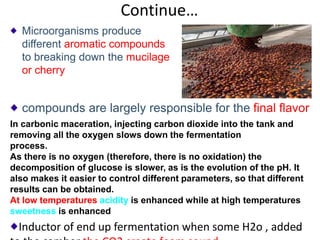
Microorganisms produce
different aromatic compounds
to breaking down the mucilage
or cherry
58
In carbonic maceration, injecting carbon dioxide into the tank and
removing all the oxygen slows down the fermentation
process.
As there is no oxygen (therefore, there is no oxidation) the
decomposition of glucose is slower, as is the evolution of the pH. It
also makes it easier to control different parameters, so that different
results can be obtained.
At low temperatures acidity is enhanced while at high temperatures
sweetness is enhanced
Inductor of end up fermentation when some H2o , added
compounds are largely responsible for the final flavor
Continue…
fermentation is controlled by controlling temperature,
pH and sugar levels (Brix)
by controlling the temperature you can control both
acidity and sweetness
Temperature: the temperature plays a big role as we
can choose to enhance acidity by fermenting at a lower
temperature (4-8°C) or to enhance sweetness by
fermenting at a higher temperature (18-20°C);
Duration of the fermentation: fermenting for more
than 3 days can be done only at lower temperature
and with the addition of Carbon Dioxide
59
Continue…
The biggest difference with the anaerobic process is
that the coffee fruit is fully fermented; and breaks
down the cell walls of the flesh inside out
All the flavors of the fruit meat are infused and the
beans are fermented;
The mucilage migrate to the coffee beans
and the Carbonic Maceration delivers an incredibly
crazy and amazing flavor
60
5.What is Economic Importance of New Fermentation Process?
It encourage creativity in an coffee industry frequently reliant
on tradition process
provide market differentiation for producers /processors
liberation from C-market prices($0.75-1.00)
drive positive change in the coffee sector both for farmers &
processors, buyers and roasters
Environmental and SoCal importance in coffee
habitant(producers)
Market sustainability & vertical integration
61
Continue…
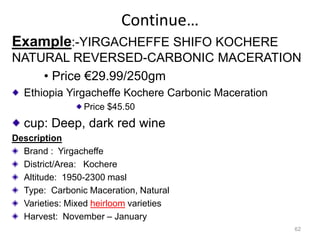
Example:-YIRGACHEFFE SHIFO KOCHERE
NATURAL REVERSED-CARBONIC MACERATION
• Price €29.99/250gm
Ethiopia Yirgacheffe Kochere Carbonic Maceration
Price $45.50
cup: Deep, dark red wine
Description
Brand : Yirgacheffe
District/Area: Kochere
Altitude: 1950-2300 masl
Type: Carbonic Maceration, Natural
Varieties: Mixed heirloom varieties
Harvest: November – January
62
Continue…
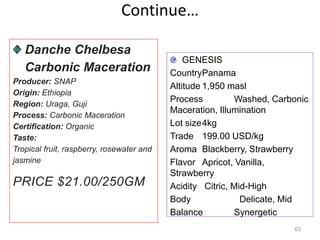
Danche Chelbesa
Carbonic Maceration
Producer: SNAP
Origin: Ethiopia
Region: Uraga, Guji
Process: Carbonic Maceration
Certification: Organic
Taste:
Tropical fruit, raspberry, rosewater and
jasmine
PRICE $21.00/250GM
GENESIS
CountryPanama
Altitude 1,950 masl
Process Washed, Carbonic
Maceration, Illumination
Lot size4kg
Trade 199.00 USD/kg
Aroma Blackberry, Strawberry
Flavor Apricot, Vanilla,
Strawberry
Acidity Citric, Mid-High
Body Delicate, Mid
Balance Synergetic
63
Continue…
64
Price $ 18,58-140/250gm $18,56-145 /250gm
Price $49.15/250gm Price $17/100gm
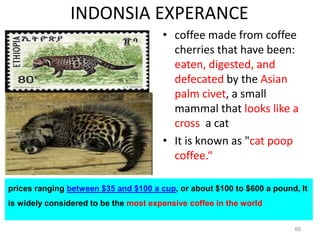
INDONSIA EXPERANCE
• coffee made from coffee
cherries that have been:
eaten, digested, and
defecated by the Asian
palm civet, a small
mammal that looks like a
cross a cat
• It is known as "cat poop
coffee.“
65
prices ranging between $35 and $100 a cup, or about $100 to $600 a pound, It
is widely considered to be the most expensive coffee in the world
66
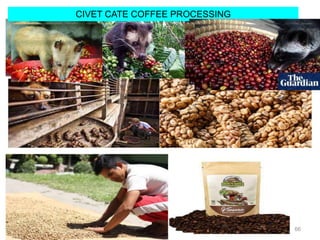
CIVET CATE COFFEE PROCESSING
Environmental Importance
water recycling systems are not working at all
Huge amount of water required for processing
coffee cherry (85,085 litter of water for 1 tons of
fresh cherry coffee)
67
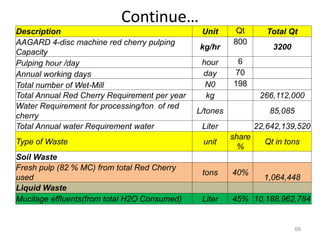
Continue…
Description Unit Qt Total Qt
AAGARD 4-disc machine red cherry pulping
Capacity
kg/hr
800
3200
Pulping hour /day hour 6
Annual working days day 70
Total number of Wet-Mill N0 198
Total Annual Red Cherry Requirement per year kg 266,112,000
Water Requirement for processing/ton of red
cherry
L/tones 85,085
Total Annual water Requirement water Liter 22,642,139,520
Type of Waste unit
share
%
Qt in tons
Soil Waste
Fresh pulp (82 % MC) from total Red Cherry
used
tons 40%
1,064,448
Liquid Waste
Mucilage effluents(from total H2O Consumed) Liter 45% 10,188,962,784
68
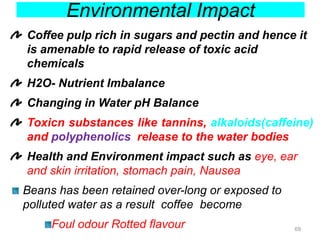
Environmental Impact
Coffee pulp rich in sugars and pectin and hence it
is amenable to rapid release of toxic acid
chemicals
H2O- Nutrient Imbalance
Changing in Water pH Balance
Toxicn substances like tannins, alkaloids(caffeine)
and polyphenolics release to the water bodies
Health and Environment impact such as eye, ear
and skin irritation, stomach pain, Nausea
Beans has been retained over-long or exposed to
polluted water as a result coffee become
Foul odour Rotted flavour 69
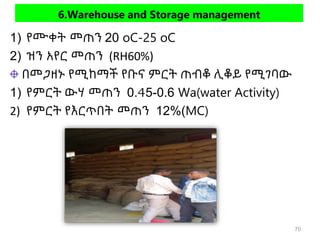
6.Warehouse and Storage management
1) የሙቀት መጠን 20 oC-25 oC
2) ዝን አየር መጠን (RH60%)
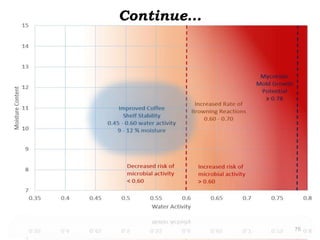
በመጋዘኑ የሚከማች የቡና ምርት ጠብቆ ሊቆይ የሚገባው
1) የምርት ውሃ መጠን 0.45-0.6 Wa(water Activity)
2) የምርት የእርጥበት መጠን 12%(MC)
70
Continue…
Temperature – Temperature can also affect the
moisture levels of the green beans, regardless if
it’s too cold or too hot
Room temperature is recommended by Sweet
Maria, which is 68 to 77º F or 20 to 25º C
Pests – One of the most inevitable things that
mess with coffee beans are pests, wherein holes or
bites are your indicators
The worst part is when an insect gets inside the
packaging 71
Continue…
Moisture Content in Coffee
Moisture content: refers to how much moisture
there is inside coffee bean. Physical property of
bean. Condition's are
Too low Mc- It is hard to roast
High Mc- It may taste woody quicker or more
difficult to roast
Bound-water- Can not use Enzymes and Bacteria, does not
take
Moisture content is Affect :-
flavor,
quality,
Prevent ‘leaching’ of potassium from
the coffee bean
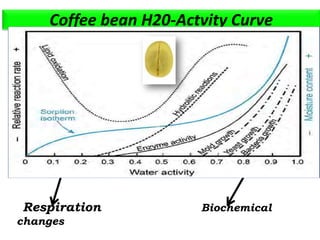
Water activity(aW) In Coffee
Water activity, (aW), is a measure of how
much of that water is free, i.e., unbound, and
available to micro-organisms to use for growth.
Water activity indicates how water is to result in
further transformations, such as fermentation and
mold.
Water activity is measured on a scale from 0 to
1.0, where 0 is dry and 1.0 refers to pure
water condition.
Variations in aW can significantly affect,
colour, taste, aroma, food poisoning, &
spoilage
Continue…
Micro-organisms will not grow below a certain
aW level
for most pathogenic bacteria, aW =0.90
for spoilage molds, and aW=0.70
for all microorganisms aW=0.60, while
temperature, pH, oxygen availability is considered
aW important indicator of “microbial, chemical,
and physical properties… than is total moisture
content.
In green Coffee in Higher water activity indicate past crop’
taste… is partially associated with the hydrolysis of sucrose
into glucose, especially
Coffee bean H20-Actvity Curve
Respiration Biochemical
changes
Continue…
76
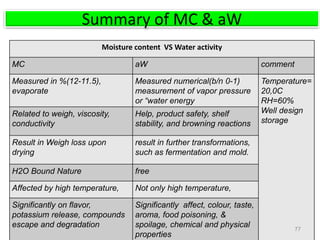
Summary of MC & aW
Moisture content VS Water activity
MC aW comment
Measured in %(12-11.5),
evaporate
Measured numerical(b/n 0-1)
measurement of vapor pressure
or “water energy
Temperature=
20,0C
RH=60%
Well design
storage
Related to weigh, viscosity,
conductivity
Help, product safety, shelf
stability, and browning reactions
Result in Weigh loss upon
drying
result in further transformations,
such as fermentation and mold.
H2O Bound Nature free
Affected by high temperature, Not only high temperature,
Significantly on flavor,
potassium release, compounds
escape and degradation
Significantly affect, colour, taste,
aroma, food poisoning, &
spoilage, chemical and physical
properties
77
Water activity Relevant Measurement Equipment
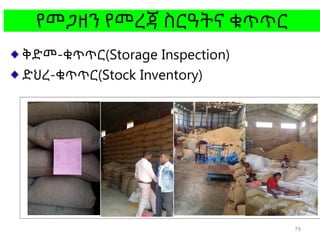
የመጋዘን የመረጃ ስርዓትና ቁጥጥር
ቅድመ-ቁጥጥር(Storage Inspection)
ድህረ-ቁጥጥር(Stock Inventory)
79
የዘር ስርጭት
80

New coffee Processing 2014 Revised.ppt

  • 1.
    ቡና፣ሻይና ቅመማ ቅመምባለስልጣን አዲስ የቡና ምርት አዘገጃጀት ተግባራዊ ስልጠና እና የቀእቅድ አፈጻጸም የመስክ ግበወረ-መልስ 0 አብርሃም አስታጥቄ Emil: fisum1959@gmail.com
  • 2.
  • 3.
    1. Introduction The GlobalCoffee trade and Production Processing is become more challenged and competitive due to: The popular of honey coffee in the world market The rise of ‘”anaerobic” fermentation and carbonic maceration(winning international coffee competition, barista& brewers, competition, Cup of excellence, National competition, etc..) The rise of experimental coffee processing rather than the usual(high-end MICRO lots Consumer behavior is changing) Emergence of infused coffees Shift in global market place from the usual 2
  • 4.
    2. MARKET ORIENTEDPROCESSING Why Processing is very IMPORTANT in coffee? Different coffee processing method make a big difference in both the aroma and taste of coffee beans/ a major impact on flavor, body, aroma, and acidity power to release the flavor and aroma power of the bean. Better processed coffee has better command on price Any coffee processor who wants to raise the quality (and subsequently the price) of their coffee really only has three options: they can change the tree varietal they grow, change the Micro- climate (terror) or change the processing method. 3
  • 5.
    MARKET ORIENTED PROCESSING/ገበያተኮር አመራረት… World coffee Market Segments The coffee Industry market is segmented in to three (or more)tiers based on quality and cost of green coffee in processing 4 Commodity Coffee Specialty Coffee Boutique Coffee
  • 6.
    Commodity Coffee  Sometimescall conventional or regular coffee.  It’s low cost, low quality, but high volume market.  The largest tier is commodity coffee with an estimated production of 18+ billion pounds per year purchased around the world  trading price, in recent years, has averaged between $0.5 to $2 USD per pound.  The sales price usually set using NY “C” pricing as a bench price.  These coffees are often different varieties that are blended and  roasted for sale in the mass consumer market 5
  • 7.
    Specialty Coffee Processing Definition Specialtycoffee meant that:- coffee beans from special geographic environments provide specific flavor characteristics, protected in their identity, higher quality coffees, both single origins estate coffees 6
  • 8.
    Continue… The second tierof the total worldwide production is a higher quality coffee designated “Specialty Coffee,” which is traded at $2-$4 per pound with an estimated market size of 3.5 billion pounds. Specialty Coffee is the category that started in the 1980s,by companies such as Starbucks. Coffee scoring 86 and above with SCA scoring scale (or 88 point and above in some market), mostly designated as Grade 1 and 2 coffee. 7
  • 9.
    Boutique Coffee The highestquality, and most distinctly favorable coffee, is further classified by the industry into a third tier designated “Boutique or high-end Coffee” and traded at $4-$1,000 per pound. It was sold in 2019 at the price of $1,029 It also sold per pound, and at $10,000/kg. This market segment is estimated to be approaching 500 million pounds or approximately 1-2% of the overall global coffee market. 8
  • 10.
    Continue… This coffee industry'sfastest growing sector at an estimated 25% growth in 2017-2020. This coffee is positioned almost exclusively in prestige Cafes and featured on menus prepared by special techniques and experienced baristas. The sales in this market is highly dependent on credibility and relationship with the final buyer Engaging with “Third Wave” movement is the key Knowing baristas around the world is a key in engaging with Boutique Coffee Market 9
  • 11.
    Continue… Who are the“Third Wave”? • The Third Wave is a movement within the coffee world that seeks to elevate the drink from the status of a simple commodity to the level of something like wine. • Third Wave is as much a mind set as anything else. • A “Third Waver” is just as interested in the precise farm where the coffee was grown, the precise processing method, the precise varietal of bean etc. as in the • flavor in the cup – in very much the same way a wine connoisseur is interested. 10
  • 12.
    3. COFFEE PROCESSINGFUNDAMENTS #1Variety Ethiopia, the “origin of all origins”, is believed to have more than 10,000 indigenous varieties growing in different parts of the country(1963,Gesha arrived in panama), today Panama Gesha sold from $/Lab range each variety has a very distinct property in its genetic composition and in how it tastes after it has been processed and brewed. #2Micro-climate Micro-Climate (Terroir) is the complete natural environment including factors such as the soil, topography, and climate. 11
  • 13.
    #3Agronomy  One ofthe key area which need attention in order to build resilience in coffee production is the coffee agronomy (farming).  Good agricultural practices (GAP) such as tree shade management, mulching, pruning, and intercropping are important to monitor soil fertility and quality. 12
  • 14.
    #4 Cherry • Carefulselection of red cherries at harvesting is essential for good quality coffee. Cherry quality • contributes 50% of the final taste-quality. • Fully matured, ripe, red cherries, all handpicked, • should arrive to processing site within 8 hours. • mid-crop is the best for Specialty Coffee processing 13
  • 15.
    #5 Fermentation  Fermentationis the key in coffee processing!!  It has the power to unlock the flavor/aroma inside the bean.  Improved fermentation method and degree helps to achieve unique target flavor profile.  Fermentation techniques are the key for flavor development 14
  • 16.
    #6 Drying  Thefully ripen cherries/ or parchment/ are dried on raised  Shade drying system should be encouraged in Ethiopia, mainly for specialty coffee preparation.  The coffee on the drying bed will be stirred until the moisture content is about 11.5%. (10-12% is acceptable)  Moisture Taster and Water Activity Measurement should be mandatory for coffee processing in Ethiopia. #7 Stirring • Every one hour is good practice in most countries. • Rack stirring sometimes would be available 15
  • 17.
    #8 Sorting #9/ warehouseCondition • The warehouse should be in good condition - dry, clean and cool #10 Quality Control • Coffee quality is achieved through meticulous • processing techniques and through adhering to certain quality control measures. • Quality is at each and every steps of the supply chain. • Quality Certificate should be mandatory for Ethiopian • Exporters, and also accessible to all producers/Suppliers 16
  • 18.
    4.THE SCIENCE OFCOFFEE PROCESSING The Secrete of Fermentation 17
  • 19.
    A coffee beanis really 2 seeds that are side by side, sometimes one Peaberry accounts for about 5% of the world’s coffee,, and is a natural mutation The Main parts of the coffee bean (seed) are:- outer skin & Pulp Parchment, silver Skin, Bean 18 Coffee Fruit & Seed Anatomy in Coffee processing & Quality
  • 20.
    Continue… Bean or seed Comprisesa silver skin, an endosperm, and an embryo Coffee seed (bean) sizes vary; however, they average 10mm long and 6mm wide Parchment or endocarp The “flesh” part of coffee fruit- during cherry maturation This layer is rich in sugars & has a huge influence on the taste of the coffee bean In Arabica coffee, the average weight of the parchment with 11% moisture content is around 3.8% of total coffee fruit weight 19
  • 21.
    Continue… Mucilage or mesocarp theterm usually refers to a combination of the exocarp and part of the mesocarp removed during pulping coffee fruit- during cherry maturation contains pectolytic enzymes which break down pectic chains, resulting in an insoluble hydrogel that is rich in sugars and pectins This layer is left on to dry for our Semi-Washed process Outer Skin or Exocarp At the beginning of fruit development, the skin is green, it turns yellow, then orange and then a ripe red the outermost layer of the coffee fruit It is important for the coffee process 20
  • 22.
    Continue… Silver Skin The silverskin, is the perisperm or spermoderm, The presence of a large amount of silver skin on milled coffee is a sign of coffee picked before its ideal ripeness Endosperm the exterior & interior portion of the endosperm vary in oil content and cell wall thickness the precursor(main) to the flavor and aroma of roasted coffee The chemical compounds found can be classified as soluble or insoluble in water water-soluble compounds are caffeine, trigonelline, nicotinic acid (niacin), insoluble in water include cellulose, polysaccharides, lignin, and hemicullulose, as well as some proteins, minerals, and lipids 21
  • 23.
    Continue… Natural Compounds ofCoffee Bean/seeds Amino Acids Carbohydrates  Carbohydrates make up about 50% of a coffee bean and the soluble sugars of roasted coffee contain glucose, sucrose, and fructose. Fiber:- nutritious indigestible dietary fibers Minerals:-include calcium, magnesium, phosphorous, potassium and zinc and vitamins like folate, vitamin B-6, thiamin, riboflavin, and niacin. Antioxidants:-which can reduce the effects of type 2 diabetes, colon cancer, Caffeine:-depends upon the coffee bean size & weight of coffee beans determine the amounts of caffeine present
  • 24.
    Harvesting Berries(Bean) Coffee ripenesscan be identified by: Color change Pulp softening (solubilization) Maximum sugar and dry matter contents Aromatic compound presence 23
  • 25.
    Continue… quality of theharvested coffee cherries is the cornerstone of coffee processing most important factor in determining coffee quality is the care taken red cherry picking A single mistake can have serious implications, at times, capable of spoiling an entire batch of coffee quality 24
  • 26.
    Continue… Why Size andripeness of Coffee Beans determined Coffee quality? Do you know that coffee bean sizes are as usually referred to as coffee grades? Amount of caffeine? Coffee bean size variation depend on include its elevation and varieties coffee bean sizes (mm) categorizing by screen sorting system Analyzed using a perforated screen plate where an inch diameter screen screens themselves are metal strips of varied sizes and holes with the numbers related Grading analyzing 25
  • 27.
    Science of CoffeeProcessing - Fermentation  Fermentation is a key part of post-harvest coffee processing.  It’s the central part of coffee processing.  Fermentation will begin as soon as a coffee is picked from the tree  due to the presence of water, sugar, bacteria, and yeast.  The sugars and acids in the coffee’s mucilage are then converted into different acids, CO2, ethyl alcohol, and other compounds.
  • 28.
    Contn….. Fermentation  Thesedifferent fermentation types can be applied the three major coffee processing types (Washed, Honey, Natural). Therefore, we can have such different type of coffees fermentation process  Washed Aerobic  Washed Anaerobic  Washed Carbonic  Honey Aerobic  Honey Anaerobic  Honey Carbonic  Natural Aerobic  Natural Anaerobic  Natural Carbonic  The thing is, fermentation can improve a coffee’s flavor or ruin it. It’s just a matter of how you deal with it.
  • 29.
    Contn…  Lots ofvariables are involved in coffee fermentation, for best result, however, we need to control the major variables such as temp, time, pH, sugar, moisture.  Optimal fermentation is highly recommended.  If the rate of fermentation is too slow this could lead to the development of butyric acid. We want to avoid butyric acid fermentation, as these types of acids produce unpleasant flavors and odors.  We are aiming for alcohols or lactic acid fermentation to produce a cleaner cup profile with increased acidity.  We need also avoid over-fermentation which will result in vinegar taste
  • 30.
    COFFEE PROCESSING TYPES Thereare 3 methods of coffee processing that are applied in the world; I. Natural coffee processing II. Washed processing method III. Honey processing method There are different types of new fermentation system , such as: 1. Anaerobic method 2. Carbonic Maceration 3. Aerobic 4. Yeast Inoculation 29  The most common and an old type  C-market
  • 31.
    Washed Coffee -at glance  Washed coffees focus solely on the bean.  They let you taste you what’s on the inside, not the outside.  Washed coffees depend almost 100% on the bean having absorbed enough natural sugars and nutrients during its growing cycle.  This means the varietal, soil, weather, ripeness, fermentation, washing, and drying are key.  This means that the washed process highlights the true character of a single origin bean like no other process.  But the process can consume over 40 gallons to produce one cup of coffee.
  • 32.
    Honey processing method Origen:-Central América(Costa Rica and El Salvador) Definition(“pulped natural process”) Honey processing bridges the gap between wet and natural coffees; the coffee cherry is pulped and then dried with the mucilage layer still left on the parchment the coffee or that the coffee itself resembles honey tasting notes 31
  • 33.
    Continue… Once a coffeebean is separated from its cherry, it’s left covered in a mucilage layer that, when dried, will continue to reabsorb moisture from the air and become sticky 32
  • 34.
    Continue… Why Is HoneyCoffee Processing Become popular Honey process is a combination of washed and dry processing great sweetness and a balanced acidity with fruity undertones The flavours are typically powerful than natural processed coffee high sugars and acidity in the mucilage Over the drying period, the sugars in the mucilage become more and more concentrated and then these sugars begin to soak through to the coffee bean 33
  • 35.
    Continue… Honey Processing Procedures ittakes a long time A very careful task to keep quality Stapes Collect only the ripest cherries The beans are then pulped from their outer skin left in a layer ofmucilage(mucilage layer contains a high amount of sucrose (sugar) and acids) the drying phase you have to get enough timing 34
  • 36.
    Continue… avoid fermentation within thebean, to protect mouldy coffee laid on raised drying beds or concrete slabs the beans need to be raked multiple times each hour This usually takes between 6-10 hours Drying a minimum of 8-24 days 35
  • 37.
    Continue… There are differenttypes of honey cofee processing Type Mucilage % Drying Character Black Honey 100% usually covered so as to elongate Sweet and full bodied with fruity/pulp depth Red Honey 75% cloud cover or shading Sweet and syrup Yellow Honey 50% cloud/shade cover Floral, light body, White Honey 0% Dried uncovered Clean, balanced Golden Honey 25% Dried uncovered Crisp, citrusy 36
  • 38.
    General Characteristic ofHoney Coffee WHITE/BASIC HONEY • White Honey has the fastest drying, where the coffee receives full- sunlight giving the coffee a light- yellow color by the time it has reached its proper finished moisture level. • Dry time: 8 days • Technique: exposed to full-sunlight while drying. • Flavor profile: apricot-like, light and floral. • Mucilage: 50%
  • 39.
    Method – 2White Honey Anaerobic  It’s advance processing style  Ferment the hulled coffee for 8-12 hours, anaerobically  Dry time: 8 days  Technique: exposed to full- sunlight while drying.  Flavor profile: more intense a pricot-like, light and floral, and other flavor notes.  Mucilage: 60%
  • 40.
    YELLOW/GOLD HONEY  GoldHoney takes longer to dry, usually developed during cloud cover, often taking about 12 days to finish drying.  Dry time: 12 days  Technique: typically processes during cloud cover.  Flavor profile: sweet and syrupy.  Mucilage: 75%
  • 41.
    Method – 2Gold Honey Anaerobic It’s advance processing style Ferment the hulled coffee for 20-24 hours, anaerobically Dry time: 12 days Technique: typically processes during cloud cover or shade. Flavor profile: intense sweet, syrupy, and other flavor notes. Mucilage: 85%
  • 42.
    RED/BLACK HONEY  Blackhoney is the most complex, laborious, and expensive. This is because it takes the longest time to ferment and takes up space on the drying beds.  Dry time: 15 days  Technique: covered by a black plastic tarp while turned on raised African-style beds.  Flavor profile: full-bodied, sweet with fruity/pulp depth.  Mucilage: 100%  As beans drying, they oxidize and darken in color.
  • 43.
    Method – 2Black Honey Anaerobic  It’s advance processing style Ferment the hulled coffee for 20-24 hours, anaerobically Dry time: 15 days  Dry time: 15 days  Technique: covered by a black  plastic tarp while turned on raised African-style beds.  Flavor profile: very intense fullbodied, sweet with fruity/pulp depth.  Mucilage: 100%
  • 44.
    Honey Coffee DryingSystem 43 Proses_Kopi_Anaerobic_honey(360p ).mp4
  • 45.
    ANAEROBIC AND CARBONICCOFFEE PROCESSING Anaerobic – an environment with no oxygen present Carbonic – an environment rich in carbon dioxide Maceration – a broader term than fermentation, it refers to microbial metabolism 44 The prestige coffee in the market
  • 46.
    Anaerobic Coffee Anaerobic (= oxygen-free) fermentation is one of the newest methods to process coffee and has gotten popularity especially among really high end coffee such as competition coffees. In Anaerobic processing the fermentation is done in fully sealed and oxygen deprived tanks. The methods is still quite new but anaerobic processed coffees have often wild, unexpected and complex flavors. You can have anaerobic naturals, honeys, and washed coffees. The fermentation can take place in cherry or de- pulped in the mucilage. In anaerobic fermentation, it is important to control temperature, pH and sugar levels (Brix).
  • 47.
    With anaerobic fermentation,the aim is to improve the coffee by enhancing aromas, improving sweetness and acidity and obtaining a coffee with more body. when oxygen is removed, the coffee is allowed to ferment slowly. It’s given space and time to develop a more complex flavor profile, resulting in a punchy explosion of fruity flavors
  • 48.
    There are differenttypes of fermentation resulting from the action of yeast and other microorganisms such as lactic acid bacteria. The principal type of fermentation is the action of the yeast on sugars (mucilage) to produce carbon dioxide (CO2), ethanol,and some aromatic and flavor compounds
  • 49.
    Continue… Recently, innovative coffee processingmethod Fermentation without oxygen or limited O2 Anaerobic fermentation in coffee may refer both cherry and mucilage-covered seeds are added to a sealed tank(Sealed environment) 48 Some country use different spices or fruit example, like Cinnamon or Bananas added & mixed into the tank to impart their flavor onto the coffee. Anaerobic Fermentation(With out oxygne)
  • 50.
    Continue… sugars and acidsin the coffee’s mucilage are then converted into different acids, CO2, ethyl alcohol, and other compounds (C6H12O6 bacteria 2C5H5OH +2CO2) As fermentation progresses, the drum becomes increasingly carbon rich with minimal oxygen You can use for both anaerobic naturals, honeys, and washed coffees During this process, pressurized from CO2 buildup, and then remaining pressure in side and oxygen are let out using release valves 49
  • 51.
    Anaerobic…. • Anaerobic preparationusing • plastic tank, with CO2 tubes 50
  • 52.
    Continue… Procedures of AnaerobicFermentation Origin in Costa Rica & common in Latin America Steps:- Coffee cherries and pulped seeds has been placed to ferment in a sealed tank, barrels, metal drum or plastic container it is left alone & fermented in an environment of limited oxygen As coffee ferments, sugars are broken down by bacteria in to CO2 & alcohol
  • 53.
    Continue… tanks are bestkept in a cool area to breakdown of the mucilage generates heat that accelerate the fermentation microorganisms start to produce different aromatic compounds while breaking down the mucilage & those compounds are largely responsible for the final flavor increased pressure will also affect the migration of compounds into the seed, affect yielding more intense flavor This fermentation can create bright, crisp, and clean coffee with more traditional flavor notes 52
  • 54.
    Continue… the process controlby managing the Ph, Brix readings (indications of the sugar content) and controlling the temperature inside the tank Time left fermenting can range from 12-100 hours depending on the producer’s objective (acid & sweetness) lengthening the fermentation of coffee results Exaple:- a too-long fermentation can have the opposite effect, acidity, body and aroma are loss alteration of its chemical composition, and therefore its organoleptic profile too, distinct acids, like lactic acids, that give the final product a striking flavor 53
  • 55.
    Continue… Fermentation without O2 Itcan be use for both pulped, honey, washed and dried coffee coffee placed in sealed container The processes are more homogeneous resualt easier to monitor time and Temperatures Produce bright, crisp, and clean Fermentation with oxygen It can be use washed coffee mucilage covered seeds is placed in an open channal or a container let the microorganisms work. more heterogeneous result more complex to monitor produce inconstancy taste Difference between Aerobic and Anaerobic Process anaerobic method Aerobic method
  • 56.
    Carbonic Coffee Maceration 55 Definition:-CarbonicMaceration is a technique adapted from wine-making in which whole grapes are fermented instead of being crushed. The same is true for coffee Origin:- in Brazil and common in Latin America The processing is occurred in a sealed environment like a metal drum or plastic container macerated (fermented) in a carbon-dioxide rich environment
  • 57.
    Continue… Processing Steps:- the wholecherry is added to the fermentation tank and sealed for the carbonic maceration process a valve must be installed to allow for the excess pressure to be released, without the addition of oxygen into the chamber a valve must be installed in the container to allow for the excess pressure to be released 56 Valve
  • 58.
    Carbonic Maceration  Thismethod is similar to the anaerobic and it has been stolen from the winemaking world.  The biggest difference to anaerobic process is that the cherries are fermented as whole in cold CO2 gas.  All the crazy flavors from the fruit flesh is soaked into the beans during the fermentation and carbonic maceration yields extremely crazy and incredible flavors such as red whine, whisky, banana and bubblegum to the cup.
  • 59.
    Continue… Microorganisms produce different aromaticcompounds to breaking down the mucilage or cherry 58 In carbonic maceration, injecting carbon dioxide into the tank and removing all the oxygen slows down the fermentation process. As there is no oxygen (therefore, there is no oxidation) the decomposition of glucose is slower, as is the evolution of the pH. It also makes it easier to control different parameters, so that different results can be obtained. At low temperatures acidity is enhanced while at high temperatures sweetness is enhanced Inductor of end up fermentation when some H2o , added compounds are largely responsible for the final flavor
  • 60.
    Continue… fermentation is controlledby controlling temperature, pH and sugar levels (Brix) by controlling the temperature you can control both acidity and sweetness Temperature: the temperature plays a big role as we can choose to enhance acidity by fermenting at a lower temperature (4-8°C) or to enhance sweetness by fermenting at a higher temperature (18-20°C); Duration of the fermentation: fermenting for more than 3 days can be done only at lower temperature and with the addition of Carbon Dioxide 59
  • 61.
    Continue… The biggest differencewith the anaerobic process is that the coffee fruit is fully fermented; and breaks down the cell walls of the flesh inside out All the flavors of the fruit meat are infused and the beans are fermented; The mucilage migrate to the coffee beans and the Carbonic Maceration delivers an incredibly crazy and amazing flavor 60
  • 62.
    5.What is EconomicImportance of New Fermentation Process? It encourage creativity in an coffee industry frequently reliant on tradition process provide market differentiation for producers /processors liberation from C-market prices($0.75-1.00) drive positive change in the coffee sector both for farmers & processors, buyers and roasters Environmental and SoCal importance in coffee habitant(producers) Market sustainability & vertical integration 61
  • 63.
    Continue… Example:-YIRGACHEFFE SHIFO KOCHERE NATURALREVERSED-CARBONIC MACERATION • Price €29.99/250gm Ethiopia Yirgacheffe Kochere Carbonic Maceration Price $45.50 cup: Deep, dark red wine Description Brand : Yirgacheffe District/Area: Kochere Altitude: 1950-2300 masl Type: Carbonic Maceration, Natural Varieties: Mixed heirloom varieties Harvest: November – January 62
  • 64.
    Continue… Danche Chelbesa Carbonic Maceration Producer:SNAP Origin: Ethiopia Region: Uraga, Guji Process: Carbonic Maceration Certification: Organic Taste: Tropical fruit, raspberry, rosewater and jasmine PRICE $21.00/250GM GENESIS CountryPanama Altitude 1,950 masl Process Washed, Carbonic Maceration, Illumination Lot size4kg Trade 199.00 USD/kg Aroma Blackberry, Strawberry Flavor Apricot, Vanilla, Strawberry Acidity Citric, Mid-High Body Delicate, Mid Balance Synergetic 63
  • 65.
    Continue… 64 Price $ 18,58-140/250gm$18,56-145 /250gm Price $49.15/250gm Price $17/100gm
  • 66.
    INDONSIA EXPERANCE • coffeemade from coffee cherries that have been: eaten, digested, and defecated by the Asian palm civet, a small mammal that looks like a cross a cat • It is known as "cat poop coffee.“ 65 prices ranging between $35 and $100 a cup, or about $100 to $600 a pound, It is widely considered to be the most expensive coffee in the world
  • 67.
  • 68.
    Environmental Importance water recyclingsystems are not working at all Huge amount of water required for processing coffee cherry (85,085 litter of water for 1 tons of fresh cherry coffee) 67
  • 69.
    Continue… Description Unit QtTotal Qt AAGARD 4-disc machine red cherry pulping Capacity kg/hr 800 3200 Pulping hour /day hour 6 Annual working days day 70 Total number of Wet-Mill N0 198 Total Annual Red Cherry Requirement per year kg 266,112,000 Water Requirement for processing/ton of red cherry L/tones 85,085 Total Annual water Requirement water Liter 22,642,139,520 Type of Waste unit share % Qt in tons Soil Waste Fresh pulp (82 % MC) from total Red Cherry used tons 40% 1,064,448 Liquid Waste Mucilage effluents(from total H2O Consumed) Liter 45% 10,188,962,784 68
  • 70.
    Environmental Impact Coffee pulprich in sugars and pectin and hence it is amenable to rapid release of toxic acid chemicals H2O- Nutrient Imbalance Changing in Water pH Balance Toxicn substances like tannins, alkaloids(caffeine) and polyphenolics release to the water bodies Health and Environment impact such as eye, ear and skin irritation, stomach pain, Nausea Beans has been retained over-long or exposed to polluted water as a result coffee become Foul odour Rotted flavour 69
  • 71.
    6.Warehouse and Storagemanagement 1) የሙቀት መጠን 20 oC-25 oC 2) ዝን አየር መጠን (RH60%) በመጋዘኑ የሚከማች የቡና ምርት ጠብቆ ሊቆይ የሚገባው 1) የምርት ውሃ መጠን 0.45-0.6 Wa(water Activity) 2) የምርት የእርጥበት መጠን 12%(MC) 70
  • 72.
    Continue… Temperature – Temperaturecan also affect the moisture levels of the green beans, regardless if it’s too cold or too hot Room temperature is recommended by Sweet Maria, which is 68 to 77º F or 20 to 25º C Pests – One of the most inevitable things that mess with coffee beans are pests, wherein holes or bites are your indicators The worst part is when an insect gets inside the packaging 71
  • 73.
    Continue… Moisture Content inCoffee Moisture content: refers to how much moisture there is inside coffee bean. Physical property of bean. Condition's are Too low Mc- It is hard to roast High Mc- It may taste woody quicker or more difficult to roast Bound-water- Can not use Enzymes and Bacteria, does not take Moisture content is Affect :- flavor, quality, Prevent ‘leaching’ of potassium from the coffee bean
  • 74.
    Water activity(aW) InCoffee Water activity, (aW), is a measure of how much of that water is free, i.e., unbound, and available to micro-organisms to use for growth. Water activity indicates how water is to result in further transformations, such as fermentation and mold. Water activity is measured on a scale from 0 to 1.0, where 0 is dry and 1.0 refers to pure water condition. Variations in aW can significantly affect, colour, taste, aroma, food poisoning, & spoilage
  • 75.
    Continue… Micro-organisms will notgrow below a certain aW level for most pathogenic bacteria, aW =0.90 for spoilage molds, and aW=0.70 for all microorganisms aW=0.60, while temperature, pH, oxygen availability is considered aW important indicator of “microbial, chemical, and physical properties… than is total moisture content. In green Coffee in Higher water activity indicate past crop’ taste… is partially associated with the hydrolysis of sucrose into glucose, especially
  • 76.
    Coffee bean H20-ActvityCurve Respiration Biochemical changes
  • 77.
  • 78.
    Summary of MC& aW Moisture content VS Water activity MC aW comment Measured in %(12-11.5), evaporate Measured numerical(b/n 0-1) measurement of vapor pressure or “water energy Temperature= 20,0C RH=60% Well design storage Related to weigh, viscosity, conductivity Help, product safety, shelf stability, and browning reactions Result in Weigh loss upon drying result in further transformations, such as fermentation and mold. H2O Bound Nature free Affected by high temperature, Not only high temperature, Significantly on flavor, potassium release, compounds escape and degradation Significantly affect, colour, taste, aroma, food poisoning, & spoilage, chemical and physical properties 77
  • 79.
    Water activity RelevantMeasurement Equipment
  • 80.
    የመጋዘን የመረጃ ስርዓትናቁጥጥር ቅድመ-ቁጥጥር(Storage Inspection) ድህረ-ቁጥጥር(Stock Inventory) 79
  • 81.