New Central Library
LEED Performance Report
BROUGHT TO YOU BY THE
OFFICE OF THE CITY ARCHITECT
ACKNOWLEDGEMENTS
The following Performance Reports were created in accordance with Council Resolution 20071129-045. The
City of Austin is a recognized international leader in sustainable building practices in which municipal building
strive to conserve energy, water, and other natural resources while promoting human health and safety. The
holistic approach to architecture creates high-quality and enduring structures that enhance the economic
value and reduce the lifecycle costs of a building.
Design and construction of buildings are driven by the United States Green Building Council’s (USGBC)
Leadership in Energy and Environmental Design (LEED) guidelines and promote these goals. The following
reports provide information about municipal buildings, highlight LEED credentials, and promote sustainable
building achievements.
City of Austin
Office of the City Architect
Peter Davis, AIA, LEED AP
Peter.Davis@austintexas.gov
Maanasa Nathan
Priscilla Hon
2018
ACKNOWLEDGEMENTS
Owner: City of Austin
Architect: Lake Flato Architects
Landscape Architect: Blu Fish Collaborative
MEP Engineer: Jose I. Guerra Inc.
Environmental Advisor: Downtown Austin Alliance
Construction Manager: Hensel Phelps Construction
Consultants: Austin Energy
Commissioning Agent: NV5
Lighting Designer: Clanton Associates
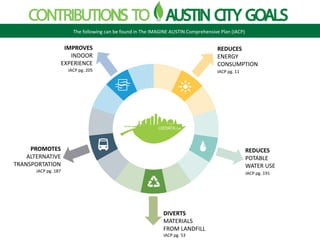
REDUCES
ENERGY
CONSUMPTION
REDUCES
POTABLE
WATER USE
DIVERTS
MATERIALS
FROM LANDFILL
PROMOTES
ALTERNATIVE
TRANSPORTATION
IMPROVES
INDOOR
EXPERIENCE
IACP pg. 191
IACP pg. 11
IACP pg. 53
IACP pg. 187
IACP pg. 205
The following can be found in The IMAGINE AUSTIN Comprehensive Plan (IACP)
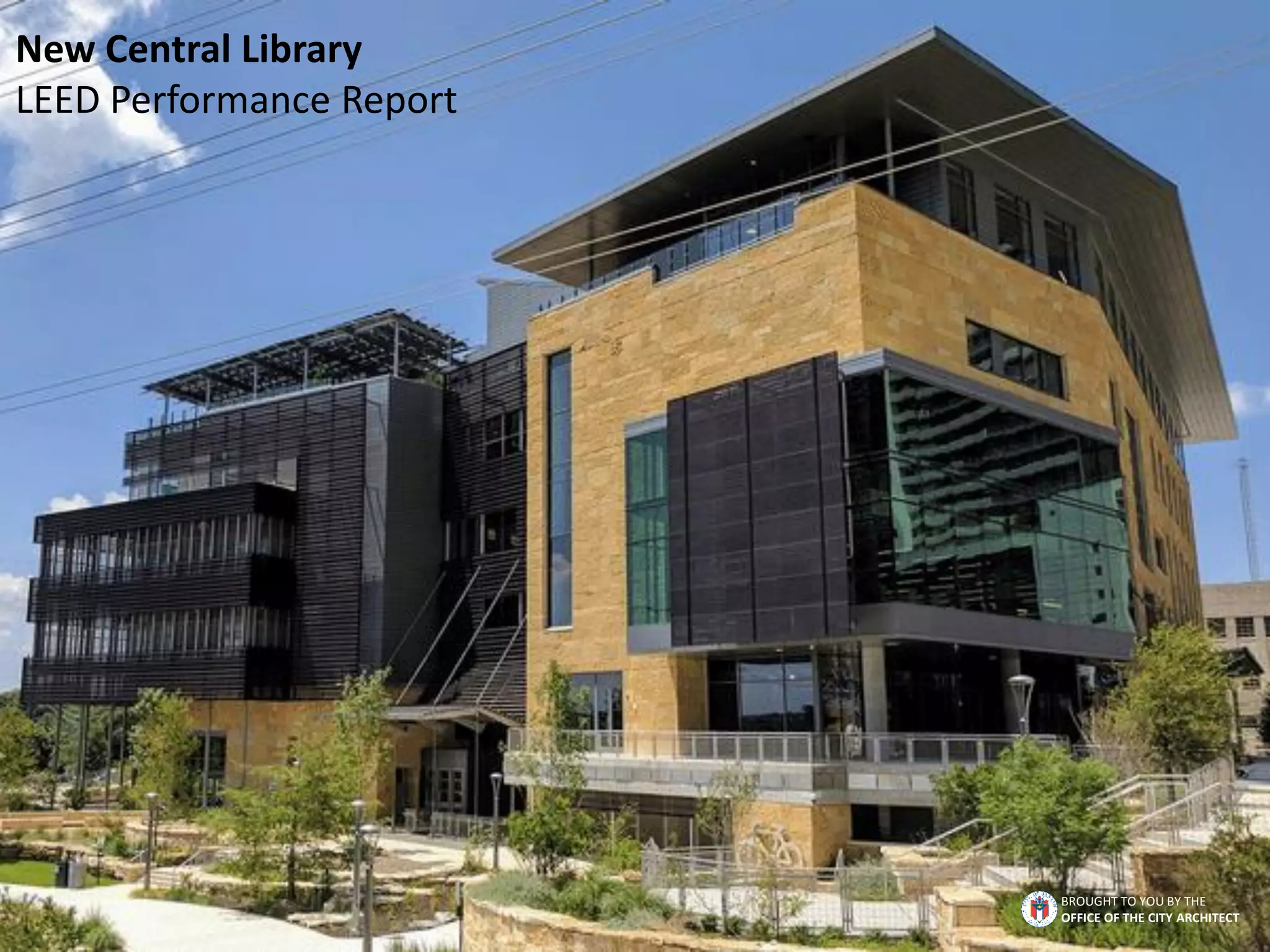
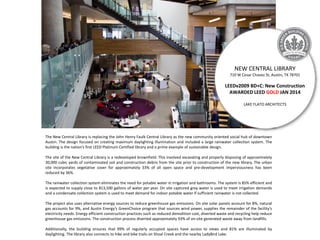
The New Central Library is replacing the John Henry Faulk Central Library as the new community oriented social hub of downtown
Austin. The design focused on creating maximum daylighting illumination and included a large rainwater collection system. The
building is the nation’s first LEED Platinum Certified library and a prime example of sustainable design.
The site of the New Central Library is a redeveloped brownfield. This involved excavating and properly disposing of approximately
30,000 cubic yards of contaminated soil and construction debris from the site prior to construction of the new library. The urban
site incorporates vegetative cover for approximately 33% of all open space and pre-development imperviousness has been
reduced by 36%.
The rainwater collection system eliminates the need for potable water in irrigation and bathrooms. The system is 85% efficient and
is expected to supply close to 813,500 gallons of water per year. On site captured grey water is used to meet irrigation demands
and a condensate collection system is used to meet demand for indoor potable water if sufficient rainwater is not collected.
The project also uses alternative energy sources to reduce greenhouse gas emissions. On site solar panels account for 8%, natural
gas accounts for 9%, and Austin Energy’s GreenChoice program that sources wind power, supplies the remainder of the facility’s
electricity needs. Energy efficient construction practices such as reduced demolition cost, diverted waste and recycling help reduce
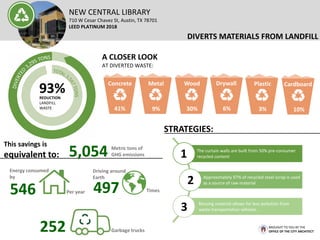
greenhouse gas emissions. The construction process diverted approximately 93% of on-site generated waste away from landfills.
Additionally, the building ensures that 99% of regularly occupied spaces have access to views and 81% are illuminated by
daylighting. The library also connects to hike and bike trails on Shoal Creek and the nearby LadyBird Lake.
NEW CENTRAL LIBRARY
710 W Cesar Chavez St, Austin, TX 78701
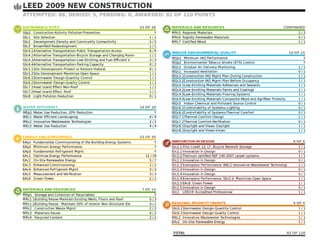
LEEDv2009 BD+C: New Construction
AWARDED LEED GOLD JAN 2014
LAKE FLATO ARCHITECTS
NEW CENTRAL LIBRARY
710 W Cesar Chavez St, Austin, TX 78701
LEED PLATINUM 2018
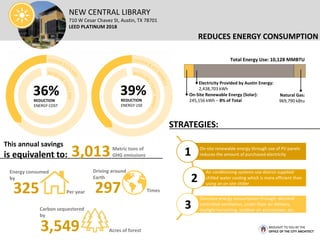
REDUCES ENERGY CONSUMPTION
1
2
3
STRATEGIES:
This annual savings
is equivalent to:
On-site renewable energy through use of PV panels
reduces the amount of purchased electricity
Air conditioning systems use district supplied
chilled water cooling which is more efficient than
using an on site chiller
Decrease energy consumption through: demand
controlled ventilation, under-floor air delivery,
daylight harvesting, outdoor air economizer, etc.
3,013Metric tons of
GHG emissions
325
Energy consumed
by
Per year
Acres of forest3,549
Carbon sequestered
by
297 Times
Driving around
Earth
36%REDUCTION
ENERGY COST
BROUGHT TO YOU BY THE
OFFICE OF THE CITY ARCHITECT
39%REDUCTION
ENERGY USE
On-Site Renewable Energy (Solar):
245,156 kWh – 8% of Total
Total Energy Use: 10,128 MMBTU
Electricity Provided by Austin Energy:
2,438,703 kWh
Natural Gas:
969,790 kBtu
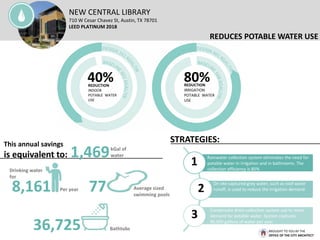
Rainwater collection system eliminates the need for
potable water in irrigation and in bathrooms. The
collection efficiency is 85%
On site captured grey water, such as roof water
runoff, is used to reduce the irrigation demand
Condensate drain collection system use to meet
demand for potable water. System captures
90,000 gallons of water per year.
REDUCES POTABLE WATER USE
Per year8,161
Drinking water
for
77 Average sized
swimming pools
36,725 Bathtubs
80%REDUCTION
IRRIGATION
POTABLE WATER
USE
1
2
3
This annual savings
is equivalent to: 1,469kGal of
water
40%REDUCTION
INDOOR
POTABLE WATER
USE
NEW CENTRAL LIBRARY
710 W Cesar Chavez St, Austin, TX 78701
LEED PLATINUM 2018
BROUGHT TO YOU BY THE
OFFICE OF THE CITY ARCHITECT
STRATEGIES:
DIVERTS MATERIALS FROM LANDFILL
1
2
3
The curtain walls are built from 50% pre-consumer
recycled content
Approximately 97% of recycled steel scrap is used
as a source of raw material
Reusing material allows for less pollution from
waste transportation vehicles.
This savings is
equivalent to: 5,054 Metric tons of
GHG emissions
546
Energy consumed
by
Per year
Garbage trucks252
Times
Driving around
Earth
497
93%REDUCTION
LANDFILL
WASTE
NEW CENTRAL LIBRARY
710 W Cesar Chavez St, Austin, TX 78701
LEED PLATINUM 2018
BROUGHT TO YOU BY THE
OFFICE OF THE CITY ARCHITECT
STRATEGIES:
Concrete
41% 9%
Metal
30%
Wood
6%
Drywall
A CLOSER LOOK
AT DIVERTED WASTE:
3%
Plastic
10%
Cardboard
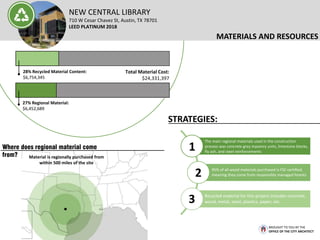
MATERIALS AND RESOURCES
1
2
3
The main regional materials used in the construction
process was concrete grey masonry units, limestone blocks,
fly ash, and steel reinforcements
95% of all wood materials purchased is FSC certified,
meaning they come from responsibly managed forests
Recycled material for this project includes concrete,
wood, metal, steel, plastics, paper, etc.
Where does regional material come
from? Material is regionally purchased from
within 500 miles of the site
NEW CENTRAL LIBRARY
710 W Cesar Chavez St, Austin, TX 78701
LEED PLATINUM 2018
27% Regional Material:
$6,452,689
Total Material Cost:
$24,331,397
28% Recycled Material Content:
$6,754,345
BROUGHT TO YOU BY THE
OFFICE OF THE CITY ARCHITECT
STRATEGIES:
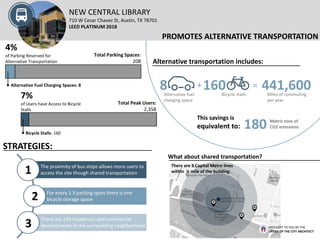
PROMOTES ALTERNATIVE TRANSPORTATION
There are 3 Capital Metro lines
within ¼ mile of the building.
What about shared transportation?
This savings is
equivalent to:
Alternative transportation includes:
Metric tons of
CO2 emissions180
+ =8 160Alternative fuel
charging space
Bicycle stalls Miles of commuting
per year
441,600
1
2
3
The proximity of bus stops allows more users to
access the site though shared transportation
For every 1.3 parking spots there is one
bicycle storage space
There are 239 residences and commercial
developments in the surrounding neighborhood
NEW CENTRAL LIBRARY
710 W Cesar Chavez St, Austin, TX 78701
LEED PLATINUM 2018
4%
of Parking Reserved for
Alternative Transportation
Alternative Fuel Charging Spaces: 8
Total Parking Spaces:
208
Bicycle Stalls: 160
7%
of Users have Access to Bicycle
Stalls
Total Peak Users:
2,358
BROUGHT TO YOU BY THE
OFFICE OF THE CITY ARCHITECT
STRATEGIES:
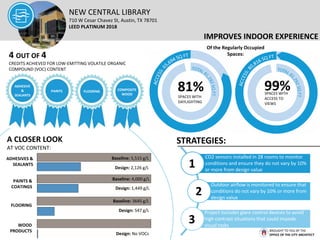
81%SPACES WITH
DAYLIGHTING
IMPROVES INDOOR EXPERIENCE
1
2
3
CO2 sensors installed in 28 rooms to monitor
conditions and ensure they do not vary by 10%
or more from design value
Outdoor airflow is monitored to ensure that
conditions do not vary by 10% or more from
design value
Project includes glare control devices to avoid
high contrast situations that could impede
visual tasks
Of the Regularly Occupied
Spaces:
99%SPACES WITH
ACCESS TO
VIEWS
NEW CENTRAL LIBRARY
710 W Cesar Chavez St, Austin, TX 78701
LEED PLATINUM 2018
BROUGHT TO YOU BY THE
OFFICE OF THE CITY ARCHITECT
STRATEGIES:
4 OUT OF 4
CREDITS ACHIEVED FOR LOW-EMITTING VOLATILE ORGANIC
COMPOUND (VOC) CONTENT
ADHESIVE
&
SEALANTS
PAINTS FLOORING COMPOSITE
WOOD
A CLOSER LOOK
AT VOC CONTENT:
ADHESIVES &
SEALANTS
FLOORING
WOOD
PRODUCTS
Baseline: 4,000 g/L
Design: 1,449 g/L
Baseline: 3645 g/L
Design: 547 g/L
Design: No VOCs
PAINTS &
COATINGS
Baseline: 5,515 g/L
Design: 2,126 g/L
RESOURCES
Leedatx.com
USGBC
Website
usgbc.org/leed
Project Profile
usgbc.org/projects/coa-african-amer-culturalheritage-faci
Imagine Austin
Imagine Austin Vision
austintexas.gov/department/imagine-austin
Comprehensive Plan
ftp://ftp.ci.austin.tx.us/npzd/ImagineAustin/IACP_corrected2018.pdf
EPA
Waste Reduction Model
epa.gov/warm/versions-waste-reduction-model-warm#WARM Tool V14
GHG Conversion Calculator
epa.gov/energy/greenhouse-gas-equivalencies-calculator
Public Works Department
Website
austintexas.gov/department/public-works
PWD Capital Green Infrastructure
austintexas.gov/page/green-capital-improvement-projects BROUGHT TO YOU BY THE
OFFICE OF THE CITY ARCHITECT
Office of the City Architect
Contact Us
pwdcityarchitect@austintexas.gov
Team
Peter Davis, AIA, LEED AP
LEED/Sustainability Project Manager
Peter.Davis@austintexas.gov
Theresa Cascio
Silvia Calderon Laiton
Angela Cai

New Central Library- LEED Profile

  • 1.
    New Central Library LEEDPerformance Report BROUGHT TO YOU BY THE OFFICE OF THE CITY ARCHITECT
  • 2.
    ACKNOWLEDGEMENTS The following PerformanceReports were created in accordance with Council Resolution 20071129-045. The City of Austin is a recognized international leader in sustainable building practices in which municipal building strive to conserve energy, water, and other natural resources while promoting human health and safety. The holistic approach to architecture creates high-quality and enduring structures that enhance the economic value and reduce the lifecycle costs of a building. Design and construction of buildings are driven by the United States Green Building Council’s (USGBC) Leadership in Energy and Environmental Design (LEED) guidelines and promote these goals. The following reports provide information about municipal buildings, highlight LEED credentials, and promote sustainable building achievements. City of Austin Office of the City Architect Peter Davis, AIA, LEED AP Peter.Davis@austintexas.gov Maanasa Nathan Priscilla Hon 2018
  • 3.
    ACKNOWLEDGEMENTS Owner: City ofAustin Architect: Lake Flato Architects Landscape Architect: Blu Fish Collaborative MEP Engineer: Jose I. Guerra Inc. Environmental Advisor: Downtown Austin Alliance Construction Manager: Hensel Phelps Construction Consultants: Austin Energy Commissioning Agent: NV5 Lighting Designer: Clanton Associates
  • 4.
    REDUCES ENERGY CONSUMPTION REDUCES POTABLE WATER USE DIVERTS MATERIALS FROM LANDFILL PROMOTES ALTERNATIVE TRANSPORTATION IMPROVES INDOOR EXPERIENCE IACPpg. 191 IACP pg. 11 IACP pg. 53 IACP pg. 187 IACP pg. 205 The following can be found in The IMAGINE AUSTIN Comprehensive Plan (IACP)
  • 5.
    The New CentralLibrary is replacing the John Henry Faulk Central Library as the new community oriented social hub of downtown Austin. The design focused on creating maximum daylighting illumination and included a large rainwater collection system. The building is the nation’s first LEED Platinum Certified library and a prime example of sustainable design. The site of the New Central Library is a redeveloped brownfield. This involved excavating and properly disposing of approximately 30,000 cubic yards of contaminated soil and construction debris from the site prior to construction of the new library. The urban site incorporates vegetative cover for approximately 33% of all open space and pre-development imperviousness has been reduced by 36%. The rainwater collection system eliminates the need for potable water in irrigation and bathrooms. The system is 85% efficient and is expected to supply close to 813,500 gallons of water per year. On site captured grey water is used to meet irrigation demands and a condensate collection system is used to meet demand for indoor potable water if sufficient rainwater is not collected. The project also uses alternative energy sources to reduce greenhouse gas emissions. On site solar panels account for 8%, natural gas accounts for 9%, and Austin Energy’s GreenChoice program that sources wind power, supplies the remainder of the facility’s electricity needs. Energy efficient construction practices such as reduced demolition cost, diverted waste and recycling help reduce greenhouse gas emissions. The construction process diverted approximately 93% of on-site generated waste away from landfills. Additionally, the building ensures that 99% of regularly occupied spaces have access to views and 81% are illuminated by daylighting. The library also connects to hike and bike trails on Shoal Creek and the nearby LadyBird Lake. NEW CENTRAL LIBRARY 710 W Cesar Chavez St, Austin, TX 78701 LEEDv2009 BD+C: New Construction AWARDED LEED GOLD JAN 2014 LAKE FLATO ARCHITECTS
  • 7.
    NEW CENTRAL LIBRARY 710W Cesar Chavez St, Austin, TX 78701 LEED PLATINUM 2018 REDUCES ENERGY CONSUMPTION 1 2 3 STRATEGIES: This annual savings is equivalent to: On-site renewable energy through use of PV panels reduces the amount of purchased electricity Air conditioning systems use district supplied chilled water cooling which is more efficient than using an on site chiller Decrease energy consumption through: demand controlled ventilation, under-floor air delivery, daylight harvesting, outdoor air economizer, etc. 3,013Metric tons of GHG emissions 325 Energy consumed by Per year Acres of forest3,549 Carbon sequestered by 297 Times Driving around Earth 36%REDUCTION ENERGY COST BROUGHT TO YOU BY THE OFFICE OF THE CITY ARCHITECT 39%REDUCTION ENERGY USE On-Site Renewable Energy (Solar): 245,156 kWh – 8% of Total Total Energy Use: 10,128 MMBTU Electricity Provided by Austin Energy: 2,438,703 kWh Natural Gas: 969,790 kBtu
  • 8.
    Rainwater collection systemeliminates the need for potable water in irrigation and in bathrooms. The collection efficiency is 85% On site captured grey water, such as roof water runoff, is used to reduce the irrigation demand Condensate drain collection system use to meet demand for potable water. System captures 90,000 gallons of water per year. REDUCES POTABLE WATER USE Per year8,161 Drinking water for 77 Average sized swimming pools 36,725 Bathtubs 80%REDUCTION IRRIGATION POTABLE WATER USE 1 2 3 This annual savings is equivalent to: 1,469kGal of water 40%REDUCTION INDOOR POTABLE WATER USE NEW CENTRAL LIBRARY 710 W Cesar Chavez St, Austin, TX 78701 LEED PLATINUM 2018 BROUGHT TO YOU BY THE OFFICE OF THE CITY ARCHITECT STRATEGIES:
  • 9.
    DIVERTS MATERIALS FROMLANDFILL 1 2 3 The curtain walls are built from 50% pre-consumer recycled content Approximately 97% of recycled steel scrap is used as a source of raw material Reusing material allows for less pollution from waste transportation vehicles. This savings is equivalent to: 5,054 Metric tons of GHG emissions 546 Energy consumed by Per year Garbage trucks252 Times Driving around Earth 497 93%REDUCTION LANDFILL WASTE NEW CENTRAL LIBRARY 710 W Cesar Chavez St, Austin, TX 78701 LEED PLATINUM 2018 BROUGHT TO YOU BY THE OFFICE OF THE CITY ARCHITECT STRATEGIES: Concrete 41% 9% Metal 30% Wood 6% Drywall A CLOSER LOOK AT DIVERTED WASTE: 3% Plastic 10% Cardboard
  • 10.
    MATERIALS AND RESOURCES 1 2 3 Themain regional materials used in the construction process was concrete grey masonry units, limestone blocks, fly ash, and steel reinforcements 95% of all wood materials purchased is FSC certified, meaning they come from responsibly managed forests Recycled material for this project includes concrete, wood, metal, steel, plastics, paper, etc. Where does regional material come from? Material is regionally purchased from within 500 miles of the site NEW CENTRAL LIBRARY 710 W Cesar Chavez St, Austin, TX 78701 LEED PLATINUM 2018 27% Regional Material: $6,452,689 Total Material Cost: $24,331,397 28% Recycled Material Content: $6,754,345 BROUGHT TO YOU BY THE OFFICE OF THE CITY ARCHITECT STRATEGIES:
  • 11.
    PROMOTES ALTERNATIVE TRANSPORTATION Thereare 3 Capital Metro lines within ¼ mile of the building. What about shared transportation? This savings is equivalent to: Alternative transportation includes: Metric tons of CO2 emissions180 + =8 160Alternative fuel charging space Bicycle stalls Miles of commuting per year 441,600 1 2 3 The proximity of bus stops allows more users to access the site though shared transportation For every 1.3 parking spots there is one bicycle storage space There are 239 residences and commercial developments in the surrounding neighborhood NEW CENTRAL LIBRARY 710 W Cesar Chavez St, Austin, TX 78701 LEED PLATINUM 2018 4% of Parking Reserved for Alternative Transportation Alternative Fuel Charging Spaces: 8 Total Parking Spaces: 208 Bicycle Stalls: 160 7% of Users have Access to Bicycle Stalls Total Peak Users: 2,358 BROUGHT TO YOU BY THE OFFICE OF THE CITY ARCHITECT STRATEGIES:
  • 12.
    81%SPACES WITH DAYLIGHTING IMPROVES INDOOREXPERIENCE 1 2 3 CO2 sensors installed in 28 rooms to monitor conditions and ensure they do not vary by 10% or more from design value Outdoor airflow is monitored to ensure that conditions do not vary by 10% or more from design value Project includes glare control devices to avoid high contrast situations that could impede visual tasks Of the Regularly Occupied Spaces: 99%SPACES WITH ACCESS TO VIEWS NEW CENTRAL LIBRARY 710 W Cesar Chavez St, Austin, TX 78701 LEED PLATINUM 2018 BROUGHT TO YOU BY THE OFFICE OF THE CITY ARCHITECT STRATEGIES: 4 OUT OF 4 CREDITS ACHIEVED FOR LOW-EMITTING VOLATILE ORGANIC COMPOUND (VOC) CONTENT ADHESIVE & SEALANTS PAINTS FLOORING COMPOSITE WOOD A CLOSER LOOK AT VOC CONTENT: ADHESIVES & SEALANTS FLOORING WOOD PRODUCTS Baseline: 4,000 g/L Design: 1,449 g/L Baseline: 3645 g/L Design: 547 g/L Design: No VOCs PAINTS & COATINGS Baseline: 5,515 g/L Design: 2,126 g/L
  • 13.
    RESOURCES Leedatx.com USGBC Website usgbc.org/leed Project Profile usgbc.org/projects/coa-african-amer-culturalheritage-faci Imagine Austin ImagineAustin Vision austintexas.gov/department/imagine-austin Comprehensive Plan ftp://ftp.ci.austin.tx.us/npzd/ImagineAustin/IACP_corrected2018.pdf EPA Waste Reduction Model epa.gov/warm/versions-waste-reduction-model-warm#WARM Tool V14 GHG Conversion Calculator epa.gov/energy/greenhouse-gas-equivalencies-calculator Public Works Department Website austintexas.gov/department/public-works PWD Capital Green Infrastructure austintexas.gov/page/green-capital-improvement-projects BROUGHT TO YOU BY THE OFFICE OF THE CITY ARCHITECT Office of the City Architect Contact Us pwdcityarchitect@austintexas.gov Team Peter Davis, AIA, LEED AP LEED/Sustainability Project Manager Peter.Davis@austintexas.gov Theresa Cascio Silvia Calderon Laiton Angela Cai