Natasha Simons
Navigating the shift to journal data
policies
Research Support Community Day, Melbourne
12 February 2018
Talk outline
Data sharing
• What is it? Why is there a trend towards it?
• What are publishers and journals doing?
Journal data sharing policies
• What are common approaches? Examples?
Policy challenges
• What are the policy challenges?
• What is being done to address these?
Photo by Janis Oppliger on Unsplash
What is data sharing?
Data sharing is the practice of making data used for scholarly research available.
Types of shared data might include:
 Observational
 Experimental
 Simulation
 Derived/compiled
 Reference or canonical
Formats of shared data might include:
 Text, Image, Spreadsheets
 Audio/video files
 Drawings, Lab notebooks
 Numeric data etc
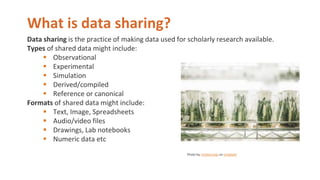
Photo by chuttersnap on Unsplash
Data sharing models
https://vimeo.com/125783029
Data sharing trends
We can see strong signals
that open data is becoming
more embedded [but] there
is still a lack of confidence
around open data.
Figshare open data survey
2017
Data sharing trends
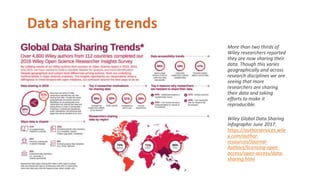
More than two thirds of
Wiley researchers reported
they are now sharing their
data. Though this varies
geographically and across
research disciplines we are
seeing that more
researchers are sharing
their data and taking
efforts to make it
reproducible.
Wiley Global Data Sharing
Infographic June 2017.
https://authorservices.wile
y.com/author-
resources/Journal-
Authors/licensing-open-
access/open-access/data-
sharing.html
Publishers/Journals and data sharing
• An increasing number of publishers and journals are introducing data sharing
policies e.g. PLOS, Nature, Elsevier, Wiley
• Publishers and journals are at forefront of data sharing policy initiatives e.g.
COPDESS, TOP Guidelines, JDAP
Journal data sharing policies
Photo by Elaine Casap on Unsplash
Common approaches
Data availability statements provide a statement about where data supporting the
results reported in a published article can be found. Required by many
journals/publishers (PLOS, BMJ, Nature, BMC, new ICMJE policy) and some funding
agencies (e.g. EPSRC in the UK). Common forms:
• The datasets generated during and/or analysed during the current study are
available in the [NAME] repository, [PERSISTENT WEB LINK TO DATASETS].
• The datasets generated during and/or analysed during the current study are
available from the corresponding author on reasonable request.
• All data generated or analysed during this study are included in this published
article (and its supplementary information files).
Springer Nature – Data availability statements. http://www.springernature.com/gp/group/data-policy/data-availability-statements
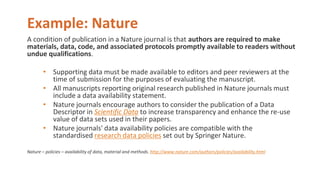
Example: Nature
A condition of publication in a Nature journal is that authors are required to make
materials, data, code, and associated protocols promptly available to readers without
undue qualifications.
• Supporting data must be made available to editors and peer reviewers at the
time of submission for the purposes of evaluating the manuscript.
• All manuscripts reporting original research published in Nature journals must
include a data availability statement.
• Nature journals encourage authors to consider the publication of a Data
Descriptor in Scientific Data to increase transparency and enhance the re-use
value of data sets used in their papers.
• Nature journals' data availability policies are compatible with the
standardised research data policies set out by Springer Nature.
Nature – policies – availability of data, material and methods. http://www.nature.com/authors/policies/availability.html
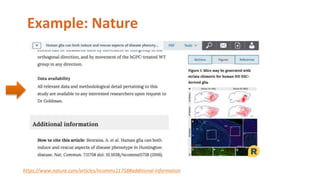
Example: Nature
https://www.nature.com/articles/ncomms11758#additional-information
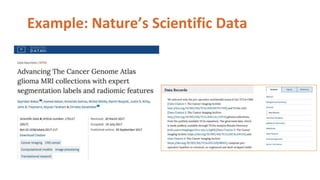
Example: Nature’s Scientific Data
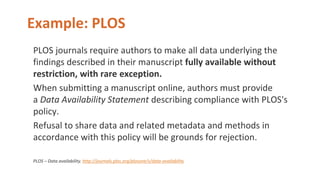
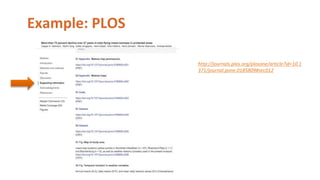
Example: PLOS
PLOS journals require authors to make all data underlying the
findings described in their manuscript fully available without
restriction, with rare exception.
When submitting a manuscript online, authors must provide
a Data Availability Statement describing compliance with PLOS's
policy.
Refusal to share data and related metadata and methods in
accordance with this policy will be grounds for rejection.
PLOS – Data availability. http://journals.plos.org/plosone/s/data-availability
Example: PLOS
http://journals.plos.org/plosone/article?id=10.1
371/journal.pone.0185809#sec012
Example: BMJ journals
We encourage authors to include a data sharing statement when
submitting their article, explaining:
What additional unpublished data from the study - if any - are
available
Who can access the data
How to obtain the data
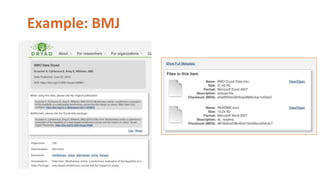
At present there is no major repository for clinical data,
but Dryad has declared its willingness to accept medical datasets.
BMJ Author Hub: Data sharing. http://authors.bmj.com/submitting-your-paper/data-sharing/
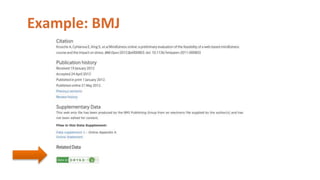
Example: BMJ
Example: BMJ
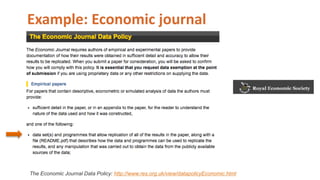
Example: Economic journal
The Economic Journal Data Policy: http://www.res.org.uk/view/datapolicyEconomic.html
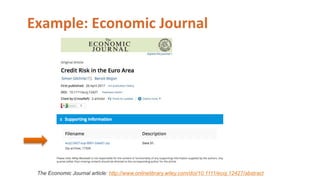
Example: Economic Journal
The Economic Journal article: http://www.onlinelibrary.wiley.com/doi/10.1111/ecoj.12427/abstract
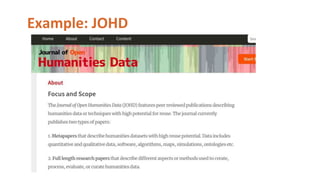
Example: JOHD
Policy challenges
Photo by asoggetti on Unsplash
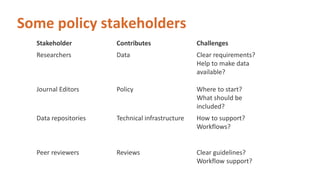
Some policy stakeholders
Stakeholder Contributes Challenges
Researchers Data Clear requirements?
Help to make data
available?
Journal Editors Policy Where to start?
What should be
included?
Data repositories Technical infrastructure How to support?
Workflows?
Peer reviewers Reviews Clear guidelines?
Workflow support?
Journal data sharing policy challenges
Wide variance between journals on:
• Existence of data policy: the higher the Impact Factor of the journal the more
likely they are to have a data availability policy and to enforce it (1)
• Data policy aspects: content, discoverability, ease of interpretation,
infrastructure providers, support for compliance (2)
• Most data sharing policies do not provide specific guidance on the practices
that ensure data is maximally available and reusable (3)
(1) Piwowar, HA and Chapman, WW (2010) Public sharing of research datasets: A pilot study of associations. Journal of
Informetrics, 4 (2). 148 - 156. ISSN 1751-1577
(2) Naughton, L. & Kernohan, D., (2016). Making sense of journal research data policies. Insights. 29(1), pp.84–89.
DOI: http://doi.org/10.1629/uksg.284
(3) Vasilevsky NA, Minnier J, Haendel MA, Champieux RE. (2017) Reproducible and reusable research: are journal data
sharing policies meeting the mark? PeerJ 5:e3208https://doi.org/10.7717/peerj.3208
A standardised approach
• There is clear benefit in a more standardised approach (1).
• Greater standardisation could also facilitate the construction of a
register of data policies, similar to the SHERPA registers for funder and
publisher policies on open access (1).
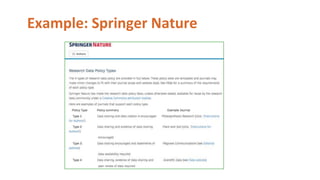
• Springer Nature research data policy types as standardisation
example: more than 1,000 (~45%) Springer Nature journals have
adopted a standard policy (2).
(1) Naughton, L. & Kernohan, D., (2016). Making sense of journal research data policies. Insights. 29(1), pp.84–89.
DOI: http://doi.org/10.1629/uksg.284
(2) Springer Nature Research Data Policy Types https://www.springernature.com/de/authors/research-data-policy/data-
policy-types/12327096
Example: Springer Nature
Research Data Alliance activities
https://www.rd-alliance.org/groups/data-policy-standardisation-and-implementation
• RDA Data Policy Standardisation and
Implementation Interest Group
• Co-chairs: Iain Hrynaszkiewicz (Springer
Nature), Natasha Simons (ANDS), Simon
Goudie (Wiley), Azhar Hussain (Jisc)
• Working on draft policy guidelines
• Anyone can join – level of participation up
to you
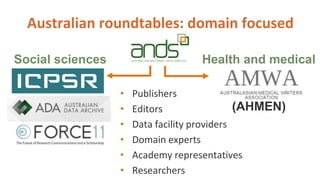
Australian roundtables: domain focused
• Publishers
• Editors
• Data facility providers
• Domain experts
• Academy representatives
• Researchers
(AHMEN)
Social sciences Health and medical
Research support?
If you are in research support, how might you help researchers?
• Become familiar with example journal requirements for data
• Become familiar with the journal recommended data repositories
• Join the RDA Group on Data Policy Standardisation and
Implementation and contribute your thoughts – we’d like your input!
• Refer journal editors to ANDS when helpful
• Participate in future events
With the exception of third party images or where otherwise indicated, this work is licensed under the Creative
Commons 4.0 International Attribution Licence.
ANDS, Nectar and RDS are supported by the Australian Government through the National Collaborative Research
Infrastructure Strategy Program (NCRIS).
Natasha Simons
Program Leader, Skills Policy and Resources | Australian National Data Service
Industry Fellow | The University of Queensland
T: +61 7 3346 9991 | E: natasha.simons@ands.org.au | W: ands.org.au
ORCID: https://orcid.org/0000-0003-0635-1998 Tw: @n_simons
Address: Scholarly Communication & Repository Services, The University of Queensland, Level 7
Duhig Building, St Lucia, QLD 4072, Australia
Thank you!

Journal Data Sharing Policies rscd2018

  • 1.
    Natasha Simons Navigating theshift to journal data policies Research Support Community Day, Melbourne 12 February 2018
  • 2.
    Talk outline Data sharing •What is it? Why is there a trend towards it? • What are publishers and journals doing? Journal data sharing policies • What are common approaches? Examples? Policy challenges • What are the policy challenges? • What is being done to address these? Photo by Janis Oppliger on Unsplash
  • 3.
    What is datasharing? Data sharing is the practice of making data used for scholarly research available. Types of shared data might include:  Observational  Experimental  Simulation  Derived/compiled  Reference or canonical Formats of shared data might include:  Text, Image, Spreadsheets  Audio/video files  Drawings, Lab notebooks  Numeric data etc Photo by chuttersnap on Unsplash
  • 4.
  • 5.
    Data sharing trends Wecan see strong signals that open data is becoming more embedded [but] there is still a lack of confidence around open data. Figshare open data survey 2017
  • 6.
    Data sharing trends Morethan two thirds of Wiley researchers reported they are now sharing their data. Though this varies geographically and across research disciplines we are seeing that more researchers are sharing their data and taking efforts to make it reproducible. Wiley Global Data Sharing Infographic June 2017. https://authorservices.wile y.com/author- resources/Journal- Authors/licensing-open- access/open-access/data- sharing.html
  • 7.
    Publishers/Journals and datasharing • An increasing number of publishers and journals are introducing data sharing policies e.g. PLOS, Nature, Elsevier, Wiley • Publishers and journals are at forefront of data sharing policy initiatives e.g. COPDESS, TOP Guidelines, JDAP
  • 8.
    Journal data sharingpolicies Photo by Elaine Casap on Unsplash
  • 9.
    Common approaches Data availabilitystatements provide a statement about where data supporting the results reported in a published article can be found. Required by many journals/publishers (PLOS, BMJ, Nature, BMC, new ICMJE policy) and some funding agencies (e.g. EPSRC in the UK). Common forms: • The datasets generated during and/or analysed during the current study are available in the [NAME] repository, [PERSISTENT WEB LINK TO DATASETS]. • The datasets generated during and/or analysed during the current study are available from the corresponding author on reasonable request. • All data generated or analysed during this study are included in this published article (and its supplementary information files). Springer Nature – Data availability statements. http://www.springernature.com/gp/group/data-policy/data-availability-statements
  • 10.
    Example: Nature A conditionof publication in a Nature journal is that authors are required to make materials, data, code, and associated protocols promptly available to readers without undue qualifications. • Supporting data must be made available to editors and peer reviewers at the time of submission for the purposes of evaluating the manuscript. • All manuscripts reporting original research published in Nature journals must include a data availability statement. • Nature journals encourage authors to consider the publication of a Data Descriptor in Scientific Data to increase transparency and enhance the re-use value of data sets used in their papers. • Nature journals' data availability policies are compatible with the standardised research data policies set out by Springer Nature. Nature – policies – availability of data, material and methods. http://www.nature.com/authors/policies/availability.html
  • 11.
  • 12.
  • 13.
    Example: PLOS PLOS journalsrequire authors to make all data underlying the findings described in their manuscript fully available without restriction, with rare exception. When submitting a manuscript online, authors must provide a Data Availability Statement describing compliance with PLOS's policy. Refusal to share data and related metadata and methods in accordance with this policy will be grounds for rejection. PLOS – Data availability. http://journals.plos.org/plosone/s/data-availability
  • 14.
  • 15.
    Example: BMJ journals Weencourage authors to include a data sharing statement when submitting their article, explaining: What additional unpublished data from the study - if any - are available Who can access the data How to obtain the data At present there is no major repository for clinical data, but Dryad has declared its willingness to accept medical datasets. BMJ Author Hub: Data sharing. http://authors.bmj.com/submitting-your-paper/data-sharing/
  • 16.
  • 17.
  • 18.
    Example: Economic journal TheEconomic Journal Data Policy: http://www.res.org.uk/view/datapolicyEconomic.html
  • 19.
    Example: Economic Journal TheEconomic Journal article: http://www.onlinelibrary.wiley.com/doi/10.1111/ecoj.12427/abstract
  • 20.
  • 21.
    Policy challenges Photo byasoggetti on Unsplash
  • 22.
    Some policy stakeholders StakeholderContributes Challenges Researchers Data Clear requirements? Help to make data available? Journal Editors Policy Where to start? What should be included? Data repositories Technical infrastructure How to support? Workflows? Peer reviewers Reviews Clear guidelines? Workflow support?
  • 23.
    Journal data sharingpolicy challenges Wide variance between journals on: • Existence of data policy: the higher the Impact Factor of the journal the more likely they are to have a data availability policy and to enforce it (1) • Data policy aspects: content, discoverability, ease of interpretation, infrastructure providers, support for compliance (2) • Most data sharing policies do not provide specific guidance on the practices that ensure data is maximally available and reusable (3) (1) Piwowar, HA and Chapman, WW (2010) Public sharing of research datasets: A pilot study of associations. Journal of Informetrics, 4 (2). 148 - 156. ISSN 1751-1577 (2) Naughton, L. & Kernohan, D., (2016). Making sense of journal research data policies. Insights. 29(1), pp.84–89. DOI: http://doi.org/10.1629/uksg.284 (3) Vasilevsky NA, Minnier J, Haendel MA, Champieux RE. (2017) Reproducible and reusable research: are journal data sharing policies meeting the mark? PeerJ 5:e3208https://doi.org/10.7717/peerj.3208
  • 24.
    A standardised approach •There is clear benefit in a more standardised approach (1). • Greater standardisation could also facilitate the construction of a register of data policies, similar to the SHERPA registers for funder and publisher policies on open access (1). • Springer Nature research data policy types as standardisation example: more than 1,000 (~45%) Springer Nature journals have adopted a standard policy (2). (1) Naughton, L. & Kernohan, D., (2016). Making sense of journal research data policies. Insights. 29(1), pp.84–89. DOI: http://doi.org/10.1629/uksg.284 (2) Springer Nature Research Data Policy Types https://www.springernature.com/de/authors/research-data-policy/data- policy-types/12327096
  • 25.
  • 26.
    Research Data Allianceactivities https://www.rd-alliance.org/groups/data-policy-standardisation-and-implementation • RDA Data Policy Standardisation and Implementation Interest Group • Co-chairs: Iain Hrynaszkiewicz (Springer Nature), Natasha Simons (ANDS), Simon Goudie (Wiley), Azhar Hussain (Jisc) • Working on draft policy guidelines • Anyone can join – level of participation up to you
  • 27.
    Australian roundtables: domainfocused • Publishers • Editors • Data facility providers • Domain experts • Academy representatives • Researchers (AHMEN) Social sciences Health and medical
  • 28.
    Research support? If youare in research support, how might you help researchers? • Become familiar with example journal requirements for data • Become familiar with the journal recommended data repositories • Join the RDA Group on Data Policy Standardisation and Implementation and contribute your thoughts – we’d like your input! • Refer journal editors to ANDS when helpful • Participate in future events
  • 29.
    With the exceptionof third party images or where otherwise indicated, this work is licensed under the Creative Commons 4.0 International Attribution Licence. ANDS, Nectar and RDS are supported by the Australian Government through the National Collaborative Research Infrastructure Strategy Program (NCRIS). Natasha Simons Program Leader, Skills Policy and Resources | Australian National Data Service Industry Fellow | The University of Queensland T: +61 7 3346 9991 | E: natasha.simons@ands.org.au | W: ands.org.au ORCID: https://orcid.org/0000-0003-0635-1998 Tw: @n_simons Address: Scholarly Communication & Repository Services, The University of Queensland, Level 7 Duhig Building, St Lucia, QLD 4072, Australia Thank you!

Editor's Notes

  • #28 Outcomes: follow up with individual journal editors and infrastructure providers.