Publishers and RDM
Seminar:‘TheMakingofResearchDataManagementPolicy'
Wageningen,December1,2016
UKB Working Committee Research Data
Mariette van Selm, University of Amsterdam
Henk van der Hoogen, University of Maastricht
Madeleine de Smaele, Technical University Delft
Rutger de Jong, University Libraries Leiden
Fieke Schoots, University Libraries Leiden
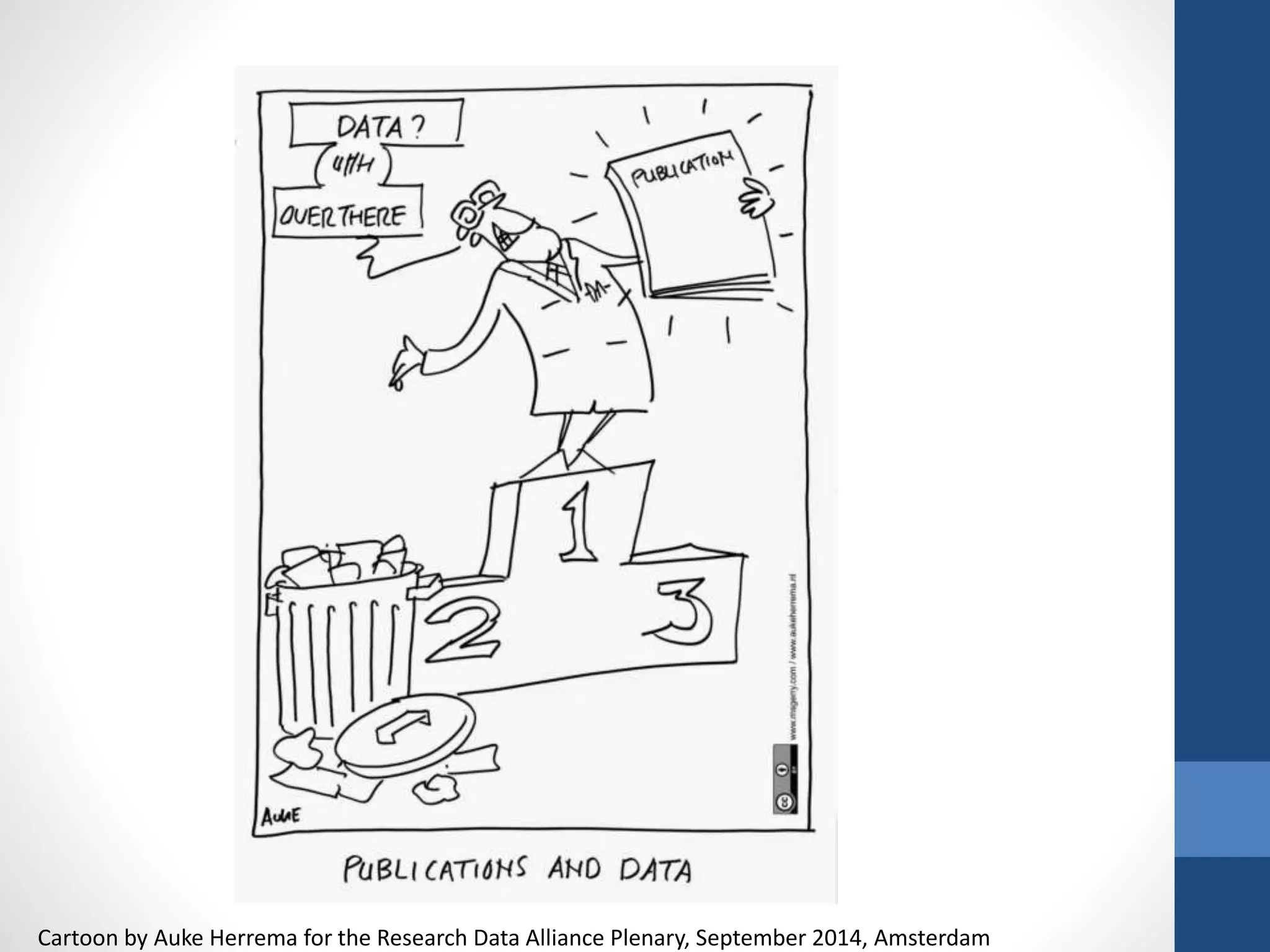
Cartoon by Auke Herrema for the Research Data Alliance Plenary, September 2014, Amsterdam
• Data journals
• No narrative but data descriptors
• Quick and easy
• Publish negative results
• Data Availability Policy
• Availability of underlying data (different shades of open)
• List of (preferred) repositories
• Options: peer review of data, data accessibility paragraph in
manuscript, paragraph on reuse
• Data services
• Search engines (Data search, Elsevier, )
• Data citation instruments (Data Citation Index, Thomson Reuters)
• Cooperation with data repositories
• Other services like Mendeley for data …
Publishers and RDM
What is
current state
of data
policies for
journals in
which Dutch
researchers
publish most?
For all
disciplines we
selected top
10 from the
CRIS systems
of 4
universities
For 128
journals we
checked if
journal or
publisher has
a policy for
data
availability
We noted
characteristics
of the policy:
Status,
materials,
citation,
repository?
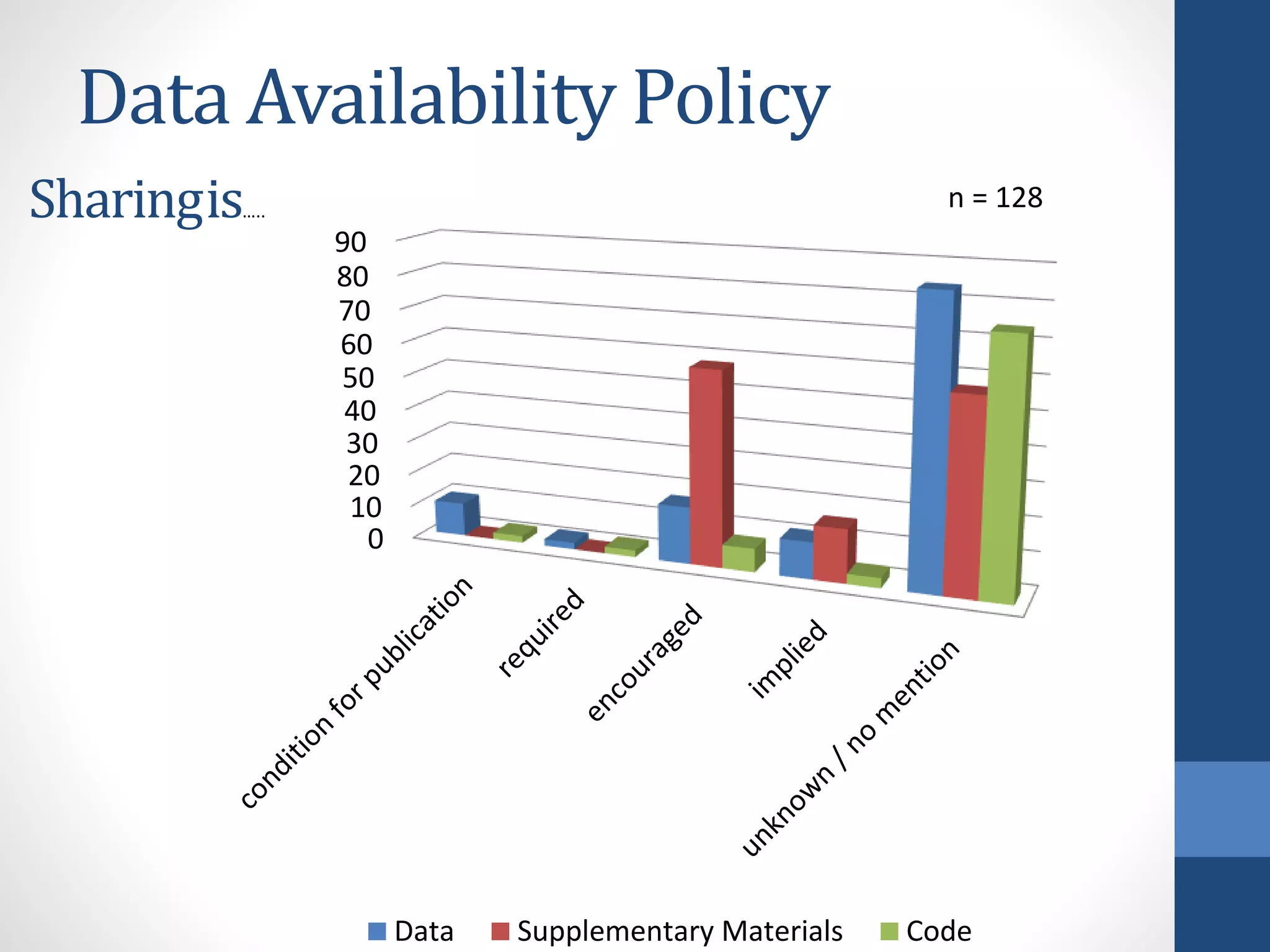
Data Availability Policy
Title list and findings will be available on wiki of the UKB working group Research Data
0
10
20
30
40
50
60
70
80
90
Data Supplementary Materials Code
Data Availability Policy
n = 128Sharingis…..
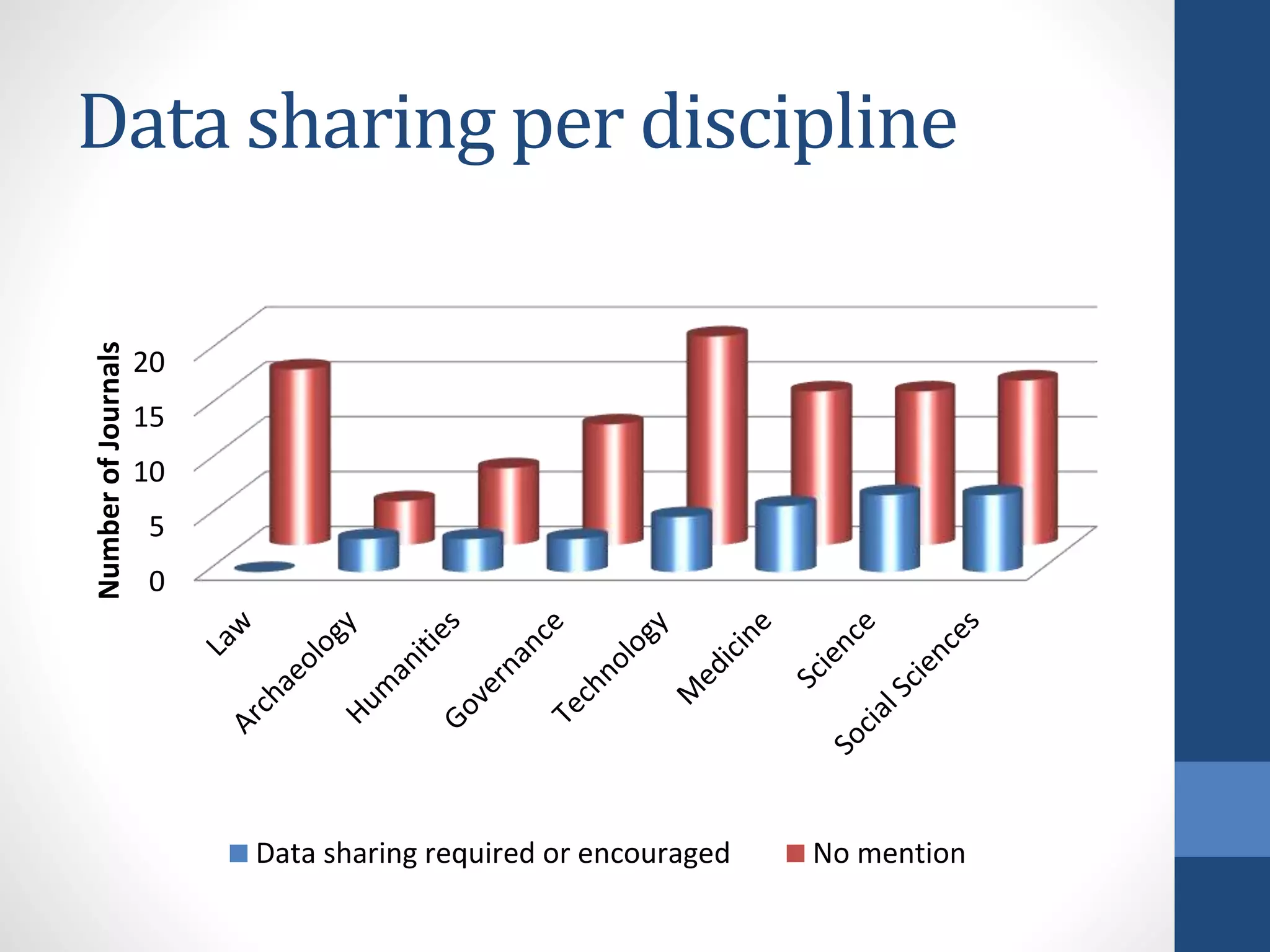
Data sharing per discipline
0
5
10
15
20
NumberofJournals
Data sharing required or encouraged No mention
Example: Elsevier
“ Elsevier supports the principle that "Raw research data should
be made freely available to all researchers" and authors should
be free to publically post their raw research data”
• Open data pilot
upload data as supplementary materials in Science Direct, available
for download under a CC BY user license
• Mendeley data
authors upload their data in Mendeley, get a DOI, and choose a
license
https://www.elsevier.com/books-and-journals/enrichments/open-data
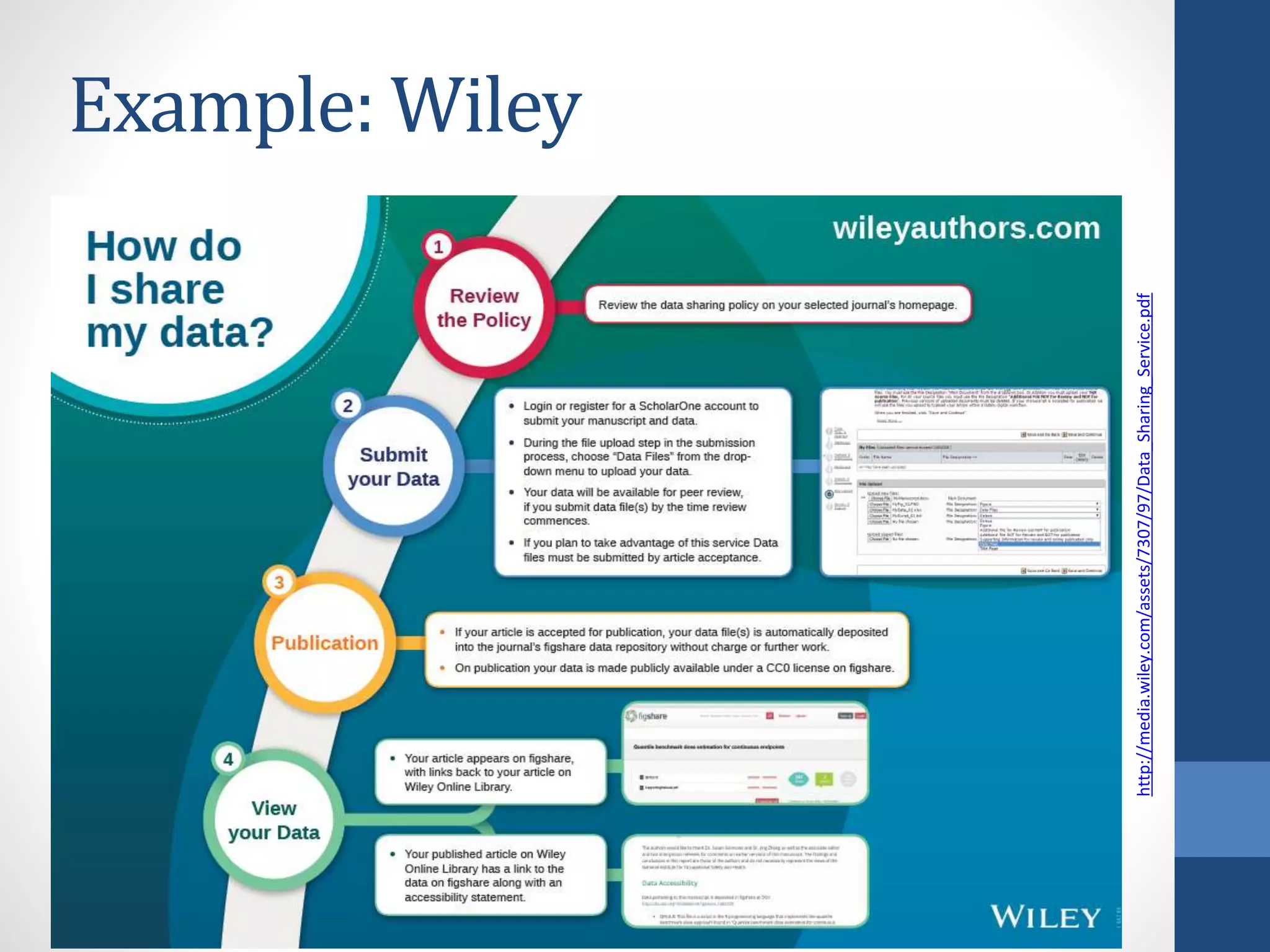
Example: Wiley
http://media.wiley.com/assets/7307/97/Data_Sharing_Service.pdf
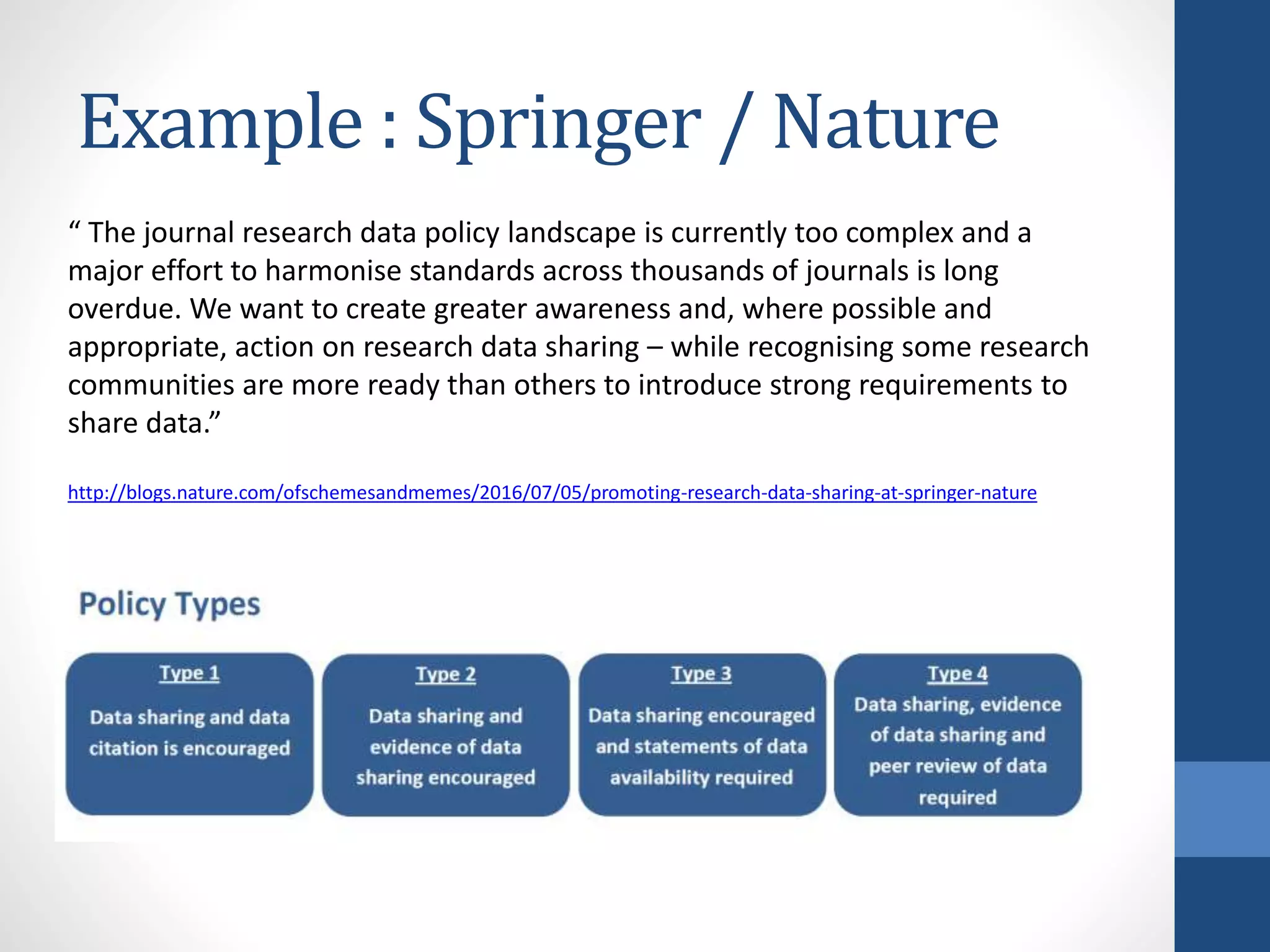
Example : Springer / Nature
“ The journal research data policy landscape is currently too complex and a
major effort to harmonise standards across thousands of journals is long
overdue. We want to create greater awareness and, where possible and
appropriate, action on research data sharing – while recognising some research
communities are more ready than others to introduce strong requirements to
share data.”
http://blogs.nature.com/ofschemesandmemes/2016/07/05/promoting-research-data-sharing-at-springer-nature
What’s the problem?
Too many journals have ‘type zero’ policy:
no policy at all or data seen as ‘traditional’ supplementary
materials
X Data is unavailable after publication
X Data is behind pay walls
X Formats (pdf, word) prevent reuse of the data
X No persistent links to the data
X Data can not be cited
X Only part of the data is available
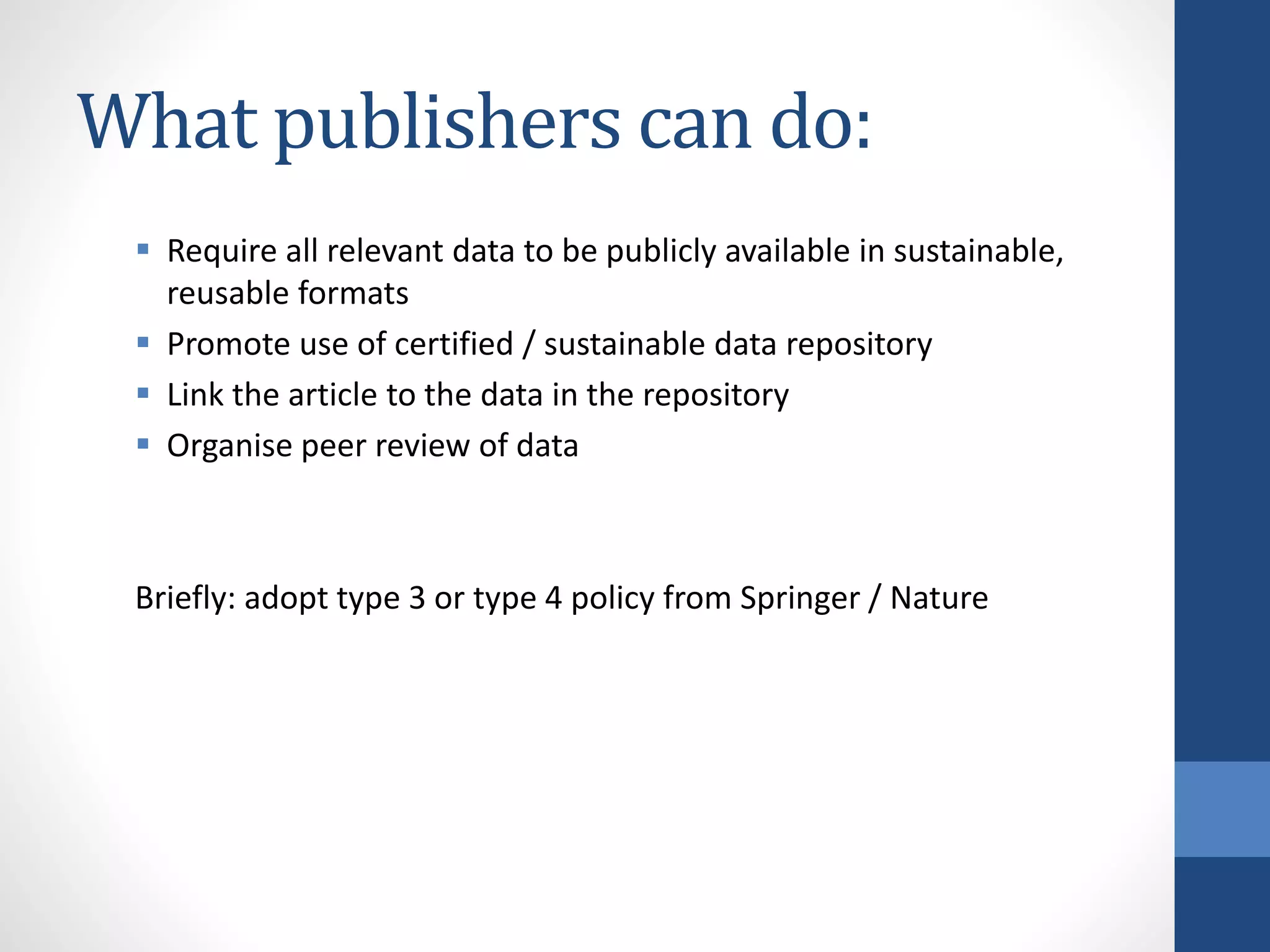
What publishers can do:
 Require all relevant data to be publicly available in sustainable,
reusable formats
 Promote use of certified / sustainable data repository
 Link the article to the data in the repository
 Organise peer review of data
Briefly: adopt type 3 or type 4 policy from Springer / Nature
What data archives can do:
 Enable peer review before publication of study
 Make it easy to cite data
 Make it easy to link to the publication
 Track citations of the data
What libraries can do:
 Inform researchers about Data Availability Policies and
guidelines in their discipline
 Advise researchers on best way to make data underlying a
publication available
 Conversation will be easier if researchers are used to publications
with supplementary materials?
 Help researchers deposit data in a sustainable repository
 Create (international) tool for registration of Data Availability
Policies?
Statement
• For the sake of research quality, institutions must make sure
that all data underlying the publications of their researchers
are publicly available in a sustainable manner.

Publishers and RDM

  • 1.
    Publishers and RDM Seminar:‘TheMakingofResearchDataManagementPolicy' Wageningen,December1,2016 UKBWorking Committee Research Data Mariette van Selm, University of Amsterdam Henk van der Hoogen, University of Maastricht Madeleine de Smaele, Technical University Delft Rutger de Jong, University Libraries Leiden Fieke Schoots, University Libraries Leiden
  • 2.
    Cartoon by AukeHerrema for the Research Data Alliance Plenary, September 2014, Amsterdam
  • 3.
    • Data journals •No narrative but data descriptors • Quick and easy • Publish negative results • Data Availability Policy • Availability of underlying data (different shades of open) • List of (preferred) repositories • Options: peer review of data, data accessibility paragraph in manuscript, paragraph on reuse • Data services • Search engines (Data search, Elsevier, ) • Data citation instruments (Data Citation Index, Thomson Reuters) • Cooperation with data repositories • Other services like Mendeley for data … Publishers and RDM
  • 4.
    What is current state ofdata policies for journals in which Dutch researchers publish most? For all disciplines we selected top 10 from the CRIS systems of 4 universities For 128 journals we checked if journal or publisher has a policy for data availability We noted characteristics of the policy: Status, materials, citation, repository? Data Availability Policy Title list and findings will be available on wiki of the UKB working group Research Data
  • 5.
    0 10 20 30 40 50 60 70 80 90 Data Supplementary MaterialsCode Data Availability Policy n = 128Sharingis…..
  • 6.
    Data sharing perdiscipline 0 5 10 15 20 NumberofJournals Data sharing required or encouraged No mention
  • 7.
    Example: Elsevier “ Elseviersupports the principle that "Raw research data should be made freely available to all researchers" and authors should be free to publically post their raw research data” • Open data pilot upload data as supplementary materials in Science Direct, available for download under a CC BY user license • Mendeley data authors upload their data in Mendeley, get a DOI, and choose a license https://www.elsevier.com/books-and-journals/enrichments/open-data
  • 8.
  • 9.
    Example : Springer/ Nature “ The journal research data policy landscape is currently too complex and a major effort to harmonise standards across thousands of journals is long overdue. We want to create greater awareness and, where possible and appropriate, action on research data sharing – while recognising some research communities are more ready than others to introduce strong requirements to share data.” http://blogs.nature.com/ofschemesandmemes/2016/07/05/promoting-research-data-sharing-at-springer-nature
  • 10.
    What’s the problem? Toomany journals have ‘type zero’ policy: no policy at all or data seen as ‘traditional’ supplementary materials X Data is unavailable after publication X Data is behind pay walls X Formats (pdf, word) prevent reuse of the data X No persistent links to the data X Data can not be cited X Only part of the data is available
  • 11.
    What publishers cando:  Require all relevant data to be publicly available in sustainable, reusable formats  Promote use of certified / sustainable data repository  Link the article to the data in the repository  Organise peer review of data Briefly: adopt type 3 or type 4 policy from Springer / Nature
  • 12.
    What data archivescan do:  Enable peer review before publication of study  Make it easy to cite data  Make it easy to link to the publication  Track citations of the data
  • 13.
    What libraries cando:  Inform researchers about Data Availability Policies and guidelines in their discipline  Advise researchers on best way to make data underlying a publication available  Conversation will be easier if researchers are used to publications with supplementary materials?  Help researchers deposit data in a sustainable repository  Create (international) tool for registration of Data Availability Policies?
  • 14.
    Statement • For thesake of research quality, institutions must make sure that all data underlying the publications of their researchers are publicly available in a sustainable manner.

Editor's Notes

  • #10 Policy as of September 8th 2016