NeuRoute: Predictive Dynamic Routing for
Software-Defined Networks
Abdelhadi Azzouni 1 Raouf Boutaba 2 Guy Pujolle 1
1Universit´e Pierre et Marie Curie, France
2University of Waterloo, Canada
ManSDN/NFV, 2017
a.azzouni (LIp6, UPMC) NeuRoute: Predictive Dynamic Routing for Software-Defined NetworksManSDN/NFV, 2017 1 / 27
Outline
1 Introduction
Motivation
2 The Dynamic Routing Problem
3 NeuRoute
Traffic Matrix Estimator
Traffic Matrix Predictor
Traffic Routing Unit
Learning Algorithm and Optimization Algorithm
4 Implementation
5 Evaluation Results
6 Conclusion
a.azzouni (LIp6, UPMC) NeuRoute: Predictive Dynamic Routing for Software-Defined NetworksManSDN/NFV, 2017 2 / 27
Outline
1 Introduction
Motivation
2 The Dynamic Routing Problem
3 NeuRoute
Traffic Matrix Estimator
Traffic Matrix Predictor
Traffic Routing Unit
Learning Algorithm and Optimization Algorithm
4 Implementation
5 Evaluation Results
6 Conclusion
a.azzouni (LIp6, UPMC) NeuRoute: Predictive Dynamic Routing for Software-Defined NetworksManSDN/NFV, 2017 3 / 27
Introduction
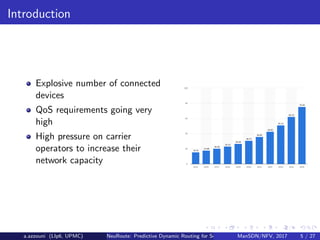
The number of connected devices (Internet of Things; IoT) worldwide
(www.statista.com)
a.azzouni (LIp6, UPMC) NeuRoute: Predictive Dynamic Routing for Software-Defined NetworksManSDN/NFV, 2017 4 / 27
Introduction
The number of connected devices (Internet of Things; IoT) worldwide
(www.statista.com)
a.azzouni (LIp6, UPMC) NeuRoute: Predictive Dynamic Routing for Software-Defined NetworksManSDN/NFV, 2017 4 / 27
Introduction
Explosive number of connected
devices
QoS requirements going very
high
High pressure on carrier
operators to increase their
network capacity
a.azzouni (LIp6, UPMC) NeuRoute: Predictive Dynamic Routing for Software-Defined NetworksManSDN/NFV, 2017 5 / 27
Introduction
Explosive number of connected
devices
QoS requirements going very
high
High pressure on carrier
operators to increase their
network capacity
a.azzouni (LIp6, UPMC) NeuRoute: Predictive Dynamic Routing for Software-Defined NetworksManSDN/NFV, 2017 5 / 27
Introduction
The common practice to ensure a good QoS so far is to
over-provision network resources.
Operators over-provision a network so that capacity is based on peak
traffic load estimates.
Although this approach is simple for networks with predictable peak
loads, it is not economically justified in the long-term.
a.azzouni (LIp6, UPMC) NeuRoute: Predictive Dynamic Routing for Software-Defined NetworksManSDN/NFV, 2017 6 / 27
Introduction
The common practice to ensure a good QoS so far is to
over-provision network resources.
Operators over-provision a network so that capacity is based on peak
traffic load estimates.
Although this approach is simple for networks with predictable peak
loads, it is not economically justified in the long-term.
a.azzouni (LIp6, UPMC) NeuRoute: Predictive Dynamic Routing for Software-Defined NetworksManSDN/NFV, 2017 7 / 27
Introduction
The common practice to ensure a good QoS so far is to
over-provision network resources.
Operators over-provision a network so that capacity is based on peak
traffic load estimates.
Although this approach is simple for networks with predictable peak
loads, it is not economically justified in the long-term.
a.azzouni (LIp6, UPMC) NeuRoute: Predictive Dynamic Routing for Software-Defined NetworksManSDN/NFV, 2017 7 / 27
Introduction
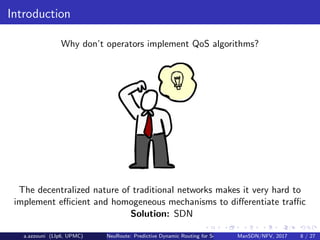
Why don’t operators implement QoS algorithms?
a.azzouni (LIp6, UPMC) NeuRoute: Predictive Dynamic Routing for Software-Defined NetworksManSDN/NFV, 2017 8 / 27
Introduction
Why don’t operators implement QoS algorithms?
The decentralized nature of traditional networks makes it very hard to
implement efficient and homogeneous mechanisms to differentiate traffic
Solution: SDN
a.azzouni (LIp6, UPMC) NeuRoute: Predictive Dynamic Routing for Software-Defined NetworksManSDN/NFV, 2017 8 / 27
The Dynamic Routing Problem
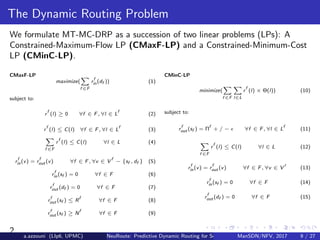
We formulate MT-MC-DRP as a succession of two linear problems (LPs): A
Constrained-Maximum-Flow LP (CMaxF-LP) and a Constrained-Minimum-Cost
LP (CMinC-LP).
CMaxF-LP
maximize(
f ∈F
r
f
in(df )) (1)
subject to:
r
f
(l) ≥ 0 ∀f ∈ F, ∀l ∈ L
f
(2)
r
f
(l) ≤ C(l) ∀f ∈ F, ∀l ∈ L
f
(3)
f ∈F
r
f
(l) ≤ C(l) ∀l ∈ L (4)
r
f
in(v) = r
f
out (v) ∀f ∈ F, ∀v ∈ V
f
− {sf , df } (5)
r
f
in(sf ) = 0 ∀f ∈ F (6)
r
f
out (df ) = 0 ∀f ∈ F (7)
r
f
out (sf ) ≤ R
f
∀f ∈ F (8)
r
f
out (sf ) ≥ N
f
∀f ∈ F (9)
CMinC-LP
minimize(
f ∈F l∈L
r
f
(l) × Θ(l)) (10)
subject to:
r
f
out (sf ) = Π
f
+ / − ∀f ∈ F, ∀l ∈ L
f
(11)
f ∈F
r
f
(l) ≤ C(l) ∀l ∈ L (12)
r
f
in(v) = r
f
out (v) ∀f ∈ F, ∀v ∈ V (13)
r
f
in(sf ) = 0 ∀f ∈ F (14)
r
f
out (df ) = 0 ∀f ∈ F (15)
2
a.azzouni (LIp6, UPMC) NeuRoute: Predictive Dynamic Routing for Software-Defined NetworksManSDN/NFV, 2017 9 / 27
The Dynamic Routing Problem
As we mentioned before, there are a lot of approximative solutions to the
dynamic routing problem. We take a different approach.
a.azzouni (LIp6, UPMC) NeuRoute: Predictive Dynamic Routing for Software-Defined NetworksManSDN/NFV, 2017 10 / 27
NeuRoute
The Routing Problem As A Game
Machine Learning is getting so good!
AlphaGo wins against world’s
best Go human player
DeepMind has been breaking
records in Atari games
OpanAI’s program beats world’s
best DOTA2 human player
a.azzouni (LIp6, UPMC) NeuRoute: Predictive Dynamic Routing for Software-Defined NetworksManSDN/NFV, 2017 11 / 27
NeuRoute
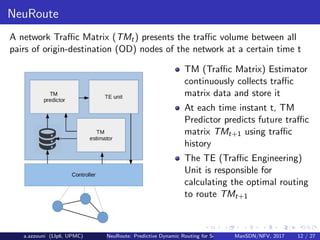
A network Traffic Matrix (TMt) presents the traffic volume between all
pairs of origin-destination (OD) nodes of the network at a certain time t
TM (Traffic Matrix) Estimator
continuously collects traffic
matrix data and store it
At each time instant t, TM
Predictor predicts future traffic
matrix TMt+1 using traffic
history
The TE (Traffic Engineering)
Unit is responsible for
calculating the optimal routing
to route TMt+1
a.azzouni (LIp6, UPMC) NeuRoute: Predictive Dynamic Routing for Software-Defined NetworksManSDN/NFV, 2017 12 / 27
Outline
1 Introduction
Motivation
2 The Dynamic Routing Problem
3 NeuRoute
Traffic Matrix Estimator
Traffic Matrix Predictor
Traffic Routing Unit
Learning Algorithm and Optimization Algorithm
4 Implementation
5 Evaluation Results
6 Conclusion
a.azzouni (LIp6, UPMC) NeuRoute: Predictive Dynamic Routing for Software-Defined NetworksManSDN/NFV, 2017 13 / 27
Traffic Matrix Estimator
In the current implementation, NeuRoute uses
a variant of openMeasure (Chang. et al.
Infocom WKSHPS’16) to estimate traffic
matrix.
The idea is to measure heavy hitters first
a.azzouni (LIp6, UPMC) NeuRoute: Predictive Dynamic Routing for Software-Defined NetworksManSDN/NFV, 2017 14 / 27
Outline
1 Introduction
Motivation
2 The Dynamic Routing Problem
3 NeuRoute
Traffic Matrix Estimator
Traffic Matrix Predictor
Traffic Routing Unit
Learning Algorithm and Optimization Algorithm
4 Implementation
5 Evaluation Results
6 Conclusion
a.azzouni (LIp6, UPMC) NeuRoute: Predictive Dynamic Routing for Software-Defined NetworksManSDN/NFV, 2017 15 / 27
Traffic Matrix Predictor
TM predictor uses LSTM (Long Short Term
Memory) Neural Networks to predict time
series of TM
Sliding window technique: At eat time t, TM
Predictor uses n measured TMs to predict
TMt+1
Extensive details on TM predictor in our paper NeuTM, submitted to NOMS’17
a.azzouni (LIp6, UPMC) NeuRoute: Predictive Dynamic Routing for Software-Defined NetworksManSDN/NFV, 2017 16 / 27
Outline
1 Introduction
Motivation
2 The Dynamic Routing Problem
3 NeuRoute
Traffic Matrix Estimator
Traffic Matrix Predictor
Traffic Routing Unit
Learning Algorithm and Optimization Algorithm
4 Implementation
5 Evaluation Results
6 Conclusion
a.azzouni (LIp6, UPMC) NeuRoute: Predictive Dynamic Routing for Software-Defined NetworksManSDN/NFV, 2017 17 / 27
Traffic Routing Unit
At each time t, TE Unit receives TMt+1 as
input and outputs the optimal routing paths for
it
TE Unit is a feed forward deep neural network
TE Unit learns network characteristics from
TM data and matches them to optimal routing
paths
a.azzouni (LIp6, UPMC) NeuRoute: Predictive Dynamic Routing for Software-Defined NetworksManSDN/NFV, 2017 18 / 27
Traffic Routing Unit
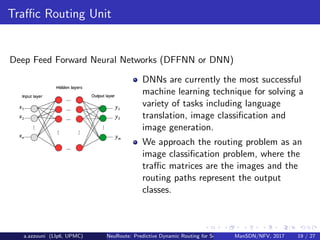
Deep Feed Forward Neural Networks (DFFNN or DNN)
DNNs are currently the most successful
machine learning technique for solving a
variety of tasks including language
translation, image classification and
image generation.
We approach the routing problem as an
image classification problem, where the
traffic matrices are the images and the
routing paths represent the output
classes.
a.azzouni (LIp6, UPMC) NeuRoute: Predictive Dynamic Routing for Software-Defined NetworksManSDN/NFV, 2017 19 / 27
Traffic Routing Unit
Learning Algorithm
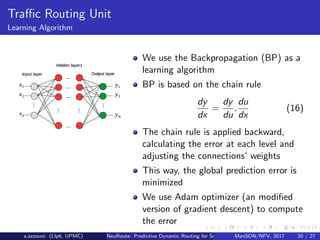
We use the Backpropagation (BP) as a
learning algorithm
BP is based on the chain rule
dy
dx
=
dy
du
.
du
dx
(16)
The chain rule is applied backward,
calculating the error at each level and
adjusting the connections’ weights
This way, the global prediction error is
minimized
We use Adam optimizer (an modified
version of gradient descent) to compute
the error
a.azzouni (LIp6, UPMC) NeuRoute: Predictive Dynamic Routing for Software-Defined NetworksManSDN/NFV, 2017 20 / 27
Implementation
We use data from the G´EANT network: 23
nodes and 38 links
The TE Units neural network is implemented
using Keras on top of Googles TensorFlow
We implemented the G´EANT topology as an
SDN network using Mininet setting link
capacities at 10Mbps Figure: The G´EANT
topology
a.azzouni (LIp6, UPMC) NeuRoute: Predictive Dynamic Routing for Software-Defined NetworksManSDN/NFV, 2017 21 / 27
Implementation
Learning-data generation
Data generation. In order to generate the learning routing-data, we
applied a heuristic (Aleksander. et al) on GANTs traffic matrices
We obtained a data set of 10000 samples (traffic matrix+network
state, near optimal path) that we split to training data set of 7000
samples and test data set of 3000 samples.
Figure: The cross validation technique
a.azzouni (LIp6, UPMC) NeuRoute: Predictive Dynamic Routing for Software-Defined NetworksManSDN/NFV, 2017 22 / 27
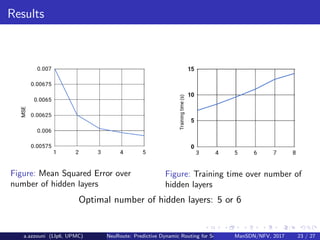
Results
Figure: Mean Squared Error over
number of hidden layers
Figure: Training time over number of
hidden layers
Optimal number of hidden layers: 5 or 6
a.azzouni (LIp6, UPMC) NeuRoute: Predictive Dynamic Routing for Software-Defined NetworksManSDN/NFV, 2017 23 / 27
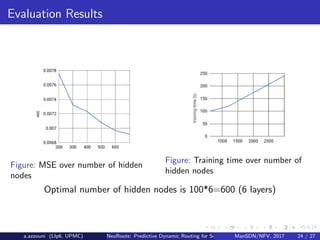
Evaluation Results
Figure: MSE over number of hidden
nodes
Figure: Training time over number of
hidden nodes
Optimal number of hidden nodes is 100*6=600 (6 layers)
a.azzouni (LIp6, UPMC) NeuRoute: Predictive Dynamic Routing for Software-Defined NetworksManSDN/NFV, 2017 24 / 27
Evaluation Results
Figure: Accuracy over number of
training epochs
Finally, the execution time of the TE unit is 25ms. 1/5 the execution time
of the heuristic ( 125ms)
a.azzouni (LIp6, UPMC) NeuRoute: Predictive Dynamic Routing for Software-Defined NetworksManSDN/NFV, 2017 25 / 27
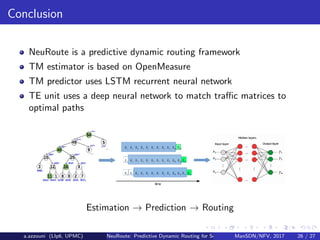
Conclusion
NeuRoute is a predictive dynamic routing framework
TM estimator is based on OpenMeasure
TM predictor uses LSTM recurrent neural network
TE unit uses a deep neural network to match traffic matrices to
optimal paths
Estimation → Prediction → Routing
a.azzouni (LIp6, UPMC) NeuRoute: Predictive Dynamic Routing for Software-Defined NetworksManSDN/NFV, 2017 26 / 27
For Further Reading I
A. Author.
Handbook of Everything.
Some Press, 1990.
S. Someone.
On this and that.
Journal of This and That, 2(1):50–100, 2000.
a.azzouni (LIp6, UPMC) NeuRoute: Predictive Dynamic Routing for Software-Defined NetworksManSDN/NFV, 2017 27 / 27

NeuRoute: Predictive Dynamic Routing for Software-Defined Networks

  • 1.
    NeuRoute: Predictive DynamicRouting for Software-Defined Networks Abdelhadi Azzouni 1 Raouf Boutaba 2 Guy Pujolle 1 1Universit´e Pierre et Marie Curie, France 2University of Waterloo, Canada ManSDN/NFV, 2017 a.azzouni (LIp6, UPMC) NeuRoute: Predictive Dynamic Routing for Software-Defined NetworksManSDN/NFV, 2017 1 / 27
  • 2.
    Outline 1 Introduction Motivation 2 TheDynamic Routing Problem 3 NeuRoute Traffic Matrix Estimator Traffic Matrix Predictor Traffic Routing Unit Learning Algorithm and Optimization Algorithm 4 Implementation 5 Evaluation Results 6 Conclusion a.azzouni (LIp6, UPMC) NeuRoute: Predictive Dynamic Routing for Software-Defined NetworksManSDN/NFV, 2017 2 / 27
  • 3.
    Outline 1 Introduction Motivation 2 TheDynamic Routing Problem 3 NeuRoute Traffic Matrix Estimator Traffic Matrix Predictor Traffic Routing Unit Learning Algorithm and Optimization Algorithm 4 Implementation 5 Evaluation Results 6 Conclusion a.azzouni (LIp6, UPMC) NeuRoute: Predictive Dynamic Routing for Software-Defined NetworksManSDN/NFV, 2017 3 / 27
  • 4.
    Introduction The number ofconnected devices (Internet of Things; IoT) worldwide (www.statista.com) a.azzouni (LIp6, UPMC) NeuRoute: Predictive Dynamic Routing for Software-Defined NetworksManSDN/NFV, 2017 4 / 27
  • 5.
    Introduction The number ofconnected devices (Internet of Things; IoT) worldwide (www.statista.com) a.azzouni (LIp6, UPMC) NeuRoute: Predictive Dynamic Routing for Software-Defined NetworksManSDN/NFV, 2017 4 / 27
  • 6.
    Introduction Explosive number ofconnected devices QoS requirements going very high High pressure on carrier operators to increase their network capacity a.azzouni (LIp6, UPMC) NeuRoute: Predictive Dynamic Routing for Software-Defined NetworksManSDN/NFV, 2017 5 / 27
  • 7.
    Introduction Explosive number ofconnected devices QoS requirements going very high High pressure on carrier operators to increase their network capacity a.azzouni (LIp6, UPMC) NeuRoute: Predictive Dynamic Routing for Software-Defined NetworksManSDN/NFV, 2017 5 / 27
  • 8.
    Introduction The common practiceto ensure a good QoS so far is to over-provision network resources. Operators over-provision a network so that capacity is based on peak traffic load estimates. Although this approach is simple for networks with predictable peak loads, it is not economically justified in the long-term. a.azzouni (LIp6, UPMC) NeuRoute: Predictive Dynamic Routing for Software-Defined NetworksManSDN/NFV, 2017 6 / 27
  • 9.
    Introduction The common practiceto ensure a good QoS so far is to over-provision network resources. Operators over-provision a network so that capacity is based on peak traffic load estimates. Although this approach is simple for networks with predictable peak loads, it is not economically justified in the long-term. a.azzouni (LIp6, UPMC) NeuRoute: Predictive Dynamic Routing for Software-Defined NetworksManSDN/NFV, 2017 7 / 27
  • 10.
    Introduction The common practiceto ensure a good QoS so far is to over-provision network resources. Operators over-provision a network so that capacity is based on peak traffic load estimates. Although this approach is simple for networks with predictable peak loads, it is not economically justified in the long-term. a.azzouni (LIp6, UPMC) NeuRoute: Predictive Dynamic Routing for Software-Defined NetworksManSDN/NFV, 2017 7 / 27
  • 11.
    Introduction Why don’t operatorsimplement QoS algorithms? a.azzouni (LIp6, UPMC) NeuRoute: Predictive Dynamic Routing for Software-Defined NetworksManSDN/NFV, 2017 8 / 27
  • 12.
    Introduction Why don’t operatorsimplement QoS algorithms? The decentralized nature of traditional networks makes it very hard to implement efficient and homogeneous mechanisms to differentiate traffic Solution: SDN a.azzouni (LIp6, UPMC) NeuRoute: Predictive Dynamic Routing for Software-Defined NetworksManSDN/NFV, 2017 8 / 27
  • 13.
    The Dynamic RoutingProblem We formulate MT-MC-DRP as a succession of two linear problems (LPs): A Constrained-Maximum-Flow LP (CMaxF-LP) and a Constrained-Minimum-Cost LP (CMinC-LP). CMaxF-LP maximize( f ∈F r f in(df )) (1) subject to: r f (l) ≥ 0 ∀f ∈ F, ∀l ∈ L f (2) r f (l) ≤ C(l) ∀f ∈ F, ∀l ∈ L f (3) f ∈F r f (l) ≤ C(l) ∀l ∈ L (4) r f in(v) = r f out (v) ∀f ∈ F, ∀v ∈ V f − {sf , df } (5) r f in(sf ) = 0 ∀f ∈ F (6) r f out (df ) = 0 ∀f ∈ F (7) r f out (sf ) ≤ R f ∀f ∈ F (8) r f out (sf ) ≥ N f ∀f ∈ F (9) CMinC-LP minimize( f ∈F l∈L r f (l) × Θ(l)) (10) subject to: r f out (sf ) = Π f + / − ∀f ∈ F, ∀l ∈ L f (11) f ∈F r f (l) ≤ C(l) ∀l ∈ L (12) r f in(v) = r f out (v) ∀f ∈ F, ∀v ∈ V (13) r f in(sf ) = 0 ∀f ∈ F (14) r f out (df ) = 0 ∀f ∈ F (15) 2 a.azzouni (LIp6, UPMC) NeuRoute: Predictive Dynamic Routing for Software-Defined NetworksManSDN/NFV, 2017 9 / 27
  • 14.
    The Dynamic RoutingProblem As we mentioned before, there are a lot of approximative solutions to the dynamic routing problem. We take a different approach. a.azzouni (LIp6, UPMC) NeuRoute: Predictive Dynamic Routing for Software-Defined NetworksManSDN/NFV, 2017 10 / 27
  • 15.
    NeuRoute The Routing ProblemAs A Game Machine Learning is getting so good! AlphaGo wins against world’s best Go human player DeepMind has been breaking records in Atari games OpanAI’s program beats world’s best DOTA2 human player a.azzouni (LIp6, UPMC) NeuRoute: Predictive Dynamic Routing for Software-Defined NetworksManSDN/NFV, 2017 11 / 27
  • 16.
    NeuRoute A network TrafficMatrix (TMt) presents the traffic volume between all pairs of origin-destination (OD) nodes of the network at a certain time t TM (Traffic Matrix) Estimator continuously collects traffic matrix data and store it At each time instant t, TM Predictor predicts future traffic matrix TMt+1 using traffic history The TE (Traffic Engineering) Unit is responsible for calculating the optimal routing to route TMt+1 a.azzouni (LIp6, UPMC) NeuRoute: Predictive Dynamic Routing for Software-Defined NetworksManSDN/NFV, 2017 12 / 27
  • 17.
    Outline 1 Introduction Motivation 2 TheDynamic Routing Problem 3 NeuRoute Traffic Matrix Estimator Traffic Matrix Predictor Traffic Routing Unit Learning Algorithm and Optimization Algorithm 4 Implementation 5 Evaluation Results 6 Conclusion a.azzouni (LIp6, UPMC) NeuRoute: Predictive Dynamic Routing for Software-Defined NetworksManSDN/NFV, 2017 13 / 27
  • 18.
    Traffic Matrix Estimator Inthe current implementation, NeuRoute uses a variant of openMeasure (Chang. et al. Infocom WKSHPS’16) to estimate traffic matrix. The idea is to measure heavy hitters first a.azzouni (LIp6, UPMC) NeuRoute: Predictive Dynamic Routing for Software-Defined NetworksManSDN/NFV, 2017 14 / 27
  • 19.
    Outline 1 Introduction Motivation 2 TheDynamic Routing Problem 3 NeuRoute Traffic Matrix Estimator Traffic Matrix Predictor Traffic Routing Unit Learning Algorithm and Optimization Algorithm 4 Implementation 5 Evaluation Results 6 Conclusion a.azzouni (LIp6, UPMC) NeuRoute: Predictive Dynamic Routing for Software-Defined NetworksManSDN/NFV, 2017 15 / 27
  • 20.
    Traffic Matrix Predictor TMpredictor uses LSTM (Long Short Term Memory) Neural Networks to predict time series of TM Sliding window technique: At eat time t, TM Predictor uses n measured TMs to predict TMt+1 Extensive details on TM predictor in our paper NeuTM, submitted to NOMS’17 a.azzouni (LIp6, UPMC) NeuRoute: Predictive Dynamic Routing for Software-Defined NetworksManSDN/NFV, 2017 16 / 27
  • 21.
    Outline 1 Introduction Motivation 2 TheDynamic Routing Problem 3 NeuRoute Traffic Matrix Estimator Traffic Matrix Predictor Traffic Routing Unit Learning Algorithm and Optimization Algorithm 4 Implementation 5 Evaluation Results 6 Conclusion a.azzouni (LIp6, UPMC) NeuRoute: Predictive Dynamic Routing for Software-Defined NetworksManSDN/NFV, 2017 17 / 27
  • 22.
    Traffic Routing Unit Ateach time t, TE Unit receives TMt+1 as input and outputs the optimal routing paths for it TE Unit is a feed forward deep neural network TE Unit learns network characteristics from TM data and matches them to optimal routing paths a.azzouni (LIp6, UPMC) NeuRoute: Predictive Dynamic Routing for Software-Defined NetworksManSDN/NFV, 2017 18 / 27
  • 23.
    Traffic Routing Unit DeepFeed Forward Neural Networks (DFFNN or DNN) DNNs are currently the most successful machine learning technique for solving a variety of tasks including language translation, image classification and image generation. We approach the routing problem as an image classification problem, where the traffic matrices are the images and the routing paths represent the output classes. a.azzouni (LIp6, UPMC) NeuRoute: Predictive Dynamic Routing for Software-Defined NetworksManSDN/NFV, 2017 19 / 27
  • 24.
    Traffic Routing Unit LearningAlgorithm We use the Backpropagation (BP) as a learning algorithm BP is based on the chain rule dy dx = dy du . du dx (16) The chain rule is applied backward, calculating the error at each level and adjusting the connections’ weights This way, the global prediction error is minimized We use Adam optimizer (an modified version of gradient descent) to compute the error a.azzouni (LIp6, UPMC) NeuRoute: Predictive Dynamic Routing for Software-Defined NetworksManSDN/NFV, 2017 20 / 27
  • 25.
    Implementation We use datafrom the G´EANT network: 23 nodes and 38 links The TE Units neural network is implemented using Keras on top of Googles TensorFlow We implemented the G´EANT topology as an SDN network using Mininet setting link capacities at 10Mbps Figure: The G´EANT topology a.azzouni (LIp6, UPMC) NeuRoute: Predictive Dynamic Routing for Software-Defined NetworksManSDN/NFV, 2017 21 / 27
  • 26.
    Implementation Learning-data generation Data generation.In order to generate the learning routing-data, we applied a heuristic (Aleksander. et al) on GANTs traffic matrices We obtained a data set of 10000 samples (traffic matrix+network state, near optimal path) that we split to training data set of 7000 samples and test data set of 3000 samples. Figure: The cross validation technique a.azzouni (LIp6, UPMC) NeuRoute: Predictive Dynamic Routing for Software-Defined NetworksManSDN/NFV, 2017 22 / 27
  • 27.
    Results Figure: Mean SquaredError over number of hidden layers Figure: Training time over number of hidden layers Optimal number of hidden layers: 5 or 6 a.azzouni (LIp6, UPMC) NeuRoute: Predictive Dynamic Routing for Software-Defined NetworksManSDN/NFV, 2017 23 / 27
  • 28.
    Evaluation Results Figure: MSEover number of hidden nodes Figure: Training time over number of hidden nodes Optimal number of hidden nodes is 100*6=600 (6 layers) a.azzouni (LIp6, UPMC) NeuRoute: Predictive Dynamic Routing for Software-Defined NetworksManSDN/NFV, 2017 24 / 27
  • 29.
    Evaluation Results Figure: Accuracyover number of training epochs Finally, the execution time of the TE unit is 25ms. 1/5 the execution time of the heuristic ( 125ms) a.azzouni (LIp6, UPMC) NeuRoute: Predictive Dynamic Routing for Software-Defined NetworksManSDN/NFV, 2017 25 / 27
  • 30.
    Conclusion NeuRoute is apredictive dynamic routing framework TM estimator is based on OpenMeasure TM predictor uses LSTM recurrent neural network TE unit uses a deep neural network to match traffic matrices to optimal paths Estimation → Prediction → Routing a.azzouni (LIp6, UPMC) NeuRoute: Predictive Dynamic Routing for Software-Defined NetworksManSDN/NFV, 2017 26 / 27
  • 31.
    For Further ReadingI A. Author. Handbook of Everything. Some Press, 1990. S. Someone. On this and that. Journal of This and That, 2(1):50–100, 2000. a.azzouni (LIp6, UPMC) NeuRoute: Predictive Dynamic Routing for Software-Defined NetworksManSDN/NFV, 2017 27 / 27