CSE390 – Advanced
Computer Networks
Lecture 22: Software designed
networking
Based on slides by J. Rexford @ Princeton & N. Mckeown @
Stanford & S. Shenker @ Berkeley. Updated by P. Gill Fall 2014.
Data, Control, and Management
Planes
2
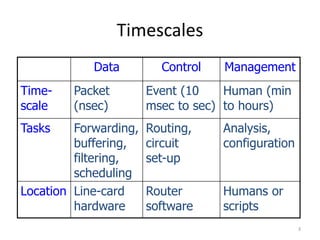
Timescales
3
Data Control Management
Time-
scale
Packet
(nsec)
Event (10
msec to sec)
Human (min
to hours)
Tasks Forwarding,
buffering,
filtering,
scheduling
Routing,
circuit
set-up
Analysis,
configuration
Location Line-card
hardware
Router
software
Humans or
scripts
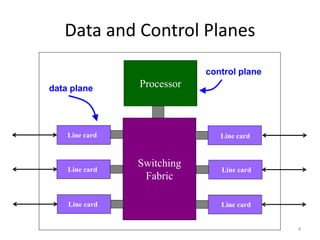
Data and Control Planes
4
Switching
Fabric
Processor
Line card
Line card
Line card
Line card
Line card
Line card
data plane
control plane
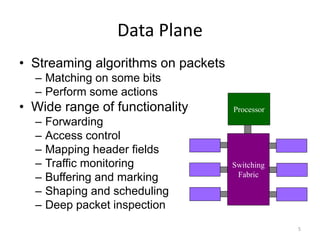
Data Plane
• Streaming algorithms on packets
– Matching on some bits
– Perform some actions
• Wide range of functionality
– Forwarding
– Access control
– Mapping header fields
– Traffic monitoring
– Buffering and marking
– Shaping and scheduling
– Deep packet inspection
5
Switching
Fabric
Processor
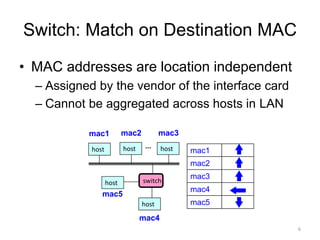
Switch: Match on Destination MAC
• MAC addresses are location independent
– Assigned by the vendor of the interface card
– Cannot be aggregated across hosts in LAN
6
mac1
mac2
mac3
mac4
mac5
host host host
...
mac1 mac2 mac3
switch
host
host
mac4
mac5
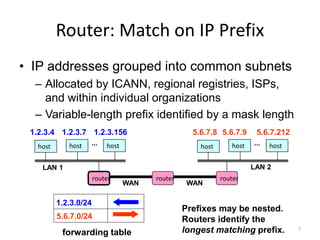
Router: Match on IP Prefix
• IP addresses grouped into common subnets
– Allocated by ICANN, regional registries, ISPs,
and within individual organizations
– Variable-length prefix identified by a mask length
7
host host host
LAN 1
... host host host
LAN 2
...
router router router
WAN WAN
1.2.3.4 1.2.3.7 1.2.3.156 5.6.7.8 5.6.7.9 5.6.7.212
1.2.3.0/24
5.6.7.0/24
forwarding table
Prefixes may be nested.
Routers identify the
longest matching prefix.
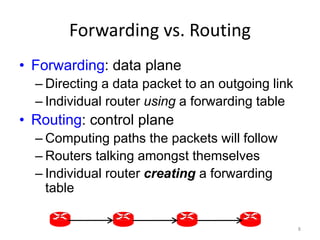
Forwarding vs. Routing
• Forwarding: data plane
– Directing a data packet to an outgoing link
– Individual router using a forwarding table
• Routing: control plane
– Computing paths the packets will follow
– Routers talking amongst themselves
– Individual router creating a forwarding
table
8
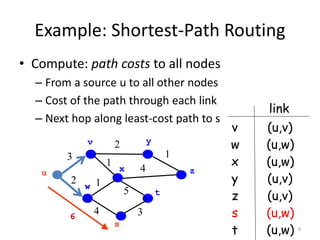
Example: Shortest-Path Routing
• Compute: path costs to all nodes
– From a source u to all other nodes
– Cost of the path through each link
– Next hop along least-cost path to s
9
3
2
2
1
1
4
1
4
5
3
u
s
6
v (u,v)
w (u,w)
x (u,w)
y (u,v)
z (u,v)
link
s (u,w)
t (u,w)
v
w
y
x
t
z
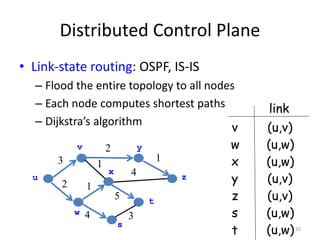
Distributed Control Plane
• Link-state routing: OSPF, IS-IS
– Flood the entire topology to all nodes
– Each node computes shortest paths
– Dijkstra’s algorithm
10
10
v (u,v)
w (u,w)
x (u,w)
y (u,v)
z (u,v)
link
s (u,w)
t (u,w)
3
2
2
1
1
4
1
4
5
3
u
v
w
x
y
z
s
t
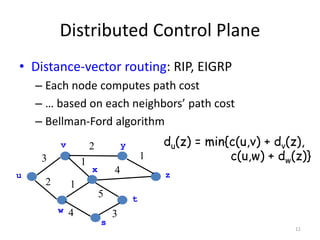
Distributed Control Plane
• Distance-vector routing: RIP, EIGRP
– Each node computes path cost
– … based on each neighbors’ path cost
– Bellman-Ford algorithm
11
3
2
2
1
1
4
1
4
5
3
u
v
w
x
y
z
s
t
du(z) = min{c(u,v) + dv(z),
c(u,w) + dw(z)}
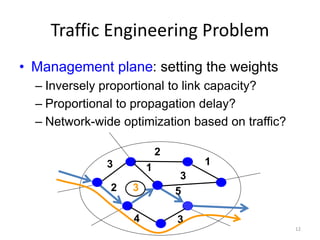
Traffic Engineering Problem
• Management plane: setting the weights
– Inversely proportional to link capacity?
– Proportional to propagation delay?
– Network-wide optimization based on traffic?
12
3
2
2
1
1
3
1
4
5
3
3
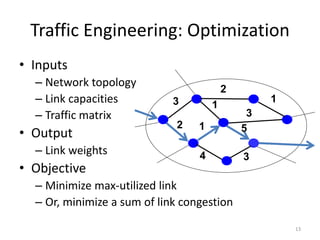
Traffic Engineering: Optimization
• Inputs
– Network topology
– Link capacities
– Traffic matrix
• Output
– Link weights
• Objective
– Minimize max-utilized link
– Or, minimize a sum of link congestion
13
3
2
2
1
1
3
1
4
5
3
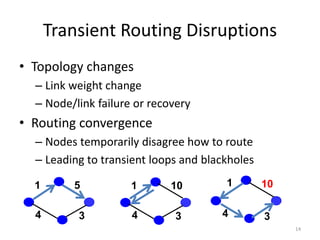
Transient Routing Disruptions
• Topology changes
– Link weight change
– Node/link failure or recovery
• Routing convergence
– Nodes temporarily disagree how to route
– Leading to transient loops and blackholes
14
1
4
5
3
1
4
10
3
1
4
10
3
Management Plane Challenges
• Indirect control
– Changing weights instead of paths
– Complex optimization problem
• Uncoordinated control
– Cannot control which router updates first
• Interacting protocols and mechanisms
– Routing and forwarding
– Naming and addressing
– Access control
– Quality of service
– …
15
Software Defined Networking
(high level view)
16
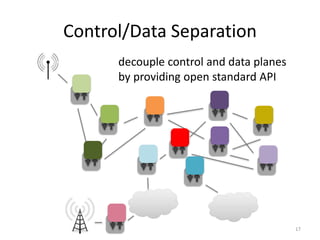
decouple control and data planes
by providing open standard API
Control/Data Separation
17
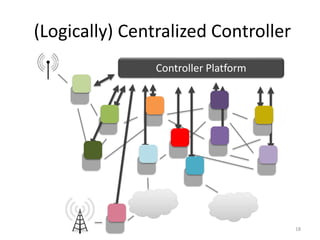
(Logically) Centralized Controller
Controller Platform
18
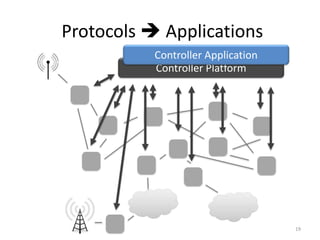
Protocols  Applications
Controller Platform
19
Controller Application
Outline
1. What are Software Defined
Networks?
2. Why SDN?
3. The Consequences
 For industry
 For research
 For standards and protocols
20
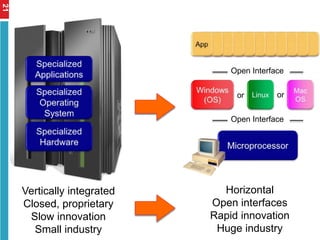
Vertically integrated
Closed, proprietary
Slow innovation
Small industry
Horizontal
Open interfaces
Rapid innovation
Huge industry
Open Interface
or or
Open Interface
21
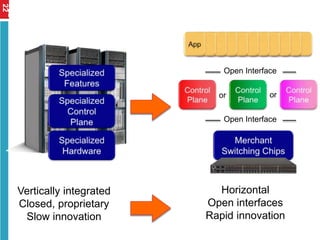
Vertically integrated
Closed, proprietary
Slow innovation
Horizontal
Open interfaces
Rapid innovation
or or
Open Interface
Open Interface
22
22
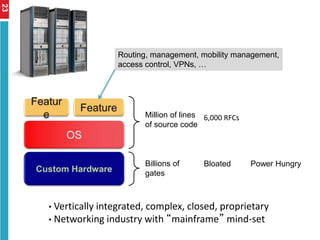
Million of lines
of source code
6,000 RFCs
Billions of
gates
Bloated Power Hungry
• Vertically integrated, complex, closed, proprietary
• Networking industry with “mainframe” mind-set
Routing, management, mobility management,
access control, VPNs, …
23
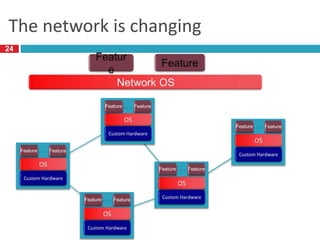
The network is changing
Feature Feature
Feature Feature
Feature Feature
Feature Feature
Feature Feature
24
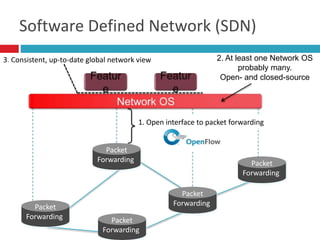
1. Open interface to packet forwarding
3. Consistent, up-to-date global network view 2. At least one Network OS
probably many.
Open- and closed-source
Software Defined Network (SDN)
Packet
Forwarding Packet
Forwarding
Packet
Forwarding
Packet
Forwarding
Packet
Forwarding
25
Network OS
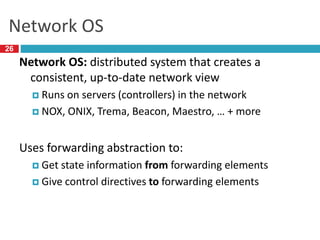
Network OS: distributed system that creates a
consistent, up-to-date network view
 Runs on servers (controllers) in the network
 NOX, ONIX, Trema, Beacon, Maestro, … + more
Uses forwarding abstraction to:
 Get state information from forwarding elements
 Give control directives to forwarding elements
26
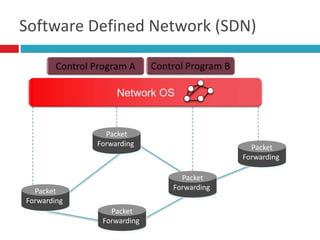
Software Defined Network (SDN)
Packet
Forwarding
Packet
Forwarding
Packet
Forwarding
Packet
Forwarding
Packet
Forwarding
Control Program
 Control program operates on view of network
 Input: global network view (graph/database)
 Output: configuration of each network device
 Control program is not a distributed system
 Abstraction hides details of distributed state
28
Forwarding Abstraction
Purpose: Abstract away forwarding hardware
 Flexible
 Behavior specified by control plane
 Built from basic set of forwarding primitives
 Minimal
 Streamlined for speed and low-power
 Control program not vendor-specific
 OpenFlow is an example of such an abstraction
29
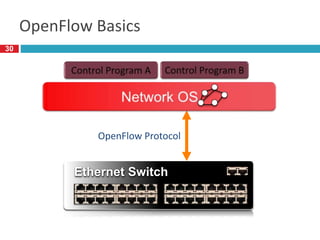
OpenFlow Protocol
Data Path (Hardware)
Control Path OpenFlow
Ethernet Switch
OpenFlow Basics
30
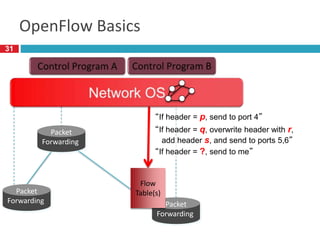
OpenFlow Basics
Packet
Forwarding
Packet
Forwarding
Packet
Forwarding
Flow
Table(s)
“If header = p, send to port 4”
“If header = ?, send to me”
“If header = q, overwrite header with r,
add header s, and send to ports 5,6”
31
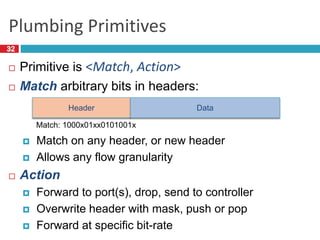
Plumbing Primitives
 Primitive is <Match, Action>
 Match arbitrary bits in headers:
 Match on any header, or new header
 Allows any flow granularity
 Action
 Forward to port(s), drop, send to controller
 Overwrite header with mask, push or pop
 Forward at specific bit-rate
32
Header Data
Match: 1000x01xx0101001x
32
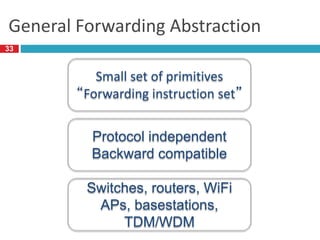
General Forwarding Abstraction
Small set of primitives
“Forwarding instruction set”
Protocol independent
Backward compatible
Switches, routers, WiFi
APs, basestations,
TDM/WDM
33
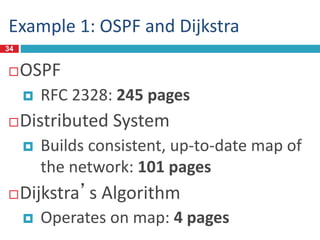
Example 1: OSPF and Dijkstra
34
OSPF
 RFC 2328: 245 pages
Distributed System
 Builds consistent, up-to-date map of
the network: 101 pages
Dijkstra’s Algorithm
 Operates on map: 4 pages
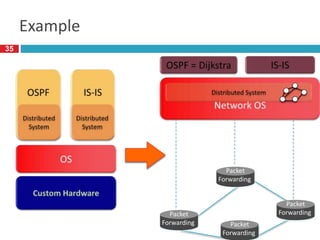
Example
Packet
Forwarding Packet
Forwarding
Packet
Forwarding
Packet
Forwarding
35
Outline
36
1. What are Software Defined
Networks?
2. Why SDN?
3. The Consequences
 For industry
 For research
 For standards and protocols
GREAT TALK BY SCOTT
SHENKER
HTTP://WWW.YOUTUBE.COM/WATCH?V=WVS7
PC99S7W
(Story summarized here)
Networking
38
 Networking is
 “Intellectually Weak”
 behind other fields
 about the mastery of complexity
Good abstractions tame complexity
 Interfaces are instances of those abstractions
No abstraction => increasing complexity
 We are now at the complexity limit
By comparison: Programming
 Machine languages: no abstractions
 Had to deal with low-level details
 Higher-level languages: OS and other abstractions
 File system, virtual memory, abstract data types, ...
 Modern languages: even more abstractions
 Object orientation, garbage collection,…
39
Programming Analogy
 What if programmers had to:
 Specify where each bit was stored
 Explicitly deal with internal communication errors
 Within a programming language with limited expressibility
 Programmers would redefine problem by:
 Defining higher level abstractions for memory
 Building on reliable communication primitives
 Using a more general language
40
Specification Abstraction
 Network OS eases implementation
 E.g., Helps manage distributed state
 Next step is to ease specification
 E.g., How do you specify what the system should do?
 Key goals
 Provide abstract view of network map
 Control program operates on abstract view
 Develop means to simplify specification
41
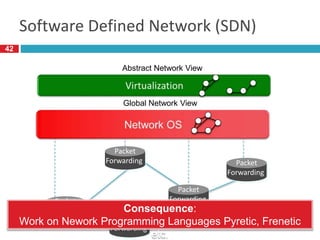
Software Defined Network (SDN)
Packet
Forwarding
Packet
Forwarding
Packet
Forwarding
Packet
Forwarding
Packet
Forwarding
Global Network View
Abstract Network View
42
Consequence:
Work on Nework Programming Languages Pyretic, Frenetic
etc.
Outline
43
1. What are Software Defined
Networks?
2. Why SDN?
3. The Consequences
 For industry
 For research
 For standards and protocols
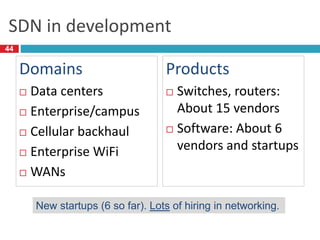
SDN in development
Domains
 Data centers
 Enterprise/campus
 Cellular backhaul
 Enterprise WiFi
 WANs
Products
 Switches, routers:
About 15 vendors
 Software: About 6
vendors and startups
New startups (6 so far). Lots of hiring in networking.
44
Cellular industry
 Recently made transition to IP
 Billions of mobile users
 Need to securely extract payments and hold users
accountable
 IP is bad at both, yet hard to change
SDN enables industry to customize their network
46
Telco Operators
 Global IP traffic growing 40-50% per year
 End-customer monthly bill remains unchanged
 Therefore, CAPEX and OPEX need to reduce 40-50%
per Gb/s per year
 But in practice, reduces by ~20% per year
SDN enables industry to reduce OPEX and CAPEX
…and to create new differentiating services
47
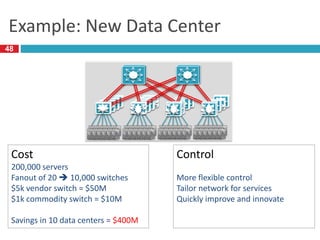
Example: New Data Center
Cost
200,000 servers
Fanout of 20  10,000 switches
$5k vendor switch = $50M
$1k commodity switch = $10M
Savings in 10 data centers = $400M
Control
More flexible control
Tailor network for services
Quickly improve and innovate
48
Consequences for research
Ease of trying new ideas
 Existing tools: NOX, Beacon, switches, Mininet
 More rapid technology transfer
 GENI, Ofelia and many more
A stronger foundation to build upon
 Provable properties of forwarding
 New languages and specification tools
49
Consequences for standards
Standards will define the interfaces
The role of standards will change:
 Network owners will define network behavior
 Features will be adopted without standards
Programming world
 Good software is adopted, not standardized
50
Summary
 Networks becoming
 More programmatic
 Defined by owners and operators, not vendors
 Faster changing, to meet operator needs
 Lower opex, capex and power
 Abstractions
 Will shield programmers from complexity
 Make behavior more provable
 Will take us places we can’t yet imagine
51
Administravia …
52
 Assignment 4 due December 13
 Internet in the News (10% of final grade)
 Due next Monday Dec. 1 on Piazza
 Reading/commenting on others’ Internet in the News
part of participation mark
 Recent news: http://www.newsweek.com/china-could-
shut-down-us-power-grid-cyber-attack-says-nsa-chief-
286119
 Lots of topics, pick something you find interesting
 No class Wednesday!
 Next Monday  Mobile networks!

Software defined network

  • 1.
    CSE390 – Advanced ComputerNetworks Lecture 22: Software designed networking Based on slides by J. Rexford @ Princeton & N. Mckeown @ Stanford & S. Shenker @ Berkeley. Updated by P. Gill Fall 2014.
  • 2.
    Data, Control, andManagement Planes 2
  • 3.
    Timescales 3 Data Control Management Time- scale Packet (nsec) Event(10 msec to sec) Human (min to hours) Tasks Forwarding, buffering, filtering, scheduling Routing, circuit set-up Analysis, configuration Location Line-card hardware Router software Humans or scripts
  • 4.
    Data and ControlPlanes 4 Switching Fabric Processor Line card Line card Line card Line card Line card Line card data plane control plane
  • 5.
    Data Plane • Streamingalgorithms on packets – Matching on some bits – Perform some actions • Wide range of functionality – Forwarding – Access control – Mapping header fields – Traffic monitoring – Buffering and marking – Shaping and scheduling – Deep packet inspection 5 Switching Fabric Processor
  • 6.
    Switch: Match onDestination MAC • MAC addresses are location independent – Assigned by the vendor of the interface card – Cannot be aggregated across hosts in LAN 6 mac1 mac2 mac3 mac4 mac5 host host host ... mac1 mac2 mac3 switch host host mac4 mac5
  • 7.
    Router: Match onIP Prefix • IP addresses grouped into common subnets – Allocated by ICANN, regional registries, ISPs, and within individual organizations – Variable-length prefix identified by a mask length 7 host host host LAN 1 ... host host host LAN 2 ... router router router WAN WAN 1.2.3.4 1.2.3.7 1.2.3.156 5.6.7.8 5.6.7.9 5.6.7.212 1.2.3.0/24 5.6.7.0/24 forwarding table Prefixes may be nested. Routers identify the longest matching prefix.
  • 8.
    Forwarding vs. Routing •Forwarding: data plane – Directing a data packet to an outgoing link – Individual router using a forwarding table • Routing: control plane – Computing paths the packets will follow – Routers talking amongst themselves – Individual router creating a forwarding table 8
  • 9.
    Example: Shortest-Path Routing •Compute: path costs to all nodes – From a source u to all other nodes – Cost of the path through each link – Next hop along least-cost path to s 9 3 2 2 1 1 4 1 4 5 3 u s 6 v (u,v) w (u,w) x (u,w) y (u,v) z (u,v) link s (u,w) t (u,w) v w y x t z
  • 10.
    Distributed Control Plane •Link-state routing: OSPF, IS-IS – Flood the entire topology to all nodes – Each node computes shortest paths – Dijkstra’s algorithm 10 10 v (u,v) w (u,w) x (u,w) y (u,v) z (u,v) link s (u,w) t (u,w) 3 2 2 1 1 4 1 4 5 3 u v w x y z s t
  • 11.
    Distributed Control Plane •Distance-vector routing: RIP, EIGRP – Each node computes path cost – … based on each neighbors’ path cost – Bellman-Ford algorithm 11 3 2 2 1 1 4 1 4 5 3 u v w x y z s t du(z) = min{c(u,v) + dv(z), c(u,w) + dw(z)}
  • 12.
    Traffic Engineering Problem •Management plane: setting the weights – Inversely proportional to link capacity? – Proportional to propagation delay? – Network-wide optimization based on traffic? 12 3 2 2 1 1 3 1 4 5 3 3
  • 13.
    Traffic Engineering: Optimization •Inputs – Network topology – Link capacities – Traffic matrix • Output – Link weights • Objective – Minimize max-utilized link – Or, minimize a sum of link congestion 13 3 2 2 1 1 3 1 4 5 3
  • 14.
    Transient Routing Disruptions •Topology changes – Link weight change – Node/link failure or recovery • Routing convergence – Nodes temporarily disagree how to route – Leading to transient loops and blackholes 14 1 4 5 3 1 4 10 3 1 4 10 3
  • 15.
    Management Plane Challenges •Indirect control – Changing weights instead of paths – Complex optimization problem • Uncoordinated control – Cannot control which router updates first • Interacting protocols and mechanisms – Routing and forwarding – Naming and addressing – Access control – Quality of service – … 15
  • 16.
  • 17.
    decouple control anddata planes by providing open standard API Control/Data Separation 17
  • 18.
  • 19.
    Protocols  Applications ControllerPlatform 19 Controller Application
  • 20.
    Outline 1. What areSoftware Defined Networks? 2. Why SDN? 3. The Consequences  For industry  For research  For standards and protocols 20
  • 21.
    Vertically integrated Closed, proprietary Slowinnovation Small industry Horizontal Open interfaces Rapid innovation Huge industry Open Interface or or Open Interface 21
  • 22.
    Vertically integrated Closed, proprietary Slowinnovation Horizontal Open interfaces Rapid innovation or or Open Interface Open Interface 22 22
  • 23.
    Million of lines ofsource code 6,000 RFCs Billions of gates Bloated Power Hungry • Vertically integrated, complex, closed, proprietary • Networking industry with “mainframe” mind-set Routing, management, mobility management, access control, VPNs, … 23
  • 24.
    The network ischanging Feature Feature Feature Feature Feature Feature Feature Feature Feature Feature 24
  • 25.
    1. Open interfaceto packet forwarding 3. Consistent, up-to-date global network view 2. At least one Network OS probably many. Open- and closed-source Software Defined Network (SDN) Packet Forwarding Packet Forwarding Packet Forwarding Packet Forwarding Packet Forwarding 25
  • 26.
    Network OS Network OS:distributed system that creates a consistent, up-to-date network view  Runs on servers (controllers) in the network  NOX, ONIX, Trema, Beacon, Maestro, … + more Uses forwarding abstraction to:  Get state information from forwarding elements  Give control directives to forwarding elements 26
  • 27.
    Software Defined Network(SDN) Packet Forwarding Packet Forwarding Packet Forwarding Packet Forwarding Packet Forwarding
  • 28.
    Control Program  Controlprogram operates on view of network  Input: global network view (graph/database)  Output: configuration of each network device  Control program is not a distributed system  Abstraction hides details of distributed state 28
  • 29.
    Forwarding Abstraction Purpose: Abstractaway forwarding hardware  Flexible  Behavior specified by control plane  Built from basic set of forwarding primitives  Minimal  Streamlined for speed and low-power  Control program not vendor-specific  OpenFlow is an example of such an abstraction 29
  • 30.
    OpenFlow Protocol Data Path(Hardware) Control Path OpenFlow Ethernet Switch OpenFlow Basics 30
  • 31.
    OpenFlow Basics Packet Forwarding Packet Forwarding Packet Forwarding Flow Table(s) “If header= p, send to port 4” “If header = ?, send to me” “If header = q, overwrite header with r, add header s, and send to ports 5,6” 31
  • 32.
    Plumbing Primitives  Primitiveis <Match, Action>  Match arbitrary bits in headers:  Match on any header, or new header  Allows any flow granularity  Action  Forward to port(s), drop, send to controller  Overwrite header with mask, push or pop  Forward at specific bit-rate 32 Header Data Match: 1000x01xx0101001x 32
  • 33.
    General Forwarding Abstraction Smallset of primitives “Forwarding instruction set” Protocol independent Backward compatible Switches, routers, WiFi APs, basestations, TDM/WDM 33
  • 34.
    Example 1: OSPFand Dijkstra 34 OSPF  RFC 2328: 245 pages Distributed System  Builds consistent, up-to-date map of the network: 101 pages Dijkstra’s Algorithm  Operates on map: 4 pages
  • 35.
  • 36.
    Outline 36 1. What areSoftware Defined Networks? 2. Why SDN? 3. The Consequences  For industry  For research  For standards and protocols
  • 37.
    GREAT TALK BYSCOTT SHENKER HTTP://WWW.YOUTUBE.COM/WATCH?V=WVS7 PC99S7W (Story summarized here)
  • 38.
    Networking 38  Networking is “Intellectually Weak”  behind other fields  about the mastery of complexity Good abstractions tame complexity  Interfaces are instances of those abstractions No abstraction => increasing complexity  We are now at the complexity limit
  • 39.
    By comparison: Programming Machine languages: no abstractions  Had to deal with low-level details  Higher-level languages: OS and other abstractions  File system, virtual memory, abstract data types, ...  Modern languages: even more abstractions  Object orientation, garbage collection,… 39
  • 40.
    Programming Analogy  Whatif programmers had to:  Specify where each bit was stored  Explicitly deal with internal communication errors  Within a programming language with limited expressibility  Programmers would redefine problem by:  Defining higher level abstractions for memory  Building on reliable communication primitives  Using a more general language 40
  • 41.
    Specification Abstraction  NetworkOS eases implementation  E.g., Helps manage distributed state  Next step is to ease specification  E.g., How do you specify what the system should do?  Key goals  Provide abstract view of network map  Control program operates on abstract view  Develop means to simplify specification 41
  • 42.
    Software Defined Network(SDN) Packet Forwarding Packet Forwarding Packet Forwarding Packet Forwarding Packet Forwarding Global Network View Abstract Network View 42 Consequence: Work on Nework Programming Languages Pyretic, Frenetic etc.
  • 43.
    Outline 43 1. What areSoftware Defined Networks? 2. Why SDN? 3. The Consequences  For industry  For research  For standards and protocols
  • 44.
    SDN in development Domains Data centers  Enterprise/campus  Cellular backhaul  Enterprise WiFi  WANs Products  Switches, routers: About 15 vendors  Software: About 6 vendors and startups New startups (6 so far). Lots of hiring in networking. 44
  • 45.
    Cellular industry  Recentlymade transition to IP  Billions of mobile users  Need to securely extract payments and hold users accountable  IP is bad at both, yet hard to change SDN enables industry to customize their network 46
  • 46.
    Telco Operators  GlobalIP traffic growing 40-50% per year  End-customer monthly bill remains unchanged  Therefore, CAPEX and OPEX need to reduce 40-50% per Gb/s per year  But in practice, reduces by ~20% per year SDN enables industry to reduce OPEX and CAPEX …and to create new differentiating services 47
  • 47.
    Example: New DataCenter Cost 200,000 servers Fanout of 20  10,000 switches $5k vendor switch = $50M $1k commodity switch = $10M Savings in 10 data centers = $400M Control More flexible control Tailor network for services Quickly improve and innovate 48
  • 48.
    Consequences for research Easeof trying new ideas  Existing tools: NOX, Beacon, switches, Mininet  More rapid technology transfer  GENI, Ofelia and many more A stronger foundation to build upon  Provable properties of forwarding  New languages and specification tools 49
  • 49.
    Consequences for standards Standardswill define the interfaces The role of standards will change:  Network owners will define network behavior  Features will be adopted without standards Programming world  Good software is adopted, not standardized 50
  • 50.
    Summary  Networks becoming More programmatic  Defined by owners and operators, not vendors  Faster changing, to meet operator needs  Lower opex, capex and power  Abstractions  Will shield programmers from complexity  Make behavior more provable  Will take us places we can’t yet imagine 51
  • 51.
    Administravia … 52  Assignment4 due December 13  Internet in the News (10% of final grade)  Due next Monday Dec. 1 on Piazza  Reading/commenting on others’ Internet in the News part of participation mark  Recent news: http://www.newsweek.com/china-could- shut-down-us-power-grid-cyber-attack-says-nsa-chief- 286119  Lots of topics, pick something you find interesting  No class Wednesday!  Next Monday  Mobile networks!

Editor's Notes

  • #22 The mainframe industry in the 1980s was vertical and closed: it consisted of specialized hardware, operating system and applications --- all from the same company. A revolution happened when open interfaces started to appear. The industry became horizontal. Innovation exploded.