Neurophysiology.
1
Human cell
Cell membrane consists of phospholipids.
The lipid bilayer permits passage of fat soluble
substances.
Other substances enter the cell through protein gates which
propagates along the cell membrane.
2
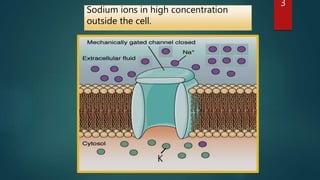
Sodium ions in high concentration
outside the cell.
3
Stimulus
Opening of sodium
gates
Influx of Na ions from
outside to inside cell
Action potential
Depolarization
Propagation
Repolarization
Resting state
Resting state
In resting state of cell membrane the sodium molecules
concentrated outside of the cell membrane, while
potassium concentrates inside the cell .
With resultant
Relative negative charges created inside the cell
membrane while positive charges detected outside.
4
-70mv
State of polarization
0
5
Stimulus
Opening of sodium
gates
Influx of Na ions from
outside to inside cell
Action potential
Depolarization
Propagation
Repolarization
Resting state
Resting state
5
Stimulus
Opening of sodium
gates
Influx of Na ions from
outside to inside cell
Action potential
Depolarization
Propagation
Repolarization
Resting state
Resting state
5
Stimulus
Opening of sodium
gates
Influx of Na ions from
outside to inside cell
Action potential
Depolarization
Propagation
Repolarization
Resting state
Resting state
6
Stimulus
Opening of sodium
gates
Influx of Na ions from
outside to inside cell
Action potential
Depolarization
Propagation
Repolarization
Resting state
Resting state
7
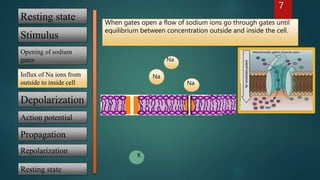
When gates open a flow of sodium ions go through gates until
equilibrium between concentration outside and inside the cell.
Na
Na
Na
K
Stimulus
Opening of sodium
gates
Influx of Na ions from
outside to inside cell
Action potential
Depolarization
Propagation
Repolarization
Resting state
Resting state
7
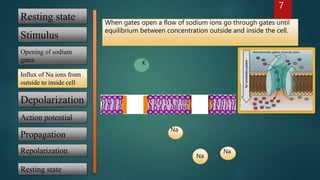
When gates open a flow of sodium ions go through gates until
equilibrium between concentration outside and inside the cell.
Na
Na
Na
K
Stimulus
Opening of sodium
gates
Influx of Na ions from
outside to inside cell
Action potential
Depolarization
Propagation
Repolarization
Resting state
Resting state
7
When gates open a flow of sodium ions go through gates until
equilibrium between concentration outside and inside the cell.
Na
Na
Na
K
Stimulus
Opening of sodium
gates
Influx of Na ions from
outside to inside cell
Action potential
Depolarization
Propagation
Repolarization
Resting state
Resting state
8
-70mv
+40mv
Depolarization
Stimulus
Opening of sodium
gates
Influx of Na ions from
outside to inside cell
Action potential
Depolarization
Propagation
Repolarization
Resting state
Resting state
0
9
Na
Na
Na
K
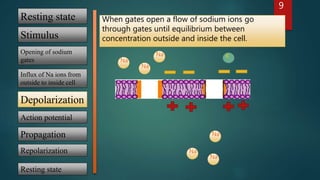
When gates open a flow of sodium ions go
through gates until equilibrium between
concentration outside and inside the cell.
Na
Na
Na
Stimulus
Opening of sodium
gates
Influx of Na ions from
outside to inside cell
Action potential
Depolarization
Propagation
Repolarization
Resting state
Resting state
10
Stimulus
Opening of sodium
gates
Influx of Na ions from
outside to inside cell
Action potential
Depolarization
Propagation
Repolarization
Resting state
Resting state
-70mv
+40mv
Depolarization
Action potential
0
11
Stimulus
Opening of sodium
gates
Influx of Na ions from
outside to inside cell
Action potential
Depolarization
Propagation
Repolarization
Resting state
Resting state
Propagation of action potential
Stimulus
Opening of sodium
gates
Influx of Na ions from
outside to inside cell
Action potential
Depolarization
Propagation
Repolarization
Resting state
Resting state
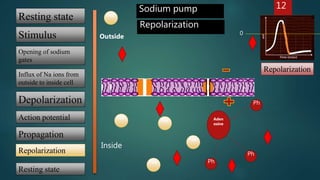
Repolarization
Na
Na
Na
Na
Na
Na
Aden
osine
Ph
Ph
Ph
Outside
Inside
Repolarization
Sodium pump 12
0
Stimulus
Opening of sodium
gates
Influx of Na ions from
outside to inside cell
Action potential
Depolarization
Propagation
Repolarization
Resting state
Resting state
Repolarization
Na
Na
Na
Na
Na
Na
Aden
osine
Outside
Inside
Repolarization
Sodium pump 12
0
18
To prevent the action potential.
The influx of sodium ion through the gates
should be prohibited.
The membrane gates should be
closed through
Pharmacological Action of local
anesthetic agents.
Local Pain control
Neurophysiology

Neurophysiology

  • 1.
  • 2.
    Human cell Cell membraneconsists of phospholipids. The lipid bilayer permits passage of fat soluble substances. Other substances enter the cell through protein gates which propagates along the cell membrane. 2
  • 3.
    Sodium ions inhigh concentration outside the cell. 3
  • 4.
    Stimulus Opening of sodium gates Influxof Na ions from outside to inside cell Action potential Depolarization Propagation Repolarization Resting state Resting state In resting state of cell membrane the sodium molecules concentrated outside of the cell membrane, while potassium concentrates inside the cell . With resultant Relative negative charges created inside the cell membrane while positive charges detected outside. 4 -70mv State of polarization 0
  • 5.
    5 Stimulus Opening of sodium gates Influxof Na ions from outside to inside cell Action potential Depolarization Propagation Repolarization Resting state Resting state
  • 6.
    5 Stimulus Opening of sodium gates Influxof Na ions from outside to inside cell Action potential Depolarization Propagation Repolarization Resting state Resting state
  • 7.
    5 Stimulus Opening of sodium gates Influxof Na ions from outside to inside cell Action potential Depolarization Propagation Repolarization Resting state Resting state
  • 8.
    6 Stimulus Opening of sodium gates Influxof Na ions from outside to inside cell Action potential Depolarization Propagation Repolarization Resting state Resting state
  • 9.
    7 When gates opena flow of sodium ions go through gates until equilibrium between concentration outside and inside the cell. Na Na Na K Stimulus Opening of sodium gates Influx of Na ions from outside to inside cell Action potential Depolarization Propagation Repolarization Resting state Resting state
  • 10.
    7 When gates opena flow of sodium ions go through gates until equilibrium between concentration outside and inside the cell. Na Na Na K Stimulus Opening of sodium gates Influx of Na ions from outside to inside cell Action potential Depolarization Propagation Repolarization Resting state Resting state
  • 11.
    7 When gates opena flow of sodium ions go through gates until equilibrium between concentration outside and inside the cell. Na Na Na K Stimulus Opening of sodium gates Influx of Na ions from outside to inside cell Action potential Depolarization Propagation Repolarization Resting state Resting state
  • 12.
    8 -70mv +40mv Depolarization Stimulus Opening of sodium gates Influxof Na ions from outside to inside cell Action potential Depolarization Propagation Repolarization Resting state Resting state 0
  • 13.
    9 Na Na Na K When gates opena flow of sodium ions go through gates until equilibrium between concentration outside and inside the cell. Na Na Na Stimulus Opening of sodium gates Influx of Na ions from outside to inside cell Action potential Depolarization Propagation Repolarization Resting state Resting state
  • 14.
    10 Stimulus Opening of sodium gates Influxof Na ions from outside to inside cell Action potential Depolarization Propagation Repolarization Resting state Resting state -70mv +40mv Depolarization Action potential 0
  • 15.
    11 Stimulus Opening of sodium gates Influxof Na ions from outside to inside cell Action potential Depolarization Propagation Repolarization Resting state Resting state Propagation of action potential
  • 16.
    Stimulus Opening of sodium gates Influxof Na ions from outside to inside cell Action potential Depolarization Propagation Repolarization Resting state Resting state Repolarization Na Na Na Na Na Na Aden osine Ph Ph Ph Outside Inside Repolarization Sodium pump 12 0
  • 17.
    Stimulus Opening of sodium gates Influxof Na ions from outside to inside cell Action potential Depolarization Propagation Repolarization Resting state Resting state Repolarization Na Na Na Na Na Na Aden osine Outside Inside Repolarization Sodium pump 12 0
  • 18.
    18 To prevent theaction potential. The influx of sodium ion through the gates should be prohibited. The membrane gates should be closed through Pharmacological Action of local anesthetic agents. Local Pain control