Subjects
 Fascial spaces infection of Max.Fac. Region.
 Neurologic considerations of Max.Fac.infection
 Fatal complications of MaxFac. Infection.
Time allowed:
4 hours.
Mandibular spaces
Submandibular
space
Submental
space
Submandibular
space
Sublingual
space
Submental
space
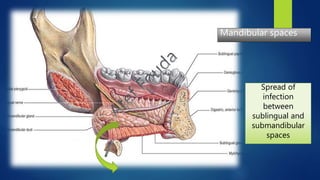
Mandibular spaces
Mandibular spaces
Spread of
infection
between
sublingual and
submandibular
spaces
Sublingual
infection push the
tongue backward
narrowing the
airway
Mandibular spaces
Mandibular spaces
 Sub masseteric space
 Pterygo Mandibular space
 Superficial temporal space
 Deep temporal space.
 Infratemporal space.
Masticator spaces
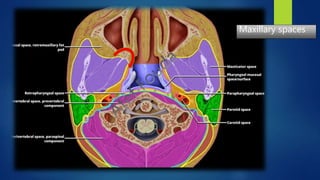
Maxillary spaces
Maxilary anterior
teeth and
premolars.
Canine space
Maxilary posterior
teeth.
Buccal space
Maxillary spaces
Lateral(para)pharyngeal
space
is the continuation
of
buccal space.
Maxillary spaces
Maxillary spaces
Lateral(para)pharyngeal
space is the continuation
of
Infratemporal space
&
buccal space.
And
Pterygomandibular space
Maxillary spaces
Retropharyngeal
space
is the continuation
of Lateral
(para)pharyngeal
space
Maxillary spaces
Retropharyngeal space
lead to
Danger space
Mediastinal
space.
C6
Maxillary spaces
Para-pharyngeal
Submental
Pterygo
mandibular
Masseteric
Buccal
Retro-
pharyngeal
Mediastinal
Sublingual
Sub
mandibular
Dangerous
Mandibular infection
Para-pharyngeal
Submental
Pterygo
mandibular
MassetericBuccal
Retro-
pharyngeal
Mediastinal
Sub
mandibular
Dangerous
Maxillary infection
Infra-
Temporal
Canine
Deep
Temporal
Superficial
Temporal
Intra-cranial
Sub
lingual
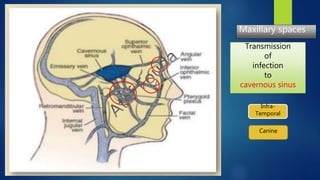
Transmission
of
infection
to
cavernous sinus
Maxillary spaces
Infra-
Temporal
Canine
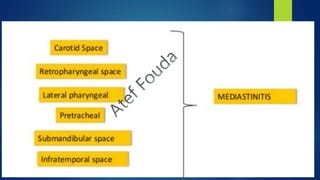
 Mediastinal
infection
 [vital organs].
 Lateral pharyngeal
space infection
[vascular problems]
Submandibular-Sublingual-Submental
[Air-way].
Fatal complications of maxillofacial infection
Canine-Infratemporal
Neurological & [Brain damage].
Cavernous sinus thrombosis
Sensory nerves:
 Ophthalmic
nerve.
 Maxillary
nerve.
Motor nerves:
 Oculomotor nerve.
 Trochlear nerve.
 Abducent nerve.
Vascular structures:
 Internal carotid artery.
 Venous drainage.
G08
Cavernous sinus thrombosis
Neurological manifestations:
Sensory deficits [V1 & V2]
 Ophthalmic nerve.
 Maxillary nerve.
Hypoesthesia or hyperesthesia of
the ophthalmic and maxillary
branch of the fifth nerve is
common.
Periorbital sensory loss and
impaired corneal reflex.
Cavernous sinus thrombosis
Neurological manifestations:
Motor cranial nerves:
 Oculomotor nerve.[III]
 Trochlear nerve. [IV]
 Abducent nerve. [VI]
Cavernous sinus thrombosis
Eyelid drooping (ptosis)
pupil dilation (mydriasis)
 Oculomotor nerve.[III]
ptosis
Mydriasis
 Trochlear nerve. [IV]
 Abducent nerve. [VI]
Diplopia
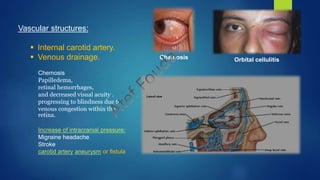
Vascular structures:
 Internal carotid artery.
 Venous drainage.
Chemosis
Papilledema,
retinal hemorrhages,
and decreased visual acuity .
progressing to blindness due to
venous congestion within the
retina.
Chemosis
Increase of intracranial pressure:
Migraine headache
Stroke
carotid artery aneurysm or fistula
Orbital cellulitis
Chemosis
ptosis
Mydriasis
Papilledema
Exophthalmos
Periorbital cellulitis
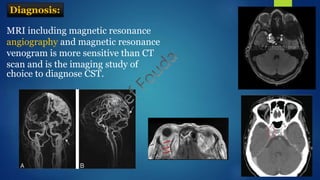
MRI including magnetic resonance
angiography and magnetic resonance
venogram is more sensitive than CT
scan and is the imaging study of
choice to diagnose CST.
Diagnosis:
Anticoagulant:
Early heparinization [to achieve an INR of 2 to 3]
• Intracranial hemorrhage should first be ruled out before initiating heparin therapy.
Unilateral affection.
Steroid therapy helpful when progression to pituitary insufficiency
occurs.
Steroid
•Vancomycin plus ceftriaxone.
•Metronidazole IV should be added if anaerobic bacterial infection is suspected
(dental or sinus infection).
Antimicrobials
Treatment:
Ludwig’s Angina
 Nasal intubation under sedation with topical anesthesia is
the preferred method of airway control.
 Guided Oral or direct laryngoscopy can be particularly
difficult because of the inability to retract the tongue into the
submandibular space and posterior displacement of the
tongue by the infection.
 Emergent tracheostomy may be necessary in patients with
Ludwig's angina if flexible endoscopic intubation cannot be
accomplished. Cricothyrotomy may be technically difficult
due to anatomic distortion and opens tissue planes that
increase the risk of spreading infection into the mediastinum.
 Hospitalization:
 Air way management:
C.T
MRI
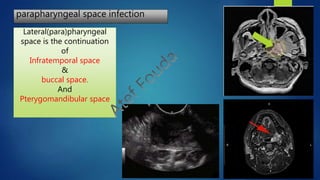
parapharyngeal space infection
Lateral(para)pharyngeal
space is the continuation
of
Infratemporal space
&
buccal space.
And
Pterygomandibular space
Complications
 Carotid artery rupture.
 Jugular vein coagulopathy.
 Retropharyngeal extension [dangerous space].
 Necrotizing fasciitis.
Carotid artery angiography
Retropharyngeal extension [dangerous space]
Retropharyngeal space
is the continuation of
Lateral(para)pharyngeal
space
and
Infratemporal space
Complications
 Extension to dangerous space.
 Mediastinitis.
 Necrotizing fasciitis.
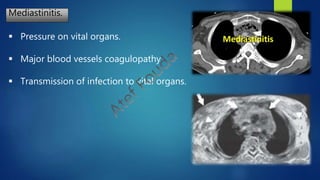
Mediastinitis.
 Pressure on vital organs.
 Major blood vessels coagulopathy.
 Transmission of infection to vital organs.
Necrotizing fasciitis.
 A vascularity of the area due
to infection.
 Mainly in compromised
patients.
 Antimicrobial agents.
 Surgical debridement.
 Hyperbaric oxygen.
Management:
Lab investigations.
 Blood cell count.
 Culture and sensitivity.
 C-reactive protein.
 PCR [New].
Imaging.
 X-ray.
 MRI
 C.T
 Ultra-sound.
Diagnostic aids:
Drawbacks of culture and sensitivity testing:
4-Delayed treatment [72 hours].
5-Economic status of the patient not taken into consideration.[price of antibiotic].
6-Errors of sampling may affect results.
7-Viral and fungal infections may be neglected.
8-Change of domain infective organism by time.
9-Most of viral infections couldn’t be cultured.
10-Systemic conditions of the patient may interfere with the results.
11-Availability of antibiotic should be taken into consideration.
12-Quality depend on the laboratory procedure.
1-Couldn’t test the ability of the antibiotic to reach the site of infection.
2-Host's immune system may affect antibiotic selected [bactericidal-bacteriostatic].
3-Problem of mixed infection.
 CRP is a protein found in blood which rises in response to infection in order to activate
the complement system.
 CRP binds to the surface of dead cells and some bacteria which activates the
complement system and promoting phagocytosis by macrophages, which clears necrotic
cells and bacteria.
 Normal concentration in healthy human serum is between 5 and 10 mg/L.
 bacterial infection (40–200 mg/L) and in severe infection (>200 mg/L).
C-reactive protein.
Interferon alpha inhibits CRP production from liver cells which may explain the relatively
low levels of CRP found during viral infections compared to bacterial infections.
Diagnostic use:
Measuring and charting CRP values can prove useful in determining disease progress or the
effectiveness of treatments.
CRP is a more sensitive and accurate reflection of the acute phase response than the ESR.
CRP returns to normal more quickly than ESR in response to therapy.
genetic testing can be used to detect genes in the microorganism that cause resistance to certain
antimicrobial drugs Methicillin-Resistant Staphylococcus Aureus (MRSA) bacteria can be identified by
testing for the bacterial genes.
If a microorganism is difficult to culture or identify by other methods, doctors can do tests to identify
pieces of the microorganism’s genetic material. This genetic material consists of nucleic acids:
deoxyribonucleic acid (DNA) or ribonucleic acid (RNA).
The polymerase chain reaction (PCR) is an example of this type of test. The PCR technique is used to
produce many copies of a gene from a microorganism, making the microorganism much easier to identify.
Most nucleic acid–based tests are designed to identify the presence of a microorganism (called qualitative
testing). However, a few of these tests can measure the amount of genetic material present (called
quantitative testing) in certain microorganisms, such as HIV and hepatitis C, and thus determine how
severe the infection is. Quantitative tests can also be used to monitor how well treatment is
working[prognosis].
New trends in diagnosis:
Polymerase chain reaction [PCR].
New trends in diagnosis:
Polymerase chain reaction [PCR].
New trends in diagnosis:
Polymerase chain reaction [PCR].
Infectious disease applications:
• PCR allows for rapid and highly specific diagnosis of infectious diseases, including those
caused by bacteria or viruses.
• PCR also permits identification of non-cultivatable or slow-growing microorganisms such
as mycobacteria, anaerobic bacteria, or viruses from tissue culture.
• Some organisms are difficult to sample from patients and slow to be grown in the
laboratory[T.B] . PCR-based tests have allowed detection of small numbers of disease
organisms (both live or dead), in convenient samples.
• PCR tests have been developed that can detect as little as one viral genome. Infections can
be detected earlier.
• Donated blood can be screened directly for the virus.
• Detailed genetic analysis can also be used to detect antibiotic resistance, allowing
immediate and effective therapy.
• The spread of a disease organism through populations can be monitored by PCR testing.
• In many cases, the appearance of new virulent sub-types can be detected and monitored.
• The high sensitivity of PCR permits virus detection soon after infection and even before
the onset of disease. Such early detection may give physicians a significant lead time in
treatment. The amount of virus in a patient can also be quantified by PCR-based DNA
quantitation techniques.
New trends in diagnosis:
Polymerase chain reaction [PCR].
Infectious disease applications:
In modern laboratories, bacteria are usually identified by
characterization of the genome: identifying the characteristics of the
DNA and RNA of a sample species. This type of testing is generally
considered more reliable (and soon, less expensive) than actually
growing bacterial cultures and exposing them to various types of
antibiotics to see which drugs kill or inhibit the bacterial growth.
New trends in diagnosis:
Polymerase chain reaction [PCR].
Infectious disease applications:
• Expensive, not widely available.
• Each genetic test is specific to only one specific microorganism.
Imaging:
osteomyelitis
Simple plain x-ray usually more than enough to give required data for source and spread infection.
In few cases advanced imaging required to detect Spread of infection into:
• Hidden spaces.
• Soft tissue vital structures.
• Sequestration of bone.
• Lymph nodes condition.
• Air way endangering.
Infra-temporal
space infection
S.g infection
Peritonsilar
abscess
MRI-Lymph nodes
Fatal maxillofac. infection

Fatal maxillofac. infection

  • 1.
    Subjects  Fascial spacesinfection of Max.Fac. Region.  Neurologic considerations of Max.Fac.infection  Fatal complications of MaxFac. Infection. Time allowed: 4 hours.
  • 3.
  • 4.
  • 5.
  • 6.
    Sublingual infection push the tonguebackward narrowing the airway Mandibular spaces
  • 7.
    Mandibular spaces  Submasseteric space  Pterygo Mandibular space  Superficial temporal space  Deep temporal space.  Infratemporal space. Masticator spaces
  • 8.
    Maxillary spaces Maxilary anterior teethand premolars. Canine space
  • 9.
  • 10.
  • 11.
  • 12.
    Lateral(para)pharyngeal space is thecontinuation of Infratemporal space & buccal space. And Pterygomandibular space Maxillary spaces
  • 13.
    Retropharyngeal space is the continuation ofLateral (para)pharyngeal space Maxillary spaces
  • 14.
    Retropharyngeal space lead to Dangerspace Mediastinal space. C6 Maxillary spaces
  • 15.
  • 16.
  • 17.
  • 19.
     Mediastinal infection  [vitalorgans].  Lateral pharyngeal space infection [vascular problems] Submandibular-Sublingual-Submental [Air-way]. Fatal complications of maxillofacial infection Canine-Infratemporal Neurological & [Brain damage].
  • 21.
    Cavernous sinus thrombosis Sensorynerves:  Ophthalmic nerve.  Maxillary nerve. Motor nerves:  Oculomotor nerve.  Trochlear nerve.  Abducent nerve. Vascular structures:  Internal carotid artery.  Venous drainage. G08
  • 22.
    Cavernous sinus thrombosis Neurologicalmanifestations: Sensory deficits [V1 & V2]  Ophthalmic nerve.  Maxillary nerve. Hypoesthesia or hyperesthesia of the ophthalmic and maxillary branch of the fifth nerve is common. Periorbital sensory loss and impaired corneal reflex.
  • 23.
    Cavernous sinus thrombosis Neurologicalmanifestations: Motor cranial nerves:  Oculomotor nerve.[III]  Trochlear nerve. [IV]  Abducent nerve. [VI]
  • 24.
    Cavernous sinus thrombosis Eyeliddrooping (ptosis) pupil dilation (mydriasis)  Oculomotor nerve.[III] ptosis Mydriasis  Trochlear nerve. [IV]  Abducent nerve. [VI] Diplopia
  • 25.
    Vascular structures:  Internalcarotid artery.  Venous drainage. Chemosis Papilledema, retinal hemorrhages, and decreased visual acuity . progressing to blindness due to venous congestion within the retina. Chemosis Increase of intracranial pressure: Migraine headache Stroke carotid artery aneurysm or fistula Orbital cellulitis
  • 26.
  • 27.
    MRI including magneticresonance angiography and magnetic resonance venogram is more sensitive than CT scan and is the imaging study of choice to diagnose CST. Diagnosis:
  • 28.
    Anticoagulant: Early heparinization [toachieve an INR of 2 to 3] • Intracranial hemorrhage should first be ruled out before initiating heparin therapy. Unilateral affection. Steroid therapy helpful when progression to pituitary insufficiency occurs. Steroid •Vancomycin plus ceftriaxone. •Metronidazole IV should be added if anaerobic bacterial infection is suspected (dental or sinus infection). Antimicrobials Treatment:
  • 29.
    Ludwig’s Angina  Nasalintubation under sedation with topical anesthesia is the preferred method of airway control.  Guided Oral or direct laryngoscopy can be particularly difficult because of the inability to retract the tongue into the submandibular space and posterior displacement of the tongue by the infection.  Emergent tracheostomy may be necessary in patients with Ludwig's angina if flexible endoscopic intubation cannot be accomplished. Cricothyrotomy may be technically difficult due to anatomic distortion and opens tissue planes that increase the risk of spreading infection into the mediastinum.  Hospitalization:  Air way management:
  • 30.
  • 31.
    parapharyngeal space infection Lateral(para)pharyngeal spaceis the continuation of Infratemporal space & buccal space. And Pterygomandibular space
  • 32.
    Complications  Carotid arteryrupture.  Jugular vein coagulopathy.  Retropharyngeal extension [dangerous space].  Necrotizing fasciitis. Carotid artery angiography
  • 33.
    Retropharyngeal extension [dangerousspace] Retropharyngeal space is the continuation of Lateral(para)pharyngeal space and Infratemporal space
  • 34.
    Complications  Extension todangerous space.  Mediastinitis.  Necrotizing fasciitis.
  • 35.
    Mediastinitis.  Pressure onvital organs.  Major blood vessels coagulopathy.  Transmission of infection to vital organs.
  • 36.
    Necrotizing fasciitis.  Avascularity of the area due to infection.  Mainly in compromised patients.  Antimicrobial agents.  Surgical debridement.  Hyperbaric oxygen. Management:
  • 37.
    Lab investigations.  Bloodcell count.  Culture and sensitivity.  C-reactive protein.  PCR [New]. Imaging.  X-ray.  MRI  C.T  Ultra-sound. Diagnostic aids:
  • 38.
    Drawbacks of cultureand sensitivity testing: 4-Delayed treatment [72 hours]. 5-Economic status of the patient not taken into consideration.[price of antibiotic]. 6-Errors of sampling may affect results. 7-Viral and fungal infections may be neglected. 8-Change of domain infective organism by time. 9-Most of viral infections couldn’t be cultured. 10-Systemic conditions of the patient may interfere with the results. 11-Availability of antibiotic should be taken into consideration. 12-Quality depend on the laboratory procedure. 1-Couldn’t test the ability of the antibiotic to reach the site of infection. 2-Host's immune system may affect antibiotic selected [bactericidal-bacteriostatic]. 3-Problem of mixed infection.
  • 39.
     CRP isa protein found in blood which rises in response to infection in order to activate the complement system.  CRP binds to the surface of dead cells and some bacteria which activates the complement system and promoting phagocytosis by macrophages, which clears necrotic cells and bacteria.  Normal concentration in healthy human serum is between 5 and 10 mg/L.  bacterial infection (40–200 mg/L) and in severe infection (>200 mg/L). C-reactive protein.
  • 40.
    Interferon alpha inhibitsCRP production from liver cells which may explain the relatively low levels of CRP found during viral infections compared to bacterial infections. Diagnostic use: Measuring and charting CRP values can prove useful in determining disease progress or the effectiveness of treatments. CRP is a more sensitive and accurate reflection of the acute phase response than the ESR. CRP returns to normal more quickly than ESR in response to therapy.
  • 41.
    genetic testing canbe used to detect genes in the microorganism that cause resistance to certain antimicrobial drugs Methicillin-Resistant Staphylococcus Aureus (MRSA) bacteria can be identified by testing for the bacterial genes. If a microorganism is difficult to culture or identify by other methods, doctors can do tests to identify pieces of the microorganism’s genetic material. This genetic material consists of nucleic acids: deoxyribonucleic acid (DNA) or ribonucleic acid (RNA). The polymerase chain reaction (PCR) is an example of this type of test. The PCR technique is used to produce many copies of a gene from a microorganism, making the microorganism much easier to identify. Most nucleic acid–based tests are designed to identify the presence of a microorganism (called qualitative testing). However, a few of these tests can measure the amount of genetic material present (called quantitative testing) in certain microorganisms, such as HIV and hepatitis C, and thus determine how severe the infection is. Quantitative tests can also be used to monitor how well treatment is working[prognosis]. New trends in diagnosis: Polymerase chain reaction [PCR].
  • 42.
    New trends indiagnosis: Polymerase chain reaction [PCR].
  • 43.
    New trends indiagnosis: Polymerase chain reaction [PCR]. Infectious disease applications: • PCR allows for rapid and highly specific diagnosis of infectious diseases, including those caused by bacteria or viruses. • PCR also permits identification of non-cultivatable or slow-growing microorganisms such as mycobacteria, anaerobic bacteria, or viruses from tissue culture. • Some organisms are difficult to sample from patients and slow to be grown in the laboratory[T.B] . PCR-based tests have allowed detection of small numbers of disease organisms (both live or dead), in convenient samples. • PCR tests have been developed that can detect as little as one viral genome. Infections can be detected earlier.
  • 44.
    • Donated bloodcan be screened directly for the virus. • Detailed genetic analysis can also be used to detect antibiotic resistance, allowing immediate and effective therapy. • The spread of a disease organism through populations can be monitored by PCR testing. • In many cases, the appearance of new virulent sub-types can be detected and monitored. • The high sensitivity of PCR permits virus detection soon after infection and even before the onset of disease. Such early detection may give physicians a significant lead time in treatment. The amount of virus in a patient can also be quantified by PCR-based DNA quantitation techniques. New trends in diagnosis: Polymerase chain reaction [PCR]. Infectious disease applications:
  • 45.
    In modern laboratories,bacteria are usually identified by characterization of the genome: identifying the characteristics of the DNA and RNA of a sample species. This type of testing is generally considered more reliable (and soon, less expensive) than actually growing bacterial cultures and exposing them to various types of antibiotics to see which drugs kill or inhibit the bacterial growth. New trends in diagnosis: Polymerase chain reaction [PCR]. Infectious disease applications: • Expensive, not widely available. • Each genetic test is specific to only one specific microorganism.
  • 46.
    Imaging: osteomyelitis Simple plain x-rayusually more than enough to give required data for source and spread infection. In few cases advanced imaging required to detect Spread of infection into: • Hidden spaces. • Soft tissue vital structures. • Sequestration of bone. • Lymph nodes condition. • Air way endangering. Infra-temporal space infection S.g infection Peritonsilar abscess MRI-Lymph nodes