Neuropathic pain
Peter Kamerman
XXII World Congress of Neurology, Santiago, Chile, 2015
EPIDEMIOLOGY, RISKS, AND PREVENTION
Disclosures
I have no actual or potential conflicts of interest related to the material
being presented.
Nor do I discuss off-label indications for any medications.
Learning objectives
By the end of this presentation, delegates will be able to:
● Describe the burden of chronic pain in the general population;
● Report the proportion of chronic pain that is neuropathic in origin;
● Describe the prevalence of neuropathic pain in special populations;
● Appraise the socio-economic consequences of having neuropathic pain.
Key message
Neuropathic pain:
● Is common, especially in special populations (e.g., diabetes, HIV,
spinal cord injury);
● Has a significant negative impact on the affected individual, and
society
What is epidemiology?
“The study of the distribution and
determinants of health-related states
or events in specified populations, and
the application of this study to control
health problems.”
Last, 1995
Epidemiology and neuropathic pain
Adapted from: Smith and Torrance, 2012
To inform understanding, at a population level, of:
Prevalence and incidence
Risk factors and aetiology
Impact on quality of life and prognosis
Prevention
Design, targeting, and evaluation of treatment strategies
Allocation of health resources
Allocation of educational resources
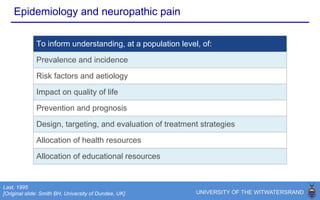
Epidemiology and neuropathic pain
To inform understanding, at a population level, of:
Prevalence and incidence
Risk factors and aetiology
Impact on quality of life and prognosis
Prevention
Design, targeting, and evaluation of treatment strategies
Allocation of health resources
Allocation of educational resources
Predictions on the future
Adapted from: Smith and Torrance, 2012
Prevalence of neuropathic pain
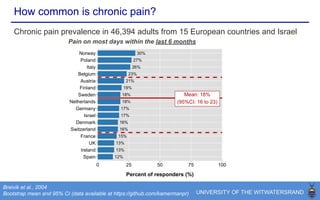
How common is chronic pain?
Breivik et al., 2004
Bootstrap mean and 95% CI (data available at https://github.com/kamermanpr)
Chronic pain prevalence in 46,394 adults from 15 European countries and Israel
Pain on most days within the last 6 months
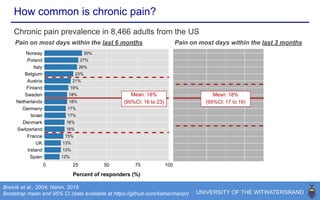
How common is chronic pain?
Breivik et al., 2004; Nahin, 2015
Bootstrap mean and 95% CI (data available at https://github.com/kamermanpr)
Pain on most days within the last 6 months
Chronic pain prevalence in 8,466 adults from the US
Pain on most days within the last 3 months
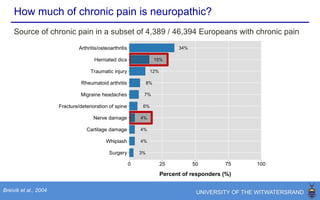
How much of chronic pain is neuropathic?
Breivik et al., 2004
Source of chronic pain in a subset of 4,389 / 46,394 Europeans with chronic pain
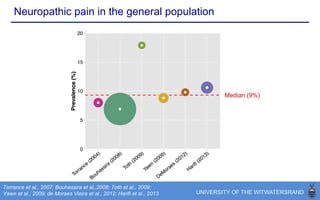
Neuropathic pain in the general population
Torrance et al., 2007; Bouhassira et al.,2008; Toth et al., 2009;
Yawn et al., 2009; de Moraes Vieira et al., 2012; Harifi et al., 2013
Median (9%)
How good are the data?
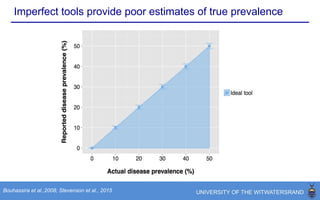
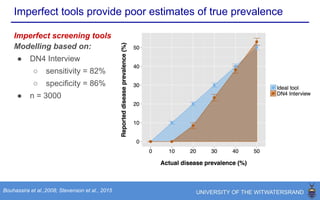
Imperfect tools provide poor estimates of true prevalence
Bouhassira et al.,2008; Stevenson et al., 2015
Imperfect screening tools
Modelling based on:
● DN4 Interview
○ sensitivity = 82%
○ specificity = 86%
● n = 3000
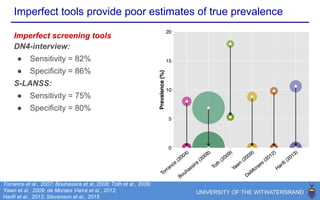
Imperfect tools provide poor estimates of true prevalence
Imperfect screening tools
DN4-interview:
● Sensitivity = 82%
● Specificity = 86%
S-LANSS:
● Sensitivity = 75%
● Specificity = 80%
Torrance et al., 2007; Bouhassira et al.,2008; Toth et al., 2009;
Yawn et al., 2009; de Moraes Vieira et al., 2012;
Harifi et al., 2013; Stevenson et al., 2015
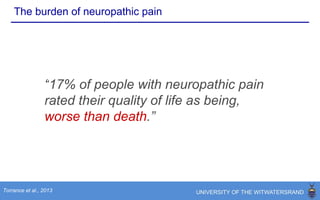
The burden of neuropathic pain
“17% of people with neuropathic pain
rated their quality of life as being,
worse than death.”
Torrance et al., 2013
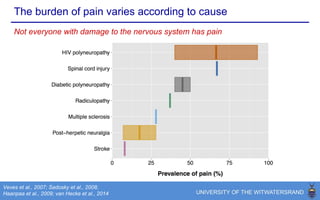
The burden of pain varies according to cause
Not everyone with damage to the nervous system has pain
Veves et al., 2007; Sadosky et al., 2008;
Haanpaa et al., 2009; van Hecke et al., 2014
The burden of neuropathic pain
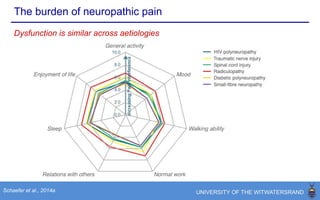
Schaefer et al., 2014a
Dysfunction is similar across aetiologies
The burden of neuropathic pain
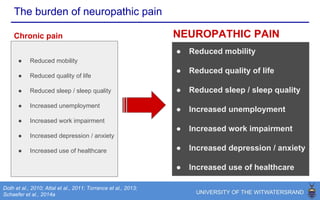
Doth et al., 2010; Attal et al., 2011; Torrance et al., 2013;
Schaefer et al., 2014a
Chronic pain
● Reduced mobility
● Reduced quality of life
● Reduced sleep / sleep quality
● Increased unemployment
● Increased work impairment
● Increased depression / anxiety
● Increased use of healthcare
NEUROPATHIC PAIN
● Reduced mobility
● Reduced quality of life
● Reduced sleep / sleep quality
● Increased unemployment
● Increased work impairment
● Increased depression / anxiety
● Increased use of healthcare
The burden of neuropathic pain
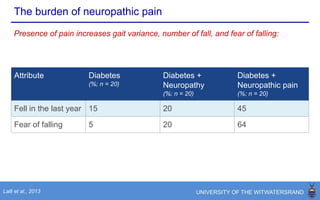
Lalli et al., 2013
Attribute Diabetes
(%; n = 20)
Diabetes +
Neuropathy
(%; n = 20)
Diabetes +
Neuropathic pain
(%; n = 20)
Fell in the last year 15 20 45
Fear of falling 5 20 64
Presence of pain increases gait variance, number of fall, and fear of falling:
The burden of neuropathic pain
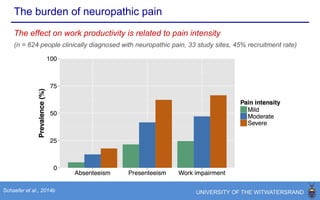
Schaefer et al., 2014b
The effect on work productivity is related to pain intensity
(n = 624 people clinically diagnosed with neuropathic pain, 33 study sites, 45% recruitment rate)
Burden of neuropathic pain
van Hecke et al., 2014
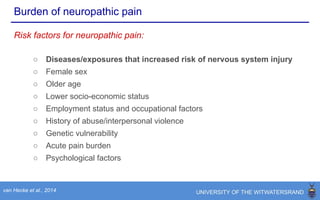
Risk factors for neuropathic pain:
○ Diseases/exposures that increased risk of nervous system injury
○ Female sex
○ Older age
○ Lower socio-economic status
○ Employment status and occupational factors
○ History of abuse/interpersonal violence
○ Genetic vulnerability
○ Acute pain burden
○ Psychological factors
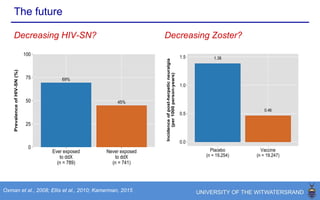
The future
The future
Oxman et al., 2008; Ellis et al., 2010; Kamerman, 2015
Decreasing HIV-SN? Decreasing Zoster?
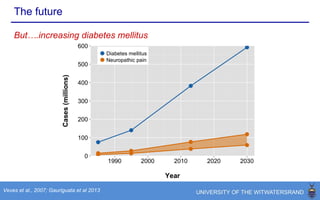
The future
Veves et al., 2007; Gauriguata et al 2013
But….increasing diabetes mellitus
Summary
Neuropathic pain:
● Affects 1-8% of the adult population;
● Is more common in specific patient populations (e.g., diabetes, HIV, spinal
cord injury);
● Has a significant, negative impact on the affected individual, and society;
● Resulting from diabetes mellitus could reach epidemic levels.
Selected reading
Bibliography
Breivik H, Collett B, Ventafridda V, et al. Survey of chronic pain in Europe: Prevalence,
impact on daily life, and treatment. European Journal of Pain 10: 287-287, 2005. doi:
10.1016/j.ejpain.2005.06.009.
van Hecke O, Austin SK, Khan RA, et al. Neuropathic pain in the general population: A
systematic review of epidemiological studies. PAIN 155: 654-662, 2013. doi: 10.1016/j.pain.
2013.11.013.
Smith BH, Torrance N. Epidemiology of Neuropathic Pain and Its Impact on Quality of Life.
Current Pain and Headache Reports 16: 191-198, 2012. doi: 10.1007/s11916-012-0256-0.

Neuropathic pain: epidemiology, risks and prevention

  • 1.
    Neuropathic pain Peter Kamerman XXIIWorld Congress of Neurology, Santiago, Chile, 2015 EPIDEMIOLOGY, RISKS, AND PREVENTION
  • 2.
    Disclosures I have noactual or potential conflicts of interest related to the material being presented. Nor do I discuss off-label indications for any medications.
  • 3.
    Learning objectives By theend of this presentation, delegates will be able to: ● Describe the burden of chronic pain in the general population; ● Report the proportion of chronic pain that is neuropathic in origin; ● Describe the prevalence of neuropathic pain in special populations; ● Appraise the socio-economic consequences of having neuropathic pain.
  • 4.
    Key message Neuropathic pain: ●Is common, especially in special populations (e.g., diabetes, HIV, spinal cord injury); ● Has a significant negative impact on the affected individual, and society
  • 5.
    What is epidemiology? “Thestudy of the distribution and determinants of health-related states or events in specified populations, and the application of this study to control health problems.” Last, 1995
  • 6.
    Epidemiology and neuropathicpain Adapted from: Smith and Torrance, 2012 To inform understanding, at a population level, of: Prevalence and incidence Risk factors and aetiology Impact on quality of life and prognosis Prevention Design, targeting, and evaluation of treatment strategies Allocation of health resources Allocation of educational resources
  • 7.
    Epidemiology and neuropathicpain To inform understanding, at a population level, of: Prevalence and incidence Risk factors and aetiology Impact on quality of life and prognosis Prevention Design, targeting, and evaluation of treatment strategies Allocation of health resources Allocation of educational resources Predictions on the future Adapted from: Smith and Torrance, 2012
  • 8.
  • 9.
    How common ischronic pain? Breivik et al., 2004 Bootstrap mean and 95% CI (data available at https://github.com/kamermanpr) Chronic pain prevalence in 46,394 adults from 15 European countries and Israel Pain on most days within the last 6 months
  • 10.
    How common ischronic pain? Breivik et al., 2004; Nahin, 2015 Bootstrap mean and 95% CI (data available at https://github.com/kamermanpr) Pain on most days within the last 6 months Chronic pain prevalence in 8,466 adults from the US Pain on most days within the last 3 months
  • 11.
    How much ofchronic pain is neuropathic? Breivik et al., 2004 Source of chronic pain in a subset of 4,389 / 46,394 Europeans with chronic pain
  • 12.
    Neuropathic pain inthe general population Torrance et al., 2007; Bouhassira et al.,2008; Toth et al., 2009; Yawn et al., 2009; de Moraes Vieira et al., 2012; Harifi et al., 2013 Median (9%)
  • 13.
    How good arethe data?
  • 14.
    Imperfect tools providepoor estimates of true prevalence
  • 15.
    Imperfect tools providepoor estimates of true prevalence Bouhassira et al.,2008; Stevenson et al., 2015 Imperfect screening tools Modelling based on: ● DN4 Interview ○ sensitivity = 82% ○ specificity = 86% ● n = 3000
  • 16.
    Imperfect tools providepoor estimates of true prevalence Imperfect screening tools DN4-interview: ● Sensitivity = 82% ● Specificity = 86% S-LANSS: ● Sensitivity = 75% ● Specificity = 80% Torrance et al., 2007; Bouhassira et al.,2008; Toth et al., 2009; Yawn et al., 2009; de Moraes Vieira et al., 2012; Harifi et al., 2013; Stevenson et al., 2015
  • 17.
    The burden ofneuropathic pain
  • 18.
    The burden ofneuropathic pain “17% of people with neuropathic pain rated their quality of life as being, worse than death.” Torrance et al., 2013
  • 19.
    The burden ofpain varies according to cause Not everyone with damage to the nervous system has pain Veves et al., 2007; Sadosky et al., 2008; Haanpaa et al., 2009; van Hecke et al., 2014
  • 20.
    The burden ofneuropathic pain Schaefer et al., 2014a Dysfunction is similar across aetiologies
  • 21.
    The burden ofneuropathic pain Doth et al., 2010; Attal et al., 2011; Torrance et al., 2013; Schaefer et al., 2014a Chronic pain ● Reduced mobility ● Reduced quality of life ● Reduced sleep / sleep quality ● Increased unemployment ● Increased work impairment ● Increased depression / anxiety ● Increased use of healthcare NEUROPATHIC PAIN ● Reduced mobility ● Reduced quality of life ● Reduced sleep / sleep quality ● Increased unemployment ● Increased work impairment ● Increased depression / anxiety ● Increased use of healthcare
  • 22.
    The burden ofneuropathic pain Lalli et al., 2013 Attribute Diabetes (%; n = 20) Diabetes + Neuropathy (%; n = 20) Diabetes + Neuropathic pain (%; n = 20) Fell in the last year 15 20 45 Fear of falling 5 20 64 Presence of pain increases gait variance, number of fall, and fear of falling:
  • 23.
    The burden ofneuropathic pain Schaefer et al., 2014b The effect on work productivity is related to pain intensity (n = 624 people clinically diagnosed with neuropathic pain, 33 study sites, 45% recruitment rate)
  • 24.
    Burden of neuropathicpain van Hecke et al., 2014 Risk factors for neuropathic pain: ○ Diseases/exposures that increased risk of nervous system injury ○ Female sex ○ Older age ○ Lower socio-economic status ○ Employment status and occupational factors ○ History of abuse/interpersonal violence ○ Genetic vulnerability ○ Acute pain burden ○ Psychological factors
  • 25.
  • 26.
    The future Oxman etal., 2008; Ellis et al., 2010; Kamerman, 2015 Decreasing HIV-SN? Decreasing Zoster?
  • 27.
    The future Veves etal., 2007; Gauriguata et al 2013 But….increasing diabetes mellitus
  • 28.
    Summary Neuropathic pain: ● Affects1-8% of the adult population; ● Is more common in specific patient populations (e.g., diabetes, HIV, spinal cord injury); ● Has a significant, negative impact on the affected individual, and society; ● Resulting from diabetes mellitus could reach epidemic levels.
  • 29.
    Selected reading Bibliography Breivik H,Collett B, Ventafridda V, et al. Survey of chronic pain in Europe: Prevalence, impact on daily life, and treatment. European Journal of Pain 10: 287-287, 2005. doi: 10.1016/j.ejpain.2005.06.009. van Hecke O, Austin SK, Khan RA, et al. Neuropathic pain in the general population: A systematic review of epidemiological studies. PAIN 155: 654-662, 2013. doi: 10.1016/j.pain. 2013.11.013. Smith BH, Torrance N. Epidemiology of Neuropathic Pain and Its Impact on Quality of Life. Current Pain and Headache Reports 16: 191-198, 2012. doi: 10.1007/s11916-012-0256-0.