J e r o e n S o e t e r s
NEUROEVOLUTION
A hitchhiker’s guide to neuroevolution in
Erlang.
MEET GARY
2
WHAT IS MACHINE LEARNING?
• Artificial Neural Networks
• Genetic Algorithms
3
ARTIFICIAL NEURAL
NETWORKS
4
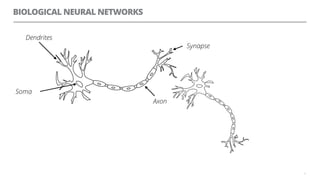
BIOLOGICAL NEURAL NETWORKS
5
Dendrites
Soma
Axon
Synapse
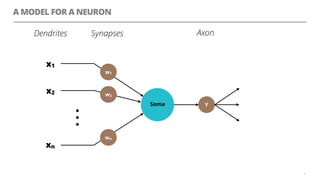
A MODEL FOR A NEURON
6
Y
w1
w2
wn
x1
x2
xn
Dendrites Synapses Axon
Soma
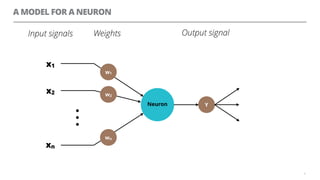
A MODEL FOR A NEURON
6
Y
w1
w2
wn
x1
x2
xn
Input signals Weights Output signal
Neuron
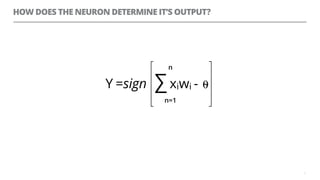
HOW DOES THE NEURON DETERMINE IT’S OUTPUT?
Y =sign ∑xiwi - ⍬
7
n=1
n
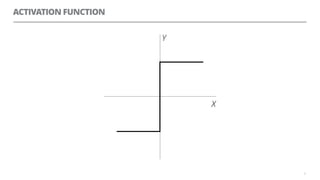
ACTIVATION FUNCTION
8
X
Y
MEET FRANK
9
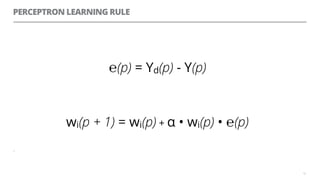
PERCEPTRON LEARNING RULE
℮(p) = Yd(p) - Y(p)
wi(p + 1) = wi(p) + α • wi(p) • ℮(p)
=
10
PERCEPTRON TRAINING ALGORITHM
11
weight training
start
stop
weights converged? yes
no
set weights and threshold to
random values [-0.5, 0.5]
activate the perceptron
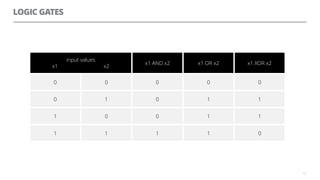
LOGIC GATES
12
input values
x1 x2
x1 AND x2 x1 OR x2 x1 XOR x2
0 0 0 0 0
0 1 0 1 1
1 0 0 1 1
1 1 1 1 0
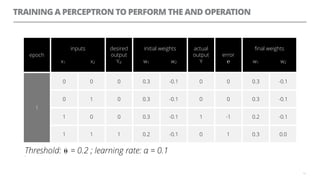
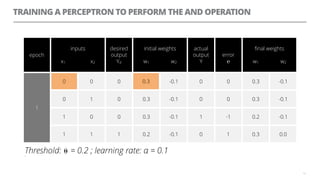
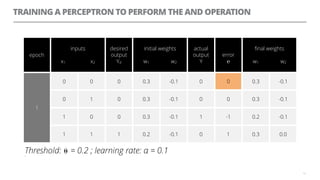
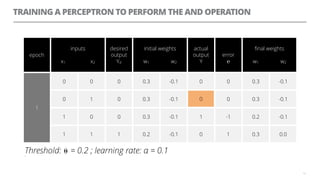
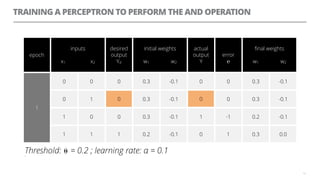
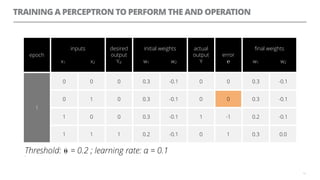
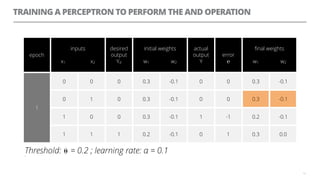
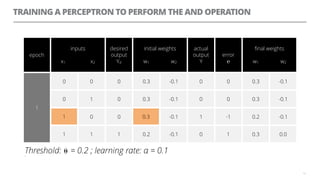
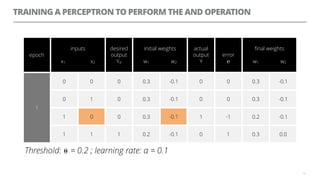
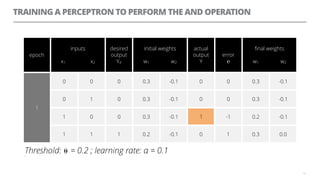
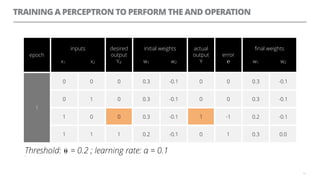
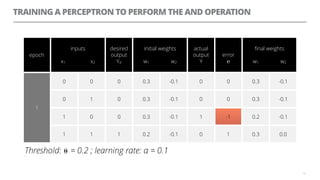
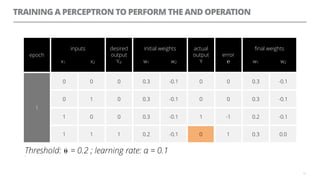
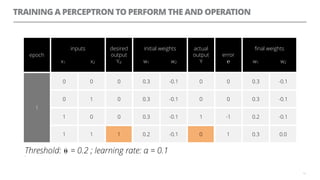
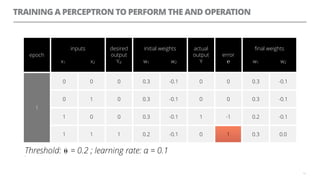
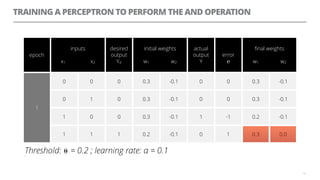
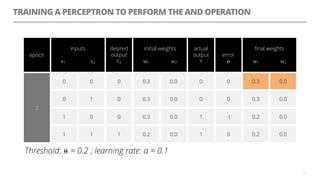
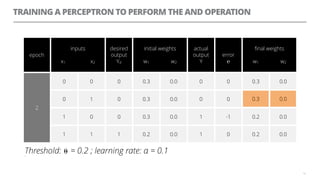
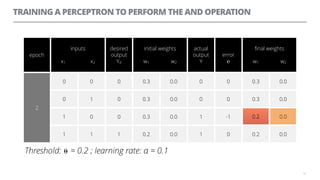
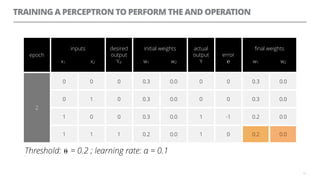
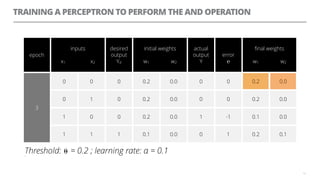
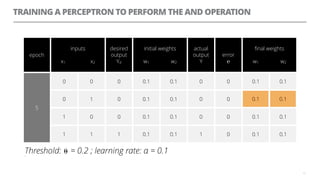
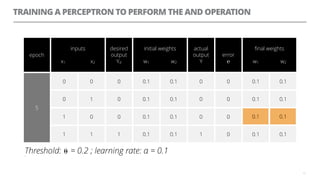
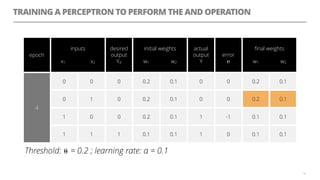
TRAINING A PERCEPTRON TO PERFORM THE AND OPERATION
13
epoch
inputs
x1 x2
desired
output
Yd
initial weights
w1 w2
actual
output
Y
error
℮
final weights
w1 w2
1
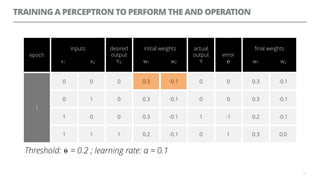
0 0 0 0.3 -0.1 0 0 0.3 -0.1
0 1 0 0.3 -0.1 0 0 0.3 -0.1
1 0 0 0.3 -0.1 1 -1 0.2 -0.1
1 1 1 0.2 -0.1 0 1 0.3 0.0
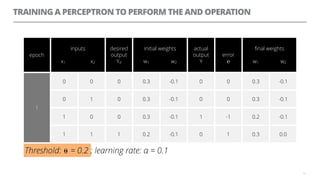
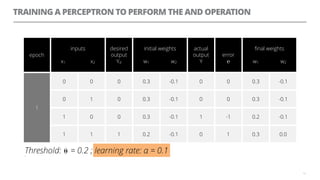
Threshold: ⍬ = 0.2 ; learning rate: α = 0.1=
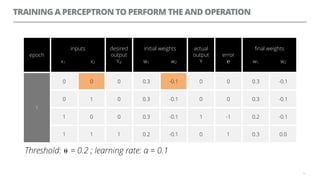
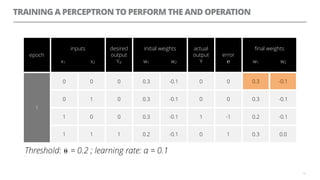
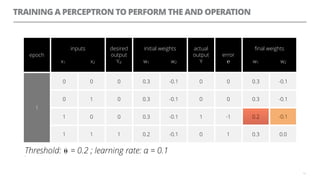
TRAINING A PERCEPTRON TO PERFORM THE AND OPERATION
13
epoch
inputs
x1 x2
desired
output
Yd
initial weights
w1 w2
actual
output
Y
error
℮
final weights
w1 w2
1
0 0 0 0.3 -0.1 0 0 0.3 -0.1
0 1 0 0.3 -0.1 0 0 0.3 -0.1
1 0 0 0.3 -0.1 1 -1 0.2 -0.1
1 1 1 0.2 -0.1 0 1 0.3 0.0
Threshold: ⍬ = 0.2 ; learning rate: α = 0.1=
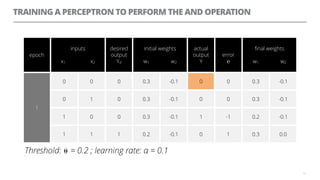
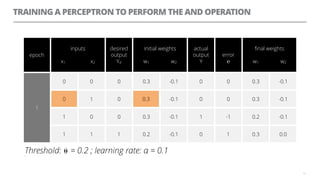
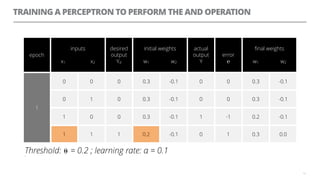
TRAINING A PERCEPTRON TO PERFORM THE AND OPERATION
13
epoch
inputs
x1 x2
desired
output
Yd
initial weights
w1 w2
actual
output
Y
error
℮
final weights
w1 w2
1
0 0 0 0.3 -0.1 0 0 0.3 -0.1
0 1 0 0.3 -0.1 0 0 0.3 -0.1
1 0 0 0.3 -0.1 1 -1 0.2 -0.1
1 1 1 0.2 -0.1 0 1 0.3 0.0
Threshold: ⍬ = 0.2 ; learning rate: α = 0.1=
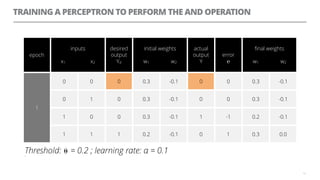
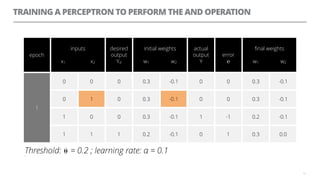
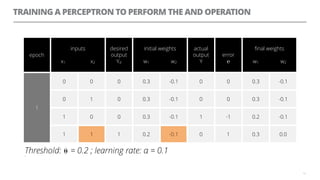
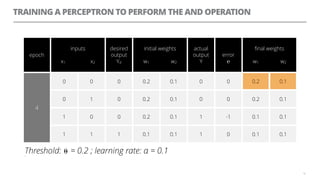
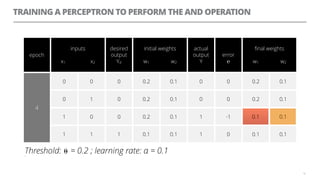
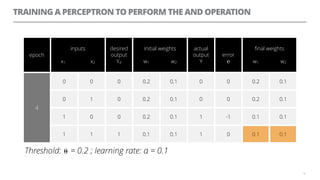
TRAINING A PERCEPTRON TO PERFORM THE AND OPERATION
13
epoch
inputs
x1 x2
desired
output
Yd
initial weights
w1 w2
actual
output
Y
error
℮
final weights
w1 w2
1
0 0 0 0.3 -0.1 0 0 0.3 -0.1
0 1 0 0.3 -0.1 0 0 0.3 -0.1
1 0 0 0.3 -0.1 1 -1 0.2 -0.1
1 1 1 0.2 -0.1 0 1 0.3 0.0
Threshold: ⍬ = 0.2 ; learning rate: α = 0.1=
0.3 -0.1
TRAINING A PERCEPTRON TO PERFORM THE AND OPERATION
13
epoch
inputs
x1 x2
desired
output
Yd
initial weights
w1 w2
actual
output
Y
error
℮
final weights
w1 w2
1
0 0 0 0.3 -0.1 0 0 0.3 -0.1
0 1 0 0.3 -0.1 0 0 0.3 -0.1
1 0 0 0.3 -0.1 1 -1 0.2 -0.1
1 1 1 0.2 -0.1 0 1 0.3 0.0
Threshold: ⍬ = 0.2 ; learning rate: α = 0.1=
0 0.3
TRAINING A PERCEPTRON TO PERFORM THE AND OPERATION
13
epoch
inputs
x1 x2
desired
output
Yd
initial weights
w1 w2
actual
output
Y
error
℮
final weights
w1 w2
1
0 0 0 0.3 -0.1 0 0 0.3 -0.1
0 1 0 0.3 -0.1 0 0 0.3 -0.1
1 0 0 0.3 -0.1 1 -1 0.2 -0.1
1 1 1 0.2 -0.1 0 1 0.3 0.0
Threshold: ⍬ = 0.2 ; learning rate: α = 0.1=
0 -0.1
TRAINING A PERCEPTRON TO PERFORM THE AND OPERATION
13
epoch
inputs
x1 x2
desired
output
Yd
initial weights
w1 w2
actual
output
Y
error
℮
final weights
w1 w2
1
0 0 0 0.3 -0.1 0 0 0.3 -0.1
0 1 0 0.3 -0.1 0 0 0.3 -0.1
1 0 0 0.3 -0.1 1 -1 0.2 -0.1
1 1 1 0.2 -0.1 0 1 0.3 0.0
Threshold: ⍬ = 0.2 ; learning rate: α = 0.1=
0
TRAINING A PERCEPTRON TO PERFORM THE AND OPERATION
13
epoch
inputs
x1 x2
desired
output
Yd
initial weights
w1 w2
actual
output
Y
error
℮
final weights
w1 w2
1
0 0 0 0.3 -0.1 0 0 0.3 -0.1
0 1 0 0.3 -0.1 0 0 0.3 -0.1
1 0 0 0.3 -0.1 1 -1 0.2 -0.1
1 1 1 0.2 -0.1 0 1 0.3 0.0
Threshold: ⍬ = 0.2 ; learning rate: α = 0.1=
00
TRAINING A PERCEPTRON TO PERFORM THE AND OPERATION
13
epoch
inputs
x1 x2
desired
output
Yd
initial weights
w1 w2
actual
output
Y
error
℮
final weights
w1 w2
1
0 0 0 0.3 -0.1 0 0 0.3 -0.1
0 1 0 0.3 -0.1 0 0 0.3 -0.1
1 0 0 0.3 -0.1 1 -1 0.2 -0.1
1 1 1 0.2 -0.1 0 1 0.3 0.0
Threshold: ⍬ = 0.2 ; learning rate: α = 0.1=
0
TRAINING A PERCEPTRON TO PERFORM THE AND OPERATION
13
epoch
inputs
x1 x2
desired
output
Yd
initial weights
w1 w2
actual
output
Y
error
℮
final weights
w1 w2
1
0 0 0 0.3 -0.1 0 0 0.3 -0.1
0 1 0 0.3 -0.1 0 0 0.3 -0.1
1 0 0 0.3 -0.1 1 -1 0.2 -0.1
1 1 1 0.2 -0.1 0 1 0.3 0.0
Threshold: ⍬ = 0.2 ; learning rate: α = 0.1=
0.3 -0.1
TRAINING A PERCEPTRON TO PERFORM THE AND OPERATION
13
epoch
inputs
x1 x2
desired
output
Yd
initial weights
w1 w2
actual
output
Y
error
℮
final weights
w1 w2
1
0 0 0 0.3 -0.1 0 0 0.3 -0.1
0 1 0 0.3 -0.1 0 0 0.3 -0.1
1 0 0 0.3 -0.1 1 -1 0.2 -0.1
1 1 1 0.2 -0.1 0 1 0.3 0.0
Threshold: ⍬ = 0.2 ; learning rate: α = 0.1=
0 0.3
TRAINING A PERCEPTRON TO PERFORM THE AND OPERATION
13
epoch
inputs
x1 x2
desired
output
Yd
initial weights
w1 w2
actual
output
Y
error
℮
final weights
w1 w2
1
0 0 0 0.3 -0.1 0 0 0.3 -0.1
0 1 0 0.3 -0.1 0 0 0.3 -0.1
1 0 0 0.3 -0.1 1 -1 0.2 -0.1
1 1 1 0.2 -0.1 0 1 0.3 0.0
Threshold: ⍬ = 0.2 ; learning rate: α = 0.1=
1 -0.1
TRAINING A PERCEPTRON TO PERFORM THE AND OPERATION
13
epoch
inputs
x1 x2
desired
output
Yd
initial weights
w1 w2
actual
output
Y
error
℮
final weights
w1 w2
1
0 0 0 0.3 -0.1 0 0 0.3 -0.1
0 1 0 0.3 -0.1 0 0 0.3 -0.1
1 0 0 0.3 -0.1 1 -1 0.2 -0.1
1 1 1 0.2 -0.1 0 1 0.3 0.0
Threshold: ⍬ = 0.2 ; learning rate: α = 0.1=
0
TRAINING A PERCEPTRON TO PERFORM THE AND OPERATION
13
epoch
inputs
x1 x2
desired
output
Yd
initial weights
w1 w2
actual
output
Y
error
℮
final weights
w1 w2
1
0 0 0 0.3 -0.1 0 0 0.3 -0.1
0 1 0 0.3 -0.1 0 0 0.3 -0.1
1 0 0 0.3 -0.1 1 -1 0.2 -0.1
1 1 1 0.2 -0.1 0 1 0.3 0.0
Threshold: ⍬ = 0.2 ; learning rate: α = 0.1=
00
TRAINING A PERCEPTRON TO PERFORM THE AND OPERATION
13
epoch
inputs
x1 x2
desired
output
Yd
initial weights
w1 w2
actual
output
Y
error
℮
final weights
w1 w2
1
0 0 0 0.3 -0.1 0 0 0.3 -0.1
0 1 0 0.3 -0.1 0 0 0.3 -0.1
1 0 0 0.3 -0.1 1 -1 0.2 -0.1
1 1 1 0.2 -0.1 0 1 0.3 0.0
Threshold: ⍬ = 0.2 ; learning rate: α = 0.1=
0
TRAINING A PERCEPTRON TO PERFORM THE AND OPERATION
13
epoch
inputs
x1 x2
desired
output
Yd
initial weights
w1 w2
actual
output
Y
error
℮
final weights
w1 w2
1
0 0 0 0.3 -0.1 0 0 0.3 -0.1
0 1 0 0.3 -0.1 0 0 0.3 -0.1
1 0 0 0.3 -0.1 1 -1 0.2 -0.1
1 1 1 0.2 -0.1 0 1 0.3 0.0
Threshold: ⍬ = 0.2 ; learning rate: α = 0.1=
0.3 -0.1
TRAINING A PERCEPTRON TO PERFORM THE AND OPERATION
13
epoch
inputs
x1 x2
desired
output
Yd
initial weights
w1 w2
actual
output
Y
error
℮
final weights
w1 w2
1
0 0 0 0.3 -0.1 0 0 0.3 -0.1
0 1 0 0.3 -0.1 0 0 0.3 -0.1
1 0 0 0.3 -0.1 1 -1 0.2 -0.1
1 1 1 0.2 -0.1 0 1 0.3 0.0
Threshold: ⍬ = 0.2 ; learning rate: α = 0.1=
1 0.3
TRAINING A PERCEPTRON TO PERFORM THE AND OPERATION
13
epoch
inputs
x1 x2
desired
output
Yd
initial weights
w1 w2
actual
output
Y
error
℮
final weights
w1 w2
1
0 0 0 0.3 -0.1 0 0 0.3 -0.1
0 1 0 0.3 -0.1 0 0 0.3 -0.1
1 0 0 0.3 -0.1 1 -1 0.2 -0.1
1 1 1 0.2 -0.1 0 1 0.3 0.0
Threshold: ⍬ = 0.2 ; learning rate: α = 0.1=
0 -0.1
TRAINING A PERCEPTRON TO PERFORM THE AND OPERATION
13
epoch
inputs
x1 x2
desired
output
Yd
initial weights
w1 w2
actual
output
Y
error
℮
final weights
w1 w2
1
0 0 0 0.3 -0.1 0 0 0.3 -0.1
0 1 0 0.3 -0.1 0 0 0.3 -0.1
1 0 0 0.3 -0.1 1 -1 0.2 -0.1
1 1 1 0.2 -0.1 0 1 0.3 0.0
Threshold: ⍬ = 0.2 ; learning rate: α = 0.1=
1
TRAINING A PERCEPTRON TO PERFORM THE AND OPERATION
13
epoch
inputs
x1 x2
desired
output
Yd
initial weights
w1 w2
actual
output
Y
error
℮
final weights
w1 w2
1
0 0 0 0.3 -0.1 0 0 0.3 -0.1
0 1 0 0.3 -0.1 0 0 0.3 -0.1
1 0 0 0.3 -0.1 1 -1 0.2 -0.1
1 1 1 0.2 -0.1 0 1 0.3 0.0
Threshold: ⍬ = 0.2 ; learning rate: α = 0.1=
10
TRAINING A PERCEPTRON TO PERFORM THE AND OPERATION
13
epoch
inputs
x1 x2
desired
output
Yd
initial weights
w1 w2
actual
output
Y
error
℮
final weights
w1 w2
1
0 0 0 0.3 -0.1 0 0 0.3 -0.1
0 1 0 0.3 -0.1 0 0 0.3 -0.1
1 0 0 0.3 -0.1 1 -1 0.2 -0.1
1 1 1 0.2 -0.1 0 1 0.3 0.0
Threshold: ⍬ = 0.2 ; learning rate: α = 0.1=
-1
TRAINING A PERCEPTRON TO PERFORM THE AND OPERATION
13
epoch
inputs
x1 x2
desired
output
Yd
initial weights
w1 w2
actual
output
Y
error
℮
final weights
w1 w2
1
0 0 0 0.3 -0.1 0 0 0.3 -0.1
0 1 0 0.3 -0.1 0 0 0.3 -0.1
1 0 0 0.3 -0.1 1 -1 0.2 -0.1
1 1 1 0.2 -0.1 0 1 0.3 0.0
Threshold: ⍬ = 0.2 ; learning rate: α = 0.1=
0.2 -0.1
TRAINING A PERCEPTRON TO PERFORM THE AND OPERATION
13
epoch
inputs
x1 x2
desired
output
Yd
initial weights
w1 w2
actual
output
Y
error
℮
final weights
w1 w2
1
0 0 0 0.3 -0.1 0 0 0.3 -0.1
0 1 0 0.3 -0.1 0 0 0.3 -0.1
1 0 0 0.3 -0.1 1 -1 0.2 -0.1
1 1 1 0.2 -0.1 0 1 0.3 0.0
Threshold: ⍬ = 0.2 ; learning rate: α = 0.1=
1 0.2
TRAINING A PERCEPTRON TO PERFORM THE AND OPERATION
13
epoch
inputs
x1 x2
desired
output
Yd
initial weights
w1 w2
actual
output
Y
error
℮
final weights
w1 w2
1
0 0 0 0.3 -0.1 0 0 0.3 -0.1
0 1 0 0.3 -0.1 0 0 0.3 -0.1
1 0 0 0.3 -0.1 1 -1 0.2 -0.1
1 1 1 0.2 -0.1 0 1 0.3 0.0
Threshold: ⍬ = 0.2 ; learning rate: α = 0.1=
1 -0.1
TRAINING A PERCEPTRON TO PERFORM THE AND OPERATION
13
epoch
inputs
x1 x2
desired
output
Yd
initial weights
w1 w2
actual
output
Y
error
℮
final weights
w1 w2
1
0 0 0 0.3 -0.1 0 0 0.3 -0.1
0 1 0 0.3 -0.1 0 0 0.3 -0.1
1 0 0 0.3 -0.1 1 -1 0.2 -0.1
1 1 1 0.2 -0.1 0 1 0.3 0.0
Threshold: ⍬ = 0.2 ; learning rate: α = 0.1=
0
TRAINING A PERCEPTRON TO PERFORM THE AND OPERATION
13
epoch
inputs
x1 x2
desired
output
Yd
initial weights
w1 w2
actual
output
Y
error
℮
final weights
w1 w2
1
0 0 0 0.3 -0.1 0 0 0.3 -0.1
0 1 0 0.3 -0.1 0 0 0.3 -0.1
1 0 0 0.3 -0.1 1 -1 0.2 -0.1
1 1 1 0.2 -0.1 0 1 0.3 0.0
Threshold: ⍬ = 0.2 ; learning rate: α = 0.1=
01
TRAINING A PERCEPTRON TO PERFORM THE AND OPERATION
13
epoch
inputs
x1 x2
desired
output
Yd
initial weights
w1 w2
actual
output
Y
error
℮
final weights
w1 w2
1
0 0 0 0.3 -0.1 0 0 0.3 -0.1
0 1 0 0.3 -0.1 0 0 0.3 -0.1
1 0 0 0.3 -0.1 1 -1 0.2 -0.1
1 1 1 0.2 -0.1 0 1 0.3 0.0
Threshold: ⍬ = 0.2 ; learning rate: α = 0.1=
1
TRAINING A PERCEPTRON TO PERFORM THE AND OPERATION
13
epoch
inputs
x1 x2
desired
output
Yd
initial weights
w1 w2
actual
output
Y
error
℮
final weights
w1 w2
1
0 0 0 0.3 -0.1 0 0 0.3 -0.1
0 1 0 0.3 -0.1 0 0 0.3 -0.1
1 0 0 0.3 -0.1 1 -1 0.2 -0.1
1 1 1 0.2 -0.1 0 1 0.3 0.0
Threshold: ⍬ = 0.2 ; learning rate: α = 0.1=
0.3 0.0
TRAINING A PERCEPTRON TO PERFORM THE AND OPERATION
14
epoch
inputs
x1 x2
desired
output
Yd
initial weights
w1 w2
actual
output
Y
error
℮
final weights
w1 w2
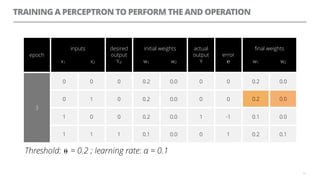
2
0 0 0 0.3 0.0 0 0 0.3 0.0
0 1 0 0.3 0.0 0 0 0.3 0.0
1 0 0 0.3 0.0 1 -1 0.2 0.0
1 1 1 0.2 0.0 1 0 0.2 0.0
Threshold: ⍬ = 0.2 ; learning rate: α = 0.1=
0.3 0.0
TRAINING A PERCEPTRON TO PERFORM THE AND OPERATION
14
epoch
inputs
x1 x2
desired
output
Yd
initial weights
w1 w2
actual
output
Y
error
℮
final weights
w1 w2
2
0 0 0 0.3 0.0 0 0 0.3 0.0
0 1 0 0.3 0.0 0 0 0.3 0.0
1 0 0 0.3 0.0 1 -1 0.2 0.0
1 1 1 0.2 0.0 1 0 0.2 0.0
Threshold: ⍬ = 0.2 ; learning rate: α = 0.1=
0.3 0.0
TRAINING A PERCEPTRON TO PERFORM THE AND OPERATION
14
epoch
inputs
x1 x2
desired
output
Yd
initial weights
w1 w2
actual
output
Y
error
℮
final weights
w1 w2
2
0 0 0 0.3 0.0 0 0 0.3 0.0
0 1 0 0.3 0.0 0 0 0.3 0.0
1 0 0 0.3 0.0 1 -1 0.2 0.0
1 1 1 0.2 0.0 1 0 0.2 0.0
Threshold: ⍬ = 0.2 ; learning rate: α = 0.1=
0.2 0.0
TRAINING A PERCEPTRON TO PERFORM THE AND OPERATION
14
epoch
inputs
x1 x2
desired
output
Yd
initial weights
w1 w2
actual
output
Y
error
℮
final weights
w1 w2
2
0 0 0 0.3 0.0 0 0 0.3 0.0
0 1 0 0.3 0.0 0 0 0.3 0.0
1 0 0 0.3 0.0 1 -1 0.2 0.0
1 1 1 0.2 0.0 1 0 0.2 0.0
Threshold: ⍬ = 0.2 ; learning rate: α = 0.1=
0.2 0.0
TRAINING A PERCEPTRON TO PERFORM THE AND OPERATION
15
epoch
inputs
x1 x2
desired
output
Yd
initial weights
w1 w2
actual
output
Y
error
℮
final weights
w1 w2
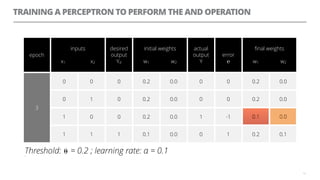
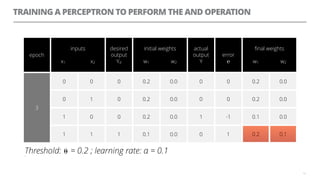
3
0 0 0 0.2 0.0 0 0 0.2 0.0
0 1 0 0.2 0.0 0 0 0.2 0.0
1 0 0 0.2 0.0 1 -1 0.1 0.0
1 1 1 0.1 0.0 0 1 0.2 0.1
Threshold: ⍬ = 0.2 ; learning rate: α = 0.1=
0.2 0.0
TRAINING A PERCEPTRON TO PERFORM THE AND OPERATION
15
epoch
inputs
x1 x2
desired
output
Yd
initial weights
w1 w2
actual
output
Y
error
℮
final weights
w1 w2
3
0 0 0 0.2 0.0 0 0 0.2 0.0
0 1 0 0.2 0.0 0 0 0.2 0.0
1 0 0 0.2 0.0 1 -1 0.1 0.0
1 1 1 0.1 0.0 0 1 0.2 0.1
Threshold: ⍬ = 0.2 ; learning rate: α = 0.1=
0.2 0.0
TRAINING A PERCEPTRON TO PERFORM THE AND OPERATION
15
epoch
inputs
x1 x2
desired
output
Yd
initial weights
w1 w2
actual
output
Y
error
℮
final weights
w1 w2
3
0 0 0 0.2 0.0 0 0 0.2 0.0
0 1 0 0.2 0.0 0 0 0.2 0.0
1 0 0 0.2 0.0 1 -1 0.1 0.0
1 1 1 0.1 0.0 0 1 0.2 0.1
Threshold: ⍬ = 0.2 ; learning rate: α = 0.1=
0.1 0.0
TRAINING A PERCEPTRON TO PERFORM THE AND OPERATION
15
epoch
inputs
x1 x2
desired
output
Yd
initial weights
w1 w2
actual
output
Y
error
℮
final weights
w1 w2
3
0 0 0 0.2 0.0 0 0 0.2 0.0
0 1 0 0.2 0.0 0 0 0.2 0.0
1 0 0 0.2 0.0 1 -1 0.1 0.0
1 1 1 0.1 0.0 0 1 0.2 0.1
Threshold: ⍬ = 0.2 ; learning rate: α = 0.1=
0.2 0.1
TRAINING A PERCEPTRON TO PERFORM THE AND OPERATION
16
epoch
inputs
x1 x2
desired
output
Yd
initial weights
w1 w2
actual
output
Y
error
℮
final weights
w1 w2
4
0 0 0 0.2 0.1 0 0 0.2 0.1
0 1 0 0.2 0.1 0 0 0.2 0.1
1 0 0 0.2 0.1 1 -1 0.1 0.1
1 1 1 0.1 0.1 1 0 0.1 0.1
Threshold: ⍬ = 0.2 ; learning rate: α = 0.1=
0.2 0.1
TRAINING A PERCEPTRON TO PERFORM THE AND OPERATION
16
epoch
inputs
x1 x2
desired
output
Yd
initial weights
w1 w2
actual
output
Y
error
℮
final weights
w1 w2
4
0 0 0 0.2 0.1 0 0 0.2 0.1
0 1 0 0.2 0.1 0 0 0.2 0.1
1 0 0 0.2 0.1 1 -1 0.1 0.1
1 1 1 0.1 0.1 1 0 0.1 0.1
Threshold: ⍬ = 0.2 ; learning rate: α = 0.1=
0.2 0.1
TRAINING A PERCEPTRON TO PERFORM THE AND OPERATION
16
epoch
inputs
x1 x2
desired
output
Yd
initial weights
w1 w2
actual
output
Y
error
℮
final weights
w1 w2
4
0 0 0 0.2 0.1 0 0 0.2 0.1
0 1 0 0.2 0.1 0 0 0.2 0.1
1 0 0 0.2 0.1 1 -1 0.1 0.1
1 1 1 0.1 0.1 1 0 0.1 0.1
Threshold: ⍬ = 0.2 ; learning rate: α = 0.1=
0.1 0.1
TRAINING A PERCEPTRON TO PERFORM THE AND OPERATION
16
epoch
inputs
x1 x2
desired
output
Yd
initial weights
w1 w2
actual
output
Y
error
℮
final weights
w1 w2
4
0 0 0 0.2 0.1 0 0 0.2 0.1
0 1 0 0.2 0.1 0 0 0.2 0.1
1 0 0 0.2 0.1 1 -1 0.1 0.1
1 1 1 0.1 0.1 1 0 0.1 0.1
Threshold: ⍬ = 0.2 ; learning rate: α = 0.1=
0.1 0.1
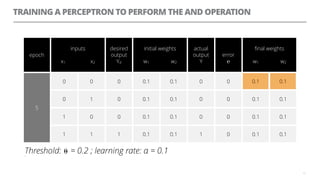
TRAINING A PERCEPTRON TO PERFORM THE AND OPERATION
17
epoch
inputs
x1 x2
desired
output
Yd
initial weights
w1 w2
actual
output
Y
error
℮
final weights
w1 w2
5
0 0 0 0.1 0.1 0 0 0.1 0.1
0 1 0 0.1 0.1 0 0 0.1 0.1
1 0 0 0.1 0.1 0 0 0.1 0.1
1 1 1 0.1 0.1 1 0 0.1 0.1
Threshold: ⍬ = 0.2 ; learning rate: α = 0.1=
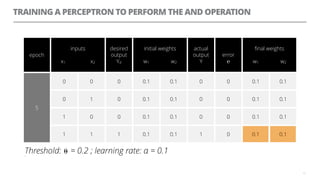
0.1 0.1
TRAINING A PERCEPTRON TO PERFORM THE AND OPERATION
17
epoch
inputs
x1 x2
desired
output
Yd
initial weights
w1 w2
actual
output
Y
error
℮
final weights
w1 w2
5
0 0 0 0.1 0.1 0 0 0.1 0.1
0 1 0 0.1 0.1 0 0 0.1 0.1
1 0 0 0.1 0.1 0 0 0.1 0.1
1 1 1 0.1 0.1 1 0 0.1 0.1
Threshold: ⍬ = 0.2 ; learning rate: α = 0.1=
0.1 0.1
TRAINING A PERCEPTRON TO PERFORM THE AND OPERATION
17
epoch
inputs
x1 x2
desired
output
Yd
initial weights
w1 w2
actual
output
Y
error
℮
final weights
w1 w2
5
0 0 0 0.1 0.1 0 0 0.1 0.1
0 1 0 0.1 0.1 0 0 0.1 0.1
1 0 0 0.1 0.1 0 0 0.1 0.1
1 1 1 0.1 0.1 1 0 0.1 0.1
Threshold: ⍬ = 0.2 ; learning rate: α = 0.1=
0.1 0.1
TRAINING A PERCEPTRON TO PERFORM THE AND OPERATION
17
epoch
inputs
x1 x2
desired
output
Yd
initial weights
w1 w2
actual
output
Y
error
℮
final weights
w1 w2
5
0 0 0 0.1 0.1 0 0 0.1 0.1
0 1 0 0.1 0.1 0 0 0.1 0.1
1 0 0 0.1 0.1 0 0 0.1 0.1
1 1 1 0.1 0.1 1 0 0.1 0.1
Threshold: ⍬ = 0.2 ; learning rate: α = 0.1=
0.1 0.1
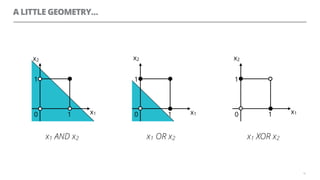
A LITTLE GEOMETRY…
18
0 1
1
x2
x1 0 1
1
x2
x10 1
1
x2
x1
x1 AND x2 x1 OR x2 x1 XOR x2
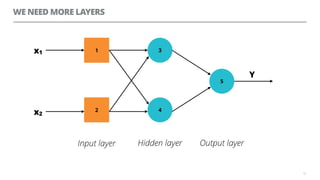
WE NEED MORE LAYERS
19
3
4
5
1
2
Input layer Hidden layer Output layer
x1
x2
Y
PROBLEMS WITH BACK PROPAGATION
•a training set of sufficient size is required
•topology of the network needs to be known in advance
•no recurrent connections are allowed
•activation function must be differentiable
Does not emulate the biological world
20
EVOLUTIONARY
COMPUTATION
21
MEET JOHN
22
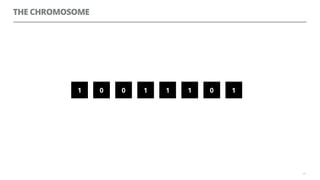
THE CHROMOSOME
23
10 11 101 0
1 1000 11 0
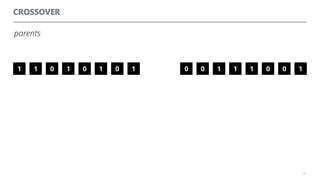
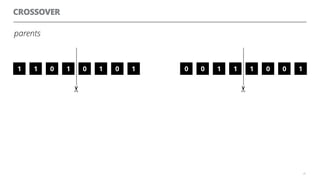
CROSSOVER
24
0 111 0 11 0 1 100 1 10 0
parents
1 1000 11 0
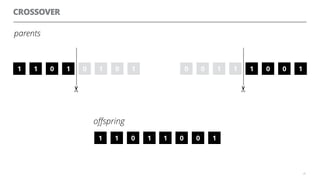
CROSSOVER
24
0 111 0 11 0 1 100 1 10 0
✂
parents
✂
1 1000 11 0
1 10 00 111
offspring
CROSSOVER
24
0 111 1 10 0
✂
parents
✂
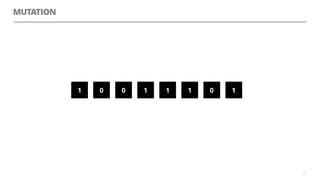
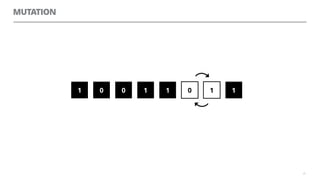
MUTATION
25
A D10 11 101 0
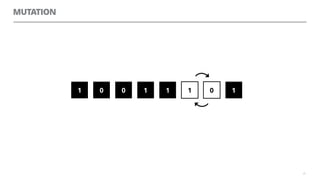
MUTATION
25
A DA D10 11 101 01 0
MUTATION
25
A DA D10 11 101 01 00 1
EVOLUTIONARY ALGORITHM
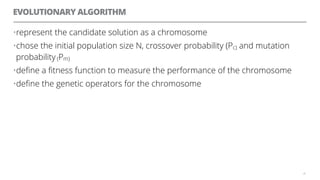
•represent the candidate solution as a chromosome
•chose the initial population size N, crossover probability (Pc) and mutation
probability (Pm)
•define a fitness function to measure the performance of the chromosome
•define the genetic operators for the chromosome
26
EVOLUTIONARY ALGORITHM
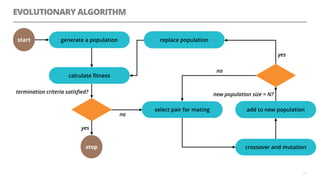
27
start
stop
generate a population
calculate fitness
termination criteria satisfied?
yes
no
new population size = N?
crossover and mutation
select pair for mating add to new population
replace population
no
yes
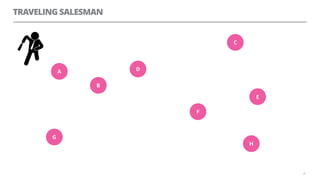
TRAVELING SALESMAN
28
A
B
D
F
G
C
E
H
EVOLUTIONARY ALGORITHM
•represent the candidate solution as a chromosome
•define a fitness function to measure the performance of the chromosome
•define the genetic operators for the chromosome
•chose the initial population size N, crossover probability Pc and mutation
probability Pm
29
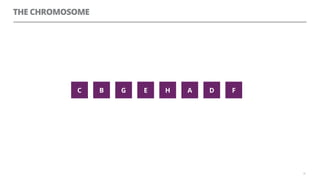
THE CHROMOSOME
30
HG FE ABC D
EVOLUTIONARY ALGORITHM
•represent the candidate solution as a chromosome
•define a fitness function to measure the performance of the
chromosome
•define the genetic operators for the chromosome
•chose the initial population size N, crossover probability Pc and mutation
probability Pm
31
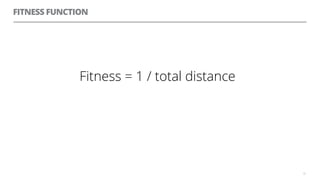
FITNESS FUNCTION
Fitness = 1 / total distance
32
EVOLUTIONARY ALGORITHM
•represent the candidate solution as a chromosome
•define a fitness function to measure the performance of the chromosome
•define the genetic operators for the chromosome
•chose the initial population size N, crossover probability Pc and mutation
probability Pm
33
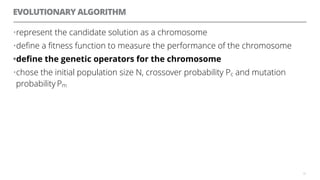
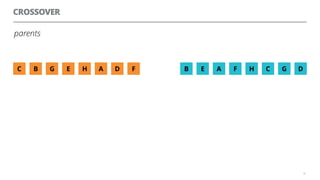
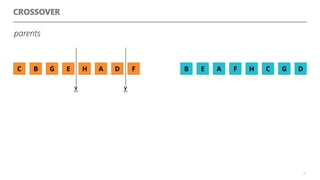
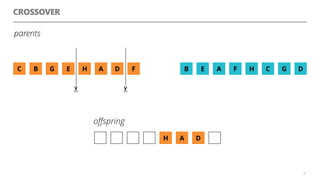
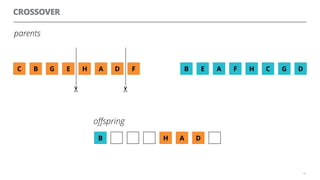
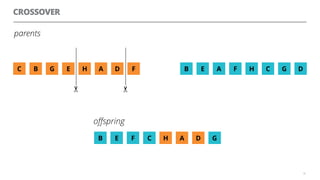
CROSSOVER
34
G EBC H FA D A FEB H DC G
parents
CROSSOVER
34
G EBC H FA D A FEB H DC G
✂
✂
parents
H A D
offspring
CROSSOVER
34
G EBC H FA D A FEB H DC G
✂
✂
parents
H A D
offspring
CROSSOVER
34
G EBC H FA D A FEB H DC G
✂
✂
parents
B
H A D
offspring
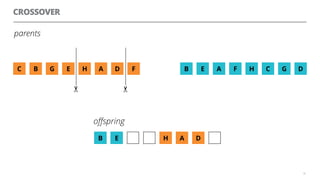
CROSSOVER
34
G EBC H FA D A FEB H DC G
✂
✂
parents
B E
H A D
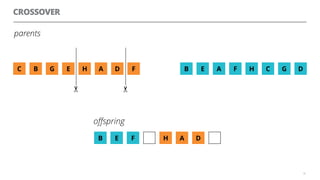
offspring
CROSSOVER
34
G EBC H FA D A FEB H DC G
✂
✂
parents
B E F
H A D
offspring
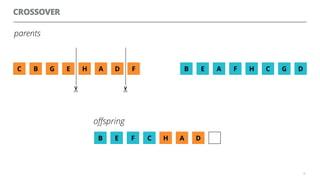
CROSSOVER
34
G EBC H FA D A FEB H DC G
✂
✂
parents
B E F C
H A D
offspring
CROSSOVER
34
G EBC H FA D A FEB H DC G
✂
✂
parents
B E F C G
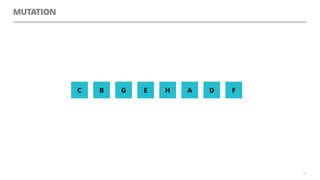
MUTATION
35
HG FE ABC D
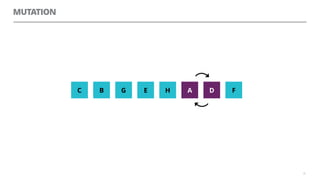
MUTATION
35
HG FE ABC DA D
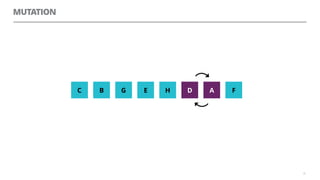
MUTATION
35
HG FE ABC DA DAD
EVOLUTIONARY ALGORITHM
•represent the candidate solution as a chromosome
•define a fitness function to measure the performance of the chromosome
•define the genetic operators for the chromosome
•chose the initial population size N, crossover probability Pc and
mutation probability Pm
36
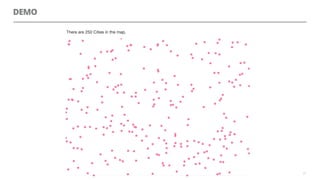
DEMO
37
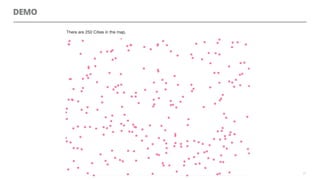
DEMO
37
NEUROEVOLUTION
38
MEET GENE
39
SIMULATION
•inputs (sensors)
•outputs (actuators)
•fitness function
40
CLEANING ROBOT
41
FOREX TRADING
42
AND LOTS MORE…
•data compression
•training NPCs in a video game
•cyber warfare
43
EVOLUTIONARY ALGORITHM
•represent the candidate solution as a chromosome
•define a fitness function to measure the performance of the chromosome
•define the genetic operators for the chromosome
•chose the initial population size N, crossover probability Pc and mutation
probability Pm
44
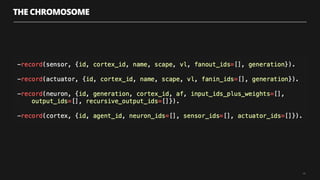
THE CHROMOSOME
45
EVOLUTIONARY ALGORITHM
•represent the candidate solution as a chromosome
•define a fitness function to measure the performance of the
chromosome
•define the genetic operators for the chromosome
•chose the initial population size N, crossover probability Pc and mutation
probability Pm
46
FITNESS FUNCTION
Fitness = performance of network on an actual problem
47
EVOLUTIONARY ALGORITHM
•represent the candidate solution as a chromosome
•define a fitness function to measure the performance of the chromosome
•define the genetic operators for the chromosome
•chose the initial population size N, crossover probability Pc and mutation
probability Pm
48
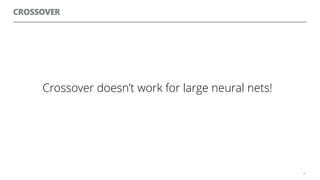
CROSSOVER
Crossover doesn’t work for large neural nets!
49
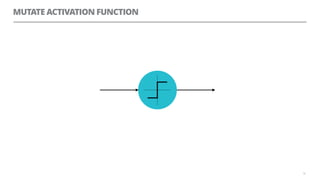
MUTATE ACTIVATION FUNCTION
50
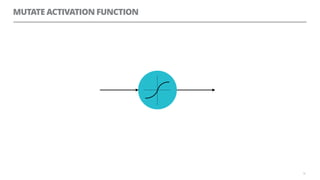
MUTATE ACTIVATION FUNCTION
50
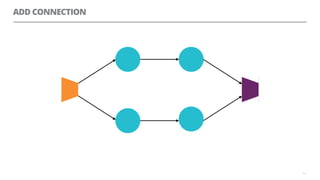
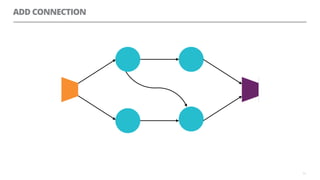
ADD CONNECTION
51
ADD CONNECTION
51
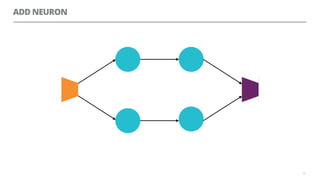
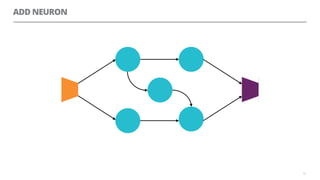
ADD NEURON
52
ADD NEURON
52
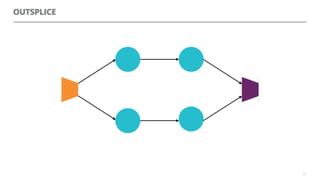
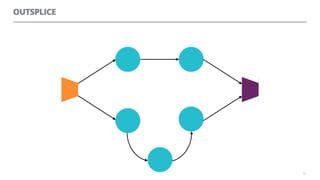
OUTSPLICE
53
OUTSPLICE
53
MUTATION OPERATORS
and lots more…
54
EVOLUTIONARY ALGORITHM
•represent the candidate solution as a chromosome
•define a fitness function to measure the performance of the chromosome
•define the genetic operators for the chromosome
•chose the initial population size N, crossover probability Pc and
mutation probability Pm
55
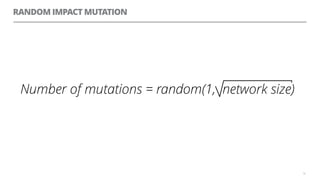
RANDOM IMPACT MUTATION
Number of mutations = random(1, network size)
56
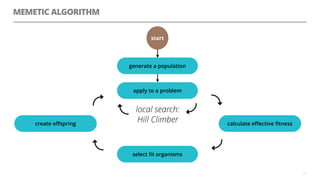
MEMETIC ALGORITHM
57
apply to a problem
start
generate a population
local search:
Hill Climber calculate effective fitness
select fit organisms
create offspring
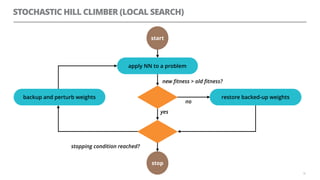
STOCHASTIC HILL CLIMBER (LOCAL SEARCH)
58
start
new fitness > old fitness?
yes
no
stopping condition reached?
stop
apply NN to a problem
backup and perturb weights restore backed-up weights
A LANGUAGE FOR NEUROEVOLUTION
•The system must be able to handle very large numbers of concurrent activities
•Actions must be performed at a certain point in time or within a certain time
•Systems may be distributed over several computers
•The system is used to control hardware
•The software systems are very large
59
A LANGUAGE FOR NEUROEVOLUTION
59
•The system exhibits complex functionality such as, feature interaction.
•The systems should be in continuous operation for many years.
•Software maintenance (reconfiguration, etc) should be performed without
stopping the system.
•There are stringent quality, and reliability requirements.
•Fault tolerance
A LANGUAGE FOR NEUROEVOLUTION
59
•The system exhibits complex functionality such as, feature interaction.
•The systems should be in continuous operation for many years.
•Software maintenance (reconfiguration, etc) should be performed without
stopping the system.
•There are stringent quality, and reliability requirements.
•Fault tolerance
Bjarne Dacker. Erlang - A New Programming Language. Ericsson Review,
no 2, 1993.
MEET JOE
60
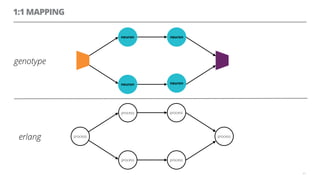
1:1 MAPPING
61
neuron
neuronneuron
neuron
process process
process process
processprocess
genotype
erlang
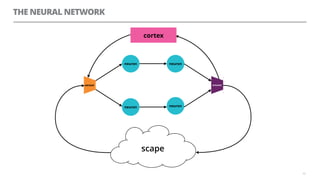
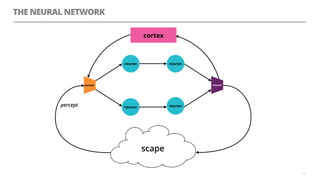
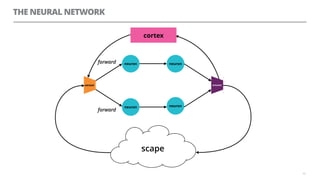
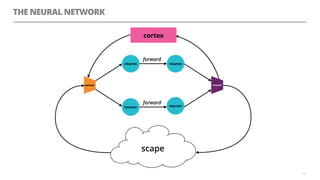
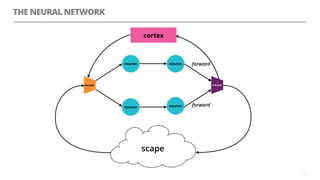
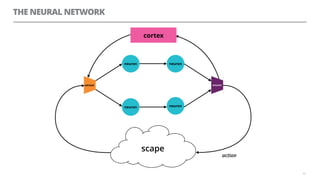
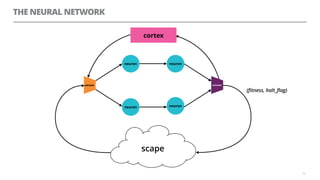
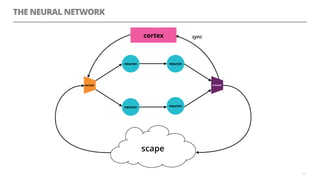
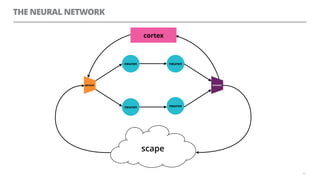
THE NEURAL NETWORK
62
neuron
neuronneuron
actuatorsensor
neuron
cortex
scape
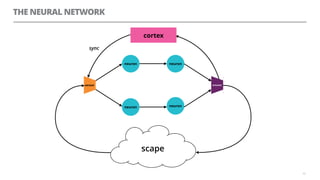
THE NEURAL NETWORK
62
neuron
neuronneuron
actuatorsensor
neuron
cortex
scape
sync
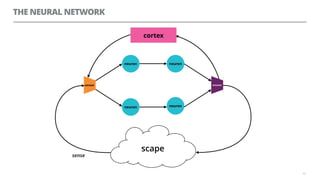
THE NEURAL NETWORK
62
neuron
neuronneuron
actuatorsensor
neuron
cortex
scape
sense
THE NEURAL NETWORK
62
neuron
neuronneuron
actuatorsensor
neuron
cortex
scape
percept
THE NEURAL NETWORK
62
neuron
neuronneuron
actuatorsensor
neuron
cortex
scape
forward
forward
THE NEURAL NETWORK
62
neuron
neuronneuron
actuatorsensor
neuron
cortex
scape
forward
forward
THE NEURAL NETWORK
62
neuron
neuronneuron
actuatorsensor
neuron
cortex
scape
forward
forward
THE NEURAL NETWORK
62
neuron
neuronneuron
actuatorsensor
neuron
cortex
scape
action
THE NEURAL NETWORK
62
neuron
neuronneuron
actuatorsensor
neuron
cortex
scape
{fitness, halt_flag}
THE NEURAL NETWORK
62
neuron
neuronneuron
actuatorsensor
neuron
cortex
scape
sync
THE NEURAL NETWORK
62
neuron
neuronneuron
actuatorsensor
neuron
cortex
scape
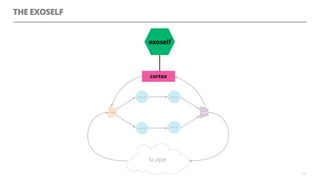
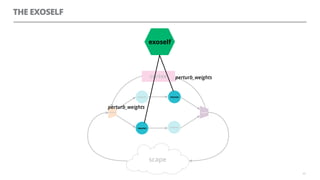
THE EXOSELF
63
neuron
neuronneuron
actuatorsensor
neuron
cortex
scape
exoself
cortex
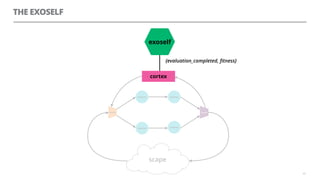
THE EXOSELF
63
neuron
neuronneuron
actuatorsensor
neuron
cortex
scape
exoself
{evaluation_completed, fitness}
cortex
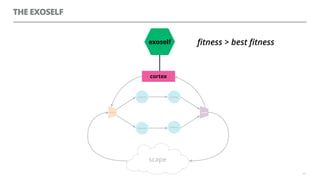
THE EXOSELF
63
neuron
neuronneuron
actuatorsensor
neuron
cortex
scape
exoself
cortex
fitness > best fitness
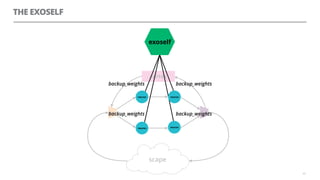
THE EXOSELF
63
neuron
neuronneuron
actuatorsensor
neuron
cortex
scape
exoself
backup_weights
backup_weights
backup_weights
backup_weights
neuron neuron
neuronneuron
THE EXOSELF
63
neuron
neuronneuron
actuatorsensor
neuron
cortex
scape
exoself
neuron
neuron
perturb_weights
perturb_weights
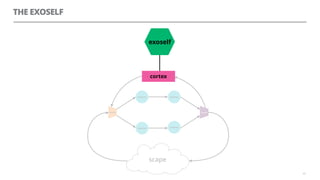
THE EXOSELF
63
neuron
neuronneuron
actuatorsensor
neuron
cortex
scape
exoself
cortex
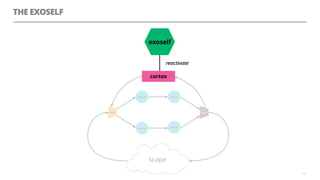
THE EXOSELF
63
neuron
neuronneuron
actuatorsensor
neuron
cortex
scape
exoself
cortex
reactivate
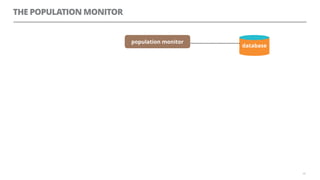
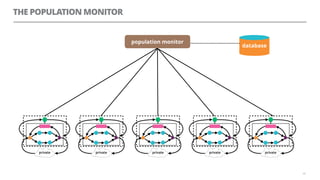
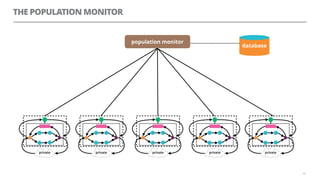
THE POPULATION MONITOR
64
population monitor
database
THE POPULATION MONITOR
64
population monitor
database
private private privateprivate private
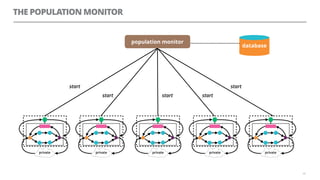
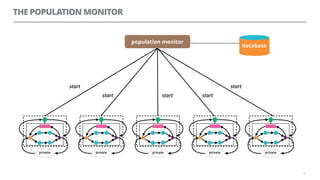
THE POPULATION MONITOR
64
population monitor
database
private private privateprivate private
start
start start start
start
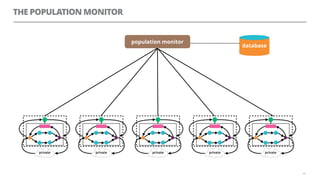
THE POPULATION MONITOR
64
population monitor
database
private private privateprivate private
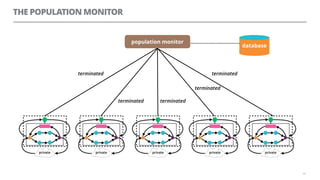
THE POPULATION MONITOR
64
population monitor
database
private private privateprivate private
terminated
terminated terminated
terminated
terminated
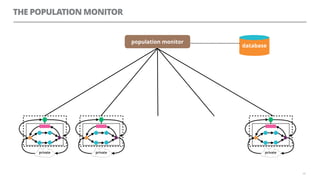
THE POPULATION MONITOR
64
population monitor
database
private private privateprivate private
THE POPULATION MONITOR
64
population monitor
database
private privateprivate
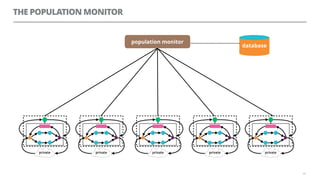
THE POPULATION MONITOR
64
population monitor
database
private privateprivate private private
THE POPULATION MONITOR
64
population monitor
database
private privateprivate private private
start
start start start
start
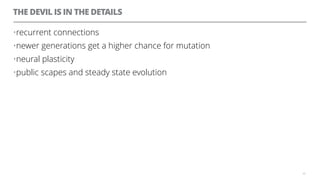
THE DEVIL IS IN THE DETAILS
•recurrent connections
•newer generations get a higher chance for mutation
•neural plasticity
•public scapes and steady state evolution
65
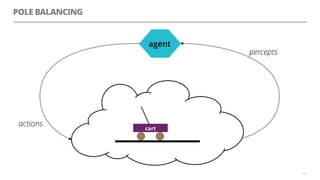
POLE BALANCING
66
agent
cart
actions
percepts
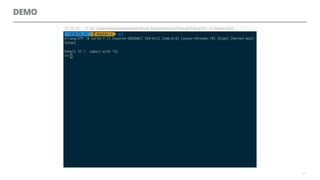
DEMO
67
DEMO
67
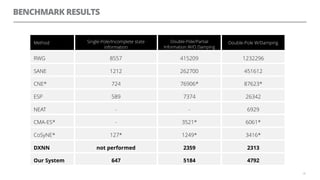
BENCHMARK RESULTS
68
Method Single-Pole/Incomplete state
information
Double-Pole/Partial
Information W/O Damping
Double-Pole W/Damping
RWG 8557 415209 1232296
SANE 1212 262700 451612
CNE* 724 76906* 87623*
ESP 589 7374 26342
NEAT - - 6929
CMA-ES* - 3521* 6061*
CoSyNE* 127* 1249* 3416*
DXNN not performed 2359 2313
Our System 647 5184 4792
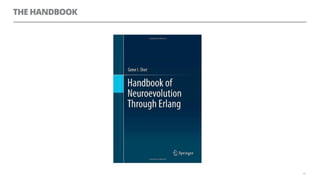
THE HANDBOOK
69
Feel free to reach out at:
e. jsoeters@thoughtworks.com
t. @JeroenSoeters
THANK YOU
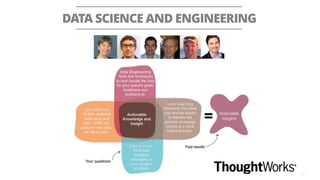
DATA SCIENCE AND ENGINEERING
71

A hitchhiker’s guide to neuroevolution in Erlang

  • 1.
    J e ro e n S o e t e r s NEUROEVOLUTION A hitchhiker’s guide to neuroevolution in Erlang.
  • 2.
  • 3.
    WHAT IS MACHINELEARNING? • Artificial Neural Networks • Genetic Algorithms 3
  • 4.
  • 5.
  • 6.
    A MODEL FORA NEURON 6 Y w1 w2 wn x1 x2 xn Dendrites Synapses Axon Soma
  • 7.
    A MODEL FORA NEURON 6 Y w1 w2 wn x1 x2 xn Input signals Weights Output signal Neuron
  • 8.
    HOW DOES THENEURON DETERMINE IT’S OUTPUT? Y =sign ∑xiwi - ⍬ 7 n=1 n
  • 9.
  • 10.
  • 11.
    PERCEPTRON LEARNING RULE ℮(p)= Yd(p) - Y(p) wi(p + 1) = wi(p) + α • wi(p) • ℮(p) = 10
  • 12.
    PERCEPTRON TRAINING ALGORITHM 11 weighttraining start stop weights converged? yes no set weights and threshold to random values [-0.5, 0.5] activate the perceptron
  • 13.
    LOGIC GATES 12 input values x1x2 x1 AND x2 x1 OR x2 x1 XOR x2 0 0 0 0 0 0 1 0 1 1 1 0 0 1 1 1 1 1 1 0
  • 14.
    TRAINING A PERCEPTRONTO PERFORM THE AND OPERATION 13 epoch inputs x1 x2 desired output Yd initial weights w1 w2 actual output Y error ℮ final weights w1 w2 1 0 0 0 0.3 -0.1 0 0 0.3 -0.1 0 1 0 0.3 -0.1 0 0 0.3 -0.1 1 0 0 0.3 -0.1 1 -1 0.2 -0.1 1 1 1 0.2 -0.1 0 1 0.3 0.0 Threshold: ⍬ = 0.2 ; learning rate: α = 0.1=
  • 15.
    TRAINING A PERCEPTRONTO PERFORM THE AND OPERATION 13 epoch inputs x1 x2 desired output Yd initial weights w1 w2 actual output Y error ℮ final weights w1 w2 1 0 0 0 0.3 -0.1 0 0 0.3 -0.1 0 1 0 0.3 -0.1 0 0 0.3 -0.1 1 0 0 0.3 -0.1 1 -1 0.2 -0.1 1 1 1 0.2 -0.1 0 1 0.3 0.0 Threshold: ⍬ = 0.2 ; learning rate: α = 0.1=
  • 16.
    TRAINING A PERCEPTRONTO PERFORM THE AND OPERATION 13 epoch inputs x1 x2 desired output Yd initial weights w1 w2 actual output Y error ℮ final weights w1 w2 1 0 0 0 0.3 -0.1 0 0 0.3 -0.1 0 1 0 0.3 -0.1 0 0 0.3 -0.1 1 0 0 0.3 -0.1 1 -1 0.2 -0.1 1 1 1 0.2 -0.1 0 1 0.3 0.0 Threshold: ⍬ = 0.2 ; learning rate: α = 0.1=
  • 17.
    TRAINING A PERCEPTRONTO PERFORM THE AND OPERATION 13 epoch inputs x1 x2 desired output Yd initial weights w1 w2 actual output Y error ℮ final weights w1 w2 1 0 0 0 0.3 -0.1 0 0 0.3 -0.1 0 1 0 0.3 -0.1 0 0 0.3 -0.1 1 0 0 0.3 -0.1 1 -1 0.2 -0.1 1 1 1 0.2 -0.1 0 1 0.3 0.0 Threshold: ⍬ = 0.2 ; learning rate: α = 0.1= 0.3 -0.1
  • 18.
    TRAINING A PERCEPTRONTO PERFORM THE AND OPERATION 13 epoch inputs x1 x2 desired output Yd initial weights w1 w2 actual output Y error ℮ final weights w1 w2 1 0 0 0 0.3 -0.1 0 0 0.3 -0.1 0 1 0 0.3 -0.1 0 0 0.3 -0.1 1 0 0 0.3 -0.1 1 -1 0.2 -0.1 1 1 1 0.2 -0.1 0 1 0.3 0.0 Threshold: ⍬ = 0.2 ; learning rate: α = 0.1= 0 0.3
  • 19.
    TRAINING A PERCEPTRONTO PERFORM THE AND OPERATION 13 epoch inputs x1 x2 desired output Yd initial weights w1 w2 actual output Y error ℮ final weights w1 w2 1 0 0 0 0.3 -0.1 0 0 0.3 -0.1 0 1 0 0.3 -0.1 0 0 0.3 -0.1 1 0 0 0.3 -0.1 1 -1 0.2 -0.1 1 1 1 0.2 -0.1 0 1 0.3 0.0 Threshold: ⍬ = 0.2 ; learning rate: α = 0.1= 0 -0.1
  • 20.
    TRAINING A PERCEPTRONTO PERFORM THE AND OPERATION 13 epoch inputs x1 x2 desired output Yd initial weights w1 w2 actual output Y error ℮ final weights w1 w2 1 0 0 0 0.3 -0.1 0 0 0.3 -0.1 0 1 0 0.3 -0.1 0 0 0.3 -0.1 1 0 0 0.3 -0.1 1 -1 0.2 -0.1 1 1 1 0.2 -0.1 0 1 0.3 0.0 Threshold: ⍬ = 0.2 ; learning rate: α = 0.1= 0
  • 21.
    TRAINING A PERCEPTRONTO PERFORM THE AND OPERATION 13 epoch inputs x1 x2 desired output Yd initial weights w1 w2 actual output Y error ℮ final weights w1 w2 1 0 0 0 0.3 -0.1 0 0 0.3 -0.1 0 1 0 0.3 -0.1 0 0 0.3 -0.1 1 0 0 0.3 -0.1 1 -1 0.2 -0.1 1 1 1 0.2 -0.1 0 1 0.3 0.0 Threshold: ⍬ = 0.2 ; learning rate: α = 0.1= 00
  • 22.
    TRAINING A PERCEPTRONTO PERFORM THE AND OPERATION 13 epoch inputs x1 x2 desired output Yd initial weights w1 w2 actual output Y error ℮ final weights w1 w2 1 0 0 0 0.3 -0.1 0 0 0.3 -0.1 0 1 0 0.3 -0.1 0 0 0.3 -0.1 1 0 0 0.3 -0.1 1 -1 0.2 -0.1 1 1 1 0.2 -0.1 0 1 0.3 0.0 Threshold: ⍬ = 0.2 ; learning rate: α = 0.1= 0
  • 23.
    TRAINING A PERCEPTRONTO PERFORM THE AND OPERATION 13 epoch inputs x1 x2 desired output Yd initial weights w1 w2 actual output Y error ℮ final weights w1 w2 1 0 0 0 0.3 -0.1 0 0 0.3 -0.1 0 1 0 0.3 -0.1 0 0 0.3 -0.1 1 0 0 0.3 -0.1 1 -1 0.2 -0.1 1 1 1 0.2 -0.1 0 1 0.3 0.0 Threshold: ⍬ = 0.2 ; learning rate: α = 0.1= 0.3 -0.1
  • 24.
    TRAINING A PERCEPTRONTO PERFORM THE AND OPERATION 13 epoch inputs x1 x2 desired output Yd initial weights w1 w2 actual output Y error ℮ final weights w1 w2 1 0 0 0 0.3 -0.1 0 0 0.3 -0.1 0 1 0 0.3 -0.1 0 0 0.3 -0.1 1 0 0 0.3 -0.1 1 -1 0.2 -0.1 1 1 1 0.2 -0.1 0 1 0.3 0.0 Threshold: ⍬ = 0.2 ; learning rate: α = 0.1= 0 0.3
  • 25.
    TRAINING A PERCEPTRONTO PERFORM THE AND OPERATION 13 epoch inputs x1 x2 desired output Yd initial weights w1 w2 actual output Y error ℮ final weights w1 w2 1 0 0 0 0.3 -0.1 0 0 0.3 -0.1 0 1 0 0.3 -0.1 0 0 0.3 -0.1 1 0 0 0.3 -0.1 1 -1 0.2 -0.1 1 1 1 0.2 -0.1 0 1 0.3 0.0 Threshold: ⍬ = 0.2 ; learning rate: α = 0.1= 1 -0.1
  • 26.
    TRAINING A PERCEPTRONTO PERFORM THE AND OPERATION 13 epoch inputs x1 x2 desired output Yd initial weights w1 w2 actual output Y error ℮ final weights w1 w2 1 0 0 0 0.3 -0.1 0 0 0.3 -0.1 0 1 0 0.3 -0.1 0 0 0.3 -0.1 1 0 0 0.3 -0.1 1 -1 0.2 -0.1 1 1 1 0.2 -0.1 0 1 0.3 0.0 Threshold: ⍬ = 0.2 ; learning rate: α = 0.1= 0
  • 27.
    TRAINING A PERCEPTRONTO PERFORM THE AND OPERATION 13 epoch inputs x1 x2 desired output Yd initial weights w1 w2 actual output Y error ℮ final weights w1 w2 1 0 0 0 0.3 -0.1 0 0 0.3 -0.1 0 1 0 0.3 -0.1 0 0 0.3 -0.1 1 0 0 0.3 -0.1 1 -1 0.2 -0.1 1 1 1 0.2 -0.1 0 1 0.3 0.0 Threshold: ⍬ = 0.2 ; learning rate: α = 0.1= 00
  • 28.
    TRAINING A PERCEPTRONTO PERFORM THE AND OPERATION 13 epoch inputs x1 x2 desired output Yd initial weights w1 w2 actual output Y error ℮ final weights w1 w2 1 0 0 0 0.3 -0.1 0 0 0.3 -0.1 0 1 0 0.3 -0.1 0 0 0.3 -0.1 1 0 0 0.3 -0.1 1 -1 0.2 -0.1 1 1 1 0.2 -0.1 0 1 0.3 0.0 Threshold: ⍬ = 0.2 ; learning rate: α = 0.1= 0
  • 29.
    TRAINING A PERCEPTRONTO PERFORM THE AND OPERATION 13 epoch inputs x1 x2 desired output Yd initial weights w1 w2 actual output Y error ℮ final weights w1 w2 1 0 0 0 0.3 -0.1 0 0 0.3 -0.1 0 1 0 0.3 -0.1 0 0 0.3 -0.1 1 0 0 0.3 -0.1 1 -1 0.2 -0.1 1 1 1 0.2 -0.1 0 1 0.3 0.0 Threshold: ⍬ = 0.2 ; learning rate: α = 0.1= 0.3 -0.1
  • 30.
    TRAINING A PERCEPTRONTO PERFORM THE AND OPERATION 13 epoch inputs x1 x2 desired output Yd initial weights w1 w2 actual output Y error ℮ final weights w1 w2 1 0 0 0 0.3 -0.1 0 0 0.3 -0.1 0 1 0 0.3 -0.1 0 0 0.3 -0.1 1 0 0 0.3 -0.1 1 -1 0.2 -0.1 1 1 1 0.2 -0.1 0 1 0.3 0.0 Threshold: ⍬ = 0.2 ; learning rate: α = 0.1= 1 0.3
  • 31.
    TRAINING A PERCEPTRONTO PERFORM THE AND OPERATION 13 epoch inputs x1 x2 desired output Yd initial weights w1 w2 actual output Y error ℮ final weights w1 w2 1 0 0 0 0.3 -0.1 0 0 0.3 -0.1 0 1 0 0.3 -0.1 0 0 0.3 -0.1 1 0 0 0.3 -0.1 1 -1 0.2 -0.1 1 1 1 0.2 -0.1 0 1 0.3 0.0 Threshold: ⍬ = 0.2 ; learning rate: α = 0.1= 0 -0.1
  • 32.
    TRAINING A PERCEPTRONTO PERFORM THE AND OPERATION 13 epoch inputs x1 x2 desired output Yd initial weights w1 w2 actual output Y error ℮ final weights w1 w2 1 0 0 0 0.3 -0.1 0 0 0.3 -0.1 0 1 0 0.3 -0.1 0 0 0.3 -0.1 1 0 0 0.3 -0.1 1 -1 0.2 -0.1 1 1 1 0.2 -0.1 0 1 0.3 0.0 Threshold: ⍬ = 0.2 ; learning rate: α = 0.1= 1
  • 33.
    TRAINING A PERCEPTRONTO PERFORM THE AND OPERATION 13 epoch inputs x1 x2 desired output Yd initial weights w1 w2 actual output Y error ℮ final weights w1 w2 1 0 0 0 0.3 -0.1 0 0 0.3 -0.1 0 1 0 0.3 -0.1 0 0 0.3 -0.1 1 0 0 0.3 -0.1 1 -1 0.2 -0.1 1 1 1 0.2 -0.1 0 1 0.3 0.0 Threshold: ⍬ = 0.2 ; learning rate: α = 0.1= 10
  • 34.
    TRAINING A PERCEPTRONTO PERFORM THE AND OPERATION 13 epoch inputs x1 x2 desired output Yd initial weights w1 w2 actual output Y error ℮ final weights w1 w2 1 0 0 0 0.3 -0.1 0 0 0.3 -0.1 0 1 0 0.3 -0.1 0 0 0.3 -0.1 1 0 0 0.3 -0.1 1 -1 0.2 -0.1 1 1 1 0.2 -0.1 0 1 0.3 0.0 Threshold: ⍬ = 0.2 ; learning rate: α = 0.1= -1
  • 35.
    TRAINING A PERCEPTRONTO PERFORM THE AND OPERATION 13 epoch inputs x1 x2 desired output Yd initial weights w1 w2 actual output Y error ℮ final weights w1 w2 1 0 0 0 0.3 -0.1 0 0 0.3 -0.1 0 1 0 0.3 -0.1 0 0 0.3 -0.1 1 0 0 0.3 -0.1 1 -1 0.2 -0.1 1 1 1 0.2 -0.1 0 1 0.3 0.0 Threshold: ⍬ = 0.2 ; learning rate: α = 0.1= 0.2 -0.1
  • 36.
    TRAINING A PERCEPTRONTO PERFORM THE AND OPERATION 13 epoch inputs x1 x2 desired output Yd initial weights w1 w2 actual output Y error ℮ final weights w1 w2 1 0 0 0 0.3 -0.1 0 0 0.3 -0.1 0 1 0 0.3 -0.1 0 0 0.3 -0.1 1 0 0 0.3 -0.1 1 -1 0.2 -0.1 1 1 1 0.2 -0.1 0 1 0.3 0.0 Threshold: ⍬ = 0.2 ; learning rate: α = 0.1= 1 0.2
  • 37.
    TRAINING A PERCEPTRONTO PERFORM THE AND OPERATION 13 epoch inputs x1 x2 desired output Yd initial weights w1 w2 actual output Y error ℮ final weights w1 w2 1 0 0 0 0.3 -0.1 0 0 0.3 -0.1 0 1 0 0.3 -0.1 0 0 0.3 -0.1 1 0 0 0.3 -0.1 1 -1 0.2 -0.1 1 1 1 0.2 -0.1 0 1 0.3 0.0 Threshold: ⍬ = 0.2 ; learning rate: α = 0.1= 1 -0.1
  • 38.
    TRAINING A PERCEPTRONTO PERFORM THE AND OPERATION 13 epoch inputs x1 x2 desired output Yd initial weights w1 w2 actual output Y error ℮ final weights w1 w2 1 0 0 0 0.3 -0.1 0 0 0.3 -0.1 0 1 0 0.3 -0.1 0 0 0.3 -0.1 1 0 0 0.3 -0.1 1 -1 0.2 -0.1 1 1 1 0.2 -0.1 0 1 0.3 0.0 Threshold: ⍬ = 0.2 ; learning rate: α = 0.1= 0
  • 39.
    TRAINING A PERCEPTRONTO PERFORM THE AND OPERATION 13 epoch inputs x1 x2 desired output Yd initial weights w1 w2 actual output Y error ℮ final weights w1 w2 1 0 0 0 0.3 -0.1 0 0 0.3 -0.1 0 1 0 0.3 -0.1 0 0 0.3 -0.1 1 0 0 0.3 -0.1 1 -1 0.2 -0.1 1 1 1 0.2 -0.1 0 1 0.3 0.0 Threshold: ⍬ = 0.2 ; learning rate: α = 0.1= 01
  • 40.
    TRAINING A PERCEPTRONTO PERFORM THE AND OPERATION 13 epoch inputs x1 x2 desired output Yd initial weights w1 w2 actual output Y error ℮ final weights w1 w2 1 0 0 0 0.3 -0.1 0 0 0.3 -0.1 0 1 0 0.3 -0.1 0 0 0.3 -0.1 1 0 0 0.3 -0.1 1 -1 0.2 -0.1 1 1 1 0.2 -0.1 0 1 0.3 0.0 Threshold: ⍬ = 0.2 ; learning rate: α = 0.1= 1
  • 41.
    TRAINING A PERCEPTRONTO PERFORM THE AND OPERATION 13 epoch inputs x1 x2 desired output Yd initial weights w1 w2 actual output Y error ℮ final weights w1 w2 1 0 0 0 0.3 -0.1 0 0 0.3 -0.1 0 1 0 0.3 -0.1 0 0 0.3 -0.1 1 0 0 0.3 -0.1 1 -1 0.2 -0.1 1 1 1 0.2 -0.1 0 1 0.3 0.0 Threshold: ⍬ = 0.2 ; learning rate: α = 0.1= 0.3 0.0
  • 42.
    TRAINING A PERCEPTRONTO PERFORM THE AND OPERATION 14 epoch inputs x1 x2 desired output Yd initial weights w1 w2 actual output Y error ℮ final weights w1 w2 2 0 0 0 0.3 0.0 0 0 0.3 0.0 0 1 0 0.3 0.0 0 0 0.3 0.0 1 0 0 0.3 0.0 1 -1 0.2 0.0 1 1 1 0.2 0.0 1 0 0.2 0.0 Threshold: ⍬ = 0.2 ; learning rate: α = 0.1= 0.3 0.0
  • 43.
    TRAINING A PERCEPTRONTO PERFORM THE AND OPERATION 14 epoch inputs x1 x2 desired output Yd initial weights w1 w2 actual output Y error ℮ final weights w1 w2 2 0 0 0 0.3 0.0 0 0 0.3 0.0 0 1 0 0.3 0.0 0 0 0.3 0.0 1 0 0 0.3 0.0 1 -1 0.2 0.0 1 1 1 0.2 0.0 1 0 0.2 0.0 Threshold: ⍬ = 0.2 ; learning rate: α = 0.1= 0.3 0.0
  • 44.
    TRAINING A PERCEPTRONTO PERFORM THE AND OPERATION 14 epoch inputs x1 x2 desired output Yd initial weights w1 w2 actual output Y error ℮ final weights w1 w2 2 0 0 0 0.3 0.0 0 0 0.3 0.0 0 1 0 0.3 0.0 0 0 0.3 0.0 1 0 0 0.3 0.0 1 -1 0.2 0.0 1 1 1 0.2 0.0 1 0 0.2 0.0 Threshold: ⍬ = 0.2 ; learning rate: α = 0.1= 0.2 0.0
  • 45.
    TRAINING A PERCEPTRONTO PERFORM THE AND OPERATION 14 epoch inputs x1 x2 desired output Yd initial weights w1 w2 actual output Y error ℮ final weights w1 w2 2 0 0 0 0.3 0.0 0 0 0.3 0.0 0 1 0 0.3 0.0 0 0 0.3 0.0 1 0 0 0.3 0.0 1 -1 0.2 0.0 1 1 1 0.2 0.0 1 0 0.2 0.0 Threshold: ⍬ = 0.2 ; learning rate: α = 0.1= 0.2 0.0
  • 46.
    TRAINING A PERCEPTRONTO PERFORM THE AND OPERATION 15 epoch inputs x1 x2 desired output Yd initial weights w1 w2 actual output Y error ℮ final weights w1 w2 3 0 0 0 0.2 0.0 0 0 0.2 0.0 0 1 0 0.2 0.0 0 0 0.2 0.0 1 0 0 0.2 0.0 1 -1 0.1 0.0 1 1 1 0.1 0.0 0 1 0.2 0.1 Threshold: ⍬ = 0.2 ; learning rate: α = 0.1= 0.2 0.0
  • 47.
    TRAINING A PERCEPTRONTO PERFORM THE AND OPERATION 15 epoch inputs x1 x2 desired output Yd initial weights w1 w2 actual output Y error ℮ final weights w1 w2 3 0 0 0 0.2 0.0 0 0 0.2 0.0 0 1 0 0.2 0.0 0 0 0.2 0.0 1 0 0 0.2 0.0 1 -1 0.1 0.0 1 1 1 0.1 0.0 0 1 0.2 0.1 Threshold: ⍬ = 0.2 ; learning rate: α = 0.1= 0.2 0.0
  • 48.
    TRAINING A PERCEPTRONTO PERFORM THE AND OPERATION 15 epoch inputs x1 x2 desired output Yd initial weights w1 w2 actual output Y error ℮ final weights w1 w2 3 0 0 0 0.2 0.0 0 0 0.2 0.0 0 1 0 0.2 0.0 0 0 0.2 0.0 1 0 0 0.2 0.0 1 -1 0.1 0.0 1 1 1 0.1 0.0 0 1 0.2 0.1 Threshold: ⍬ = 0.2 ; learning rate: α = 0.1= 0.1 0.0
  • 49.
    TRAINING A PERCEPTRONTO PERFORM THE AND OPERATION 15 epoch inputs x1 x2 desired output Yd initial weights w1 w2 actual output Y error ℮ final weights w1 w2 3 0 0 0 0.2 0.0 0 0 0.2 0.0 0 1 0 0.2 0.0 0 0 0.2 0.0 1 0 0 0.2 0.0 1 -1 0.1 0.0 1 1 1 0.1 0.0 0 1 0.2 0.1 Threshold: ⍬ = 0.2 ; learning rate: α = 0.1= 0.2 0.1
  • 50.
    TRAINING A PERCEPTRONTO PERFORM THE AND OPERATION 16 epoch inputs x1 x2 desired output Yd initial weights w1 w2 actual output Y error ℮ final weights w1 w2 4 0 0 0 0.2 0.1 0 0 0.2 0.1 0 1 0 0.2 0.1 0 0 0.2 0.1 1 0 0 0.2 0.1 1 -1 0.1 0.1 1 1 1 0.1 0.1 1 0 0.1 0.1 Threshold: ⍬ = 0.2 ; learning rate: α = 0.1= 0.2 0.1
  • 51.
    TRAINING A PERCEPTRONTO PERFORM THE AND OPERATION 16 epoch inputs x1 x2 desired output Yd initial weights w1 w2 actual output Y error ℮ final weights w1 w2 4 0 0 0 0.2 0.1 0 0 0.2 0.1 0 1 0 0.2 0.1 0 0 0.2 0.1 1 0 0 0.2 0.1 1 -1 0.1 0.1 1 1 1 0.1 0.1 1 0 0.1 0.1 Threshold: ⍬ = 0.2 ; learning rate: α = 0.1= 0.2 0.1
  • 52.
    TRAINING A PERCEPTRONTO PERFORM THE AND OPERATION 16 epoch inputs x1 x2 desired output Yd initial weights w1 w2 actual output Y error ℮ final weights w1 w2 4 0 0 0 0.2 0.1 0 0 0.2 0.1 0 1 0 0.2 0.1 0 0 0.2 0.1 1 0 0 0.2 0.1 1 -1 0.1 0.1 1 1 1 0.1 0.1 1 0 0.1 0.1 Threshold: ⍬ = 0.2 ; learning rate: α = 0.1= 0.1 0.1
  • 53.
    TRAINING A PERCEPTRONTO PERFORM THE AND OPERATION 16 epoch inputs x1 x2 desired output Yd initial weights w1 w2 actual output Y error ℮ final weights w1 w2 4 0 0 0 0.2 0.1 0 0 0.2 0.1 0 1 0 0.2 0.1 0 0 0.2 0.1 1 0 0 0.2 0.1 1 -1 0.1 0.1 1 1 1 0.1 0.1 1 0 0.1 0.1 Threshold: ⍬ = 0.2 ; learning rate: α = 0.1= 0.1 0.1
  • 54.
    TRAINING A PERCEPTRONTO PERFORM THE AND OPERATION 17 epoch inputs x1 x2 desired output Yd initial weights w1 w2 actual output Y error ℮ final weights w1 w2 5 0 0 0 0.1 0.1 0 0 0.1 0.1 0 1 0 0.1 0.1 0 0 0.1 0.1 1 0 0 0.1 0.1 0 0 0.1 0.1 1 1 1 0.1 0.1 1 0 0.1 0.1 Threshold: ⍬ = 0.2 ; learning rate: α = 0.1= 0.1 0.1
  • 55.
    TRAINING A PERCEPTRONTO PERFORM THE AND OPERATION 17 epoch inputs x1 x2 desired output Yd initial weights w1 w2 actual output Y error ℮ final weights w1 w2 5 0 0 0 0.1 0.1 0 0 0.1 0.1 0 1 0 0.1 0.1 0 0 0.1 0.1 1 0 0 0.1 0.1 0 0 0.1 0.1 1 1 1 0.1 0.1 1 0 0.1 0.1 Threshold: ⍬ = 0.2 ; learning rate: α = 0.1= 0.1 0.1
  • 56.
    TRAINING A PERCEPTRONTO PERFORM THE AND OPERATION 17 epoch inputs x1 x2 desired output Yd initial weights w1 w2 actual output Y error ℮ final weights w1 w2 5 0 0 0 0.1 0.1 0 0 0.1 0.1 0 1 0 0.1 0.1 0 0 0.1 0.1 1 0 0 0.1 0.1 0 0 0.1 0.1 1 1 1 0.1 0.1 1 0 0.1 0.1 Threshold: ⍬ = 0.2 ; learning rate: α = 0.1= 0.1 0.1
  • 57.
    TRAINING A PERCEPTRONTO PERFORM THE AND OPERATION 17 epoch inputs x1 x2 desired output Yd initial weights w1 w2 actual output Y error ℮ final weights w1 w2 5 0 0 0 0.1 0.1 0 0 0.1 0.1 0 1 0 0.1 0.1 0 0 0.1 0.1 1 0 0 0.1 0.1 0 0 0.1 0.1 1 1 1 0.1 0.1 1 0 0.1 0.1 Threshold: ⍬ = 0.2 ; learning rate: α = 0.1= 0.1 0.1
  • 58.
    A LITTLE GEOMETRY… 18 01 1 x2 x1 0 1 1 x2 x10 1 1 x2 x1 x1 AND x2 x1 OR x2 x1 XOR x2
  • 59.
    WE NEED MORELAYERS 19 3 4 5 1 2 Input layer Hidden layer Output layer x1 x2 Y
  • 60.
    PROBLEMS WITH BACKPROPAGATION •a training set of sufficient size is required •topology of the network needs to be known in advance •no recurrent connections are allowed •activation function must be differentiable Does not emulate the biological world 20
  • 61.
  • 62.
  • 63.
  • 64.
    1 1000 110 CROSSOVER 24 0 111 0 11 0 1 100 1 10 0 parents
  • 65.
    1 1000 110 CROSSOVER 24 0 111 0 11 0 1 100 1 10 0 ✂ parents ✂
  • 66.
    1 1000 110 1 10 00 111 offspring CROSSOVER 24 0 111 1 10 0 ✂ parents ✂
  • 67.
  • 68.
  • 69.
    MUTATION 25 A DA D1011 101 01 00 1
  • 70.
    EVOLUTIONARY ALGORITHM •represent thecandidate solution as a chromosome •chose the initial population size N, crossover probability (Pc) and mutation probability (Pm) •define a fitness function to measure the performance of the chromosome •define the genetic operators for the chromosome 26
  • 71.
    EVOLUTIONARY ALGORITHM 27 start stop generate apopulation calculate fitness termination criteria satisfied? yes no new population size = N? crossover and mutation select pair for mating add to new population replace population no yes
  • 72.
  • 73.
    EVOLUTIONARY ALGORITHM •represent thecandidate solution as a chromosome •define a fitness function to measure the performance of the chromosome •define the genetic operators for the chromosome •chose the initial population size N, crossover probability Pc and mutation probability Pm 29
  • 74.
  • 75.
    EVOLUTIONARY ALGORITHM •represent thecandidate solution as a chromosome •define a fitness function to measure the performance of the chromosome •define the genetic operators for the chromosome •chose the initial population size N, crossover probability Pc and mutation probability Pm 31
  • 76.
    FITNESS FUNCTION Fitness =1 / total distance 32
  • 77.
    EVOLUTIONARY ALGORITHM •represent thecandidate solution as a chromosome •define a fitness function to measure the performance of the chromosome •define the genetic operators for the chromosome •chose the initial population size N, crossover probability Pc and mutation probability Pm 33
  • 78.
    CROSSOVER 34 G EBC HFA D A FEB H DC G parents
  • 79.
    CROSSOVER 34 G EBC HFA D A FEB H DC G ✂ ✂ parents
  • 80.
    H A D offspring CROSSOVER 34 GEBC H FA D A FEB H DC G ✂ ✂ parents
  • 81.
    H A D offspring CROSSOVER 34 GEBC H FA D A FEB H DC G ✂ ✂ parents B
  • 82.
    H A D offspring CROSSOVER 34 GEBC H FA D A FEB H DC G ✂ ✂ parents B E
  • 83.
    H A D offspring CROSSOVER 34 GEBC H FA D A FEB H DC G ✂ ✂ parents B E F
  • 84.
    H A D offspring CROSSOVER 34 GEBC H FA D A FEB H DC G ✂ ✂ parents B E F C
  • 85.
    H A D offspring CROSSOVER 34 GEBC H FA D A FEB H DC G ✂ ✂ parents B E F C G
  • 86.
  • 87.
  • 88.
  • 89.
    EVOLUTIONARY ALGORITHM •represent thecandidate solution as a chromosome •define a fitness function to measure the performance of the chromosome •define the genetic operators for the chromosome •chose the initial population size N, crossover probability Pc and mutation probability Pm 36
  • 90.
  • 91.
  • 92.
  • 93.
  • 94.
  • 95.
  • 96.
  • 97.
    AND LOTS MORE… •datacompression •training NPCs in a video game •cyber warfare 43
  • 98.
    EVOLUTIONARY ALGORITHM •represent thecandidate solution as a chromosome •define a fitness function to measure the performance of the chromosome •define the genetic operators for the chromosome •chose the initial population size N, crossover probability Pc and mutation probability Pm 44
  • 99.
  • 100.
    EVOLUTIONARY ALGORITHM •represent thecandidate solution as a chromosome •define a fitness function to measure the performance of the chromosome •define the genetic operators for the chromosome •chose the initial population size N, crossover probability Pc and mutation probability Pm 46
  • 101.
    FITNESS FUNCTION Fitness =performance of network on an actual problem 47
  • 102.
    EVOLUTIONARY ALGORITHM •represent thecandidate solution as a chromosome •define a fitness function to measure the performance of the chromosome •define the genetic operators for the chromosome •chose the initial population size N, crossover probability Pc and mutation probability Pm 48
  • 103.
    CROSSOVER Crossover doesn’t workfor large neural nets! 49
  • 104.
  • 105.
  • 106.
  • 107.
  • 108.
  • 109.
  • 110.
  • 111.
  • 112.
  • 113.
    EVOLUTIONARY ALGORITHM •represent thecandidate solution as a chromosome •define a fitness function to measure the performance of the chromosome •define the genetic operators for the chromosome •chose the initial population size N, crossover probability Pc and mutation probability Pm 55
  • 114.
    RANDOM IMPACT MUTATION Numberof mutations = random(1, network size) 56
  • 115.
    MEMETIC ALGORITHM 57 apply toa problem start generate a population local search: Hill Climber calculate effective fitness select fit organisms create offspring
  • 116.
    STOCHASTIC HILL CLIMBER(LOCAL SEARCH) 58 start new fitness > old fitness? yes no stopping condition reached? stop apply NN to a problem backup and perturb weights restore backed-up weights
  • 117.
    A LANGUAGE FORNEUROEVOLUTION •The system must be able to handle very large numbers of concurrent activities •Actions must be performed at a certain point in time or within a certain time •Systems may be distributed over several computers •The system is used to control hardware •The software systems are very large 59
  • 118.
    A LANGUAGE FORNEUROEVOLUTION 59 •The system exhibits complex functionality such as, feature interaction. •The systems should be in continuous operation for many years. •Software maintenance (reconfiguration, etc) should be performed without stopping the system. •There are stringent quality, and reliability requirements. •Fault tolerance
  • 119.
    A LANGUAGE FORNEUROEVOLUTION 59 •The system exhibits complex functionality such as, feature interaction. •The systems should be in continuous operation for many years. •Software maintenance (reconfiguration, etc) should be performed without stopping the system. •There are stringent quality, and reliability requirements. •Fault tolerance Bjarne Dacker. Erlang - A New Programming Language. Ericsson Review, no 2, 1993.
  • 120.
  • 121.
  • 122.
  • 123.
  • 124.
  • 125.
  • 126.
  • 127.
  • 128.
  • 129.
  • 130.
  • 131.
  • 132.
  • 133.
  • 134.
  • 135.
  • 136.
  • 137.
  • 138.
  • 139.
  • 140.
  • 141.
    THE POPULATION MONITOR 64 populationmonitor database private private privateprivate private
  • 142.
    THE POPULATION MONITOR 64 populationmonitor database private private privateprivate private start start start start start
  • 143.
    THE POPULATION MONITOR 64 populationmonitor database private private privateprivate private
  • 144.
    THE POPULATION MONITOR 64 populationmonitor database private private privateprivate private terminated terminated terminated terminated terminated
  • 145.
    THE POPULATION MONITOR 64 populationmonitor database private private privateprivate private
  • 146.
    THE POPULATION MONITOR 64 populationmonitor database private privateprivate
  • 147.
    THE POPULATION MONITOR 64 populationmonitor database private privateprivate private private
  • 148.
    THE POPULATION MONITOR 64 populationmonitor database private privateprivate private private start start start start start
  • 149.
    THE DEVIL ISIN THE DETAILS •recurrent connections •newer generations get a higher chance for mutation •neural plasticity •public scapes and steady state evolution 65
  • 150.
  • 151.
  • 152.
  • 153.
    BENCHMARK RESULTS 68 Method Single-Pole/Incompletestate information Double-Pole/Partial Information W/O Damping Double-Pole W/Damping RWG 8557 415209 1232296 SANE 1212 262700 451612 CNE* 724 76906* 87623* ESP 589 7374 26342 NEAT - - 6929 CMA-ES* - 3521* 6061* CoSyNE* 127* 1249* 3416* DXNN not performed 2359 2313 Our System 647 5184 4792
  • 154.
  • 155.
    Feel free toreach out at: e. jsoeters@thoughtworks.com t. @JeroenSoeters THANK YOU
  • 156.
    DATA SCIENCE ANDENGINEERING 71