Brainstem (1)
Overview & Medulla Oblangata
By: Ahmed A. E. Eljack
Objectives
By the end of this session you should be able to:
● Describe the brainstem, its internal and
external parts, and its anatomical relations.
● List the major functions of the brainstem.
● Describe the development of the brainstem.
2
3
Objectives
● Mention the different components of cranial
nerves.
● Describe the location and external features of
the medulla oblangata.
4
Objectives
● Describe the internal structure of the medulla
oblangata at different levels of section
● Mention the important clinical syndromes
affecting the medulla oblongata and their
clinical features.
General Information on the
Brainstem
5
Definition and Relations
● The brainstem is the part of the brain that lies
between the cerebrum and the spinal cord.
● It has the following important functions:
○ Regulatory functions (respiratory and
cardiovascular centers along with autonomic
functions)
6
7
Definition and Relations
○ Cranial nerves nuclei (from III to XII)
○ Regulation of the level of consciousness
○ Serves as a conduit for ascending and
descending tracts
● It lies in the posterior cranial fossa.
Definition and Relations
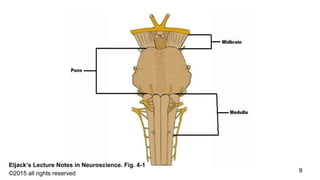
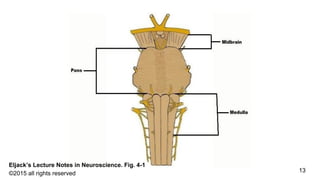
● It’s composed of three parts mainly:
○ Midbrain.
○ Pons.
○ Medulla oblongata.
● The cerebellum is considered a part of the
brainstem in some references.
8
Eljack’s Lecture Notes in Neuroscience. Fig. 4-1
©2015 all rights reserved 9
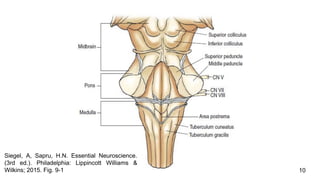
Siegel, A, Sapru, H.N. Essential Neuroscience.
(3rd ed.). Philadelphia: Lippincott Williams &
Wilkins; 2015. Fig. 9-1 10
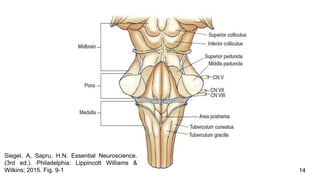
External Features of the Brainstem
● There are four hillocks in the posterior aspect
of the midbrain: two superior and two inferior
colliculi.
● Pons is the largest part of the brainstem and it
has parallel horizontal fibers.
11
● The superior, middle, and inferior cerebellar
peduncles connect the midbrain, pons, and
medulla with the cerebellum, respectively.
● It may be difficult to distinguish the lower part
of the medulla from the spinal cord.
External Features of the Brainstem
12
Eljack’s Lecture Notes in Neuroscience. Fig. 4-1
©2015 all rights reserved 13
Siegel, A, Sapru, H.N. Essential Neuroscience.
(3rd ed.). Philadelphia: Lippincott Williams &
Wilkins; 2015. Fig. 9-1 14
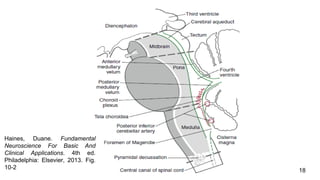
Internal Structures of the Brainstem
● The brainstem constitute a passage for all
tracts that originate from the brainstem or
terminate in the spinal cord.
● All ascending tracts that reach cerebral cortex
pass through the brainstem.
15
Internal Components of the
Brainstem
● All cranial nerves nuclei are located in the
brainstem except the olfactory and optic
nerves.
● The tectum constitute the roof of the midbrain.
● The tegmentum is a part of the brainstem
resembling the core of the midbrain and pons.
16
Internal Structures of the Brainstem
17
Internal Components of the
Brainstem
● The reticular formation lies in the tegmentum of
the brainstem.
● The basilar areas lie anterior to the tegmentum.
Internal Structures of the Brainstem
Haines, Duane. Fundamental
Neuroscience For Basic And
Clinical Applications. 4th ed.
Philadelphia: Elsevier, 2013. Fig.
10-2
18
Principles of Cranial Nerves Nuclei
19
Importance of This Section
● Understanding these principle enable the
student to understand the complexity of the
cranial nerves development, origin, structure,
and functions.
● This part is poorly understood by medical
students which results in difficulty in learning
about cranial nerves.
20
Classification of Cranial Nerves Components
● There are some overlaps and exceptions!
● According to the direction of the component:
○ Afferent: means going from peripheral
tissues to the brain (inward signal).
○ Efferent: means going from the brain to
peripheral tissues (outward signal). [consider
Efferent=Exit to memorize].
21
Classification of Cranial Nerves Components
● According to the innervated tissue:
○ Somatic: innervates primarily skeletal
muscles, joints, tendons, skin, and other
somatic parts.
○ Visceral: innervates primarily smooth
muscles, viscera, and glands.
22
Classification of Cranial Nerves Components
● According to the receptors and muscle:
○ General: standard afferents and efferents
going to different body parts.
○ Special: to the muscle from mesenchyme of
the branchial arches (muscles of
mastication) and from highly specialized
receptors (e.g. chemoreceptors).
23
Classification of Cranial Nerves Components
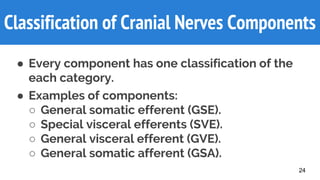
● Every component has one classification of the
each category.
● Examples of components:
○ General somatic efferent (GSE).
○ Special visceral efferents (SVE).
○ General visceral efferent (GVE).
○ General somatic afferent (GSA).
24
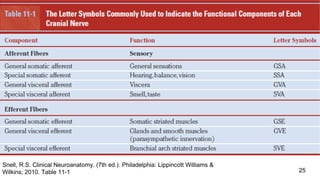
25
Snell, R.S. Clinical Neuroanatomy. (7th ed.). Philadelphia: Lippincott Williams &
Wilkins; 2010. Table 11-1
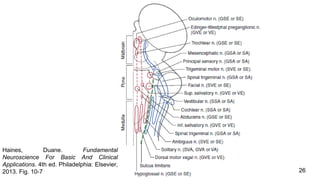
26
Haines, Duane. Fundamental
Neuroscience For Basic And Clinical
Applications. 4th ed. Philadelphia: Elsevier,
2013. Fig. 10-7
Anatomy of the Medulla Oblongata
27
28
External Features
● It develops from the myelencephalon (lower
part of the hindbrain.
● Connected to the pons rostrally and to the
spinal cord caudally.
● It has a conical shape (broader superiorly).
29
● The junction between the spinal cord and the
medulla is at the origin of the first cervical
spinal nerve (level of foramen magnum).
● The central canal of the spinal cord continues
to the lower part of the medulla.
External Features
30
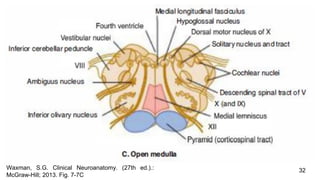
External Features
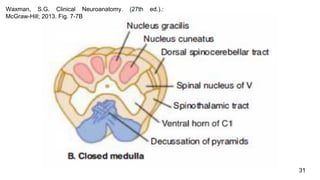
● The medulla is divided based on the presence
of the fourth ventricle into:
○ Caudal (closed) medulla
○ Rostral (open) medulla
31
Waxman, S.G. Clinical Neuroanatomy. (27th ed.).:
McGraw-Hill; 2013. Fig. 7-7B
32Waxman, S.G. Clinical Neuroanatomy. (27th ed.).:
McGraw-Hill; 2013. Fig. 7-7C
33
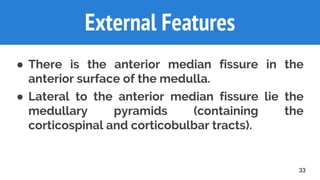
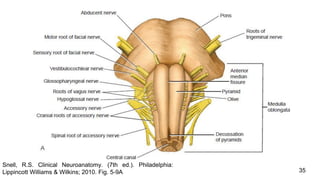
External Features
● There is the anterior median fissure in the
anterior surface of the medulla.
● Lateral to the anterior median fissure lie the
medullary pyramids (containing the
corticospinal and corticobulbar tracts).
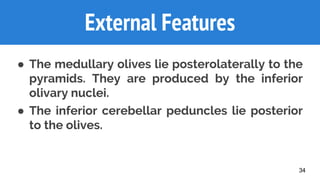
34
External Features
● The medullary olives lie posterolaterally to the
pyramids. They are produced by the inferior
olivary nuclei.
● The inferior cerebellar peduncles lie posterior
to the olives.
35
Snell, R.S. Clinical Neuroanatomy. (7th ed.). Philadelphia:
Lippincott Williams & Wilkins; 2010. Fig. 5-9A
36
External Features
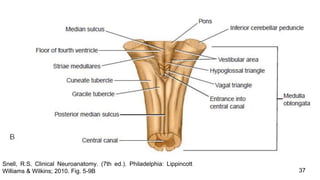
● The posterior median sulcus lies in the posterior
part of the caudal medulla.
● Lateral to the posterior median sulcus in the
caudal medulla there are the gracile and
cuneate tubercles produced by the gracile and
cuneate nuclei, respectively.
37
Snell, R.S. Clinical Neuroanatomy. (7th ed.). Philadelphia: Lippincott
Williams & Wilkins; 2010. Fig. 5-9B
38
Basics on the Internal Features
● Medulla oblongata contains grey and white
matter.
● Sulcus limitans is important to differentiate
between sensory and motor nuclei.
39
Basics on the Internal Features
● We divided the medulla anatomically into four
levels:
○ Level of pyramidal (motor) decussation
○ Level of lemniscus (sensory) decussation
○ Level of the olives (midmedullary level)
○ Level of pontomedullary junction
40
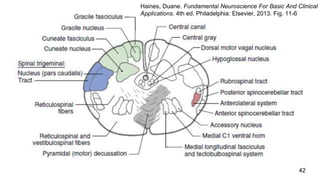
Level of Pyramidal Decussation
● Around 90% of corticospinal tracts fibers
decussate at this level.
● The cuneate and gracile nuclei (posterior
column nuclei) appear at this level to their
respective fasciculi.
41
Level of Pyramidal Decussation
● The substantia gelatinosa of the spinal cord
becomes continuous with the spinal nucleus of
the trigeminal nerve.
● Fibers of the anterolateral system and fibers of
the spinal trigeminal tract lie adjecent to each
other in the lateral medulla.
42
Haines, Duane. Fundamental Neuroscience For Basic And Clinical
Applications. 4th ed. Philadelphia: Elsevier, 2013. Fig. 11-6
43
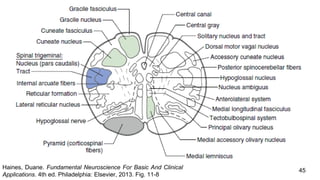
Level of Lemniscus Decussation
● The internal arcuate fibers (forming the medial
lemniscus) decussate at this level anterior to
central grey and posterior to the pyramids.
● The spinal nucleus of the trigeminal nerve lies
lateral to the internal arcuate fibers.
44
Level of Lemniscus Decussation
● The nucleus ambiguus lies medial to the spinal
trigeminal nucleus (SE components to the
glossopharyngeal and vagus nerves).
● The spinothalamic and spinotectal tracts lie
lateral to the lemniscus decussation.
45
Haines, Duane. Fundamental Neuroscience For Basic And Clinical
Applications. 4th ed. Philadelphia: Elsevier, 2013. Fig. 11-8
46
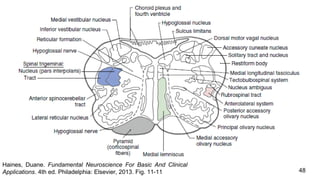
Level of the Olives
● Section at this level passes across the inferior
part of the fourth ventricle.
● Many cranial nerve nuclei appear at this level.
● The most prominent nuclei are the olivary
nuclear complex especially the inferior olivary
nucleus.
47
● The restiform body forms a prominent
elevation on the posterolateral aspect of the
medulla. It contains many cerebellar afferents.
● The spinal trigeminal tract and nucleus are
interior to the restiform body.
Level of the Olives
48
Haines, Duane. Fundamental Neuroscience For Basic And Clinical
Applications. 4th ed. Philadelphia: Elsevier, 2013. Fig. 11-11
49
Lesions of the Medulla Oblongata
50
Arnold-Chiari Syndrome
● Congenital herniation of cerebellar tonsils and
medulla through the foramen magnum.
● Results in hydrocephalus and involvement of
the last four cranial nerves along with
cerebellar signs.
51
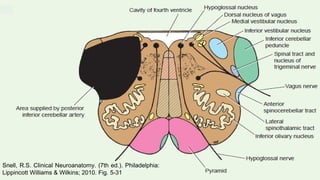
Lateral Medullary Syndrome
● Also known as “Wallenberg’s syndrome”.
● Results from a vascular lesion of the vertebral
and posterior inferior cerebellar arteries.
● Signs and symptoms include:
○ Loss of pain and temperature on the
opposite side of the body and the ipsilateral
face
52
Lateral Medullary Syndrome
○ Loss of coordination
○ Vertigo
○ Loss of the gag reflex
○ Difficulty with speech and swallowing
○ Horner’s syndrome
53
Snell, R.S. Clinical Neuroanatomy. (7th ed.). Philadelphia:
Lippincott Williams & Wilkins; 2010. Fig. 5-31
54
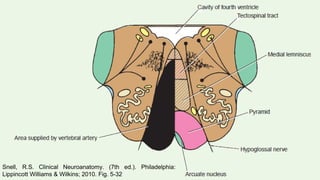
Medial Medullary Syndrome
● Also known as the “Déjérine’s syndrome”.
● Results from damage to the medial branches of
the vertebral artery or the anterior spinal artery.
● Signs and symptoms include:
○ Contralateral hemiparesis.
55
Medial Medullary Syndrome
○ Contralateral impaired prorioception and
tactile sensations
○ Ipsilateral paralysis of the tongue muscles
● In case of anterior spinal artery oclusion, signs
and symptoms may be bilateral
56
Snell, R.S. Clinical Neuroanatomy. (7th ed.). Philadelphia:
Lippincott Williams & Wilkins; 2010. Fig. 5-32
Further Readings
● Sinnatamby, C.S. Last's Anatomy Regional and
Applied. (12th ed.). : Churchill Livingstone; 2011.
● Snell, R.S. Clinical Neuroanatomy. (7th ed.).
Philadelphia: Lippincott Williams & Wilkins; 2010.
57
Further Readings
● Eljack, A. A. E. Eljack’s Lecture Notes in
Neuroscience. Khartoum; 2015.
● Siegel, A, Sapru, H.N. Essential Neuroscience.
(3rd ed.). Philadelphia: Lippincott Williams &
Wilkins; 2015.
58
● Waxman, S.G. Clinical Neuroanatomy. (27th
ed.). : McGraw-Hill; 2013.
● Medical Neuroscience MOOC by Duke
University | Coursera.
● Haines, Duane. Fundamental Neuroscience For
Basic And Clinical Applications. 4th ed.
Philadelphia: Elsevier, 2013
Further Readings
59

4. Brainstem (1): Overview & Medulla Oblongata

  • 1.
    Brainstem (1) Overview &Medulla Oblangata By: Ahmed A. E. Eljack
  • 2.
    Objectives By the endof this session you should be able to: ● Describe the brainstem, its internal and external parts, and its anatomical relations. ● List the major functions of the brainstem. ● Describe the development of the brainstem. 2
  • 3.
    3 Objectives ● Mention thedifferent components of cranial nerves. ● Describe the location and external features of the medulla oblangata.
  • 4.
    4 Objectives ● Describe theinternal structure of the medulla oblangata at different levels of section ● Mention the important clinical syndromes affecting the medulla oblongata and their clinical features.
  • 5.
    General Information onthe Brainstem 5
  • 6.
    Definition and Relations ●The brainstem is the part of the brain that lies between the cerebrum and the spinal cord. ● It has the following important functions: ○ Regulatory functions (respiratory and cardiovascular centers along with autonomic functions) 6
  • 7.
    7 Definition and Relations ○Cranial nerves nuclei (from III to XII) ○ Regulation of the level of consciousness ○ Serves as a conduit for ascending and descending tracts ● It lies in the posterior cranial fossa.
  • 8.
    Definition and Relations ●It’s composed of three parts mainly: ○ Midbrain. ○ Pons. ○ Medulla oblongata. ● The cerebellum is considered a part of the brainstem in some references. 8
  • 9.
    Eljack’s Lecture Notesin Neuroscience. Fig. 4-1 ©2015 all rights reserved 9
  • 10.
    Siegel, A, Sapru,H.N. Essential Neuroscience. (3rd ed.). Philadelphia: Lippincott Williams & Wilkins; 2015. Fig. 9-1 10
  • 11.
    External Features ofthe Brainstem ● There are four hillocks in the posterior aspect of the midbrain: two superior and two inferior colliculi. ● Pons is the largest part of the brainstem and it has parallel horizontal fibers. 11
  • 12.
    ● The superior,middle, and inferior cerebellar peduncles connect the midbrain, pons, and medulla with the cerebellum, respectively. ● It may be difficult to distinguish the lower part of the medulla from the spinal cord. External Features of the Brainstem 12
  • 13.
    Eljack’s Lecture Notesin Neuroscience. Fig. 4-1 ©2015 all rights reserved 13
  • 14.
    Siegel, A, Sapru,H.N. Essential Neuroscience. (3rd ed.). Philadelphia: Lippincott Williams & Wilkins; 2015. Fig. 9-1 14
  • 15.
    Internal Structures ofthe Brainstem ● The brainstem constitute a passage for all tracts that originate from the brainstem or terminate in the spinal cord. ● All ascending tracts that reach cerebral cortex pass through the brainstem. 15
  • 16.
    Internal Components ofthe Brainstem ● All cranial nerves nuclei are located in the brainstem except the olfactory and optic nerves. ● The tectum constitute the roof of the midbrain. ● The tegmentum is a part of the brainstem resembling the core of the midbrain and pons. 16 Internal Structures of the Brainstem
  • 17.
    17 Internal Components ofthe Brainstem ● The reticular formation lies in the tegmentum of the brainstem. ● The basilar areas lie anterior to the tegmentum. Internal Structures of the Brainstem
  • 18.
    Haines, Duane. Fundamental NeuroscienceFor Basic And Clinical Applications. 4th ed. Philadelphia: Elsevier, 2013. Fig. 10-2 18
  • 19.
    Principles of CranialNerves Nuclei 19
  • 20.
    Importance of ThisSection ● Understanding these principle enable the student to understand the complexity of the cranial nerves development, origin, structure, and functions. ● This part is poorly understood by medical students which results in difficulty in learning about cranial nerves. 20
  • 21.
    Classification of CranialNerves Components ● There are some overlaps and exceptions! ● According to the direction of the component: ○ Afferent: means going from peripheral tissues to the brain (inward signal). ○ Efferent: means going from the brain to peripheral tissues (outward signal). [consider Efferent=Exit to memorize]. 21
  • 22.
    Classification of CranialNerves Components ● According to the innervated tissue: ○ Somatic: innervates primarily skeletal muscles, joints, tendons, skin, and other somatic parts. ○ Visceral: innervates primarily smooth muscles, viscera, and glands. 22
  • 23.
    Classification of CranialNerves Components ● According to the receptors and muscle: ○ General: standard afferents and efferents going to different body parts. ○ Special: to the muscle from mesenchyme of the branchial arches (muscles of mastication) and from highly specialized receptors (e.g. chemoreceptors). 23
  • 24.
    Classification of CranialNerves Components ● Every component has one classification of the each category. ● Examples of components: ○ General somatic efferent (GSE). ○ Special visceral efferents (SVE). ○ General visceral efferent (GVE). ○ General somatic afferent (GSA). 24
  • 25.
    25 Snell, R.S. ClinicalNeuroanatomy. (7th ed.). Philadelphia: Lippincott Williams & Wilkins; 2010. Table 11-1
  • 26.
    26 Haines, Duane. Fundamental NeuroscienceFor Basic And Clinical Applications. 4th ed. Philadelphia: Elsevier, 2013. Fig. 10-7
  • 27.
    Anatomy of theMedulla Oblongata 27
  • 28.
    28 External Features ● Itdevelops from the myelencephalon (lower part of the hindbrain. ● Connected to the pons rostrally and to the spinal cord caudally. ● It has a conical shape (broader superiorly).
  • 29.
    29 ● The junctionbetween the spinal cord and the medulla is at the origin of the first cervical spinal nerve (level of foramen magnum). ● The central canal of the spinal cord continues to the lower part of the medulla. External Features
  • 30.
    30 External Features ● Themedulla is divided based on the presence of the fourth ventricle into: ○ Caudal (closed) medulla ○ Rostral (open) medulla
  • 31.
    31 Waxman, S.G. ClinicalNeuroanatomy. (27th ed.).: McGraw-Hill; 2013. Fig. 7-7B
  • 32.
    32Waxman, S.G. ClinicalNeuroanatomy. (27th ed.).: McGraw-Hill; 2013. Fig. 7-7C
  • 33.
    33 External Features ● Thereis the anterior median fissure in the anterior surface of the medulla. ● Lateral to the anterior median fissure lie the medullary pyramids (containing the corticospinal and corticobulbar tracts).
  • 34.
    34 External Features ● Themedullary olives lie posterolaterally to the pyramids. They are produced by the inferior olivary nuclei. ● The inferior cerebellar peduncles lie posterior to the olives.
  • 35.
    35 Snell, R.S. ClinicalNeuroanatomy. (7th ed.). Philadelphia: Lippincott Williams & Wilkins; 2010. Fig. 5-9A
  • 36.
    36 External Features ● Theposterior median sulcus lies in the posterior part of the caudal medulla. ● Lateral to the posterior median sulcus in the caudal medulla there are the gracile and cuneate tubercles produced by the gracile and cuneate nuclei, respectively.
  • 37.
    37 Snell, R.S. ClinicalNeuroanatomy. (7th ed.). Philadelphia: Lippincott Williams & Wilkins; 2010. Fig. 5-9B
  • 38.
    38 Basics on theInternal Features ● Medulla oblongata contains grey and white matter. ● Sulcus limitans is important to differentiate between sensory and motor nuclei.
  • 39.
    39 Basics on theInternal Features ● We divided the medulla anatomically into four levels: ○ Level of pyramidal (motor) decussation ○ Level of lemniscus (sensory) decussation ○ Level of the olives (midmedullary level) ○ Level of pontomedullary junction
  • 40.
    40 Level of PyramidalDecussation ● Around 90% of corticospinal tracts fibers decussate at this level. ● The cuneate and gracile nuclei (posterior column nuclei) appear at this level to their respective fasciculi.
  • 41.
    41 Level of PyramidalDecussation ● The substantia gelatinosa of the spinal cord becomes continuous with the spinal nucleus of the trigeminal nerve. ● Fibers of the anterolateral system and fibers of the spinal trigeminal tract lie adjecent to each other in the lateral medulla.
  • 42.
    42 Haines, Duane. FundamentalNeuroscience For Basic And Clinical Applications. 4th ed. Philadelphia: Elsevier, 2013. Fig. 11-6
  • 43.
    43 Level of LemniscusDecussation ● The internal arcuate fibers (forming the medial lemniscus) decussate at this level anterior to central grey and posterior to the pyramids. ● The spinal nucleus of the trigeminal nerve lies lateral to the internal arcuate fibers.
  • 44.
    44 Level of LemniscusDecussation ● The nucleus ambiguus lies medial to the spinal trigeminal nucleus (SE components to the glossopharyngeal and vagus nerves). ● The spinothalamic and spinotectal tracts lie lateral to the lemniscus decussation.
  • 45.
    45 Haines, Duane. FundamentalNeuroscience For Basic And Clinical Applications. 4th ed. Philadelphia: Elsevier, 2013. Fig. 11-8
  • 46.
    46 Level of theOlives ● Section at this level passes across the inferior part of the fourth ventricle. ● Many cranial nerve nuclei appear at this level. ● The most prominent nuclei are the olivary nuclear complex especially the inferior olivary nucleus.
  • 47.
    47 ● The restiformbody forms a prominent elevation on the posterolateral aspect of the medulla. It contains many cerebellar afferents. ● The spinal trigeminal tract and nucleus are interior to the restiform body. Level of the Olives
  • 48.
    48 Haines, Duane. FundamentalNeuroscience For Basic And Clinical Applications. 4th ed. Philadelphia: Elsevier, 2013. Fig. 11-11
  • 49.
    49 Lesions of theMedulla Oblongata
  • 50.
    50 Arnold-Chiari Syndrome ● Congenitalherniation of cerebellar tonsils and medulla through the foramen magnum. ● Results in hydrocephalus and involvement of the last four cranial nerves along with cerebellar signs.
  • 51.
    51 Lateral Medullary Syndrome ●Also known as “Wallenberg’s syndrome”. ● Results from a vascular lesion of the vertebral and posterior inferior cerebellar arteries. ● Signs and symptoms include: ○ Loss of pain and temperature on the opposite side of the body and the ipsilateral face
  • 52.
    52 Lateral Medullary Syndrome ○Loss of coordination ○ Vertigo ○ Loss of the gag reflex ○ Difficulty with speech and swallowing ○ Horner’s syndrome
  • 53.
    53 Snell, R.S. ClinicalNeuroanatomy. (7th ed.). Philadelphia: Lippincott Williams & Wilkins; 2010. Fig. 5-31
  • 54.
    54 Medial Medullary Syndrome ●Also known as the “Déjérine’s syndrome”. ● Results from damage to the medial branches of the vertebral artery or the anterior spinal artery. ● Signs and symptoms include: ○ Contralateral hemiparesis.
  • 55.
    55 Medial Medullary Syndrome ○Contralateral impaired prorioception and tactile sensations ○ Ipsilateral paralysis of the tongue muscles ● In case of anterior spinal artery oclusion, signs and symptoms may be bilateral
  • 56.
    56 Snell, R.S. ClinicalNeuroanatomy. (7th ed.). Philadelphia: Lippincott Williams & Wilkins; 2010. Fig. 5-32
  • 57.
    Further Readings ● Sinnatamby,C.S. Last's Anatomy Regional and Applied. (12th ed.). : Churchill Livingstone; 2011. ● Snell, R.S. Clinical Neuroanatomy. (7th ed.). Philadelphia: Lippincott Williams & Wilkins; 2010. 57
  • 58.
    Further Readings ● Eljack,A. A. E. Eljack’s Lecture Notes in Neuroscience. Khartoum; 2015. ● Siegel, A, Sapru, H.N. Essential Neuroscience. (3rd ed.). Philadelphia: Lippincott Williams & Wilkins; 2015. 58
  • 59.
    ● Waxman, S.G.Clinical Neuroanatomy. (27th ed.). : McGraw-Hill; 2013. ● Medical Neuroscience MOOC by Duke University | Coursera. ● Haines, Duane. Fundamental Neuroscience For Basic And Clinical Applications. 4th ed. Philadelphia: Elsevier, 2013 Further Readings 59