
Practical Tips and Techniques for Getting to
the Right People with the Right Messages
PRESENTED BY: DON WEINTRAUB, EXECUNET MANAGING DIRECTOR








Networking is a critical “life skill.” Knowing how to effectively network
will serve you well throughout your personal and professional life.
If you’re currently in “job search mode,” it’s most likely that your next
job will be facilitated by someone who was a stranger when your
search began.

An effective job search strategy requires you to get out there to both
meet new people and maximize current relationships.
For those of you who are INTROVERTS—push yourself no matter how
uncomfortable you feel. There is an option, however, continue to be
unemployed or dissatisfied with your current job.

2
 Your Job Search Strategy and Plan must have both a Push and a
Pull Strategy.
 Your Push Strategy requires:
A plan with clear goals and success metrics
World-class personal marketing collateral
Recruiters to help you identify “hidden jobs”
Responding to “posted jobs” (knowing they represent a small
fraction of all available jobs)
 A well-designed Networking plan-of-attack





 Your Pull Strategy is equally critical because so much of your
eventual success finding a new role is predicated on being
easily found.

3
For each networking encounter, decide:


With whom you’re hoping to speak and why



What you plan to say/share and why



What you’re looking to accomplish



How you’ll know if you’ve succeeded



What to bring as a “leave behind”



What you’re prepared to give in return for the
favor you’re about to receive

4
In my experience leading networking groups and doing
networking coaching, it’s clear that many of you are
uncomfortable with and/or resist networking. When I ask why,
here are the top five explanations you’ve shared:
#5)
#4)
#3)
#2)

I don’t know where to go or what to say.
I’ve never been unemployed/had to do this before.
I had a bad/uncomfortable experience in the past.
I’m an introvert and don’t like interacting with people I
don’t know.
#1) I don’t like asking for favors.

5
#5) I don’t know where to go or what to say.
Easily fixed. Shall I tell you where to go and what to say?
#4) I’ve never been unemployed/had to do this before.
You’ve been very lucky but we live in different times and they require
different actions.
#3) I had a bad/uncomfortable experience in the past.
Sorry to hear it. It’s time to move on.
#2) I’m an introvert and don’t like interacting face-to-face with people I
don’t know.
Then network with people you do know or do it virtually.
#1) I don’t like asking for favors.
Either get over it and/or find opportunities for you to give before
requesting help.

6









ExecuNet runs “Connections Meetings” in 30+ North American
cities.
Other highly recommended national groups:
◦ Association for Corporate Growth (ACG)
◦ Corporate Directors’ Forum
◦ If you know of others, please share them now.
Were you aware that on the ExecuNet member site, you can reach
out to any other member—even strangers?
Targeted LinkedIn Groups offer great potential.
Tap into religious, alumni, military, former employer and/or
volunteer groups. Any other suggestions?

7


Throughout your search process—from writing a resume to networking
to interviewing to negotiating to landing and onboarding—one of the
most critical (and poorly done) elements requires your knowing your
uniqueness (Value Proposition) and being able to articulate it fluently.



When networking, you’ll get a few seconds of another person’s attention.

◦ How will you maximize this opportunity?
◦ What do you want them to learn/know/take away about you?


What can you share that will generate questions/lead to a conversation

and a willingness to help you?


Do you have a “wow factor” buried in there somewhere?

8
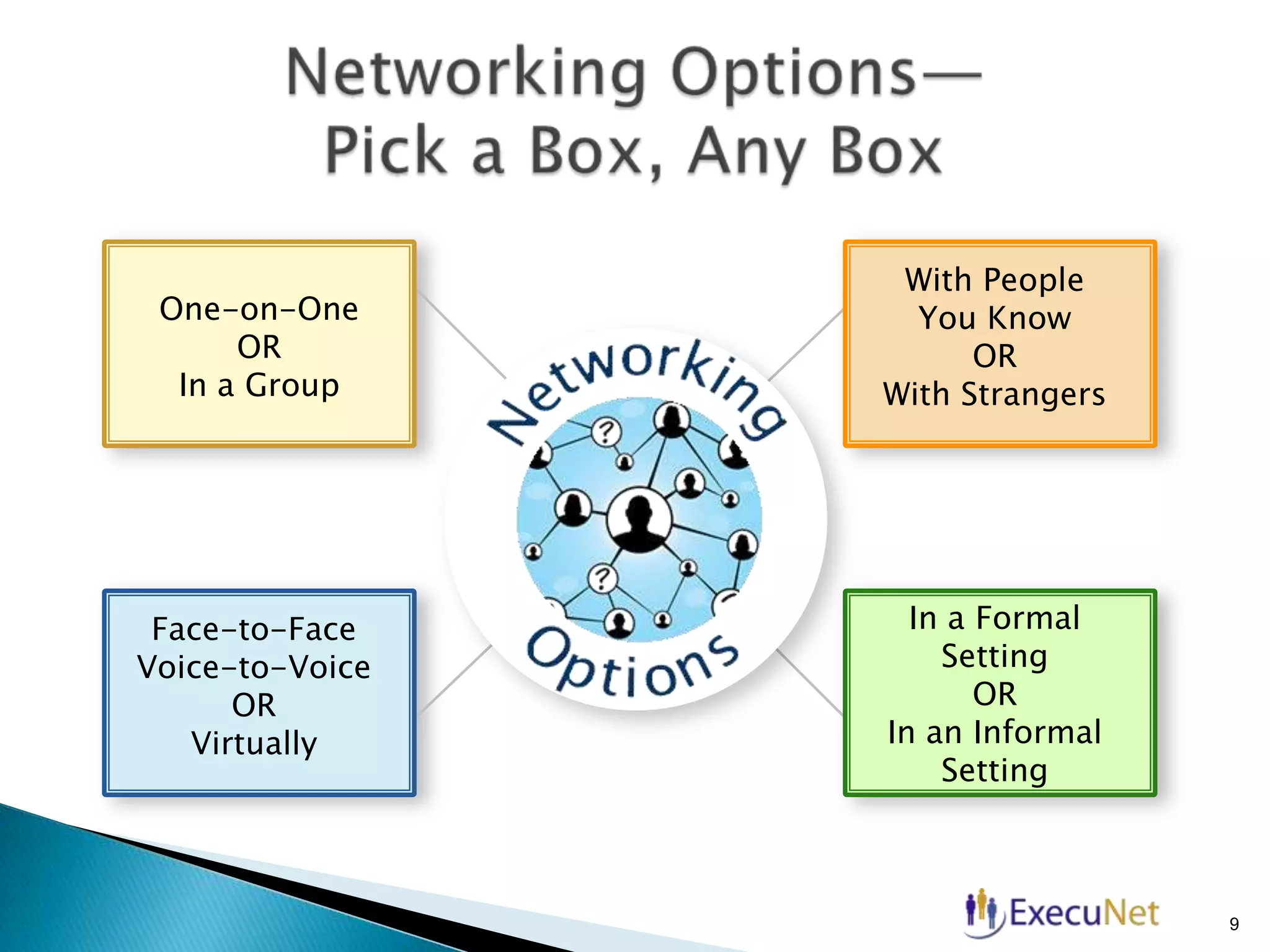
One-on-One
OR
In a Group

With People
You Know
OR
With Strangers

Face-to-Face
Voice-to-Voice
OR
Virtually

In a Formal
Setting
OR
In an Informal
Setting

9
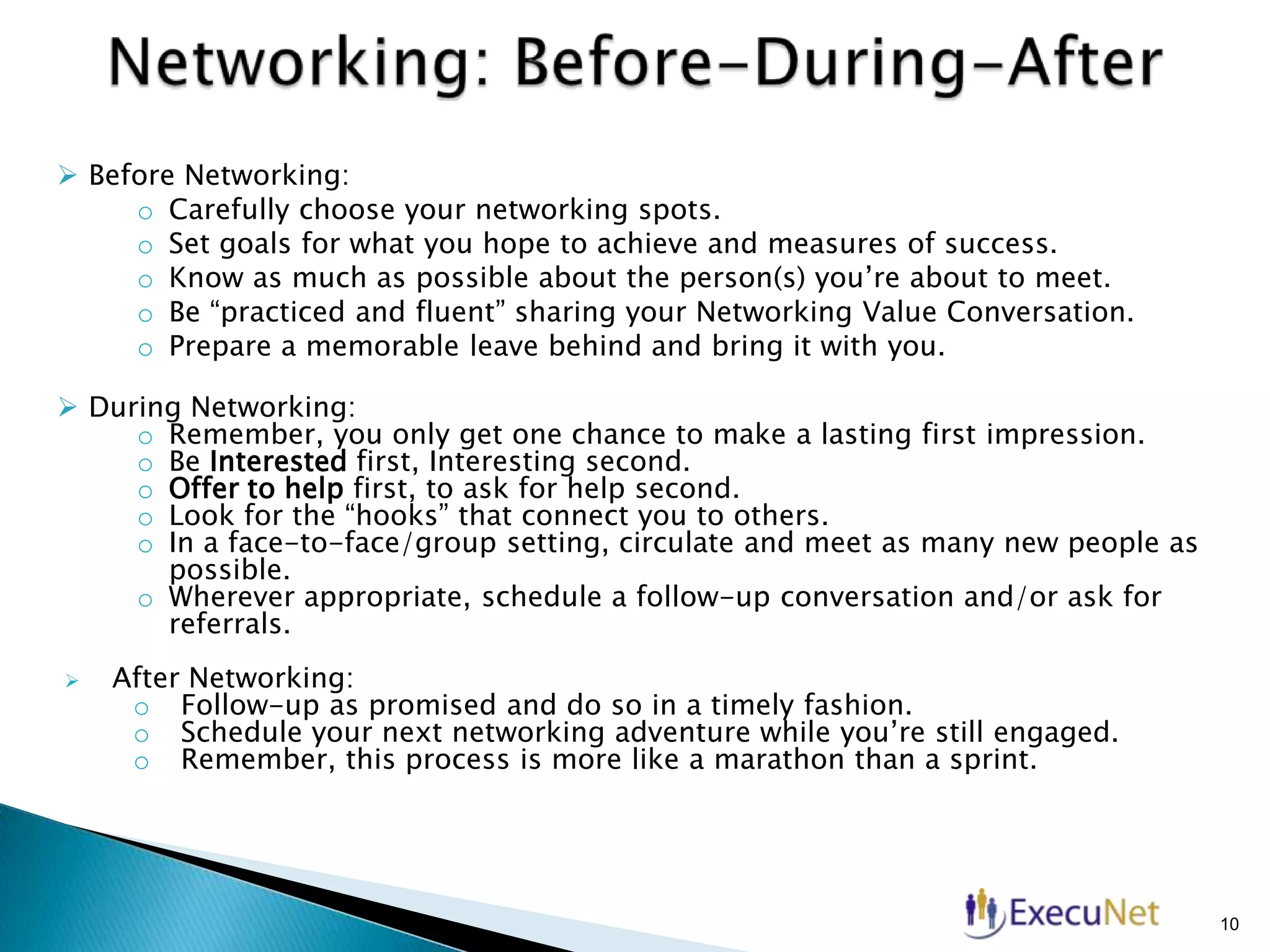
 Before Networking:
o Carefully choose your networking spots.
o Set goals for what you hope to achieve and measures of success.
o Know as much as possible about the person(s) you’re about to meet.
o Be “practiced and fluent” sharing your Networking Value Conversation.
o Prepare a memorable leave behind and bring it with you.
 During Networking:
o Remember, you only get one chance to make a lasting first impression.
o Be Interested first, Interesting second.
o Offer to help first, to ask for help second.
o Look for the “hooks” that connect you to others.
o In a face-to-face/group setting, circulate and meet as many new people as
possible.
o Wherever appropriate, schedule a follow-up conversation and/or ask for
referrals.


After Networking:
o Follow-up as promised and do so in a timely fashion.
o Schedule your next networking adventure while you’re still engaged.
o Remember, this process is more like a marathon than a sprint.

10








Most people you know/approach say they will help, mean it
when they say it and then quickly forget what they’ve
promised. It’s not personal—it is what it is.
Most people you’re expecting to help will disappoint you. A
few people you never expected to help you will step-up and
surprise you.
Offer help before you ask for help.
Make your requests for help as specific as possible.
If I only had one suggestion to make, it’s to find the
“enthusiastic introducers” in your network—those who get
great pleasure making connections and helping others—and
tap into their generosity.

11
Everything I’ve shared about networking when you’re in job
search mode applies once you’re re-employed.
In most cases, your biggest networking obstacle is you. Get
over your discomforts; get out of your own way or live with
the consequences.
Never just show up and hope for the best. Plan, prepare,
circulate, offer your help, share the two/three things you
want others to know about you and make sure to follow-up.
Your next job is MOST LIKELY to come to you through a
stranger—someone you didn’t know before starting your
search. If you’re not networking effectively, your sabotaging
your success. It’s time for a change!

12












Partner with a skilled team of career and business coaches,
marketing
strategists, HR professionals and executive recruiters who
have proven track
records of helping executives in career transition and beyond.
Get Started Now.
If you aren’t ready now, we’ll be happy to follow up with you.
Please provide
your name and email address here:
http://www.execunet.com/events?id=9130

13

Networking critical job_search_beyond_v2

  • 1.
    Practical Tips andTechniques for Getting to the Right People with the Right Messages PRESENTED BY: DON WEINTRAUB, EXECUNET MANAGING DIRECTOR
  • 2.
        Networking is acritical “life skill.” Knowing how to effectively network will serve you well throughout your personal and professional life. If you’re currently in “job search mode,” it’s most likely that your next job will be facilitated by someone who was a stranger when your search began. An effective job search strategy requires you to get out there to both meet new people and maximize current relationships. For those of you who are INTROVERTS—push yourself no matter how uncomfortable you feel. There is an option, however, continue to be unemployed or dissatisfied with your current job. 2
  • 3.
     Your JobSearch Strategy and Plan must have both a Push and a Pull Strategy.  Your Push Strategy requires: A plan with clear goals and success metrics World-class personal marketing collateral Recruiters to help you identify “hidden jobs” Responding to “posted jobs” (knowing they represent a small fraction of all available jobs)  A well-designed Networking plan-of-attack      Your Pull Strategy is equally critical because so much of your eventual success finding a new role is predicated on being easily found. 3
  • 4.
    For each networkingencounter, decide:  With whom you’re hoping to speak and why  What you plan to say/share and why  What you’re looking to accomplish  How you’ll know if you’ve succeeded  What to bring as a “leave behind”  What you’re prepared to give in return for the favor you’re about to receive 4
  • 5.
    In my experienceleading networking groups and doing networking coaching, it’s clear that many of you are uncomfortable with and/or resist networking. When I ask why, here are the top five explanations you’ve shared: #5) #4) #3) #2) I don’t know where to go or what to say. I’ve never been unemployed/had to do this before. I had a bad/uncomfortable experience in the past. I’m an introvert and don’t like interacting with people I don’t know. #1) I don’t like asking for favors. 5
  • 6.
    #5) I don’tknow where to go or what to say. Easily fixed. Shall I tell you where to go and what to say? #4) I’ve never been unemployed/had to do this before. You’ve been very lucky but we live in different times and they require different actions. #3) I had a bad/uncomfortable experience in the past. Sorry to hear it. It’s time to move on. #2) I’m an introvert and don’t like interacting face-to-face with people I don’t know. Then network with people you do know or do it virtually. #1) I don’t like asking for favors. Either get over it and/or find opportunities for you to give before requesting help. 6
  • 7.
         ExecuNet runs “ConnectionsMeetings” in 30+ North American cities. Other highly recommended national groups: ◦ Association for Corporate Growth (ACG) ◦ Corporate Directors’ Forum ◦ If you know of others, please share them now. Were you aware that on the ExecuNet member site, you can reach out to any other member—even strangers? Targeted LinkedIn Groups offer great potential. Tap into religious, alumni, military, former employer and/or volunteer groups. Any other suggestions? 7
  • 8.
     Throughout your searchprocess—from writing a resume to networking to interviewing to negotiating to landing and onboarding—one of the most critical (and poorly done) elements requires your knowing your uniqueness (Value Proposition) and being able to articulate it fluently.  When networking, you’ll get a few seconds of another person’s attention. ◦ How will you maximize this opportunity? ◦ What do you want them to learn/know/take away about you?  What can you share that will generate questions/lead to a conversation and a willingness to help you?  Do you have a “wow factor” buried in there somewhere? 8
  • 9.
    One-on-One OR In a Group WithPeople You Know OR With Strangers Face-to-Face Voice-to-Voice OR Virtually In a Formal Setting OR In an Informal Setting 9
  • 10.
     Before Networking: oCarefully choose your networking spots. o Set goals for what you hope to achieve and measures of success. o Know as much as possible about the person(s) you’re about to meet. o Be “practiced and fluent” sharing your Networking Value Conversation. o Prepare a memorable leave behind and bring it with you.  During Networking: o Remember, you only get one chance to make a lasting first impression. o Be Interested first, Interesting second. o Offer to help first, to ask for help second. o Look for the “hooks” that connect you to others. o In a face-to-face/group setting, circulate and meet as many new people as possible. o Wherever appropriate, schedule a follow-up conversation and/or ask for referrals.  After Networking: o Follow-up as promised and do so in a timely fashion. o Schedule your next networking adventure while you’re still engaged. o Remember, this process is more like a marathon than a sprint. 10
  • 11.
         Most people youknow/approach say they will help, mean it when they say it and then quickly forget what they’ve promised. It’s not personal—it is what it is. Most people you’re expecting to help will disappoint you. A few people you never expected to help you will step-up and surprise you. Offer help before you ask for help. Make your requests for help as specific as possible. If I only had one suggestion to make, it’s to find the “enthusiastic introducers” in your network—those who get great pleasure making connections and helping others—and tap into their generosity. 11
  • 12.
    Everything I’ve sharedabout networking when you’re in job search mode applies once you’re re-employed. In most cases, your biggest networking obstacle is you. Get over your discomforts; get out of your own way or live with the consequences. Never just show up and hope for the best. Plan, prepare, circulate, offer your help, share the two/three things you want others to know about you and make sure to follow-up. Your next job is MOST LIKELY to come to you through a stranger—someone you didn’t know before starting your search. If you’re not networking effectively, your sabotaging your success. It’s time for a change! 12
  • 13.
           Partner with askilled team of career and business coaches, marketing strategists, HR professionals and executive recruiters who have proven track records of helping executives in career transition and beyond. Get Started Now. If you aren’t ready now, we’ll be happy to follow up with you. Please provide your name and email address here: http://www.execunet.com/events?id=9130 13