NETWORKING COMMANDS
CONTENTS
• BASIC NETWORKING COMMANDS
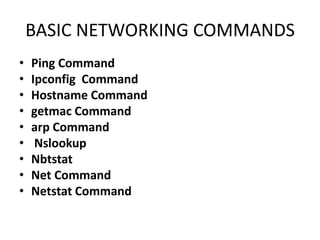
BASIC NETWORKING COMMANDS
• Ping Command
• Ipconfig Command
• Hostname Command
• getmac Command
• arp Command
• Nslookup
• Nbtstat
• Net Command
• Netstat Command
PING ((Packet Internet or Inter-
Network Groper)
• The ping command is one of the most often used
networking utilities for detecting devices on a
network and for troubleshooting network
problems.
• When you ping a device you send that device a
short message, which it then sends back (the
echo).
• The general format is ping hostname or ping
IPaddress.
• Example
• ping www.google.com or ping 216.58.208.68
IPCONFIG
• It is used for finding network information about your local
machine like IP addresses, DNS addresses etc
• Basic Use: Finding Your IP Address and Default Gateway
Type the command ipconfig at the prompt.
• ip config has a number of switches the most common are:
- ipconfig /all – displays more information about the
network setup on your systems including the MAC address.
– ipconfig /release – release the current IP address
– ipconfig /renew – renew IP address
– ipconfig /? -shows help
– ipconfig/flushdns – flush the dns cache
Hostname command
• A very simple command that displays the host
name of your machine. This is much quicker
than going to the control panel>system route.
• getmac Command
– Another very simple command that shows the
MAC address of your network interfaces
arp Command
• This is used for showing the address resolution cache.
• This command must be used with a command line
switch arp -a is the most common.
• NSlookup
– Used for checking DNS record entries.
• Nbtstat
– Diagnostic tool for troubleshooting netBIOS problems.
• Net Command
– Used for managing users,service,shares etc
• Netstat Command
• Used for displaying information about tcp and udp
connections and ports.

NETWORKING COMMANDS.pptx

  • 1.
  • 2.
  • 3.
    BASIC NETWORKING COMMANDS •Ping Command • Ipconfig Command • Hostname Command • getmac Command • arp Command • Nslookup • Nbtstat • Net Command • Netstat Command
  • 4.
    PING ((Packet Internetor Inter- Network Groper) • The ping command is one of the most often used networking utilities for detecting devices on a network and for troubleshooting network problems. • When you ping a device you send that device a short message, which it then sends back (the echo). • The general format is ping hostname or ping IPaddress. • Example • ping www.google.com or ping 216.58.208.68
  • 5.
    IPCONFIG • It isused for finding network information about your local machine like IP addresses, DNS addresses etc • Basic Use: Finding Your IP Address and Default Gateway Type the command ipconfig at the prompt. • ip config has a number of switches the most common are: - ipconfig /all – displays more information about the network setup on your systems including the MAC address. – ipconfig /release – release the current IP address – ipconfig /renew – renew IP address – ipconfig /? -shows help – ipconfig/flushdns – flush the dns cache
  • 6.
    Hostname command • Avery simple command that displays the host name of your machine. This is much quicker than going to the control panel>system route. • getmac Command – Another very simple command that shows the MAC address of your network interfaces
  • 7.
    arp Command • Thisis used for showing the address resolution cache. • This command must be used with a command line switch arp -a is the most common. • NSlookup – Used for checking DNS record entries. • Nbtstat – Diagnostic tool for troubleshooting netBIOS problems. • Net Command – Used for managing users,service,shares etc • Netstat Command • Used for displaying information about tcp and udp connections and ports.