
NETWORKING
AN INTRODUCTION TO SOME OF THE MOST COMMON TERMS IN BUSINESS THA T
EVERY IT PROFESSIONAL MUST BE AWARE OF.
NETWORKING: INTRO
NETWORKING is the construction,
design, and use of a network,
including the physical selection and
use of telecommunication
protocol.
APPLICATIONSOF NETWORKS
RESOURCE SHARING:
 Hardware
 Software
INFORMATION SHARING:
 Easy accessibility from anywhere
 Search Capability
COMMUNICATION:
 E-mail
 Message Broadcasting
TYPES OF
NETWORKS
LOCAL AREA NETWORK
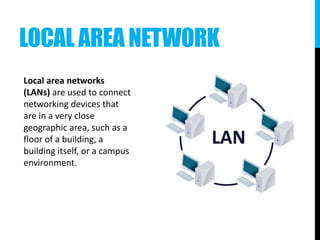
Local area networks
(LANs) are used to connect
networking devices that
are in a very close
geographic area, such as a
floor of a building, a
building itself, or a campus
environment.
WIDE AREA NETWORK
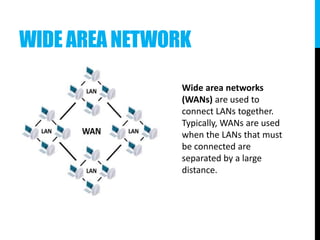
Wide area networks
(WANs) are used to
connect LANs together.
Typically, WANs are used
when the LANs that must
be connected are
separated by a large
distance.
METROPOLITAN AREA NETWORK
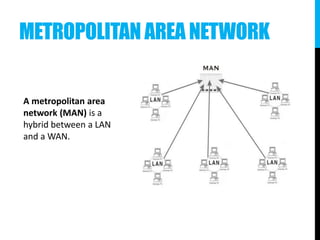
A metropolitan area
network (MAN) is a
hybrid between a LAN
and a WAN.
NETWORK
NODES
NETWORK INTERFACES: Provides a computer with the ability to access the
transmission media, and has the ability to process low-level network
information.
REPEATER: An electronic device that receives a network signal, cleans it of
unnecessary noise, and regenerates it.
HUB: A repeater with multiple ports is known as a hub.
BRIDGE: Connects and filters traffic between two network segments at the
data link layer to form a single network.
SWITCH: Device that forwards and filters OSI layer 2 datagrams between
ports based on the MAC addresses in the packets.
ROUTER: An internetworking device that forwards packets between
networks by processing the routing information included in the packet or
datagram.
MODEM: Used to connect network nodes via wire not originally designed
for digital network traffic, or for wireless.
FIREWALL: Network device for controlling network security and access
rules.
NETWORK
TOPOLOGY
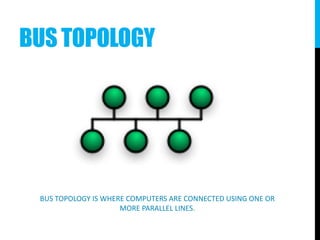
BUS TOPOLOGY
BUS TOPOLOGY IS WHERE COMPUTERS ARE CONNECTED USING ONE OR
MORE PARALLEL LINES.
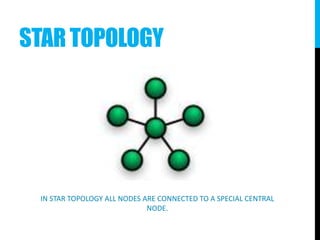
STAR TOPOLOGY
IN STAR TOPOLOGY ALL NODES ARE CONNECTED TO A SPECIAL CENTRAL
NODE.
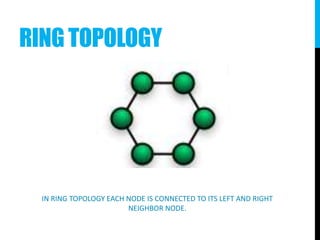
RING TOPOLOGY
IN RING TOPOLOGY EACH NODE IS CONNECTED TO ITS LEFT AND RIGHT
NEIGHBOR NODE.
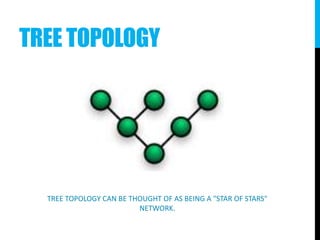
TREE TOPOLOGY
TREE TOPOLOGY CAN BE THOUGHT OF AS BEING A "STAR OF STARS"
NETWORK.
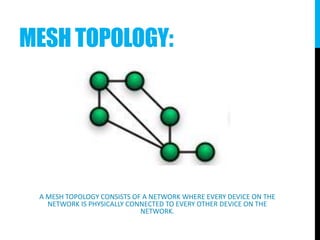
MESH TOPOLOGY:
A MESH TOPOLOGY CONSISTS OF A NETWORK WHERE EVERY DEVICE ON THE
NETWORK IS PHYSICALLY CONNECTED TO EVERY OTHER DEVICE ON THE
NETWORK.
MODERN
INTERNETWORK
INTRANET: The main purpose of an intranet is to share
company information and computing resources among
employees.
EXTRANET: An extranet is a computer network that allows
controlled access from outside of an organization's intranet.
INTERNET: The Internet is a global system of interconnected
computer networks that use the standard Internet protocol
suite (TCP/IP) to link several billion devices worldwide.
TYPES OF
COMMUNICATION
IN NETWORK
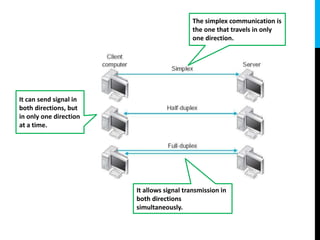
The simplex communication is
the one that travels in only
one direction.
It can send signal in
both directions, but
in only one direction
at a time.
It allows signal transmission in
both directions
simultaneously.
THANK
YOU!!!

Networking

  • 1.
    NETWORKING AN INTRODUCTION TOSOME OF THE MOST COMMON TERMS IN BUSINESS THA T EVERY IT PROFESSIONAL MUST BE AWARE OF.
  • 2.
    NETWORKING: INTRO NETWORKING isthe construction, design, and use of a network, including the physical selection and use of telecommunication protocol.
  • 3.
    APPLICATIONSOF NETWORKS RESOURCE SHARING: Hardware  Software INFORMATION SHARING:  Easy accessibility from anywhere  Search Capability COMMUNICATION:  E-mail  Message Broadcasting
  • 4.
  • 5.
    LOCAL AREA NETWORK Localarea networks (LANs) are used to connect networking devices that are in a very close geographic area, such as a floor of a building, a building itself, or a campus environment.
  • 6.
    WIDE AREA NETWORK Widearea networks (WANs) are used to connect LANs together. Typically, WANs are used when the LANs that must be connected are separated by a large distance.
  • 7.
    METROPOLITAN AREA NETWORK Ametropolitan area network (MAN) is a hybrid between a LAN and a WAN.
  • 8.
  • 9.
    NETWORK INTERFACES: Providesa computer with the ability to access the transmission media, and has the ability to process low-level network information. REPEATER: An electronic device that receives a network signal, cleans it of unnecessary noise, and regenerates it. HUB: A repeater with multiple ports is known as a hub. BRIDGE: Connects and filters traffic between two network segments at the data link layer to form a single network. SWITCH: Device that forwards and filters OSI layer 2 datagrams between ports based on the MAC addresses in the packets. ROUTER: An internetworking device that forwards packets between networks by processing the routing information included in the packet or datagram. MODEM: Used to connect network nodes via wire not originally designed for digital network traffic, or for wireless. FIREWALL: Network device for controlling network security and access rules.
  • 10.
  • 11.
    BUS TOPOLOGY BUS TOPOLOGYIS WHERE COMPUTERS ARE CONNECTED USING ONE OR MORE PARALLEL LINES.
  • 12.
    STAR TOPOLOGY IN STARTOPOLOGY ALL NODES ARE CONNECTED TO A SPECIAL CENTRAL NODE.
  • 13.
    RING TOPOLOGY IN RINGTOPOLOGY EACH NODE IS CONNECTED TO ITS LEFT AND RIGHT NEIGHBOR NODE.
  • 14.
    TREE TOPOLOGY TREE TOPOLOGYCAN BE THOUGHT OF AS BEING A "STAR OF STARS" NETWORK.
  • 15.
    MESH TOPOLOGY: A MESHTOPOLOGY CONSISTS OF A NETWORK WHERE EVERY DEVICE ON THE NETWORK IS PHYSICALLY CONNECTED TO EVERY OTHER DEVICE ON THE NETWORK.
  • 16.
  • 17.
    INTRANET: The mainpurpose of an intranet is to share company information and computing resources among employees. EXTRANET: An extranet is a computer network that allows controlled access from outside of an organization's intranet. INTERNET: The Internet is a global system of interconnected computer networks that use the standard Internet protocol suite (TCP/IP) to link several billion devices worldwide.
  • 18.
  • 19.
    The simplex communicationis the one that travels in only one direction. It can send signal in both directions, but in only one direction at a time. It allows signal transmission in both directions simultaneously.
  • 20.