1AWU vijayapur5/28/2018 7:09 AM
2
Security Vulnerability and Security
Requirements using Key Management
in Sensor Network
5/28/2018 7:09 AM
AWU vijayapur
3AWU vijayapur
Presented by:
5/28/2018 7:09 AM
4AWU vijayapur
PRESENTATION OBJECTIVES
Security constraint
 Security vulnerability
 Security attacks
 Robust security
 Key management
Public key
 Elliptic Curve Cryptography (ECC)
5/28/2018 7:09 AM
5AWU vijayapur
What is a sensor network?
Consists of spatially distributed sensors
Sensors work cooperatively
Used to monitor or detect phenomena at a
particular location
Sensor node has sensing, data processing
and communication components
Resource constrained, limited battery
5/28/2018 7:09 AM
6AWU vijayapur
Applications of sensor networks
Environmental monitoring – great duck island
Video surveillance
Traffic monitoring
Air traffic control
Robotics
Cars
Home monitoring
Industrial and manufacturing automation.
5/28/2018 7:09 AM
7AWU vijayapur
Constraints in Wireless Sensor
Networks:
The traditional security mechanism of normal computer network may not
directly shift to the sensor network because of the resource constraint nature
of the nodes.
 In order to optimize the conventional security algorithms for WSNs, it is
necessary to be aware about the constraints of sensor nodes.
Communication is more costly than computation in sensor networks.
 Further, higher security levels in sensor networks usually correspond to
more energy consumption for cryptographic functions.
 Thus, Sensor networks could be divided into different security levels
depending on energy cost.
5/28/2018 7:09 AM
8AWU vijayapur5/28/2018 7:09 AM
9AWU vijayapur
Security Vulnerability
The broadcast nature of communication, lack of
infrastructure and hostile environment for the
deployment may lead to vulnerability in sensor
network.
The different attacks are possible in various
constraints based sensor network.
5/28/2018 7:09 AM
10AWU vijayapur
The broadcast nature of communication, infrastructural
constraint, power limitation and hostile environment for the
deployment may lead to adversaries in sensor network.
Types of Adversaries
1. Passive Adversaries
2. active Adversaries
5/28/2018 7:09 AM
11AWU vijayapur
Security Attacks in Sensor Network
Sensor network uses Application layer, Transport layer,
Network layer, Data-link layer and Physical layer for the
communication across the sensor network.
 These layers are having its own functionality and
security requirements. According to the implementation
they provide security. Every layer has its own set of
protocol for unique functionality.
 Different attacks are transpiring at different layer for the
communication.
5/28/2018 7:09 AM
12AWU vijayapur
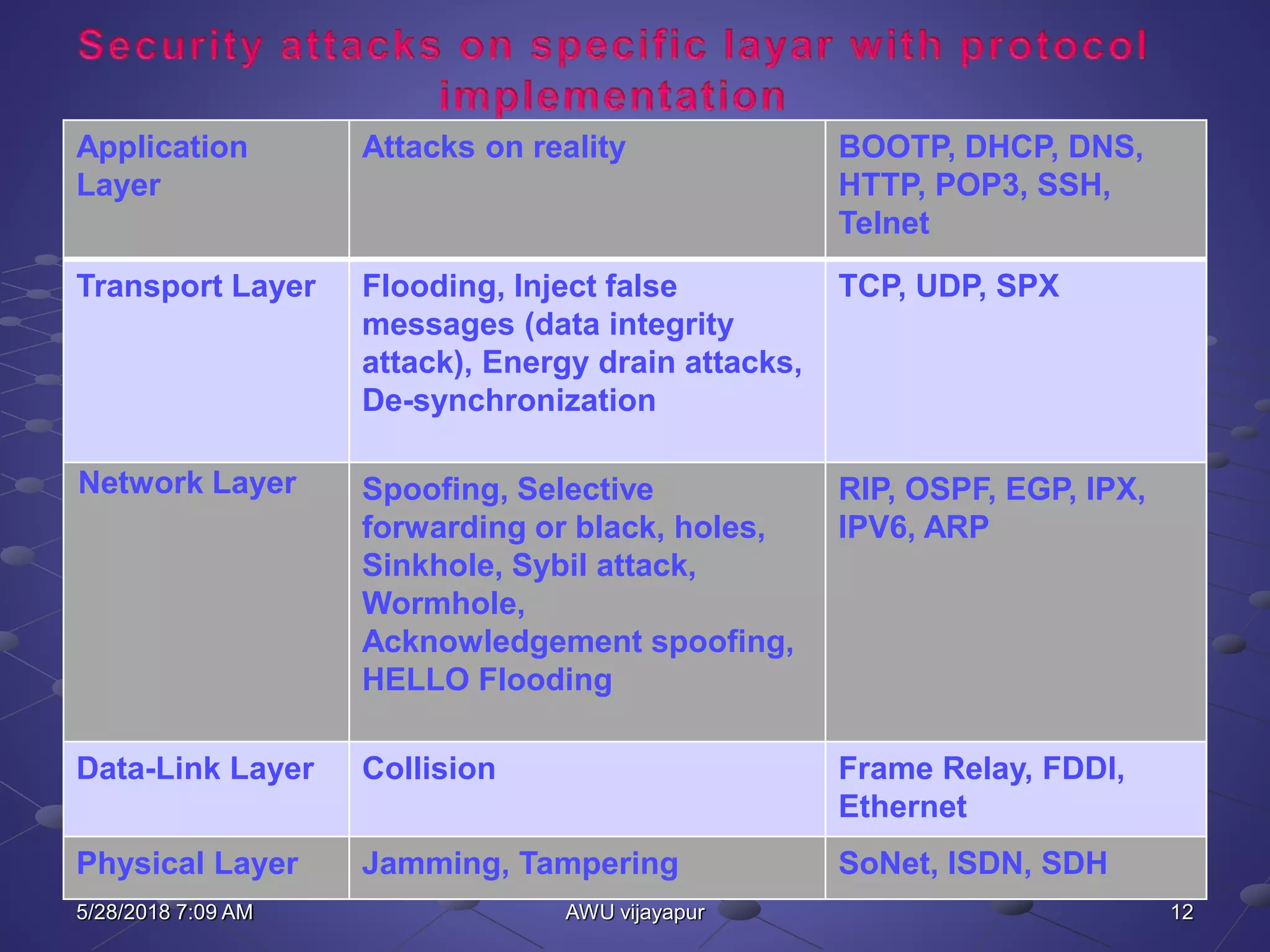
Application
Layer
Attacks on reality BOOTP, DHCP, DNS,
HTTP, POP3, SSH,
Telnet
Transport Layer Flooding, Inject false
messages (data integrity
attack), Energy drain attacks,
De-synchronization
TCP, UDP, SPX
Network Layer Spoofing, Selective
forwarding or black, holes,
Sinkhole, Sybil attack,
Wormhole,
Acknowledgement spoofing,
HELLO Flooding
RIP, OSPF, EGP, IPX,
IPV6, ARP
Data-Link Layer Collision Frame Relay, FDDI,
Ethernet
Physical Layer Jamming, Tampering SoNet, ISDN, SDH
5/28/2018 7:09 AM
13AWU vijayapur
The number of mechanisms are available to provide robust
security.
In sensor network using asymmetric or symmetric concept
of cryptography.
The algorithm is enriched with various calculations through
which the cipher text becomes unpredictable and breaking
the security by eavesdropper becomes harder.
5/28/2018 7:09 AM
14AWU vijayapur
Security Requirements
Security requirements mainly focus on authentication,
confidentiality and integrity.
 The authentication can achieve through hash or MAC /
HMAC algorithms.
 Confidentiality can achieve through encryption
algorithms.
The encryption algorithms may have symmetric or
asymmetric in nature.
5/28/2018 7:09 AM
15AWU vijayapur
Security Requirements in Wireless
Sensor Networks:
 Availability
 Authentication
 Integrity
 Confidentiality
 Non repudiation
 Data freshness
 Robustness
 Self-Healing
 Time Synchronization
5/28/2018 7:09 AM
16AWU vijayapur
Symmetric key cryptography in
WSNs:
Symmetric key cryptographic mechanisms use a single
shared key between the two communicating host which is used
both for encryption and decryption.
 However, one major challenge for deployment of symmetric
key cryptography is how to securely distribute the shared key
between the two communicating hosts.
 This is a non-trivial problem since pre-distributing the key
may not always be feasible
5/28/2018 7:09 AM
17AWU vijayapur
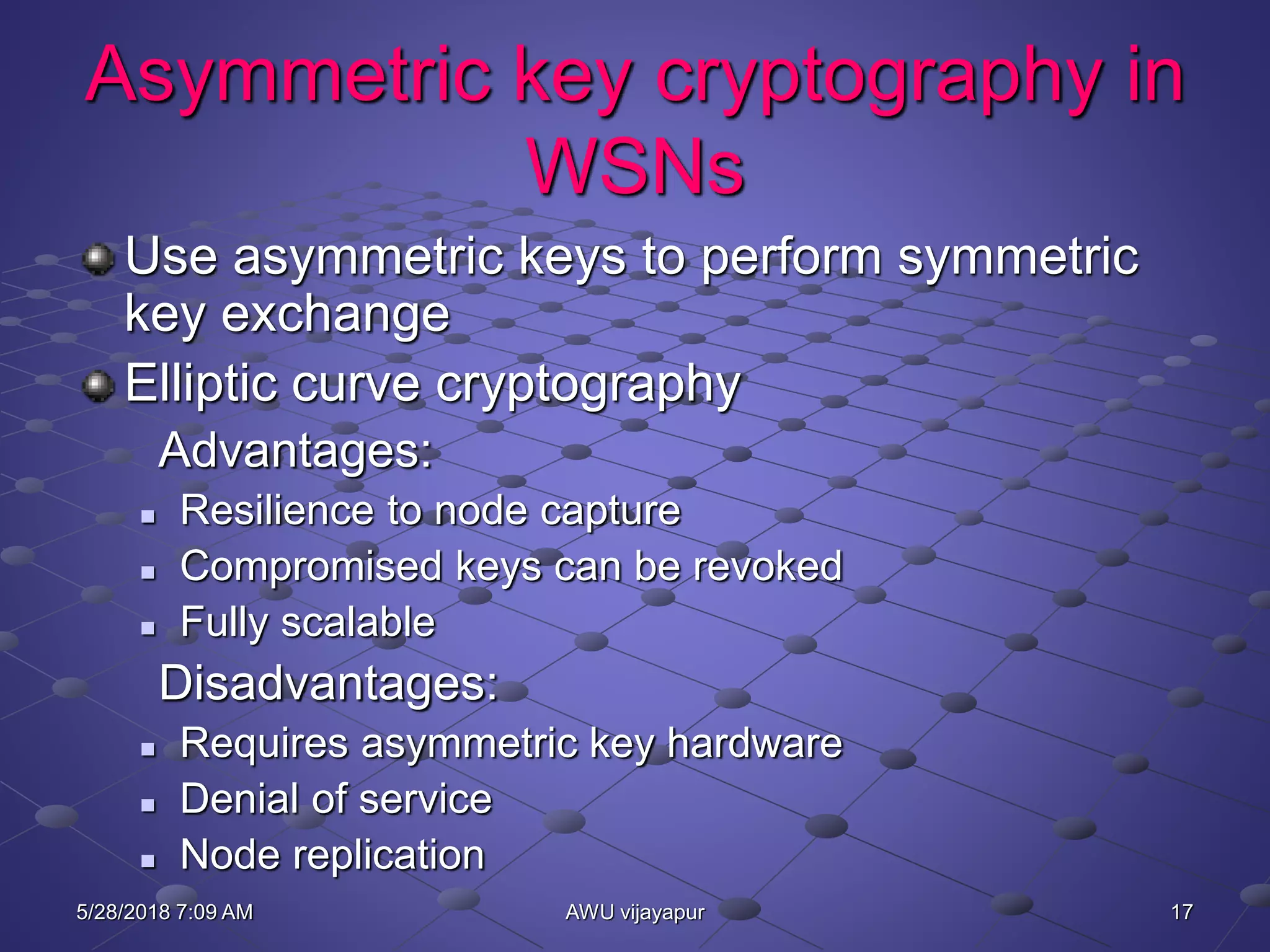
Asymmetric key cryptography in
WSNs
Use asymmetric keys to perform symmetric
key exchange
Elliptic curve cryptography
Advantages:
 Resilience to node capture
 Compromised keys can be revoked
 Fully scalable
Disadvantages:
 Requires asymmetric key hardware
 Denial of service
 Node replication
5/28/2018 7:09 AM
18AWU vijayapur
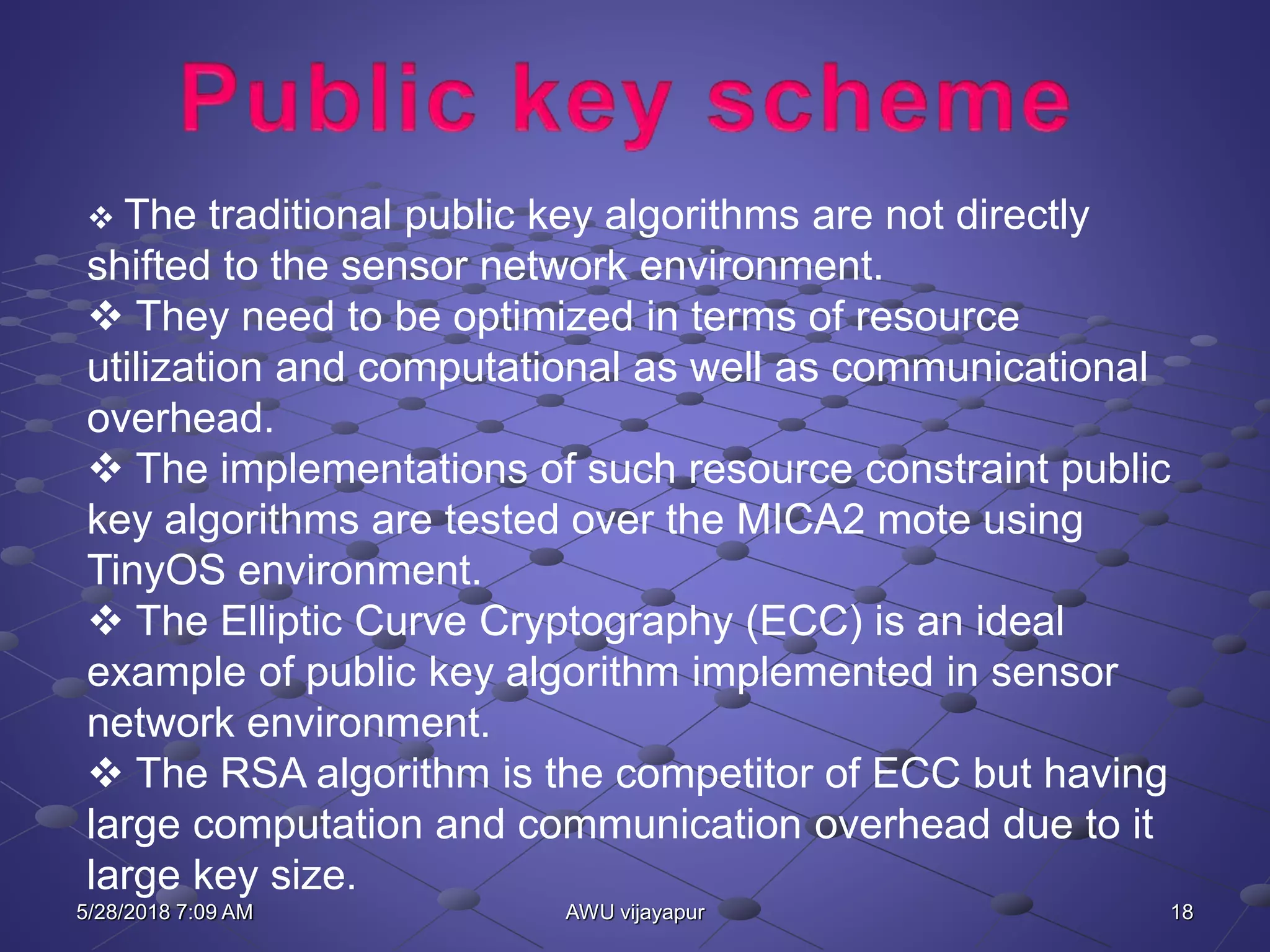
 The traditional public key algorithms are not directly
shifted to the sensor network environment.
 They need to be optimized in terms of resource
utilization and computational as well as communicational
overhead.
 The implementations of such resource constraint public
key algorithms are tested over the MICA2 mote using
TinyOS environment.
 The Elliptic Curve Cryptography (ECC) is an ideal
example of public key algorithm implemented in sensor
network environment.
 The RSA algorithm is the competitor of ECC but having
large computation and communication overhead due to it
large key size.
5/28/2018 7:09 AM
19AWU vijayapur5/28/2018 7:09 AM
20AWU vijayapur
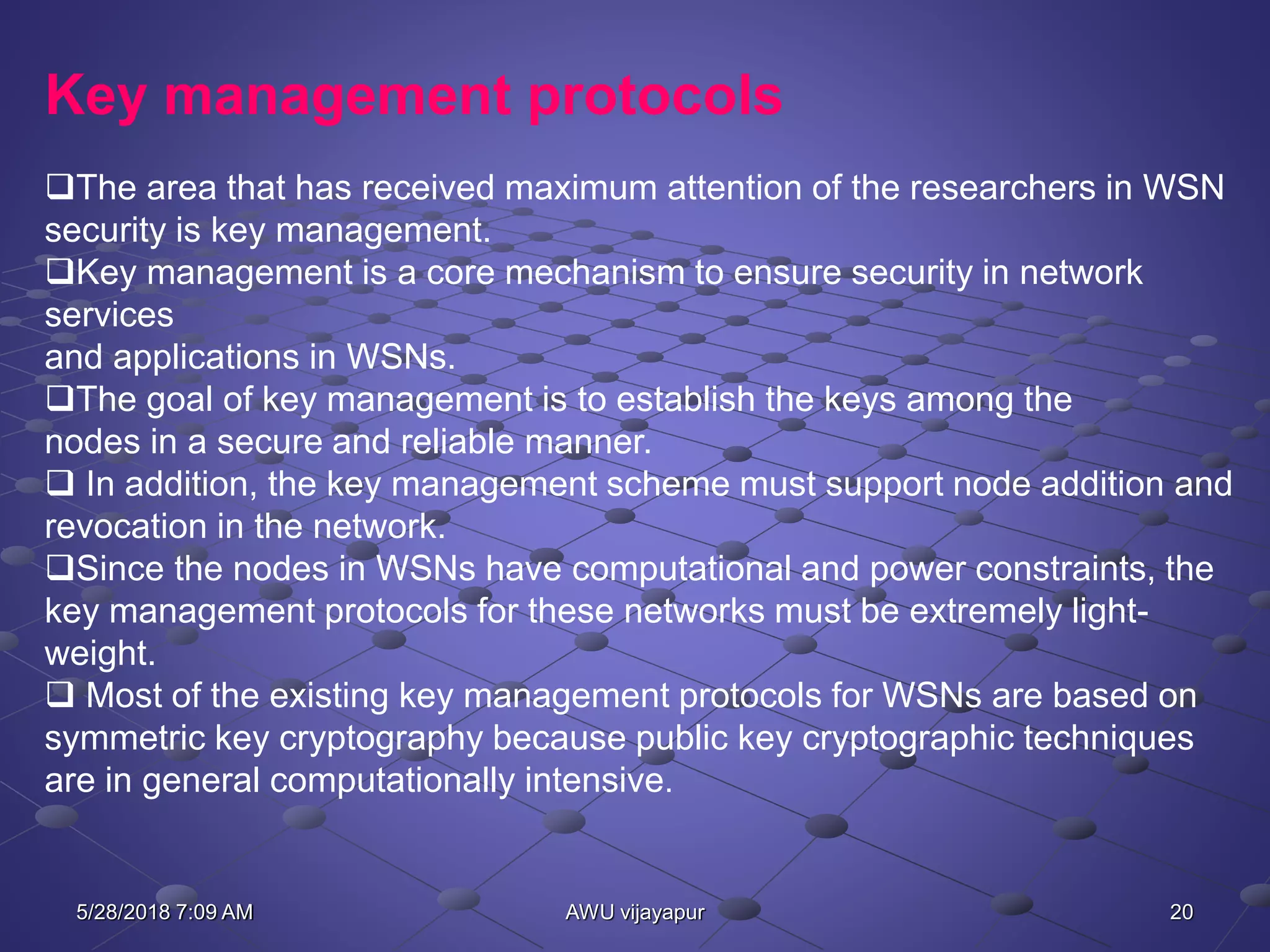
Key management protocols
The area that has received maximum attention of the researchers in WSN
security is key management.
Key management is a core mechanism to ensure security in network
services
and applications in WSNs.
The goal of key management is to establish the keys among the
nodes in a secure and reliable manner.
 In addition, the key management scheme must support node addition and
revocation in the network.
Since the nodes in WSNs have computational and power constraints, the
key management protocols for these networks must be extremely light-
weight.
 Most of the existing key management protocols for WSNs are based on
symmetric key cryptography because public key cryptographic techniques
are in general computationally intensive.
5/28/2018 7:09 AM
21AWU vijayapur
Conclusion
In this paper, we demonstrate various constraints in sensor network.
We also specify the vulnerability situation where the various
security attacks are occur at each layer during the communication.
We also demonstrate the security requirement in sensor network
and finally we suggest the public key management scheme using
Elliptic Curve Cryptography to reduce storage space requirement,
reduce communication as well as computational overhead and
provide robust security using elliptic curve operation like point
addition and point multiplications.
5/28/2018 7:09 AM
22AWU vijayapur
References
[1] J. Xu, J. Wang, S. Xie, W. Chen and J. Kim, “Study on Intrusion
Detection Policy for Wireless Sensor Networks”, International Journal of
Security and Its Applications, vol. 7, no. 1, (2013) January, pp. 1-6.
[2] I. Akyildiz, W. Su, Y. Sankarasubramaniam, and E. Cayirci, “Wireless
Sensor Networks: a Survey”, Computer Networks, vol. 38, no. 4, (2002), pp.
393-422.
[3] K. Martinez, J. Hart, and R. Ong, “Environmental Sensor Networks”,
IEEE Computer, vol. 37, no. 8, (2004), pp. 50-56
[4] R. Abouhogail, “Security Assessment for Key Management in Mobile Ad
Hoc Networks”, International Journal of Security and Its Applications, vol. 8,
no. 1, (2014), pp. 169-182, http://dx.doi.org/10.14257/ijsia.2014.8.1.16
[5] J. Zhang, J. Tan, and J. Li, “Key Distribution using Double Keyed-hash
Chains for Wireless Sensor Networks”, International Journal of Security and
Its Applications, vol. 7,
5/28/2018 7:09 AM
23AWU vijayapur
[6] E. Ngai, J. Liu, and M. Lyu, “On the Intruder Detection for Sinkhole Attack in
Wireless Sensor Networks”, IEEE International Conference on
Communications, (2006).
[7] D. Martins and H. Guyennet, “Wireless Sensor Network Attacks and Security
Mechanisms: A Short Survey”, 13th International Conference on Network-
Based Information Systems, (2010).
[8] M. Jain, “Wireless Sensor Networks: Security Issues and Challenges”,
International Journal of Computer and Information Technology, vol. 2, no. 1,
(2011), pp. 62-67.
[9] N. Sethi and D. Sharma, “A Novel Method of Image Encryption Using
Logistic Mapping”, International Journal of Computer Science Engineering, vol.
1, no. 2, (2012) November.
[10] S. Karmakar and S. Chandra, “An Approach for Ensuring Security and its
Verification”, International Journal of Computer Science Engineering”, vol. 2, no.
3, (2013) May.
5/28/2018 7:09 AM
24AWU vijayapur5/28/2018 7:09 AM

Network security ppt

  • 1.
  • 2.
    2 Security Vulnerability andSecurity Requirements using Key Management in Sensor Network 5/28/2018 7:09 AM AWU vijayapur
  • 3.
  • 4.
    4AWU vijayapur PRESENTATION OBJECTIVES Securityconstraint  Security vulnerability  Security attacks  Robust security  Key management Public key  Elliptic Curve Cryptography (ECC) 5/28/2018 7:09 AM
  • 5.
    5AWU vijayapur What isa sensor network? Consists of spatially distributed sensors Sensors work cooperatively Used to monitor or detect phenomena at a particular location Sensor node has sensing, data processing and communication components Resource constrained, limited battery 5/28/2018 7:09 AM
  • 6.
    6AWU vijayapur Applications ofsensor networks Environmental monitoring – great duck island Video surveillance Traffic monitoring Air traffic control Robotics Cars Home monitoring Industrial and manufacturing automation. 5/28/2018 7:09 AM
  • 7.
    7AWU vijayapur Constraints inWireless Sensor Networks: The traditional security mechanism of normal computer network may not directly shift to the sensor network because of the resource constraint nature of the nodes.  In order to optimize the conventional security algorithms for WSNs, it is necessary to be aware about the constraints of sensor nodes. Communication is more costly than computation in sensor networks.  Further, higher security levels in sensor networks usually correspond to more energy consumption for cryptographic functions.  Thus, Sensor networks could be divided into different security levels depending on energy cost. 5/28/2018 7:09 AM
  • 8.
  • 9.
    9AWU vijayapur Security Vulnerability Thebroadcast nature of communication, lack of infrastructure and hostile environment for the deployment may lead to vulnerability in sensor network. The different attacks are possible in various constraints based sensor network. 5/28/2018 7:09 AM
  • 10.
    10AWU vijayapur The broadcastnature of communication, infrastructural constraint, power limitation and hostile environment for the deployment may lead to adversaries in sensor network. Types of Adversaries 1. Passive Adversaries 2. active Adversaries 5/28/2018 7:09 AM
  • 11.
    11AWU vijayapur Security Attacksin Sensor Network Sensor network uses Application layer, Transport layer, Network layer, Data-link layer and Physical layer for the communication across the sensor network.  These layers are having its own functionality and security requirements. According to the implementation they provide security. Every layer has its own set of protocol for unique functionality.  Different attacks are transpiring at different layer for the communication. 5/28/2018 7:09 AM
  • 12.
    12AWU vijayapur Application Layer Attacks onreality BOOTP, DHCP, DNS, HTTP, POP3, SSH, Telnet Transport Layer Flooding, Inject false messages (data integrity attack), Energy drain attacks, De-synchronization TCP, UDP, SPX Network Layer Spoofing, Selective forwarding or black, holes, Sinkhole, Sybil attack, Wormhole, Acknowledgement spoofing, HELLO Flooding RIP, OSPF, EGP, IPX, IPV6, ARP Data-Link Layer Collision Frame Relay, FDDI, Ethernet Physical Layer Jamming, Tampering SoNet, ISDN, SDH 5/28/2018 7:09 AM
  • 13.
    13AWU vijayapur The numberof mechanisms are available to provide robust security. In sensor network using asymmetric or symmetric concept of cryptography. The algorithm is enriched with various calculations through which the cipher text becomes unpredictable and breaking the security by eavesdropper becomes harder. 5/28/2018 7:09 AM
  • 14.
    14AWU vijayapur Security Requirements Securityrequirements mainly focus on authentication, confidentiality and integrity.  The authentication can achieve through hash or MAC / HMAC algorithms.  Confidentiality can achieve through encryption algorithms. The encryption algorithms may have symmetric or asymmetric in nature. 5/28/2018 7:09 AM
  • 15.
    15AWU vijayapur Security Requirementsin Wireless Sensor Networks:  Availability  Authentication  Integrity  Confidentiality  Non repudiation  Data freshness  Robustness  Self-Healing  Time Synchronization 5/28/2018 7:09 AM
  • 16.
    16AWU vijayapur Symmetric keycryptography in WSNs: Symmetric key cryptographic mechanisms use a single shared key between the two communicating host which is used both for encryption and decryption.  However, one major challenge for deployment of symmetric key cryptography is how to securely distribute the shared key between the two communicating hosts.  This is a non-trivial problem since pre-distributing the key may not always be feasible 5/28/2018 7:09 AM
  • 17.
    17AWU vijayapur Asymmetric keycryptography in WSNs Use asymmetric keys to perform symmetric key exchange Elliptic curve cryptography Advantages:  Resilience to node capture  Compromised keys can be revoked  Fully scalable Disadvantages:  Requires asymmetric key hardware  Denial of service  Node replication 5/28/2018 7:09 AM
  • 18.
    18AWU vijayapur  Thetraditional public key algorithms are not directly shifted to the sensor network environment.  They need to be optimized in terms of resource utilization and computational as well as communicational overhead.  The implementations of such resource constraint public key algorithms are tested over the MICA2 mote using TinyOS environment.  The Elliptic Curve Cryptography (ECC) is an ideal example of public key algorithm implemented in sensor network environment.  The RSA algorithm is the competitor of ECC but having large computation and communication overhead due to it large key size. 5/28/2018 7:09 AM
  • 19.
  • 20.
    20AWU vijayapur Key managementprotocols The area that has received maximum attention of the researchers in WSN security is key management. Key management is a core mechanism to ensure security in network services and applications in WSNs. The goal of key management is to establish the keys among the nodes in a secure and reliable manner.  In addition, the key management scheme must support node addition and revocation in the network. Since the nodes in WSNs have computational and power constraints, the key management protocols for these networks must be extremely light- weight.  Most of the existing key management protocols for WSNs are based on symmetric key cryptography because public key cryptographic techniques are in general computationally intensive. 5/28/2018 7:09 AM
  • 21.
    21AWU vijayapur Conclusion In thispaper, we demonstrate various constraints in sensor network. We also specify the vulnerability situation where the various security attacks are occur at each layer during the communication. We also demonstrate the security requirement in sensor network and finally we suggest the public key management scheme using Elliptic Curve Cryptography to reduce storage space requirement, reduce communication as well as computational overhead and provide robust security using elliptic curve operation like point addition and point multiplications. 5/28/2018 7:09 AM
  • 22.
    22AWU vijayapur References [1] J.Xu, J. Wang, S. Xie, W. Chen and J. Kim, “Study on Intrusion Detection Policy for Wireless Sensor Networks”, International Journal of Security and Its Applications, vol. 7, no. 1, (2013) January, pp. 1-6. [2] I. Akyildiz, W. Su, Y. Sankarasubramaniam, and E. Cayirci, “Wireless Sensor Networks: a Survey”, Computer Networks, vol. 38, no. 4, (2002), pp. 393-422. [3] K. Martinez, J. Hart, and R. Ong, “Environmental Sensor Networks”, IEEE Computer, vol. 37, no. 8, (2004), pp. 50-56 [4] R. Abouhogail, “Security Assessment for Key Management in Mobile Ad Hoc Networks”, International Journal of Security and Its Applications, vol. 8, no. 1, (2014), pp. 169-182, http://dx.doi.org/10.14257/ijsia.2014.8.1.16 [5] J. Zhang, J. Tan, and J. Li, “Key Distribution using Double Keyed-hash Chains for Wireless Sensor Networks”, International Journal of Security and Its Applications, vol. 7, 5/28/2018 7:09 AM
  • 23.
    23AWU vijayapur [6] E.Ngai, J. Liu, and M. Lyu, “On the Intruder Detection for Sinkhole Attack in Wireless Sensor Networks”, IEEE International Conference on Communications, (2006). [7] D. Martins and H. Guyennet, “Wireless Sensor Network Attacks and Security Mechanisms: A Short Survey”, 13th International Conference on Network- Based Information Systems, (2010). [8] M. Jain, “Wireless Sensor Networks: Security Issues and Challenges”, International Journal of Computer and Information Technology, vol. 2, no. 1, (2011), pp. 62-67. [9] N. Sethi and D. Sharma, “A Novel Method of Image Encryption Using Logistic Mapping”, International Journal of Computer Science Engineering, vol. 1, no. 2, (2012) November. [10] S. Karmakar and S. Chandra, “An Approach for Ensuring Security and its Verification”, International Journal of Computer Science Engineering”, vol. 2, no. 3, (2013) May. 5/28/2018 7:09 AM
  • 24.