NetSim: Getting Started
Kalpalatha S
Krishna Bharadwaj, Venkatesh Ramaiyan
Department of Electrical Engineering,
Indian Institute of Technology Madras,
Chennai, India.
Kalpalatha S Krishna Bharadwaj, Venkatesh Ramaiyan Department of Electrical Engineering, Indian Institute of Technology Madras,NetSim: Getting Started 28 September 2017 1 / 39
Outline of the Presentation
Introduction to NetSim
Installation Guidelines
Help & Resources
A Simple Network Simulation
NetSim Simulation Libraries
Simulation Results
A Comparison with NS-3
R&D with NetSim: RRM for WiFi
Kalpalatha S Krishna Bharadwaj, Venkatesh Ramaiyan Department of Electrical Engineering, Indian Institute of Technology Madras,NetSim: Getting Started 28 September 2017 2 / 39
Introduction to NetSim
NetSim: A Simulation and Emulation Tool
Network Design and Planning
Protocol and Network Modeling
Highlights
Cognitive Radio, LTE 5G, MANETs, VANETs, WLANs, WSNs, IoTs
GUI
Packet Animator
Interface with Matlab, Wireshark and SUMO
NetSim Emulator
Applications
Network R&D and Academic Projects
Focus on Defense Applications, Tactical Communications, Public
Utility Networks
Kalpalatha S Krishna Bharadwaj, Venkatesh Ramaiyan Department of Electrical Engineering, Indian Institute of Technology Madras,NetSim: Getting Started 28 September 2017 3 / 39
How is NetSim Used? Design the Network
Design the Network
using NetSim GUI or .XML config files
Kalpalatha S Krishna Bharadwaj, Venkatesh Ramaiyan Department of Electrical Engineering, Indian Institute of Technology Madras,NetSim: Getting Started 28 September 2017 4 / 39
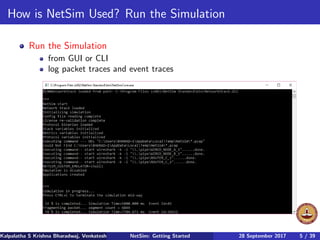
How is NetSim Used? Run the Simulation
Run the Simulation
from GUI or CLI
log packet traces and event traces
Kalpalatha S Krishna Bharadwaj, Venkatesh Ramaiyan Department of Electrical Engineering, Indian Institute of Technology Madras,NetSim: Getting Started 28 September 2017 5 / 39
How is NetSim Used? Visualize using Packet Animator
Visualize the Simulation
using Packet Animator
Kalpalatha S Krishna Bharadwaj, Venkatesh Ramaiyan Department of Electrical Engineering, Indian Institute of Technology Madras,NetSim: Getting Started 28 September 2017 6 / 39
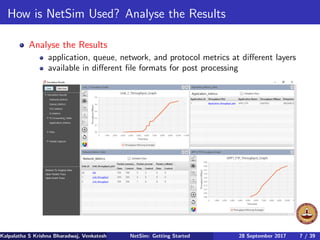
How is NetSim Used? Analyse the Results
Analyse the Results
application, queue, network, and protocol metrics at different layers
available in different file formats for post processing
Kalpalatha S Krishna Bharadwaj, Venkatesh Ramaiyan Department of Electrical Engineering, Indian Institute of Technology Madras,NetSim: Getting Started 28 September 2017 7 / 39
How is NetSim Used?
Design the Network
using NetSim GUI or .XML config files
Run the Simulation
from GUI or CLI
log packet traces and event traces
Visualize the Simulation
using Packet Animator
Analyse the Results
application, queue, network, and protocol metrics at different layers
available in different file formats for post processing
Develop your own Protocol/Algorithm
modify or create algorithms and protocols
support for debug in IDE
Interface with External Software
such as MATLAB, SUMO
Kalpalatha S Krishna Bharadwaj, Venkatesh Ramaiyan Department of Electrical Engineering, Indian Institute of Technology Madras,NetSim: Getting Started 28 September 2017 8 / 39
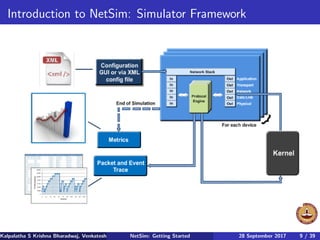
Introduction to NetSim: Simulator Framework
Kalpalatha S Krishna Bharadwaj, Venkatesh Ramaiyan Department of Electrical Engineering, Indian Institute of Technology Madras,NetSim: Getting Started 28 September 2017 9 / 39
NetSim Installation: Download Executable File
Download NetSim Software Executable File (only for licensed users)
http://www.tetcos.com/software-download.html
Available as Pro, Standard and Academic versions
Requires Username and Password
Kalpalatha S Krishna Bharadwaj, Venkatesh Ramaiyan Department of Electrical Engineering, Indian Institute of Technology Madras,NetSim: Getting Started 28 September 2017 10 / 39
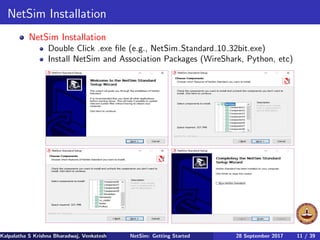
NetSim Installation
NetSim Installation
Double Click .exe file (e.g., NetSim Standard 10 32bit.exe)
Install NetSim and Association Packages (WireShark, Python, etc)
Kalpalatha S Krishna Bharadwaj, Venkatesh Ramaiyan Department of Electrical Engineering, Indian Institute of Technology Madras,NetSim: Getting Started 28 September 2017 11 / 39
NetSim Installation: Copy License File
License
Copy License File into the NetSim folder
(e.g., C:Program Files(x86)NetSim Standardbin)
Kalpalatha S Krishna Bharadwaj, Venkatesh Ramaiyan Department of Electrical Engineering, Indian Institute of Technology Madras,NetSim: Getting Started 28 September 2017 12 / 39
NetSim Installation
Download NetSim Software Executable File
http://www.tetcos.com/software-download.html
Available as Pro, Standard and Academic versions
Requires Username and Password
Installation
Double Click .exe file (e.g., NetSim Standard 10 32bit.exe)
Install NetSim and Association Packages (WireShark, Python, etc)
License
Copy License File into the NetSim folder
(e.g., C:Program Files(x86)NetSim Standardbin)
Launch NetSim
Other Prerequisites
MS Visual Studio 2015 (for code modification)
Kalpalatha S Krishna Bharadwaj, Venkatesh Ramaiyan Department of Electrical Engineering, Indian Institute of Technology Madras,NetSim: Getting Started 28 September 2017 13 / 39
NetSim Help & Resources
NetSim Homepage - http://www.tetcos.com/
Simulation Software Versions and Features
Download Page and Support
Documentation - User Manual, Experimental Manual, Help Files
List of Supported Technologies, Protocols and Algorithms
Simulator Information - https://tetcos.freshdesk.com/support/home
FAQs, Getting Started
Modeling and Simulation, Emulation,
Cognitive radios, IoTs, WSNs, WLANs, LTE
NetSim Videos - https://www.youtube.com/user/Tetcos/videos
Help, Webinars and Informational Videos
On Facebook - https://www.facebook.com/tetcosnetsim/
On Twitter - https://twitter.com/tetcos?lang=en
Kalpalatha S Krishna Bharadwaj, Venkatesh Ramaiyan Department of Electrical Engineering, Indian Institute of Technology Madras,NetSim: Getting Started 28 September 2017 14 / 39
NetSim User Manual
Getting Started
Installation, About NetSim Environment, Simple Experiments
Illustrations by Examples
Discusses All Network Protocols and Components
Details on Traffic Models and Generators
Details on Mobility Models
Measurements and Analysis
Network Simulation Data Traces
Analysis with Pivot Tables, Wireshark, etc
Packet Animator
List of Advanced Features
Writing Custom Code in NetSim
Interfacing with Matlab
Lists Known Issues and Solutions
Kalpalatha S Krishna Bharadwaj, Venkatesh Ramaiyan Department of Electrical Engineering, Indian Institute of Technology Madras,NetSim: Getting Started 28 September 2017 15 / 39
NetSim Experiment Manual
Lists Experiments to Illustrate Network Protocols and Features
Performance of IoTs, MANETs, LTE, WiFi, ZigBee
TCP Connection Establishment and Congestion Control
IP Forwarding, Network Routing Protocls (OSPF, RIP)
Spanning Tree Algorithm
Legacy Networks such as ALOHA, CSMA
Knowledge Base with Project Code -
http://www.tetcos.com/file-exchange.html
Kalpalatha S Krishna Bharadwaj, Venkatesh Ramaiyan Department of Electrical Engineering, Indian Institute of Technology Madras,NetSim: Getting Started 28 September 2017 16 / 39
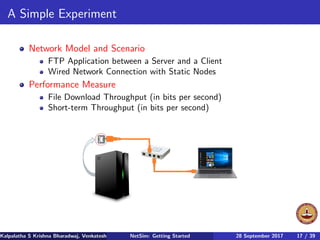
A Simple Experiment
Network Model and Scenario
FTP Application between a Server and a Client
Wired Network Connection with Static Nodes
Performance Measure
File Download Throughput (in bits per second)
Short-term Throughput (in bits per second)
Kalpalatha S Krishna Bharadwaj, Venkatesh Ramaiyan Department of Electrical Engineering, Indian Institute of Technology Madras,NetSim: Getting Started 28 September 2017 17 / 39
A Simple Experiment: Network Configuration
Kalpalatha S Krishna Bharadwaj, Venkatesh Ramaiyan Department of Electrical Engineering, Indian Institute of Technology Madras,NetSim: Getting Started 28 September 2017 18 / 39
A Simple Experiment: NetSim Simulation
Input via GUI or .XML (Enable Traces and Dynamic Metrics)
Run Simulation (must specify Simulation Time)
Kalpalatha S Krishna Bharadwaj, Venkatesh Ramaiyan Department of Electrical Engineering, Indian Institute of Technology Madras,NetSim: Getting Started 28 September 2017 19 / 39
Performance Metrics
Average Throughput @ Application Layer
AT =
(Total Payload Delivered to Destination (in bytes) * 8)
Simulation Time
Fundamental Measure of Performance for Voice, Video or BE Traffic
Average Delay
AD =
Sum of Delay of Successfully Delivered Packets
Number of Successfully Delivered Packets
Fundamental Measure of Performance for Voice, Transactions
Other Measures
Jitter (Voice)
RSSI (Wireless Channels)
Retransmission Counts (TCP, WiFi)
Collision Probability (WiFi)
Kalpalatha S Krishna Bharadwaj, Venkatesh Ramaiyan Department of Electrical Engineering, Indian Institute of Technology Madras,NetSim: Getting Started 28 September 2017 20 / 39
NetSim Libraries
Application
FTP, HTTP, Email,
Voice, Video, CBR, Custom
Transport
TCP ((Old) Tahoe, (New) Reno, Cubic),
UDP
Network
OSPF, RIP,
DSR, AODV, ZRP, OLSR,
IPV4 Addressing
MAC/PHY
GSM, CDMA, LTE, LTE-A,
WiFi, Ethernet, WRAN, TDMA,
Aloha, CSMA/CD,
Queueing and Scheduling (FIFO, WFQ, Priority)
Miscellaneous Channel and Propagation Models, Mobility Models
Kalpalatha S Krishna Bharadwaj, Venkatesh Ramaiyan Department of Electrical Engineering, Indian Institute of Technology Madras,NetSim: Getting Started 28 September 2017 21 / 39
Simulation Results: Data Files
Simulation Output Files
Metrics.xml, PacketTrace.csv, EventTrace.csv, Animation.txt,
Node.pcap
Kalpalatha S Krishna Bharadwaj, Venkatesh Ramaiyan Department of Electrical Engineering, Indian Institute of Technology Madras,NetSim: Getting Started 28 September 2017 22 / 39
Simulation Results: Data Analysis
Data Analysis
Results Dashboard, Packet Animator, Pivot Tables, Wireshark
Kalpalatha S Krishna Bharadwaj, Venkatesh Ramaiyan Department of Electrical Engineering, Indian Institute of Technology Madras,NetSim: Getting Started 28 September 2017 23 / 39
Simulation Results
Simulation Output
Metrics.xml, PacketTrace.csv, EventTrace.csv, Animation.txt,
Node.pcap
Data Analysis
Results Dashboard, Packet Animator, Pivot Tables, Wireshark
NetSim permits Analytics of Multiple Experiments
Kalpalatha S Krishna Bharadwaj, Venkatesh Ramaiyan Department of Electrical Engineering, Indian Institute of Technology Madras,NetSim: Getting Started 28 September 2017 24 / 39
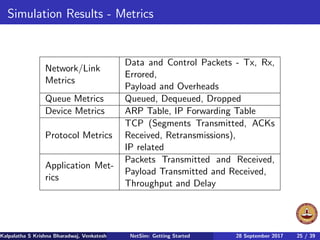
Simulation Results - Metrics
Network/Link
Metrics
Data and Control Packets - Tx, Rx,
Errored,
Payload and Overheads
Queue Metrics Queued, Dequeued, Dropped
Device Metrics ARP Table, IP Forwarding Table
Protocol Metrics
TCP (Segments Transmitted, ACKs
Received, Retransmissions),
IP related
Application Met-
rics
Packets Transmitted and Received,
Payload Transmitted and Received,
Throughput and Delay
Kalpalatha S Krishna Bharadwaj, Venkatesh Ramaiyan Department of Electrical Engineering, Indian Institute of Technology Madras,NetSim: Getting Started 28 September 2017 25 / 39
Simulation Results - Metrics - Results Dashboard
Kalpalatha S Krishna Bharadwaj, Venkatesh Ramaiyan Department of Electrical Engineering, Indian Institute of Technology Madras,NetSim: Getting Started 28 September 2017 26 / 39
Simulation Results - Metrics - Results Dashboard
Kalpalatha S Krishna Bharadwaj, Venkatesh Ramaiyan Department of Electrical Engineering, Indian Institute of Technology Madras,NetSim: Getting Started 28 September 2017 27 / 39
Simulation Results - Packet Traces
Trace of a Packet in the Network
Trace is saved as a Spread Sheet
Kalpalatha S Krishna Bharadwaj, Venkatesh Ramaiyan Department of Electrical Engineering, Indian Institute of Technology Madras,NetSim: Getting Started 28 September 2017 28 / 39
Simulation Results - Packet Traces
Trace of a Packet in the Network
Trace is saved as a Spread Sheet
Items Listed in Packet Trace
Packet ID, Segment ID, Packet Type
Source ID, Destination ID, Transmitter ID, Receiver ID
IN and OUT Times in the Network Stack
Data Analysis
PivotTables are Effective to Analyze Measurement Data
See User Manual for Help
Measurements and Metrics
Throughput, Delay, Jitter
Average, Max, Min Measurements
Kalpalatha S Krishna Bharadwaj, Venkatesh Ramaiyan Department of Electrical Engineering, Indian Institute of Technology Madras,NetSim: Getting Started 28 September 2017 29 / 39
Simulation Results - Event Traces
Record of All Events in the Network and Stacks
Packet IN and OUT Events in the Network Stack
Events related to Protocols - Schedule, Backoff, Timeouts, etc
Trace is saved as a Spread Sheet
Kalpalatha S Krishna Bharadwaj, Venkatesh Ramaiyan Department of Electrical Engineering, Indian Institute of Technology Madras,NetSim: Getting Started 28 September 2017 30 / 39
Simulation Results - Event Traces
Record of All Events in the Network and Stacks
Packet IN and OUT Events in the Network Stack
Events related to Protocols - Schedule, Backoff, Timeouts, etc
Trace is saved as a Spread Sheet
Items Listed in Event Trace
Time Stamp, Event ID, Event Type, Device Type and ID, Protocol
Name, Packet Details, etc
Additional Data for Debugging
Data Analysis
PivotTables are Effective to Analyze Measurement Data
See User Manual for Help
Measurements and Metrics
Packet Metrics such as Throughput, Delay, Jitter
Protocol Metrics and Device Metrics
Kalpalatha S Krishna Bharadwaj, Venkatesh Ramaiyan Department of Electrical Engineering, Indian Institute of Technology Madras,NetSim: Getting Started 28 September 2017 31 / 39
Data Analysis with PivotTables∗
Kalpalatha S Krishna Bharadwaj, Venkatesh Ramaiyan Department of Electrical Engineering, Indian Institute of Technology Madras,NetSim: Getting Started 28 September 2017 32 / 39
Data Analysis with Wireshark∗
Kalpalatha S Krishna Bharadwaj, Venkatesh Ramaiyan Department of Electrical Engineering, Indian Institute of Technology Madras,NetSim: Getting Started 28 September 2017 33 / 39
A Comparison with NS-3
NetSim NS-3
Installation Easy Easy
Input GUI or CLI Script File
Output
Trace Files & Results
Dashboard
Trace Files Only
Libraries Extensive Extensive
Animation Packet Animator NetAnim
Support
Essential Documentation
& Support Team
Extensive Documenta-
tion & Google Groups
Correctness
Verified Regularly by
Support Team
Ensured by NS-3 Users
Difficulty Easy for Beginners
Comparable for Complex
Networks
Kalpalatha S Krishna Bharadwaj, Venkatesh Ramaiyan Department of Electrical Engineering, Indian Institute of Technology Madras,NetSim: Getting Started 28 September 2017 34 / 39
Network R&D with NetSim: RRM for WiFi Networks
WiFi Standards Focus on Wireless Access and Management of a BSS
MAC: RTS/CTS, Backoff, etc
PHY: MCS, MIMO, etc
Management: Beacons, Authentication, Association, Mobility, etc
Performance Critically Depends on the Wireless Environment
Interference can Limit Channel Access and Decrease Throughput
Poor Link Quality can lead to Slow Talker Problem
Network-wide Solutions Necessary for Optimal Operation
Radio Resource Management of WiFi Networks
Focus on Management of the Wireless Environment
Channel Selection and Transmit Power Control @ APs
User Association @ Clients and APs
Kalpalatha S Krishna Bharadwaj, Venkatesh Ramaiyan Department of Electrical Engineering, Indian Institute of Technology Madras,NetSim: Getting Started 28 September 2017 35 / 39
Transmit Power Control: An Illustration∗
Transmit Power Control
Objective: Maximize Network Capacity
Control: Transmit Power of Access Points
Simulation Environment
Topology: Linear (50 metres)
WiFi Standard: IEEE 802.11ac
Bandwidth: 20MHz
Rate Adaptation: Minstrel
Channel: Log Distance Propagation Loss Model with η = 3.5
Max Transmit Power: 23dBm
Min Transmit Power: 0dBm
2-3 Clients per AP
Application: FTP (Downlink)
Kalpalatha S Krishna Bharadwaj, Venkatesh Ramaiyan Department of Electrical Engineering, Indian Institute of Technology Madras,NetSim: Getting Started 28 September 2017 36 / 39
Transmit Power Control: An Illustration∗
1 5 9 13 17 21
0
50
100
150
Number of Access Points
AggregateThroughput(inMbps)
Best Equal Tx Power
NO TPC
1 5 9 13 17 21
0
10
20
30
Number of APs
AverageTransmitPower
Best Equal Tx Power
NO TPC
Aggregate Network Throughput Increases with TPC
Optimal Transmit Power Decreases with Density
TPC Minimizes Interference and Enables Spatial Reuse
Kalpalatha S Krishna Bharadwaj, Venkatesh Ramaiyan Department of Electrical Engineering, Indian Institute of Technology Madras,NetSim: Getting Started 28 September 2017 37 / 39
Network R&D with NetSim: Transmit Power Control
Transmit Power Control
Effective in Increasing Network Capacity
Tradeoff between Capacity (Spatial Reuse) and Coverage
Challenges in Design
A Distributed Algorithm for TPC
Dynamic and Adaptive Algorithm for Dynamic Wireless Environment
Support for Heterogeneous Devices and Standards
Limited Client Support
Other Network and Non-WiFi Interference
TPC Design with NetSim
Limited Analytical Insights Available
Experimentation is Costly
Network Simulators are Effective Means to Study Performance
Kalpalatha S Krishna Bharadwaj, Venkatesh Ramaiyan Department of Electrical Engineering, Indian Institute of Technology Madras,NetSim: Getting Started 28 September 2017 38 / 39
Questions!
Kalpalatha S Krishna Bharadwaj, Venkatesh Ramaiyan Department of Electrical Engineering, Indian Institute of Technology Madras,NetSim: Getting Started 28 September 2017 39 / 39

Netsim webinar-iitm-sep-17

  • 1.
    NetSim: Getting Started KalpalathaS Krishna Bharadwaj, Venkatesh Ramaiyan Department of Electrical Engineering, Indian Institute of Technology Madras, Chennai, India. Kalpalatha S Krishna Bharadwaj, Venkatesh Ramaiyan Department of Electrical Engineering, Indian Institute of Technology Madras,NetSim: Getting Started 28 September 2017 1 / 39
  • 2.
    Outline of thePresentation Introduction to NetSim Installation Guidelines Help & Resources A Simple Network Simulation NetSim Simulation Libraries Simulation Results A Comparison with NS-3 R&D with NetSim: RRM for WiFi Kalpalatha S Krishna Bharadwaj, Venkatesh Ramaiyan Department of Electrical Engineering, Indian Institute of Technology Madras,NetSim: Getting Started 28 September 2017 2 / 39
  • 3.
    Introduction to NetSim NetSim:A Simulation and Emulation Tool Network Design and Planning Protocol and Network Modeling Highlights Cognitive Radio, LTE 5G, MANETs, VANETs, WLANs, WSNs, IoTs GUI Packet Animator Interface with Matlab, Wireshark and SUMO NetSim Emulator Applications Network R&D and Academic Projects Focus on Defense Applications, Tactical Communications, Public Utility Networks Kalpalatha S Krishna Bharadwaj, Venkatesh Ramaiyan Department of Electrical Engineering, Indian Institute of Technology Madras,NetSim: Getting Started 28 September 2017 3 / 39
  • 4.
    How is NetSimUsed? Design the Network Design the Network using NetSim GUI or .XML config files Kalpalatha S Krishna Bharadwaj, Venkatesh Ramaiyan Department of Electrical Engineering, Indian Institute of Technology Madras,NetSim: Getting Started 28 September 2017 4 / 39
  • 5.
    How is NetSimUsed? Run the Simulation Run the Simulation from GUI or CLI log packet traces and event traces Kalpalatha S Krishna Bharadwaj, Venkatesh Ramaiyan Department of Electrical Engineering, Indian Institute of Technology Madras,NetSim: Getting Started 28 September 2017 5 / 39
  • 6.
    How is NetSimUsed? Visualize using Packet Animator Visualize the Simulation using Packet Animator Kalpalatha S Krishna Bharadwaj, Venkatesh Ramaiyan Department of Electrical Engineering, Indian Institute of Technology Madras,NetSim: Getting Started 28 September 2017 6 / 39
  • 7.
    How is NetSimUsed? Analyse the Results Analyse the Results application, queue, network, and protocol metrics at different layers available in different file formats for post processing Kalpalatha S Krishna Bharadwaj, Venkatesh Ramaiyan Department of Electrical Engineering, Indian Institute of Technology Madras,NetSim: Getting Started 28 September 2017 7 / 39
  • 8.
    How is NetSimUsed? Design the Network using NetSim GUI or .XML config files Run the Simulation from GUI or CLI log packet traces and event traces Visualize the Simulation using Packet Animator Analyse the Results application, queue, network, and protocol metrics at different layers available in different file formats for post processing Develop your own Protocol/Algorithm modify or create algorithms and protocols support for debug in IDE Interface with External Software such as MATLAB, SUMO Kalpalatha S Krishna Bharadwaj, Venkatesh Ramaiyan Department of Electrical Engineering, Indian Institute of Technology Madras,NetSim: Getting Started 28 September 2017 8 / 39
  • 9.
    Introduction to NetSim:Simulator Framework Kalpalatha S Krishna Bharadwaj, Venkatesh Ramaiyan Department of Electrical Engineering, Indian Institute of Technology Madras,NetSim: Getting Started 28 September 2017 9 / 39
  • 10.
    NetSim Installation: DownloadExecutable File Download NetSim Software Executable File (only for licensed users) http://www.tetcos.com/software-download.html Available as Pro, Standard and Academic versions Requires Username and Password Kalpalatha S Krishna Bharadwaj, Venkatesh Ramaiyan Department of Electrical Engineering, Indian Institute of Technology Madras,NetSim: Getting Started 28 September 2017 10 / 39
  • 11.
    NetSim Installation NetSim Installation DoubleClick .exe file (e.g., NetSim Standard 10 32bit.exe) Install NetSim and Association Packages (WireShark, Python, etc) Kalpalatha S Krishna Bharadwaj, Venkatesh Ramaiyan Department of Electrical Engineering, Indian Institute of Technology Madras,NetSim: Getting Started 28 September 2017 11 / 39
  • 12.
    NetSim Installation: CopyLicense File License Copy License File into the NetSim folder (e.g., C:Program Files(x86)NetSim Standardbin) Kalpalatha S Krishna Bharadwaj, Venkatesh Ramaiyan Department of Electrical Engineering, Indian Institute of Technology Madras,NetSim: Getting Started 28 September 2017 12 / 39
  • 13.
    NetSim Installation Download NetSimSoftware Executable File http://www.tetcos.com/software-download.html Available as Pro, Standard and Academic versions Requires Username and Password Installation Double Click .exe file (e.g., NetSim Standard 10 32bit.exe) Install NetSim and Association Packages (WireShark, Python, etc) License Copy License File into the NetSim folder (e.g., C:Program Files(x86)NetSim Standardbin) Launch NetSim Other Prerequisites MS Visual Studio 2015 (for code modification) Kalpalatha S Krishna Bharadwaj, Venkatesh Ramaiyan Department of Electrical Engineering, Indian Institute of Technology Madras,NetSim: Getting Started 28 September 2017 13 / 39
  • 14.
    NetSim Help &Resources NetSim Homepage - http://www.tetcos.com/ Simulation Software Versions and Features Download Page and Support Documentation - User Manual, Experimental Manual, Help Files List of Supported Technologies, Protocols and Algorithms Simulator Information - https://tetcos.freshdesk.com/support/home FAQs, Getting Started Modeling and Simulation, Emulation, Cognitive radios, IoTs, WSNs, WLANs, LTE NetSim Videos - https://www.youtube.com/user/Tetcos/videos Help, Webinars and Informational Videos On Facebook - https://www.facebook.com/tetcosnetsim/ On Twitter - https://twitter.com/tetcos?lang=en Kalpalatha S Krishna Bharadwaj, Venkatesh Ramaiyan Department of Electrical Engineering, Indian Institute of Technology Madras,NetSim: Getting Started 28 September 2017 14 / 39
  • 15.
    NetSim User Manual GettingStarted Installation, About NetSim Environment, Simple Experiments Illustrations by Examples Discusses All Network Protocols and Components Details on Traffic Models and Generators Details on Mobility Models Measurements and Analysis Network Simulation Data Traces Analysis with Pivot Tables, Wireshark, etc Packet Animator List of Advanced Features Writing Custom Code in NetSim Interfacing with Matlab Lists Known Issues and Solutions Kalpalatha S Krishna Bharadwaj, Venkatesh Ramaiyan Department of Electrical Engineering, Indian Institute of Technology Madras,NetSim: Getting Started 28 September 2017 15 / 39
  • 16.
    NetSim Experiment Manual ListsExperiments to Illustrate Network Protocols and Features Performance of IoTs, MANETs, LTE, WiFi, ZigBee TCP Connection Establishment and Congestion Control IP Forwarding, Network Routing Protocls (OSPF, RIP) Spanning Tree Algorithm Legacy Networks such as ALOHA, CSMA Knowledge Base with Project Code - http://www.tetcos.com/file-exchange.html Kalpalatha S Krishna Bharadwaj, Venkatesh Ramaiyan Department of Electrical Engineering, Indian Institute of Technology Madras,NetSim: Getting Started 28 September 2017 16 / 39
  • 17.
    A Simple Experiment NetworkModel and Scenario FTP Application between a Server and a Client Wired Network Connection with Static Nodes Performance Measure File Download Throughput (in bits per second) Short-term Throughput (in bits per second) Kalpalatha S Krishna Bharadwaj, Venkatesh Ramaiyan Department of Electrical Engineering, Indian Institute of Technology Madras,NetSim: Getting Started 28 September 2017 17 / 39
  • 18.
    A Simple Experiment:Network Configuration Kalpalatha S Krishna Bharadwaj, Venkatesh Ramaiyan Department of Electrical Engineering, Indian Institute of Technology Madras,NetSim: Getting Started 28 September 2017 18 / 39
  • 19.
    A Simple Experiment:NetSim Simulation Input via GUI or .XML (Enable Traces and Dynamic Metrics) Run Simulation (must specify Simulation Time) Kalpalatha S Krishna Bharadwaj, Venkatesh Ramaiyan Department of Electrical Engineering, Indian Institute of Technology Madras,NetSim: Getting Started 28 September 2017 19 / 39
  • 20.
    Performance Metrics Average Throughput@ Application Layer AT = (Total Payload Delivered to Destination (in bytes) * 8) Simulation Time Fundamental Measure of Performance for Voice, Video or BE Traffic Average Delay AD = Sum of Delay of Successfully Delivered Packets Number of Successfully Delivered Packets Fundamental Measure of Performance for Voice, Transactions Other Measures Jitter (Voice) RSSI (Wireless Channels) Retransmission Counts (TCP, WiFi) Collision Probability (WiFi) Kalpalatha S Krishna Bharadwaj, Venkatesh Ramaiyan Department of Electrical Engineering, Indian Institute of Technology Madras,NetSim: Getting Started 28 September 2017 20 / 39
  • 21.
    NetSim Libraries Application FTP, HTTP,Email, Voice, Video, CBR, Custom Transport TCP ((Old) Tahoe, (New) Reno, Cubic), UDP Network OSPF, RIP, DSR, AODV, ZRP, OLSR, IPV4 Addressing MAC/PHY GSM, CDMA, LTE, LTE-A, WiFi, Ethernet, WRAN, TDMA, Aloha, CSMA/CD, Queueing and Scheduling (FIFO, WFQ, Priority) Miscellaneous Channel and Propagation Models, Mobility Models Kalpalatha S Krishna Bharadwaj, Venkatesh Ramaiyan Department of Electrical Engineering, Indian Institute of Technology Madras,NetSim: Getting Started 28 September 2017 21 / 39
  • 22.
    Simulation Results: DataFiles Simulation Output Files Metrics.xml, PacketTrace.csv, EventTrace.csv, Animation.txt, Node.pcap Kalpalatha S Krishna Bharadwaj, Venkatesh Ramaiyan Department of Electrical Engineering, Indian Institute of Technology Madras,NetSim: Getting Started 28 September 2017 22 / 39
  • 23.
    Simulation Results: DataAnalysis Data Analysis Results Dashboard, Packet Animator, Pivot Tables, Wireshark Kalpalatha S Krishna Bharadwaj, Venkatesh Ramaiyan Department of Electrical Engineering, Indian Institute of Technology Madras,NetSim: Getting Started 28 September 2017 23 / 39
  • 24.
    Simulation Results Simulation Output Metrics.xml,PacketTrace.csv, EventTrace.csv, Animation.txt, Node.pcap Data Analysis Results Dashboard, Packet Animator, Pivot Tables, Wireshark NetSim permits Analytics of Multiple Experiments Kalpalatha S Krishna Bharadwaj, Venkatesh Ramaiyan Department of Electrical Engineering, Indian Institute of Technology Madras,NetSim: Getting Started 28 September 2017 24 / 39
  • 25.
    Simulation Results -Metrics Network/Link Metrics Data and Control Packets - Tx, Rx, Errored, Payload and Overheads Queue Metrics Queued, Dequeued, Dropped Device Metrics ARP Table, IP Forwarding Table Protocol Metrics TCP (Segments Transmitted, ACKs Received, Retransmissions), IP related Application Met- rics Packets Transmitted and Received, Payload Transmitted and Received, Throughput and Delay Kalpalatha S Krishna Bharadwaj, Venkatesh Ramaiyan Department of Electrical Engineering, Indian Institute of Technology Madras,NetSim: Getting Started 28 September 2017 25 / 39
  • 26.
    Simulation Results -Metrics - Results Dashboard Kalpalatha S Krishna Bharadwaj, Venkatesh Ramaiyan Department of Electrical Engineering, Indian Institute of Technology Madras,NetSim: Getting Started 28 September 2017 26 / 39
  • 27.
    Simulation Results -Metrics - Results Dashboard Kalpalatha S Krishna Bharadwaj, Venkatesh Ramaiyan Department of Electrical Engineering, Indian Institute of Technology Madras,NetSim: Getting Started 28 September 2017 27 / 39
  • 28.
    Simulation Results -Packet Traces Trace of a Packet in the Network Trace is saved as a Spread Sheet Kalpalatha S Krishna Bharadwaj, Venkatesh Ramaiyan Department of Electrical Engineering, Indian Institute of Technology Madras,NetSim: Getting Started 28 September 2017 28 / 39
  • 29.
    Simulation Results -Packet Traces Trace of a Packet in the Network Trace is saved as a Spread Sheet Items Listed in Packet Trace Packet ID, Segment ID, Packet Type Source ID, Destination ID, Transmitter ID, Receiver ID IN and OUT Times in the Network Stack Data Analysis PivotTables are Effective to Analyze Measurement Data See User Manual for Help Measurements and Metrics Throughput, Delay, Jitter Average, Max, Min Measurements Kalpalatha S Krishna Bharadwaj, Venkatesh Ramaiyan Department of Electrical Engineering, Indian Institute of Technology Madras,NetSim: Getting Started 28 September 2017 29 / 39
  • 30.
    Simulation Results -Event Traces Record of All Events in the Network and Stacks Packet IN and OUT Events in the Network Stack Events related to Protocols - Schedule, Backoff, Timeouts, etc Trace is saved as a Spread Sheet Kalpalatha S Krishna Bharadwaj, Venkatesh Ramaiyan Department of Electrical Engineering, Indian Institute of Technology Madras,NetSim: Getting Started 28 September 2017 30 / 39
  • 31.
    Simulation Results -Event Traces Record of All Events in the Network and Stacks Packet IN and OUT Events in the Network Stack Events related to Protocols - Schedule, Backoff, Timeouts, etc Trace is saved as a Spread Sheet Items Listed in Event Trace Time Stamp, Event ID, Event Type, Device Type and ID, Protocol Name, Packet Details, etc Additional Data for Debugging Data Analysis PivotTables are Effective to Analyze Measurement Data See User Manual for Help Measurements and Metrics Packet Metrics such as Throughput, Delay, Jitter Protocol Metrics and Device Metrics Kalpalatha S Krishna Bharadwaj, Venkatesh Ramaiyan Department of Electrical Engineering, Indian Institute of Technology Madras,NetSim: Getting Started 28 September 2017 31 / 39
  • 32.
    Data Analysis withPivotTables∗ Kalpalatha S Krishna Bharadwaj, Venkatesh Ramaiyan Department of Electrical Engineering, Indian Institute of Technology Madras,NetSim: Getting Started 28 September 2017 32 / 39
  • 33.
    Data Analysis withWireshark∗ Kalpalatha S Krishna Bharadwaj, Venkatesh Ramaiyan Department of Electrical Engineering, Indian Institute of Technology Madras,NetSim: Getting Started 28 September 2017 33 / 39
  • 34.
    A Comparison withNS-3 NetSim NS-3 Installation Easy Easy Input GUI or CLI Script File Output Trace Files & Results Dashboard Trace Files Only Libraries Extensive Extensive Animation Packet Animator NetAnim Support Essential Documentation & Support Team Extensive Documenta- tion & Google Groups Correctness Verified Regularly by Support Team Ensured by NS-3 Users Difficulty Easy for Beginners Comparable for Complex Networks Kalpalatha S Krishna Bharadwaj, Venkatesh Ramaiyan Department of Electrical Engineering, Indian Institute of Technology Madras,NetSim: Getting Started 28 September 2017 34 / 39
  • 35.
    Network R&D withNetSim: RRM for WiFi Networks WiFi Standards Focus on Wireless Access and Management of a BSS MAC: RTS/CTS, Backoff, etc PHY: MCS, MIMO, etc Management: Beacons, Authentication, Association, Mobility, etc Performance Critically Depends on the Wireless Environment Interference can Limit Channel Access and Decrease Throughput Poor Link Quality can lead to Slow Talker Problem Network-wide Solutions Necessary for Optimal Operation Radio Resource Management of WiFi Networks Focus on Management of the Wireless Environment Channel Selection and Transmit Power Control @ APs User Association @ Clients and APs Kalpalatha S Krishna Bharadwaj, Venkatesh Ramaiyan Department of Electrical Engineering, Indian Institute of Technology Madras,NetSim: Getting Started 28 September 2017 35 / 39
  • 36.
    Transmit Power Control:An Illustration∗ Transmit Power Control Objective: Maximize Network Capacity Control: Transmit Power of Access Points Simulation Environment Topology: Linear (50 metres) WiFi Standard: IEEE 802.11ac Bandwidth: 20MHz Rate Adaptation: Minstrel Channel: Log Distance Propagation Loss Model with η = 3.5 Max Transmit Power: 23dBm Min Transmit Power: 0dBm 2-3 Clients per AP Application: FTP (Downlink) Kalpalatha S Krishna Bharadwaj, Venkatesh Ramaiyan Department of Electrical Engineering, Indian Institute of Technology Madras,NetSim: Getting Started 28 September 2017 36 / 39
  • 37.
    Transmit Power Control:An Illustration∗ 1 5 9 13 17 21 0 50 100 150 Number of Access Points AggregateThroughput(inMbps) Best Equal Tx Power NO TPC 1 5 9 13 17 21 0 10 20 30 Number of APs AverageTransmitPower Best Equal Tx Power NO TPC Aggregate Network Throughput Increases with TPC Optimal Transmit Power Decreases with Density TPC Minimizes Interference and Enables Spatial Reuse Kalpalatha S Krishna Bharadwaj, Venkatesh Ramaiyan Department of Electrical Engineering, Indian Institute of Technology Madras,NetSim: Getting Started 28 September 2017 37 / 39
  • 38.
    Network R&D withNetSim: Transmit Power Control Transmit Power Control Effective in Increasing Network Capacity Tradeoff between Capacity (Spatial Reuse) and Coverage Challenges in Design A Distributed Algorithm for TPC Dynamic and Adaptive Algorithm for Dynamic Wireless Environment Support for Heterogeneous Devices and Standards Limited Client Support Other Network and Non-WiFi Interference TPC Design with NetSim Limited Analytical Insights Available Experimentation is Costly Network Simulators are Effective Means to Study Performance Kalpalatha S Krishna Bharadwaj, Venkatesh Ramaiyan Department of Electrical Engineering, Indian Institute of Technology Madras,NetSim: Getting Started 28 September 2017 38 / 39
  • 39.
    Questions! Kalpalatha S KrishnaBharadwaj, Venkatesh Ramaiyan Department of Electrical Engineering, Indian Institute of Technology Madras,NetSim: Getting Started 28 September 2017 39 / 39