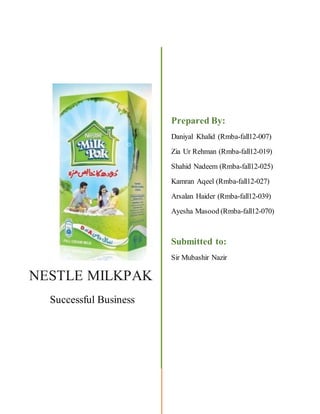
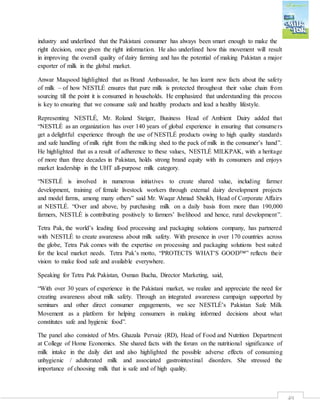
NESTLE MILKPAK
Prepared By:
Daniyal Khalid (Rmba-fall12-007)
Zia Ur Rehman (Rmba-fall12-019)
Shahid Nadeem (Rmba-fall12-025)
Kamran Aqeel (Rmba-fall12-027)
Arsalan Haider (Rmba-fall12-039)
Ayesha Masood (Rmba-fall12-070)
Submitted to:
Sir Mubashir Nazir
Successful Business
1
Acknowledgment
All the members worked as a team. The true team work
was seen between them. They devoted day and nights
in making of this project as if there was some
motivational force between them such that to have or
obtained maximum benefit out of this project and it
proved to be an effective work group when every
individual group member completed the task provided
in said period of time. The project has been made for
general audience. The main purpose of the
project was to understand how to make project.
All the credits go to ALLAH THE All
MIGHTY AND THE MOST BENIFICIAL
for giving us such power and wisdom to
complete the project on time. May Allah’s
blessings remain on us forever (ameen) . And at
the last we would like to thank Sir Mubasher
Nazir for taking us in confidence and giving us
an opportunity to make the project and to learn
for making a project.
2
Contents
Acknowledgment ............................................................................................................................ 1
Executive Summary........................................................................................................................ 7
History............................................................................................................................................. 8
Henri Nestlé, the founder of Nestlé............................................................................................. 9
Nestle ............................................................................................................................................ 10
Nestlé’s Vision Statement ......................................................................................................... 11
Nestlé’s Mission Statement....................................................................................................... 11
Nestlé’s Slogan.......................................................................................................................... 11
Nestle Core Values.................................................................................................................... 11
Brands and Product mix ............................................................................................................ 12
WORLDWIDE PRESENCE ........................................................................................................ 13
Operations by region and country ............................................................................................. 13
Global Structure ............................................................................................................................ 13
Nestle Pakistan.............................................................................................................................. 15
Main Offices Head Office......................................................................................................... 16
Sub Offices................................................................................................................................ 16
Organizational Structure (Nestle PK) ........................................................................................... 16
Milk Industry in Pakistan.............................................................................................................. 17
Nestle MilkPak.............................................................................................................................. 18
MilkPak History........................................................................................................................ 18
Nestlé MilkPak UHT Milk:....................................................................................................... 18
SWOT Analysis......................................................................................................................... 18
Strengths: ............................................................................................................................... 18
Weaknesses............................................................................................................................ 19
Opportunities ......................................................................................................................... 19
Threats ................................................................................................................................... 19
PEST Analysis........................................................................................................................... 20
Political Factors ..................................................................................................................... 20
Economic Factors .................................................................................................................. 20
3
Social Factors.......................................................................................................................20
Technological Factors............................................................................................................ 20
MilkPak Marketing Analysis ........................................................................................................ 21
Marketing Strategy.................................................................................................................... 21
Targeting................................................................................................................................ 21
Advertising Plan........................................................................................................................ 21
Background Research............................................................................................................ 22
Problem Identification ........................................................................................................... 22
Target Audience..................................................................................................................... 22
Strategies ................................................................................................................................... 23
Positioning Strategy............................................................................................................... 23
Message Strategy................................................................................................................... 23
Media Strategy....................................................................................................................... 24
Operations of Nestle MILKPAK:................................................................................................. 25
Process Flow Diagram for Nestle Milkpak ............................................................................... 25
Homogenization..................................................................................................................... 26
Balance Tank ......................................................................................................................... 26
Supply Chain Management ....................................................................................................... 26
Supply Chain Mission............................................................................................................ 27
Parameter of Supply Chain Management.................................................................................. 27
Logistics................................................................................................................................. 27
Distribution Network ............................................................................................................. 27
Warehousing Facilities .......................................................................................................... 28
Product visibility.................................................................................................................... 30
Customer Relationship Management..................................................................................... 30
Milk Collection System............................................................................................................. 31
Milk processing procedure........................................................................................................ 31
Milk Reception ...................................................................................................................... 31
Heating & Cooling................................................................................................................. 32
Standardization ...................................................................................................................... 32
Pasteurization......................................................................................................................... 32
4
UHT treatment .....................................................................................................................32
Inventory Management ............................................................................................................. 32
Packaging .................................................................................................................................. 33
Transportation ........................................................................................................................... 33
Human Resource Management of Nestle MilkPak....................................................................... 33
Human Resource Structure........................................................................................................ 34
Shared Services...................................................................................................................... 34
Centre of Expertise ................................................................................................................ 34
Business Partners ................................................................................................................... 34
Nestle Continuous Excellence Department............................................................................... 34
Reward system .......................................................................................................................... 35
Reward linkage with Performance: ....................................................................................... 35
Employee wellness programs ................................................................................................ 36
Perks at Work Programs ........................................................................................................ 36
Problems in Reward System.................................................................................................. 37
Selection & Recruitment in Nestle Pakistan ............................................................................. 37
Recruitment............................................................................................................................ 37
Selection ................................................................................................................................ 37
Training Programs at Nestlé...................................................................................................... 38
Literacy Training ................................................................................................................... 38
Nestlé Apprenticeship Program............................................................................................. 39
Local Training ....................................................................................................................... 39
International Training ............................................................................................................ 39
Development Programme in Nestle .......................................................................................... 39
Task Design............................................................................................................................... 39
Job Description (JDs) ............................................................................................................ 40
Information system Strategy Nestle Pk (MilkPak) ................................................................... 40
Globe Program Objectives..................................................................................................... 41
ERP AT NESTLE ..................................................................................................................... 42
Problems in Information system of Nestle ............................................................................ 42
Competitive Analysis.................................................................................................................... 43
5
Competitors of Milkpak UHT milk:........................................................................................43
Porter Five Model...................................................................................................................... 43
Rivalry among the Competitors ................................................................................................ 44
Buyer demand........................................................................................................................ 45
Less costly for buyers to switch brands................................................................................. 45
Industry products ................................................................................................................... 45
Number of competitors .......................................................................................................... 45
High exit barriers ................................................................................................................... 45
Threat of New Entrant............................................................................................................... 45
Strength of Barriers to Entry.................................................................................................. 45
Attractiveness of a Particular Market’s Growth in Demand and Profit Potential ................. 46
Capabilities and Resources of Potential Entrants .................................................................. 46
Market Entry Barriers Facing New Entrants ......................................................................... 46
Bargaining Power of Buyer....................................................................................................... 46
Buyer’s Cost for Switching to Competing Suppliers ............................................................ 46
Number of Buyers Relative to Sellers ................................................................................... 46
Buyer Knowledge of Products, Costs and Pricing................................................................. 47
Bargaining Power of Supplier................................................................................................... 47
Ready Availability of Products.............................................................................................. 47
Buyer’s Cost for Switching among Suppliers ....................................................................... 47
Threat of Substitutes.................................................................................................................. 47
MilkPak & Olper’s........................................................................................................................ 48
NESTLÉ MILKPAK and Tetra Pak Pakistan Launch Pakistan Safe Milk .................................. 48
Evaluating MilkPak Internal Situation.......................................................................................... 50
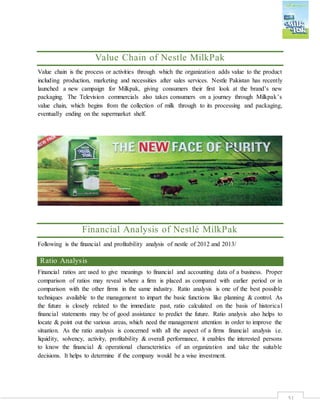
Value Chain of Nestle MilkPak .................................................................................................... 51
Financial Analysis of Nestlé MilkPak .......................................................................................... 51
Ratio Analysis........................................................................................................................ 51
Defining the bases for Comparative Analysis ....................................................................... 52
Determining the criteria of work ........................................................................................... 52
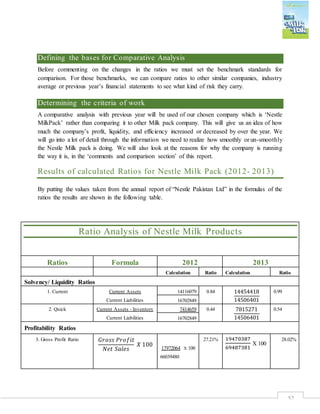
Results of calculated Ratios for Nestle Milk Pack (2012- 2013).............................................. 52
Ratio Analysis of Nestle Milk Products........................................................................................ 52
6
Comments and Comparison........................................................................................................53
Liquidity Ratios......................................................................................................................... 53
Current Ratio ......................................................................................................................... 53
Quick Ratio............................................................................................................................ 53
Profitability Ratios .................................................................................................................... 54
Gross Profit Margin ............................................................................................................... 54
Operating Profit Margin ........................................................................................................ 54
Net Profit Margin................................................................................................................... 54
Inventory Turnover ................................................................................................................... 55
Working Capital Ratios............................................................................................................. 55
Inventory Days: ..................................................................................................................... 55
Receivables Days................................................................................................................... 56
Payable Period ....................................................................................................................... 56
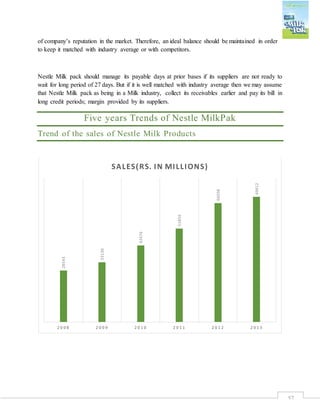
Five years Trends of Nestle MilkPak............................................................................................ 57
Trend of the sales of Nestle Milk Products............................................................................... 57
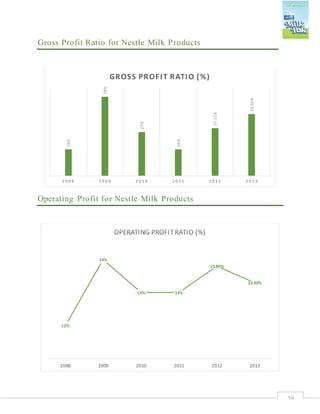
Gross Profit Ratio for Nestle Milk Products ............................................................................. 58
Operating Profit for Nestle Milk Products ................................................................................ 58
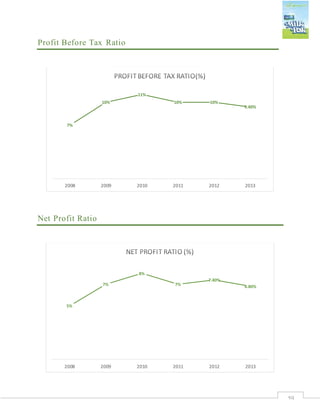
Profit Before Tax Ratio............................................................................................................. 59
Net Profit Ratio ......................................................................................................................... 59
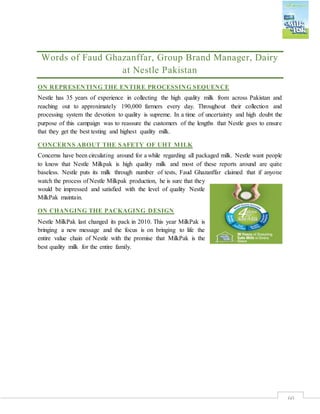
Words of Faud Ghazanffar, Group Brand Manager, Dairy at Nestle Pakistan............................. 60
7
Executive Summary
Nestlé is one of theleading food producing brand in wholeworld production around
in 80+ counties and network in 100+ countries. A company emphasizing on
nutritious and healthy dairy and other products. Leading brand in dairy industry.
Nestle Pakistan is the leading brand in Pakistan in Dairy products. One of the
leading dairy product is Nestle MilkPak availablein every part of Pakistan. Nestle
MilkPak has some strengths and some weaknesses to think upon seriously. As milk
market is increasing, new rivals are coming in the market.
Nestle MilkPak has strongest points in some area like distribution network. Olperz
is a brand that are giving tough time in the market. Production technique is
according to the internationalstandards.
HR practices are strong there and IT system is one of the developed of all butdue to
some circumstances profits are falling. Marketing department’s decreasing
performance is the alarming situation for Nestle.
8
History
The key factor which drove the early history of the enterprise that would become The Nestlé
Company was Henri Nestlé's search for a healthy, economical alternative to breastfeeding for
mothers who could not feed their infants at the breast. Nestlé is a Swiss company, founded in 1866
by Henri Nestlé invests Around CHF 1.5 billion in Research and Development every year Nestlé
markets its products in 130 countries across the world.
Henri Nestlé also showed early understanding of the power of branding. He had adopted his own
coat of arms as a trademark; in Swiss German, Nestlé means 'little nest'. One of his agents
suggested that the nest could be exchanged for the white cross of the Swiss flag. His response was
firm: "I regret that I cannot allow you to change my nest for a Swiss cross .... I cannot have a
different trademark in every country; anyone can make use of a cross, but no one else may use my
coat of arms."
The Company's strategy will continue to be guided by several fundamental principles. Nestlé’s
existing products will grow through innovation and renovation while maintaining a balance in
geographic activities and product lines. Long-term potential will never be sacrificed for short-term
performance. The Company's priority will be to bring the best and most relevant products to
people, wherever they are, whatever their needs, throughout their lives.
The timeline below reviews the significant events that mark the history of Nestlé:
1866‐1905:
In 1866, two separate Swiss enterprises that would later form the core of Nestle, the Anglo‐Swiss
Condensed Milk Company and the Farine Lactee Henri Nestle Company, were established.
1905‐1918:
The Company formed by the merger was called the Nestlé and Anglo‐Swiss Milk Company. By
the early 1900s, the Company was operating factories in the United States, Britain, Germany and
Spain. In 1907, the Company began full‐scale manufacturing in Australia, its second‐largest export
market. Warehouses were built in Singapore, Hong Kong, and Bombay to supply the rapidly
growing Asian markets.
1918‐1938:
The manufacture of chocolate became the Company's second most important activity. New
products appeared steadily: malted milk, a powdered beverage called Milo, a powdered buttermilk
for infants, and, in 1938, Nescafé.
1938‐1944:
Due to World War II, neutral Switzerland became increasingly isolated, and many of Nestlé's
executives were transferred to offices in Stamford, Connecticut. To overcome distribution
problems, factories were established in developing countries, particularly in Latin America.
1944‐1975:
Throughout this period, Nestlé's growth was based on its policy of diversifying within the food
sector to meet the needs of consumers. Mergers and acquisitions made by Nestlé within this period
include Alimentana S.A., the manufacturer of Maggi seasonings and soups (1947), Crosse &
9
Blackwell, the British manufacturer of preserves and canned foods (1960), Findus frozen foods
(1963), Libby's fruit juices (1971), Stouffer's frozen foods (1973), and finally becoming a
shareholder in L'Oréal (1974), which is outside the food industry.
1975‐1981:
Nestlé's rapid growth in the developing world partially offset a slowdown in the Company's
traditional markets, but it also carried with it the risks associated with unstable political and
economic conditions. To maintain a balance, Nestlé made its second venture outside the food
industry by acquiring Alcon Laboratories, Inc., a U.S. manufacturer of pharmaceutical and
ophthalmic products.
1981‐1995:
The Company's strategy for this period was twofold: improve its financial situation through
internal adjustments and divestments, and continue its policy of strategic acquisitions. In 1984,
Nestlé's improved bottom line allowed the Company to launch a new round of acquisitions,
including a public offer of $3 billion for the American food giant Carnation. At the time, the
takeover, sealed in 1985, was one of the largest in the history of the food industry.
1996‐2002:
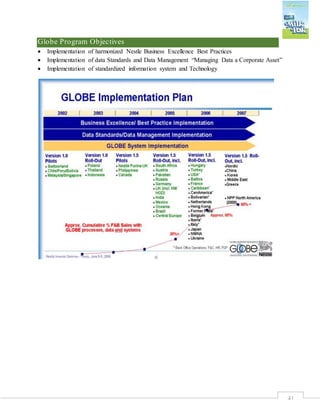
In July 2000, Nestlé launched a Group‐wide initiative called GLOBE (Global Business
Excellence), aimed at harmonizing and simplifying business process architecture. Two major
acquisitions took place in North America in 2002 Dreyer's and Chef America, Inc. Also in 2002,
the joint venture Dairy Partners Americas was set up with Fonterra.
2003‐2009:
Acquisitions made during this period include Mövenpick Ice Cream, Jenny Craig, Uncle Toby's,
Novartis Medical Nutrition, Gerber and Henniez. Also, Nestlé entered into a strategic alliance with
the Belgian chocolatier Pierre Marcolini. In 2008, Nestlé began a process of selling Alcon by
divesting 24.8% to Novartis. In 2009, Nestlé opened the Chocolate Centre of Excellence in Broc,
Switzerland, with Pierre Marcolini one of the master chocolatiers.
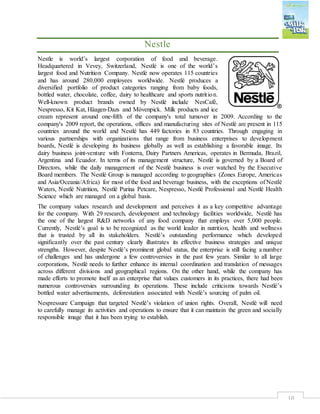
Henri Nestlé, the founder of Nestlé
Henri Nestlé, the founder of Nestlé, was a life-saving
chemist but also an innovative marketer. He used
scientific knowledge to develop products that met
consumer needs. He used his name to brand his products
in a distinctive way. And he set up systems to distribute
his products quickly and effectively.
10
Nestle
Nestle is world’s largest corporation of food and beverage.
Headquartered in Vevey, Switzerland, Nestlé is one of the world’s
largest food and Nutrition Company. Nestlé now operates 115 countries
and has around 280,000 employees worldwide. Nestlé produces a
diversified portfolio of product categories ranging from baby foods,
bottled water, chocolate, coffee, dairy to healthcare and sports nutrition.
Well‐known product brands owned by Nestlé include NesCafé,
Nespresso, Kit Kat, Häagen‐Dazs and Mövenpick. Milk products and ice
cream represent around one‐fifth of the company's total turnover in 2009. According to the
company's 2009 report, the operations, offices and manufacturing sites of Nestlé are present in 115
countries around the world and Nestlé has 449 factories in 83 countries. Through engaging in
various partnerships with organizations that range from business enterprises to development
boards, Nestlé is developing its business globally as well as establishing a favorable image. Its
dairy business joint‐venture with Fonterra, Dairy Partners Americas, operates in Bermuda, Brazil,
Argentina and Ecuador. In terms of its management structure, Nestlé is governed by a Board of
Directors, while the daily management of the Nestlé business is over watched by the Executive
Board members. The Nestlé Group is managed according to geographies (Zones Europe, Americas
and Asia/Oceania/Africa) for most of the food and beverage business, with the exceptions of Nestlé
Waters, Nestlé Nutrition, Nestlé Purina Petcare, Nespresso, Nestlé Professional and Nestlé Health
Science which are managed on a global basis.
The company values research and development and perceives it as a key competitive advantage
for the company. With 29 research, development and technology facilities worldwide, Nestlé has
the one of the largest R&D networks of any food company that employs over 5,000 people.
Currently, Nestlé’s goal is to be recognized as the world leader in nutrition, health and wellness
that is trusted by all its stakeholders. Nestlé’s outstanding performance which developed
significantly over the past century clearly illustrates its effective business strategies and unique
strengths. However, despite Nestlé’s prominent global status, the enterprise is still facing a number
of challenges and has undergone a few controversies in the past few years. Similar to all large
corporations, Nestlé needs to further enhance its internal coordination and translation of messages
across different divisions and geographical regions. On the other hand, while the company has
made efforts to promote itself as an enterprise that values customers in its practices, there had been
numerous controversies surrounding its operations. These include criticisms towards Nestlé’s
bottled water advertisements, deforestation associated with Nestlé’s sourcing of palm oil.
Nespressure Campaign that targeted Nestlé’s violation of union rights. Overall, Nestlé will need
to carefully manage its activities and operations to ensure that it can maintain the green and socially
responsible image that it has been trying to establish.
11
Nestlé’s Vision Statement
“Nestlé’s aim is to meet the various needs of the consumer everyday by marketing and selling
foods of a consistently high quality.”
Nestlé’s Mission Statement
“We strive to bring consumers foods that are safe, of high quality and provide optimal nutrient
to meet physiological need. Nestle helps provide selections for all individual taste and lifestyle
preferences.”
Nestlé’s Slogan
“Good food good life”
Nestle Core Values
“The Nestlé global vision is to be the leading health, wellness, and Nutrition Company in the
world. Nestlé Pakistan subscribes fully to this vision”.
In particular, NESTLE envision to:
 Lead a dynamic motivated and professional workforce – proud of its heritage and
bullish about the future.
 Meet the nutritional needs of consumers of all age groups – from infancy to old age,
from nutrition to pleasure, through an innovative portfolio of branded food and
beverage products of the highest quality.
 Deliver shareholder value through profitable long-term growth, while continuing to
play a significant and responsible role in the social, economic and environmental
sectors of the country.
 We have profitable and diversified high quality food and beverage product portfolio,
delivering advantage to consumers, available across all sales channels.
 Our brands are the preferred choice in their categories. Consumer insight drives all
aspects of our marketing and communication efforts.
 Our communications to the consumer are relevant, cutting-edge, and adhere to the
highest standards of responsible communication.
 Our company is seen as the No. 1 career destination for talented, motivated and
ambitious professionals.
 Our result-oriented organizational structure ensures effective communication and
empowered self-management.
 Our milk collectionand agricultural services will continue to play the primary role in
development of the dairy sectors in all over the world.
12
 Our proactive innovation and renovation culture is the key to our success in the
marketplace.
 Fully integrated systems (suppliers, customers) ensure efficient business processes.
 Non-strategic activities and products are outsourced or discontinued.
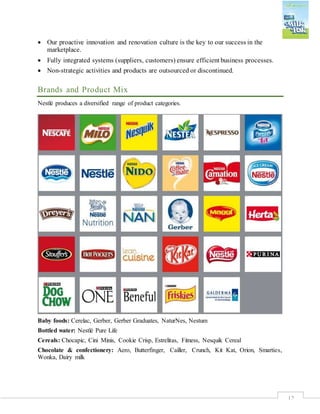
Brands and Product Mix
Nestlé produces a diversified range of product categories.
Baby foods: Cerelac, Gerber, Gerber Graduates, NaturNes, Nestum
Bottled water: Nestlé Pure Life
Cereals: Chocapic, Cini Minis, Cookie Crisp, Estrelitas, Fitness, Nesquik Cereal
Chocolate & confectionery: Aero, Butterfinger, Cailler, Crunch, Kit Kat, Orion, Smarties,
Wonka, Dairy milk
13
Coffee: Nescafé, Nescafé 3 in 1, Nescafé Cappuccino, Nescafé Classic, Nescafé Decaff,
Nescafé, Dolce Gusto, Nescafé Gold, Nespresso
Culinary, chilled and frozen food: Buitoni, Herta, Hot Pockets, Lean Cuisine, Maggi, Stouffer's,
Thomy
Dairy: Carnation, Coffee‐Mate, La Laitière, Nido, Milkpak
Drinks: Juicy Juice, Milo, Nesquik, Nestea
Healthcare nutrition: Boost, Nutren Junior, Peptamen, Resource
Ice cream: Dreyer’s, Extrême, Häagen‐Dazs, Mövenpick, Nestlé Ice Cream
Petcare: Alpo, Bakers Complete, Beneful, Cat Chow, Chef Michael’s Canine Creations, Dog
WORLDWIDE PRESENCE
Operations by region and country
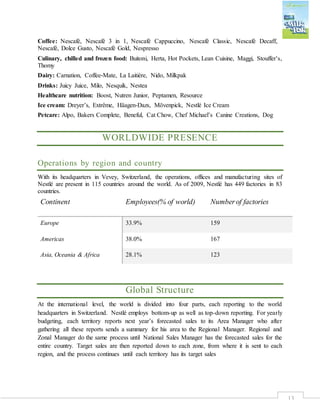
With its headquarters in Vevey, Switzerland, the operations, offices and manufacturing sites of
Nestlé are present in 115 countries around the world. As of 2009, Nestlé has 449 factories in 83
countries.
Continent Employees(% of world) Numberof factories
Europe 33.9% 159
Americas 38.0% 167
Asia, Oceania & Africa 28.1% 123
Global Structure
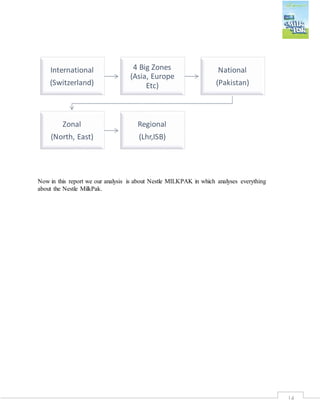
At the international level, the world is divided into four parts, each reporting to the world
headquarters in Switzerland. Nestlé employs bottom-up as well as top-down reporting. For yearly
budgeting, each territory reports next year’s forecasted sales to its Area Manager who after
gathering all these reports sends a summary for his area to the Regional Manager. Regional and
Zonal Manager do the same process until National Sales Manager has the forecasted sales for the
entire country. Target sales are then reported down to each zone, from where it is sent to each
region, and the process continues until each territory has its target sales
14
Now in this report we our analysis is about Nestle MILKPAK in which analyses everything
about the Nestle MilkPak.
International
(Switzerland)
4 Big Zones
(Asia, Europe
Etc)
National
(Pakistan)
Zonal
(North, East)
Regional
(Lhr,ISB)
15
Nestle Pakistan
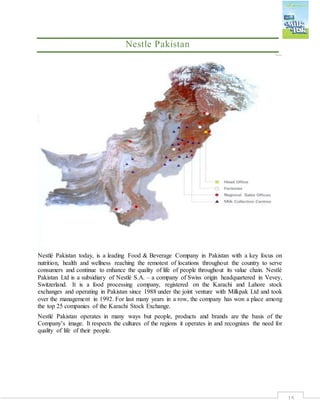
Nestlé Pakistan today, is a leading Food & Beverage Company in Pakistan with a key focus on
nutrition, health and wellness reaching the remotest of locations throughout the country to serve
consumers and continue to enhance the quality of life of people throughout its value chain. Nestlé
Pakistan Ltd is a subsidiary of Nestlé S.A. – a company of Swiss origin headquartered in Vevey,
Switzerland. It is a food processing company, registered on the Karachi and Lahore stock
exchanges and operating in Pakistan since 1988 under the joint venture with Milkpak Ltd and took
over the management in 1992. For last many years in a row, the company has won a place among
the top 25 companies of the Karachi Stock Exchange.
Nestlé Pakistan operates in many ways but people, products and brands are the basis of the
Company’s image. It respects the cultures of the regions it operates in and recognizes the need for
quality of life of their people.
16
Main Offices Head Office
308, Upper Mall, Lahore, 54000, Pakistan
Phone - 042 - 5757082 – 95, Fax - 042-5711820
Sub Offices
1. Islamabad
2. Karachi
3. Peshawar
4. Sheikhupura
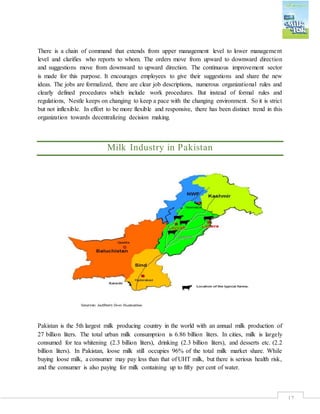
Organizational Structure (Nestle PK)
Managing
Director
Marketingand
Sales Manager
NationalSales
Manager
Zonal Sales
Manager
Area Sales
Manager
Group Brand
Manager
Technical
Manager
Plant Manager
Corporate
Manager
SupplyChain
Manager
Distribution
Operations
Distribution
Services
Demandand
supplyPlanning
Finance Control
Manager
Finance Controller
Corporate HR
Manager
HR Manager
Corporate Quality
Assurance
Manager
QualityAssurance
Manager
17
There is a chain of command that extends from upper management level to lower management
level and clarifies who reports to whom. The orders move from upward to downward direction
and suggestions move from downward to upward direction. The continuous improvement sector
is made for this purpose. It encourages employees to give their suggestions and share the new
ideas. The jobs are formalized, there are clear job descriptions, numerous organizational rules and
clearly defined procedures which include work procedures. But instead of formal rules and
regulations, Nestle keeps on changing to keep a pace with the changing environment. So it is strict
but not inflexible. In effort to be more flexible and responsive, there has been distinct trend in this
organization towards decentralizing decision making.
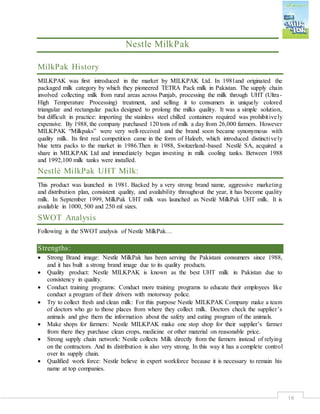
Milk Industry in Pakistan
Pakistan is the 5th largest milk producing country in the world with an annual milk production of
27 billion liters. The total urban milk consumption is 6.86 billion liters. In cities, milk is largely
consumed for tea whitening (2.3 billion liters), drinking (2.3 billion liters), and desserts etc. (2.2
billion liters). In Pakistan, loose milk still occupies 96% of the total milk market share. While
buying loose milk, a consumer may pay less than that of UHT milk, but there is serious health risk,
and the consumer is also paying for milk containing up to fifty per cent of water.
18
Nestle MilkPak
MilkPak History
MILKPAK was first introduced in the market by MILKPAK Ltd. In 1981and originated the
packaged milk category by which they pioneered TETRA Pack milk in Pakistan. The supply chain
involved collecting milk from rural areas across Punjab, processing the milk through UHT (Ultra-
High Temperature Processing) treatment, and selling it to consumers in uniquely colored
triangular and rectangular packs designed to prolong the milks quality. It was a simple solution,
but difficult in practice: importing the stainless steel chilled containers required was prohibitively
expensive. By 1988, the company purchased 120 tons of milk a day from 26,000 farmers. However
MILKPAK “Milkpaks” were very well-received and the brand soon became synonymous with
quality milk. Its first real competition came in the form of Haleeb, which introduced distinctively
blue tetra packs to the market in 1986.Then in 1988, Switzerland-based Nestlé SA, acquired a
share in MILKPAK Ltd and immediately began investing in milk cooling tanks. Between 1988
and 1992,100 milk tanks were installed.
Nestlé MilkPak UHT Milk:
This product was launched in 1981. Backed by a very strong brand name, aggressive marketing
and distribution plan, consistent quality, and availability throughout the year, it has become quality
milk. In September 1999, MilkPak UHT milk was launched as Nestlé MilkPak UHT milk. It is
available in 1000, 500 and 250 ml sizes.
SWOT Analysis
Following is the SWOT analysis of Nestle MilkPak…
Strengths:
 Strong Brand image: Nestle MilkPak has been serving the Pakistani consumers since 1988,
and it has built a strong brand image due to its quality products.
 Quality product: Nestle MILKPAK is known as the best UHT milk in Pakistan due to
consistency in quality.
 Conduct training programs: Conduct more training programs to educate their employees like
conduct a program of their drivers with motorway police.
 Try to collect fresh and clean milk: For this purpose Nestle MILKPAK Company make a team
of doctors who go to those places from where they collect milk. Doctors check the supplier’s
animals and give them the information about the safety and eating program of the animals.
 Make shops for farmers: Nestle MILKPAK make one stop shop for their supplier’s farmer
from there they purchase clean crops, medicine or other material on reasonable price.
 Strong supply chain network: Nestle collects Milk directly from the farmers instead of relying
on the contractors. And its distribution is also very strong. In this way it has a complete control
over its supply chain.
 Qualified work force: Nestle believe in expert workforce because it is necessary to remain his
name at top companies.
19
 Commitment to High Quality Products: For this purpose they make customer service
management who receive the complaints or suggestion of customer and take quick action.
 Focus on research and development: Nestle MILKPAK give the value to the customer through
new innovation. For this purpose they add iron quality in milk and Nesvita for strong bones.
Weaknesses
 Nestle MILKPAK does not give milk to the shopkeeper on credit. This thing has affected on
the annual sale of the milk because their competitors give milk on credit.
 Nestle MILKPAK company does not spend its lot of money on advertising or other promotion
programs.
 Price is also weakness of MILKPAK because sometime its price is high than other competitors.
 Nestle has not been able to retain talented workers. People at the centers are sometimes treated
in an insulting manner. There is a lack of job surety in nestle MILKPAK because they give job
most to their employees on contract basis.
Opportunities
 Pakistan dairy industry is the World’s fifth largest industry with annual production over 40
million tones.
 There is an opportunity for Nestle MilkPak to introduce value-added products like ice creams,
Paneer, Khoya, flavored milk, dairy sweets, etc.
 There is a phenomenal scope for innovations in product development, packaging and
presentation.
Threats
 Very low quality milk is provided by the milkmen to dairy farms which is a very big threat for
the entire market.
 The shortage of milk providing animals is also a threat.
 Poor profitability for farmers.
 Lack of contact for farmers to the market mechanism.
 Lack of education among the farmers is making it difficult to change farm and dairy
management systems.
 Despite the huge volume of milk produced in Pakistan, processors find it hard to procure
sufficient milk to meet future consumer demand.
 Load shedding is a major problem of all companies because they purchase generator for the
running of their chiller, due to this the company’s budget and price of milk increase.
20
PEST Analysis
Political Factors
 The rules of government of Pakistan do affect the company and its brand. The company
policies are affected and its budget is also affected.
 Nestle paid 15% sales tax and 18% excise duty when they direct import chiller from the other
country but mostly they purchase chillers inside the country.
 Increases the prices of light and petrol effect transportation and other cost.
 On the other hand, Government gives chiller to the Nestle MILKPAK at interest free
installment through UNDP and PDDP projects. This process reduces the pressure on milk
industry and increase the productivity.
 Daily changing policies of Government effects overall industry.
Economic Factors
 If we disintegrate our milk supply chain and re-evaluate its each component in detail, it will be
safe to say that there are fair enough chances of such lethal contaminations.
 The first and probably the most crucial problem arise from the on-field farm practices of our
rural farmers.
 Pakistan is blessed with good genetic potential for dairy development, buffalo being the
principal source of milk. But due to problems such as poor nutrition, mismanagement, failure
to control disease, unavailability of veterinary and poor animal husbandry, only 5% milk is
used for processing.
 Nestle MILKPAK is playing an important role in the economic growth of Pakistan.
 They earn lot of profit and also trust its profit in social welfare through making schools etc.
They also give job opportunities to the people of rural areas through giving them animal on
interest free installments.
 Now a days, our economy is on recession due to this the prices of processing milk is increasing
day by day.
Social Factors
 Social factors include the demographic and culture aspect of the external micro environment.
These factors affect customer needs and the size of potential market.
 People mostly prefer fresh and open milk & rely less on processing milk because they
understand processing milk companies add chemical in milk during process. But Nestle
MILKPAK try to change this trend through advertisement and awareness programs.
 Processing milk is mostly used in large cities or towns.
 Companies try to win large number of customers giving quality or values.
Technological Factors
 Technological variables have an overall positive effect on the business.
 As rate of innovation and production technology is always in the favor of company.
 Technology is particular importance because it has always been the main source of increase in
productivity.
21
 Nestle uses latest technology and high quality machinery in the production of milk. For
example Nestle recently open Asia’s largest factory in Kabirwala.
 Nestle MILKPAK used machinery which produced 1800 to 2000 tones milk daily.
MilkPak Marketing Analysis
Marketing Strategy
Targeting
 Urban areas of the country
 Upper and Middle income class
Advertising Plan
Following is the procedure to make Advertising plan
Background
Research
Problem
Identification
Target Customer
Strategies
Advertisement
22
Background Research
 Pakistan is the 5th largest milk producing country in the world.
 An estimated 33.25 billion liters of annual milk is produced.
Total Target Market Of Milk 180000000
Annual Production Of Milk (Billion Liters) 33.25
Total market of Gawala (96%) Billion
liters
31.92
Total existing market of processed milk
(4%) Billion Liters
1.33
Problem Identification
Decreasing profits leads to Decline Market Share.
OBJECTIVES
 To increase market share.
 To Create Brand awareness.
Target Audience
DEMOGRAPHIC SEGMENTATION
 Children,
 Women of Child Bearing Age 15 - 45,
 Elder Women
 Upper and middle class families, specially focusing on middle class.
PSYCHOGRAPHIC SEGMENTATION
 Milkpak have segmented the market more towards achievers who are goal-oriented and
focused on their careers.
 Those who are health conscious.
BEHAVIOURAL SEGMENTATION
 Milkpak’s products have been segmented on the basis of benefits that consumers seek in the
milk.
 People look for a brand that can be used for all purposes from drinking to, tea whiteners as
well as for health related uses
23
Strategies
INCREASE MILK USAGE
 Through building brand alliances with Tea & Juice manufacturers like Tapal Tea & Hamdard
Rooh Afza.
 To also make alliances with cooking channels specially Masala TV to sponsor their hot shows.
o Will run Nestle Milkpak show to provide new recipes to, increase milk usage and
therefore increase our sale and increase share of processed milk.
INCREASE HEALTH AWARENESS
 Increase Health Awareness by focusing on professionals.
INCREASE BRAND AWARENESS
 Increase Brand awareness through advertisement.
Positioning Strategy
BRAND POSITION
 Functional Positioning
 Nestle Milkpak has adopted the functional positioning strategy like:
o “Khaalis He Sab Kuch Hai”
o “Wohi Qudarti Maza”
o “Jaan Banaoo”
o “PURE MILK, HEALTHY LIVING”
BRAND IMAGE
 Quality Nutritious Milk.
Message Strategy
KEY CONSUMER INSIGHT
 Age------------Children, Women of Child Bearing Age, Elderly Women.
 Sex------------Either Sex but special focus on Women.
 Race----------Any.
 Ethnicity-----Pakistani.
 Income-------Middle Classes.
 Occupation---Professional (i.e., Healthy, Active, Goal oriented people).
SELLING PREMISE
 Quality pure milk
24
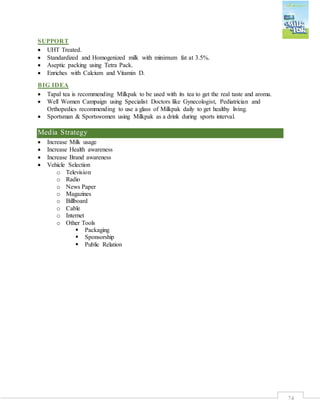
SUPPORT
 UHT Treated.
 Standardized and Homogenized milk with minimum fat at 3.5%.
 Aseptic packing using Tetra Pack.
 Enriches with Calcium and Vitamin D.
BIG IDEA
 Tapal tea is recommending Milkpak to be used with its tea to get the real taste and aroma.
 Well Women Campaign using Specialist Doctors like Gynecologist, Pediatrician and
Orthopedics recommending to use a glass of Milkpak daily to get healthy living.
 Sportsman & Sportswomen using Milkpak as a drink during sports interval.
Media Strategy
 Increase Milk usage
 Increase Health awareness
 Increase Brand awareness
 Vehicle Selection
o Television
o Radio
o News Paper
o Magazines
o Billboard
o Cable
o Internet
o Other Tools
 Packaging
 Sponsorship
 Public Relation
25
Operations of Nestle MILKPAK:
The operations performed in the Nestle milk are explained as follow.
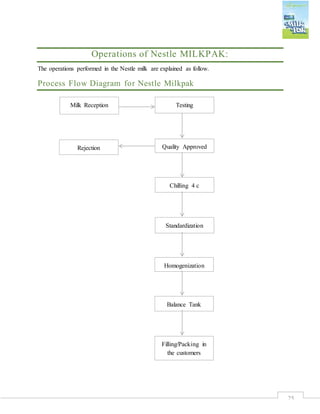
Process Flow Diagram for Nestle Milkpak
Milk Reception Testing
Quality Approved
Milk
Rejection
Chilling 4 c
Standardization
Homogenization
Balance Tank
Filling/Packing in
the customers
26
Homogenization
A mechanical process that breaks the fat globules into smaller droplets so that they stay suspended
in the milk.
Balance Tank
Raw product tank located at the start of a pasteurization system used to maintain a constant supply
of product
Supply Chain Management
Supply chain management is the streamlining of a business’s supply-side activities to maximize
the customer value and to gain a competitive edge in the marketplace. “Nestlé’s ambition is to
achieve high level of customer satisfaction through low cost, highly efficient operations driven by
value creation and continuous improvement”
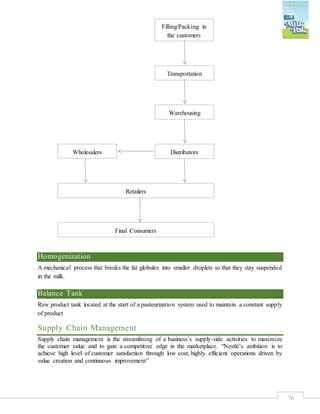
Filling/Packing in
the customers
Transportation
Warehousing
Distributors
Retailers
Wholesalers
Final Consumers
27
Supply Chain Mission
 Optimize and consolidate resources and processes for a low-cost but efficient.
 Develop and manage simplified and effective supply network to achieve a high level of service.
 Create a continuous improvement culture driven by performance measures and reward.
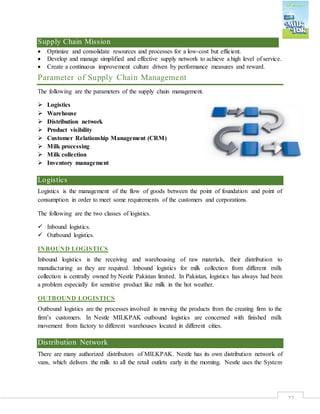
Parameter of Supply Chain Management
The following are the parameters of the supply chain management.
 Logistics
 Warehouse
 Distribution network
 Product visibility
 Customer Relationship Management (CRM)
 Milk processing
 Milk collection
 Inventory management
Logistics
Logistics is the management of the flow of goods between the point of foundation and point of
consumption in order to meet some requirements of the customers and corporations.
The following are the two classes of logistics.
 Inbound logistics.
 Outbound logistics.
INBOUND LOGISTICS
Inbound logistics is the receiving and warehousing of raw materials, their distribution to
manufacturing as they are required. Inbound logistics for milk collection from different milk
collection is centrally owned by Nestle Pakistan limited. In Pakistan, logistics has always had been
a problem especially for sensitive product like milk in the hot weather.
OUTBOUND LOGISTICS
Outbound logistics are the processes involved in moving the products from the creating firm to the
firm’s customers. In Nestle MILKPAK outbound logistics are concerned with finished milk
movement from factory to different warehouses located in different cities.
Distribution Network
There are many authorized distributors of MILKPAK. Nestle has its own distribution network of
vans, which delivers the milk to all the retail outlets early in the morning. Nestle uses the System
28
Application and Product software to make the response time effective and fast enough so that
goods can be delivered.
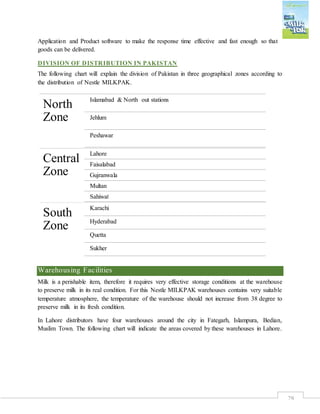
DIVISION OF DISTRIBUTION IN PAKISTAN
The following chart will explain the division of Pakistan in three geographical zones according to
the distribution of Nestle MILKPAK.
Warehousing Facilities
Milk is a perishable item, therefore it requires very effective storage conditions at the warehouse
to preserve milk in its real condition. For this Nestle MILKPAK warehouses contains very suitable
temperature atmosphere, the temperature of the warehouse should not increase from 38 degree to
preserve milk in its fresh condition.
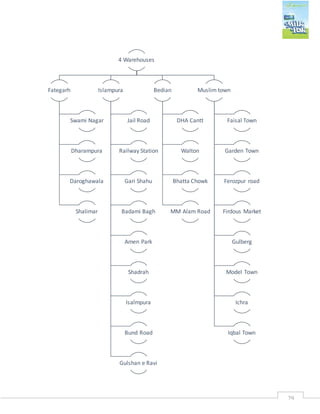
In Lahore distributors have four warehouses around the city in Fategarh, Islampura, Bedian,
Muslim Town. The following chart will indicate the areas covered by these warehouses in Lahore.
North
Zone
Islamabad & North out stations
Jehlum
Peshawar
Central
Zone
Lahore
Faisalabad
Gujranwala
Multan
Sahiwal
South
Zone
Karachi
Hyderabad
Quetta
Sukher
29
4 Warehouses
Fategarh
Swami Nagar
Dharampura
Daroghawala
Shalimar
Islampura
Jail Road
Railway Station
Gari Shahu
Badami Bagh
Amen Park
Shadrah
Isalmpura
Bund Road
Gulshan e Ravi
Bedian
DHA Cantt
Walton
Bhatta Chowk
MM Alam Road
Muslim town
Faisal Town
Garden Town
Ferozpur road
Firdous Market
Gulberg
Model Town
Ichra
Iqbal Town
30
Nestlé’s warehouses uses a proper system to record all the in and out of the products. Warehouse
in charge is a person who is responsible to record all the transactions regarding the movement of
the products of Nestle.
Product visibility
Product visibility is the measure of the distance at the product can be clearly recognized. Nestle
have the highest product visibility. It is because of the distribution Nestle’s distribution network
and decentralizing of the warehouse. Although it effects in the increase of the cost of warehouse
but the product is available in about all the cities of Pakistan.
Customer Relationship Management
Customer Relationship Management is the system of managing a company’s interactions with
current and future customers. It often involves using technology to organize, automate and
coordinate sales, marketing, customer and technical support. Customer Relationship Management
is the key to success to any organization. Many organizations fail due to the bad practices of the
Customer Relationship Management. If the customer is satisfied with the services of the company,
the customer will be willing to purchase more often the product which the organization is offering.
Nestle have developed deep relationships with the farmers. Due to which Nestle MILKPAK is
competing effectively in the market.
TRANSACTION PROCESSING SYSTEM
Through this system Nestle process the data resulting from the business transactions,
updates the operational databases and produces business documentations.
PROCESS CONTROL SYSTEM
Nestle uses the Process Control System in the food department. They use the electric sensors linked
to the computers to continuous monitor food material processing and made instant adjustments.
ENTERPRISE COLLABORATION SYSTEM
Through this system Nestle considers team-work and workgroup collaboration within and outside
the boundaries of the organization. Like e-mail, chat, video conferencing software.
31
Milk Collection System
Step1
A small farmer in rural area milks his buffalo twice a day and takes about liters to one of the village
milk collection centers.
Step2
At the village Milk Collection Centre the farmer’s milk is poured into the aluminum churns. The
agent checks the milk freshness and purity, and enters the quantity into the farmer’s record. He
takes it to one of the secondary reception and cooling stations.
Step3
The Secondary Reception Station has a large electrically powered tank. A milk inspector measures
the fat content, the non-fat content and the milk’s acidity. Once he satisfied with content in the
milk, he takes the milk to main reception and cooling stations.
Step4
At the main reception and cooling stations the milk is transferred to the large tanks and is
thoroughly checked for quality. Then the milk dispatched to the factory.
Step5
The milk is processed and packed into the familiar cartons you can find into grocery store. It is
checked for quality thrice before being released for sale. Some is processed into yogurt, powdered
milk and other dairy products.
Milk processing procedure
The production procedure of MILKPAK is divided into the following processes.
 Milk reception:
 Heating & cooling:
 Standardization:
 Pasteurization:
 UHT treatment
Milk Reception
The milk reception unit receives milk for a milk processing plant. The unit measures the quantity,
checks the quality of milk, and then pushes the product for further treatment.
32
Heating & Cooling
Heating and cooling are the basic processes within dairy processing and take place in plate or
tabular heating exchanges. Tetra pack heat exchangers have high thermal efficiency for low energy
consumption.
Standardization
Automatic direct in-line standardization of milk, accurate control of fat and non-fat ration gives
better utilization and control of the production parameters.
 20% Iron.
 41% calcium.
 18% vitamin A.
 20% vitamin C.
Pasteurization
Pasteurization is the process of heating milk up and then quickly cooling it down to eliminate the
certain bacteria. Along with the cooling, Pasteurization is the most important process in the
processing of milk. Temperature and pasteurization time are very important factors which must be
specified exactly in relation to the quality of the milk. The temperature for homogenized, regular
graded milk is usually 72 to 75 degree for 15 seconds to 20 seconds.
UHT treatment
UHT treatment is a thermal process for preserving liquid milk. UHT stands for Ultra High
Temperature and by heating to 137 to 140 degree for 2 to 10 seconds, so the micro-organisms are
inactivated. If the milk is packaged under disease-free conditions, it can be stored at room
temperature for months.
Inventory Management
Inventory management is the forecasting and controlling of the ordering, storage and use of
components that the organization will use in the production of the item it will sell and well and
forecasting and controlling the quantities of goods for sale.
Milk is a perishable item. So it cannot be stored for long period of time. Even after processing milk
to increase its shelf life up to six months still the organizations has adopt First-in-first-out (FIFO)
method to issue the inventory. In this method of issue of inventory the organization supplies the
product which is produced first is put in the market first. As the cost of inventory is very high the
organization tries to maintain the minimum inventory to meet the customer’s expectations under
the normal circumstances. Nestle use the First-in-first-out (FIFO) system of inventory issue. Nestle
33
have a safe inventory of eight days. Inventory also comes with cost. The more the inventory
level, the more the cost of inventory will increase and the profit margins will decrease
automatically.
Packaging
Nestle is committed to reduce the environmental impact of packaging without the risk of safety,
quality or consumer acceptance of its products. As soon as milk is concerned packaging is very
important, it is perishable item which requires special packaging to preserve it for few months. In
order to meet this objective Nestle MILKPAK use tetra pack to deliver fresh milk to its customers
without sacrificing in health measures.
The following are the objectives of MILKPAK packaging.
 Result in the lowest possible weight and volume of packages while maintain pack reliability.
 Avoid the use of material that can adversely impact the environment during packaging
production and disposal.
 Decrease packaging wastage at all stages in supply chain, including package manufacturing,
utilization and disposal.
 Increase the use of recycled material wherever possible, and increase the recyclables and
compatibility of packages with existing waste management schemes.
Transportation
The logistics concerns finished with movement of MILKPAK from factory to warehouses. The
logistics deliver the milk from manufacturing factories.
Human Resource Management of Nestle MilkPak
In 2012, Human Resource continued its journey from last year, to cultivate a culture of talent
diversity, high performance and ensuring compliance.
Initiatives taken were focused towards enhancing performance principles, leadership development,
and career growth, attracting right talent and providing avenues for learning. Additionally, Human
Resource team has been thoroughly involved in the progress of the Nestlé Continuous Excellence
journey, by providing its support and guidance in maintaining employee engagement, people
development processes and appropriate goal alignment.
With a mindset towards achieving sustainable excellence, a comprehensive learning programmer
surrounding concepts of coaching and feedback was rolled-out to targeted groups of existing and
upcoming leadership. With blended learning approach and meticulous evaluation technique, the
programmer was well received and laid foundations for a community dedicated to drive the desired
mindset to all levels within the organization.
With focus on bringing excellence in our service delivery, Human Resource continued to
implement the findings of the survey results regarding level of satisfaction on our processes and
34
services. The objective remains to fortify the strengths identified and work on gaps highlighted
in our journey.
For Human Resource, 2012 was about continuity, pursuing its drive for strengthening a high
performance culture and developing the people by facilitating them with a progressive and healthy
work environment.
Human Resource Structure
The Human Resource Department is subdivided into three branches:
 Shared Services
 Centre of Expertise
 Business Partners
Shared Services
Shared Services are responsible for data and record collections of all the employees of Nestlé
Pakistan. They handle the payrolls, division of provident funds, medical allowances, travel
allowances, and all other administration of the employee funds.
Centre of Expertise
Centre of expertise is responsible for recruitment, remuneration and organization development
through Nestle Training programs, both local and international.
Business Partners
The Business Partners form the link between different human resource activities of the
organization, and the functional departments they are working with. The Human Resource
Manager–Commercial is a Business Partner for Sales and reports to the Head of Sales Department.
He is supposed to form a link between the Human Resource Department and the Sales Department,
making sure all decisions made by the Sales Department are in line with the Company’s goals and
policies.
Nestle Continuous Excellence Department
During the year 2012 Nestle has continued to hold the responsibility for the environment, personal
safety, and the safety of others. In view of the growing demands of the market and changing
consumer needs, an expansion in the current manufacturing foot print is under execution.
On one hand Nestlé Pakistan is investing to take care of health and wellness of the consumer while
on the other hand the Company is keen to look after the needs of its employees, hence addition of
new social block in the factory.
35
Reward system
In Nestle MilkPak there is proper reward system for employees. Nestlé favors competitive,
stimulating and fair remuneration structures offering an overall competitive and attractive
compensation package. Remuneration includes salary, any variable part of remuneration as well
as social, pension and other benefits. Employees are paid for their skills as they deserve. Attractive
salary is paid to them as they deserve. Much kind of facilities are also provided to the employees
which motivate the employees.
Reward linkage with Performance:
=Effort Performance
=Performance-reward linkage
=Attractiveness
A B C
A
B
C
Individual
Goals
Individual
Performanc
e
Organizational
Reward
36
Employee wellness programs
Worksite wellness programs have gotten a boost in recent months because of their possible role in
promoting employee wellness through such benefits as counselling and onsite health centers.
Perks at Work Programs
Nestle help its team keep their work and home life in balance through what they call 'Perks at
Work. The best associates are healthy and happy, and lead full lives.
 Pets in the Workplace
All full-time and part-time Purina headquarter associates are encouraged to bring their pets to work
with them daily.
 Paid Time Off
Associates earn paid time off each month to use for sick leave, family illness, vacation, or personal
reasons.
 Holidays
Nestlé Purina provides regular paid holidays each year.
 ParentalLeave
Leave is available for birth and adoptive fathers and mothers who are salaried or non-union hourly
associates.
 Health Works
The Health Works program helps Nestle associates and their families stay fit and healthy. Nestle
program also provides associates with opportunities to participate in preventative programs that
help save money on heath benefit costs while ensuring Nestlé’s associates remain healthy.
 Online Services & Discounts
Nestlé Purina associates can receive discounts for theater and entertainment, travel and lodging,
electronics, gifts, financial services, local services and more.
 Employee Assistance Program(EAP)
The EAP provides easy, free, confidential access to professional counselors trained to help with a
variety of personal or family problems.
37
Problems in Reward System
But there are also an element of scheme system in nestle reward system in which reward are
provided to the employees through the schemes. In which deserving employees can’t receive these
kind of reward but those employees that does not deserve these kind of rewards, get these reward,
so those employees those work hard , and deserve these kind of rewards demotivate with these
kind of things.
Moreover some training programs , foreign tours, and many more these kind of facilities are also
provided to just some employees other employees working on the same post does not receive these
facilities at the same time so those employees who get these facilities motivated but those
employees those does not receive these kind of facilities demotivate because of these things.
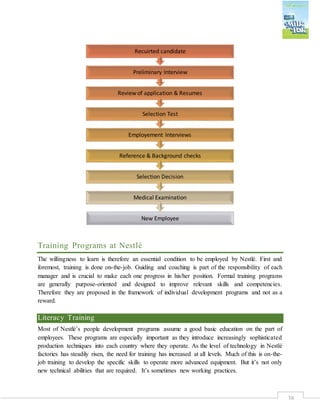
Selection & Recruitment in Nestle Pakistan
Recruitment and selection forms a core part of the central activities underlying human resource
management: namely, the acquisition, development and reward of workers. It frequently forms an
important part of the work of human resource managers – or designated specialists within work
organizations. However, and importantly, recruitment and selection decisions are often for good
reason taken by non-specialists, by the line managers. There is, therefore, an important sense in
which it is the responsibility of all managers, and where human resource departments exist, it may
be that HR managers play more of a supporting advisory role to those people who will supervise
or in other ways work with the new employee.
Recruitment
Recruitment is the process of attracting individuals on a timely basis, in sufficient numbers, and
with appropriate qualification, and encouraging them to apply for jobs with an organization.
Selection
38
Training Programs at Nestlé
The willingness to learn is therefore an essential condition to be employed by Nestlé. First and
foremost, training is done on-the-job. Guiding and coaching is part of the responsibility of each
manager and is crucial to make each one progress in his/her position. Formal training programs
are generally purpose-oriented and designed to improve relevant skills and competencies.
Therefore they are proposed in the framework of individual development programs and not as a
reward.
Literacy Training
Most of Nestlé’s people development programs assume a good basic education on the part of
employees. These programs are especially important as they introduce increasingly sophisticated
production techniques into each country where they operate. As the level of technology in Nestlé
factories has steadily risen, the need for training has increased at all levels. Much of this is on-the-
job training to develop the specific skills to operate more advanced equipment. But it’s not only
new technical abilities that are required. It’s sometimes new working practices.
New Employee
Medical Examination
Selection Decision
Reference & Background checks
Employement Interviews
Selection Test
Review of application & Resumes
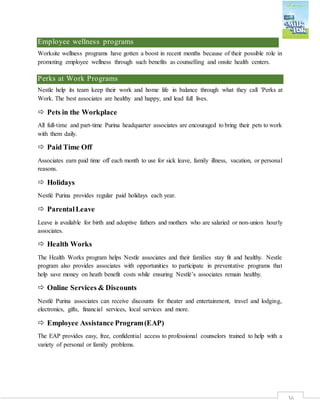
Preliminary Interview
Recuirted candidate
39
Nestlé Apprenticeship Program
Apprenticeship programs have been an essential part of Nestlé training where the young trainees
spent three days a week at work and two at school. Positive results observed but some of these
soon ran into a problem. At the end of training, many students were hired away by other companies
which provided no training of their own.
Local Training
Two-thirds of all Nestlé employees work in factories, most of which organize continuous training
to meet their specific needs. In addition, a number of Nestlé operating companies run their own
residential training centers. Virtually every national Nestlé company organizes management-
training courses for new employees with High school or university qualifications. But their
approaches vary considerably
International Training
Nestlé’s success in growing local companies in each country has been highly influenced by the
functioning of its international Training Centre, located near our company’s corporate
headquarters in Switzerland.
Development Programme in Nestle
Learning is part of the Nestlé’s culture. Each employee, at all levels, is conscious of the need to
upgrade continuously her/his knowledge and skills. The willingness to learn is therefore a non-
negotiable condition to be employed by Nestlé.
Each employee is in charge of her/his own professional development. However, the Company
actions to offer the opportunity to progress for those having the determination and the potential to
develop their capabilities
Task Design
Task Design determines how the details of the organization’s necessary activities will be grouped,
whether into jobs or team responsibilities.
40
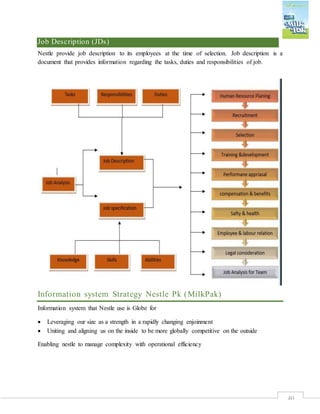
Job Description (JDs)
Nestle provide job description to its employees at the time of selection. Job description is a
document that provides information regarding the tasks, duties and responsibilities of job.
Information system Strategy Nestle Pk (MilkPak)
Information system that Nestle use is Globe for
 Leveraging our size as a strength in a rapidly changing enjoinment
 Uniting and aligning us on the inside to be more globally competitive on the outside
Enabling nestle to manage complexity with operational efficiency
41
Globe Program Objectives
 Implementation of harmonized Nestle Business Excellence Best Practices
 Implementation of data Standards and Data Management “Managing Data a Corporate Asset”
 Implementation of standardized information system and Technology
42
Globe allow Nestle to
 Speed to share and implement new best practices
 Provide better information for better decision
 Facilitate Organizational change
 Allow for focus on generating demand activities
Email
Email is also used to communicate with employees and external parties
Telephone
Telephones are also used to communicate with lower staff or other peoples
ERP AT NESTLE
 In 2000 Nestle signed a $200 million contract with SAP to roll out an ERP system.
 Nestle also committed to an additional $80 million to be spent on consulting, maintenance, and
upgrades.
 Keeps track of customer orders
 Reduce overstocking
 Enables group buying of materials
 Data sharing among subsidiaries
Problems in Information system of Nestle
 2,30,000 employees and 500 facilities in 80 countries
 To support the decentralized strategy, it has 80 different information technology units that’s
runs nearly 900 IBM as/400 mid-range computers ,15 main frames , and 200 Unix system
 Despite its size the company has had no corporate computer centre
 Local difference created inefficiencies and extra costs that could prevent the company from
competing effectively in electronic commerce.
 The lack of standard business processes prevented it from obtaining lower prices for its raw
material.
 At first project decide not to use SAP’s supply chain software because that module was brand
new and appeared to be risky
 The staff that would be directly affected by the changes was not included in the key stake
holder team.
 The lower level worker did not understand how to use the new system and also did not
understand the changes; nobody was prepared for the new ways of doing things.
43
Competitive Analysis
Competitors of Milkpak UHT milk:
 Olpers milk
Olpers milk is second highest selling packaged milk brand in Pakistan. It is owned by Engro
foods in Pakistan.
 Good Milk
A known name in Pakistan milk industry and owned by Shakarganj.
 Adam Milk
Adam’s Milk foods is a company with a wide range of dairy products including cheese and
other dairy products. It has gained a large number of customers.
 Anhaar
Anhaar is Pakistani local brand which so far has introduced different range of milk including
low fat and whole cream etc.
Nestlé’s Advantage
 We never compromise on quality and quantity
 Our extensive milk collection system ensures that the Milk you get is of the finest quality.
 Our products are available in every city and town
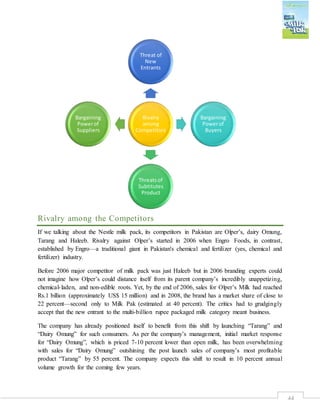
Porter Five Model
Porter five forces study is a structure to examine level of competition inside the industry and
business strategy growth. It draws upon industrial organization economics to derive five forces
that define the competitive strength and therefore attractiveness of a market.
Five forces are following there:
1. Rivalry among the competitors
2. Potential of new entrants into industry
3. Power of suppliers
4. Power of customers
5. Threat of substitute products
44
Rivalry among the Competitors
If we talking about the Nestle milk pack, its competitors in Pakistan are Olper’s, dairy Omung,
Tarang and Haleeb. Rivalry against Olper’s started in 2006 when Engro Foods, in contrast,
established by Engro—a traditional giant in Pakistan's chemical and fertilizer (yes, chemical and
fertilizer) industry.
Before 2006 major competitor of milk pack was just Haleeb but in 2006 branding experts could
not imagine how Olper’s could distance itself from its parent company’s incredibly unappetizing,
chemical-laden, and non-edible roots. Yet, by the end of 2006, sales for Olper’s Milk had reached
Rs.1 billion (approximately US$ 15 million) and in 2008, the brand has a market share of close to
22 percent—second only to Milk Pak (estimated at 40 percent). The critics had to grudgingly
accept that the new entrant to the multi-billion rupee packaged milk category meant business.
The company has already positioned itself to benefit from this shift by launching “Tarang” and
“Dairy Omung” for such consumers. As per the company’s management, initial market response
for “Dairy Omung”, which is priced 7-10 percent lower than open milk, has been overwhelming
with sales for “Dairy Omung” outshining the post launch sales of company’s most profitable
product “Tarang” by 55 percent. The company expects this shift to result in 10 percent annual
volume growth for the coming few years.
Rivalry
among
Competitors
Threat of
New
Entrants
Bargaining
Powerof
Buyers
Threatsof
Subtitutes
Product
Bargaining
Powerof
Suppliers
45
Buyer demand
Buyers demand in market for nestle milk pack is declining the reason is that Olper’s and dairy
Omang affect market share of the Nestle milk pack.
Less costly for buyers to switch brands
It is favorable for customers to switch from milk pack to Olper’s or dairy Omang because of the
same quality and same price.
Industry products
Industry products are becoming more alike because now there are a lot of rivals for milk pack in
the industry of milk.
Number of competitors
Number of competitors increasing and they are more competitive strength in market.
High exit barriers
Haleeb is about to exit the market but Olper’s develop by Engro foods and other brands have high
exit barriers so Nestle MilkPak facing high Rivalry because of this situation.
So rivalry in case of Nestle milk pack is high because:
♦ Buyers demand is declining
♦ It is easy for existing customers to switch on other brands
♦ Tetra pack charge high packing cost so cost of product is high.
♦ Rivals have high exit barriers.
Threat of New Entrant
Every year many companies enter into the market to gain a portion of profitable market and the
Nestle Company over a century boasts a long history of quality products and customer satisfaction,
so it allowed the company to gain a considerable market share. In Pakistan Multinational
companies has very small competition. Currently 2-3 companies of dairy products are doing the
business, one is international and other two are local companies, so there would be a lot of chances
for the other international brands to start their business of dairy products in Pakistan. But for the
new entrants firstly they have to seize a portion of Nestle market share in order to survive, and
Nestle has a constantly target, so there is the threat of new entrants is moderate.
Strength of Barriers to Entry
Nestle have strong barriers to new entrants because of their brand awareness and number of
customers buying their products in all over the world but in Pakistan Nestle milk pack face a strong
46
competition because of the new entrant of 2006 (Engro Food Olper’s).So Olper’s and other milk
products of Engro food giving tough time to Nestle Milk pack so by analysis its observed that Milk
pack now have low strength of barriers to new entrants.
Attractiveness of a Particular Market’s Growth in Demand and Profit
Potential
As we observe, there are a lot of attractiveness of the growth of milk market in demand and profit
potential. Engro just start producing milk in 2006, but they gain a lot of market share in little time.
Capabilities and Resources of Potential Entrants
Resources in Milk industry is Milk so this is the reason for so many local and international New
Entrants that resources are easily available.
Market Entry Barriers Facing New Entrants
♦ High capital requirements
Main resources of Milk is easily available but there are lot of Capital required to open the business
of this level.
♦ Strong Brand Preferencesand CustomerLoyalty
Brand preference and loyalty is high in Nestle but In the case of UHT milk Engro change
perception of most of the people.
♦ Building a Network of Distributors or Dealers
Nestle Builds a networks of distributes or dealers but in 2006 Engro also give it tough time but is
very difficult to compete both of them in this market.
Bargaining Power of Buyer
Bargain power of customer is ability of the customers to put the firm under pressure, which affects
the customer’s sensitivity to price changes in competitive market.
Buyer’s Cost for Switching to Competing Suppliers
As discussed above that industries of packaged industries has been increased in the market so if
Nestle does not perform well regarding the price and quality the customer can easily switch to
other brand because the packaged milk of all brands are easily available in the market.
Number of Buyers Relative to Sellers
The number of buyers of Nestle MilkPak is relatively more than the suppliers so the bargain power
of customer for Nestle is high.
47
Buyer Knowledge of Products, Costs and Pricing
The people on urban areas usually use the packaged milk of different brands and the milk of all
the brands are easily available in market so it is easy for customer to keep updated with the price
of the packaged milk of different brands, so we can say that regarding this factor the bargain power
of customer for Nestle is high. If Nestle charges relatively high price for packaged milk the
customer will switch to other brand.
Bargaining Power of Supplier
Bargain power of suppliers is one of the five forces that define the strength of competition in the
industry. It is very significant factor to be considered in any industry as they are main strength of
the organization.
Ready Availability of Products
The milk is readily available in the farms if Nestle does not make good relationships with its
suppliers and does not perform well regarding the transactions with its supplier, the supplier will
sell their products to other packaged milk brand who offer more prices and favorable terms of
payments.
Buyer’s Cost for Switching among Suppliers
The cost for Nestle for switching among suppliers is high because the number of packaged
industries has been increased, in past there are two milk packaged industries which are Nestle and
Haleeb. But now the situation has been changed, there are number of milk packaged industries in
the market, to whom the suppliers can sell milk, which has decreased the power of Nestle to
influence the price of milk.
Threat of Substitutes
Substitutes of the UHT milk are Soy Milk, Almond milk, Coconut mil etc available on the shops.
But threat is not so high because of less awareness of substitute products.
48
MilkPak & Olper’s
Olper’s by Engro Foods siding the Nestle MilkPak and becoming the market leader of the
category.Brands like MilkPak (owned by Nestle) had led the dairy market in the world’s fifth
largest milk producing country for nearly two decades without any real sustained competition.
Engro Foods, in contrast, had only recently been established by Engro a traditional giant in
Pakistan’s chemical and fertilizer industry. Evidently, Olper’s has woken up the competition.
MilkPak responded with campaigns of its own to reaffirm the positive equity of its brand and has
largely focused on a message of health, vitality, and strength through quality milk. Despite
dwindling market share Olper’s is very strong in terms of consumer quality perception. Our
monthly blind taste tests show that consumers rate Olper’s significantly higher than MilkPak.
Olper's continues to understand its consumers and follow through on that knowledge. Engro Foods
aims to become the only company to utilize all of the milk collecting areas in Pakistan and also
plans on developing the biggest dairy farm in the country. The company’s reputation as a local
giant actively involved with community welfare in remote areas has also been a positive add-on
for Engro Foods. Branding experts could not imagine how Olper’s could distance itself from its
parent company’s incredibly unappetizing, chemical-laden, and non-edible roots. Yet, by the end
of 2006, sales for Olper’s Milk had reached Rs.1 billion (approximately US$ 15 million) and in
2008, the brand has a market share of close to 22 percent second only to MilkPak (estimated at 40
percent). The critics had to grudgingly accept that the new entrant to the multi-billion rupee
packaged milk category meant business.
NESTLÉ MILKPAK and Tetra Pak Pakistan Launch
Pakistan Safe Milk
NESTLÉ Pakistan and Tetra Pak Pakistan proudly co-launched the Pakistan Safe Milk Movement.
The aim of the movement is to educate every Pakistani on the importance of consuming milk that
is safe. In addition, the movement also intends to give enough awareness to everyone to be able to
understand how milk could be unsafe and the subsequent adverse effects on health owing to the
consumption of unsafe milk.
The ceremony was hosted by Sidra Iqbal, leading media anchorperson and development activist.
Among other notables from both NESTLÉ Pakistan and Tetra Pak Pakistan, the launch event was
attended by renowned philanthropist Syed Babar Ali and also by distinguished writer and respected
media personality Anwar Maqsood, the brand ambassador for NESTLÉ MILKPAK, who is also
spearheading the movement.
Mr. Babar Ali, as member of the expert panel at the press briefing, said he recognized the
movement as an extension of his mission of providing high quality products to the Pakistani
consumer. He highlighted the importance of consumer education about the packaged foods
49
industry and underlined that the Pakistani consumer has always been smart enough to make the
right decision, once given the right information. He also underlined how this movement will result
in improving the overall quality of dairy farming and has the potential of making Pakistan a major
exporter of milk in the global market.
Anwar Maqsood highlighted that as Brand Ambassador, he has learnt new facts about the safety
of milk – of how NESTLÉ ensures that pure milk is protected throughout their value chain from
sourcing till the point it is consumed in households. He emphasized that understanding this process
is key to ensuring that we consume safe and healthy products and lead a healthy lifestyle.
Representing NESTLÉ, Mr. Roland Steiger, Business Head of Ambient Dairy added that
“NESTLÉ as an organization has over 140 years of global experience in ensuring that consumers
get a delightful experience through the use of NESTLÉ products owing to high quality standards
and safe handling of milk right from the milking shed to the pack of milk in the consumer’s hand”.
He highlighted that as a result of adherence to these values, NESTLÉ MILKPAK, with a heritage
of more than three decades in Pakistan, holds strong brand equity with its consumers and enjoys
market leadership in the UHT all-purpose milk category.
“NESTLÉ is involved in numerous initiatives to create shared value, including farmer
development, training of female livestock workers through external dairy development projects
and model farms, among many others” said Mr. Waqar Ahmad Sheikh, Head of Corporate Affairs
at NESTLÉ. “Over and above, by purchasing milk on a daily basis from more than 190,000
farmers, NESTLÉ is contributing positively to farmers’ livelihood and hence, rural development”.
Tetra Pak, the world’s leading food processing and packaging solutions company, has partnered
with NESTLÉ to create awareness about milk safety. With presence in over 170 countries across
the globe, Tetra Pak comes with the expertise on processing and packaging solutions best suited
for the local market needs. Tetra Pak’s motto, “PROTECTS WHAT’S GOOD™” reflects their
vision to make food safe and available everywhere.
Speaking for Tetra Pak Pakistan, Osman Bucha, Director Marketing, said,
“With over 30 years of experience in the Pakistani market, we realize and appreciate the need for
creating awareness about milk safety. Through an integrated awareness campaign supported by
seminars and other direct consumer engagements, we see NESTLÉ’s Pakistan Safe Milk
Movement as a platform for helping consumers in making informed decisions about what
constitutes safe and hygienic food”.
The panel also consisted of Mrs. Ghazala Pervaiz (RD), Head of Food and Nutrition Department
at College of Home Economics. She shared facts with the forum on the nutritional significance of
milk intake in the daily diet and also highlighted the possible adverse effects of consuming
unhygienic / adulterated milk and associated gastrointestinal disorders. She stressed the
importance of choosing milk that is safe and of high quality.
50
Evaluating MilkPak Internal Situation
HOW WELL IS MILKPAK PRESENT STRATEGY WORKING
The present strategy of the firm is not working very well, because Engro Olper’s gain a major
market share in the milk industry so MilkPak strategies to gain a major market share is failed.
The reasons are following there
♦ Nestle MilkPak sales and market share is decreasing
♦ Acquisition and retention of customers is decreasing
♦ Decreasing profit margins, net profits and ROI
♦ Negatively viewed by shareholders and customers
♦ Leadership in factors relevant to marketindustry success is disappearing
♦ There are no continuing improvement in operating performance
WHAT ARE MILKPAK COMPETITIVELY IMPORTANT RESOURCES AND
CAPABILITIES?
MilkPak has a long experience in comparison Engro starts producing Olper’s in 2006 so it have
competitively advantage but in present situation MilkPak gain no advantage from its edge.
Reason is Rivals providing better substitutes over time.
IS THE MILKPAK ABLE TO TAKE ADVANTAGE OF MARKET
OPPORTUNITIES AND OVERCOME EXTERNAL THREATS TO ITS
EXTERNAL WELL-BEING?
In the answer of this question Nestle MilkPak is not able to take advantage of market opportunities
and overcome external threats to its external well-being because its market share is continuously
deceasing.
ARE THE FIRM’S PRICES AND COSTS COMPETITIVE WITH THOSE OF KEY
RIVALS, AND DOES IT HAVE AN APPEALING CUSTOMER VALUE
PROPOSITION?
Prices of the MilkPak are higher than others, so it does not have appealing customer value
proposition.
IS THE FIRM COMPETITIVELY STRONGER OR WEAKER THAN KEY
RIVALS?
In present situation MilkPak is getting weaker than key rivals.
51
Value Chain of Nestle MilkPak
Value chain is the process or activities through which the organization adds value to the product
including production, marketing and necessities after sales services. Nestle Pakistan has recently
launched a new campaign for Milkpak, giving consumers their first look at the brand’s new
packaging. The Television commercials also takes consumers on a journey through Milkpak’s
value chain, which begins from the collection of milk through to its processing and packaging,
eventually ending on the supermarket shelf.
Financial Analysis of Nestlé MilkPak
Following is the financial and profitability analysis of nestle of 2012 and 2013/
Ratio Analysis
Financial ratios are used to give meanings to financial and accounting data of a business. Proper
comparison of ratios may reveal where a firm is placed as compared with earlier period or in
comparison with the other firms in the same industry. Ratio analysis is one of the best possible
techniques available to the management to impart the basic functions like planning & control. As
the future is closely related to the immediate past, ratio calculated on the basis of historical
financial statements may be of good assistance to predict the future. Ratio analysis also helps to
locate & point out the various areas, which need the management attention in order to improve the
situation. As the ratio analysis is concerned with all the aspect of a firms financial analysis i.e.
liquidity, solvency, activity, profitability & overall performance, it enables the interested persons
to know the financial & operational characteristics of an organization and take the suitable
decisions. It helps to determine if the company would be a wise investment.
52
Defining the bases for Comparative Analysis
Before commenting on the changes in the ratios we must set the benchmark standards for
comparison. For those benchmarks, we can compare ratios to other similar companies, industry
average or previous year’s financial statements to see what kind of risk they carry.
Determining the criteria of work
A comparative analysis with previous year will be used of our chosen company which is ‘Nestle
MilkPack’ rather than comparing it to other Milk pack company. This will give us an idea of how
much the company’s profit, liquidity, and efficiency increased or decreased by over the year. We
will go into a lot of detail through the information we need to realize how smoothly or un-smoothly
the Nestle Milk pack is doing. We will also look at the reasons for why the company is running
the way it is, in the ‘comments and comparison section’ of this report.
Results of calculated Ratios for Nestle Milk Pack (2012- 2013)
By putting the values taken from the annual report of “Nestle Pakistan Ltd” in the formulas of the
ratios the results are shown in the following table.
Ratio Analysis of Nestle Milk Products
Ratios Formula 2012 2013
Calculation Ratio Calculation Ratio
Solvency/ Liquidity Ratios
1. Current Current Assets
Current Liabilities
14116079 0.84 14454418
14506401
0.99
16702849
2. Quick Current Assets - Inventory
Current Liabilities
7414659 0.44 7815271
14506401
0.54
16702849
Profitability Ratios
3. Gross Profit Ratio 𝐺𝑟𝑜𝑠𝑠 𝑃𝑟𝑜𝑓𝑖𝑡
𝑁𝑒𝑡 𝑆𝑎𝑙𝑒𝑠
𝑋 100
17972064 X 100
66039480
27.21% 19470387
69487381
X 100
28.02%
53
4. Operating Profit Ratio Operating Profit X100
Sales
9156710 X 100
66039480
13.8% 9244317
69487381
𝑋 100
13.3%
Profit before tax Ratio Profit before tax x100
Sales
6661608 X100
66039480
10% 6537968
69487381
𝑋 100
9.4%
Net Profit Ratio Net profit x100
Sales
4896866 X100
66039480
7.4% 4727831
69487381
𝑋 100
6.80%
5. Inventory Turnover Cost of Goods Sales
Inventory
48066161
6701420
7.17 50016994
6386602
7.83
Working Capital/ Management Ratios
6. Inventory (days) Avg. Inventory x365
Cost of Goods Sold
6701420 x365
48066161
50 days 6386602 x365
50014994
46.62 days
7. Collection Period (days) Avg. Receivables x365
Sales
577574 x365
66039480
3.2 days 574598 x365
69487381
3.02 days
8. Accounts Payable (Days) Avg. Payables x365
Purchases
2256597 x365
36637980
22 days 2762482 x 365
36982209
27 days
Comments and Comparison
Liquidity Ratios
Current Ratio
The above shown results state that current ratio for the year 2012 is 0.84 which means that only
0.84 worth of current assets are available for paying the one unit worth of current liabilities (current
assets can’t pay current liabilities). This ratio has increased in the next year 2013 to 0.99 which
shows that company’s current assets are more than the liabilities. The data in SOFP 2013
(Appendix) support the fact that company’s current assets have increased with a significant
increment of ‘short term investments. This shows an improved performance of the company, over
the year 2013.
As ideal balance for current ratio depend upon the nature of the industry in which the company
does work so for commenting with more confidence about the liquidity performance of Nestle
Milk pack, we must need the Milk pack industry’s liquidity ratio trend in Pakistan. Anyhow an
improvement has been seen over the year 2013 but still it will be better to consider the quick ratio
before as inventory is not readily available for paying the dues of the company.
Quick Ratio
54
This ratio is a better indicator of the liquidity of the firm as it excluded least liquid asset
‘inventory’ from the current assets. In Nestle Milk pack scenario Quick ratio in 2012 was 0.44 and
it has increased over the year 2013 to 0.54.
A comparison between both the current and quick ratios for both the years clearly signifies that
there is a big difference between them. It identifies that cash is tied up much in the inventory.
Therefore, reason for lower quick ratio than the ideal balance is reflected by the effect of already
lowered current assets as compare to current liabilities.
Hence we would be in a better position to comment on the liquidity of Nestle Milk pack if we will
aid by the industry average data. Thus, the comparison of two year’s performance of Nestle Milk
pack suggests an improving condition of the company in liquidity terms
Profitability Ratios
Gross Profit Margin
The above calculated ratio for gross profit margin shows that it is 27.21% (2012) and 28.02%
(2013). It tells that if we make a 100 worth of sales how much we get after paying its COGS as
remaining GP. It is good for the Nestle Milk pack to have a higher percentage for GP margin as it
aids to bear the other operating expenses with a higher capability to manage, giving higher
probability to get higher NP margin in response. Thus, Nestle Milk pack has shown an increased
percentage of GP margin over the year 2013.
The reason behind higher GP margin may be the lower COGS. As Nestle Milk pack is well
established company with highest market share in the Milk industry, the lower COGS may be
because of better choice of supplier; discounts availed by bulk purchasing to a target a huge market
of customers. Also, due to being market leader, there is an assumption that Nestle is charging high
sale price which can directly tend to GP margin to grow.
Operating Profit Margin
Operating profit margin for Nestle Milk pack for the both years shows a difference over the past
year from 13.8% to 13.3%. It decrease 0.5% from the year of 2012, it means operating expense
increase in 2013. Operating expense in 2012 were 13.41% then they increase and in 2013 were
14.72%. It shows that 1.31% operating expense increase in 2013.
Net Profit Margin
The calculated NP margin for Nestle Milk pack of both years shows that it decrease over the past
year from 7.4% to 6.8%. By comparing GP and NP margins we can explore that in 2013 company
has a very high percentage of its expenses that is 21.22% as compare to 2012. Anyhow expense to
55
sales ratio of both the years is not much acceptable to a huge company like Nestle Milk Pack, so
they have a need to better control over the operating expenses, because in 2013 GP Margin was
increased by 0.81% but net profit is decrease by 0.6% as compare to 2012.
In spite of decrease in NP margin in 2013, we are not in a position to conclude that company is
showing poor performing in 2013 without additional information as there may be a pause due to
profit handling strategy working at the back end to support future revenue progress.
Furthermore, it may also be assumed that 21.22% expenses in 2013 may be due to poor quality
production to gain short run profits which can harm the long term future benefits or goodwill etc.
in the market. So, the comparison of performance of two years isn’t a good benchmark as will be
the industry average. Anyhow on the bases of two years’ comparison, it is clear that Nestle Milk
pack is not very much good in profitability terms.
Inventory Turnover
This ratio measures that how well the company is using its assets to make the sale. The asset
turnover ratio for the year 2012 is 7.17 and during the year 2013 it is increase to 7.83. This is a
prime time to relate this ratio with decrease inventory stock in 2013 (as shown in Appendix SOFP
2013) as increase ratio may be caused by decrease unproductive assets like receivables, equipment
or inventory for its current levels of sales. Also we can relate it with decrease inventory turnover
days (from 50 to 46), but since we don’t know the industry average, we can’t conclude that the
inventory stock is unproductive. Furthermore the change of the ratio over the year 2013 is only
from 7.17 to 7.83 which also suggests not classifying the decrease inventory as unproductive. It
also shows that sales increase 0.66 time as compare to 2012.
Another assumption can be that the current level of sales has not yet reached to the amount
appropriate for the new asset invested by Nestle. Hence, we can’t be state that increase ratio is
because of good performance until proper information is not available as increased assets are also
related to asset revaluation process. Mean, if we revalue the fixed assets at their increased market
value instead of net book value, net assets will be decrease as a result, thus can affect the asset
turnover ratio to be increase.
Summarizing all about profitability ratio for Nestle Milk pack in 2012 and 2013, it is concluded
that company has shown poor performance during the year. To be sure industry average for
expense to sale ratio and NP margin, inventory holding days and company policies for their
revaluation process are required.
Working Capital Ratios
Inventory Days:
56
The inventory holding days for Nestle Milk pack in 2012 is 50 days and for 2013, it is 46.62.
This shows that the period for which the inventory remains in stock from the day of purchase to
the day of sale, has decrease over the year, in 2013. This information about the inventory days
cannot clarify the performance, until we don’t know about the trend to hold inventory in Milk
industry.
Anyhow, if we relate inventory days with receivable collection period, it is seen during the year
2013 that receivable period has decreased to 3.02 days from 3.2 days, so it is not a bigger
difference. Hence, it’s a general view that more flexible credit allowed period to the debtors or
customers, more will the desirable sales volume, resulting in efficient inventory management. But
in the scenario of Nestle Milk pack, no conclusion can be drawn without any appropriate
benchmark (industry average or any competitor). So from the result only we can say that it is too
much time to hold the inventory of Milk products because they have to bear a high storage cost.
Now they decrease their holding time from 50 days to 46 days as compared to 2012
Furthermore, inventory management is mainly based on considering economic order quantity and
receivable period terms. Thus, it depends on the facts that whether the company is applying these
concepts or not. Therefore, it will be better to consider the company’s internal policies before
commenting on the ratio. Hence, until we don’t have proper information, it will not be appropriate
to assume that inventory is decrease because of decrease in holding days as difference between
current ratio and quick ratio is much higher. This suggests that it depends upon the proper criteria
given as additional information for evaluating the performance of Nestle Milk pack in inventory
holding days.
Receivables Days
The ratio calculated for Nestle Milk pack 2012 and 2013 shows that these days have not much
difference from 3.2 to 3.02. It clearly supports the evidence that early receivable collection will
tend towards the more cash liquidity and leading to a higher liquidity ratios. Anyhow, if will have
industry average, we can comment with more assurance about whether decreased collection period
is required or not for Nestle Milk pack.
Moreover, decreased receivable days will create more working capital at the cost of possible
decreased sales in the future as lessened collection days are caused by tightening credit policy for
credit sales. Thus, while comparing ratios we cannot ignore the effect of one on the other.
Payable Period
This ratio indicates that how long the company takes time to pay its bills or account payables. For
Nestle Milk pack, this period has increased from 22 to 27 days during the year 2013. The increased
payable period is generally considered as supportive as cash remains in hand for a long period. But
on the contrary bases, it can also create credit rating (payback or repayment) problems in regard
57
of company’s reputation in the market. Therefore, an ideal balance should be maintained in order
to keep it matched with industry average or with competitors.
Nestle Milk pack should manage its payable days at prior bases if its suppliers are not ready to
wait for long period of 27 days. But if it is well matched with industry average then we may assume
that Nestle Milk pack as being in a Milk industry, collect its receivables earlier and pay its bill in
long credit periods; margin provided by its suppliers.
Five years Trends of Nestle MilkPak
Trend of the sales of Nestle Milk Products
28543
33130
42476
51859
66038
69412
2 0 0 8 2 0 0 9 2 0 1 0 2 0 1 1 2 0 1 2 2 0 1 3
SALES(RS. IN MILLIONS)
58
Gross Profit Ratio for Nestle Milk Products
Operating Profit for Nestle Milk Products
26%
29%
27%
26%
27.21%
28.02%
2 0 0 8 2 0 0 9 2 0 1 0 2 0 1 1 2 0 1 2 2 0 1 3
GROSS PROFIT RATIO (%)
12%
14%
13% 13%
13.80%
13.30%
2008 2009 2010 2011 2012 2013
59
Profit Before Tax Ratio
Net Profit Ratio
7%
10%
11%
10% 10%
9.40%
2008 2009 2010 2011 2012 2013
5%
7%
8%
7%
7.40%
6.80%
2008 2009 2010 2011 2012 2013
60
Words of Faud Ghazanffar, Group Brand Manager, Dairy
at Nestle Pakistan
ON REPRESENTING THE ENTIRE PROCESSING SEQUENCE
Nestle has 35 years of experience in collecting the high quality milk from across Pakistan and
reaching out to approximately 190,000 farmers every day. Throughout their collection and
processing system the devotion to quality is supreme. In a time of uncertainty and high doubt the
purpose of this campaign was to reassure the customers of the lengths that Nestle goes to ensure
that they get the best testing and highest quality milk.
CONCERNS ABOUT THE SAFETY OF UHT MILK
Concerns have been circulating around for a while regarding all packaged milk. Nestle want people
to know that Nestle Milkpak is high quality milk and most of these reports around are quite
baseless. Nestle puts its milk through number of tests, Faud Ghazanffar claimed that if anyone
watch the process of Nestle Milkpak production, he is sure that they
would be impressed and satisfied with the level of quality Nestle
MilkPak maintain.
ON CHANGING THE PACKAGING DESIGN
Nestle MilkPak last changed its pack in 2010. This year MilkPak is
bringing a new message and the focus is on bringing to life the
entire value chain of Nestle with the promise that MilkPak is the
best quality milk for the entire family.

Nestle milk pak

  • 1.
    NESTLE MILKPAK Prepared By: DaniyalKhalid (Rmba-fall12-007) Zia Ur Rehman (Rmba-fall12-019) Shahid Nadeem (Rmba-fall12-025) Kamran Aqeel (Rmba-fall12-027) Arsalan Haider (Rmba-fall12-039) Ayesha Masood (Rmba-fall12-070) Submitted to: Sir Mubashir Nazir Successful Business
  • 2.
    1 Acknowledgment All the membersworked as a team. The true team work was seen between them. They devoted day and nights in making of this project as if there was some motivational force between them such that to have or obtained maximum benefit out of this project and it proved to be an effective work group when every individual group member completed the task provided in said period of time. The project has been made for general audience. The main purpose of the project was to understand how to make project. All the credits go to ALLAH THE All MIGHTY AND THE MOST BENIFICIAL for giving us such power and wisdom to complete the project on time. May Allah’s blessings remain on us forever (ameen) . And at the last we would like to thank Sir Mubasher Nazir for taking us in confidence and giving us an opportunity to make the project and to learn for making a project.
  • 3.
    2 Contents Acknowledgment ............................................................................................................................ 1 ExecutiveSummary........................................................................................................................ 7 History............................................................................................................................................. 8 Henri Nestlé, the founder of Nestlé............................................................................................. 9 Nestle ............................................................................................................................................ 10 Nestlé’s Vision Statement ......................................................................................................... 11 Nestlé’s Mission Statement....................................................................................................... 11 Nestlé’s Slogan.......................................................................................................................... 11 Nestle Core Values.................................................................................................................... 11 Brands and Product mix ............................................................................................................ 12 WORLDWIDE PRESENCE ........................................................................................................ 13 Operations by region and country ............................................................................................. 13 Global Structure ............................................................................................................................ 13 Nestle Pakistan.............................................................................................................................. 15 Main Offices Head Office......................................................................................................... 16 Sub Offices................................................................................................................................ 16 Organizational Structure (Nestle PK) ........................................................................................... 16 Milk Industry in Pakistan.............................................................................................................. 17 Nestle MilkPak.............................................................................................................................. 18 MilkPak History........................................................................................................................ 18 Nestlé MilkPak UHT Milk:....................................................................................................... 18 SWOT Analysis......................................................................................................................... 18 Strengths: ............................................................................................................................... 18 Weaknesses............................................................................................................................ 19 Opportunities ......................................................................................................................... 19 Threats ................................................................................................................................... 19 PEST Analysis........................................................................................................................... 20 Political Factors ..................................................................................................................... 20 Economic Factors .................................................................................................................. 20
  • 4.
    3 Social Factors.......................................................................................................................20 Technological Factors............................................................................................................20 MilkPak Marketing Analysis ........................................................................................................ 21 Marketing Strategy.................................................................................................................... 21 Targeting................................................................................................................................ 21 Advertising Plan........................................................................................................................ 21 Background Research............................................................................................................ 22 Problem Identification ........................................................................................................... 22 Target Audience..................................................................................................................... 22 Strategies ................................................................................................................................... 23 Positioning Strategy............................................................................................................... 23 Message Strategy................................................................................................................... 23 Media Strategy....................................................................................................................... 24 Operations of Nestle MILKPAK:................................................................................................. 25 Process Flow Diagram for Nestle Milkpak ............................................................................... 25 Homogenization..................................................................................................................... 26 Balance Tank ......................................................................................................................... 26 Supply Chain Management ....................................................................................................... 26 Supply Chain Mission............................................................................................................ 27 Parameter of Supply Chain Management.................................................................................. 27 Logistics................................................................................................................................. 27 Distribution Network ............................................................................................................. 27 Warehousing Facilities .......................................................................................................... 28 Product visibility.................................................................................................................... 30 Customer Relationship Management..................................................................................... 30 Milk Collection System............................................................................................................. 31 Milk processing procedure........................................................................................................ 31 Milk Reception ...................................................................................................................... 31 Heating & Cooling................................................................................................................. 32 Standardization ...................................................................................................................... 32 Pasteurization......................................................................................................................... 32
  • 5.
    4 UHT treatment .....................................................................................................................32 InventoryManagement ............................................................................................................. 32 Packaging .................................................................................................................................. 33 Transportation ........................................................................................................................... 33 Human Resource Management of Nestle MilkPak....................................................................... 33 Human Resource Structure........................................................................................................ 34 Shared Services...................................................................................................................... 34 Centre of Expertise ................................................................................................................ 34 Business Partners ................................................................................................................... 34 Nestle Continuous Excellence Department............................................................................... 34 Reward system .......................................................................................................................... 35 Reward linkage with Performance: ....................................................................................... 35 Employee wellness programs ................................................................................................ 36 Perks at Work Programs ........................................................................................................ 36 Problems in Reward System.................................................................................................. 37 Selection & Recruitment in Nestle Pakistan ............................................................................. 37 Recruitment............................................................................................................................ 37 Selection ................................................................................................................................ 37 Training Programs at Nestlé...................................................................................................... 38 Literacy Training ................................................................................................................... 38 Nestlé Apprenticeship Program............................................................................................. 39 Local Training ....................................................................................................................... 39 International Training ............................................................................................................ 39 Development Programme in Nestle .......................................................................................... 39 Task Design............................................................................................................................... 39 Job Description (JDs) ............................................................................................................ 40 Information system Strategy Nestle Pk (MilkPak) ................................................................... 40 Globe Program Objectives..................................................................................................... 41 ERP AT NESTLE ..................................................................................................................... 42 Problems in Information system of Nestle ............................................................................ 42 Competitive Analysis.................................................................................................................... 43
  • 6.
    5 Competitors of MilkpakUHT milk:........................................................................................43 Porter Five Model...................................................................................................................... 43 Rivalry among the Competitors ................................................................................................ 44 Buyer demand........................................................................................................................ 45 Less costly for buyers to switch brands................................................................................. 45 Industry products ................................................................................................................... 45 Number of competitors .......................................................................................................... 45 High exit barriers ................................................................................................................... 45 Threat of New Entrant............................................................................................................... 45 Strength of Barriers to Entry.................................................................................................. 45 Attractiveness of a Particular Market’s Growth in Demand and Profit Potential ................. 46 Capabilities and Resources of Potential Entrants .................................................................. 46 Market Entry Barriers Facing New Entrants ......................................................................... 46 Bargaining Power of Buyer....................................................................................................... 46 Buyer’s Cost for Switching to Competing Suppliers ............................................................ 46 Number of Buyers Relative to Sellers ................................................................................... 46 Buyer Knowledge of Products, Costs and Pricing................................................................. 47 Bargaining Power of Supplier................................................................................................... 47 Ready Availability of Products.............................................................................................. 47 Buyer’s Cost for Switching among Suppliers ....................................................................... 47 Threat of Substitutes.................................................................................................................. 47 MilkPak & Olper’s........................................................................................................................ 48 NESTLÉ MILKPAK and Tetra Pak Pakistan Launch Pakistan Safe Milk .................................. 48 Evaluating MilkPak Internal Situation.......................................................................................... 50 Value Chain of Nestle MilkPak .................................................................................................... 51 Financial Analysis of Nestlé MilkPak .......................................................................................... 51 Ratio Analysis........................................................................................................................ 51 Defining the bases for Comparative Analysis ....................................................................... 52 Determining the criteria of work ........................................................................................... 52 Results of calculated Ratios for Nestle Milk Pack (2012- 2013).............................................. 52 Ratio Analysis of Nestle Milk Products........................................................................................ 52
  • 7.
    6 Comments and Comparison........................................................................................................53 LiquidityRatios......................................................................................................................... 53 Current Ratio ......................................................................................................................... 53 Quick Ratio............................................................................................................................ 53 Profitability Ratios .................................................................................................................... 54 Gross Profit Margin ............................................................................................................... 54 Operating Profit Margin ........................................................................................................ 54 Net Profit Margin................................................................................................................... 54 Inventory Turnover ................................................................................................................... 55 Working Capital Ratios............................................................................................................. 55 Inventory Days: ..................................................................................................................... 55 Receivables Days................................................................................................................... 56 Payable Period ....................................................................................................................... 56 Five years Trends of Nestle MilkPak............................................................................................ 57 Trend of the sales of Nestle Milk Products............................................................................... 57 Gross Profit Ratio for Nestle Milk Products ............................................................................. 58 Operating Profit for Nestle Milk Products ................................................................................ 58 Profit Before Tax Ratio............................................................................................................. 59 Net Profit Ratio ......................................................................................................................... 59 Words of Faud Ghazanffar, Group Brand Manager, Dairy at Nestle Pakistan............................. 60
  • 8.
    7 Executive Summary Nestlé isone of theleading food producing brand in wholeworld production around in 80+ counties and network in 100+ countries. A company emphasizing on nutritious and healthy dairy and other products. Leading brand in dairy industry. Nestle Pakistan is the leading brand in Pakistan in Dairy products. One of the leading dairy product is Nestle MilkPak availablein every part of Pakistan. Nestle MilkPak has some strengths and some weaknesses to think upon seriously. As milk market is increasing, new rivals are coming in the market. Nestle MilkPak has strongest points in some area like distribution network. Olperz is a brand that are giving tough time in the market. Production technique is according to the internationalstandards. HR practices are strong there and IT system is one of the developed of all butdue to some circumstances profits are falling. Marketing department’s decreasing performance is the alarming situation for Nestle.
  • 9.
    8 History The key factorwhich drove the early history of the enterprise that would become The Nestlé Company was Henri Nestlé's search for a healthy, economical alternative to breastfeeding for mothers who could not feed their infants at the breast. Nestlé is a Swiss company, founded in 1866 by Henri Nestlé invests Around CHF 1.5 billion in Research and Development every year Nestlé markets its products in 130 countries across the world. Henri Nestlé also showed early understanding of the power of branding. He had adopted his own coat of arms as a trademark; in Swiss German, Nestlé means 'little nest'. One of his agents suggested that the nest could be exchanged for the white cross of the Swiss flag. His response was firm: "I regret that I cannot allow you to change my nest for a Swiss cross .... I cannot have a different trademark in every country; anyone can make use of a cross, but no one else may use my coat of arms." The Company's strategy will continue to be guided by several fundamental principles. Nestlé’s existing products will grow through innovation and renovation while maintaining a balance in geographic activities and product lines. Long-term potential will never be sacrificed for short-term performance. The Company's priority will be to bring the best and most relevant products to people, wherever they are, whatever their needs, throughout their lives. The timeline below reviews the significant events that mark the history of Nestlé: 1866‐1905: In 1866, two separate Swiss enterprises that would later form the core of Nestle, the Anglo‐Swiss Condensed Milk Company and the Farine Lactee Henri Nestle Company, were established. 1905‐1918: The Company formed by the merger was called the Nestlé and Anglo‐Swiss Milk Company. By the early 1900s, the Company was operating factories in the United States, Britain, Germany and Spain. In 1907, the Company began full‐scale manufacturing in Australia, its second‐largest export market. Warehouses were built in Singapore, Hong Kong, and Bombay to supply the rapidly growing Asian markets. 1918‐1938: The manufacture of chocolate became the Company's second most important activity. New products appeared steadily: malted milk, a powdered beverage called Milo, a powdered buttermilk for infants, and, in 1938, Nescafé. 1938‐1944: Due to World War II, neutral Switzerland became increasingly isolated, and many of Nestlé's executives were transferred to offices in Stamford, Connecticut. To overcome distribution problems, factories were established in developing countries, particularly in Latin America. 1944‐1975: Throughout this period, Nestlé's growth was based on its policy of diversifying within the food sector to meet the needs of consumers. Mergers and acquisitions made by Nestlé within this period include Alimentana S.A., the manufacturer of Maggi seasonings and soups (1947), Crosse &
  • 10.
    9 Blackwell, the Britishmanufacturer of preserves and canned foods (1960), Findus frozen foods (1963), Libby's fruit juices (1971), Stouffer's frozen foods (1973), and finally becoming a shareholder in L'Oréal (1974), which is outside the food industry. 1975‐1981: Nestlé's rapid growth in the developing world partially offset a slowdown in the Company's traditional markets, but it also carried with it the risks associated with unstable political and economic conditions. To maintain a balance, Nestlé made its second venture outside the food industry by acquiring Alcon Laboratories, Inc., a U.S. manufacturer of pharmaceutical and ophthalmic products. 1981‐1995: The Company's strategy for this period was twofold: improve its financial situation through internal adjustments and divestments, and continue its policy of strategic acquisitions. In 1984, Nestlé's improved bottom line allowed the Company to launch a new round of acquisitions, including a public offer of $3 billion for the American food giant Carnation. At the time, the takeover, sealed in 1985, was one of the largest in the history of the food industry. 1996‐2002: In July 2000, Nestlé launched a Group‐wide initiative called GLOBE (Global Business Excellence), aimed at harmonizing and simplifying business process architecture. Two major acquisitions took place in North America in 2002 Dreyer's and Chef America, Inc. Also in 2002, the joint venture Dairy Partners Americas was set up with Fonterra. 2003‐2009: Acquisitions made during this period include Mövenpick Ice Cream, Jenny Craig, Uncle Toby's, Novartis Medical Nutrition, Gerber and Henniez. Also, Nestlé entered into a strategic alliance with the Belgian chocolatier Pierre Marcolini. In 2008, Nestlé began a process of selling Alcon by divesting 24.8% to Novartis. In 2009, Nestlé opened the Chocolate Centre of Excellence in Broc, Switzerland, with Pierre Marcolini one of the master chocolatiers. Henri Nestlé, the founder of Nestlé Henri Nestlé, the founder of Nestlé, was a life-saving chemist but also an innovative marketer. He used scientific knowledge to develop products that met consumer needs. He used his name to brand his products in a distinctive way. And he set up systems to distribute his products quickly and effectively.
  • 11.
    10 Nestle Nestle is world’slargest corporation of food and beverage. Headquartered in Vevey, Switzerland, Nestlé is one of the world’s largest food and Nutrition Company. Nestlé now operates 115 countries and has around 280,000 employees worldwide. Nestlé produces a diversified portfolio of product categories ranging from baby foods, bottled water, chocolate, coffee, dairy to healthcare and sports nutrition. Well‐known product brands owned by Nestlé include NesCafé, Nespresso, Kit Kat, Häagen‐Dazs and Mövenpick. Milk products and ice cream represent around one‐fifth of the company's total turnover in 2009. According to the company's 2009 report, the operations, offices and manufacturing sites of Nestlé are present in 115 countries around the world and Nestlé has 449 factories in 83 countries. Through engaging in various partnerships with organizations that range from business enterprises to development boards, Nestlé is developing its business globally as well as establishing a favorable image. Its dairy business joint‐venture with Fonterra, Dairy Partners Americas, operates in Bermuda, Brazil, Argentina and Ecuador. In terms of its management structure, Nestlé is governed by a Board of Directors, while the daily management of the Nestlé business is over watched by the Executive Board members. The Nestlé Group is managed according to geographies (Zones Europe, Americas and Asia/Oceania/Africa) for most of the food and beverage business, with the exceptions of Nestlé Waters, Nestlé Nutrition, Nestlé Purina Petcare, Nespresso, Nestlé Professional and Nestlé Health Science which are managed on a global basis. The company values research and development and perceives it as a key competitive advantage for the company. With 29 research, development and technology facilities worldwide, Nestlé has the one of the largest R&D networks of any food company that employs over 5,000 people. Currently, Nestlé’s goal is to be recognized as the world leader in nutrition, health and wellness that is trusted by all its stakeholders. Nestlé’s outstanding performance which developed significantly over the past century clearly illustrates its effective business strategies and unique strengths. However, despite Nestlé’s prominent global status, the enterprise is still facing a number of challenges and has undergone a few controversies in the past few years. Similar to all large corporations, Nestlé needs to further enhance its internal coordination and translation of messages across different divisions and geographical regions. On the other hand, while the company has made efforts to promote itself as an enterprise that values customers in its practices, there had been numerous controversies surrounding its operations. These include criticisms towards Nestlé’s bottled water advertisements, deforestation associated with Nestlé’s sourcing of palm oil. Nespressure Campaign that targeted Nestlé’s violation of union rights. Overall, Nestlé will need to carefully manage its activities and operations to ensure that it can maintain the green and socially responsible image that it has been trying to establish.
  • 12.
    11 Nestlé’s Vision Statement “Nestlé’saim is to meet the various needs of the consumer everyday by marketing and selling foods of a consistently high quality.” Nestlé’s Mission Statement “We strive to bring consumers foods that are safe, of high quality and provide optimal nutrient to meet physiological need. Nestle helps provide selections for all individual taste and lifestyle preferences.” Nestlé’s Slogan “Good food good life” Nestle Core Values “The Nestlé global vision is to be the leading health, wellness, and Nutrition Company in the world. Nestlé Pakistan subscribes fully to this vision”. In particular, NESTLE envision to:  Lead a dynamic motivated and professional workforce – proud of its heritage and bullish about the future.  Meet the nutritional needs of consumers of all age groups – from infancy to old age, from nutrition to pleasure, through an innovative portfolio of branded food and beverage products of the highest quality.  Deliver shareholder value through profitable long-term growth, while continuing to play a significant and responsible role in the social, economic and environmental sectors of the country.  We have profitable and diversified high quality food and beverage product portfolio, delivering advantage to consumers, available across all sales channels.  Our brands are the preferred choice in their categories. Consumer insight drives all aspects of our marketing and communication efforts.  Our communications to the consumer are relevant, cutting-edge, and adhere to the highest standards of responsible communication.  Our company is seen as the No. 1 career destination for talented, motivated and ambitious professionals.  Our result-oriented organizational structure ensures effective communication and empowered self-management.  Our milk collectionand agricultural services will continue to play the primary role in development of the dairy sectors in all over the world.
  • 13.
    12  Our proactiveinnovation and renovation culture is the key to our success in the marketplace.  Fully integrated systems (suppliers, customers) ensure efficient business processes.  Non-strategic activities and products are outsourced or discontinued. Brands and Product Mix Nestlé produces a diversified range of product categories. Baby foods: Cerelac, Gerber, Gerber Graduates, NaturNes, Nestum Bottled water: Nestlé Pure Life Cereals: Chocapic, Cini Minis, Cookie Crisp, Estrelitas, Fitness, Nesquik Cereal Chocolate & confectionery: Aero, Butterfinger, Cailler, Crunch, Kit Kat, Orion, Smarties, Wonka, Dairy milk
  • 14.
    13 Coffee: Nescafé, Nescafé3 in 1, Nescafé Cappuccino, Nescafé Classic, Nescafé Decaff, Nescafé, Dolce Gusto, Nescafé Gold, Nespresso Culinary, chilled and frozen food: Buitoni, Herta, Hot Pockets, Lean Cuisine, Maggi, Stouffer's, Thomy Dairy: Carnation, Coffee‐Mate, La Laitière, Nido, Milkpak Drinks: Juicy Juice, Milo, Nesquik, Nestea Healthcare nutrition: Boost, Nutren Junior, Peptamen, Resource Ice cream: Dreyer’s, Extrême, Häagen‐Dazs, Mövenpick, Nestlé Ice Cream Petcare: Alpo, Bakers Complete, Beneful, Cat Chow, Chef Michael’s Canine Creations, Dog WORLDWIDE PRESENCE Operations by region and country With its headquarters in Vevey, Switzerland, the operations, offices and manufacturing sites of Nestlé are present in 115 countries around the world. As of 2009, Nestlé has 449 factories in 83 countries. Continent Employees(% of world) Numberof factories Europe 33.9% 159 Americas 38.0% 167 Asia, Oceania & Africa 28.1% 123 Global Structure At the international level, the world is divided into four parts, each reporting to the world headquarters in Switzerland. Nestlé employs bottom-up as well as top-down reporting. For yearly budgeting, each territory reports next year’s forecasted sales to its Area Manager who after gathering all these reports sends a summary for his area to the Regional Manager. Regional and Zonal Manager do the same process until National Sales Manager has the forecasted sales for the entire country. Target sales are then reported down to each zone, from where it is sent to each region, and the process continues until each territory has its target sales
  • 15.
    14 Now in thisreport we our analysis is about Nestle MILKPAK in which analyses everything about the Nestle MilkPak. International (Switzerland) 4 Big Zones (Asia, Europe Etc) National (Pakistan) Zonal (North, East) Regional (Lhr,ISB)
  • 16.
    15 Nestle Pakistan Nestlé Pakistantoday, is a leading Food & Beverage Company in Pakistan with a key focus on nutrition, health and wellness reaching the remotest of locations throughout the country to serve consumers and continue to enhance the quality of life of people throughout its value chain. Nestlé Pakistan Ltd is a subsidiary of Nestlé S.A. – a company of Swiss origin headquartered in Vevey, Switzerland. It is a food processing company, registered on the Karachi and Lahore stock exchanges and operating in Pakistan since 1988 under the joint venture with Milkpak Ltd and took over the management in 1992. For last many years in a row, the company has won a place among the top 25 companies of the Karachi Stock Exchange. Nestlé Pakistan operates in many ways but people, products and brands are the basis of the Company’s image. It respects the cultures of the regions it operates in and recognizes the need for quality of life of their people.
  • 17.
    16 Main Offices HeadOffice 308, Upper Mall, Lahore, 54000, Pakistan Phone - 042 - 5757082 – 95, Fax - 042-5711820 Sub Offices 1. Islamabad 2. Karachi 3. Peshawar 4. Sheikhupura Organizational Structure (Nestle PK) Managing Director Marketingand Sales Manager NationalSales Manager Zonal Sales Manager Area Sales Manager Group Brand Manager Technical Manager Plant Manager Corporate Manager SupplyChain Manager Distribution Operations Distribution Services Demandand supplyPlanning Finance Control Manager Finance Controller Corporate HR Manager HR Manager Corporate Quality Assurance Manager QualityAssurance Manager
  • 18.
    17 There is achain of command that extends from upper management level to lower management level and clarifies who reports to whom. The orders move from upward to downward direction and suggestions move from downward to upward direction. The continuous improvement sector is made for this purpose. It encourages employees to give their suggestions and share the new ideas. The jobs are formalized, there are clear job descriptions, numerous organizational rules and clearly defined procedures which include work procedures. But instead of formal rules and regulations, Nestle keeps on changing to keep a pace with the changing environment. So it is strict but not inflexible. In effort to be more flexible and responsive, there has been distinct trend in this organization towards decentralizing decision making. Milk Industry in Pakistan Pakistan is the 5th largest milk producing country in the world with an annual milk production of 27 billion liters. The total urban milk consumption is 6.86 billion liters. In cities, milk is largely consumed for tea whitening (2.3 billion liters), drinking (2.3 billion liters), and desserts etc. (2.2 billion liters). In Pakistan, loose milk still occupies 96% of the total milk market share. While buying loose milk, a consumer may pay less than that of UHT milk, but there is serious health risk, and the consumer is also paying for milk containing up to fifty per cent of water.
  • 19.
    18 Nestle MilkPak MilkPak History MILKPAKwas first introduced in the market by MILKPAK Ltd. In 1981and originated the packaged milk category by which they pioneered TETRA Pack milk in Pakistan. The supply chain involved collecting milk from rural areas across Punjab, processing the milk through UHT (Ultra- High Temperature Processing) treatment, and selling it to consumers in uniquely colored triangular and rectangular packs designed to prolong the milks quality. It was a simple solution, but difficult in practice: importing the stainless steel chilled containers required was prohibitively expensive. By 1988, the company purchased 120 tons of milk a day from 26,000 farmers. However MILKPAK “Milkpaks” were very well-received and the brand soon became synonymous with quality milk. Its first real competition came in the form of Haleeb, which introduced distinctively blue tetra packs to the market in 1986.Then in 1988, Switzerland-based Nestlé SA, acquired a share in MILKPAK Ltd and immediately began investing in milk cooling tanks. Between 1988 and 1992,100 milk tanks were installed. Nestlé MilkPak UHT Milk: This product was launched in 1981. Backed by a very strong brand name, aggressive marketing and distribution plan, consistent quality, and availability throughout the year, it has become quality milk. In September 1999, MilkPak UHT milk was launched as Nestlé MilkPak UHT milk. It is available in 1000, 500 and 250 ml sizes. SWOT Analysis Following is the SWOT analysis of Nestle MilkPak… Strengths:  Strong Brand image: Nestle MilkPak has been serving the Pakistani consumers since 1988, and it has built a strong brand image due to its quality products.  Quality product: Nestle MILKPAK is known as the best UHT milk in Pakistan due to consistency in quality.  Conduct training programs: Conduct more training programs to educate their employees like conduct a program of their drivers with motorway police.  Try to collect fresh and clean milk: For this purpose Nestle MILKPAK Company make a team of doctors who go to those places from where they collect milk. Doctors check the supplier’s animals and give them the information about the safety and eating program of the animals.  Make shops for farmers: Nestle MILKPAK make one stop shop for their supplier’s farmer from there they purchase clean crops, medicine or other material on reasonable price.  Strong supply chain network: Nestle collects Milk directly from the farmers instead of relying on the contractors. And its distribution is also very strong. In this way it has a complete control over its supply chain.  Qualified work force: Nestle believe in expert workforce because it is necessary to remain his name at top companies.
  • 20.
    19  Commitment toHigh Quality Products: For this purpose they make customer service management who receive the complaints or suggestion of customer and take quick action.  Focus on research and development: Nestle MILKPAK give the value to the customer through new innovation. For this purpose they add iron quality in milk and Nesvita for strong bones. Weaknesses  Nestle MILKPAK does not give milk to the shopkeeper on credit. This thing has affected on the annual sale of the milk because their competitors give milk on credit.  Nestle MILKPAK company does not spend its lot of money on advertising or other promotion programs.  Price is also weakness of MILKPAK because sometime its price is high than other competitors.  Nestle has not been able to retain talented workers. People at the centers are sometimes treated in an insulting manner. There is a lack of job surety in nestle MILKPAK because they give job most to their employees on contract basis. Opportunities  Pakistan dairy industry is the World’s fifth largest industry with annual production over 40 million tones.  There is an opportunity for Nestle MilkPak to introduce value-added products like ice creams, Paneer, Khoya, flavored milk, dairy sweets, etc.  There is a phenomenal scope for innovations in product development, packaging and presentation. Threats  Very low quality milk is provided by the milkmen to dairy farms which is a very big threat for the entire market.  The shortage of milk providing animals is also a threat.  Poor profitability for farmers.  Lack of contact for farmers to the market mechanism.  Lack of education among the farmers is making it difficult to change farm and dairy management systems.  Despite the huge volume of milk produced in Pakistan, processors find it hard to procure sufficient milk to meet future consumer demand.  Load shedding is a major problem of all companies because they purchase generator for the running of their chiller, due to this the company’s budget and price of milk increase.
  • 21.
    20 PEST Analysis Political Factors The rules of government of Pakistan do affect the company and its brand. The company policies are affected and its budget is also affected.  Nestle paid 15% sales tax and 18% excise duty when they direct import chiller from the other country but mostly they purchase chillers inside the country.  Increases the prices of light and petrol effect transportation and other cost.  On the other hand, Government gives chiller to the Nestle MILKPAK at interest free installment through UNDP and PDDP projects. This process reduces the pressure on milk industry and increase the productivity.  Daily changing policies of Government effects overall industry. Economic Factors  If we disintegrate our milk supply chain and re-evaluate its each component in detail, it will be safe to say that there are fair enough chances of such lethal contaminations.  The first and probably the most crucial problem arise from the on-field farm practices of our rural farmers.  Pakistan is blessed with good genetic potential for dairy development, buffalo being the principal source of milk. But due to problems such as poor nutrition, mismanagement, failure to control disease, unavailability of veterinary and poor animal husbandry, only 5% milk is used for processing.  Nestle MILKPAK is playing an important role in the economic growth of Pakistan.  They earn lot of profit and also trust its profit in social welfare through making schools etc. They also give job opportunities to the people of rural areas through giving them animal on interest free installments.  Now a days, our economy is on recession due to this the prices of processing milk is increasing day by day. Social Factors  Social factors include the demographic and culture aspect of the external micro environment. These factors affect customer needs and the size of potential market.  People mostly prefer fresh and open milk & rely less on processing milk because they understand processing milk companies add chemical in milk during process. But Nestle MILKPAK try to change this trend through advertisement and awareness programs.  Processing milk is mostly used in large cities or towns.  Companies try to win large number of customers giving quality or values. Technological Factors  Technological variables have an overall positive effect on the business.  As rate of innovation and production technology is always in the favor of company.  Technology is particular importance because it has always been the main source of increase in productivity.
  • 22.
    21  Nestle useslatest technology and high quality machinery in the production of milk. For example Nestle recently open Asia’s largest factory in Kabirwala.  Nestle MILKPAK used machinery which produced 1800 to 2000 tones milk daily. MilkPak Marketing Analysis Marketing Strategy Targeting  Urban areas of the country  Upper and Middle income class Advertising Plan Following is the procedure to make Advertising plan Background Research Problem Identification Target Customer Strategies Advertisement
  • 23.
    22 Background Research  Pakistanis the 5th largest milk producing country in the world.  An estimated 33.25 billion liters of annual milk is produced. Total Target Market Of Milk 180000000 Annual Production Of Milk (Billion Liters) 33.25 Total market of Gawala (96%) Billion liters 31.92 Total existing market of processed milk (4%) Billion Liters 1.33 Problem Identification Decreasing profits leads to Decline Market Share. OBJECTIVES  To increase market share.  To Create Brand awareness. Target Audience DEMOGRAPHIC SEGMENTATION  Children,  Women of Child Bearing Age 15 - 45,  Elder Women  Upper and middle class families, specially focusing on middle class. PSYCHOGRAPHIC SEGMENTATION  Milkpak have segmented the market more towards achievers who are goal-oriented and focused on their careers.  Those who are health conscious. BEHAVIOURAL SEGMENTATION  Milkpak’s products have been segmented on the basis of benefits that consumers seek in the milk.  People look for a brand that can be used for all purposes from drinking to, tea whiteners as well as for health related uses
  • 24.
    23 Strategies INCREASE MILK USAGE Through building brand alliances with Tea & Juice manufacturers like Tapal Tea & Hamdard Rooh Afza.  To also make alliances with cooking channels specially Masala TV to sponsor their hot shows. o Will run Nestle Milkpak show to provide new recipes to, increase milk usage and therefore increase our sale and increase share of processed milk. INCREASE HEALTH AWARENESS  Increase Health Awareness by focusing on professionals. INCREASE BRAND AWARENESS  Increase Brand awareness through advertisement. Positioning Strategy BRAND POSITION  Functional Positioning  Nestle Milkpak has adopted the functional positioning strategy like: o “Khaalis He Sab Kuch Hai” o “Wohi Qudarti Maza” o “Jaan Banaoo” o “PURE MILK, HEALTHY LIVING” BRAND IMAGE  Quality Nutritious Milk. Message Strategy KEY CONSUMER INSIGHT  Age------------Children, Women of Child Bearing Age, Elderly Women.  Sex------------Either Sex but special focus on Women.  Race----------Any.  Ethnicity-----Pakistani.  Income-------Middle Classes.  Occupation---Professional (i.e., Healthy, Active, Goal oriented people). SELLING PREMISE  Quality pure milk
  • 25.
    24 SUPPORT  UHT Treated. Standardized and Homogenized milk with minimum fat at 3.5%.  Aseptic packing using Tetra Pack.  Enriches with Calcium and Vitamin D. BIG IDEA  Tapal tea is recommending Milkpak to be used with its tea to get the real taste and aroma.  Well Women Campaign using Specialist Doctors like Gynecologist, Pediatrician and Orthopedics recommending to use a glass of Milkpak daily to get healthy living.  Sportsman & Sportswomen using Milkpak as a drink during sports interval. Media Strategy  Increase Milk usage  Increase Health awareness  Increase Brand awareness  Vehicle Selection o Television o Radio o News Paper o Magazines o Billboard o Cable o Internet o Other Tools  Packaging  Sponsorship  Public Relation
  • 26.
    25 Operations of NestleMILKPAK: The operations performed in the Nestle milk are explained as follow. Process Flow Diagram for Nestle Milkpak Milk Reception Testing Quality Approved Milk Rejection Chilling 4 c Standardization Homogenization Balance Tank Filling/Packing in the customers
  • 27.
    26 Homogenization A mechanical processthat breaks the fat globules into smaller droplets so that they stay suspended in the milk. Balance Tank Raw product tank located at the start of a pasteurization system used to maintain a constant supply of product Supply Chain Management Supply chain management is the streamlining of a business’s supply-side activities to maximize the customer value and to gain a competitive edge in the marketplace. “Nestlé’s ambition is to achieve high level of customer satisfaction through low cost, highly efficient operations driven by value creation and continuous improvement” Filling/Packing in the customers Transportation Warehousing Distributors Retailers Wholesalers Final Consumers
  • 28.
    27 Supply Chain Mission Optimize and consolidate resources and processes for a low-cost but efficient.  Develop and manage simplified and effective supply network to achieve a high level of service.  Create a continuous improvement culture driven by performance measures and reward. Parameter of Supply Chain Management The following are the parameters of the supply chain management.  Logistics  Warehouse  Distribution network  Product visibility  Customer Relationship Management (CRM)  Milk processing  Milk collection  Inventory management Logistics Logistics is the management of the flow of goods between the point of foundation and point of consumption in order to meet some requirements of the customers and corporations. The following are the two classes of logistics.  Inbound logistics.  Outbound logistics. INBOUND LOGISTICS Inbound logistics is the receiving and warehousing of raw materials, their distribution to manufacturing as they are required. Inbound logistics for milk collection from different milk collection is centrally owned by Nestle Pakistan limited. In Pakistan, logistics has always had been a problem especially for sensitive product like milk in the hot weather. OUTBOUND LOGISTICS Outbound logistics are the processes involved in moving the products from the creating firm to the firm’s customers. In Nestle MILKPAK outbound logistics are concerned with finished milk movement from factory to different warehouses located in different cities. Distribution Network There are many authorized distributors of MILKPAK. Nestle has its own distribution network of vans, which delivers the milk to all the retail outlets early in the morning. Nestle uses the System
  • 29.
    28 Application and Productsoftware to make the response time effective and fast enough so that goods can be delivered. DIVISION OF DISTRIBUTION IN PAKISTAN The following chart will explain the division of Pakistan in three geographical zones according to the distribution of Nestle MILKPAK. Warehousing Facilities Milk is a perishable item, therefore it requires very effective storage conditions at the warehouse to preserve milk in its real condition. For this Nestle MILKPAK warehouses contains very suitable temperature atmosphere, the temperature of the warehouse should not increase from 38 degree to preserve milk in its fresh condition. In Lahore distributors have four warehouses around the city in Fategarh, Islampura, Bedian, Muslim Town. The following chart will indicate the areas covered by these warehouses in Lahore. North Zone Islamabad & North out stations Jehlum Peshawar Central Zone Lahore Faisalabad Gujranwala Multan Sahiwal South Zone Karachi Hyderabad Quetta Sukher
  • 30.
    29 4 Warehouses Fategarh Swami Nagar Dharampura Daroghawala Shalimar Islampura JailRoad Railway Station Gari Shahu Badami Bagh Amen Park Shadrah Isalmpura Bund Road Gulshan e Ravi Bedian DHA Cantt Walton Bhatta Chowk MM Alam Road Muslim town Faisal Town Garden Town Ferozpur road Firdous Market Gulberg Model Town Ichra Iqbal Town
  • 31.
    30 Nestlé’s warehouses usesa proper system to record all the in and out of the products. Warehouse in charge is a person who is responsible to record all the transactions regarding the movement of the products of Nestle. Product visibility Product visibility is the measure of the distance at the product can be clearly recognized. Nestle have the highest product visibility. It is because of the distribution Nestle’s distribution network and decentralizing of the warehouse. Although it effects in the increase of the cost of warehouse but the product is available in about all the cities of Pakistan. Customer Relationship Management Customer Relationship Management is the system of managing a company’s interactions with current and future customers. It often involves using technology to organize, automate and coordinate sales, marketing, customer and technical support. Customer Relationship Management is the key to success to any organization. Many organizations fail due to the bad practices of the Customer Relationship Management. If the customer is satisfied with the services of the company, the customer will be willing to purchase more often the product which the organization is offering. Nestle have developed deep relationships with the farmers. Due to which Nestle MILKPAK is competing effectively in the market. TRANSACTION PROCESSING SYSTEM Through this system Nestle process the data resulting from the business transactions, updates the operational databases and produces business documentations. PROCESS CONTROL SYSTEM Nestle uses the Process Control System in the food department. They use the electric sensors linked to the computers to continuous monitor food material processing and made instant adjustments. ENTERPRISE COLLABORATION SYSTEM Through this system Nestle considers team-work and workgroup collaboration within and outside the boundaries of the organization. Like e-mail, chat, video conferencing software.
  • 32.
    31 Milk Collection System Step1 Asmall farmer in rural area milks his buffalo twice a day and takes about liters to one of the village milk collection centers. Step2 At the village Milk Collection Centre the farmer’s milk is poured into the aluminum churns. The agent checks the milk freshness and purity, and enters the quantity into the farmer’s record. He takes it to one of the secondary reception and cooling stations. Step3 The Secondary Reception Station has a large electrically powered tank. A milk inspector measures the fat content, the non-fat content and the milk’s acidity. Once he satisfied with content in the milk, he takes the milk to main reception and cooling stations. Step4 At the main reception and cooling stations the milk is transferred to the large tanks and is thoroughly checked for quality. Then the milk dispatched to the factory. Step5 The milk is processed and packed into the familiar cartons you can find into grocery store. It is checked for quality thrice before being released for sale. Some is processed into yogurt, powdered milk and other dairy products. Milk processing procedure The production procedure of MILKPAK is divided into the following processes.  Milk reception:  Heating & cooling:  Standardization:  Pasteurization:  UHT treatment Milk Reception The milk reception unit receives milk for a milk processing plant. The unit measures the quantity, checks the quality of milk, and then pushes the product for further treatment.
  • 33.
    32 Heating & Cooling Heatingand cooling are the basic processes within dairy processing and take place in plate or tabular heating exchanges. Tetra pack heat exchangers have high thermal efficiency for low energy consumption. Standardization Automatic direct in-line standardization of milk, accurate control of fat and non-fat ration gives better utilization and control of the production parameters.  20% Iron.  41% calcium.  18% vitamin A.  20% vitamin C. Pasteurization Pasteurization is the process of heating milk up and then quickly cooling it down to eliminate the certain bacteria. Along with the cooling, Pasteurization is the most important process in the processing of milk. Temperature and pasteurization time are very important factors which must be specified exactly in relation to the quality of the milk. The temperature for homogenized, regular graded milk is usually 72 to 75 degree for 15 seconds to 20 seconds. UHT treatment UHT treatment is a thermal process for preserving liquid milk. UHT stands for Ultra High Temperature and by heating to 137 to 140 degree for 2 to 10 seconds, so the micro-organisms are inactivated. If the milk is packaged under disease-free conditions, it can be stored at room temperature for months. Inventory Management Inventory management is the forecasting and controlling of the ordering, storage and use of components that the organization will use in the production of the item it will sell and well and forecasting and controlling the quantities of goods for sale. Milk is a perishable item. So it cannot be stored for long period of time. Even after processing milk to increase its shelf life up to six months still the organizations has adopt First-in-first-out (FIFO) method to issue the inventory. In this method of issue of inventory the organization supplies the product which is produced first is put in the market first. As the cost of inventory is very high the organization tries to maintain the minimum inventory to meet the customer’s expectations under the normal circumstances. Nestle use the First-in-first-out (FIFO) system of inventory issue. Nestle
  • 34.
    33 have a safeinventory of eight days. Inventory also comes with cost. The more the inventory level, the more the cost of inventory will increase and the profit margins will decrease automatically. Packaging Nestle is committed to reduce the environmental impact of packaging without the risk of safety, quality or consumer acceptance of its products. As soon as milk is concerned packaging is very important, it is perishable item which requires special packaging to preserve it for few months. In order to meet this objective Nestle MILKPAK use tetra pack to deliver fresh milk to its customers without sacrificing in health measures. The following are the objectives of MILKPAK packaging.  Result in the lowest possible weight and volume of packages while maintain pack reliability.  Avoid the use of material that can adversely impact the environment during packaging production and disposal.  Decrease packaging wastage at all stages in supply chain, including package manufacturing, utilization and disposal.  Increase the use of recycled material wherever possible, and increase the recyclables and compatibility of packages with existing waste management schemes. Transportation The logistics concerns finished with movement of MILKPAK from factory to warehouses. The logistics deliver the milk from manufacturing factories. Human Resource Management of Nestle MilkPak In 2012, Human Resource continued its journey from last year, to cultivate a culture of talent diversity, high performance and ensuring compliance. Initiatives taken were focused towards enhancing performance principles, leadership development, and career growth, attracting right talent and providing avenues for learning. Additionally, Human Resource team has been thoroughly involved in the progress of the Nestlé Continuous Excellence journey, by providing its support and guidance in maintaining employee engagement, people development processes and appropriate goal alignment. With a mindset towards achieving sustainable excellence, a comprehensive learning programmer surrounding concepts of coaching and feedback was rolled-out to targeted groups of existing and upcoming leadership. With blended learning approach and meticulous evaluation technique, the programmer was well received and laid foundations for a community dedicated to drive the desired mindset to all levels within the organization. With focus on bringing excellence in our service delivery, Human Resource continued to implement the findings of the survey results regarding level of satisfaction on our processes and
  • 35.
    34 services. The objectiveremains to fortify the strengths identified and work on gaps highlighted in our journey. For Human Resource, 2012 was about continuity, pursuing its drive for strengthening a high performance culture and developing the people by facilitating them with a progressive and healthy work environment. Human Resource Structure The Human Resource Department is subdivided into three branches:  Shared Services  Centre of Expertise  Business Partners Shared Services Shared Services are responsible for data and record collections of all the employees of Nestlé Pakistan. They handle the payrolls, division of provident funds, medical allowances, travel allowances, and all other administration of the employee funds. Centre of Expertise Centre of expertise is responsible for recruitment, remuneration and organization development through Nestle Training programs, both local and international. Business Partners The Business Partners form the link between different human resource activities of the organization, and the functional departments they are working with. The Human Resource Manager–Commercial is a Business Partner for Sales and reports to the Head of Sales Department. He is supposed to form a link between the Human Resource Department and the Sales Department, making sure all decisions made by the Sales Department are in line with the Company’s goals and policies. Nestle Continuous Excellence Department During the year 2012 Nestle has continued to hold the responsibility for the environment, personal safety, and the safety of others. In view of the growing demands of the market and changing consumer needs, an expansion in the current manufacturing foot print is under execution. On one hand Nestlé Pakistan is investing to take care of health and wellness of the consumer while on the other hand the Company is keen to look after the needs of its employees, hence addition of new social block in the factory.
  • 36.
    35 Reward system In NestleMilkPak there is proper reward system for employees. Nestlé favors competitive, stimulating and fair remuneration structures offering an overall competitive and attractive compensation package. Remuneration includes salary, any variable part of remuneration as well as social, pension and other benefits. Employees are paid for their skills as they deserve. Attractive salary is paid to them as they deserve. Much kind of facilities are also provided to the employees which motivate the employees. Reward linkage with Performance: =Effort Performance =Performance-reward linkage =Attractiveness A B C A B C Individual Goals Individual Performanc e Organizational Reward
  • 37.
    36 Employee wellness programs Worksitewellness programs have gotten a boost in recent months because of their possible role in promoting employee wellness through such benefits as counselling and onsite health centers. Perks at Work Programs Nestle help its team keep their work and home life in balance through what they call 'Perks at Work. The best associates are healthy and happy, and lead full lives.  Pets in the Workplace All full-time and part-time Purina headquarter associates are encouraged to bring their pets to work with them daily.  Paid Time Off Associates earn paid time off each month to use for sick leave, family illness, vacation, or personal reasons.  Holidays Nestlé Purina provides regular paid holidays each year.  ParentalLeave Leave is available for birth and adoptive fathers and mothers who are salaried or non-union hourly associates.  Health Works The Health Works program helps Nestle associates and their families stay fit and healthy. Nestle program also provides associates with opportunities to participate in preventative programs that help save money on heath benefit costs while ensuring Nestlé’s associates remain healthy.  Online Services & Discounts Nestlé Purina associates can receive discounts for theater and entertainment, travel and lodging, electronics, gifts, financial services, local services and more.  Employee Assistance Program(EAP) The EAP provides easy, free, confidential access to professional counselors trained to help with a variety of personal or family problems.
  • 38.
    37 Problems in RewardSystem But there are also an element of scheme system in nestle reward system in which reward are provided to the employees through the schemes. In which deserving employees can’t receive these kind of reward but those employees that does not deserve these kind of rewards, get these reward, so those employees those work hard , and deserve these kind of rewards demotivate with these kind of things. Moreover some training programs , foreign tours, and many more these kind of facilities are also provided to just some employees other employees working on the same post does not receive these facilities at the same time so those employees who get these facilities motivated but those employees those does not receive these kind of facilities demotivate because of these things. Selection & Recruitment in Nestle Pakistan Recruitment and selection forms a core part of the central activities underlying human resource management: namely, the acquisition, development and reward of workers. It frequently forms an important part of the work of human resource managers – or designated specialists within work organizations. However, and importantly, recruitment and selection decisions are often for good reason taken by non-specialists, by the line managers. There is, therefore, an important sense in which it is the responsibility of all managers, and where human resource departments exist, it may be that HR managers play more of a supporting advisory role to those people who will supervise or in other ways work with the new employee. Recruitment Recruitment is the process of attracting individuals on a timely basis, in sufficient numbers, and with appropriate qualification, and encouraging them to apply for jobs with an organization. Selection
  • 39.
    38 Training Programs atNestlé The willingness to learn is therefore an essential condition to be employed by Nestlé. First and foremost, training is done on-the-job. Guiding and coaching is part of the responsibility of each manager and is crucial to make each one progress in his/her position. Formal training programs are generally purpose-oriented and designed to improve relevant skills and competencies. Therefore they are proposed in the framework of individual development programs and not as a reward. Literacy Training Most of Nestlé’s people development programs assume a good basic education on the part of employees. These programs are especially important as they introduce increasingly sophisticated production techniques into each country where they operate. As the level of technology in Nestlé factories has steadily risen, the need for training has increased at all levels. Much of this is on-the- job training to develop the specific skills to operate more advanced equipment. But it’s not only new technical abilities that are required. It’s sometimes new working practices. New Employee Medical Examination Selection Decision Reference & Background checks Employement Interviews Selection Test Review of application & Resumes Preliminary Interview Recuirted candidate
  • 40.
    39 Nestlé Apprenticeship Program Apprenticeshipprograms have been an essential part of Nestlé training where the young trainees spent three days a week at work and two at school. Positive results observed but some of these soon ran into a problem. At the end of training, many students were hired away by other companies which provided no training of their own. Local Training Two-thirds of all Nestlé employees work in factories, most of which organize continuous training to meet their specific needs. In addition, a number of Nestlé operating companies run their own residential training centers. Virtually every national Nestlé company organizes management- training courses for new employees with High school or university qualifications. But their approaches vary considerably International Training Nestlé’s success in growing local companies in each country has been highly influenced by the functioning of its international Training Centre, located near our company’s corporate headquarters in Switzerland. Development Programme in Nestle Learning is part of the Nestlé’s culture. Each employee, at all levels, is conscious of the need to upgrade continuously her/his knowledge and skills. The willingness to learn is therefore a non- negotiable condition to be employed by Nestlé. Each employee is in charge of her/his own professional development. However, the Company actions to offer the opportunity to progress for those having the determination and the potential to develop their capabilities Task Design Task Design determines how the details of the organization’s necessary activities will be grouped, whether into jobs or team responsibilities.
  • 41.
    40 Job Description (JDs) Nestleprovide job description to its employees at the time of selection. Job description is a document that provides information regarding the tasks, duties and responsibilities of job. Information system Strategy Nestle Pk (MilkPak) Information system that Nestle use is Globe for  Leveraging our size as a strength in a rapidly changing enjoinment  Uniting and aligning us on the inside to be more globally competitive on the outside Enabling nestle to manage complexity with operational efficiency
  • 42.
    41 Globe Program Objectives Implementation of harmonized Nestle Business Excellence Best Practices  Implementation of data Standards and Data Management “Managing Data a Corporate Asset”  Implementation of standardized information system and Technology
  • 43.
    42 Globe allow Nestleto  Speed to share and implement new best practices  Provide better information for better decision  Facilitate Organizational change  Allow for focus on generating demand activities Email Email is also used to communicate with employees and external parties Telephone Telephones are also used to communicate with lower staff or other peoples ERP AT NESTLE  In 2000 Nestle signed a $200 million contract with SAP to roll out an ERP system.  Nestle also committed to an additional $80 million to be spent on consulting, maintenance, and upgrades.  Keeps track of customer orders  Reduce overstocking  Enables group buying of materials  Data sharing among subsidiaries Problems in Information system of Nestle  2,30,000 employees and 500 facilities in 80 countries  To support the decentralized strategy, it has 80 different information technology units that’s runs nearly 900 IBM as/400 mid-range computers ,15 main frames , and 200 Unix system  Despite its size the company has had no corporate computer centre  Local difference created inefficiencies and extra costs that could prevent the company from competing effectively in electronic commerce.  The lack of standard business processes prevented it from obtaining lower prices for its raw material.  At first project decide not to use SAP’s supply chain software because that module was brand new and appeared to be risky  The staff that would be directly affected by the changes was not included in the key stake holder team.  The lower level worker did not understand how to use the new system and also did not understand the changes; nobody was prepared for the new ways of doing things.
  • 44.
    43 Competitive Analysis Competitors ofMilkpak UHT milk:  Olpers milk Olpers milk is second highest selling packaged milk brand in Pakistan. It is owned by Engro foods in Pakistan.  Good Milk A known name in Pakistan milk industry and owned by Shakarganj.  Adam Milk Adam’s Milk foods is a company with a wide range of dairy products including cheese and other dairy products. It has gained a large number of customers.  Anhaar Anhaar is Pakistani local brand which so far has introduced different range of milk including low fat and whole cream etc. Nestlé’s Advantage  We never compromise on quality and quantity  Our extensive milk collection system ensures that the Milk you get is of the finest quality.  Our products are available in every city and town Porter Five Model Porter five forces study is a structure to examine level of competition inside the industry and business strategy growth. It draws upon industrial organization economics to derive five forces that define the competitive strength and therefore attractiveness of a market. Five forces are following there: 1. Rivalry among the competitors 2. Potential of new entrants into industry 3. Power of suppliers 4. Power of customers 5. Threat of substitute products
  • 45.
    44 Rivalry among theCompetitors If we talking about the Nestle milk pack, its competitors in Pakistan are Olper’s, dairy Omung, Tarang and Haleeb. Rivalry against Olper’s started in 2006 when Engro Foods, in contrast, established by Engro—a traditional giant in Pakistan's chemical and fertilizer (yes, chemical and fertilizer) industry. Before 2006 major competitor of milk pack was just Haleeb but in 2006 branding experts could not imagine how Olper’s could distance itself from its parent company’s incredibly unappetizing, chemical-laden, and non-edible roots. Yet, by the end of 2006, sales for Olper’s Milk had reached Rs.1 billion (approximately US$ 15 million) and in 2008, the brand has a market share of close to 22 percent—second only to Milk Pak (estimated at 40 percent). The critics had to grudgingly accept that the new entrant to the multi-billion rupee packaged milk category meant business. The company has already positioned itself to benefit from this shift by launching “Tarang” and “Dairy Omung” for such consumers. As per the company’s management, initial market response for “Dairy Omung”, which is priced 7-10 percent lower than open milk, has been overwhelming with sales for “Dairy Omung” outshining the post launch sales of company’s most profitable product “Tarang” by 55 percent. The company expects this shift to result in 10 percent annual volume growth for the coming few years. Rivalry among Competitors Threat of New Entrants Bargaining Powerof Buyers Threatsof Subtitutes Product Bargaining Powerof Suppliers
  • 46.
    45 Buyer demand Buyers demandin market for nestle milk pack is declining the reason is that Olper’s and dairy Omang affect market share of the Nestle milk pack. Less costly for buyers to switch brands It is favorable for customers to switch from milk pack to Olper’s or dairy Omang because of the same quality and same price. Industry products Industry products are becoming more alike because now there are a lot of rivals for milk pack in the industry of milk. Number of competitors Number of competitors increasing and they are more competitive strength in market. High exit barriers Haleeb is about to exit the market but Olper’s develop by Engro foods and other brands have high exit barriers so Nestle MilkPak facing high Rivalry because of this situation. So rivalry in case of Nestle milk pack is high because: ♦ Buyers demand is declining ♦ It is easy for existing customers to switch on other brands ♦ Tetra pack charge high packing cost so cost of product is high. ♦ Rivals have high exit barriers. Threat of New Entrant Every year many companies enter into the market to gain a portion of profitable market and the Nestle Company over a century boasts a long history of quality products and customer satisfaction, so it allowed the company to gain a considerable market share. In Pakistan Multinational companies has very small competition. Currently 2-3 companies of dairy products are doing the business, one is international and other two are local companies, so there would be a lot of chances for the other international brands to start their business of dairy products in Pakistan. But for the new entrants firstly they have to seize a portion of Nestle market share in order to survive, and Nestle has a constantly target, so there is the threat of new entrants is moderate. Strength of Barriers to Entry Nestle have strong barriers to new entrants because of their brand awareness and number of customers buying their products in all over the world but in Pakistan Nestle milk pack face a strong
  • 47.
    46 competition because ofthe new entrant of 2006 (Engro Food Olper’s).So Olper’s and other milk products of Engro food giving tough time to Nestle Milk pack so by analysis its observed that Milk pack now have low strength of barriers to new entrants. Attractiveness of a Particular Market’s Growth in Demand and Profit Potential As we observe, there are a lot of attractiveness of the growth of milk market in demand and profit potential. Engro just start producing milk in 2006, but they gain a lot of market share in little time. Capabilities and Resources of Potential Entrants Resources in Milk industry is Milk so this is the reason for so many local and international New Entrants that resources are easily available. Market Entry Barriers Facing New Entrants ♦ High capital requirements Main resources of Milk is easily available but there are lot of Capital required to open the business of this level. ♦ Strong Brand Preferencesand CustomerLoyalty Brand preference and loyalty is high in Nestle but In the case of UHT milk Engro change perception of most of the people. ♦ Building a Network of Distributors or Dealers Nestle Builds a networks of distributes or dealers but in 2006 Engro also give it tough time but is very difficult to compete both of them in this market. Bargaining Power of Buyer Bargain power of customer is ability of the customers to put the firm under pressure, which affects the customer’s sensitivity to price changes in competitive market. Buyer’s Cost for Switching to Competing Suppliers As discussed above that industries of packaged industries has been increased in the market so if Nestle does not perform well regarding the price and quality the customer can easily switch to other brand because the packaged milk of all brands are easily available in the market. Number of Buyers Relative to Sellers The number of buyers of Nestle MilkPak is relatively more than the suppliers so the bargain power of customer for Nestle is high.
  • 48.
    47 Buyer Knowledge ofProducts, Costs and Pricing The people on urban areas usually use the packaged milk of different brands and the milk of all the brands are easily available in market so it is easy for customer to keep updated with the price of the packaged milk of different brands, so we can say that regarding this factor the bargain power of customer for Nestle is high. If Nestle charges relatively high price for packaged milk the customer will switch to other brand. Bargaining Power of Supplier Bargain power of suppliers is one of the five forces that define the strength of competition in the industry. It is very significant factor to be considered in any industry as they are main strength of the organization. Ready Availability of Products The milk is readily available in the farms if Nestle does not make good relationships with its suppliers and does not perform well regarding the transactions with its supplier, the supplier will sell their products to other packaged milk brand who offer more prices and favorable terms of payments. Buyer’s Cost for Switching among Suppliers The cost for Nestle for switching among suppliers is high because the number of packaged industries has been increased, in past there are two milk packaged industries which are Nestle and Haleeb. But now the situation has been changed, there are number of milk packaged industries in the market, to whom the suppliers can sell milk, which has decreased the power of Nestle to influence the price of milk. Threat of Substitutes Substitutes of the UHT milk are Soy Milk, Almond milk, Coconut mil etc available on the shops. But threat is not so high because of less awareness of substitute products.
  • 49.
    48 MilkPak & Olper’s Olper’sby Engro Foods siding the Nestle MilkPak and becoming the market leader of the category.Brands like MilkPak (owned by Nestle) had led the dairy market in the world’s fifth largest milk producing country for nearly two decades without any real sustained competition. Engro Foods, in contrast, had only recently been established by Engro a traditional giant in Pakistan’s chemical and fertilizer industry. Evidently, Olper’s has woken up the competition. MilkPak responded with campaigns of its own to reaffirm the positive equity of its brand and has largely focused on a message of health, vitality, and strength through quality milk. Despite dwindling market share Olper’s is very strong in terms of consumer quality perception. Our monthly blind taste tests show that consumers rate Olper’s significantly higher than MilkPak. Olper's continues to understand its consumers and follow through on that knowledge. Engro Foods aims to become the only company to utilize all of the milk collecting areas in Pakistan and also plans on developing the biggest dairy farm in the country. The company’s reputation as a local giant actively involved with community welfare in remote areas has also been a positive add-on for Engro Foods. Branding experts could not imagine how Olper’s could distance itself from its parent company’s incredibly unappetizing, chemical-laden, and non-edible roots. Yet, by the end of 2006, sales for Olper’s Milk had reached Rs.1 billion (approximately US$ 15 million) and in 2008, the brand has a market share of close to 22 percent second only to MilkPak (estimated at 40 percent). The critics had to grudgingly accept that the new entrant to the multi-billion rupee packaged milk category meant business. NESTLÉ MILKPAK and Tetra Pak Pakistan Launch Pakistan Safe Milk NESTLÉ Pakistan and Tetra Pak Pakistan proudly co-launched the Pakistan Safe Milk Movement. The aim of the movement is to educate every Pakistani on the importance of consuming milk that is safe. In addition, the movement also intends to give enough awareness to everyone to be able to understand how milk could be unsafe and the subsequent adverse effects on health owing to the consumption of unsafe milk. The ceremony was hosted by Sidra Iqbal, leading media anchorperson and development activist. Among other notables from both NESTLÉ Pakistan and Tetra Pak Pakistan, the launch event was attended by renowned philanthropist Syed Babar Ali and also by distinguished writer and respected media personality Anwar Maqsood, the brand ambassador for NESTLÉ MILKPAK, who is also spearheading the movement. Mr. Babar Ali, as member of the expert panel at the press briefing, said he recognized the movement as an extension of his mission of providing high quality products to the Pakistani consumer. He highlighted the importance of consumer education about the packaged foods
  • 50.
    49 industry and underlinedthat the Pakistani consumer has always been smart enough to make the right decision, once given the right information. He also underlined how this movement will result in improving the overall quality of dairy farming and has the potential of making Pakistan a major exporter of milk in the global market. Anwar Maqsood highlighted that as Brand Ambassador, he has learnt new facts about the safety of milk – of how NESTLÉ ensures that pure milk is protected throughout their value chain from sourcing till the point it is consumed in households. He emphasized that understanding this process is key to ensuring that we consume safe and healthy products and lead a healthy lifestyle. Representing NESTLÉ, Mr. Roland Steiger, Business Head of Ambient Dairy added that “NESTLÉ as an organization has over 140 years of global experience in ensuring that consumers get a delightful experience through the use of NESTLÉ products owing to high quality standards and safe handling of milk right from the milking shed to the pack of milk in the consumer’s hand”. He highlighted that as a result of adherence to these values, NESTLÉ MILKPAK, with a heritage of more than three decades in Pakistan, holds strong brand equity with its consumers and enjoys market leadership in the UHT all-purpose milk category. “NESTLÉ is involved in numerous initiatives to create shared value, including farmer development, training of female livestock workers through external dairy development projects and model farms, among many others” said Mr. Waqar Ahmad Sheikh, Head of Corporate Affairs at NESTLÉ. “Over and above, by purchasing milk on a daily basis from more than 190,000 farmers, NESTLÉ is contributing positively to farmers’ livelihood and hence, rural development”. Tetra Pak, the world’s leading food processing and packaging solutions company, has partnered with NESTLÉ to create awareness about milk safety. With presence in over 170 countries across the globe, Tetra Pak comes with the expertise on processing and packaging solutions best suited for the local market needs. Tetra Pak’s motto, “PROTECTS WHAT’S GOOD™” reflects their vision to make food safe and available everywhere. Speaking for Tetra Pak Pakistan, Osman Bucha, Director Marketing, said, “With over 30 years of experience in the Pakistani market, we realize and appreciate the need for creating awareness about milk safety. Through an integrated awareness campaign supported by seminars and other direct consumer engagements, we see NESTLÉ’s Pakistan Safe Milk Movement as a platform for helping consumers in making informed decisions about what constitutes safe and hygienic food”. The panel also consisted of Mrs. Ghazala Pervaiz (RD), Head of Food and Nutrition Department at College of Home Economics. She shared facts with the forum on the nutritional significance of milk intake in the daily diet and also highlighted the possible adverse effects of consuming unhygienic / adulterated milk and associated gastrointestinal disorders. She stressed the importance of choosing milk that is safe and of high quality.
  • 51.
    50 Evaluating MilkPak InternalSituation HOW WELL IS MILKPAK PRESENT STRATEGY WORKING The present strategy of the firm is not working very well, because Engro Olper’s gain a major market share in the milk industry so MilkPak strategies to gain a major market share is failed. The reasons are following there ♦ Nestle MilkPak sales and market share is decreasing ♦ Acquisition and retention of customers is decreasing ♦ Decreasing profit margins, net profits and ROI ♦ Negatively viewed by shareholders and customers ♦ Leadership in factors relevant to marketindustry success is disappearing ♦ There are no continuing improvement in operating performance WHAT ARE MILKPAK COMPETITIVELY IMPORTANT RESOURCES AND CAPABILITIES? MilkPak has a long experience in comparison Engro starts producing Olper’s in 2006 so it have competitively advantage but in present situation MilkPak gain no advantage from its edge. Reason is Rivals providing better substitutes over time. IS THE MILKPAK ABLE TO TAKE ADVANTAGE OF MARKET OPPORTUNITIES AND OVERCOME EXTERNAL THREATS TO ITS EXTERNAL WELL-BEING? In the answer of this question Nestle MilkPak is not able to take advantage of market opportunities and overcome external threats to its external well-being because its market share is continuously deceasing. ARE THE FIRM’S PRICES AND COSTS COMPETITIVE WITH THOSE OF KEY RIVALS, AND DOES IT HAVE AN APPEALING CUSTOMER VALUE PROPOSITION? Prices of the MilkPak are higher than others, so it does not have appealing customer value proposition. IS THE FIRM COMPETITIVELY STRONGER OR WEAKER THAN KEY RIVALS? In present situation MilkPak is getting weaker than key rivals.
  • 52.
    51 Value Chain ofNestle MilkPak Value chain is the process or activities through which the organization adds value to the product including production, marketing and necessities after sales services. Nestle Pakistan has recently launched a new campaign for Milkpak, giving consumers their first look at the brand’s new packaging. The Television commercials also takes consumers on a journey through Milkpak’s value chain, which begins from the collection of milk through to its processing and packaging, eventually ending on the supermarket shelf. Financial Analysis of Nestlé MilkPak Following is the financial and profitability analysis of nestle of 2012 and 2013/ Ratio Analysis Financial ratios are used to give meanings to financial and accounting data of a business. Proper comparison of ratios may reveal where a firm is placed as compared with earlier period or in comparison with the other firms in the same industry. Ratio analysis is one of the best possible techniques available to the management to impart the basic functions like planning & control. As the future is closely related to the immediate past, ratio calculated on the basis of historical financial statements may be of good assistance to predict the future. Ratio analysis also helps to locate & point out the various areas, which need the management attention in order to improve the situation. As the ratio analysis is concerned with all the aspect of a firms financial analysis i.e. liquidity, solvency, activity, profitability & overall performance, it enables the interested persons to know the financial & operational characteristics of an organization and take the suitable decisions. It helps to determine if the company would be a wise investment.
  • 53.
    52 Defining the basesfor Comparative Analysis Before commenting on the changes in the ratios we must set the benchmark standards for comparison. For those benchmarks, we can compare ratios to other similar companies, industry average or previous year’s financial statements to see what kind of risk they carry. Determining the criteria of work A comparative analysis with previous year will be used of our chosen company which is ‘Nestle MilkPack’ rather than comparing it to other Milk pack company. This will give us an idea of how much the company’s profit, liquidity, and efficiency increased or decreased by over the year. We will go into a lot of detail through the information we need to realize how smoothly or un-smoothly the Nestle Milk pack is doing. We will also look at the reasons for why the company is running the way it is, in the ‘comments and comparison section’ of this report. Results of calculated Ratios for Nestle Milk Pack (2012- 2013) By putting the values taken from the annual report of “Nestle Pakistan Ltd” in the formulas of the ratios the results are shown in the following table. Ratio Analysis of Nestle Milk Products Ratios Formula 2012 2013 Calculation Ratio Calculation Ratio Solvency/ Liquidity Ratios 1. Current Current Assets Current Liabilities 14116079 0.84 14454418 14506401 0.99 16702849 2. Quick Current Assets - Inventory Current Liabilities 7414659 0.44 7815271 14506401 0.54 16702849 Profitability Ratios 3. Gross Profit Ratio 𝐺𝑟𝑜𝑠𝑠 𝑃𝑟𝑜𝑓𝑖𝑡 𝑁𝑒𝑡 𝑆𝑎𝑙𝑒𝑠 𝑋 100 17972064 X 100 66039480 27.21% 19470387 69487381 X 100 28.02%
  • 54.
    53 4. Operating ProfitRatio Operating Profit X100 Sales 9156710 X 100 66039480 13.8% 9244317 69487381 𝑋 100 13.3% Profit before tax Ratio Profit before tax x100 Sales 6661608 X100 66039480 10% 6537968 69487381 𝑋 100 9.4% Net Profit Ratio Net profit x100 Sales 4896866 X100 66039480 7.4% 4727831 69487381 𝑋 100 6.80% 5. Inventory Turnover Cost of Goods Sales Inventory 48066161 6701420 7.17 50016994 6386602 7.83 Working Capital/ Management Ratios 6. Inventory (days) Avg. Inventory x365 Cost of Goods Sold 6701420 x365 48066161 50 days 6386602 x365 50014994 46.62 days 7. Collection Period (days) Avg. Receivables x365 Sales 577574 x365 66039480 3.2 days 574598 x365 69487381 3.02 days 8. Accounts Payable (Days) Avg. Payables x365 Purchases 2256597 x365 36637980 22 days 2762482 x 365 36982209 27 days Comments and Comparison Liquidity Ratios Current Ratio The above shown results state that current ratio for the year 2012 is 0.84 which means that only 0.84 worth of current assets are available for paying the one unit worth of current liabilities (current assets can’t pay current liabilities). This ratio has increased in the next year 2013 to 0.99 which shows that company’s current assets are more than the liabilities. The data in SOFP 2013 (Appendix) support the fact that company’s current assets have increased with a significant increment of ‘short term investments. This shows an improved performance of the company, over the year 2013. As ideal balance for current ratio depend upon the nature of the industry in which the company does work so for commenting with more confidence about the liquidity performance of Nestle Milk pack, we must need the Milk pack industry’s liquidity ratio trend in Pakistan. Anyhow an improvement has been seen over the year 2013 but still it will be better to consider the quick ratio before as inventory is not readily available for paying the dues of the company. Quick Ratio
  • 55.
    54 This ratio isa better indicator of the liquidity of the firm as it excluded least liquid asset ‘inventory’ from the current assets. In Nestle Milk pack scenario Quick ratio in 2012 was 0.44 and it has increased over the year 2013 to 0.54. A comparison between both the current and quick ratios for both the years clearly signifies that there is a big difference between them. It identifies that cash is tied up much in the inventory. Therefore, reason for lower quick ratio than the ideal balance is reflected by the effect of already lowered current assets as compare to current liabilities. Hence we would be in a better position to comment on the liquidity of Nestle Milk pack if we will aid by the industry average data. Thus, the comparison of two year’s performance of Nestle Milk pack suggests an improving condition of the company in liquidity terms Profitability Ratios Gross Profit Margin The above calculated ratio for gross profit margin shows that it is 27.21% (2012) and 28.02% (2013). It tells that if we make a 100 worth of sales how much we get after paying its COGS as remaining GP. It is good for the Nestle Milk pack to have a higher percentage for GP margin as it aids to bear the other operating expenses with a higher capability to manage, giving higher probability to get higher NP margin in response. Thus, Nestle Milk pack has shown an increased percentage of GP margin over the year 2013. The reason behind higher GP margin may be the lower COGS. As Nestle Milk pack is well established company with highest market share in the Milk industry, the lower COGS may be because of better choice of supplier; discounts availed by bulk purchasing to a target a huge market of customers. Also, due to being market leader, there is an assumption that Nestle is charging high sale price which can directly tend to GP margin to grow. Operating Profit Margin Operating profit margin for Nestle Milk pack for the both years shows a difference over the past year from 13.8% to 13.3%. It decrease 0.5% from the year of 2012, it means operating expense increase in 2013. Operating expense in 2012 were 13.41% then they increase and in 2013 were 14.72%. It shows that 1.31% operating expense increase in 2013. Net Profit Margin The calculated NP margin for Nestle Milk pack of both years shows that it decrease over the past year from 7.4% to 6.8%. By comparing GP and NP margins we can explore that in 2013 company has a very high percentage of its expenses that is 21.22% as compare to 2012. Anyhow expense to
  • 56.
    55 sales ratio ofboth the years is not much acceptable to a huge company like Nestle Milk Pack, so they have a need to better control over the operating expenses, because in 2013 GP Margin was increased by 0.81% but net profit is decrease by 0.6% as compare to 2012. In spite of decrease in NP margin in 2013, we are not in a position to conclude that company is showing poor performing in 2013 without additional information as there may be a pause due to profit handling strategy working at the back end to support future revenue progress. Furthermore, it may also be assumed that 21.22% expenses in 2013 may be due to poor quality production to gain short run profits which can harm the long term future benefits or goodwill etc. in the market. So, the comparison of performance of two years isn’t a good benchmark as will be the industry average. Anyhow on the bases of two years’ comparison, it is clear that Nestle Milk pack is not very much good in profitability terms. Inventory Turnover This ratio measures that how well the company is using its assets to make the sale. The asset turnover ratio for the year 2012 is 7.17 and during the year 2013 it is increase to 7.83. This is a prime time to relate this ratio with decrease inventory stock in 2013 (as shown in Appendix SOFP 2013) as increase ratio may be caused by decrease unproductive assets like receivables, equipment or inventory for its current levels of sales. Also we can relate it with decrease inventory turnover days (from 50 to 46), but since we don’t know the industry average, we can’t conclude that the inventory stock is unproductive. Furthermore the change of the ratio over the year 2013 is only from 7.17 to 7.83 which also suggests not classifying the decrease inventory as unproductive. It also shows that sales increase 0.66 time as compare to 2012. Another assumption can be that the current level of sales has not yet reached to the amount appropriate for the new asset invested by Nestle. Hence, we can’t be state that increase ratio is because of good performance until proper information is not available as increased assets are also related to asset revaluation process. Mean, if we revalue the fixed assets at their increased market value instead of net book value, net assets will be decrease as a result, thus can affect the asset turnover ratio to be increase. Summarizing all about profitability ratio for Nestle Milk pack in 2012 and 2013, it is concluded that company has shown poor performance during the year. To be sure industry average for expense to sale ratio and NP margin, inventory holding days and company policies for their revaluation process are required. Working Capital Ratios Inventory Days:
  • 57.
    56 The inventory holdingdays for Nestle Milk pack in 2012 is 50 days and for 2013, it is 46.62. This shows that the period for which the inventory remains in stock from the day of purchase to the day of sale, has decrease over the year, in 2013. This information about the inventory days cannot clarify the performance, until we don’t know about the trend to hold inventory in Milk industry. Anyhow, if we relate inventory days with receivable collection period, it is seen during the year 2013 that receivable period has decreased to 3.02 days from 3.2 days, so it is not a bigger difference. Hence, it’s a general view that more flexible credit allowed period to the debtors or customers, more will the desirable sales volume, resulting in efficient inventory management. But in the scenario of Nestle Milk pack, no conclusion can be drawn without any appropriate benchmark (industry average or any competitor). So from the result only we can say that it is too much time to hold the inventory of Milk products because they have to bear a high storage cost. Now they decrease their holding time from 50 days to 46 days as compared to 2012 Furthermore, inventory management is mainly based on considering economic order quantity and receivable period terms. Thus, it depends on the facts that whether the company is applying these concepts or not. Therefore, it will be better to consider the company’s internal policies before commenting on the ratio. Hence, until we don’t have proper information, it will not be appropriate to assume that inventory is decrease because of decrease in holding days as difference between current ratio and quick ratio is much higher. This suggests that it depends upon the proper criteria given as additional information for evaluating the performance of Nestle Milk pack in inventory holding days. Receivables Days The ratio calculated for Nestle Milk pack 2012 and 2013 shows that these days have not much difference from 3.2 to 3.02. It clearly supports the evidence that early receivable collection will tend towards the more cash liquidity and leading to a higher liquidity ratios. Anyhow, if will have industry average, we can comment with more assurance about whether decreased collection period is required or not for Nestle Milk pack. Moreover, decreased receivable days will create more working capital at the cost of possible decreased sales in the future as lessened collection days are caused by tightening credit policy for credit sales. Thus, while comparing ratios we cannot ignore the effect of one on the other. Payable Period This ratio indicates that how long the company takes time to pay its bills or account payables. For Nestle Milk pack, this period has increased from 22 to 27 days during the year 2013. The increased payable period is generally considered as supportive as cash remains in hand for a long period. But on the contrary bases, it can also create credit rating (payback or repayment) problems in regard
  • 58.
    57 of company’s reputationin the market. Therefore, an ideal balance should be maintained in order to keep it matched with industry average or with competitors. Nestle Milk pack should manage its payable days at prior bases if its suppliers are not ready to wait for long period of 27 days. But if it is well matched with industry average then we may assume that Nestle Milk pack as being in a Milk industry, collect its receivables earlier and pay its bill in long credit periods; margin provided by its suppliers. Five years Trends of Nestle MilkPak Trend of the sales of Nestle Milk Products 28543 33130 42476 51859 66038 69412 2 0 0 8 2 0 0 9 2 0 1 0 2 0 1 1 2 0 1 2 2 0 1 3 SALES(RS. IN MILLIONS)
  • 59.
    58 Gross Profit Ratiofor Nestle Milk Products Operating Profit for Nestle Milk Products 26% 29% 27% 26% 27.21% 28.02% 2 0 0 8 2 0 0 9 2 0 1 0 2 0 1 1 2 0 1 2 2 0 1 3 GROSS PROFIT RATIO (%) 12% 14% 13% 13% 13.80% 13.30% 2008 2009 2010 2011 2012 2013
  • 60.
    59 Profit Before TaxRatio Net Profit Ratio 7% 10% 11% 10% 10% 9.40% 2008 2009 2010 2011 2012 2013 5% 7% 8% 7% 7.40% 6.80% 2008 2009 2010 2011 2012 2013
  • 61.
    60 Words of FaudGhazanffar, Group Brand Manager, Dairy at Nestle Pakistan ON REPRESENTING THE ENTIRE PROCESSING SEQUENCE Nestle has 35 years of experience in collecting the high quality milk from across Pakistan and reaching out to approximately 190,000 farmers every day. Throughout their collection and processing system the devotion to quality is supreme. In a time of uncertainty and high doubt the purpose of this campaign was to reassure the customers of the lengths that Nestle goes to ensure that they get the best testing and highest quality milk. CONCERNS ABOUT THE SAFETY OF UHT MILK Concerns have been circulating around for a while regarding all packaged milk. Nestle want people to know that Nestle Milkpak is high quality milk and most of these reports around are quite baseless. Nestle puts its milk through number of tests, Faud Ghazanffar claimed that if anyone watch the process of Nestle Milkpak production, he is sure that they would be impressed and satisfied with the level of quality Nestle MilkPak maintain. ON CHANGING THE PACKAGING DESIGN Nestle MilkPak last changed its pack in 2010. This year MilkPak is bringing a new message and the focus is on bringing to life the entire value chain of Nestle with the promise that MilkPak is the best quality milk for the entire family.