“PRONOUN-ANTECEDENT AGREEMENT”
PREPARED BY : NENGUE, VINCENT JOSEPH L.
BY: MRS. ROSARY D. MANATAD
“USE OF QUOTATION
MARKS”
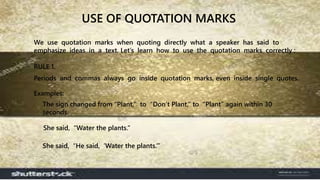
USE OF QUOTATION MARKS
We use quotation marks when quoting directly what a speaker has said to
emphasize ideas in a text. Let’s learn how to use the quotation marks correctly :
RULE 1.
Periods and commas always go inside quotation marks, even inside single quotes.
Examples:
The sign changed from “Plant,” to “Don’t Plant,” to “Plant” again within 30
seconds.
She said, “Water the plants.”
She said, “He said, ‘Water the plants.’’’
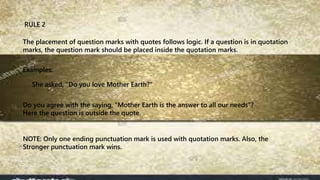
RULE 2
The placement of question marks with quotes follows logic. If a question is in quotation
marks, the question mark should be placed inside the quotation marks.
Examples:
She asked, “Do you love Mother Earth?”
Do you agree with the saying, “Mother Earth is the answer to all our needs”?
Here the question is outside the quote.
NOTE: Only one ending punctuation mark is used with quotation marks. Also, the
Stronger punctuation mark wins.
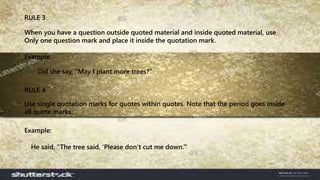
RULE 3
When you have a question outside quoted material and inside quoted material, use
Only one question mark and place it inside the quotation mark.
Example:
Did she say, “May I plant more trees?”
RULE 4
Use single quotation marks for quotes within quotes. Note that the period goes inside
all quote marks.
Example:
He said, “The tree said, ‘Please don’t cut me down.’’’
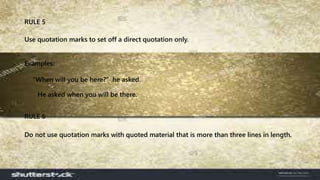
RULE 5
Use quotation marks to set off a direct quotation only.
Examples:
“When will you be here?” he asked.
He asked when you will be there.
RULE 6
Do not use quotation marks with quoted material that is more than three lines in length.
RULE 7
When you are quoting something that has a spelling or grammar mistake or presents
Material in a confusing way, insert the term sic in italics and enclose it in brackets. Sic
Means, “This is the way the original material was.”
Example:
The farmer said, “I would rather die then [sic] uproot the trees to build a house.”
Should be than, not then.
USE OF QUOTATION MARKS

USE OF QUOTATION MARKS

  • 1.
    “PRONOUN-ANTECEDENT AGREEMENT” PREPARED BY: NENGUE, VINCENT JOSEPH L. BY: MRS. ROSARY D. MANATAD “USE OF QUOTATION MARKS”
  • 2.
    USE OF QUOTATIONMARKS We use quotation marks when quoting directly what a speaker has said to emphasize ideas in a text. Let’s learn how to use the quotation marks correctly : RULE 1. Periods and commas always go inside quotation marks, even inside single quotes. Examples: The sign changed from “Plant,” to “Don’t Plant,” to “Plant” again within 30 seconds. She said, “Water the plants.” She said, “He said, ‘Water the plants.’’’
  • 3.
    RULE 2 The placementof question marks with quotes follows logic. If a question is in quotation marks, the question mark should be placed inside the quotation marks. Examples: She asked, “Do you love Mother Earth?” Do you agree with the saying, “Mother Earth is the answer to all our needs”? Here the question is outside the quote. NOTE: Only one ending punctuation mark is used with quotation marks. Also, the Stronger punctuation mark wins.
  • 4.
    RULE 3 When youhave a question outside quoted material and inside quoted material, use Only one question mark and place it inside the quotation mark. Example: Did she say, “May I plant more trees?” RULE 4 Use single quotation marks for quotes within quotes. Note that the period goes inside all quote marks. Example: He said, “The tree said, ‘Please don’t cut me down.’’’
  • 5.
    RULE 5 Use quotationmarks to set off a direct quotation only. Examples: “When will you be here?” he asked. He asked when you will be there. RULE 6 Do not use quotation marks with quoted material that is more than three lines in length.
  • 6.
    RULE 7 When youare quoting something that has a spelling or grammar mistake or presents Material in a confusing way, insert the term sic in italics and enclose it in brackets. Sic Means, “This is the way the original material was.” Example: The farmer said, “I would rather die then [sic] uproot the trees to build a house.” Should be than, not then.