ANALOGY
English 7 –
Quarter 1:
Module 1
7- Masikap
7- SPS
LEARNING OBEJCTIVES
At the end of the discussion, you should be able to:
● recognize the relationship between the words in a word
pair;
● complete the sentences by picking the correct words to
complete the analogies; and
● supply other words or expression to complete the
analogy.
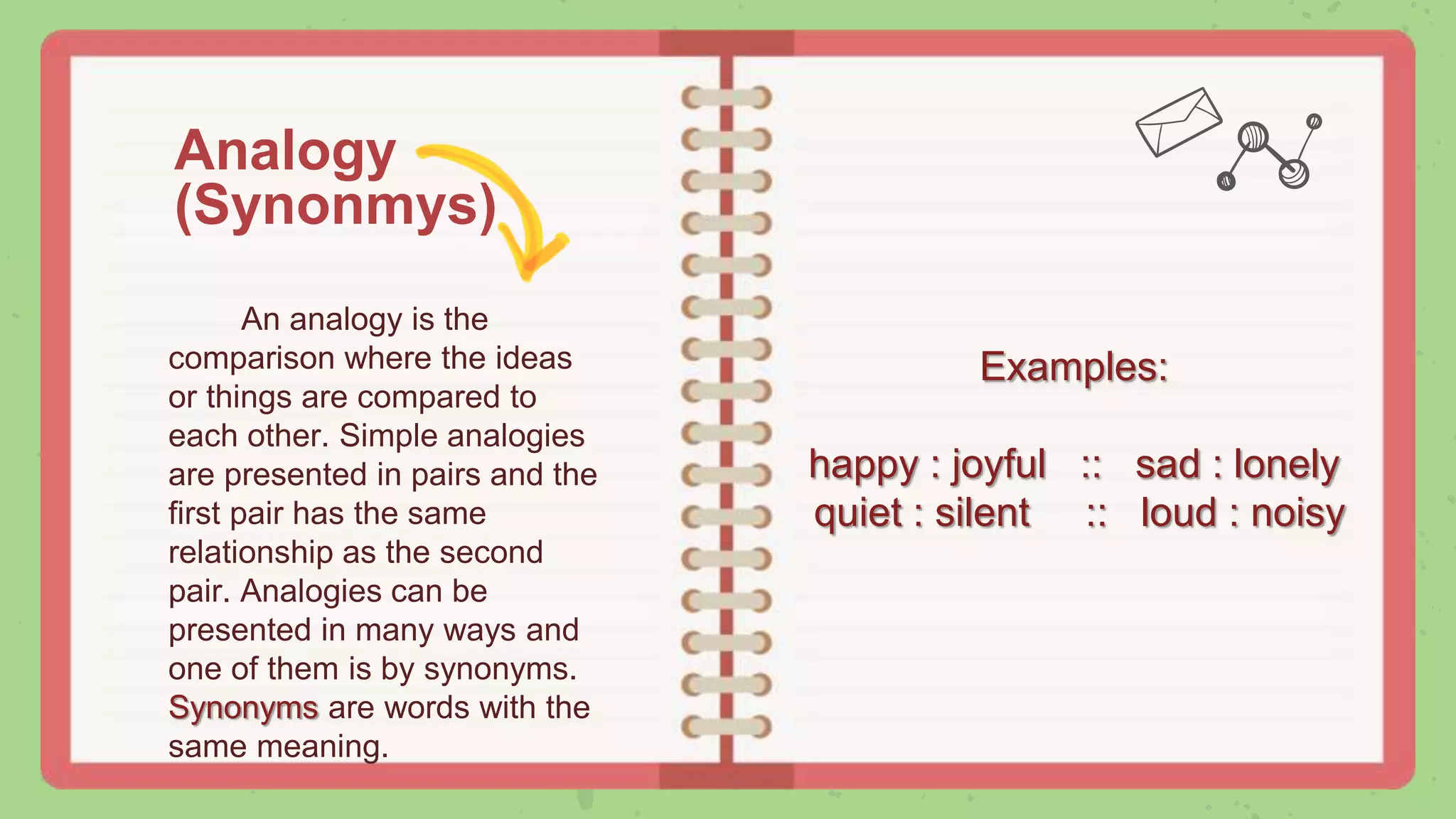
Analogy
(Synonmys)
An analogy is the
comparison where the ideas
or things are compared to
each other. Simple analogies
are presented in pairs and the
first pair has the same
relationship as the second
pair. Analogies can be
presented in many ways and
one of them is by synonyms.
Synonyms are words with the
same meaning.
Examples:
happy : joyful :: sad : lonely
quiet : silent :: loud : noisy
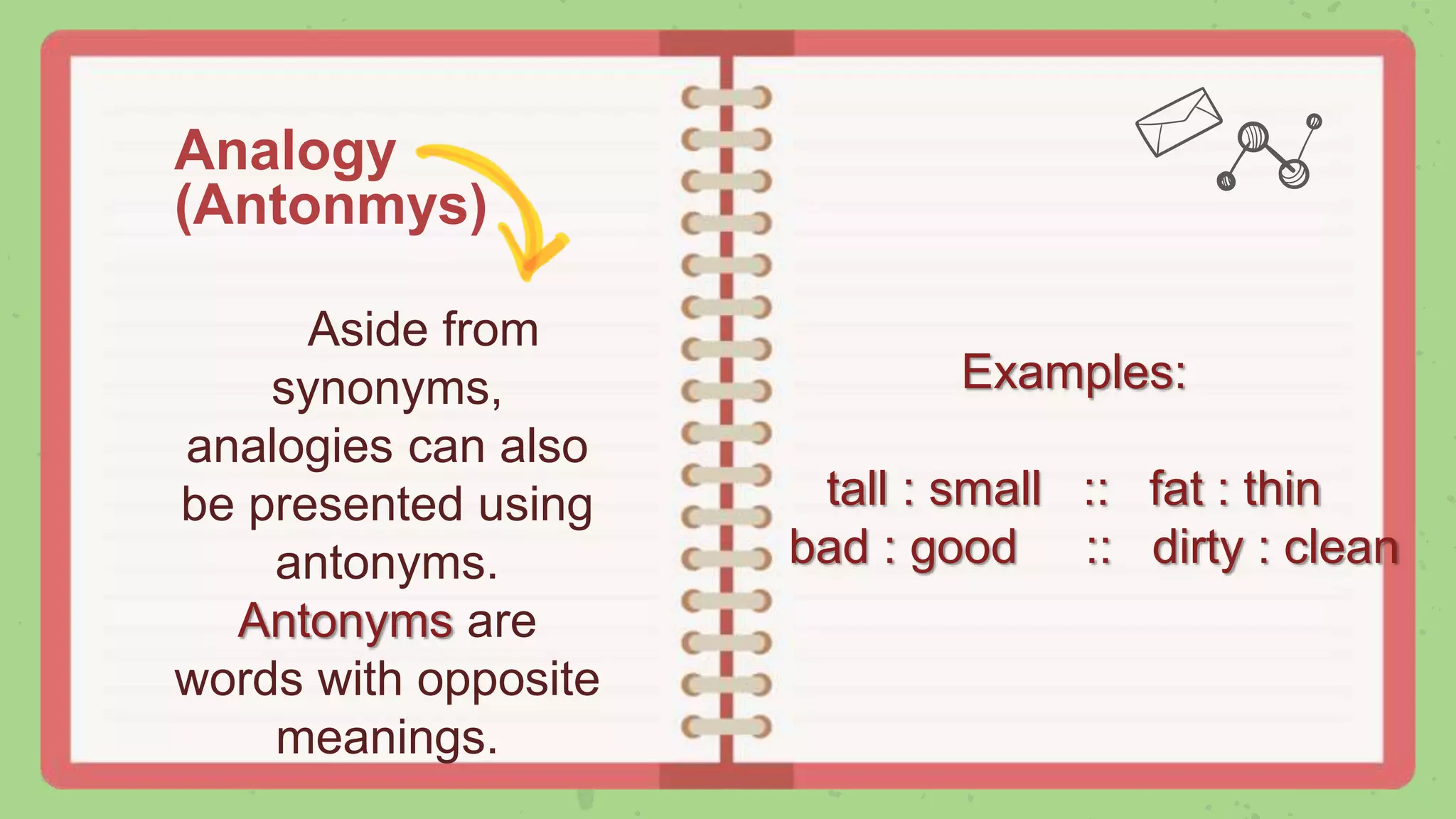
Analogy
(Antonmys)
Aside from
synonyms,
analogies can also
be presented using
antonyms.
Antonyms are
words with opposite
meanings.
Examples:
tall : small :: fat : thin
bad : good :: dirty : clean
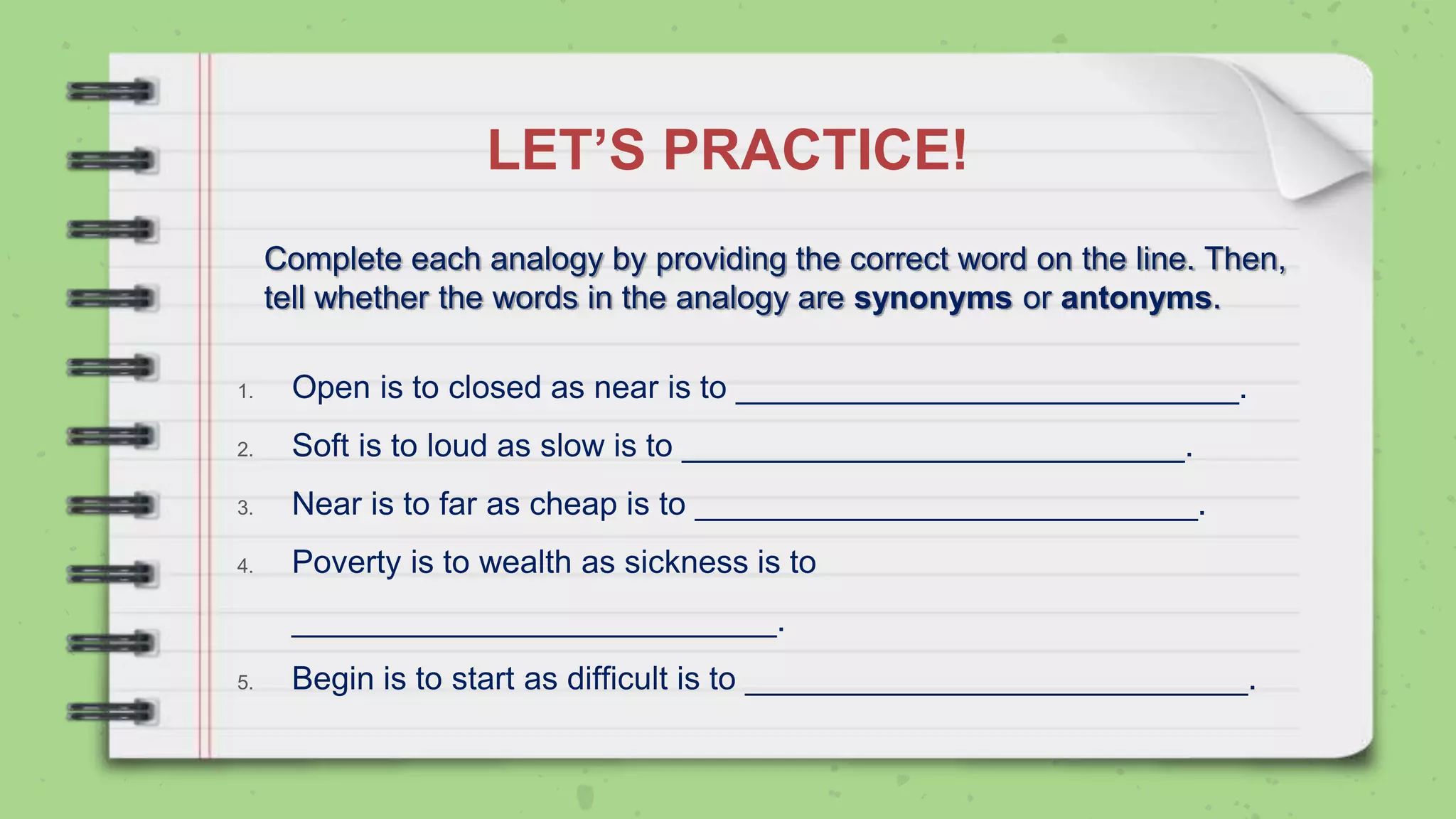
LET’S PRACTICE!
Complete each analogy by providing the correct word on the line. Then,
tell whether the words in the analogy are synonyms or antonyms.
1. Open is to closed as near is to ____________________________.
2. Soft is to loud as slow is to ____________________________.
3. Near is to far as cheap is to ____________________________.
4. Poverty is to wealth as sickness is to
___________________________.
5. Begin is to start as difficult is to ____________________________.
Analogy
(Same
Class)
Same with the
previous topic of
analogy being
presented as
antonyms and
synonyms, it can
also be shown in
same class or
group.
Blue is paired to the word green,
because they are both colors.
Avocado is paired with banana
because they are both fruits. The
analogy is shown as words that
belong in the same class or
group.
LET’S DO THIS!
Make three analogies of the same class using the words below.
________ : _________ :: _________ : _________
________ : _________ :: _________ : _________
________ : _________ :: _________ : _________
FEATURES OF
FILIPINO
PROVERBS
English 7 –
Quarter 1:
Module 2
7- Masikap
7- SPS
LEARNING OBEJCTIVES
At the end of the discussion, you should be able to:
● identifythe genreof amaterialviewed(such asmovie clip,
trailer,newsflash, internet-basedprogram,documentary,video,
etc.) EN7VC-I-d-6;
● identifythe distinguishingfeaturesof proverbs;and
● describea literary genreduringthe pre-colonial period.
Damiana L. Eugenio, the mother of
Philippine Folklore, compiled
and edited the most
comprehensive collection of
Filipino proverbs.
Proverbs are what we call
“salawikain” o “sawikain”.
These salawikain reveals the
wisdom and values of our
forefathers.
Proverbs are unwritten knowledge
passed down from generation to
generation and typically contain
advice from our ancestors.
Scholars referred to it as “the
wisdom of many, the wit of one”
which is commonly written in a
poetic form with rhymes and
parallelisms.
DAMIANA EUGENIO
“Mother of Philippine
Folklore”
Six Categories of
Proverbs
In anthology of Damiana L. Eugenio,
she classified Filipino proverbs into
six categories:
1. Proverbs expressing a general
attitude towards life and the laws that
governs life.
Walang ligaya sa lupa na ‘di dinilig
ng luha. (Tagalog)
There is no earthly joy that is not
watered with tears.
2. Ethical proverbs recommending
certain virtues and condemning certain
vices.
Dai mo pagpaagahan an magigibo mo
ngonyan. (Bikol)
Do not out off tomorrow what you can
do for today.
3. Proverbs expressing a system
of values.
Ang mga tulo sinngot sa taong
mangguibuhaton paga bayran
gayud sa guihapon. (Boholano)
Every drop of perspiration of
an industrious man will be
rewarded accordingly.
4. Proverbs expressing general
truths and observations about
life and human nature.
Huli man at magaling, ay
naihahabol din. (Tagalog)
A good thing is never too
late.
Six Categories of
Proverbs
5. Humorous proverbs
Ang gugma sang tigulang daw
igui nga nagakamang.
(Hiligaynon) The love of an
old man is like a snail that
crawls.
6. Miscellaneous proverbs
(typically expressive of
specific realities to a
certain area).
Ing matudtud a pemangca e
na balu lebasa’ ng sapa.
(Kapampangan)
The sleeping boatman does
not know the streams he
has passed.
Guess the
proverb’s
category!
Guess the
proverb’s
category!
Guess the
proverb’s
category!
Guess the
proverb’s
category!
Guess the
proverb’s
category!
Guess the
proverb’s
category!
VOICE OF THE
VERB
English 7 –
Quarter 1:
Module 3
7- Masikap
7- SPS
LEARNING OBEJCTIVES
At the end of the discussion, you should be able to:
● use the active voice and passive voice meaningfully in varied
contexts ;
● identify the voice of verb in the given statements and
sentences;
● differentiate the active to passive voice of the verb; and
● relate text content to particular social issues, concerns, or
dispositions in real life.
VOICE OF THE
VERB
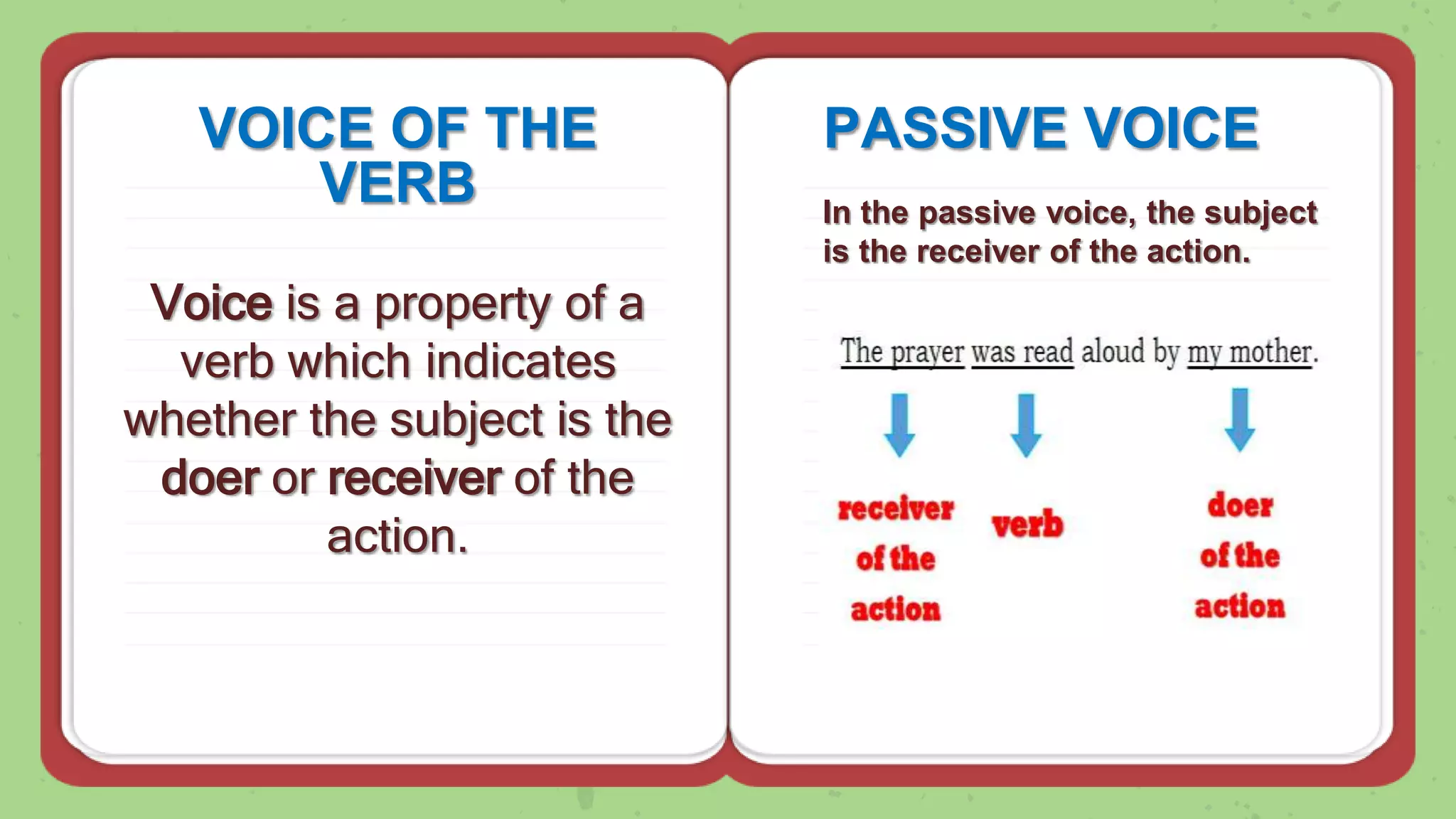
Voice is a property of a
verb which indicates
whether the subject is the
doer or receiver of the
action.
In the active voice, the subject is
the doer of the action.
ACTIVE VOICE
VOICE OF THE
VERB
Voice is a property of a
verb which indicates
whether the subject is the
doer or receiver of the
action.
In the passive voice, the subject
is the receiver of the action.
PASSIVE VOICE
Active voice is
used…
if the subject of the sentence is
performing the action or causing
the action. Thus, it is called as the
“doer” of the action.
if you want your sentence to be
direct and concise and if the focus
of your sentence is on the
performer of the action. At times,
strong writing uses active voice.
if you want to focus your attention
on the person or thing affected by
the action or the who receives the
action. Thus, it is called as the
“receiver” of the action.
 We can recognize passive-
voice expressions because
the verb phrase will often
include a form of “be,” such as
am, is, was, were, are, or
been.
 It includes a “by (someone or
something)” phrase after the
verb.
Passive voice is
used..
Examples
(Active Voice)
1. Bob drives a tractor.
2. Fiona is making clay pots.
3. Ian washed the dishes.
4. The company requires staff to
watch a safety video every year.
5. The kangaroo carried her baby
in her pouch.
1. A tractor is driven by Bob.
2. Clay pots are being made by
Fiona.
3. The dishes were washed by Ian.
4. The staff is required by the
company to watch a safety video
every year.
5. The baby was carried by the
kangaroo in her pouch.
Examples
(Passive Voice)
LET’S PRACTICE!
Tell whether the sentence is in active or passive voice.
1. Dentists are assisted by dental hygienists.
2. By pure coincidence, she came into the store when I
happened to be there.
3. Alice Munro won the Nobel Prize in Literature in 2013.
4. My spouse arrived by plane at 6:55 a.m.
5. Mom is baking a cake for Grandma’s birthday.
LET’S PRACTICE!
Tell whether the sentence is in active or passive voice.
6. This job will be done by my friend next week.
7. Mr. Johnson translated this book.
8. My brothers play basketball in our lawn every afternoon.
9. A goal was scored by Bronson.
10. The students will take the English test on Monday.
LET’S PRACTICE!
Tell whether the sentence is in active or passive voice.
6. This job will be done by my friend next week.
7. Mr. Johnson translated this book.
8. My brothers play basketball in our lawn every afternoon.
9. A goal was scored by Bronson.
10. The students will take the English test on Monday.
Insert Your
Picture Here
Ma’am
_________________
Thanks!
Do you have
any
questions?

ENGLISH 7 - QUARTER 1 - MODULE 1-3.pptx

  • 1.
    ANALOGY English 7 – Quarter1: Module 1 7- Masikap 7- SPS
  • 2.
    LEARNING OBEJCTIVES At theend of the discussion, you should be able to: ● recognize the relationship between the words in a word pair; ● complete the sentences by picking the correct words to complete the analogies; and ● supply other words or expression to complete the analogy.
  • 3.
    Analogy (Synonmys) An analogy isthe comparison where the ideas or things are compared to each other. Simple analogies are presented in pairs and the first pair has the same relationship as the second pair. Analogies can be presented in many ways and one of them is by synonyms. Synonyms are words with the same meaning. Examples: happy : joyful :: sad : lonely quiet : silent :: loud : noisy
  • 4.
    Analogy (Antonmys) Aside from synonyms, analogies canalso be presented using antonyms. Antonyms are words with opposite meanings. Examples: tall : small :: fat : thin bad : good :: dirty : clean
  • 5.
    LET’S PRACTICE! Complete eachanalogy by providing the correct word on the line. Then, tell whether the words in the analogy are synonyms or antonyms. 1. Open is to closed as near is to ____________________________. 2. Soft is to loud as slow is to ____________________________. 3. Near is to far as cheap is to ____________________________. 4. Poverty is to wealth as sickness is to ___________________________. 5. Begin is to start as difficult is to ____________________________.
  • 6.
    Analogy (Same Class) Same with the previoustopic of analogy being presented as antonyms and synonyms, it can also be shown in same class or group. Blue is paired to the word green, because they are both colors. Avocado is paired with banana because they are both fruits. The analogy is shown as words that belong in the same class or group.
  • 7.
    LET’S DO THIS! Makethree analogies of the same class using the words below. ________ : _________ :: _________ : _________ ________ : _________ :: _________ : _________ ________ : _________ :: _________ : _________
  • 8.
    FEATURES OF FILIPINO PROVERBS English 7– Quarter 1: Module 2 7- Masikap 7- SPS
  • 9.
    LEARNING OBEJCTIVES At theend of the discussion, you should be able to: ● identifythe genreof amaterialviewed(such asmovie clip, trailer,newsflash, internet-basedprogram,documentary,video, etc.) EN7VC-I-d-6; ● identifythe distinguishingfeaturesof proverbs;and ● describea literary genreduringthe pre-colonial period.
  • 10.
    Damiana L. Eugenio,the mother of Philippine Folklore, compiled and edited the most comprehensive collection of Filipino proverbs. Proverbs are what we call “salawikain” o “sawikain”. These salawikain reveals the wisdom and values of our forefathers.
  • 11.
    Proverbs are unwrittenknowledge passed down from generation to generation and typically contain advice from our ancestors. Scholars referred to it as “the wisdom of many, the wit of one” which is commonly written in a poetic form with rhymes and parallelisms.
  • 12.
    DAMIANA EUGENIO “Mother ofPhilippine Folklore”
  • 13.
    Six Categories of Proverbs Inanthology of Damiana L. Eugenio, she classified Filipino proverbs into six categories: 1. Proverbs expressing a general attitude towards life and the laws that governs life. Walang ligaya sa lupa na ‘di dinilig ng luha. (Tagalog) There is no earthly joy that is not watered with tears. 2. Ethical proverbs recommending certain virtues and condemning certain vices. Dai mo pagpaagahan an magigibo mo ngonyan. (Bikol) Do not out off tomorrow what you can do for today. 3. Proverbs expressing a system of values. Ang mga tulo sinngot sa taong mangguibuhaton paga bayran gayud sa guihapon. (Boholano) Every drop of perspiration of an industrious man will be rewarded accordingly. 4. Proverbs expressing general truths and observations about life and human nature. Huli man at magaling, ay naihahabol din. (Tagalog) A good thing is never too late.
  • 14.
    Six Categories of Proverbs 5.Humorous proverbs Ang gugma sang tigulang daw igui nga nagakamang. (Hiligaynon) The love of an old man is like a snail that crawls. 6. Miscellaneous proverbs (typically expressive of specific realities to a certain area). Ing matudtud a pemangca e na balu lebasa’ ng sapa. (Kapampangan) The sleeping boatman does not know the streams he has passed.
  • 15.
  • 16.
  • 17.
  • 18.
  • 19.
  • 20.
  • 21.
    VOICE OF THE VERB English7 – Quarter 1: Module 3 7- Masikap 7- SPS
  • 22.
    LEARNING OBEJCTIVES At theend of the discussion, you should be able to: ● use the active voice and passive voice meaningfully in varied contexts ; ● identify the voice of verb in the given statements and sentences; ● differentiate the active to passive voice of the verb; and ● relate text content to particular social issues, concerns, or dispositions in real life.
  • 23.
    VOICE OF THE VERB Voiceis a property of a verb which indicates whether the subject is the doer or receiver of the action. In the active voice, the subject is the doer of the action. ACTIVE VOICE
  • 24.
    VOICE OF THE VERB Voiceis a property of a verb which indicates whether the subject is the doer or receiver of the action. In the passive voice, the subject is the receiver of the action. PASSIVE VOICE
  • 25.
    Active voice is used… ifthe subject of the sentence is performing the action or causing the action. Thus, it is called as the “doer” of the action. if you want your sentence to be direct and concise and if the focus of your sentence is on the performer of the action. At times, strong writing uses active voice. if you want to focus your attention on the person or thing affected by the action or the who receives the action. Thus, it is called as the “receiver” of the action.  We can recognize passive- voice expressions because the verb phrase will often include a form of “be,” such as am, is, was, were, are, or been.  It includes a “by (someone or something)” phrase after the verb. Passive voice is used..
  • 26.
    Examples (Active Voice) 1. Bobdrives a tractor. 2. Fiona is making clay pots. 3. Ian washed the dishes. 4. The company requires staff to watch a safety video every year. 5. The kangaroo carried her baby in her pouch. 1. A tractor is driven by Bob. 2. Clay pots are being made by Fiona. 3. The dishes were washed by Ian. 4. The staff is required by the company to watch a safety video every year. 5. The baby was carried by the kangaroo in her pouch. Examples (Passive Voice)
  • 27.
    LET’S PRACTICE! Tell whetherthe sentence is in active or passive voice. 1. Dentists are assisted by dental hygienists. 2. By pure coincidence, she came into the store when I happened to be there. 3. Alice Munro won the Nobel Prize in Literature in 2013. 4. My spouse arrived by plane at 6:55 a.m. 5. Mom is baking a cake for Grandma’s birthday.
  • 28.
    LET’S PRACTICE! Tell whetherthe sentence is in active or passive voice. 6. This job will be done by my friend next week. 7. Mr. Johnson translated this book. 8. My brothers play basketball in our lawn every afternoon. 9. A goal was scored by Bronson. 10. The students will take the English test on Monday.
  • 29.
    LET’S PRACTICE! Tell whetherthe sentence is in active or passive voice. 6. This job will be done by my friend next week. 7. Mr. Johnson translated this book. 8. My brothers play basketball in our lawn every afternoon. 9. A goal was scored by Bronson. 10. The students will take the English test on Monday.
  • 30.
  • 31.