www.artlab23.com
         Creating is a responsibility.
Only by practicing it can you learn it.
                         --Remix, Larry Lessig
The Kids are
Online:
reading and writing in a digital
age
Storytelling
banksy


         Manijeh Verghese
There are these perspectives. . .
  In the choices we have made. . .about how we use our
  computers, we have rejected the intellectual tradition of
  solitary, single-minded concentration, the ethic the book
  bestowed on us. The Shallows, Nicholas Carr (2010)


The great paradox of “social networking” is that it uses
narcissism as the glue for “community.” Being online
means being alone, and being in an online community
means being alone together.
The community is purely symbolic.
“Twitter dot dash (blog post),”
 Nicholas Carr (2007)
Then there’s this perspective. . .
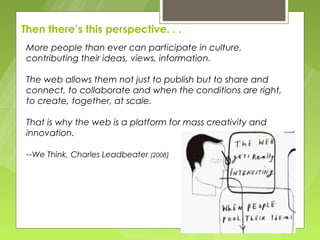
 More people than ever can participate in culture,
 contributing their ideas, views, information.

 The web allows them not just to publish but to share and
 connect, to collaborate and when the conditions are right,
 to create, together, at scale.

 That is why the web is a platform for mass creativity and
 innovation.

 --We Think, Charles Leadbeater (2008)
Finally, the practical teaching perspective. . .

 Pundits may be asking if the Internet is bad for our
 children’s mental development, but the better
 question is whether the form of learning and
 knowledge making we are instilling in our children
 is useful to their future. The Internet is here to stay.
 Are we teaching them in a way that will prepare
 them for a world of learning and for human
 relationships in which they interweave their
 interests into the vast, decentralized, yet
 entirely interconnected content online?
 Now You See It, Cathy N. Davidson (2011)
Digital Authorship Survey Results:
My Little Natives
How often do you post comments to fan sites, chat groups, blogs
or other online sites?
And then there’s this. . .
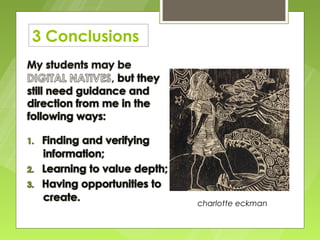
3 Conclusions


                charlotte eckman
+ 1 More. . .
And don’t forget what John
Dewey says. . .
There can be no doubt that a
peculiar artificiality attaches to
much of what is learned in
schools. . .the subject matter does
not possess for [students] the kind of
reality which the subject matter
of their vital experiences possesses.
That the [subject matter]should remain inert is
more or less a matter of course. Democracy & Education
Image from Waking Life
What if we always wanted to produce as well as consume,
but no one offered us that opportunity? The pleasure in
You can play this game too isn’t just in the making,
it’s also in the sharing. The phrase “user-generated content,”
describes not just personal but social acts.
Cognitive Surplus, Clay Shirky


           Into the Classroom:
Sample Blog Assignments
Benefits of Blog Writing
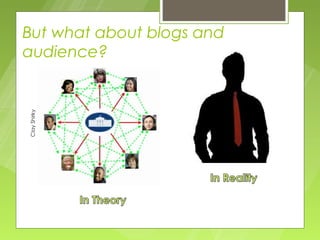
But what about blogs and
audience?
The Grey Album
               , i r “G


                                                                         DJ Dangermouse
hs l gnE n oR ” ac n eu
  i


                          “Cultural Funking Overload,” Eclectic Method
My Own Experiment

                •   Grandmother’s story
                •   Flickr images
                •   Original images
                •   Uncle’s photograph
                •   Joe Strummer’s music
The Literary Mash Up
It is primarily made up of quotes from other sources:
academic writing, works of fiction, dialogue from films
and television, song lyrics, interviews, etc. Shields does
provide some original material, but there is definitely
less of this.

It is organized by sections: "Overture," "Mimesis,” etc.
Within each section there are quotes, and each quote is
numbered. The numbering does not restart in each new
section.

Within the book itself, there are no citations. Shields wanted the
quotes to ultimately read like one unified examination of our
contemporary culture

The acknowledgments provide speaker/writer and/or title of
work for each quote. When he skips numbers/quotes, it infers
that the quote is his own.
The Assignment
Benefits of the Mash-Up
Curation:
Finding and organizing important information regarding a specific
topic.

Weaving together the information into a clear, engaging
narrative.

Helping oneself and others to see connections, juxtapositions and
threads.
If you buy the notion that we're moving from a world of content
scarcity to content abundance, and that you are facing content
overload that verges on an endless fire hose of data coming at you
from the moment you wake. . .then curation isn't just something that
may happen, it's something that has to happen. Curation Nation, Steven Rosenbaum
Mash up sample 1: “Love”


Mash up sample 2: “Grief”


         Mash up sample 3: Memory
Closing thought. . .
I prefer to think of the proliferation of
interactive media as an opportunity for
renaissance: a moment when we have the
opportunity to step out of [old stories]
altogether. Today’s renaissance is at least
as profound as the one that went before.
“Renaissance Now?” Douglas Rushkoff
Why a renaissance, according to Rushkoff?


          Rebirth of “read/write” culture.

 Rebirth of our view of ourselves and the larger world.

                Drastic growth in information.


And, like the Renaissance, none of this can
be undone.
The formal education most of us experienced
is based on giving premium value to
expertise,
        specialization,
                    and hierarchy.

It prepared us for success in the 20th Century.
Yet what form of education is required in a world of
social networking
        crowdsourcing,
                searching and browsing
                       and user-generated content?

                              How do we make over the 20th
                              Century classroom to take
                              advantage of all the digital
                              benefits of the 21st Century?
                                       Now You See It, Cathy N. Davidson

Neiu talk

  • 1.
    www.artlab23.com Creating is a responsibility. Only by practicing it can you learn it. --Remix, Larry Lessig
  • 2.
    The Kids are Online: readingand writing in a digital age
  • 3.
  • 5.
    banksy Manijeh Verghese
  • 8.
    There are theseperspectives. . . In the choices we have made. . .about how we use our computers, we have rejected the intellectual tradition of solitary, single-minded concentration, the ethic the book bestowed on us. The Shallows, Nicholas Carr (2010) The great paradox of “social networking” is that it uses narcissism as the glue for “community.” Being online means being alone, and being in an online community means being alone together. The community is purely symbolic. “Twitter dot dash (blog post),” Nicholas Carr (2007)
  • 9.
    Then there’s thisperspective. . . More people than ever can participate in culture, contributing their ideas, views, information. The web allows them not just to publish but to share and connect, to collaborate and when the conditions are right, to create, together, at scale. That is why the web is a platform for mass creativity and innovation. --We Think, Charles Leadbeater (2008)
  • 10.
    Finally, the practicalteaching perspective. . . Pundits may be asking if the Internet is bad for our children’s mental development, but the better question is whether the form of learning and knowledge making we are instilling in our children is useful to their future. The Internet is here to stay. Are we teaching them in a way that will prepare them for a world of learning and for human relationships in which they interweave their interests into the vast, decentralized, yet entirely interconnected content online? Now You See It, Cathy N. Davidson (2011)
  • 11.
  • 13.
  • 14.
    How often doyou post comments to fan sites, chat groups, blogs or other online sites?
  • 16.
  • 17.
    3 Conclusions charlotte eckman
  • 18.
  • 19.
    And don’t forgetwhat John Dewey says. . . There can be no doubt that a peculiar artificiality attaches to much of what is learned in schools. . .the subject matter does not possess for [students] the kind of reality which the subject matter of their vital experiences possesses. That the [subject matter]should remain inert is more or less a matter of course. Democracy & Education
  • 20.
  • 21.
    What if wealways wanted to produce as well as consume, but no one offered us that opportunity? The pleasure in You can play this game too isn’t just in the making, it’s also in the sharing. The phrase “user-generated content,” describes not just personal but social acts. Cognitive Surplus, Clay Shirky Into the Classroom:
  • 23.
  • 24.
  • 25.
    But what aboutblogs and audience?
  • 27.
    The Grey Album , i r “G DJ Dangermouse hs l gnE n oR ” ac n eu i “Cultural Funking Overload,” Eclectic Method
  • 28.
    My Own Experiment • Grandmother’s story • Flickr images • Original images • Uncle’s photograph • Joe Strummer’s music
  • 29.
    The Literary MashUp It is primarily made up of quotes from other sources: academic writing, works of fiction, dialogue from films and television, song lyrics, interviews, etc. Shields does provide some original material, but there is definitely less of this. It is organized by sections: "Overture," "Mimesis,” etc. Within each section there are quotes, and each quote is numbered. The numbering does not restart in each new section. Within the book itself, there are no citations. Shields wanted the quotes to ultimately read like one unified examination of our contemporary culture The acknowledgments provide speaker/writer and/or title of work for each quote. When he skips numbers/quotes, it infers that the quote is his own.
  • 30.
  • 31.
  • 32.
    Curation: Finding and organizingimportant information regarding a specific topic. Weaving together the information into a clear, engaging narrative. Helping oneself and others to see connections, juxtapositions and threads. If you buy the notion that we're moving from a world of content scarcity to content abundance, and that you are facing content overload that verges on an endless fire hose of data coming at you from the moment you wake. . .then curation isn't just something that may happen, it's something that has to happen. Curation Nation, Steven Rosenbaum
  • 33.
    Mash up sample1: “Love” Mash up sample 2: “Grief” Mash up sample 3: Memory
  • 34.
    Closing thought. .. I prefer to think of the proliferation of interactive media as an opportunity for renaissance: a moment when we have the opportunity to step out of [old stories] altogether. Today’s renaissance is at least as profound as the one that went before. “Renaissance Now?” Douglas Rushkoff
  • 35.
    Why a renaissance,according to Rushkoff? Rebirth of “read/write” culture. Rebirth of our view of ourselves and the larger world. Drastic growth in information. And, like the Renaissance, none of this can be undone.
  • 36.
    The formal educationmost of us experienced is based on giving premium value to expertise, specialization, and hierarchy. It prepared us for success in the 20th Century. Yet what form of education is required in a world of social networking crowdsourcing, searching and browsing and user-generated content? How do we make over the 20th Century classroom to take advantage of all the digital benefits of the 21st Century? Now You See It, Cathy N. Davidson

Editor's Notes

  • #4 My grandmother was a great storyteller. Here’s one she told me after my grandfather died.
  • #5 Didn’ t create it for fame, money, or to go pro
  • #6 I made the story in order to create and remember—two vital human activities. Of course, both have been executed for millenia without the aid of the internet. Telling stories predates written language. And for decades people have been able to take movies of loved ones. But digital technology expands what an amateur like me can do with these stories and with the videos I shoot, pictures I take, images I find, music I listen to—it is a literacy at once simple and incredibly deep. It allows me to replicate the process used by the pros—a process that is immersive, stimulating, and deeply fulfilling.
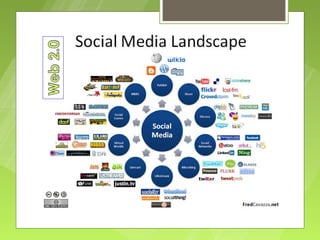
  • #7 But the internet and web 2.0 offers up interesting, vital, intriguing possiblities. No more gatekeepers—to a degree. Applications that allow passive consumers to become collaborators. Web 1.0 site has strictly defined roles and hierarchies. There is a creator of content and a consumer of content. Web 2.0 site blurs that line and makes it possible for all to become authors.
  • #9 If we are now in a web 2.0 world, what are people saying about it? so where are we at now? It seems often times that we are stuck between extremes. There’s this perspective: we’re doomed. The internet is destroying our ability to concentrate, to write, to differentiate between the serious and the superficial.
  • #10 The utopian view—the internet and digital tech will lead to a brave new world of democracy, freedom, and empowerment for all
  • #11 Like most people, I feel it is somewhere in between—clearly there are amazing examples of individuals harnessing social media to spur on revolution—Arab Spring: Wael Ghonim. Likewise, it is easy to be overwhelmed by the shrill, callous, narcissistic tendencies many individuals exhibit. As a teacher—it is here! I must figure out how to help my students be confident, creativity, and empathetic citizens.
  • #12 Speaking of my students, here’s what they have to say.
  • #13 Dig Native: person born since the rise of the internet and digital technology—these tools are second nature. Never had to relearn what it means to have a digital presence. Do not see online identity as different from offline identity. Info is malleable. Feel a sense of control over information and the ways it can be shaped. Break down the division between public and private.
  • #15 Interesting—not much activity. Then again, most use facebook and many use twitter and reddit and tumblr. Possibly a poorly worded question
  • #16 Their view of the future
  • #17 Very interesting—especially in light of the first slide
  • #18 Not just students, but most of us seldomly stop to think about where info comes from. All media manipulate the viewer to react in a certain way. One thing when we were concerned with ads on tv and billboards, and the way film presented specific stories. Much different when the internet blows up the sheer amount of info we are inundated with.
  • #19 Striking that they see it as a fundamental right. UN said same thing last June. Students understand this intuitively. Because they expect to use it in the future, it is incumbent upon me to prepare them for this possibility. Of course, some would argue that we run into problems when we abdicate curricular decisions to students. Just because they think they might do something in the future does not necessarily mean I need to invest class time. But this isn’t just “something” or some passing whim. The internet and dig. tech are changing the ways we engage in the most basic activities. I want my students to have confident, interesting voices. And to be empathetic. If they believe that there will come a time when they want to enter an online conversation, then I want them to do it as a responsible citizen. Not to mention, I am supposed to be preparing them for their future—what will that look like? We have no idea. Will it include digital technology and contributing online—most likely.
  • #20 Right now many of their vital experiences are taking place online. Easy to deride these activities as superficial and deleterious—but not the case. Engage them in rich ways in the world that exists for them. Jenkins-affinity spaces: places where our students meet to voluntarily write and create and engage in ideas.
  • #21 In any case, integrating dig tech can make the classroom feel less authoritarian and less like they are being lectured to.
  • #23 main focus over the last two years.
  • #24 Assortment of assignments—some that are very precriptive. others pretty open-ended. More general guidelines tell them to pay attention to layout, be thorough/thoughtful/ be clear.
  • #25 In general, I find very little of the contrived “student-writing-for-a-teacher” voice when I read student blogs. Why? Probably a combination of topic and location. The fact that it feels more like something they are used to—social media—makes a difference. Even if few of them blog on their own, blogs are akin to the online places where they spend a good deal of time. Add in what they told me they like about it—can be “fun.” A good counterweight to more traditional essay writing. Feel like they have more to say and more ways to say it. Even if they are not writing in a traditional way—THEY ARE WRITING. They are still using the rules of grammar to make sure the are clear and cogent and powerful. Still paying attention to sentence structure and variety. All of the things we want them to do. But it feels less burdensome. in terms of experimentation, hyperlinking and the ease with which they can use multi-media elements helps them to be more invested. It’s one thing to use in a typed, paper essay an example of a song or film that one likes. But it becomes something quite different when one is able to insert the text into the writing. In fact, if we think of hyperlinking and embedded multi-media elements as a new way of citing, then students are much more apt to credit sources. Whereas they struggle sometimes with MLA formatting and citing in-text, they show a willingness to provide and discuss these examples. And students show a inclination for structuring their writing. Many of them struggle to write more complex essays moving beyond the 5 paragraph format. But, in blogs, most students demonstrate an ability to gauge paragraph length, make effective breaks, and lead a reader through a natural progression. These same skills prove much more frustrating when they are writing about a piece of literature in a thesis driven essay.
  • #26 Part of getting students to use a more authentic voice is giving them situations in which they feel like they are writing for a real audience. A teacher is not a real audience per se. As mentioned, a hope for web 2.0 is that it provides an environment where one can express oneself and communicate with others. In order to ensure that they write for others, I have had them write in rounds. Conflicting perspective on whether blogs can have an effect on democracy—Sunstein: end up talking in an echo chamber. Lessig: the act of writing in what is a public venue forces one to think through ideas more deeply and attempt to articulare them cogently. Even if nobody is going to read it.
  • #27 When compelled, they respond to each other in very sincere ways. Take time to think about what others are saying.
  • #28 Mash ups are a kind of collage based art in which two or more existing works are combined to make a new piece. Critics complain that the resulting product is not art, or at least it is a very unoriginal and uninspired kind of work. Proponents of the form argue that appropriation and recombination has a long and illustrious history in Western tradition, from Shakespeare to Picasso to Warhol. Resultant works, they suggest, offer a new vision at the same time that they might also comment on the older pieces. Start at 4.08. Start at .48 Most works are visual or audio in nature, but there are now writers trying to bring the technique into literature. David Shields has done this most famously in the last two years with his work Reality Hunger: 600+ statements stitched together to create the sense of a unified voice. Shields’s work poses questions about cultural production and ownership, as well as the differences between fiction and non-fiction.
  • #30 The mashup my students created was text based—derived from David Shields’s work Reality Hunger and work of a colleague.
  • #32 Incredible work—most of them really attacked the books. If one goal is to get them to look into a text more deeply, to engage with the writing—then this achieved it. And it led to really interesting connections and juxtapositions—well beyond the more superficial coincidences that students usually offer up as connections.
  • #33 Topics can be anything. More and more sites exist that allow people to do this: Pinterest, Storify. Mash ups act as curation in that students explore a variety of sources with one idea in mind. Curators in the same way that DJs and hip-hop artists are curators.
  • #34 In general, students liked the project—felt like it was something more creative and interesting than writing another essay on some theme in the book. Found it much more difficult, especially when it came time to organize. Always good when students find something difficult but still want to do it.