CASE STUDY
ON
MAINSTREAMING
DRR
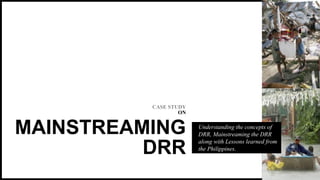
Understanding the concepts of
DRR, Mainstreaming the DRR
along with Lessons learned from
the Philippines.
WOODGROVE
BANK
PRESENTATION STRUCTURE
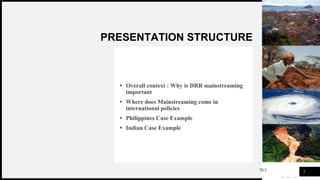
• Overall context : Why is DRR mainstreaming
important
• Where does Mainstreaming come in
international policies
• Philippines Case Example
• Indian Case Example
2
WOODGROVE
BANK
WHY MAINSTREMING
DRR ?
3
WOODGROVE
BANK
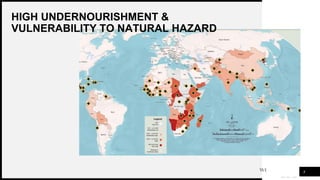
HIGH UNDERNOURISHMENT &
VULNERABILITY TO NATURAL HAZARD
4
WOODGROVE
BANK
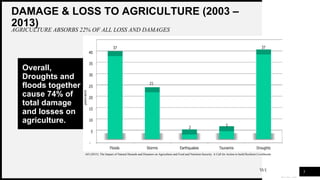
DAMAGE & LOSS TO AGRICULTURE (2003 –
2013)
AGRICULTURE ABSORBS 22% OF ALL LOSS AND DAMAGES
5
AO (2015): The Impact of Natural Hazards and Disasters on Agriculture and Food and Nutrition Security. A Call for Action to build Resilient Livelihoods
Overall,
Droughts and
floods together
cause 74% of
total damage
and losses on
agriculture.
WOODGROVE
BANK
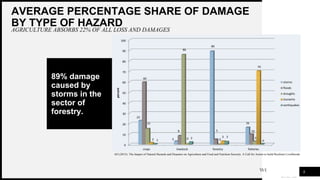
AVERAGE PERCENTAGE SHARE OF DAMAGE
BY TYPE OF HAZARD
AGRICULTURE ABSORBS 22% OF ALL LOSS AND DAMAGES
6
AO (2015): The Impact of Natural Hazards and Disasters on Agriculture and Food and Nutrition Security. A Call for Action to build Resilient Livelihoods
89% damage
caused by
storms in the
sector of
forestry.
WOODGROVE
BANK
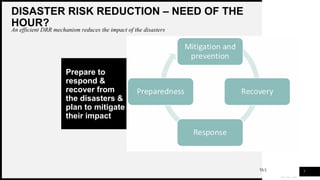
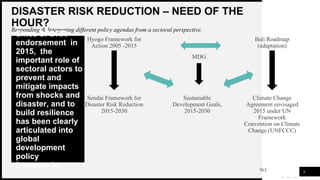
DISASTER RISK REDUCTION – NEED OF THE
HOUR?
An efficient DRR mechanism reduces the impact of the disasters
7
Prepare to
respond &
recover from
the disasters &
plan to mitigate
their impact
WOODGROVE
BANK
WHERE DOES
MAINSTREAMING DRR
COME IN
INTERNATIONAL
POLICY AGENDAS?
8
WOODGROVE
BANK
DISASTER RISK REDUCTION – NEED OF THE
HOUR?
Responding & Integrating different policy agendas from a sectoral perspective.
9
Since SFDRR
endorsement in
2015, the
important role of
sectoral actors to
prevent and
mitigate impacts
from shocks and
disaster, and to
build resilience
has been clearly
articulated into
global
development
policy
frameworks
Hyogo Framework for
Action 2005 -2015
Sendai Framework for
Disaster Risk Reduction
2015-2030
Sustainable
Development Goals,
2015-2030
Climate Change
Agreement envisaged
2015 under UN
Framework
Convention on Climate
Change (UNFCCC)
Bali Roadmap
(adaptation)
MDG
WOODGROVE
BANK
CASE - PHILIPPINES
10
WOODGROVE
BANK
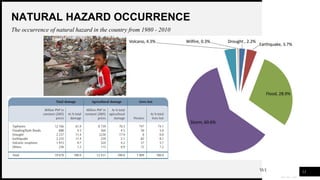
NATURAL HAZARD OCCURRENCE
The occurrence of natural hazard in the country from 1980 - 2010
11
WOODGROVE
BANK
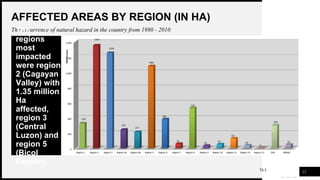
AFFECTED AREAS BY REGION (IN HA)
The occurrence of natural hazard in the country from 1980 - 2010
12
The
regions
most
impacted
were region
2 (Cagayan
Valley) with
1.35 million
Ha
affected,
region 3
(Central
Luzon) and
region 5
(Bicol
Region).
WOODGROVE
BANK
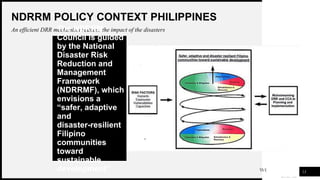
NDRRM POLICY CONTEXT PHILIPPINES
An efficient DRR mechanism reduces the impact of the disasters
13
The NDRRM
Council is guided
by the National
Disaster Risk
Reduction and
Management
Framework
(NDRRMF), which
envisions a
“safer, adaptive
and
disaster-resilient
Filipino
communities
toward
sustainable
development”
WOODGROVE
BANK
EVOLUTION
14
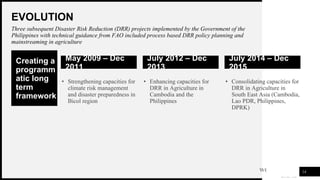
Three subsequent Disaster Risk Reduction (DRR) projects implemented by the Government of the
Philippines with technical guidance from FAO included process based DRR policy planning and
mainstreaming in agriculture
May 2009 – Dec
2011
• Strengthening capacities for
climate risk management
and disaster preparedness in
Bicol region
July 2012 – Dec
2013
• Enhancing capacities for
DRR in Agriculture in
Cambodia and the
Philippines
July 2014 – Dec
2015
• Consolidating capacities for
DRR in Agriculture in
South East Asia (Cambodia,
Lao PDR, Philippines,
DPRK)
Creating a
programm
atic long
term
framework
WOODGROVE
BANK
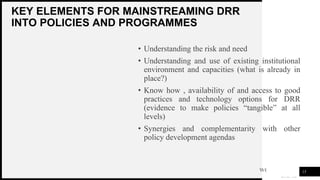
KEY ELEMENTS FOR MAINSTREAMING DRR
INTO POLICIES AND PROGRAMMES
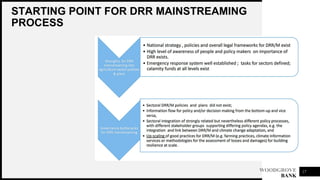
• Understanding the risk and need
• Understanding and use of existing institutional
environment and capacities (what is already in
place?)
• Know how , availability of and access to good
practices and technology options for DRR
(evidence to make policies “tangible” at all
levels)
• Synergies and complementarity with other
policy development agendas
15
WOODGROVE
BANK
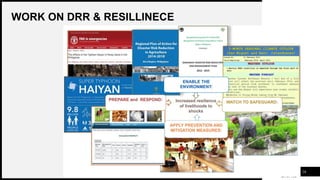
WORK ON DRR & RESILLINECE
16
WOODGROVE
BANK
STARTING POINT FOR DRR MAINSTREAMING
PROCESS
17
WOODGROVE
BANK
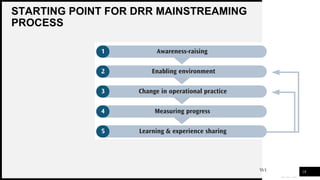
STARTING POINT FOR DRR MAINSTREAMING
PROCESS
18
WOODGROVE
BANK
AWARENESS RAISING
19
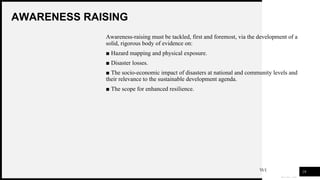
Awareness-raising must be tackled, first and foremost, via the development of a
solid, rigorous body of evidence on:
■ Hazard mapping and physical exposure.
■ Disaster losses.
■ The socio-economic impact of disasters at national and community levels and
their relevance to the sustainable development agenda.
■ The scope for enhanced resilience.
WOODGROVE
BANK
ESTABLISHING AN ENABLING ENVIRONMENT
20
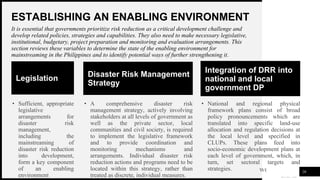
It is essential that governments prioritize risk reduction as a critical development challenge and
develop related policies, strategies and capabilities. They also need to make necessary legislative,
institutional, budgetary, project preparation and monitoring and evaluation arrangements. This
section reviews these variables to determine the state of the enabling environment for
mainstreaming in the Philippines and to identify potential ways of further strengthening it.
Legislation
• Sufficient, appropriate
legislative
arrangements for
disaster risk
management,
including the
mainstreaming of
disaster risk reduction
into development,
form a key component
of an enabling
environment
Disaster Risk Management
Strategy
• A comprehensive disaster risk
management strategy, actively involving
stakeholders at all levels of government as
well as the private sector, local
communities and civil society, is required
to implement the legislative framework
and to provide coordination and
monitoring mechanisms and
arrangements. Individual disaster risk
reduction actions and programs need to be
located within this strategy, rather than
treated as discrete, individual measures.
Integration of DRR into
national and local
government DP
• National and regional physical
framework plans consist of broad
policy pronouncements which are
translated into specific land-use
allocation and regulation decisions at
the local level and specified in
CLUPs. These plans feed into
socio-economic development plans at
each level of government, which, in
turn, set sectoral targets and
strategies.
WOODGROVE
BANK
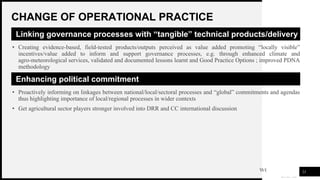
CHANGE OF OPERATIONAL PRACTICE
21
Linking governance processes with “tangible” technical products/delivery
• Creating evidence-based, field-tested products/outputs perceived as value added promoting “locally visible”
incentives/value added to inform and support governance processes, e.g. through enhanced climate and
agro-meteorological services, validated and documented lessons learnt and Good Practice Options ; improved PDNA
methodology
Enhancing political commitment
• Proactively informing on linkages between national/local/sectoral processes and “global” commitments and agendas
thus highlighting importance of local/regional processes in wider contexts
• Get agricultural sector players stronger involved into DRR and CC international discussion
WOODGROVE
BANK
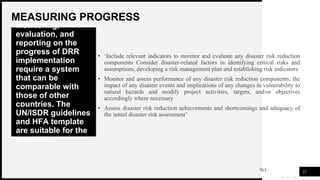
MEASURING PROGRESS
22
• ‘Include relevant indicators to monitor and evaluate any disaster risk reduction
components Consider disaster-related factors in identifying critical risks and
assumptions, developing a risk management plan and establishing risk indicators
• Monitor and assess performance of any disaster risk reduction components, the
impact of any disaster events and implications of any changes in vulnerability to
natural hazards and modify project activities, targets, and/or objectives
accordingly where necessary
• Assess disaster risk reduction achievements and shortcomings and adequacy of
the initial disaster risk assessment’
Monitoring,
evaluation, and
reporting on the
progress of DRR
implementation
require a system
that can be
comparable with
those of other
countries. The
UN/ISDR guidelines
and HFA template
are suitable for the
purpose.
WOODGROVE
BANK
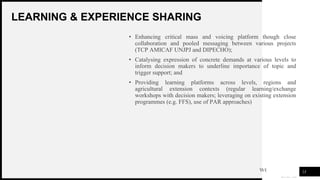
LEARNING & EXPERIENCE SHARING
23
• Enhancing critical mass and voicing platform though close
collaboration and pooled messaging between various projects
(TCP AMICAF UNJPJ and DIPECHO);
• Catalysing expression of concrete demands at various levels to
inform decision makers to underline importance of topic and
trigger support; and
• Providing learning platforms across levels, regions and
agricultural extension contexts (regular learning/exchange
workshops with decision makers; leveraging on existing extension
programmes (e.g. FFS), use of PAR approaches)
WOODGROVE
BANK
CASE – GUJRAT, INDIA
24
WOODGROVE
BANK
LEARNING & EXPERIENCE SHARING
25
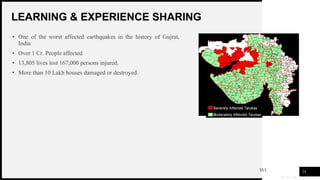
• One of the worst affected earthquakes in the history of Gujrat,
India
• Over 1 Cr. People affected
• 13,805 lives lost 167,000 persons injured.
• More than 10 Lakh houses damaged or destroyed.
WOODGROVE
BANK
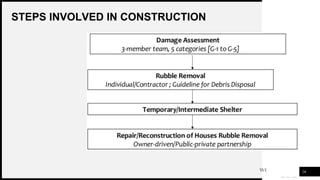
STEPS INVOLVED IN CONSTRUCTION
26
WOODGROVE
BANK
HOUSING RECONSTRUCTION
27
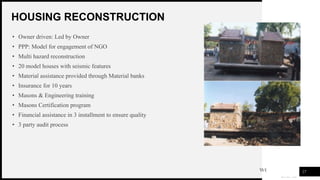
• Owner driven: Led by Owner
• PPP: Model for engagement of NGO
• Multi hazard reconstruction
• 20 model houses with seismic features
• Material assistance provided through Material banks
• Insurance for 10 years
• Masons & Engineering training
• Masons Certification program
• Financial assistance in 3 installment to ensure quality
• 3 party audit process
THANK YOU
Dhanya Pravin + 91 9969948325
poduval.dhanya@yahoo.com
https://www.preventionweb.net/files/870
0_8700mainstreamingphilippines1.pdf
https://www.unescap.org/sites/default/fil
es/publication_WEBdrr02_Mainstreami
ng.pdf
https://www.unisdr.org/files/15049_guid
ebook04lowres1.pdf
HOUSING
SPA - D

Case study on Mainstreaming DRR

  • 1.
    CASE STUDY ON MAINSTREAMING DRR Understanding theconcepts of DRR, Mainstreaming the DRR along with Lessons learned from the Philippines.
  • 2.
    WOODGROVE BANK PRESENTATION STRUCTURE • Overallcontext : Why is DRR mainstreaming important • Where does Mainstreaming come in international policies • Philippines Case Example • Indian Case Example 2
  • 3.
  • 4.
  • 5.
    WOODGROVE BANK DAMAGE & LOSSTO AGRICULTURE (2003 – 2013) AGRICULTURE ABSORBS 22% OF ALL LOSS AND DAMAGES 5 AO (2015): The Impact of Natural Hazards and Disasters on Agriculture and Food and Nutrition Security. A Call for Action to build Resilient Livelihoods Overall, Droughts and floods together cause 74% of total damage and losses on agriculture.
  • 6.
    WOODGROVE BANK AVERAGE PERCENTAGE SHAREOF DAMAGE BY TYPE OF HAZARD AGRICULTURE ABSORBS 22% OF ALL LOSS AND DAMAGES 6 AO (2015): The Impact of Natural Hazards and Disasters on Agriculture and Food and Nutrition Security. A Call for Action to build Resilient Livelihoods 89% damage caused by storms in the sector of forestry.
  • 7.
    WOODGROVE BANK DISASTER RISK REDUCTION– NEED OF THE HOUR? An efficient DRR mechanism reduces the impact of the disasters 7 Prepare to respond & recover from the disasters & plan to mitigate their impact
  • 8.
    WOODGROVE BANK WHERE DOES MAINSTREAMING DRR COMEIN INTERNATIONAL POLICY AGENDAS? 8
  • 9.
    WOODGROVE BANK DISASTER RISK REDUCTION– NEED OF THE HOUR? Responding & Integrating different policy agendas from a sectoral perspective. 9 Since SFDRR endorsement in 2015, the important role of sectoral actors to prevent and mitigate impacts from shocks and disaster, and to build resilience has been clearly articulated into global development policy frameworks Hyogo Framework for Action 2005 -2015 Sendai Framework for Disaster Risk Reduction 2015-2030 Sustainable Development Goals, 2015-2030 Climate Change Agreement envisaged 2015 under UN Framework Convention on Climate Change (UNFCCC) Bali Roadmap (adaptation) MDG
  • 10.
  • 11.
    WOODGROVE BANK NATURAL HAZARD OCCURRENCE Theoccurrence of natural hazard in the country from 1980 - 2010 11
  • 12.
    WOODGROVE BANK AFFECTED AREAS BYREGION (IN HA) The occurrence of natural hazard in the country from 1980 - 2010 12 The regions most impacted were region 2 (Cagayan Valley) with 1.35 million Ha affected, region 3 (Central Luzon) and region 5 (Bicol Region).
  • 13.
    WOODGROVE BANK NDRRM POLICY CONTEXTPHILIPPINES An efficient DRR mechanism reduces the impact of the disasters 13 The NDRRM Council is guided by the National Disaster Risk Reduction and Management Framework (NDRRMF), which envisions a “safer, adaptive and disaster-resilient Filipino communities toward sustainable development”
  • 14.
    WOODGROVE BANK EVOLUTION 14 Three subsequent DisasterRisk Reduction (DRR) projects implemented by the Government of the Philippines with technical guidance from FAO included process based DRR policy planning and mainstreaming in agriculture May 2009 – Dec 2011 • Strengthening capacities for climate risk management and disaster preparedness in Bicol region July 2012 – Dec 2013 • Enhancing capacities for DRR in Agriculture in Cambodia and the Philippines July 2014 – Dec 2015 • Consolidating capacities for DRR in Agriculture in South East Asia (Cambodia, Lao PDR, Philippines, DPRK) Creating a programm atic long term framework
  • 15.
    WOODGROVE BANK KEY ELEMENTS FORMAINSTREAMING DRR INTO POLICIES AND PROGRAMMES • Understanding the risk and need • Understanding and use of existing institutional environment and capacities (what is already in place?) • Know how , availability of and access to good practices and technology options for DRR (evidence to make policies “tangible” at all levels) • Synergies and complementarity with other policy development agendas 15
  • 16.
  • 17.
    WOODGROVE BANK STARTING POINT FORDRR MAINSTREAMING PROCESS 17
  • 18.
    WOODGROVE BANK STARTING POINT FORDRR MAINSTREAMING PROCESS 18
  • 19.
    WOODGROVE BANK AWARENESS RAISING 19 Awareness-raising mustbe tackled, first and foremost, via the development of a solid, rigorous body of evidence on: ■ Hazard mapping and physical exposure. ■ Disaster losses. ■ The socio-economic impact of disasters at national and community levels and their relevance to the sustainable development agenda. ■ The scope for enhanced resilience.
  • 20.
    WOODGROVE BANK ESTABLISHING AN ENABLINGENVIRONMENT 20 It is essential that governments prioritize risk reduction as a critical development challenge and develop related policies, strategies and capabilities. They also need to make necessary legislative, institutional, budgetary, project preparation and monitoring and evaluation arrangements. This section reviews these variables to determine the state of the enabling environment for mainstreaming in the Philippines and to identify potential ways of further strengthening it. Legislation • Sufficient, appropriate legislative arrangements for disaster risk management, including the mainstreaming of disaster risk reduction into development, form a key component of an enabling environment Disaster Risk Management Strategy • A comprehensive disaster risk management strategy, actively involving stakeholders at all levels of government as well as the private sector, local communities and civil society, is required to implement the legislative framework and to provide coordination and monitoring mechanisms and arrangements. Individual disaster risk reduction actions and programs need to be located within this strategy, rather than treated as discrete, individual measures. Integration of DRR into national and local government DP • National and regional physical framework plans consist of broad policy pronouncements which are translated into specific land-use allocation and regulation decisions at the local level and specified in CLUPs. These plans feed into socio-economic development plans at each level of government, which, in turn, set sectoral targets and strategies.
  • 21.
    WOODGROVE BANK CHANGE OF OPERATIONALPRACTICE 21 Linking governance processes with “tangible” technical products/delivery • Creating evidence-based, field-tested products/outputs perceived as value added promoting “locally visible” incentives/value added to inform and support governance processes, e.g. through enhanced climate and agro-meteorological services, validated and documented lessons learnt and Good Practice Options ; improved PDNA methodology Enhancing political commitment • Proactively informing on linkages between national/local/sectoral processes and “global” commitments and agendas thus highlighting importance of local/regional processes in wider contexts • Get agricultural sector players stronger involved into DRR and CC international discussion
  • 22.
    WOODGROVE BANK MEASURING PROGRESS 22 • ‘Includerelevant indicators to monitor and evaluate any disaster risk reduction components Consider disaster-related factors in identifying critical risks and assumptions, developing a risk management plan and establishing risk indicators • Monitor and assess performance of any disaster risk reduction components, the impact of any disaster events and implications of any changes in vulnerability to natural hazards and modify project activities, targets, and/or objectives accordingly where necessary • Assess disaster risk reduction achievements and shortcomings and adequacy of the initial disaster risk assessment’ Monitoring, evaluation, and reporting on the progress of DRR implementation require a system that can be comparable with those of other countries. The UN/ISDR guidelines and HFA template are suitable for the purpose.
  • 23.
    WOODGROVE BANK LEARNING & EXPERIENCESHARING 23 • Enhancing critical mass and voicing platform though close collaboration and pooled messaging between various projects (TCP AMICAF UNJPJ and DIPECHO); • Catalysing expression of concrete demands at various levels to inform decision makers to underline importance of topic and trigger support; and • Providing learning platforms across levels, regions and agricultural extension contexts (regular learning/exchange workshops with decision makers; leveraging on existing extension programmes (e.g. FFS), use of PAR approaches)
  • 24.
  • 25.
    WOODGROVE BANK LEARNING & EXPERIENCESHARING 25 • One of the worst affected earthquakes in the history of Gujrat, India • Over 1 Cr. People affected • 13,805 lives lost 167,000 persons injured. • More than 10 Lakh houses damaged or destroyed.
  • 26.
  • 27.
    WOODGROVE BANK HOUSING RECONSTRUCTION 27 • Ownerdriven: Led by Owner • PPP: Model for engagement of NGO • Multi hazard reconstruction • 20 model houses with seismic features • Material assistance provided through Material banks • Insurance for 10 years • Masons & Engineering training • Masons Certification program • Financial assistance in 3 installment to ensure quality • 3 party audit process
  • 28.
    THANK YOU Dhanya Pravin+ 91 9969948325 poduval.dhanya@yahoo.com https://www.preventionweb.net/files/870 0_8700mainstreamingphilippines1.pdf https://www.unescap.org/sites/default/fil es/publication_WEBdrr02_Mainstreami ng.pdf https://www.unisdr.org/files/15049_guid ebook04lowres1.pdf HOUSING SPA - D