The Finance Sector & Natural Capital: Catalyzing Action

                                                      July 14th 2010,

                                                F&C Management Limited

    A number of entrepreneurial initiatives are today seeking the transformation of the financial sector to
    incorporate ecosystem services and biodiversity—referred to as natural capital—into investment
    portfolios and decision-making processes. Volans identified some of these innovators in ‘The
    Biosphere Economy’1, a piece of innovation research with an agenda for the financial sector, which
    argued that: ‘changes are underway in terms of how corporate assets and liabilities are calculated,
    potentially influencing how natural assets find their way onto balance sheets and corporate accounts.
    UNEP-FI, as a global partnership between the finance sector and UNEP, represents almost 20 years of
    collaboration to improve the sector’s understanding of environmental and social impacts on financial
    performance.

    The meeting, which was jointly organized by Volans and UNEP-FI and hosted by F&C Asset
    Management at their HQ in London, explored how a generation of change-makers and innovative
    solutions can scale up their impact by working together with forward-looking financial institutions. This
    report outlines key elements of the innovation agenda for the finance sector in relation to natural
    capital, as well as a number of trends and opportunities that we aim to leverage going forward.

    1. A changing agenda for financial institutions:

    We now understand the intellectual argument that natural capital provides significant value to society and the
    economy, but is not recognised or accounted for accordingly. But what does this mean for the finance sector?
    The meeting began to explore the type of risks that financial institutions should begin to think about when it
    comes to natural capital, these are:

      •   Credit risks: natural capital associated risks that can cause the default of investments, inaccurate
          information on counterparts. Collateral risk is central as banks don’t have the means of recognising the
          loss of natural capital and what this means for their investments.

      •   Operational risks: is most serious when it comes to the acceleration of natural disasters or the effects
          of ecological degradation on business losses and outputs, such as agriculture.

      •   Reputation risks: being associated with financing a company that is involved in major ecological
          liabilities. “Once a financial institution loses its reputation” a participant said, “it is very hard to build it
          back up.”

    While the TEEB initiative (i.e. the 2010 UN-sponsored study on “The Economics of Ecosystems and
    Biodiversity”) inherently recognises these risks, the sector will have to pioneer fundamental changes in how it
    estimates and analyses risks. Within the financial sector, some will be hit harder than others. The insurance
    sector represents a particular case where exposure to natural capital risk is more pronounced, due to
    accelerating climate and environmental risks.

    The lack of agreement on valuation mechanisms and metrics are a barrier, but banks today use a wide range
    of instruments. We need to bring these together in a systematic way in a financial sector toolkit for natural
    capital, which also identifies good examples (i.e. the financial instruments, the institutional processes, and the
    valuation mechanisms used), tests them against scalability and then communicate them broadly.


1
    www.biosphereeconomy.com
2. Key innovation trends in the sector

Investors can play a forward-thinking role in treating natural capital issues as drivers of shareholder value.
There are five areas where some innovation is taking place, and where acceleration efforts are needed by the
industry:

(a) Accounting & Reporting:
• There are several models beginning to propose solutions to the disclosure and reporting of natural capital
    accounts but these efforts need to engage with accounting bodies and financial regulators to experiment
    with more structural changes (e.g. changes in Bloomberg terminals). One issue is that the public sector
    doesn’t report, and while public sector accounting standards are starting to appear, it is a very slow
    process. Reporting is also reliant on underpinning standards and there is a need for standardisation in how
    natural capital accounts are measured and integrated to balance sheets. NGOs and investors have
    different ways of doing this, making it difficult to know if we are comparing like with like. What might the
    role of an organisation like NERC be here, or the role of international accounting bodies?

(b) Benchmarking:
• The Natural Value Initiative has been a leading example of benchmarking, and has found that only 1 out of
    31 companies analysed in the food, beverage and tobacco sectors, were particularly mature in their
    approach to natural capital. Benchmarking companies in the responsible investment research industry are
    developing fast, but they are trying to cover a large amount of companies with predominantly publicly
    available information. Major financial companies are now getting into this space (e.g. Bloomberg, Reuters-
    Asset4, Risk Analytics). There needs to be attention to what is being benchmarked, too, as different
    companies are good at different elements.

(c) Valuation and Risk:
• Participants identified a number of entry points into the financial sector, with the main focus being on the
    externalities of the business clients. The group underscored the difficulty of getting policies embedded in
    large banks, beyond what so far has been kept within the boundaries of project finance (e.g. Equator
    Principles). UNEP-FI has been leading discussions on redefining fiduciary responsibilities, and innovation
    is emerging in that asset management funds are experimenting with ecological criteria to assess the risk of
    country bonds. At present UN PRI and UNEP FI are working on a universal ownership report, quantifying
    environmental externalities for portfolio investors.

(d) Awareness:
• Reputation is still the leading driver of change in the sector. Examples of ecosystem failures as drivers of
    change are rare. Civil society and NGOs are playing an important role in highlighting the issue – but their
    strategies could also be more effective at targeting the right stories around risk and opportunity for the
    finance sector. It is vital to bring an operational risk perspective as well as hard business case numbers to
    the story and campaigning.

(e) Knowledge barriers:
• There is a need to accelerate the translation of the biodiversity and natural capital issue into business
    language and cultures. An older generation of financers today does not understand or relate to the
    language of ecologists, climatologists and earth scientists. In some areas, the type of scientific data that is
    developed can cause financial analysts discomfort, confusion and apathy. NERC for example is looking at
    collaboration between the academic sector and finance sector on biodiversity information. There is also an
    urgent need to bridge the worlds of science-based policy on ‘ecological infrastructures’ (i.e. what is the
    optimum level of ecological balance?) and financial investment (i.e. how does this ecological equilibrium
    translate onto economic and financial values).
3. Catalyzing collaborative innovation

Building on the Biosphere Economy agenda for the finance sector this ‘design session’ explored how different
organizations can work together, as well as build on existing solutions to create impact in the finance sector.

The session involved 3 groups, each with a specific innovation focus, which were tasked with identifying
existing solutions and coming up with a set of measures (which they’d be comfortable advancing and working
on over time) to further develop and implement changes.

The innovation agendas that participants were interested in pursuing were:

1) Business Education on Natural Assets

The thinking on externalities in general, and natural capital in particular, needs to be taken up by the main
schools where business leaders and financial analysts are trained. There is a need for a new language, more
and better evidence and solutions proposed and taught, including business cases, which can become iconic
examples of business strategy and organization.

Preferred actions (Organisations interested in collaborating on this agenda in italics)
  • Bring training schemes on this issue to business schools and implement other training channels such as
  internal training schemes for companies.
  • Design “Master Classes”, peer to peer learning materials and courses; design and develop teaching
  case studies and ensure that courses at business schools adopt them, or create new courses (PWC, WWF
  and UNEP-FI)
  • NGOs and management consultancies can play a role in providing input to the design of the toolkit and
  teaching materials – but creative engagement with business scholars is critical.
  • Translating business language on natural capital for the general public (Ecosystem Marketplace)

2) Corporate Valuation and Transparency:

The group focused on turning externalities into asset valuation criteria, advance robust disclosure and
transparency issues in connection to natural capital, as well as metrics that establish a clear connection to
shareholder value. Some issues that the group recognizes as barriers are:

Preferred actions (Organisations interested in collaborating on this agenda in italics):
  • Work on the convergence of existing valuation work on particular externalities or sectors to showcase
       their applicability (TEEB, F&C, Schroders, UN-PRI, Nyenrode).
            o Extend this work to investors, bring this into the mainstream (Robeco, UN PRI, VBDO, GRI)
            o Learn from what has already been done around the carbon market (Ecosecurities)
  •   Work with institutions that gather biophysical data to develop tools that allow a financial firm to overlay
      investor information on it. Build a partnership that includes data managers, software providers and
      research institutes. Potential for shadow reporting (FFD)
  •   Pilot prototypes together with FIs who wish to be leaders in making externalities a routine part of
      corporate valuation.
  •   Valuation Techniques (separate from disclosure): develop guidance on how you value natural capital
      fairly; engage the International Accounting Standards Board (possible interest from ICAEW)
           o Integrate financial and non financial information (GRI, possibly WBCSD and WRI)
           o XBRL- driver to standardise financial information (Kurt Rahmin)
           o Take ESG work, and integrate it within internal valuation (Robeco)
  •   Sectoral Modelling (NVI, Rabobank, possibly WRI)
  •   Experimentation with a biodiversity fund (EIB, NVI)
3) New Risk Models

There is a lack of understanding of how ecological considerations are being used in practise when assessing
the long-term risk of investments. Increasingly there are sectors that are looking at natural capital risks (e.g.
fisheries and financing of vessels, or tropical cyclone high-risk areas) but which are not necessarily looking at
it through this lens.

Preferred actions (Organisations interested in collaborating on this agenda in italics):
  • A partnership proposal was devised: UN PRI, UNEP FI and IFC could possibly collaborate to stimulate
       PRI signatories to ask Equator Principle Financial Institutions to disclose how they have actually
       implemented the EPs in practice.
  • Road test a potential risk model on fisheries or a couple of other key high-impact (or highly dependant).
       sectors. Work on this model with a bank and use the findings as a benchmark for other banks and
       investors in those sectors, which would like to alter their risk models based on the outcome of such an
       exercise (UNEP FI).
  • Forest Insurance: Potential to connect the risk model in forest asset classes to insurance premiums.
       NERC and Forestry could work together in better understanding the asset class, and how natural capital
       considerations are altering the insurance ability of this asset class.

                                                       *****

4. Next steps:

Volans and UNEP-FI want to help advance some of these areas of potential innovation, building on their
complementary skills; Volans in the design and implementation of collaborative innovation processes, and
UNEP-FI as a recognized industry leadership platform from which to affect this.

In addition to the areas of activity where some of the participants would like to remain actively involved in
design and development, a number of additional action points were suggested:

    •   Peter Carter from the European Investment Bank will bring together a small group to exchange views
        on the issue of valuation of biodiversity, and how to bring geophysical data together with financial
        information to inform decisions.

    •   A document mapping out the different initiatives and actors in this space will be distributed by UNEP-
        FI, providing a framework of information to ensure that the collaborative work going forward in
        particular areas is convening leading actors in those areas.

    •   To hold a follow up meeting in early 2011 where UNEP-FI and Volans help participants refine and take
        this action agenda further, progressively including other actors and platforms, like the Finance Lab, as
        well as financial institutions who want to take central part in advancing solutions to the challenge of
        integrating natural capital to the finance sector.


With many thanks to the participants; to Sagarika Chatterjee of F&C Management for hosting the meeting; and
to Margot Hill of UNEP-FI for her extraordinary help with the organization of the meeting.


Alejandro Litovsky                                                Ivo Mulder
Director, Volans Innovation Lab                                   Programme Officer - Biodiversity &
                                                                  Ecosystems
Volans Ventures                                                   UNEP-Finance Initiative
alejandro@volans.com                                              ivo.mulder@unep.org
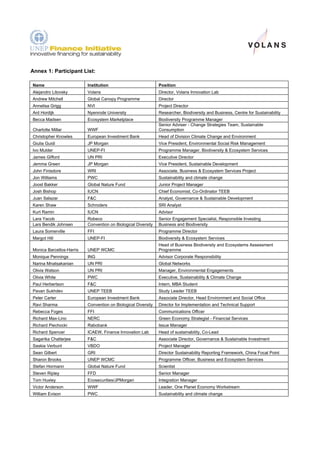
Annex 1: Participant List:

Name                      Institution                          Position
Alejandro Litovsky        Volans                               Director, Volans Innovation Lab
Andrew Mitchell           Global Canopy Programme              Director
Annelisa Grigg            NVI                                  Project Director
Ard Hordijk               Nyenrode University                  Researcher, Biodiversity and Business, Centre for Sustainability
Becca Madsen              Ecosystem Marketplace                Biodiversity Programme Manager
                                                               Senior Adviser - Change Strategies Team, Sustainable
Charlotte Millar          WWF                                  Consumption
Christopher Knowles       European Investment Bank             Head of Division Climate Change and Environment
Giulia Guidi              JP Morgan                            Vice President, Environmental Social Risk Management
Ivo Mulder                UNEP-FI                              Programme Manager, Biodiversity & Ecosystem Services
James Gifford             UN PRI                               Executive Director
Jemma Green               JP Morgan                            Vice President, Sustainable Development
John Finisdore            WRI                                  Associate, Business & Ecosystem Services Project
Jon Williams              PWC                                  Sustainability and climate change
Joost Bakker              Global Nature Fund                   Junior Project Manager
Josh Bishop               IUCN                                 Chief Economist, Co-Ordinator TEEB
Juan Salazar              F&C                                  Analyst, Governance & Sustainable Development
Karen Shaw                Schroders                            SRI Analyst
Kurt Ramin                IUCN                                 Advisor
Lara Yacob                Robeco                               Senior Engagement Specialist, Responsible Investing
Lars Bendik Johnsen       Convention on Biological Diversity   Business and Biodiversity
Laura Somerville          FFI                                  Programme Director
Margot Hill               UNEP-FI                              Biodiversity & Ecosystem Services
                                                               Head of Business Biodiversity and Ecosystems Assessment
Monica Barcellos-Harris   UNEP WCMC                            Programme
Monique Pennings          ING                                  Advisor Corporate Responsibility
Narina Mnatsakanian       UN PRI                               Global Networks
Olivia Watson             UN PRI                               Manager, Environmental Engagements
Olivia White              PWC                                  Executive, Sustainability & Climate Change
Paul Herbertson           F&C                                  Intern, MBA Student
Pavan Sukhdev             UNEP TEEB                            Study Leader TEEB
Peter Carter              European Investment Bank             Associate Director, Head Environment and Social Office
Ravi Sharma               Convention on Biological Diversity   Director for Implementation and Technical Support
Rebecca Foges             FFI                                  Communications Officer
Richard Max-Lino          NERC                                 Green Economy Strategist - Financial Services
Richard Piechocki         Rabobank                             Issue Manager
Richard Spencer           ICAEW, Finance Innovation Lab        Head of sustainability, Co-Lead
Sagarika Chatterjee       F&C                                  Associate Director, Governance & Sustainable Investment
Saskia Verbunt            VBDO                                 Project Manager
Sean Gilbert              GRI                                  Director Sustainability Reporting Framework, China Focal Point
Sharon Brooks             UNEP WCMC                            Programme Officer, Business and Ecosystem Services
Stefan Hormann            Global Nature Fund                   Scientist
Steven Ripley             FFD                                  Senior Manager
Tom Huxley                Ecosecurities/JPMorgan               Integration Manager
Victor Anderson           WWF                                  Leader, One Planet Economy Workstream
William Evison            PWC                                  Sustainability and climate change

The Finance Sector and Natural Capital - Catalyzing Acton

  • 1.
    The Finance Sector& Natural Capital: Catalyzing Action July 14th 2010, F&C Management Limited A number of entrepreneurial initiatives are today seeking the transformation of the financial sector to incorporate ecosystem services and biodiversity—referred to as natural capital—into investment portfolios and decision-making processes. Volans identified some of these innovators in ‘The Biosphere Economy’1, a piece of innovation research with an agenda for the financial sector, which argued that: ‘changes are underway in terms of how corporate assets and liabilities are calculated, potentially influencing how natural assets find their way onto balance sheets and corporate accounts. UNEP-FI, as a global partnership between the finance sector and UNEP, represents almost 20 years of collaboration to improve the sector’s understanding of environmental and social impacts on financial performance. The meeting, which was jointly organized by Volans and UNEP-FI and hosted by F&C Asset Management at their HQ in London, explored how a generation of change-makers and innovative solutions can scale up their impact by working together with forward-looking financial institutions. This report outlines key elements of the innovation agenda for the finance sector in relation to natural capital, as well as a number of trends and opportunities that we aim to leverage going forward. 1. A changing agenda for financial institutions: We now understand the intellectual argument that natural capital provides significant value to society and the economy, but is not recognised or accounted for accordingly. But what does this mean for the finance sector? The meeting began to explore the type of risks that financial institutions should begin to think about when it comes to natural capital, these are: • Credit risks: natural capital associated risks that can cause the default of investments, inaccurate information on counterparts. Collateral risk is central as banks don’t have the means of recognising the loss of natural capital and what this means for their investments. • Operational risks: is most serious when it comes to the acceleration of natural disasters or the effects of ecological degradation on business losses and outputs, such as agriculture. • Reputation risks: being associated with financing a company that is involved in major ecological liabilities. “Once a financial institution loses its reputation” a participant said, “it is very hard to build it back up.” While the TEEB initiative (i.e. the 2010 UN-sponsored study on “The Economics of Ecosystems and Biodiversity”) inherently recognises these risks, the sector will have to pioneer fundamental changes in how it estimates and analyses risks. Within the financial sector, some will be hit harder than others. The insurance sector represents a particular case where exposure to natural capital risk is more pronounced, due to accelerating climate and environmental risks. The lack of agreement on valuation mechanisms and metrics are a barrier, but banks today use a wide range of instruments. We need to bring these together in a systematic way in a financial sector toolkit for natural capital, which also identifies good examples (i.e. the financial instruments, the institutional processes, and the valuation mechanisms used), tests them against scalability and then communicate them broadly. 1 www.biosphereeconomy.com
  • 2.
    2. Key innovationtrends in the sector Investors can play a forward-thinking role in treating natural capital issues as drivers of shareholder value. There are five areas where some innovation is taking place, and where acceleration efforts are needed by the industry: (a) Accounting & Reporting: • There are several models beginning to propose solutions to the disclosure and reporting of natural capital accounts but these efforts need to engage with accounting bodies and financial regulators to experiment with more structural changes (e.g. changes in Bloomberg terminals). One issue is that the public sector doesn’t report, and while public sector accounting standards are starting to appear, it is a very slow process. Reporting is also reliant on underpinning standards and there is a need for standardisation in how natural capital accounts are measured and integrated to balance sheets. NGOs and investors have different ways of doing this, making it difficult to know if we are comparing like with like. What might the role of an organisation like NERC be here, or the role of international accounting bodies? (b) Benchmarking: • The Natural Value Initiative has been a leading example of benchmarking, and has found that only 1 out of 31 companies analysed in the food, beverage and tobacco sectors, were particularly mature in their approach to natural capital. Benchmarking companies in the responsible investment research industry are developing fast, but they are trying to cover a large amount of companies with predominantly publicly available information. Major financial companies are now getting into this space (e.g. Bloomberg, Reuters- Asset4, Risk Analytics). There needs to be attention to what is being benchmarked, too, as different companies are good at different elements. (c) Valuation and Risk: • Participants identified a number of entry points into the financial sector, with the main focus being on the externalities of the business clients. The group underscored the difficulty of getting policies embedded in large banks, beyond what so far has been kept within the boundaries of project finance (e.g. Equator Principles). UNEP-FI has been leading discussions on redefining fiduciary responsibilities, and innovation is emerging in that asset management funds are experimenting with ecological criteria to assess the risk of country bonds. At present UN PRI and UNEP FI are working on a universal ownership report, quantifying environmental externalities for portfolio investors. (d) Awareness: • Reputation is still the leading driver of change in the sector. Examples of ecosystem failures as drivers of change are rare. Civil society and NGOs are playing an important role in highlighting the issue – but their strategies could also be more effective at targeting the right stories around risk and opportunity for the finance sector. It is vital to bring an operational risk perspective as well as hard business case numbers to the story and campaigning. (e) Knowledge barriers: • There is a need to accelerate the translation of the biodiversity and natural capital issue into business language and cultures. An older generation of financers today does not understand or relate to the language of ecologists, climatologists and earth scientists. In some areas, the type of scientific data that is developed can cause financial analysts discomfort, confusion and apathy. NERC for example is looking at collaboration between the academic sector and finance sector on biodiversity information. There is also an urgent need to bridge the worlds of science-based policy on ‘ecological infrastructures’ (i.e. what is the optimum level of ecological balance?) and financial investment (i.e. how does this ecological equilibrium translate onto economic and financial values).
  • 3.
    3. Catalyzing collaborativeinnovation Building on the Biosphere Economy agenda for the finance sector this ‘design session’ explored how different organizations can work together, as well as build on existing solutions to create impact in the finance sector. The session involved 3 groups, each with a specific innovation focus, which were tasked with identifying existing solutions and coming up with a set of measures (which they’d be comfortable advancing and working on over time) to further develop and implement changes. The innovation agendas that participants were interested in pursuing were: 1) Business Education on Natural Assets The thinking on externalities in general, and natural capital in particular, needs to be taken up by the main schools where business leaders and financial analysts are trained. There is a need for a new language, more and better evidence and solutions proposed and taught, including business cases, which can become iconic examples of business strategy and organization. Preferred actions (Organisations interested in collaborating on this agenda in italics) • Bring training schemes on this issue to business schools and implement other training channels such as internal training schemes for companies. • Design “Master Classes”, peer to peer learning materials and courses; design and develop teaching case studies and ensure that courses at business schools adopt them, or create new courses (PWC, WWF and UNEP-FI) • NGOs and management consultancies can play a role in providing input to the design of the toolkit and teaching materials – but creative engagement with business scholars is critical. • Translating business language on natural capital for the general public (Ecosystem Marketplace) 2) Corporate Valuation and Transparency: The group focused on turning externalities into asset valuation criteria, advance robust disclosure and transparency issues in connection to natural capital, as well as metrics that establish a clear connection to shareholder value. Some issues that the group recognizes as barriers are: Preferred actions (Organisations interested in collaborating on this agenda in italics): • Work on the convergence of existing valuation work on particular externalities or sectors to showcase their applicability (TEEB, F&C, Schroders, UN-PRI, Nyenrode). o Extend this work to investors, bring this into the mainstream (Robeco, UN PRI, VBDO, GRI) o Learn from what has already been done around the carbon market (Ecosecurities) • Work with institutions that gather biophysical data to develop tools that allow a financial firm to overlay investor information on it. Build a partnership that includes data managers, software providers and research institutes. Potential for shadow reporting (FFD) • Pilot prototypes together with FIs who wish to be leaders in making externalities a routine part of corporate valuation. • Valuation Techniques (separate from disclosure): develop guidance on how you value natural capital fairly; engage the International Accounting Standards Board (possible interest from ICAEW) o Integrate financial and non financial information (GRI, possibly WBCSD and WRI) o XBRL- driver to standardise financial information (Kurt Rahmin) o Take ESG work, and integrate it within internal valuation (Robeco) • Sectoral Modelling (NVI, Rabobank, possibly WRI) • Experimentation with a biodiversity fund (EIB, NVI)
  • 4.
    3) New RiskModels There is a lack of understanding of how ecological considerations are being used in practise when assessing the long-term risk of investments. Increasingly there are sectors that are looking at natural capital risks (e.g. fisheries and financing of vessels, or tropical cyclone high-risk areas) but which are not necessarily looking at it through this lens. Preferred actions (Organisations interested in collaborating on this agenda in italics): • A partnership proposal was devised: UN PRI, UNEP FI and IFC could possibly collaborate to stimulate PRI signatories to ask Equator Principle Financial Institutions to disclose how they have actually implemented the EPs in practice. • Road test a potential risk model on fisheries or a couple of other key high-impact (or highly dependant). sectors. Work on this model with a bank and use the findings as a benchmark for other banks and investors in those sectors, which would like to alter their risk models based on the outcome of such an exercise (UNEP FI). • Forest Insurance: Potential to connect the risk model in forest asset classes to insurance premiums. NERC and Forestry could work together in better understanding the asset class, and how natural capital considerations are altering the insurance ability of this asset class. ***** 4. Next steps: Volans and UNEP-FI want to help advance some of these areas of potential innovation, building on their complementary skills; Volans in the design and implementation of collaborative innovation processes, and UNEP-FI as a recognized industry leadership platform from which to affect this. In addition to the areas of activity where some of the participants would like to remain actively involved in design and development, a number of additional action points were suggested: • Peter Carter from the European Investment Bank will bring together a small group to exchange views on the issue of valuation of biodiversity, and how to bring geophysical data together with financial information to inform decisions. • A document mapping out the different initiatives and actors in this space will be distributed by UNEP- FI, providing a framework of information to ensure that the collaborative work going forward in particular areas is convening leading actors in those areas. • To hold a follow up meeting in early 2011 where UNEP-FI and Volans help participants refine and take this action agenda further, progressively including other actors and platforms, like the Finance Lab, as well as financial institutions who want to take central part in advancing solutions to the challenge of integrating natural capital to the finance sector. With many thanks to the participants; to Sagarika Chatterjee of F&C Management for hosting the meeting; and to Margot Hill of UNEP-FI for her extraordinary help with the organization of the meeting. Alejandro Litovsky Ivo Mulder Director, Volans Innovation Lab Programme Officer - Biodiversity & Ecosystems Volans Ventures UNEP-Finance Initiative alejandro@volans.com ivo.mulder@unep.org
  • 5.
    Annex 1: ParticipantList: Name Institution Position Alejandro Litovsky Volans Director, Volans Innovation Lab Andrew Mitchell Global Canopy Programme Director Annelisa Grigg NVI Project Director Ard Hordijk Nyenrode University Researcher, Biodiversity and Business, Centre for Sustainability Becca Madsen Ecosystem Marketplace Biodiversity Programme Manager Senior Adviser - Change Strategies Team, Sustainable Charlotte Millar WWF Consumption Christopher Knowles European Investment Bank Head of Division Climate Change and Environment Giulia Guidi JP Morgan Vice President, Environmental Social Risk Management Ivo Mulder UNEP-FI Programme Manager, Biodiversity & Ecosystem Services James Gifford UN PRI Executive Director Jemma Green JP Morgan Vice President, Sustainable Development John Finisdore WRI Associate, Business & Ecosystem Services Project Jon Williams PWC Sustainability and climate change Joost Bakker Global Nature Fund Junior Project Manager Josh Bishop IUCN Chief Economist, Co-Ordinator TEEB Juan Salazar F&C Analyst, Governance & Sustainable Development Karen Shaw Schroders SRI Analyst Kurt Ramin IUCN Advisor Lara Yacob Robeco Senior Engagement Specialist, Responsible Investing Lars Bendik Johnsen Convention on Biological Diversity Business and Biodiversity Laura Somerville FFI Programme Director Margot Hill UNEP-FI Biodiversity & Ecosystem Services Head of Business Biodiversity and Ecosystems Assessment Monica Barcellos-Harris UNEP WCMC Programme Monique Pennings ING Advisor Corporate Responsibility Narina Mnatsakanian UN PRI Global Networks Olivia Watson UN PRI Manager, Environmental Engagements Olivia White PWC Executive, Sustainability & Climate Change Paul Herbertson F&C Intern, MBA Student Pavan Sukhdev UNEP TEEB Study Leader TEEB Peter Carter European Investment Bank Associate Director, Head Environment and Social Office Ravi Sharma Convention on Biological Diversity Director for Implementation and Technical Support Rebecca Foges FFI Communications Officer Richard Max-Lino NERC Green Economy Strategist - Financial Services Richard Piechocki Rabobank Issue Manager Richard Spencer ICAEW, Finance Innovation Lab Head of sustainability, Co-Lead Sagarika Chatterjee F&C Associate Director, Governance & Sustainable Investment Saskia Verbunt VBDO Project Manager Sean Gilbert GRI Director Sustainability Reporting Framework, China Focal Point Sharon Brooks UNEP WCMC Programme Officer, Business and Ecosystem Services Stefan Hormann Global Nature Fund Scientist Steven Ripley FFD Senior Manager Tom Huxley Ecosecurities/JPMorgan Integration Manager Victor Anderson WWF Leader, One Planet Economy Workstream William Evison PWC Sustainability and climate change