Strategy and Tactics of
Distributive Bargaining
Time to Negotiate….


The Car Dealers Game
The Distributive Bargaining
             Situation
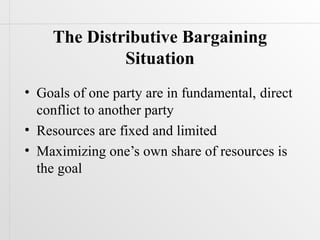
• Goals of one party are in fundamental, direct
  conflict to another party
• Resources are fixed and limited
• Maximizing one’s own share of resources is
  the goal
The Distributive Bargaining
             Situation
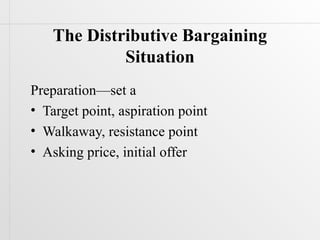
Preparation—set a
• Target point, aspiration point
• Walkaway, resistance point
• Asking price, initial offer
The Distributive Bargaining
            Situation
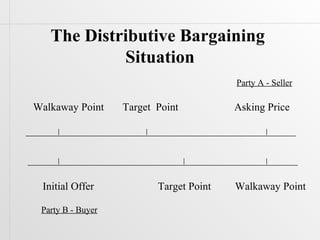
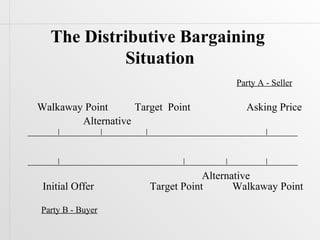
                                         Party A - Seller

Walkaway Point     Target Point          Asking Price


 Initial Offer            Target Point   Walkaway Point

 Party B - Buyer
The Role of Alternatives to a
     Negotiated Agreement
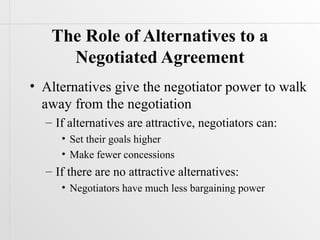
• Alternatives give the negotiator power to walk
  away from the negotiation
  – If alternatives are attractive, negotiators can:
     • Set their goals higher
     • Make fewer concessions
  – If there are no attractive alternatives:
     • Negotiators have much less bargaining power
The Distributive Bargaining
            Situation
                                         Party A - Seller

Walkaway Point      Target Point           Asking Price
        Alternative


                                   Alternative
 Initial Offer         Target Point       Walkaway Point

Party B - Buyer
Fundamental Strategies
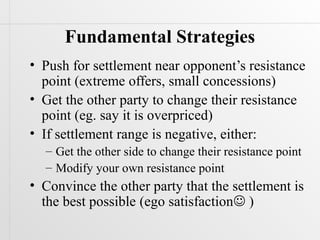
• Push for settlement near opponent’s resistance
  point (extreme offers, small concessions)
• Get the other party to change their resistance
  point (eg. say it is overpriced)
• If settlement range is negative, either:
  – Get the other side to change their resistance point
  – Modify your own resistance point
• Convince the other party that the settlement is
  the best possible (ego satisfaction )
Keys to the Strategies

The keys to implementing any of the four
  strategies are:
• Discovering the other party’s resistance
  point
• Influencing the other party’s resistance
  point
The other’s understanding of your own
               situation
• Higher the estimation of your cost of delay or
  impasse (termination) – higher RV
• Higher the estimation of his cost of delay or
  impasse – lower RV
• The less the other party values an issue –lower
  RV
• The more the estimation of the value of an
  issue for you –lower RV
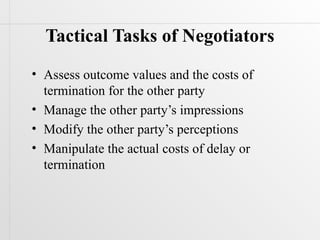
Tactical Tasks of Negotiators
• Assess outcome values and the costs of
  termination for the other party
• Manage the other party’s impressions
• Modify the other party’s perceptions
• Manipulate the actual costs of delay or
  termination
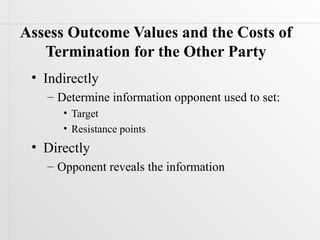
Assess Outcome Values and the Costs of
   Termination for the Other Party
 • Indirectly
   – Determine information opponent used to set:
      • Target
      • Resistance points
 • Directly
   – Opponent reveals the information
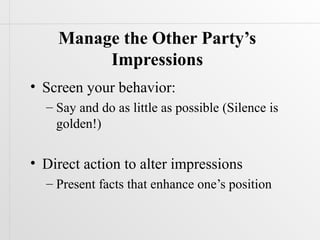
Manage the Other Party’s
         Impressions
• Screen your behavior:
  – Say and do as little as possible (Silence is
    golden!)

• Direct action to alter impressions
  – Present facts that enhance one’s position
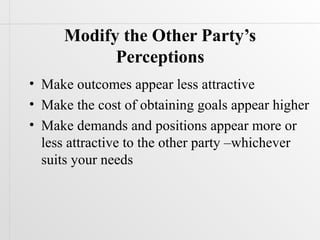
Modify the Other Party’s
           Perceptions
• Make outcomes appear less attractive
• Make the cost of obtaining goals appear higher
• Make demands and positions appear more or
  less attractive to the other party –whichever
  suits your needs
Manipulate the Actual Costs of
          Delay or Termination
• Plan disruptive action
  – Raise the costs of delay to the other party (eg. strike)
• Form an alliance with outsiders
  – Involve (or threaten to involve) other parties who can
    influence the outcome in your favor
• Schedule manipulations
  – One party is usually more vulnerable to delaying than
    the other (eg. reschedule, give shorter time to decide)
Positions Taken
        During Negotiations
• Opening offer
  – Where will you start? (anchoring!!!)
• Opening stance
  – What is your attitude?
     • Competitive? Moderate?
• Initial concessions
  – Should any be made? If so, how large?
Positions Taken
         During Negotiations
• The role of concessions
  – Without them, there is either capitulation or
    deadlock
• Patterns of concession making
  – The pattern contains valuable information (make
    lower concessions to signal that you are
    approaching your RV)
• Final offer (making a commitment)
  – “This is all I can do”
Closing the Deal
• Provide alternatives (2 or 3 packages)
• Assume the close
• Split the difference
• Exploding offers (offer is relevant for a
  short period)
• Deal sweeteners
Dealing with Typical
          Hardball Tactics
• Four main options:
  – Ignore them
  – Discuss them (“I know what you are doing”)
  – Respond in kind
  – Co-opt the other party (befriend them)
Typical Hardball Tactics
• Good Cop/Bad Cop
• Lowball/Highball – ridicolously low (high)
  opening
   – The other party: “A waste of time”
   – Ask for a more reasonable opening
• Bogey (playing up an issue of little importance)
• The Nibble (asking for a number of small
  concessions to) eg. A scarf to go with the dress
Typical Hardball Tactics
•   Chicken (bluffing)
•   Intimidation (anger, guilt, legitimacy)
•   Aggressive Behavior
•   Snow Job (overwhelm the other party
    with information)
Summary
Negotiators need to:
• Set a clear target and resistance points
• Understand and work to improve their BATNA
• Start with good opening offer
• Make appropriate concessions
• Manage the commitment process

Week_3_4_ppts

  • 1.
    Strategy and Tacticsof Distributive Bargaining
  • 2.
    Time to Negotiate…. TheCar Dealers Game
  • 4.
    The Distributive Bargaining Situation • Goals of one party are in fundamental, direct conflict to another party • Resources are fixed and limited • Maximizing one’s own share of resources is the goal
  • 5.
    The Distributive Bargaining Situation Preparation—set a • Target point, aspiration point • Walkaway, resistance point • Asking price, initial offer
  • 6.
    The Distributive Bargaining Situation Party A - Seller Walkaway Point Target Point Asking Price Initial Offer Target Point Walkaway Point Party B - Buyer
  • 7.
    The Role ofAlternatives to a Negotiated Agreement • Alternatives give the negotiator power to walk away from the negotiation – If alternatives are attractive, negotiators can: • Set their goals higher • Make fewer concessions – If there are no attractive alternatives: • Negotiators have much less bargaining power
  • 8.
    The Distributive Bargaining Situation Party A - Seller Walkaway Point Target Point Asking Price Alternative Alternative Initial Offer Target Point Walkaway Point Party B - Buyer
  • 9.
    Fundamental Strategies • Pushfor settlement near opponent’s resistance point (extreme offers, small concessions) • Get the other party to change their resistance point (eg. say it is overpriced) • If settlement range is negative, either: – Get the other side to change their resistance point – Modify your own resistance point • Convince the other party that the settlement is the best possible (ego satisfaction )
  • 10.
    Keys to theStrategies The keys to implementing any of the four strategies are: • Discovering the other party’s resistance point • Influencing the other party’s resistance point
  • 11.
    The other’s understandingof your own situation • Higher the estimation of your cost of delay or impasse (termination) – higher RV • Higher the estimation of his cost of delay or impasse – lower RV • The less the other party values an issue –lower RV • The more the estimation of the value of an issue for you –lower RV
  • 12.
    Tactical Tasks ofNegotiators • Assess outcome values and the costs of termination for the other party • Manage the other party’s impressions • Modify the other party’s perceptions • Manipulate the actual costs of delay or termination
  • 13.
    Assess Outcome Valuesand the Costs of Termination for the Other Party • Indirectly – Determine information opponent used to set: • Target • Resistance points • Directly – Opponent reveals the information
  • 14.
    Manage the OtherParty’s Impressions • Screen your behavior: – Say and do as little as possible (Silence is golden!) • Direct action to alter impressions – Present facts that enhance one’s position
  • 15.
    Modify the OtherParty’s Perceptions • Make outcomes appear less attractive • Make the cost of obtaining goals appear higher • Make demands and positions appear more or less attractive to the other party –whichever suits your needs
  • 16.
    Manipulate the ActualCosts of Delay or Termination • Plan disruptive action – Raise the costs of delay to the other party (eg. strike) • Form an alliance with outsiders – Involve (or threaten to involve) other parties who can influence the outcome in your favor • Schedule manipulations – One party is usually more vulnerable to delaying than the other (eg. reschedule, give shorter time to decide)
  • 17.
    Positions Taken During Negotiations • Opening offer – Where will you start? (anchoring!!!) • Opening stance – What is your attitude? • Competitive? Moderate? • Initial concessions – Should any be made? If so, how large?
  • 18.
    Positions Taken During Negotiations • The role of concessions – Without them, there is either capitulation or deadlock • Patterns of concession making – The pattern contains valuable information (make lower concessions to signal that you are approaching your RV) • Final offer (making a commitment) – “This is all I can do”
  • 19.
    Closing the Deal •Provide alternatives (2 or 3 packages) • Assume the close • Split the difference • Exploding offers (offer is relevant for a short period) • Deal sweeteners
  • 20.
    Dealing with Typical Hardball Tactics • Four main options: – Ignore them – Discuss them (“I know what you are doing”) – Respond in kind – Co-opt the other party (befriend them)
  • 21.
    Typical Hardball Tactics •Good Cop/Bad Cop • Lowball/Highball – ridicolously low (high) opening – The other party: “A waste of time” – Ask for a more reasonable opening • Bogey (playing up an issue of little importance) • The Nibble (asking for a number of small concessions to) eg. A scarf to go with the dress
  • 22.
    Typical Hardball Tactics • Chicken (bluffing) • Intimidation (anger, guilt, legitimacy) • Aggressive Behavior • Snow Job (overwhelm the other party with information)
  • 23.
    Summary Negotiators need to: •Set a clear target and resistance points • Understand and work to improve their BATNA • Start with good opening offer • Make appropriate concessions • Manage the commitment process