



Polio eradication in
Afghanistan
NEAP 2016-2017
NEAP Workshop, Afghanistan
24 October 2016
2
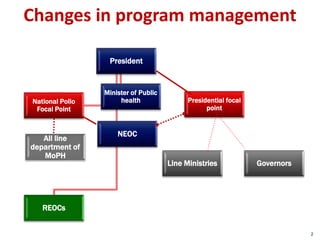
President
REOCs
National Polio
Focal Point
Presidential focal
point
Line Ministries Governors
Minister of Public
health
NEOC
All line
department of
MoPH
Changes in program management
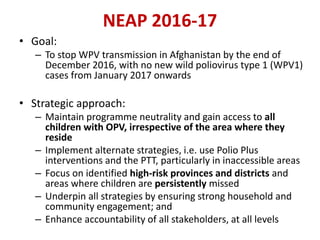
NEAP 2016-17
• Goal:
– To stop WPV transmission in Afghanistan by the end of
December 2016, with no new wild poliovirus type 1 (WPV1)
cases from January 2017 onwards
• Strategic approach:
– Maintain programme neutrality and gain access to all
children with OPV, irrespective of the area where they
reside
– Implement alternate strategies, i.e. use Polio Plus
interventions and the PTT, particularly in inaccessible areas
– Focus on identified high-risk provinces and districts and
areas where children are persistently missed
– Underpin all strategies by ensuring strong household and
community engagement; and
– Enhance accountability of all stakeholders, at all levels
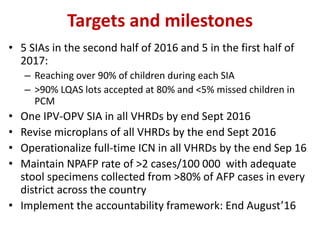
Targets and milestones
• 5 SIAs in the second half of 2016 and 5 in the first half of
2017:
– Reaching over 90% of children during each SIA
– >90% LQAS lots accepted at 80% and <5% missed children in
PCM
• One IPV-OPV SIA in all VHRDs by end Sept 2016
• Revise microplans of all VHRDs by the end Sept 2016
• Operationalize full-time ICN in all VHRDs by the end Sep 16
• Maintain NPAFP rate of >2 cases/100 000 with adequate
stool specimens collected from >80% of AFP cases in every
district across the country
• Implement the accountability framework: End August’16
NEAP 2016-17
• Continue strengthening polio governance and
management structure:
– EOC: Task team modality, weekly TCs
– Expansion of M&A officer to all 47 districts
– Provincial & district task force: Revise TOR
– Implement accountability framework from August
onwards
• High risk approach:
– Focus on 47 district and 5 high risk province
– District profile and specific plans for all VHRDs after each
SIA
– Districts in between VHRDs treated as high risk
– Revision in December 2016
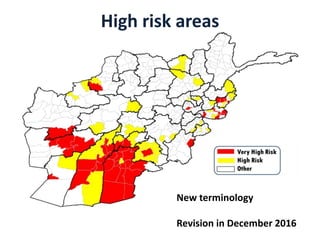
High risk areas
New terminology
Revision in December 2016
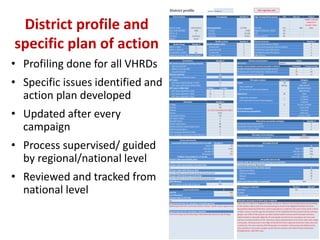
District profile and
specific plan of action
• Profiling done for all VHRDs
• Specific issues identified and
action plan developed
• Updated after every
campaign
• Process supervised/ guided
by regional/national level
• Reviewed and tracked from
national level
District profile Updated 15-May-16 Fill in light blue cells
District details Number # High risk population groups Y/N Pop size Pattern
District name Shahwalikot 117,691 Nomads Yes 600
Mobile nomads
(stays for 5
months- (Nov-
Mar)
Geo-code (DCODE) 3306 4,708 Migrant labourers, Ailaks No -
LPD (1, 2) 1 23,538 IDPs No -
Province Kandahar 52,961 Others (specify) No -
Region South
Number # Number #
Epidemiology Number # 3 2
WPVs in 2015 1 1 2
WPVs in 2010-14 7 2 1
Compatibles in 2015 No 0 0
5 0
# Planned # Implemented
3 3
24 24
16 13
Number #
139
56/day
# adeq # inadeq
5 0
10 6 28
9 3
5
0
Number #
0
2
0
Number #
72 %
1,320 23%
12 17%
165 19%
o
#
76
93
69
9
Round 1 Round 2
# No
108
13
0
Date
District Polio Officers (DPOs)
District Communication Officers (DCOs)
# of districts same PPO covers
# of districts same PCO covers
M&A Officers
Routine immunization services provided in district
Number of Health Facilities providing RI services
RI sessions per month (total incl. fixed/outrech)
RI outreach sessions per month
NameRoutine immunization
BPHS NGO BARAN
Cluster Supervisors
SIA quality (trend)
7
5
6Intra-campaign Monitors (ICM)
Post-campaign Assessment (PCA) Monitors
28
- Team workload
(# of teams by work load category)
LQAS result (March 2016. if conducted) N/A
2.3.5.7.8.9.10.11.12.13.14.15.16.19.20.22.23.24.25.26.27
2.3.5.7.8.9.10.11.12.13.14.15.16.19.20.22.23.24.25.26.27
Clusters with inaccessibility (list)
Clusters with inaccessibility >6 months (list)
Clusters under AGE influence (list)
Clusters with limited supervision (list) - Refusal
- Others
Clusters with >5% missed children during last round (list)
2.3.4.9.10.11.13.15.17.20.21.23.27
SIA quality (last round)
Reason for missed children (last round)
- House not visited
- Child not available
Missed children (last 4 rounds)
March-16
February-16
January-16
December-15
AGE influence
0
Four Picnic teans are functioning in Dalla Band during revisit day (Friday)
Index case is resident of Maghdod village, Cluster # 7. Base on revised Micro plan and according
to the old SIAs. Micro-plan the area was belong to Cluster # 26. Maghdod hamlet has only 8
households harboring 24 families, and Its population is scattered. This area is fully under control
of AGEs, almost 2 months ago the Ambulance of the Shawalikot district was burned by unknown
people, also AGEs of the area do not allow mobile health services and RI outreach activities.
Implementation, Generally Majority of local people are farmers by occupation and very poor
and have no basic facilities of life. Nutritious status and education level of the index case village
is very poor. Illiteracy level is very high at the district level in general and at the index case area
in particular. The main sources of drinking water are streams, hand pumps and shallow wells,
Area sanitation is very poor, people use pit latrines and also have habit of open defecation
AFG/08/16/141- 2016 WPV case:
IPV campaigns conducted
Start date
% target
PCA coverage
% of clusters under AGE influence 75%
%
*Narrative description of WPV cases in 2015/16
Social mobilization
# of ICN
# of influencers
No
Special events (list incl. descption, timing/frequency)
Special sites (list incl. description, location)
Clusters with no ICN (list)
Gatherings held with community elders/ shuras, mullah imams. Sports events held.
Microplan analysis#
28
6725
Villages
Teams
139
Clusters
Schools
Houses
Vaccination Teams
400-600 children
>600 children
Total
<5 teams
5-6 teams
>6 teams
Supervisors
- Supervisor workload
(# of supervisors by work load category)
Team composition
(# of teams by composition)
15/12/2015
Alternative vaccination strategies
Permanent Polio Teams (PPT)
Permanent Transit Teams (PTT)
Cross-Border Teams (CBT)
Microplan field validation
Field validation of microplan completed
at least 1 female
none local
one local
both local
at least 1 CHW
Human resources
Surveillance
AFP cases in 2014-1016
Demography
Total population
<1 years
<5 years
<15 years
Health Facilities (HFs)
- Primary HFs
- Secondary HFs
- Tertiary HFs
- Private Clinics
Health services
3
Number #
3
1
1
1
Detailed narrative description below*
Category
Total
<400 children
Inaccessible children during SIAs (last 4 rounds)
Access and security
SIA Transit Teams
Nomads Teams
Communication Cluster Supervisors
District Coordinators
%
100%
1.1
HFs which are part of reporting network
- High priority (HP)
- Medium priority (MP)
- Low priority (LP)
Weekly reporting
- Timeliness of weekly report
AFP cases
Children inaccessible for >6 months
March-16
February-16
January-16
December-15
- AFP cases expected/year in 2016
- AFP cases with 0 dose (2014+2015)
- AFP cases reported in 2016
- AFP cases reported in 2015
- AFP cases reported in 2014
Microplan
0
28
0
2 ( I each secondary and high)
Number #
941
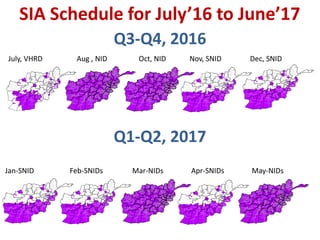
Jan-SNID Feb-SNIDs Apr-SNIDsMar-NIDs May-NIDs
SIA Schedule for July’16 to June’17
July, VHRD Aug , NID Oct, NID Dec, SNIDNov, SNID
Q3-Q4, 2016
Q1-Q2, 2017
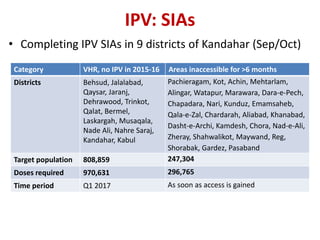
IPV: SIAs
• Completing IPV SIAs in 9 districts of Kandahar (Sep/Oct)
Category VHR, no IPV in 2015-16 Areas inaccessible for >6 months
Districts Behsud, Jalalabad,
Qaysar, Jaranj,
Dehrawood, Trinkot,
Qalat, Bermel,
Laskargah, Musaqala,
Nade Ali, Nahre Saraj,
Kandahar, Kabul
Pachieragam, Kot, Achin, Mehtarlam,
Alingar, Watapur, Marawara, Dara-e-Pech,
Chapadara, Nari, Kunduz, Emamsaheb,
Qala-e-Zal, Chardarah, Aliabad, Khanabad,
Dasht-e-Archi, Kamdesh, Chora, Nad-e-Ali,
Zheray, Shahwalikot, Maywand, Reg,
Shorabak, Gardez, Pasaband
Target population 808,859 247,304
Doses required 970,631 296,765
Time period Q1 2017 As soon as access is gained
Open for discussion
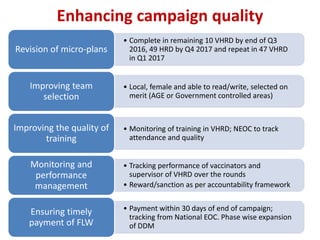
Enhancing campaign quality
• Complete in remaining 10 VHRD by end of Q3
2016, 49 HRD by Q4 2017 and repeat in 47 VHRD
in Q1 2017
Revision of micro-plans
• Local, female and able to read/write, selected on
merit (AGE or Government controlled areas)
Improving team
selection
• Monitoring of training in VHRD; NEOC to track
attendance and quality
Improving the quality of
training
• Tracking performance of vaccinators and
supervisor of VHRD over the rounds
• Reward/sanction as per accountability framework
Monitoring and
performance
management
• Payment within 30 days of end of campaign;
tracking from National EOC. Phase wise expansion
of DDM
Ensuring timely
payment of FLW
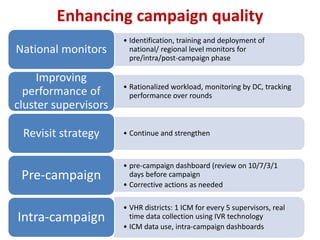
Enhancing campaign quality
• Identification, training and deployment of
national/ regional level monitors for
pre/intra/post-campaign phase
National monitors
• Rationalized workload, monitoring by DC, tracking
performance over rounds
Improving
performance of
cluster supervisors
• Continue and strengthenRevisit strategy
• pre-campaign dashboard (review on 10/7/3/1
days before campaign
• Corrective actions as needed
Pre-campaign
• VHR districts: 1 ICM for every 5 supervisors, real
time data collection using IVR technology
• ICM data use, intra-campaign dashboards
Intra-campaign
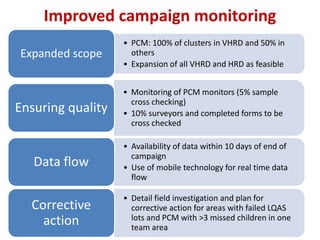
Improved campaign monitoring
• PCM: 100% of clusters in VHRD and 50% in
others
• Expansion of all VHRD and HRD as feasible
Expanded scope
• Monitoring of PCM monitors (5% sample
cross checking)
• 10% surveyors and completed forms to be
cross checked
Ensuring quality
• Availability of data within 10 days of end of
campaign
• Use of mobile technology for real time data
flow
Data flow
• Detail field investigation and plan for
corrective action for areas with failed LQAS
lots and PCM with >3 missed children in one
team area
Corrective
action
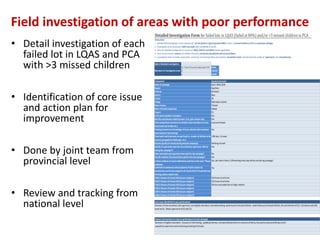
Field investigation of areas with poor performance
• Detail investigation of each
failed lot in LQAS and PCA
with >3 missed children
• Identification of core issue
and action plan for
improvement
• Done by joint team from
provincial level
• Review and tracking from
national level
Detailed Investigation Form for failed lots in LQAS (failed at 80%) and/or >3 missed children in PCA
Instructions
Date of detailedinvestigation
Dr. Tahsil PEI and Dr.Matiullah PPO WHO
0 UNICEF
0 MoPH
Yes
Yes, dot mark is there ( S/Mworkingthree days before and duringcampaign)
weak revisit , Weak supervision of DC and C/S.
Plannedinterventions toimprove performance fornextcampaign
Selection of eligible volunteers, Focused on FLWtraining, updatingitinerary, increased S/Mactivities forconvince of family, focussed on dialy and 5th day revisit.
supportive supervision and monitoringaccordingto the plan.
Selection of new volunteers and supervisor, non eligible volunteers, hurriedly working, weak record of missed children, weak follow up of missed children, No commitment of C/S , Volunteers and S/M.
Child2:Reasonof missedchild(as percaregiver) Child was not at home
Child3:Reasonof missedchild(as percaregiver) Child as vaccinated but no fingermarked
Child4:Reasonof missedchild(as percaregiver)
Child5:Reasonof missedchild(as percaregiver)
Child6:Reasonof missedchild(as percaregiver)
Core issues identifiedforpoorperformance
Has the mobilizer(if present) beenpaidforthe lastcampaign?
Is there evidence of social mobilizationactivities inthe area? Please
elaborate.
Commentonawareness andacceptance of poliovaccine by
communityas well as bycaregivers of missedchild;if householdwas
refusing, please explainwhy.
Yes
Child1:Reasonof missedchild(as percaregiver) Child was not at home
Revisits (qualityof revisits duringandpost-campaign) Workingnot well
Qualityof supervision(was the areavisitedbysupervisor, ICMetc
duringthe campaign?)
Yes
Have vaccinators andsupervisorbeenpaidforlastcampaign? No
Teamcomposition(commentonwhetherteammembers are local,
has atleastone female etc.)
Local and Female
Training(commentonknowledge of team, whetherbothmembers
were trainedinlasttraining)
Yes
Teamworkload(commentonworkloadi.e. numberof childrentobe
covered, geographical challenges, etc.)
178/ day ( G1area)
Team# T5
Is the areaincludedinmicroplan Yes
Was the area/houses visitedbyteam. If no, give reasons why. Yes
Village Rahmatulul alamin
Name of area Tortank
Name of ClusterSupervisor Sadiqa
Province Helmand
District Bost
Cluster 29
Component Inputs/Comments
Dates of campaign April, SNIDs 2016
Region Southren
Members of investigationteam
1- Detailed field investigation to beconducted for all lots failed in LQAS (rejected at80%) and/or >3missed children in PCAin a subcluster(village) .
2- Investigation to beconducted within oneweek afteravailability of results.
3- Team fordetailed investigation to consists of WHO, UNICEF, and MoPH (whereapplicable).
4- Team to look into the reasons forchildren missed by visiting thehouseholds with missed children.
5- Investigation team to review composition, work load, and training status of concerned vaccination teams and also look into quality of supervision and microplanning.
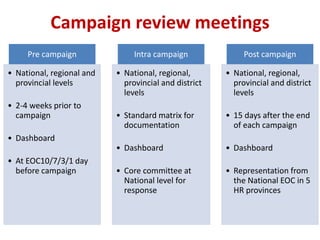
Campaign review meetings
Pre campaign
• National, regional and
provincial levels
• 2-4 weeks prior to
campaign
• Dashboard
• At EOC10/7/3/1 day
before campaign
Intra campaign
• National, regional,
provincial and district
levels
• Standard matrix for
documentation
• Dashboard
• Core committee at
National level for
response
Post campaign
• National, regional,
provincial and district
levels
• 15 days after the end
of each campaign
• Dashboard
• Representation from
the National EOC in 5
HR provinces
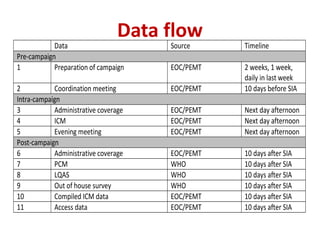
Data flow
Data Source Timeline
Pre-campaign
1 Preparation of campaign EOC/PEMT 2 weeks, 1 week,
daily in last week
2 Coordination meeting EOC/PEMT 10 days before SIA
Intra-campaign
3 Administrative coverage EOC/PEMT Next day afternoon
4 ICM EOC/PEMT Next day afternoon
5 Evening meeting EOC/PEMT Next day afternoon
Post-campaign
6 Administrative coverage EOC/PEMT 10 days after SIA
7 PCM WHO 10 days after SIA
8 LQAS WHO 10 days after SIA
9 Out of house survey WHO 10 days after SIA
10 Compiled ICM data EOC/PEMT 10 days after SIA
11 Access data EOC/PEMT 10 days after SIA
Open for discussion
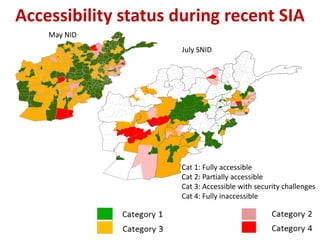
Accessibility status during recent SIA
Cat 1: Fully accessible
Cat 2: Partially accessible
Cat 3: Accessible with security challenges
Cat 4: Fully inaccessible
May NID
July SNID
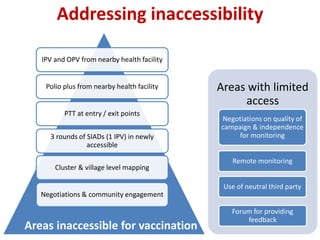
Addressing inaccessibility
IPV and OPV from nearby health facility
Polio plus from nearby health facility
PTT at entry / exit points
3 rounds of SIADs (1 IPV) in newly
accessible
Cluster & village level mapping
Negotiations & community engagement
Areas inaccessible for vaccination
Areas with limited
access
Negotiations on quality of
campaign & independence
for monitoring
Remote monitoring
Use of neutral third party
Forum for providing
feedback
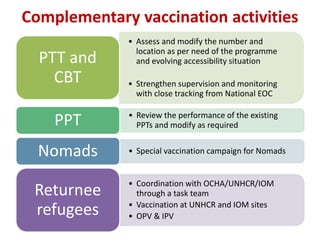
Complementary vaccination activities
• Assess and modify the number and
location as per need of the programme
and evolving accessibility situation
• Strengthen supervision and monitoring
with close tracking from National EOC
PTT and
CBT
• Review the performance of the existing
PPTs and modify as requiredPPT
• Special vaccination campaign for NomadsNomads
• Coordination with OCHA/UNHCR/IOM
through a task team
• Vaccination at UNHCR and IOM sites
• OPV & IPV
Returnee
refugees
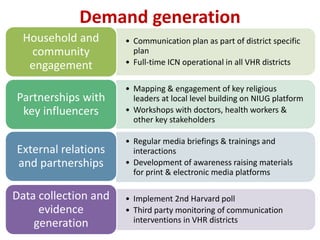
Demand generation
• Communication plan as part of district specific
plan
• Full-time ICN operational in all VHR districts
Household and
community
engagement
• Mapping & engagement of key religious
leaders at local level building on NIUG platform
• Workshops with doctors, health workers &
other key stakeholders
Partnerships with
key influencers
• Regular media briefings & trainings and
interactions
• Development of awareness raising materials
for print & electronic media platforms
External relations
and partnerships
• Implement 2nd Harvard poll
• Third party monitoring of communication
interventions in VHR districts
Data collection and
evidence
generation
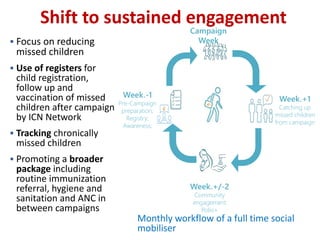
Monthly workflow of a full time social
mobiliser
Campaign
Week
Week.+1
Catching up
missed children
from campaign
Week.+/-2
Community
engagement
Polio+
Week.-1
Pre-Campaign
preparation;
Registry;
Awareness;
Shift to sustained engagement
 Focus on reducing
missed children
 Use of registers for
child registration,
follow up and
vaccination of missed
children after campaign
by ICN Network
 Tracking chronically
missed children
 Promoting a broader
package including
routine immunization
referral, hygiene and
sanitation and ANC in
between campaigns
Open for discussion
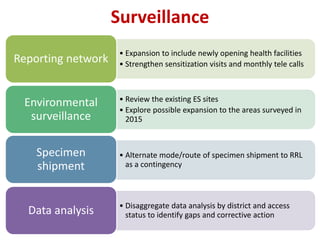
Surveillance
• Expansion to include newly opening health facilities
• Strengthen sensitization visits and monthly tele calls
Reporting network
• Review the existing ES sites
• Explore possible expansion to the areas surveyed in
2015
Environmental
surveillance
• Alternate mode/route of specimen shipment to RRL
as a contingency
Specimen
shipment
• Disaggregate data analysis by district and access
status to identify gaps and corrective actionData analysis
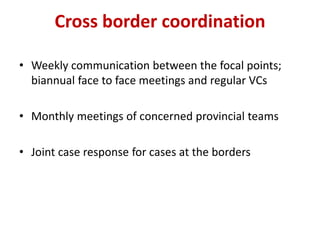
Cross border coordination
• Weekly communication between the focal points;
biannual face to face meetings and regular VCs
• Monthly meetings of concerned provincial teams
• Joint case response for cases at the borders
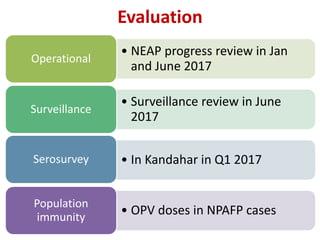
Evaluation
• NEAP progress review in Jan
and June 2017
Operational
• Surveillance review in June
2017
Surveillance
• In Kandahar in Q1 2017Serosurvey
• OPV doses in NPAFP cases
Population
immunity
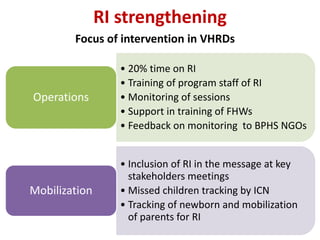
RI strengthening
• 20% time on RI
• Training of program staff of RI
• Monitoring of sessions
• Support in training of FHWs
• Feedback on monitoring to BPHS NGOs
Operations
• Inclusion of RI in the message at key
stakeholders meetings
• Missed children tracking by ICN
• Tracking of newborn and mobilization
of parents for RI
Mobilization
Focus of intervention in VHRDs
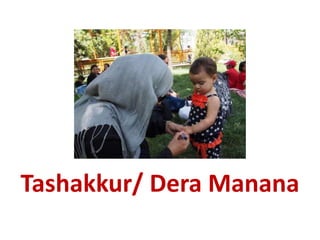
Tashakkur/ Dera Manana
Open for discussion

Neap 2016 2017 final_dr_safi

  • 1.
    Polio eradication in Afghanistan NEAP2016-2017 NEAP Workshop, Afghanistan 24 October 2016
  • 2.
    2 President REOCs National Polio Focal Point Presidentialfocal point Line Ministries Governors Minister of Public health NEOC All line department of MoPH Changes in program management
  • 3.
    NEAP 2016-17 • Goal: –To stop WPV transmission in Afghanistan by the end of December 2016, with no new wild poliovirus type 1 (WPV1) cases from January 2017 onwards • Strategic approach: – Maintain programme neutrality and gain access to all children with OPV, irrespective of the area where they reside – Implement alternate strategies, i.e. use Polio Plus interventions and the PTT, particularly in inaccessible areas – Focus on identified high-risk provinces and districts and areas where children are persistently missed – Underpin all strategies by ensuring strong household and community engagement; and – Enhance accountability of all stakeholders, at all levels
  • 4.
    Targets and milestones •5 SIAs in the second half of 2016 and 5 in the first half of 2017: – Reaching over 90% of children during each SIA – >90% LQAS lots accepted at 80% and <5% missed children in PCM • One IPV-OPV SIA in all VHRDs by end Sept 2016 • Revise microplans of all VHRDs by the end Sept 2016 • Operationalize full-time ICN in all VHRDs by the end Sep 16 • Maintain NPAFP rate of >2 cases/100 000 with adequate stool specimens collected from >80% of AFP cases in every district across the country • Implement the accountability framework: End August’16
  • 5.
    NEAP 2016-17 • Continuestrengthening polio governance and management structure: – EOC: Task team modality, weekly TCs – Expansion of M&A officer to all 47 districts – Provincial & district task force: Revise TOR – Implement accountability framework from August onwards • High risk approach: – Focus on 47 district and 5 high risk province – District profile and specific plans for all VHRDs after each SIA – Districts in between VHRDs treated as high risk – Revision in December 2016
  • 6.
    High risk areas Newterminology Revision in December 2016
  • 7.
    District profile and specificplan of action • Profiling done for all VHRDs • Specific issues identified and action plan developed • Updated after every campaign • Process supervised/ guided by regional/national level • Reviewed and tracked from national level District profile Updated 15-May-16 Fill in light blue cells District details Number # High risk population groups Y/N Pop size Pattern District name Shahwalikot 117,691 Nomads Yes 600 Mobile nomads (stays for 5 months- (Nov- Mar) Geo-code (DCODE) 3306 4,708 Migrant labourers, Ailaks No - LPD (1, 2) 1 23,538 IDPs No - Province Kandahar 52,961 Others (specify) No - Region South Number # Number # Epidemiology Number # 3 2 WPVs in 2015 1 1 2 WPVs in 2010-14 7 2 1 Compatibles in 2015 No 0 0 5 0 # Planned # Implemented 3 3 24 24 16 13 Number # 139 56/day # adeq # inadeq 5 0 10 6 28 9 3 5 0 Number # 0 2 0 Number # 72 % 1,320 23% 12 17% 165 19% o # 76 93 69 9 Round 1 Round 2 # No 108 13 0 Date District Polio Officers (DPOs) District Communication Officers (DCOs) # of districts same PPO covers # of districts same PCO covers M&A Officers Routine immunization services provided in district Number of Health Facilities providing RI services RI sessions per month (total incl. fixed/outrech) RI outreach sessions per month NameRoutine immunization BPHS NGO BARAN Cluster Supervisors SIA quality (trend) 7 5 6Intra-campaign Monitors (ICM) Post-campaign Assessment (PCA) Monitors 28 - Team workload (# of teams by work load category) LQAS result (March 2016. if conducted) N/A 2.3.5.7.8.9.10.11.12.13.14.15.16.19.20.22.23.24.25.26.27 2.3.5.7.8.9.10.11.12.13.14.15.16.19.20.22.23.24.25.26.27 Clusters with inaccessibility (list) Clusters with inaccessibility >6 months (list) Clusters under AGE influence (list) Clusters with limited supervision (list) - Refusal - Others Clusters with >5% missed children during last round (list) 2.3.4.9.10.11.13.15.17.20.21.23.27 SIA quality (last round) Reason for missed children (last round) - House not visited - Child not available Missed children (last 4 rounds) March-16 February-16 January-16 December-15 AGE influence 0 Four Picnic teans are functioning in Dalla Band during revisit day (Friday) Index case is resident of Maghdod village, Cluster # 7. Base on revised Micro plan and according to the old SIAs. Micro-plan the area was belong to Cluster # 26. Maghdod hamlet has only 8 households harboring 24 families, and Its population is scattered. This area is fully under control of AGEs, almost 2 months ago the Ambulance of the Shawalikot district was burned by unknown people, also AGEs of the area do not allow mobile health services and RI outreach activities. Implementation, Generally Majority of local people are farmers by occupation and very poor and have no basic facilities of life. Nutritious status and education level of the index case village is very poor. Illiteracy level is very high at the district level in general and at the index case area in particular. The main sources of drinking water are streams, hand pumps and shallow wells, Area sanitation is very poor, people use pit latrines and also have habit of open defecation AFG/08/16/141- 2016 WPV case: IPV campaigns conducted Start date % target PCA coverage % of clusters under AGE influence 75% % *Narrative description of WPV cases in 2015/16 Social mobilization # of ICN # of influencers No Special events (list incl. descption, timing/frequency) Special sites (list incl. description, location) Clusters with no ICN (list) Gatherings held with community elders/ shuras, mullah imams. Sports events held. Microplan analysis# 28 6725 Villages Teams 139 Clusters Schools Houses Vaccination Teams 400-600 children >600 children Total <5 teams 5-6 teams >6 teams Supervisors - Supervisor workload (# of supervisors by work load category) Team composition (# of teams by composition) 15/12/2015 Alternative vaccination strategies Permanent Polio Teams (PPT) Permanent Transit Teams (PTT) Cross-Border Teams (CBT) Microplan field validation Field validation of microplan completed at least 1 female none local one local both local at least 1 CHW Human resources Surveillance AFP cases in 2014-1016 Demography Total population <1 years <5 years <15 years Health Facilities (HFs) - Primary HFs - Secondary HFs - Tertiary HFs - Private Clinics Health services 3 Number # 3 1 1 1 Detailed narrative description below* Category Total <400 children Inaccessible children during SIAs (last 4 rounds) Access and security SIA Transit Teams Nomads Teams Communication Cluster Supervisors District Coordinators % 100% 1.1 HFs which are part of reporting network - High priority (HP) - Medium priority (MP) - Low priority (LP) Weekly reporting - Timeliness of weekly report AFP cases Children inaccessible for >6 months March-16 February-16 January-16 December-15 - AFP cases expected/year in 2016 - AFP cases with 0 dose (2014+2015) - AFP cases reported in 2016 - AFP cases reported in 2015 - AFP cases reported in 2014 Microplan 0 28 0 2 ( I each secondary and high) Number # 941
  • 8.
    Jan-SNID Feb-SNIDs Apr-SNIDsMar-NIDsMay-NIDs SIA Schedule for July’16 to June’17 July, VHRD Aug , NID Oct, NID Dec, SNIDNov, SNID Q3-Q4, 2016 Q1-Q2, 2017
  • 9.
    IPV: SIAs • CompletingIPV SIAs in 9 districts of Kandahar (Sep/Oct) Category VHR, no IPV in 2015-16 Areas inaccessible for >6 months Districts Behsud, Jalalabad, Qaysar, Jaranj, Dehrawood, Trinkot, Qalat, Bermel, Laskargah, Musaqala, Nade Ali, Nahre Saraj, Kandahar, Kabul Pachieragam, Kot, Achin, Mehtarlam, Alingar, Watapur, Marawara, Dara-e-Pech, Chapadara, Nari, Kunduz, Emamsaheb, Qala-e-Zal, Chardarah, Aliabad, Khanabad, Dasht-e-Archi, Kamdesh, Chora, Nad-e-Ali, Zheray, Shahwalikot, Maywand, Reg, Shorabak, Gardez, Pasaband Target population 808,859 247,304 Doses required 970,631 296,765 Time period Q1 2017 As soon as access is gained
  • 10.
  • 11.
    Enhancing campaign quality •Complete in remaining 10 VHRD by end of Q3 2016, 49 HRD by Q4 2017 and repeat in 47 VHRD in Q1 2017 Revision of micro-plans • Local, female and able to read/write, selected on merit (AGE or Government controlled areas) Improving team selection • Monitoring of training in VHRD; NEOC to track attendance and quality Improving the quality of training • Tracking performance of vaccinators and supervisor of VHRD over the rounds • Reward/sanction as per accountability framework Monitoring and performance management • Payment within 30 days of end of campaign; tracking from National EOC. Phase wise expansion of DDM Ensuring timely payment of FLW
  • 12.
    Enhancing campaign quality •Identification, training and deployment of national/ regional level monitors for pre/intra/post-campaign phase National monitors • Rationalized workload, monitoring by DC, tracking performance over rounds Improving performance of cluster supervisors • Continue and strengthenRevisit strategy • pre-campaign dashboard (review on 10/7/3/1 days before campaign • Corrective actions as needed Pre-campaign • VHR districts: 1 ICM for every 5 supervisors, real time data collection using IVR technology • ICM data use, intra-campaign dashboards Intra-campaign
  • 13.
    Improved campaign monitoring •PCM: 100% of clusters in VHRD and 50% in others • Expansion of all VHRD and HRD as feasible Expanded scope • Monitoring of PCM monitors (5% sample cross checking) • 10% surveyors and completed forms to be cross checked Ensuring quality • Availability of data within 10 days of end of campaign • Use of mobile technology for real time data flow Data flow • Detail field investigation and plan for corrective action for areas with failed LQAS lots and PCM with >3 missed children in one team area Corrective action
  • 14.
    Field investigation ofareas with poor performance • Detail investigation of each failed lot in LQAS and PCA with >3 missed children • Identification of core issue and action plan for improvement • Done by joint team from provincial level • Review and tracking from national level Detailed Investigation Form for failed lots in LQAS (failed at 80%) and/or >3 missed children in PCA Instructions Date of detailedinvestigation Dr. Tahsil PEI and Dr.Matiullah PPO WHO 0 UNICEF 0 MoPH Yes Yes, dot mark is there ( S/Mworkingthree days before and duringcampaign) weak revisit , Weak supervision of DC and C/S. Plannedinterventions toimprove performance fornextcampaign Selection of eligible volunteers, Focused on FLWtraining, updatingitinerary, increased S/Mactivities forconvince of family, focussed on dialy and 5th day revisit. supportive supervision and monitoringaccordingto the plan. Selection of new volunteers and supervisor, non eligible volunteers, hurriedly working, weak record of missed children, weak follow up of missed children, No commitment of C/S , Volunteers and S/M. Child2:Reasonof missedchild(as percaregiver) Child was not at home Child3:Reasonof missedchild(as percaregiver) Child as vaccinated but no fingermarked Child4:Reasonof missedchild(as percaregiver) Child5:Reasonof missedchild(as percaregiver) Child6:Reasonof missedchild(as percaregiver) Core issues identifiedforpoorperformance Has the mobilizer(if present) beenpaidforthe lastcampaign? Is there evidence of social mobilizationactivities inthe area? Please elaborate. Commentonawareness andacceptance of poliovaccine by communityas well as bycaregivers of missedchild;if householdwas refusing, please explainwhy. Yes Child1:Reasonof missedchild(as percaregiver) Child was not at home Revisits (qualityof revisits duringandpost-campaign) Workingnot well Qualityof supervision(was the areavisitedbysupervisor, ICMetc duringthe campaign?) Yes Have vaccinators andsupervisorbeenpaidforlastcampaign? No Teamcomposition(commentonwhetherteammembers are local, has atleastone female etc.) Local and Female Training(commentonknowledge of team, whetherbothmembers were trainedinlasttraining) Yes Teamworkload(commentonworkloadi.e. numberof childrentobe covered, geographical challenges, etc.) 178/ day ( G1area) Team# T5 Is the areaincludedinmicroplan Yes Was the area/houses visitedbyteam. If no, give reasons why. Yes Village Rahmatulul alamin Name of area Tortank Name of ClusterSupervisor Sadiqa Province Helmand District Bost Cluster 29 Component Inputs/Comments Dates of campaign April, SNIDs 2016 Region Southren Members of investigationteam 1- Detailed field investigation to beconducted for all lots failed in LQAS (rejected at80%) and/or >3missed children in PCAin a subcluster(village) . 2- Investigation to beconducted within oneweek afteravailability of results. 3- Team fordetailed investigation to consists of WHO, UNICEF, and MoPH (whereapplicable). 4- Team to look into the reasons forchildren missed by visiting thehouseholds with missed children. 5- Investigation team to review composition, work load, and training status of concerned vaccination teams and also look into quality of supervision and microplanning.
  • 15.
    Campaign review meetings Precampaign • National, regional and provincial levels • 2-4 weeks prior to campaign • Dashboard • At EOC10/7/3/1 day before campaign Intra campaign • National, regional, provincial and district levels • Standard matrix for documentation • Dashboard • Core committee at National level for response Post campaign • National, regional, provincial and district levels • 15 days after the end of each campaign • Dashboard • Representation from the National EOC in 5 HR provinces
  • 16.
    Data flow Data SourceTimeline Pre-campaign 1 Preparation of campaign EOC/PEMT 2 weeks, 1 week, daily in last week 2 Coordination meeting EOC/PEMT 10 days before SIA Intra-campaign 3 Administrative coverage EOC/PEMT Next day afternoon 4 ICM EOC/PEMT Next day afternoon 5 Evening meeting EOC/PEMT Next day afternoon Post-campaign 6 Administrative coverage EOC/PEMT 10 days after SIA 7 PCM WHO 10 days after SIA 8 LQAS WHO 10 days after SIA 9 Out of house survey WHO 10 days after SIA 10 Compiled ICM data EOC/PEMT 10 days after SIA 11 Access data EOC/PEMT 10 days after SIA
  • 17.
  • 18.
    Accessibility status duringrecent SIA Cat 1: Fully accessible Cat 2: Partially accessible Cat 3: Accessible with security challenges Cat 4: Fully inaccessible May NID July SNID
  • 19.
    Addressing inaccessibility IPV andOPV from nearby health facility Polio plus from nearby health facility PTT at entry / exit points 3 rounds of SIADs (1 IPV) in newly accessible Cluster & village level mapping Negotiations & community engagement Areas inaccessible for vaccination Areas with limited access Negotiations on quality of campaign & independence for monitoring Remote monitoring Use of neutral third party Forum for providing feedback
  • 20.
    Complementary vaccination activities •Assess and modify the number and location as per need of the programme and evolving accessibility situation • Strengthen supervision and monitoring with close tracking from National EOC PTT and CBT • Review the performance of the existing PPTs and modify as requiredPPT • Special vaccination campaign for NomadsNomads • Coordination with OCHA/UNHCR/IOM through a task team • Vaccination at UNHCR and IOM sites • OPV & IPV Returnee refugees
  • 21.
    Demand generation • Communicationplan as part of district specific plan • Full-time ICN operational in all VHR districts Household and community engagement • Mapping & engagement of key religious leaders at local level building on NIUG platform • Workshops with doctors, health workers & other key stakeholders Partnerships with key influencers • Regular media briefings & trainings and interactions • Development of awareness raising materials for print & electronic media platforms External relations and partnerships • Implement 2nd Harvard poll • Third party monitoring of communication interventions in VHR districts Data collection and evidence generation
  • 22.
    Monthly workflow ofa full time social mobiliser Campaign Week Week.+1 Catching up missed children from campaign Week.+/-2 Community engagement Polio+ Week.-1 Pre-Campaign preparation; Registry; Awareness; Shift to sustained engagement  Focus on reducing missed children  Use of registers for child registration, follow up and vaccination of missed children after campaign by ICN Network  Tracking chronically missed children  Promoting a broader package including routine immunization referral, hygiene and sanitation and ANC in between campaigns
  • 23.
  • 24.
    Surveillance • Expansion toinclude newly opening health facilities • Strengthen sensitization visits and monthly tele calls Reporting network • Review the existing ES sites • Explore possible expansion to the areas surveyed in 2015 Environmental surveillance • Alternate mode/route of specimen shipment to RRL as a contingency Specimen shipment • Disaggregate data analysis by district and access status to identify gaps and corrective actionData analysis
  • 25.
    Cross border coordination •Weekly communication between the focal points; biannual face to face meetings and regular VCs • Monthly meetings of concerned provincial teams • Joint case response for cases at the borders
  • 26.
    Evaluation • NEAP progressreview in Jan and June 2017 Operational • Surveillance review in June 2017 Surveillance • In Kandahar in Q1 2017Serosurvey • OPV doses in NPAFP cases Population immunity
  • 27.
    RI strengthening • 20%time on RI • Training of program staff of RI • Monitoring of sessions • Support in training of FHWs • Feedback on monitoring to BPHS NGOs Operations • Inclusion of RI in the message at key stakeholders meetings • Missed children tracking by ICN • Tracking of newborn and mobilization of parents for RI Mobilization Focus of intervention in VHRDs
  • 28.
  • 29.

Editor's Notes

  • #3 There is direct oversight on the PEI from the offices of H.E the President and H.E the CEO. “ Just yesterday, polio was the main point of the agenda of cabinet meeting” We have office of Presidential focal point for polio eradication providing support through line ministries and governors. In the ministry of public health, I have the responsibility to engage all line departments of MoPH including BPHS implementers in Polio Program