
Globalizing the policy process
Najibullah Safi, MD, MSc. HPM
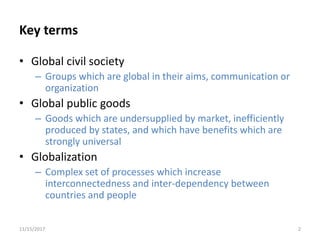
Key terms
• Global civil society
– Groups which are global in their aims, communication or
organization
• Global public goods
– Goods which are undersupplied by market, inefficiently
produced by states, and which have benefits which are
strongly universal
• Globalization
– Complex set of processes which increase
interconnectedness and inter-dependency between
countries and people
11/15/2017 2
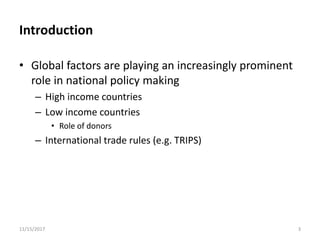
Introduction
• Global factors are playing an increasingly prominent
role in national policy making
– High income countries
– Low income countries
• Role of donors
– International trade rules (e.g. TRIPS)
11/15/2017 3
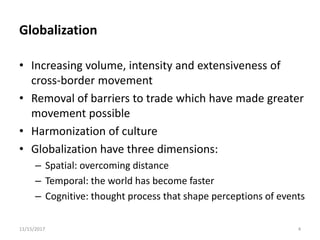
Globalization
• Increasing volume, intensity and extensiveness of
cross-border movement
• Removal of barriers to trade which have made greater
movement possible
• Harmonization of culture
• Globalization have three dimensions:
– Spatial: overcoming distance
– Temporal: the world has become faster
– Cognitive: thought process that shape perceptions of events
11/15/2017 4
Globalization cont.
• Different meanings of globalization
– Internationalization
– Liberalization
– Universalization (e.g. harmonization of culture)
– McDonaldization
– Super-territoriality
11/15/2017 5
Globalization and health
• Health is on the global policy agenda
• Achievements in health are critical to SDGs
• Domestic action alone - no longer sufficient
• New context (rules, actors, markets, tools)
requires new responses
Globalization and health cont.
• The impact of globalization on health is more evident
– Infectious diseases
• SARS 2003
• Polio 2003-04
• Ebola 2015-16
– Production, distribution and marketing of foods
– Effects of globalization on behavior
– The ability of health system to effectively respond to
threats e.g. brain drain
11/15/2017 7
Traditional inter-state cooperation for health
• International Health regulation (1969 – 2005)
• Formal arrangement for cooperation
– The United Nations
• WHO 1948 (192 members, 193 NGOs in official relations)
– Providing leadership on matters critical to health and
engaging in partnerships where joint action is needed
– Shaping the research agenda and stimulating the
generation, translation and dissemination of valuable
knowledge
11/15/2017 8
Traditional inter-state cooperation for health
cont.
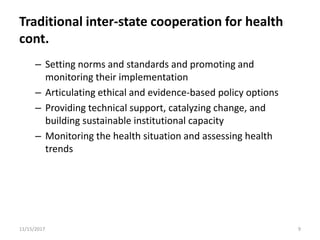
– Setting norms and standards and promoting and
monitoring their implementation
– Articulating ethical and evidence-based policy options
– Providing technical support, catalyzing change, and
building sustainable institutional capacity
– Monitoring the health situation and assessing health
trends
11/15/2017 9
Traditional inter-state cooperation for health
cont.
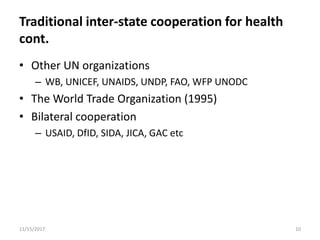
• Other UN organizations
– WB, UNICEF, UNAIDS, UNDP, FAO, WFP UNODC
• The World Trade Organization (1995)
• Bilateral cooperation
– USAID, DfID, SIDA, JICA, GAC etc
11/15/2017 10
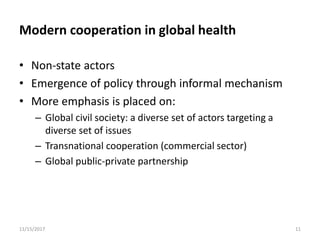
Modern cooperation in global health
• Non-state actors
• Emergence of policy through informal mechanism
• More emphasis is placed on:
– Global civil society: a diverse set of actors targeting a
diverse set of issues
– Transnational cooperation (commercial sector)
– Global public-private partnership
11/15/2017 11
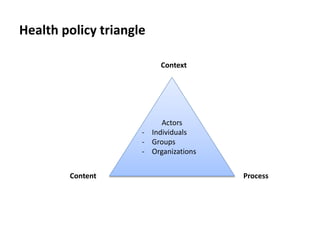
Health policy triangle
Context
ProcessContent
Actors
- Individuals
- Groups
- Organizations
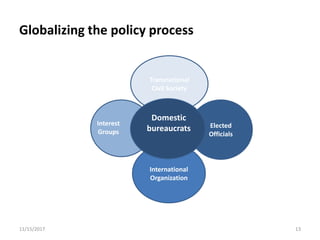
Globalizing the policy process
11/15/2017 13
Elected
Officials
Interest
Groups
International
Organization
Transnational
Civil Society
Domestic
bureaucrats
Thanks
11/15/2017 14

Globalizing the policy process

  • 1.
    Globalizing the policyprocess Najibullah Safi, MD, MSc. HPM
  • 2.
    Key terms • Globalcivil society – Groups which are global in their aims, communication or organization • Global public goods – Goods which are undersupplied by market, inefficiently produced by states, and which have benefits which are strongly universal • Globalization – Complex set of processes which increase interconnectedness and inter-dependency between countries and people 11/15/2017 2
  • 3.
    Introduction • Global factorsare playing an increasingly prominent role in national policy making – High income countries – Low income countries • Role of donors – International trade rules (e.g. TRIPS) 11/15/2017 3
  • 4.
    Globalization • Increasing volume,intensity and extensiveness of cross-border movement • Removal of barriers to trade which have made greater movement possible • Harmonization of culture • Globalization have three dimensions: – Spatial: overcoming distance – Temporal: the world has become faster – Cognitive: thought process that shape perceptions of events 11/15/2017 4
  • 5.
    Globalization cont. • Differentmeanings of globalization – Internationalization – Liberalization – Universalization (e.g. harmonization of culture) – McDonaldization – Super-territoriality 11/15/2017 5
  • 6.
    Globalization and health •Health is on the global policy agenda • Achievements in health are critical to SDGs • Domestic action alone - no longer sufficient • New context (rules, actors, markets, tools) requires new responses
  • 7.
    Globalization and healthcont. • The impact of globalization on health is more evident – Infectious diseases • SARS 2003 • Polio 2003-04 • Ebola 2015-16 – Production, distribution and marketing of foods – Effects of globalization on behavior – The ability of health system to effectively respond to threats e.g. brain drain 11/15/2017 7
  • 8.
    Traditional inter-state cooperationfor health • International Health regulation (1969 – 2005) • Formal arrangement for cooperation – The United Nations • WHO 1948 (192 members, 193 NGOs in official relations) – Providing leadership on matters critical to health and engaging in partnerships where joint action is needed – Shaping the research agenda and stimulating the generation, translation and dissemination of valuable knowledge 11/15/2017 8
  • 9.
    Traditional inter-state cooperationfor health cont. – Setting norms and standards and promoting and monitoring their implementation – Articulating ethical and evidence-based policy options – Providing technical support, catalyzing change, and building sustainable institutional capacity – Monitoring the health situation and assessing health trends 11/15/2017 9
  • 10.
    Traditional inter-state cooperationfor health cont. • Other UN organizations – WB, UNICEF, UNAIDS, UNDP, FAO, WFP UNODC • The World Trade Organization (1995) • Bilateral cooperation – USAID, DfID, SIDA, JICA, GAC etc 11/15/2017 10
  • 11.
    Modern cooperation inglobal health • Non-state actors • Emergence of policy through informal mechanism • More emphasis is placed on: – Global civil society: a diverse set of actors targeting a diverse set of issues – Transnational cooperation (commercial sector) – Global public-private partnership 11/15/2017 11
  • 12.
    Health policy triangle Context ProcessContent Actors -Individuals - Groups - Organizations
  • 13.
    Globalizing the policyprocess 11/15/2017 13 Elected Officials Interest Groups International Organization Transnational Civil Society Domestic bureaucrats
  • 14.