IMPLEMENTATION STATUS OF THE NATIONAL
EMERGENCY ACTION PLAN (NEAP) 2015-16
Afghanistan TAG
Kabul, 12 July 2016
Dr. Maiwand Ahmadzai
2
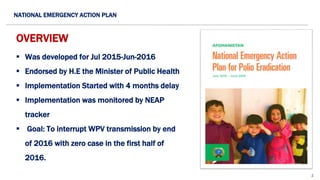
 Was developed for Jul 2015-Jun-2016
 Endorsed by H.E the Minister of Public Health
 Implementation Started with 4 months delay
 Implementation was monitored by NEAP
tracker
 Goal: To interrupt WPV transmission by end
of 2016 with zero case in the first half of
2016.
NATIONAL EMERGENCY ACTION PLAN
OVERVIEW
3
GOVERNANCE AND COORDINATION
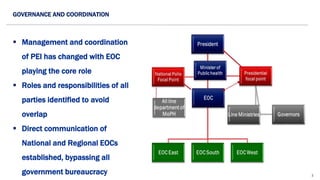
 Management and coordination
of PEI has changed with EOC
playing the core role
 Roles and responsibilities of all
parties identified to avoid
overlap
 Direct communication of
National and Regional EOCs
established, bypassing all
government bureaucracy
4
FOCUS ON HIGH RISK AREAS
5
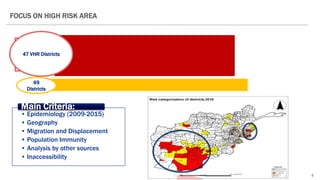
FOCUS ON HIGH RISK AREA
19
Districts
28
Districts
49
Districts
• Epidemiology (2009-2015)
• Geography
• Migration and Displacement
• Population Immunity
• Analysis by other sources
• Inaccessibility
Main Criteria:
47 VHR Districts
6
FOCUS ON HIGH RISK AREA
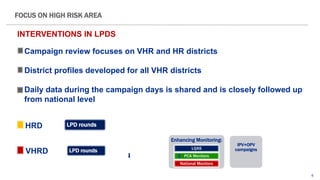
LPD rounds
IPV+OPV
campaigns
HRD
LPD rounds
Enhancing Monitoring:
LQAS
PCA Monitors
National Monitors
VHRD
Campaign review focuses on VHR and HR districts
District profiles developed for all VHR districts
Daily data during the campaign days is shared and is closely followed up
from national level
INTERVENTIONS IN LPDS
7
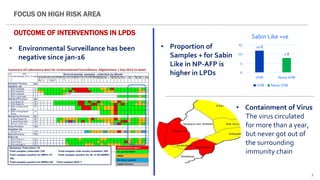
OUTCOME OF INTERVENTIONS IN LPDS
• Environmental Surveillance has been
negative since jan-16
11.8
7.8
0
5
10
15
VHR None VHR
Sabin Like +ve
VHR None VHR
• Proportion of
Samples + for Sabin
Like in NP-AFP is
higher in LPDs
• Containment of Virus
The virus circulated
for more than a year,
but never got out of
the surrounding
immunity chain
FOCUS ON HIGH RISK AREA
8
KEY STRATEGIES
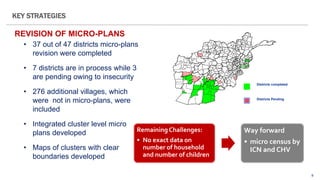
• 37 out of 47 districts micro-plans
revision were completed
• 7 districts are in process while 3
are pending owing to insecurity
• 276 additional villages, which
were not in micro-plans, were
included
• Integrated cluster level micro
plans developed
• Maps of clusters with clear
boundaries developed
Districts completed
Districts Pending
RemainingChallenges:
• No exact data on
number of household
and number of children
Way forward
• micro census by
ICN and CHV
REVISION OF MICRO-PLANS
9
IMPROVING SIAS QUALITY
10
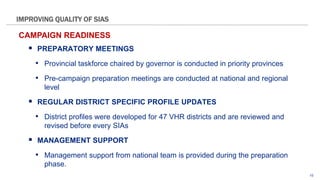
 PREPARATORY MEETINGS
• Provincial taskforce chaired by governor is conducted in priority provinces
• Pre-campaign preparation meetings are conducted at national and regional
level
 REGULAR DISTRICT SPECIFIC PROFILE UPDATES
• District profiles were developed for 47 VHR districts and are reviewed and
revised before every SIAs
 MANAGEMENT SUPPORT
• Management support from national team is provided during the preparation
phase.
IMPROVING QUALITY OF SIAS
CAMPAIGN READINESS
11
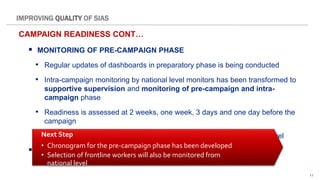
 MONITORING OF PRE-CAMPAIGN PHASE
• Regular updates of dashboards in preparatory phase is being conducted
• Intra-campaign monitoring by national level monitors has been transformed to
supportive supervision and monitoring of pre-campaign and intra-
campaign phase
• Readiness is assessed at 2 weeks, one week, 3 days and one day before the
campaign
• Joint monitoring planning process is in place at national and regional level
 EOC CORE RESPONSE TEAM TAKES CORRECTIVE ACTIONS
CAMPAIGN READINESS CONT…
Next Step
• Chronogram for the pre-campaign phase has been developed
• Selection of frontline workers will also be monitored from
national level
IMPROVING QUALITY OF SIAS
12
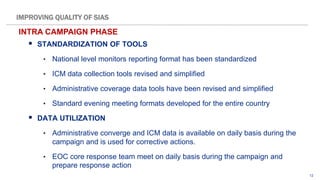
 STANDARDIZATION OF TOOLS
• National level monitors reporting format has been standardized
• ICM data collection tools revised and simplified
• Administrative coverage data tools have been revised and simplified
• Standard evening meeting formats developed for the entire country
 DATA UTILIZATION
• Administrative converge and ICM data is available on daily basis during the
campaign and is used for corrective actions.
• EOC core response team meet on daily basis during the campaign and
prepare response action
INTRA CAMPAIGN PHASE
IMPROVING QUALITY OF SIAS
13
 MONITORING
• National level monitors are sent to the area of highest risk aiming
supportive supervision and monitoring
• Joint monitoring plan at regional level is developed to ensure all the
highest risk areas are covered
• BPHS NGOs are involved in monitoring of SIAs.
 REVISIT STRATEGY:
• Revisit strategy was revised and expanded to the entire country
• School students engagement in monitoring and follow up of missed children
has been developed to maximize the impact of revisit strategy.
INTRA CAMPAIGN PHASE Cont..
IMPROVING QUALITY OF SIAS
14
 DATA FOR ACTION
• Post Campaign Assessment data (PCM, LQAS and Out of House FM
Survey) is available within two weeks of campaign
• LQAS has been expanded to all LPD 1 and 2
• PCM is now covering 100% clusters in LPD 1 and 2 (VHR)
 MAXIMIZING QUALITY OF DATA (Pre, intra and post campaign)
• Deployment of M&A officers in 47 VHR districts
• Efforts are underway for remote monitoring using mobile technology
• 10% of PCM is cross-checked in some areas but not everywhere
POST CAMPAIGN PHASE
IMPROVING QUALITY OF SIAS
15
 ASSESSMENT OF CAMPAIGN QUALITY
• Post-Campaign review and assessment take place at national and
regional level.
• All failed LQAS are investigated
• Recommendation of review are followed up in the next round
POST CAMPAIGN PHASE
IMPROVING QUALITY OF SIAS
16
0%
10%
20%
30%
40%
50%
60%
70%
80%
90%
100%
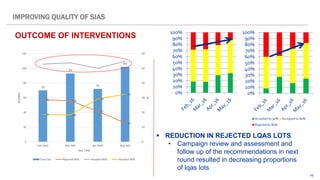
 REDUCTION IN REJECTED LQAS LOTS
• Campaign review and assessment and
follow up of the recommendations in next
round resulted in decreasing proportions
of lqas lots
0%
10%
20%
30%
40%
50%
60%
70%
80%
90%
100%
Accepted to 90% Accepted to 80%
Rejected to 80%
70
93
72
102
29 28
21
13
19 18
29
32
0
10
20
30
40
50
60
0
20
40
60
80
100
120
Feb SNID Mar NID Apr SNID May NID
%
Number
Axis Title
Total lots Rejected 80% Acepted 80% Acepted 90%
IMPROVING QUALITY OF SIAS
OUTCOME OF INTERVENTIONS
17
 Concerns regarding quality of data
• Independency of data cannot be ensured in some of the areas
• Data quality in area with limited monitoring (category 3) is of
concerns
• LQAS cannot be conducted everywhere
 Action for timely improvement
• Failed lots though improved in the next round, but on time
corrective action for the same round is not universal.
• More closer look at implementation of campaign review
recommendation in terms of selection is required
POST CAMPAIGN PHASE (CHALLENGES)
IMPROVING QUALITY OF SIAS
18
POST CAMPAIGN PHASE (PLANS AHEAD)
ALL FAILED LQAS
SHOULD BE
RECOVERED IN
THE SAME ROUND
IMPROVING QUALITY OF SIAS
19
ADRESSING INACCESSIBILITY
20
• GAINING ACCESS
• 2015-16 was one of the most challenging years for polio program in terms of
getting access
• Negotiations at different level overcame inaccessibility, but situation is dynamic
• POLIO PLUS
• To encourage families to health facilities in area where H2H vaccination is not
possible.
• Hygiene kits have been sent to Kunar province for distribution
• Mobile service are planned in Kandahar
ADRESSING INACCESSIBILITY
21
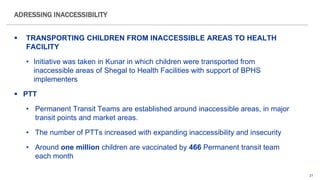
 TRANSPORTING CHILDREN FROM INACCESSIBLE AREAS TO HEALTH
FACILITY
• Initiative was taken in Kunar in which children were transported from
inaccessible areas of Shegal to Health Facilities with support of BPHS
implementers
 PTT
• Permanent Transit Teams are established around inaccessible areas, in major
transit points and market areas.
• The number of PTTs increased with expanding inaccessibility and insecurity
• Around one million children are vaccinated by 466 Permanent transit team
each month
ADRESSING INACCESSIBILITY
22
MAXIMIZING IMPACT OF FRONT LINE WORKERS
23
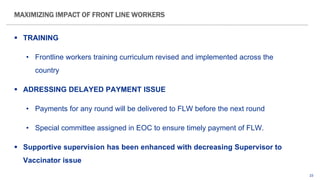
 TRAINING
• Frontline workers training curriculum revised and implemented across the
country
 ADRESSING DELAYED PAYMENT ISSUE
• Payments for any round will be delivered to FLW before the next round
• Special committee assigned in EOC to ensure timely payment of FLW.
 Supportive supervision has been enhanced with decreasing Supervisor to
Vaccinator issue
MAXIMIZING IMPACT OF FRONT LINE WORKERS
24
CROSS BORDER COORDINATION WITH PAKISTAN
25
 MEETINGS
• Regular Meeting between national and regional/provincial teams of both
countries
• DATA SHARING
• Focal points of both countries have weekly call
• Data related to confirmed and inadequate cases are shard regularly
• Cross notification of AFP cases conducted on timely basis
• Coverage data and SIAs performance in bordering districts is being shared
• Recording tools revised as per the IHR recommendation, assessing
coverage on the other side of border, and shared with Pakistan.
CROSS BORDER COORDINATION WITH PAKISTAN
26
CROSS BORDER COORDINATION WITH PAKISTAN
 SYNCHRONIZATION OF SIAS
• SIAs dates are synchronized (same day SIAs)
• Any unforeseen change in the date of SIAs is shared in advance of the
implementation.
• Cases response plan along with list of district included shared for each case
to ensure a synchronized case response in bordering districts.
 DETAILED INVESTIGATIONS OF ALL CONFIRMED CASES ARE SHARED
 REACHING POPULATION ON THE MOVE BTW BOTH COUNTRIES
• Target age group has been harmonized to less than 10 in all CB points
27
SUPPORTING STRATEGIES
28
SUPPORTING STRATIGIES
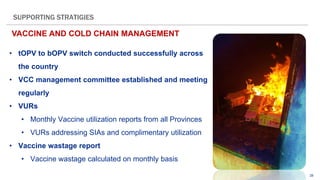
• tOPV to bOPV switch conducted successfully across
the country
• VCC management committee established and meeting
regularly
• VURs
• Monthly Vaccine utilization reports from all Provinces
• VURs addressing SIAs and complimentary utilization
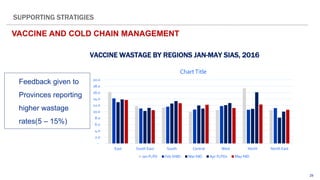
• Vaccine wastage report
• Vaccine wastage calculated on monthly basis
VACCINE AND COLD CHAIN MANAGEMENT
29
SUPPORTING STRATIGIES
VACCINE AND COLD CHAIN MANAGEMENT
-
2.0
4.0
6.0
8.0
10.0
12.0
14.0
16.0
18.0
20.0
East South East South Central West North North East
ChartTitle
Jan FLPD Feb SNID Mar NID Apr FLPDs May NID
VACCINE WASTAGE BY REGIONS JAN-MAY SIAS, 2016
Feedback given to
Provinces reporting
higher wastage
rates(5 – 15%)
30
SUPPORTING STRATIGIES
COMMUNNICATION
AFP SURVILLANCE
WILL BE COVERED IN
COMING PRESENTATIONS
31
THANK YOU

3 neap presentation for tag july 2016

  • 1.
    IMPLEMENTATION STATUS OFTHE NATIONAL EMERGENCY ACTION PLAN (NEAP) 2015-16 Afghanistan TAG Kabul, 12 July 2016 Dr. Maiwand Ahmadzai
  • 2.
    2  Was developedfor Jul 2015-Jun-2016  Endorsed by H.E the Minister of Public Health  Implementation Started with 4 months delay  Implementation was monitored by NEAP tracker  Goal: To interrupt WPV transmission by end of 2016 with zero case in the first half of 2016. NATIONAL EMERGENCY ACTION PLAN OVERVIEW
  • 3.
    3 GOVERNANCE AND COORDINATION Management and coordination of PEI has changed with EOC playing the core role  Roles and responsibilities of all parties identified to avoid overlap  Direct communication of National and Regional EOCs established, bypassing all government bureaucracy
  • 4.
    4 FOCUS ON HIGHRISK AREAS
  • 5.
    5 FOCUS ON HIGHRISK AREA 19 Districts 28 Districts 49 Districts • Epidemiology (2009-2015) • Geography • Migration and Displacement • Population Immunity • Analysis by other sources • Inaccessibility Main Criteria: 47 VHR Districts
  • 6.
    6 FOCUS ON HIGHRISK AREA LPD rounds IPV+OPV campaigns HRD LPD rounds Enhancing Monitoring: LQAS PCA Monitors National Monitors VHRD Campaign review focuses on VHR and HR districts District profiles developed for all VHR districts Daily data during the campaign days is shared and is closely followed up from national level INTERVENTIONS IN LPDS
  • 7.
    7 OUTCOME OF INTERVENTIONSIN LPDS • Environmental Surveillance has been negative since jan-16 11.8 7.8 0 5 10 15 VHR None VHR Sabin Like +ve VHR None VHR • Proportion of Samples + for Sabin Like in NP-AFP is higher in LPDs • Containment of Virus The virus circulated for more than a year, but never got out of the surrounding immunity chain FOCUS ON HIGH RISK AREA
  • 8.
    8 KEY STRATEGIES • 37out of 47 districts micro-plans revision were completed • 7 districts are in process while 3 are pending owing to insecurity • 276 additional villages, which were not in micro-plans, were included • Integrated cluster level micro plans developed • Maps of clusters with clear boundaries developed Districts completed Districts Pending RemainingChallenges: • No exact data on number of household and number of children Way forward • micro census by ICN and CHV REVISION OF MICRO-PLANS
  • 9.
  • 10.
    10  PREPARATORY MEETINGS •Provincial taskforce chaired by governor is conducted in priority provinces • Pre-campaign preparation meetings are conducted at national and regional level  REGULAR DISTRICT SPECIFIC PROFILE UPDATES • District profiles were developed for 47 VHR districts and are reviewed and revised before every SIAs  MANAGEMENT SUPPORT • Management support from national team is provided during the preparation phase. IMPROVING QUALITY OF SIAS CAMPAIGN READINESS
  • 11.
    11  MONITORING OFPRE-CAMPAIGN PHASE • Regular updates of dashboards in preparatory phase is being conducted • Intra-campaign monitoring by national level monitors has been transformed to supportive supervision and monitoring of pre-campaign and intra- campaign phase • Readiness is assessed at 2 weeks, one week, 3 days and one day before the campaign • Joint monitoring planning process is in place at national and regional level  EOC CORE RESPONSE TEAM TAKES CORRECTIVE ACTIONS CAMPAIGN READINESS CONT… Next Step • Chronogram for the pre-campaign phase has been developed • Selection of frontline workers will also be monitored from national level IMPROVING QUALITY OF SIAS
  • 12.
    12  STANDARDIZATION OFTOOLS • National level monitors reporting format has been standardized • ICM data collection tools revised and simplified • Administrative coverage data tools have been revised and simplified • Standard evening meeting formats developed for the entire country  DATA UTILIZATION • Administrative converge and ICM data is available on daily basis during the campaign and is used for corrective actions. • EOC core response team meet on daily basis during the campaign and prepare response action INTRA CAMPAIGN PHASE IMPROVING QUALITY OF SIAS
  • 13.
    13  MONITORING • Nationallevel monitors are sent to the area of highest risk aiming supportive supervision and monitoring • Joint monitoring plan at regional level is developed to ensure all the highest risk areas are covered • BPHS NGOs are involved in monitoring of SIAs.  REVISIT STRATEGY: • Revisit strategy was revised and expanded to the entire country • School students engagement in monitoring and follow up of missed children has been developed to maximize the impact of revisit strategy. INTRA CAMPAIGN PHASE Cont.. IMPROVING QUALITY OF SIAS
  • 14.
    14  DATA FORACTION • Post Campaign Assessment data (PCM, LQAS and Out of House FM Survey) is available within two weeks of campaign • LQAS has been expanded to all LPD 1 and 2 • PCM is now covering 100% clusters in LPD 1 and 2 (VHR)  MAXIMIZING QUALITY OF DATA (Pre, intra and post campaign) • Deployment of M&A officers in 47 VHR districts • Efforts are underway for remote monitoring using mobile technology • 10% of PCM is cross-checked in some areas but not everywhere POST CAMPAIGN PHASE IMPROVING QUALITY OF SIAS
  • 15.
    15  ASSESSMENT OFCAMPAIGN QUALITY • Post-Campaign review and assessment take place at national and regional level. • All failed LQAS are investigated • Recommendation of review are followed up in the next round POST CAMPAIGN PHASE IMPROVING QUALITY OF SIAS
  • 16.
    16 0% 10% 20% 30% 40% 50% 60% 70% 80% 90% 100%  REDUCTION INREJECTED LQAS LOTS • Campaign review and assessment and follow up of the recommendations in next round resulted in decreasing proportions of lqas lots 0% 10% 20% 30% 40% 50% 60% 70% 80% 90% 100% Accepted to 90% Accepted to 80% Rejected to 80% 70 93 72 102 29 28 21 13 19 18 29 32 0 10 20 30 40 50 60 0 20 40 60 80 100 120 Feb SNID Mar NID Apr SNID May NID % Number Axis Title Total lots Rejected 80% Acepted 80% Acepted 90% IMPROVING QUALITY OF SIAS OUTCOME OF INTERVENTIONS
  • 17.
    17  Concerns regardingquality of data • Independency of data cannot be ensured in some of the areas • Data quality in area with limited monitoring (category 3) is of concerns • LQAS cannot be conducted everywhere  Action for timely improvement • Failed lots though improved in the next round, but on time corrective action for the same round is not universal. • More closer look at implementation of campaign review recommendation in terms of selection is required POST CAMPAIGN PHASE (CHALLENGES) IMPROVING QUALITY OF SIAS
  • 18.
    18 POST CAMPAIGN PHASE(PLANS AHEAD) ALL FAILED LQAS SHOULD BE RECOVERED IN THE SAME ROUND IMPROVING QUALITY OF SIAS
  • 19.
  • 20.
    20 • GAINING ACCESS •2015-16 was one of the most challenging years for polio program in terms of getting access • Negotiations at different level overcame inaccessibility, but situation is dynamic • POLIO PLUS • To encourage families to health facilities in area where H2H vaccination is not possible. • Hygiene kits have been sent to Kunar province for distribution • Mobile service are planned in Kandahar ADRESSING INACCESSIBILITY
  • 21.
    21  TRANSPORTING CHILDRENFROM INACCESSIBLE AREAS TO HEALTH FACILITY • Initiative was taken in Kunar in which children were transported from inaccessible areas of Shegal to Health Facilities with support of BPHS implementers  PTT • Permanent Transit Teams are established around inaccessible areas, in major transit points and market areas. • The number of PTTs increased with expanding inaccessibility and insecurity • Around one million children are vaccinated by 466 Permanent transit team each month ADRESSING INACCESSIBILITY
  • 22.
    22 MAXIMIZING IMPACT OFFRONT LINE WORKERS
  • 23.
    23  TRAINING • Frontlineworkers training curriculum revised and implemented across the country  ADRESSING DELAYED PAYMENT ISSUE • Payments for any round will be delivered to FLW before the next round • Special committee assigned in EOC to ensure timely payment of FLW.  Supportive supervision has been enhanced with decreasing Supervisor to Vaccinator issue MAXIMIZING IMPACT OF FRONT LINE WORKERS
  • 24.
  • 25.
    25  MEETINGS • RegularMeeting between national and regional/provincial teams of both countries • DATA SHARING • Focal points of both countries have weekly call • Data related to confirmed and inadequate cases are shard regularly • Cross notification of AFP cases conducted on timely basis • Coverage data and SIAs performance in bordering districts is being shared • Recording tools revised as per the IHR recommendation, assessing coverage on the other side of border, and shared with Pakistan. CROSS BORDER COORDINATION WITH PAKISTAN
  • 26.
    26 CROSS BORDER COORDINATIONWITH PAKISTAN  SYNCHRONIZATION OF SIAS • SIAs dates are synchronized (same day SIAs) • Any unforeseen change in the date of SIAs is shared in advance of the implementation. • Cases response plan along with list of district included shared for each case to ensure a synchronized case response in bordering districts.  DETAILED INVESTIGATIONS OF ALL CONFIRMED CASES ARE SHARED  REACHING POPULATION ON THE MOVE BTW BOTH COUNTRIES • Target age group has been harmonized to less than 10 in all CB points
  • 27.
  • 28.
    28 SUPPORTING STRATIGIES • tOPVto bOPV switch conducted successfully across the country • VCC management committee established and meeting regularly • VURs • Monthly Vaccine utilization reports from all Provinces • VURs addressing SIAs and complimentary utilization • Vaccine wastage report • Vaccine wastage calculated on monthly basis VACCINE AND COLD CHAIN MANAGEMENT
  • 29.
    29 SUPPORTING STRATIGIES VACCINE ANDCOLD CHAIN MANAGEMENT - 2.0 4.0 6.0 8.0 10.0 12.0 14.0 16.0 18.0 20.0 East South East South Central West North North East ChartTitle Jan FLPD Feb SNID Mar NID Apr FLPDs May NID VACCINE WASTAGE BY REGIONS JAN-MAY SIAS, 2016 Feedback given to Provinces reporting higher wastage rates(5 – 15%)
  • 30.
  • 31.