SEMINAR ON
SUPERCRITICAL
FLUID EXTRACTION
Presented by,
Ms.Sakhare K.S.
CONTENT
WHAT IS SUPERCRITICAL FLUID?
WHAT IS SCFE?
SUPERCRITICAL FLIUD EXTRACTION PROCESS
SCHEMATIC DIGRAM OF SCFE
SUPERCRITICAL CO2
ADVANTAGES OF SCFE
LIMITATIONS OF SCFE
PRECAUTIONS OF SCFE
INDUSTRIAL APPLICATIONS
WHAT IS SUPERCRITICAL FLUID
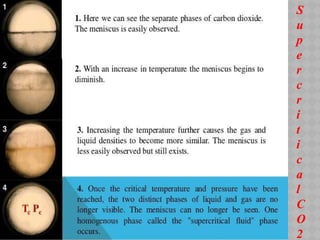
 A supercritical fluid is any substance at a temperature and
pressure above its critical
point.
 At a certain temperature and pressure condition, liquid and
vapour phases of a substance become indistinguishable,
Known as CRITICAL CONDITION
 Substances above critical point- “SUPERCRITICAL
FLUIDS” (SCF)
WHAT IS SUPERCRITICAL FLUID
EXTRACTION?
 Supercritical fluid extraction (SFE) is the process of
separating one component (the extractant) from
another (the matrix) using supercritical fluids as the
extracting solvent.
 Extraction is usually from a solid matrix, but it can
also be from liquids.
Carbon dioxide (CO2) is the most used supercritical
fluid, sometimes modified by co-solvents such as ethanol
or methanol.
 Extraction conditions for supercritical CO2 are above
the critical temperature of 31°C and critical pressure of 74
bar.
 Addition of modifiers may slightly alter this.
 Supercritical extraction mostly uses carbon dioxide at
high pressure to extract the high value products from
natural materials.
The extraction process leaves no solvent residue behind.
CO2 is
Non-toxic
 Nonflammable
Odorless
Tasteless
Inert
 Inexpensive
Due to its low critical temperature 31°C, carbon dioxide is
known to be perfectly adapted in food, aromas, essential oils
and neutraceutical industries.
Supercritical fluid extraction process
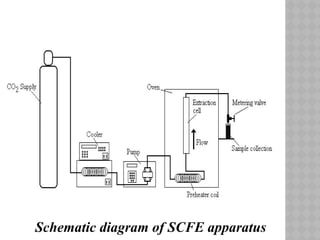
The system contain a pump for the CO2, a pressure cell to
contain the sample, a means of maintaining pressure in the
system and a collecting vessel.
The liquid is pumped to a heating zone, where it is heated to
supercritical conditions.
It then passes into the extraction vessel, where it rapidly
diffuses into the solid matrix and dissolves the material to
be extracted.
The dissolved material is swept from the extraction cell into
a separator at lower pressure, and the extracted material
settles out.
The CO2 can then be cooled, recompressed and recycled, or
discharged to atmosphere.
Schematic diagram of SCFE apparatus
S
u
p
e
r
c
r
i
t
i
c
a
l
C
O
2
•Elimination of organic solvents i.e. reduces the risk of
storage.
• Rapid (due to fast back-diffusion of analytes in the SCF
reduces the extraction time since the complete extraction
step is performed in about 20 min).
• Suitable for extraction and purification of compounds
having low volatility present in solid or liquid.
• Susceptible to thermal degradation (low operating
conditions).
ADVANTAGES OF SCFE
•Complete separation of solvent from extract and raffinate
• Continuous process
• Low handling cost
• Solvent recovery is easy
• Versatile and efficient (use of co-solvents and co-solutes)
Advantages continued……
•Prolonged time (penetration of SCF into the interior of a
solid is rapid, but solute diffusion from the solid into the
SCF).
• Modeling is inaccurate
• Scale is not possible (due to absence of fundamental,
molecular-based model of solutes in SCF).
• Expensive
• Consistency & reproducibility may vary in continuous
Production.
LIMITATIONS OF SCFE
•Adequate contact time
(for penetration of solvent into solid particles and diffusion of
solute from inside the solid particles to solvent)
• Equilibrium should be achieved
(i.e. proper flow of solvent such that concentration of
dissolved solutes in the solvent phase will be below the
solubility of solute in solvent.
PRECAUTIONS
Food and flavorings
As the residual solvent could be easily removed from the
product no matter whether it is the extract or the extracted
matrix.
 The biggest application is the decaffeination of tea and coffee.
Other important areas are the extraction of essential oils and
aroma materials from spices.
Brewery industry uses SFE for the extraction of hop.
The method is used in extracting some edible oils and
producing cholesterine-free egg powder.
INDUSTRIAL APPLICATIONS
Petrol chemistry
The distillation residue of the crude oil is handled with SFE as a
custom large-scale procedure (ROSE Residum Oil Supercritical
Extraction). The method is applied in regeneration procedures of
used oils and lubricants.
Pharmaceutical industry
Producing of active ingredients from herbal plants for avoiding
thermo or chemical degradation. Elimination of residual solvents
from the products.
THANK YOU

Super Critical Fluid and supercritical fluid Extraction Method

  • 1.
  • 2.
    CONTENT WHAT IS SUPERCRITICALFLUID? WHAT IS SCFE? SUPERCRITICAL FLIUD EXTRACTION PROCESS SCHEMATIC DIGRAM OF SCFE SUPERCRITICAL CO2 ADVANTAGES OF SCFE LIMITATIONS OF SCFE PRECAUTIONS OF SCFE INDUSTRIAL APPLICATIONS
  • 3.
    WHAT IS SUPERCRITICALFLUID  A supercritical fluid is any substance at a temperature and pressure above its critical point.  At a certain temperature and pressure condition, liquid and vapour phases of a substance become indistinguishable, Known as CRITICAL CONDITION  Substances above critical point- “SUPERCRITICAL FLUIDS” (SCF)
  • 4.
    WHAT IS SUPERCRITICALFLUID EXTRACTION?  Supercritical fluid extraction (SFE) is the process of separating one component (the extractant) from another (the matrix) using supercritical fluids as the extracting solvent.  Extraction is usually from a solid matrix, but it can also be from liquids.
  • 5.
    Carbon dioxide (CO2)is the most used supercritical fluid, sometimes modified by co-solvents such as ethanol or methanol.  Extraction conditions for supercritical CO2 are above the critical temperature of 31°C and critical pressure of 74 bar.  Addition of modifiers may slightly alter this.  Supercritical extraction mostly uses carbon dioxide at high pressure to extract the high value products from natural materials. The extraction process leaves no solvent residue behind.
  • 6.
    CO2 is Non-toxic  Nonflammable Odorless Tasteless Inert Inexpensive Due to its low critical temperature 31°C, carbon dioxide is known to be perfectly adapted in food, aromas, essential oils and neutraceutical industries.
  • 7.
    Supercritical fluid extractionprocess The system contain a pump for the CO2, a pressure cell to contain the sample, a means of maintaining pressure in the system and a collecting vessel. The liquid is pumped to a heating zone, where it is heated to supercritical conditions. It then passes into the extraction vessel, where it rapidly diffuses into the solid matrix and dissolves the material to be extracted. The dissolved material is swept from the extraction cell into a separator at lower pressure, and the extracted material settles out. The CO2 can then be cooled, recompressed and recycled, or discharged to atmosphere.
  • 8.
    Schematic diagram ofSCFE apparatus
  • 9.
  • 10.
    •Elimination of organicsolvents i.e. reduces the risk of storage. • Rapid (due to fast back-diffusion of analytes in the SCF reduces the extraction time since the complete extraction step is performed in about 20 min). • Suitable for extraction and purification of compounds having low volatility present in solid or liquid. • Susceptible to thermal degradation (low operating conditions). ADVANTAGES OF SCFE
  • 11.
    •Complete separation ofsolvent from extract and raffinate • Continuous process • Low handling cost • Solvent recovery is easy • Versatile and efficient (use of co-solvents and co-solutes) Advantages continued……
  • 12.
    •Prolonged time (penetrationof SCF into the interior of a solid is rapid, but solute diffusion from the solid into the SCF). • Modeling is inaccurate • Scale is not possible (due to absence of fundamental, molecular-based model of solutes in SCF). • Expensive • Consistency & reproducibility may vary in continuous Production. LIMITATIONS OF SCFE
  • 13.
    •Adequate contact time (forpenetration of solvent into solid particles and diffusion of solute from inside the solid particles to solvent) • Equilibrium should be achieved (i.e. proper flow of solvent such that concentration of dissolved solutes in the solvent phase will be below the solubility of solute in solvent. PRECAUTIONS
  • 14.
    Food and flavorings Asthe residual solvent could be easily removed from the product no matter whether it is the extract or the extracted matrix.  The biggest application is the decaffeination of tea and coffee. Other important areas are the extraction of essential oils and aroma materials from spices. Brewery industry uses SFE for the extraction of hop. The method is used in extracting some edible oils and producing cholesterine-free egg powder. INDUSTRIAL APPLICATIONS
  • 15.
    Petrol chemistry The distillationresidue of the crude oil is handled with SFE as a custom large-scale procedure (ROSE Residum Oil Supercritical Extraction). The method is applied in regeneration procedures of used oils and lubricants. Pharmaceutical industry Producing of active ingredients from herbal plants for avoiding thermo or chemical degradation. Elimination of residual solvents from the products.
  • 16.