Natural Resources onNatural Resources on
EarthEarth
 Air, water and land are the main resources on earth.Air, water and land are the main resources on earth.
The world of living organisms together with the layersThe world of living organisms together with the layers
of water, air and soil on the surface of this earth isof water, air and soil on the surface of this earth is
known as a biosphere. It is he sphere of life. It is theknown as a biosphere. It is he sphere of life. It is the
highest level of organization. Biosphere includeshighest level of organization. Biosphere includes
atmosphere, lithosphere, hydrosphere, plants andatmosphere, lithosphere, hydrosphere, plants and
animals. It is a biological system. There are twoanimals. It is a biological system. There are two
components of biosphere-components of biosphere-
 Abiotic components, non-living things-air, soil,Abiotic components, non-living things-air, soil,
water.water.
 Biotic components in living things.Biotic components in living things.
Natural ResourcesNatural Resources
 The Breath of Life: AirThe Breath of Life: Air
 The role of Atmosphere in climate controlThe role of Atmosphere in climate control
 The movement of air: WindsThe movement of air: Winds
 RainRain
 Air PollutionAir Pollution
 Water: A Wonder LiquidWater: A Wonder Liquid
 Water PollutionWater Pollution
 SoilSoil
 Biogeochemical CyclesBiogeochemical Cycles
 The Water CycleThe Water Cycle
 The Nitrogen CycleThe Nitrogen Cycle
 The Carbon CycleThe Carbon Cycle
 The Greenhouse EffectThe Greenhouse Effect
 The Oxygen CycleThe Oxygen Cycle
The Breath of Life: AirThe Breath of Life: Air
 Air is a mixture of gases that composes theAir is a mixture of gases that composes the
atmosphere surrounding Earth. These gasesatmosphere surrounding Earth. These gases
consist primarily of the elements nitrogen, oxygen,consist primarily of the elements nitrogen, oxygen,
argon, and smaller amounts of hydrogen, carbonargon, and smaller amounts of hydrogen, carbon
dioxide, water vapor, helium, neon, krypton, xenon,dioxide, water vapor, helium, neon, krypton, xenon,
and others. The most important attribute of air is itsand others. The most important attribute of air is its
life-sustaining property. Human and animal lifelife-sustaining property. Human and animal life
would not be possible without oxygen in thewould not be possible without oxygen in the
atmosphere. The composition of air is the result ofatmosphere. The composition of air is the result of
life on earth. life. The major component of thelife on earth. life. The major component of the
atmosphere is Carbon dioxide. It is found at Venusatmosphere is Carbon dioxide. It is found at Venus
and mars. Carbon dioxide constitutes up to 95-97and mars. Carbon dioxide constitutes up to 95-97
percentage of the atmosphere on Venus and mars.percentage of the atmosphere on Venus and mars.
AtmosphereAtmosphere
 The air that covers the whole of the Earth like a blanket, isThe air that covers the whole of the Earth like a blanket, is
called the atmosphere. It has several concentric layers.called the atmosphere. It has several concentric layers.
Troposphere, stratosphere, thermosphere and exosphere.Troposphere, stratosphere, thermosphere and exosphere.
The principal constituents of the atmosphere of Earth areThe principal constituents of the atmosphere of Earth are
nitrogen (78 percent) and oxygen (21 percent). Thenitrogen (78 percent) and oxygen (21 percent). The
atmospheric gases in the remaining 1 percent are argon (0.9atmospheric gases in the remaining 1 percent are argon (0.9
percent), carbon dioxide (0.03 percent), varying amounts ofpercent), carbon dioxide (0.03 percent), varying amounts of
water vapor, and trace amounts of hydrogen, ozone,water vapor, and trace amounts of hydrogen, ozone,
methane, carbon monoxide, helium, neon, krypton, andmethane, carbon monoxide, helium, neon, krypton, and
xenon. it. Climatic conditions and water cycle in an area isxenon. it. Climatic conditions and water cycle in an area is
regulated by circulation of the air.regulated by circulation of the air.
The role of Atmosphere inThe role of Atmosphere in
climate controlclimate control
 The atmosphere keepsThe atmosphere keeps
the average temperaturethe average temperature
of the Earth fairly steadyof the Earth fairly steady
during the day and evenduring the day and even
during the course of theduring the course of the
whole year.whole year.
 The atmosphere preventsThe atmosphere prevents
the sudden increase inthe sudden increase in
temperature during thetemperature during the
daylight hours.daylight hours.
 And during the night , itAnd during the night , it
slows down the escape ofslows down the escape of
heat into outer space.heat into outer space.
Layers of Atmosphere
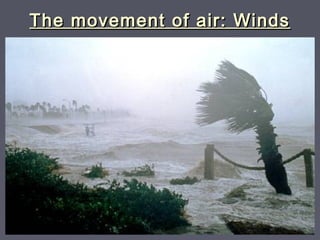
The movement of air: WindsThe movement of air: Winds
 Wind is the air in motion. The term is usually applied to theWind is the air in motion. The term is usually applied to the
natural horizontal motion of the atmosphere; motion in anatural horizontal motion of the atmosphere; motion in a
vertical, or nearly vertical, direction is called a current. Windsvertical, or nearly vertical, direction is called a current. Winds
are produced by differences in atmospheric pressure, whichare produced by differences in atmospheric pressure, which
are primarily attributable to differences in temperature.are primarily attributable to differences in temperature.
Variations in the distribution of pressure and temperature areVariations in the distribution of pressure and temperature are
caused largely by unequal distribution of heat from the sun,caused largely by unequal distribution of heat from the sun,
together with differences in the thermal properties of land andtogether with differences in the thermal properties of land and
ocean surfaces. When the temperatures of adjacent regionsocean surfaces. When the temperatures of adjacent regions
become unequal, the warmer air tends to rise and flow overbecome unequal, the warmer air tends to rise and flow over
the colder, heavier air. Winds initiated in this way are usuallythe colder, heavier air. Winds initiated in this way are usually
greatly modified by the earth's rotation.greatly modified by the earth's rotation.
Winds may be classified into four major types: the prevailingWinds may be classified into four major types: the prevailing
winds, the seasonal winds, the local winds, and the cyclonicwinds, the seasonal winds, the local winds, and the cyclonic
and anticyclonic winds.and anticyclonic winds.
The movement of air: WindsThe movement of air: Winds
Air PollutionAir Pollution
 Air Pollution, addition of harmful substances to theAir Pollution, addition of harmful substances to the
atmosphere resulting in damage to the environment,atmosphere resulting in damage to the environment,
human health, and quality of life. One of many formshuman health, and quality of life. One of many forms
of pollution, air pollution occurs inside homes,of pollution, air pollution occurs inside homes,
schools, and offices; in cities; across continents; andschools, and offices; in cities; across continents; and
even globally. Air pollution makes people sick—iteven globally. Air pollution makes people sick—it
causes breathing problems and promotes cancer—causes breathing problems and promotes cancer—
and it harms plants, animals, and the ecosystems inand it harms plants, animals, and the ecosystems in
which they live. Some air pollutants return to Earthwhich they live. Some air pollutants return to Earth
in the form of acid rain and snow, which corrodein the form of acid rain and snow, which corrode
statues and buildings, damage crops and forests,statues and buildings, damage crops and forests,
and make lakes and streams unsuitable for fish andand make lakes and streams unsuitable for fish and
other plant and animal life.other plant and animal life.
Air PollutionAir Pollution
RainRain
 Precipitation of liquid drops of water is calledPrecipitation of liquid drops of water is called
rain. Raindrops generally have a diameterrain. Raindrops generally have a diameter
greater than 0.5 mm (0.02 in). They range ingreater than 0.5 mm (0.02 in). They range in
size up to about 3 mm (about 0.13 in) insize up to about 3 mm (about 0.13 in) in
diameter, and their rate of fall increases, up todiameter, and their rate of fall increases, up to
7.6 m (25 ft) per sec with their size. Larger7.6 m (25 ft) per sec with their size. Larger
drops tend to be flattened and broken intodrops tend to be flattened and broken into
smaller drops by rapid fall through the air. Thesmaller drops by rapid fall through the air. The
precipitation of smaller drops, called drizzle,precipitation of smaller drops, called drizzle,
often severely restricts visibility but usuallyoften severely restricts visibility but usually
does not produce significant accumulations ofdoes not produce significant accumulations of
water.water.
Water: A WonderWater: A Wonder
LiquidLiquid
 Water occupies a very large area of theWater occupies a very large area of the
Earth’s surface and is also foundEarth’s surface and is also found
underground. Some amount of water exists inunderground. Some amount of water exists in
the form of water vapour in the atmosphere.the form of water vapour in the atmosphere.
Most of the water on Earth’s surface is foundMost of the water on Earth’s surface is found
in seas and oceans and is saline. Fresh waterin seas and oceans and is saline. Fresh water
is found frozen in the ice-caps at the twois found frozen in the ice-caps at the two
poles and on snow-covered mountains. Thepoles and on snow-covered mountains. The
underground water and the water in rivers,underground water and the water in rivers,
lakes and ponds is also fresh. However, thelakes and ponds is also fresh. However, the
availability of fresh water varies from place toavailability of fresh water varies from place to
place.place.
Water PollutionWater Pollution
 Water Pollution, contamination of streams, lakes,Water Pollution, contamination of streams, lakes,
underground water, bays, or oceans by substancesunderground water, bays, or oceans by substances
harmful to living things. Water is necessary to life onharmful to living things. Water is necessary to life on
earth. All organisms contain it; some live in it; someearth. All organisms contain it; some live in it; some
drink it. Plants and animals require water that isdrink it. Plants and animals require water that is
moderately pure, and they cannot survive if theirmoderately pure, and they cannot survive if their
water is loaded with toxic chemicals or harmfulwater is loaded with toxic chemicals or harmful
microorganisms. If severe, water pollution can killmicroorganisms. If severe, water pollution can kill
large numbers of fish, birds, and other animals, inlarge numbers of fish, birds, and other animals, in
some cases killing all members of a species in ansome cases killing all members of a species in an
affected area. Pollution makes streams, lakes, andaffected area. Pollution makes streams, lakes, and
coastal waters unpleasant to look at, to smell, and tocoastal waters unpleasant to look at, to smell, and to
swim in. Fish and shellfish harvested from pollutedswim in. Fish and shellfish harvested from polluted
waters may be unsafe to eat. People who ingestwaters may be unsafe to eat. People who ingest
polluted water can become ill, and, with prolongedpolluted water can become ill, and, with prolonged
exposure, may develop cancers or bear children withexposure, may develop cancers or bear children with
birth defects.birth defects.
Water PollutionWater Pollution
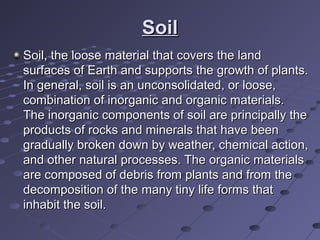
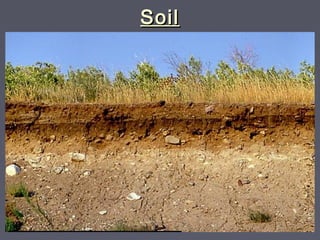
SoilSoil
Soil, the loose material that covers the land Soil, the loose material that covers the land 
surfaces of Earth and supports the growth of plants. surfaces of Earth and supports the growth of plants. 
In general, soil is an unconsolidated, or loose, In general, soil is an unconsolidated, or loose, 
combination of inorganic and organic materials. combination of inorganic and organic materials. 
The inorganic components of soil are principally the The inorganic components of soil are principally the 
products of rocks and minerals that have been products of rocks and minerals that have been 
gradually broken down by weather, chemical action, gradually broken down by weather, chemical action, 
and other natural processes. The organic materials and other natural processes. The organic materials 
are composed of debris from plants and from the are composed of debris from plants and from the 
decomposition of the many tiny life forms that decomposition of the many tiny life forms that 
inhabit the soil.inhabit the soil.
SoilSoil
Biogeochemical CyclesBiogeochemical Cycles
 The Water CycleThe Water Cycle
 The Nitrogen CycleThe Nitrogen Cycle
 The Carbon CycleThe Carbon Cycle
 The Oxygen CycleThe Oxygen Cycle
The Water CycleThe Water Cycle
 Water Cycle or Hydrologic Cycle isWater Cycle or Hydrologic Cycle is
a series of movements of water above, on,a series of movements of water above, on,
and below the surface of the earth. The waterand below the surface of the earth. The water
cycle consists of four distinct stages: storage,cycle consists of four distinct stages: storage,
evaporation, precipitation, and runoff. Waterevaporation, precipitation, and runoff. Water
may be stored temporarily in the ground; inmay be stored temporarily in the ground; in
oceans, lakes, and rivers; and in ice caps andoceans, lakes, and rivers; and in ice caps and
glaciers. It evaporates from the earth’sglaciers. It evaporates from the earth’s
surface, condenses in clouds, falls back tosurface, condenses in clouds, falls back to
the earth as precipitation (rain or snow), andthe earth as precipitation (rain or snow), and
eventually either runs into the seas oreventually either runs into the seas or
reevaporates into the atmosphere.reevaporates into the atmosphere.
The Water CycleThe Water Cycle
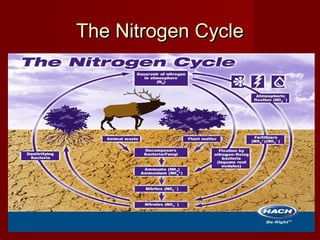
The Nitrogen CycleThe Nitrogen Cycle
 Nitrogen Cycle, natural cyclic process in the course of whichNitrogen Cycle, natural cyclic process in the course of which
atmospheric nitrogen enters the soil and becomes part ofatmospheric nitrogen enters the soil and becomes part of
living organisms, before returning to the atmosphere.living organisms, before returning to the atmosphere.
Nitrogen, an essential part of the amino acids, is a basicNitrogen, an essential part of the amino acids, is a basic
element of life. It also makes up 78 percent of the Earth’selement of life. It also makes up 78 percent of the Earth’s
atmosphere, but gaseous nitrogen must be converted to aatmosphere, but gaseous nitrogen must be converted to a
chemically usable form before it can be used by livingchemically usable form before it can be used by living
organisms. This is accomplished through the nitrogen cycle,organisms. This is accomplished through the nitrogen cycle,
in which gaseous nitrogen is converted to ammonia orin which gaseous nitrogen is converted to ammonia or
nitrates. The high energies provided by lightning and cosmicnitrates. The high energies provided by lightning and cosmic
radiation serve to combine atmospheric nitrogen and oxygenradiation serve to combine atmospheric nitrogen and oxygen
into nitrates, which are carried to the Earth’s surface ininto nitrates, which are carried to the Earth’s surface in
precipitation. Biological fixation (precipitation. Biological fixation (seesee Nitrogen Fixation),Nitrogen Fixation),
which accounts for the bulk of the nitrogen-conversionwhich accounts for the bulk of the nitrogen-conversion
process, is accomplished by free-living, nitrogen-fixingprocess, is accomplished by free-living, nitrogen-fixing
bacteria; symbiotic bacteria living on the roots of plantsbacteria; symbiotic bacteria living on the roots of plants
(mostly legumes and alders); cyanobacteria (formerly known(mostly legumes and alders); cyanobacteria (formerly known
as blue-green algae); certain lichens; and epiphytes inas blue-green algae); certain lichens; and epiphytes in
tropical forests.tropical forests.
The Nitrogen CycleThe Nitrogen Cycle
The Carbon CycleThe Carbon Cycle
 Carbon Cycle (ecology), in ecology, the cycle of carbonCarbon Cycle (ecology), in ecology, the cycle of carbon
usage by which energy flows through the earth's ecosystem.usage by which energy flows through the earth's ecosystem.
The basic cycle begins when photosynthesizing plants (The basic cycle begins when photosynthesizing plants (seesee
Photosynthesis) use carbon dioxide (CO2) found in thePhotosynthesis) use carbon dioxide (CO2) found in the
atmosphere or dissolved in water. Some of this carbon isatmosphere or dissolved in water. Some of this carbon is
incorporated in plant tissue as carbohydrates, fats, andincorporated in plant tissue as carbohydrates, fats, and
protein; the rest is returned to the atmosphere or waterprotein; the rest is returned to the atmosphere or water
primarily by aerobic respiration. Carbon is thus passed on toprimarily by aerobic respiration. Carbon is thus passed on to
herbivores that eat the plants and thereby use, rearrange,herbivores that eat the plants and thereby use, rearrange,
and degrade the carbon compounds. Much of it is given offand degrade the carbon compounds. Much of it is given off
as CO2, primarily as a by-product of aerobic respiration, butas CO2, primarily as a by-product of aerobic respiration, but
some is stored in animal tissue and is passed on tosome is stored in animal tissue and is passed on to
carnivores feeding on the herbivores. Ultimately, all thecarnivores feeding on the herbivores. Ultimately, all the
carbon compounds are broken down by decomposition, andcarbon compounds are broken down by decomposition, and
the carbon is released as CO2 to be used again by plants.the carbon is released as CO2 to be used again by plants.
The Carbon CycleThe Carbon Cycle
The Oxygen CycleThe Oxygen Cycle
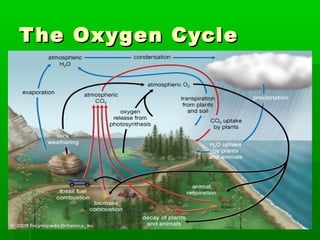
 Oxygen content of air is kept constant by theOxygen content of air is kept constant by the
green plant. Oxygen is one of the constituentsgreen plant. Oxygen is one of the constituents
of water. Oxygen forms 20 percentageof water. Oxygen forms 20 percentage
(approx) of air in atmosphere. It is needed for(approx) of air in atmosphere. It is needed for
respiration by all the living beings. Oxygenrespiration by all the living beings. Oxygen
enters the living world through respiration,enters the living world through respiration,
oxidizes the food materials and produceoxidizes the food materials and produce
energy+carbon dioxide. Carbon dioxide isenergy+carbon dioxide. Carbon dioxide is
utilized by the plants to produce foodutilized by the plants to produce food
materials during photosynthesis by them.materials during photosynthesis by them.
The Oxygen CycleThe Oxygen Cycle
The Greenhouse EffectThe Greenhouse Effect
 Greenhouse Effect, the capacity of certain gases in theGreenhouse Effect, the capacity of certain gases in the
atmosphere to trap heat emitted from the Earth’s surface,atmosphere to trap heat emitted from the Earth’s surface,
thereby insulating and warming the Earth. Without thethereby insulating and warming the Earth. Without the
thermal blanketing of the natural greenhouse effect, thethermal blanketing of the natural greenhouse effect, the
Earth’s climate would be about 33 Celsius degreesEarth’s climate would be about 33 Celsius degrees
(about 59 Fahrenheit degrees) cooler—too cold for most(about 59 Fahrenheit degrees) cooler—too cold for most
living organisms to survive. The atmospheric greenhouseliving organisms to survive. The atmospheric greenhouse
effect is a natural effect that has been occurring foreffect is a natural effect that has been occurring for
billions of years. Indeed, without it, the earth would be abillions of years. Indeed, without it, the earth would be a
frozen planet with an average temperature of about -18°frozen planet with an average temperature of about -18°
C (about 0° F). Due to the greenhouse effect, the earth’sC (about 0° F). Due to the greenhouse effect, the earth’s
average surface temperature is a comfortable 15° Caverage surface temperature is a comfortable 15° C
(about 59° F).(about 59° F).
The Greenhouse EffectThe Greenhouse Effect
Natural resource

Natural resource

  • 2.
    Natural Resources onNaturalResources on EarthEarth  Air, water and land are the main resources on earth.Air, water and land are the main resources on earth. The world of living organisms together with the layersThe world of living organisms together with the layers of water, air and soil on the surface of this earth isof water, air and soil on the surface of this earth is known as a biosphere. It is he sphere of life. It is theknown as a biosphere. It is he sphere of life. It is the highest level of organization. Biosphere includeshighest level of organization. Biosphere includes atmosphere, lithosphere, hydrosphere, plants andatmosphere, lithosphere, hydrosphere, plants and animals. It is a biological system. There are twoanimals. It is a biological system. There are two components of biosphere-components of biosphere-  Abiotic components, non-living things-air, soil,Abiotic components, non-living things-air, soil, water.water.  Biotic components in living things.Biotic components in living things.
  • 3.
    Natural ResourcesNatural Resources The Breath of Life: AirThe Breath of Life: Air  The role of Atmosphere in climate controlThe role of Atmosphere in climate control  The movement of air: WindsThe movement of air: Winds  RainRain  Air PollutionAir Pollution  Water: A Wonder LiquidWater: A Wonder Liquid  Water PollutionWater Pollution  SoilSoil  Biogeochemical CyclesBiogeochemical Cycles  The Water CycleThe Water Cycle  The Nitrogen CycleThe Nitrogen Cycle  The Carbon CycleThe Carbon Cycle  The Greenhouse EffectThe Greenhouse Effect  The Oxygen CycleThe Oxygen Cycle
  • 4.
    The Breath ofLife: AirThe Breath of Life: Air  Air is a mixture of gases that composes theAir is a mixture of gases that composes the atmosphere surrounding Earth. These gasesatmosphere surrounding Earth. These gases consist primarily of the elements nitrogen, oxygen,consist primarily of the elements nitrogen, oxygen, argon, and smaller amounts of hydrogen, carbonargon, and smaller amounts of hydrogen, carbon dioxide, water vapor, helium, neon, krypton, xenon,dioxide, water vapor, helium, neon, krypton, xenon, and others. The most important attribute of air is itsand others. The most important attribute of air is its life-sustaining property. Human and animal lifelife-sustaining property. Human and animal life would not be possible without oxygen in thewould not be possible without oxygen in the atmosphere. The composition of air is the result ofatmosphere. The composition of air is the result of life on earth. life. The major component of thelife on earth. life. The major component of the atmosphere is Carbon dioxide. It is found at Venusatmosphere is Carbon dioxide. It is found at Venus and mars. Carbon dioxide constitutes up to 95-97and mars. Carbon dioxide constitutes up to 95-97 percentage of the atmosphere on Venus and mars.percentage of the atmosphere on Venus and mars.
  • 5.
    AtmosphereAtmosphere  The airthat covers the whole of the Earth like a blanket, isThe air that covers the whole of the Earth like a blanket, is called the atmosphere. It has several concentric layers.called the atmosphere. It has several concentric layers. Troposphere, stratosphere, thermosphere and exosphere.Troposphere, stratosphere, thermosphere and exosphere. The principal constituents of the atmosphere of Earth areThe principal constituents of the atmosphere of Earth are nitrogen (78 percent) and oxygen (21 percent). Thenitrogen (78 percent) and oxygen (21 percent). The atmospheric gases in the remaining 1 percent are argon (0.9atmospheric gases in the remaining 1 percent are argon (0.9 percent), carbon dioxide (0.03 percent), varying amounts ofpercent), carbon dioxide (0.03 percent), varying amounts of water vapor, and trace amounts of hydrogen, ozone,water vapor, and trace amounts of hydrogen, ozone, methane, carbon monoxide, helium, neon, krypton, andmethane, carbon monoxide, helium, neon, krypton, and xenon. it. Climatic conditions and water cycle in an area isxenon. it. Climatic conditions and water cycle in an area is regulated by circulation of the air.regulated by circulation of the air.
  • 6.
    The role ofAtmosphere inThe role of Atmosphere in climate controlclimate control  The atmosphere keepsThe atmosphere keeps the average temperaturethe average temperature of the Earth fairly steadyof the Earth fairly steady during the day and evenduring the day and even during the course of theduring the course of the whole year.whole year.  The atmosphere preventsThe atmosphere prevents the sudden increase inthe sudden increase in temperature during thetemperature during the daylight hours.daylight hours.  And during the night , itAnd during the night , it slows down the escape ofslows down the escape of heat into outer space.heat into outer space. Layers of Atmosphere
  • 7.
    The movement ofair: WindsThe movement of air: Winds  Wind is the air in motion. The term is usually applied to theWind is the air in motion. The term is usually applied to the natural horizontal motion of the atmosphere; motion in anatural horizontal motion of the atmosphere; motion in a vertical, or nearly vertical, direction is called a current. Windsvertical, or nearly vertical, direction is called a current. Winds are produced by differences in atmospheric pressure, whichare produced by differences in atmospheric pressure, which are primarily attributable to differences in temperature.are primarily attributable to differences in temperature. Variations in the distribution of pressure and temperature areVariations in the distribution of pressure and temperature are caused largely by unequal distribution of heat from the sun,caused largely by unequal distribution of heat from the sun, together with differences in the thermal properties of land andtogether with differences in the thermal properties of land and ocean surfaces. When the temperatures of adjacent regionsocean surfaces. When the temperatures of adjacent regions become unequal, the warmer air tends to rise and flow overbecome unequal, the warmer air tends to rise and flow over the colder, heavier air. Winds initiated in this way are usuallythe colder, heavier air. Winds initiated in this way are usually greatly modified by the earth's rotation.greatly modified by the earth's rotation. Winds may be classified into four major types: the prevailingWinds may be classified into four major types: the prevailing winds, the seasonal winds, the local winds, and the cyclonicwinds, the seasonal winds, the local winds, and the cyclonic and anticyclonic winds.and anticyclonic winds.
  • 8.
    The movement ofair: WindsThe movement of air: Winds
  • 9.
    Air PollutionAir Pollution Air Pollution, addition of harmful substances to theAir Pollution, addition of harmful substances to the atmosphere resulting in damage to the environment,atmosphere resulting in damage to the environment, human health, and quality of life. One of many formshuman health, and quality of life. One of many forms of pollution, air pollution occurs inside homes,of pollution, air pollution occurs inside homes, schools, and offices; in cities; across continents; andschools, and offices; in cities; across continents; and even globally. Air pollution makes people sick—iteven globally. Air pollution makes people sick—it causes breathing problems and promotes cancer—causes breathing problems and promotes cancer— and it harms plants, animals, and the ecosystems inand it harms plants, animals, and the ecosystems in which they live. Some air pollutants return to Earthwhich they live. Some air pollutants return to Earth in the form of acid rain and snow, which corrodein the form of acid rain and snow, which corrode statues and buildings, damage crops and forests,statues and buildings, damage crops and forests, and make lakes and streams unsuitable for fish andand make lakes and streams unsuitable for fish and other plant and animal life.other plant and animal life.
  • 10.
  • 11.
    RainRain  Precipitation of liquid dropsof water is calledPrecipitation of liquid drops of water is called rain. Raindrops generally have a diameterrain. Raindrops generally have a diameter greater than 0.5 mm (0.02 in). They range ingreater than 0.5 mm (0.02 in). They range in size up to about 3 mm (about 0.13 in) insize up to about 3 mm (about 0.13 in) in diameter, and their rate of fall increases, up todiameter, and their rate of fall increases, up to 7.6 m (25 ft) per sec with their size. Larger7.6 m (25 ft) per sec with their size. Larger drops tend to be flattened and broken intodrops tend to be flattened and broken into smaller drops by rapid fall through the air. Thesmaller drops by rapid fall through the air. The precipitation of smaller drops, called drizzle,precipitation of smaller drops, called drizzle, often severely restricts visibility but usuallyoften severely restricts visibility but usually does not produce significant accumulations ofdoes not produce significant accumulations of water.water.
  • 12.
    Water: A WonderWater:A Wonder LiquidLiquid  Water occupies a very large area of theWater occupies a very large area of the Earth’s surface and is also foundEarth’s surface and is also found underground. Some amount of water exists inunderground. Some amount of water exists in the form of water vapour in the atmosphere.the form of water vapour in the atmosphere. Most of the water on Earth’s surface is foundMost of the water on Earth’s surface is found in seas and oceans and is saline. Fresh waterin seas and oceans and is saline. Fresh water is found frozen in the ice-caps at the twois found frozen in the ice-caps at the two poles and on snow-covered mountains. Thepoles and on snow-covered mountains. The underground water and the water in rivers,underground water and the water in rivers, lakes and ponds is also fresh. However, thelakes and ponds is also fresh. However, the availability of fresh water varies from place toavailability of fresh water varies from place to place.place.
  • 13.
    Water PollutionWater Pollution Water Pollution, contamination of streams, lakes,Water Pollution, contamination of streams, lakes, underground water, bays, or oceans by substancesunderground water, bays, or oceans by substances harmful to living things. Water is necessary to life onharmful to living things. Water is necessary to life on earth. All organisms contain it; some live in it; someearth. All organisms contain it; some live in it; some drink it. Plants and animals require water that isdrink it. Plants and animals require water that is moderately pure, and they cannot survive if theirmoderately pure, and they cannot survive if their water is loaded with toxic chemicals or harmfulwater is loaded with toxic chemicals or harmful microorganisms. If severe, water pollution can killmicroorganisms. If severe, water pollution can kill large numbers of fish, birds, and other animals, inlarge numbers of fish, birds, and other animals, in some cases killing all members of a species in ansome cases killing all members of a species in an affected area. Pollution makes streams, lakes, andaffected area. Pollution makes streams, lakes, and coastal waters unpleasant to look at, to smell, and tocoastal waters unpleasant to look at, to smell, and to swim in. Fish and shellfish harvested from pollutedswim in. Fish and shellfish harvested from polluted waters may be unsafe to eat. People who ingestwaters may be unsafe to eat. People who ingest polluted water can become ill, and, with prolongedpolluted water can become ill, and, with prolonged exposure, may develop cancers or bear children withexposure, may develop cancers or bear children with birth defects.birth defects.
  • 14.
  • 15.
    SoilSoil Soil, the loose material that covers the land Soil, the loose material that covers the land  surfaces of Earth and supports the growth of plants. surfaces of Earth and supports the growth of plants.  In general, soil is an unconsolidated, or loose, In general, soil is an unconsolidated, or loose,  combination of inorganic and organic materials. combination of inorganic and organic materials.  The inorganic components of soil are principally the The inorganic components of soil are principally the  products of rocks and minerals that have been products of rocks and minerals that have been  gradually broken down by weather, chemical action, gradually broken down by weather, chemical action,  and other natural processes. The organic materials and other natural processes. The organic materials  are composed of debris from plants and from the are composed of debris from plants and from the  decomposition of the many tiny life forms that decomposition of the many tiny life forms that  inhabit the soil.inhabit the soil.
  • 16.
  • 17.
    Biogeochemical CyclesBiogeochemical Cycles The Water CycleThe Water Cycle  The Nitrogen CycleThe Nitrogen Cycle  The Carbon CycleThe Carbon Cycle  The Oxygen CycleThe Oxygen Cycle
  • 18.
    The Water CycleTheWater Cycle  Water Cycle or Hydrologic Cycle isWater Cycle or Hydrologic Cycle is a series of movements of water above, on,a series of movements of water above, on, and below the surface of the earth. The waterand below the surface of the earth. The water cycle consists of four distinct stages: storage,cycle consists of four distinct stages: storage, evaporation, precipitation, and runoff. Waterevaporation, precipitation, and runoff. Water may be stored temporarily in the ground; inmay be stored temporarily in the ground; in oceans, lakes, and rivers; and in ice caps andoceans, lakes, and rivers; and in ice caps and glaciers. It evaporates from the earth’sglaciers. It evaporates from the earth’s surface, condenses in clouds, falls back tosurface, condenses in clouds, falls back to the earth as precipitation (rain or snow), andthe earth as precipitation (rain or snow), and eventually either runs into the seas oreventually either runs into the seas or reevaporates into the atmosphere.reevaporates into the atmosphere.
  • 19.
  • 20.
    The Nitrogen CycleTheNitrogen Cycle  Nitrogen Cycle, natural cyclic process in the course of whichNitrogen Cycle, natural cyclic process in the course of which atmospheric nitrogen enters the soil and becomes part ofatmospheric nitrogen enters the soil and becomes part of living organisms, before returning to the atmosphere.living organisms, before returning to the atmosphere. Nitrogen, an essential part of the amino acids, is a basicNitrogen, an essential part of the amino acids, is a basic element of life. It also makes up 78 percent of the Earth’selement of life. It also makes up 78 percent of the Earth’s atmosphere, but gaseous nitrogen must be converted to aatmosphere, but gaseous nitrogen must be converted to a chemically usable form before it can be used by livingchemically usable form before it can be used by living organisms. This is accomplished through the nitrogen cycle,organisms. This is accomplished through the nitrogen cycle, in which gaseous nitrogen is converted to ammonia orin which gaseous nitrogen is converted to ammonia or nitrates. The high energies provided by lightning and cosmicnitrates. The high energies provided by lightning and cosmic radiation serve to combine atmospheric nitrogen and oxygenradiation serve to combine atmospheric nitrogen and oxygen into nitrates, which are carried to the Earth’s surface ininto nitrates, which are carried to the Earth’s surface in precipitation. Biological fixation (precipitation. Biological fixation (seesee Nitrogen Fixation),Nitrogen Fixation), which accounts for the bulk of the nitrogen-conversionwhich accounts for the bulk of the nitrogen-conversion process, is accomplished by free-living, nitrogen-fixingprocess, is accomplished by free-living, nitrogen-fixing bacteria; symbiotic bacteria living on the roots of plantsbacteria; symbiotic bacteria living on the roots of plants (mostly legumes and alders); cyanobacteria (formerly known(mostly legumes and alders); cyanobacteria (formerly known as blue-green algae); certain lichens; and epiphytes inas blue-green algae); certain lichens; and epiphytes in tropical forests.tropical forests.
  • 21.
    The Nitrogen CycleTheNitrogen Cycle
  • 22.
    The Carbon CycleTheCarbon Cycle  Carbon Cycle (ecology), in ecology, the cycle of carbonCarbon Cycle (ecology), in ecology, the cycle of carbon usage by which energy flows through the earth's ecosystem.usage by which energy flows through the earth's ecosystem. The basic cycle begins when photosynthesizing plants (The basic cycle begins when photosynthesizing plants (seesee Photosynthesis) use carbon dioxide (CO2) found in thePhotosynthesis) use carbon dioxide (CO2) found in the atmosphere or dissolved in water. Some of this carbon isatmosphere or dissolved in water. Some of this carbon is incorporated in plant tissue as carbohydrates, fats, andincorporated in plant tissue as carbohydrates, fats, and protein; the rest is returned to the atmosphere or waterprotein; the rest is returned to the atmosphere or water primarily by aerobic respiration. Carbon is thus passed on toprimarily by aerobic respiration. Carbon is thus passed on to herbivores that eat the plants and thereby use, rearrange,herbivores that eat the plants and thereby use, rearrange, and degrade the carbon compounds. Much of it is given offand degrade the carbon compounds. Much of it is given off as CO2, primarily as a by-product of aerobic respiration, butas CO2, primarily as a by-product of aerobic respiration, but some is stored in animal tissue and is passed on tosome is stored in animal tissue and is passed on to carnivores feeding on the herbivores. Ultimately, all thecarnivores feeding on the herbivores. Ultimately, all the carbon compounds are broken down by decomposition, andcarbon compounds are broken down by decomposition, and the carbon is released as CO2 to be used again by plants.the carbon is released as CO2 to be used again by plants.
  • 23.
    The Carbon CycleTheCarbon Cycle
  • 24.
    The Oxygen CycleTheOxygen Cycle  Oxygen content of air is kept constant by theOxygen content of air is kept constant by the green plant. Oxygen is one of the constituentsgreen plant. Oxygen is one of the constituents of water. Oxygen forms 20 percentageof water. Oxygen forms 20 percentage (approx) of air in atmosphere. It is needed for(approx) of air in atmosphere. It is needed for respiration by all the living beings. Oxygenrespiration by all the living beings. Oxygen enters the living world through respiration,enters the living world through respiration, oxidizes the food materials and produceoxidizes the food materials and produce energy+carbon dioxide. Carbon dioxide isenergy+carbon dioxide. Carbon dioxide is utilized by the plants to produce foodutilized by the plants to produce food materials during photosynthesis by them.materials during photosynthesis by them.
  • 25.
    The Oxygen CycleTheOxygen Cycle
  • 26.
    The Greenhouse EffectTheGreenhouse Effect  Greenhouse Effect, the capacity of certain gases in theGreenhouse Effect, the capacity of certain gases in the atmosphere to trap heat emitted from the Earth’s surface,atmosphere to trap heat emitted from the Earth’s surface, thereby insulating and warming the Earth. Without thethereby insulating and warming the Earth. Without the thermal blanketing of the natural greenhouse effect, thethermal blanketing of the natural greenhouse effect, the Earth’s climate would be about 33 Celsius degreesEarth’s climate would be about 33 Celsius degrees (about 59 Fahrenheit degrees) cooler—too cold for most(about 59 Fahrenheit degrees) cooler—too cold for most living organisms to survive. The atmospheric greenhouseliving organisms to survive. The atmospheric greenhouse effect is a natural effect that has been occurring foreffect is a natural effect that has been occurring for billions of years. Indeed, without it, the earth would be abillions of years. Indeed, without it, the earth would be a frozen planet with an average temperature of about -18°frozen planet with an average temperature of about -18° C (about 0° F). Due to the greenhouse effect, the earth’sC (about 0° F). Due to the greenhouse effect, the earth’s average surface temperature is a comfortable 15° Caverage surface temperature is a comfortable 15° C (about 59° F).(about 59° F).
  • 27.
    The Greenhouse EffectTheGreenhouse Effect