John Brown Attorney and Founder of BEI Employee Ownership Conference Minneapolis, MN :  April 20-22, 2010 Dan Walter President and CEO Performensation
Introduction Exit Planning and Equity Compensation Basic Question:  Why should I consider incentive equity compensation for my company? Advantages of equity as an incentive. Advantages of cash as an incentive.
Overview: Equity Based Compensation Design Considerations Who How much When Why How to measure, basis for award, performance standard.
Exit Planning Perspective Owner-managed companies in transition.  Baby Boomer business owners.  Most want to exit . Need management team and other key employees motivated to stay after owner leaves and to grow value. Size of Company:  15 employees – 500 or so. What does it take for an owner to be able to exit – via ESOP or any other path?
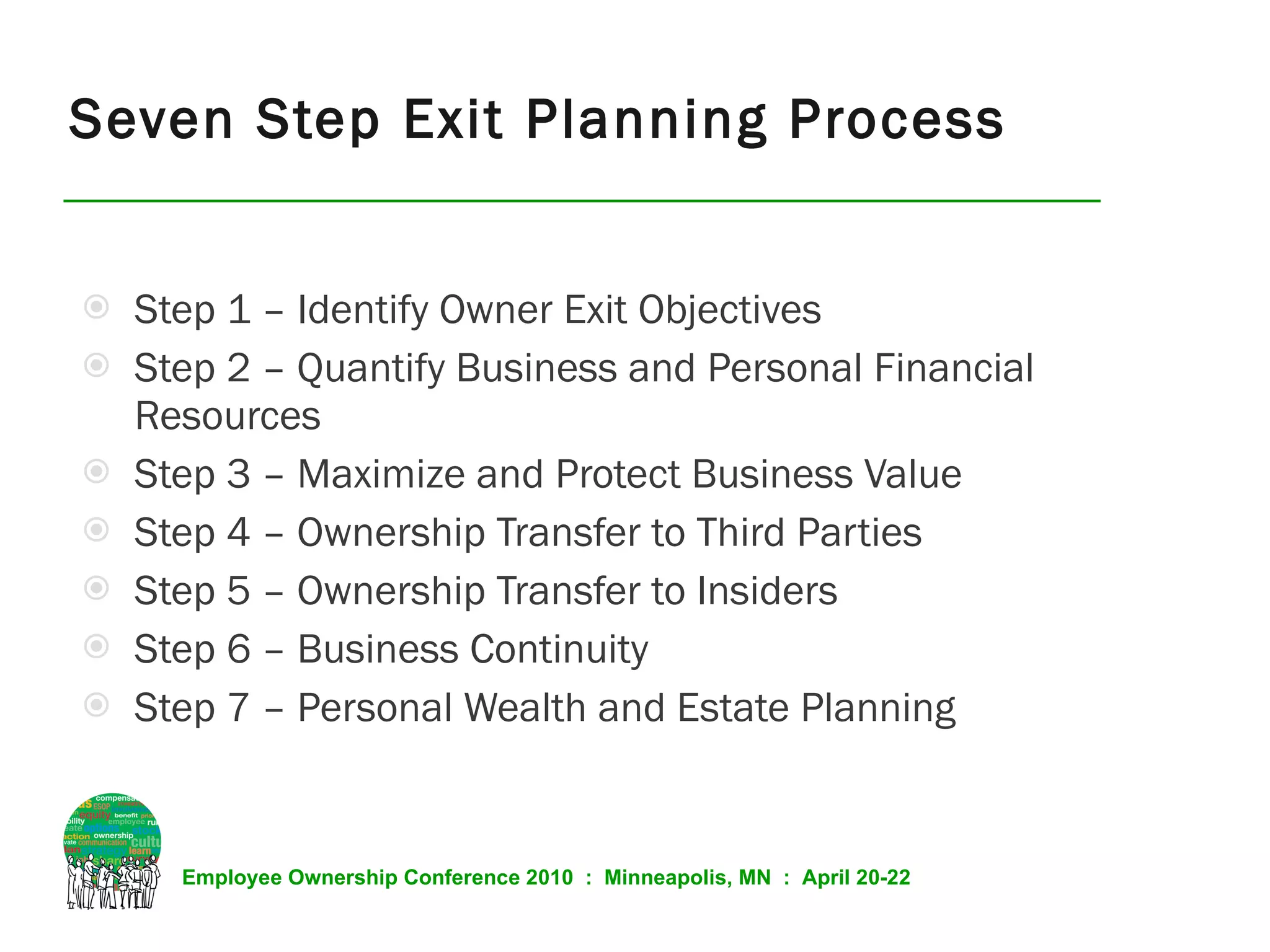
Seven Step Exit Planning Process Step 1 – Identify Owner Exit Objectives  Step 2 – Quantify Business and Personal Financial Resources Step 3 – Maximize and Protect Business Value Step 4 – Ownership Transfer to Third Parties Step 5 – Ownership Transfer to Insiders Step 6 – Business Continuity Step 7 – Personal Wealth and Estate Planning
ESOP Perspective: Should ESOP Trustees approach equity ownership decisions in same way as owners interested in exiting their businesses? ESOP Trustees represent ownership and much like departing owners may not be actively involved in the day to day business. ESOPS want management and key employees to: Stay through owner’s exit;  To have the same incentive to grow business as does ownership. To grow business value long term & continually.
Advantages of Equity Based Incentive Compensation. More effective than cash in motivating or retaining the key employee. It is part of the owner’s exit strategy to transfer ownership to key employee(s). It is cashless. It is in anticipation of a third party sale and the owner wishes to benefit selected employees with capital gains treatment.
Advantages of cash based incentive compensation More effective than stock in motivating and keeping key employees. If they have to pay for equity, most employees prefer cash to ownership.  Owner’s do not want more owners. More Flexible. Owner’s exit path is third party sale or transfer to family.
Benefit Formulas Performance based. Usually calculated annually. Performance standard benefits the owners. Subject to “vesting”. Usually long term goal is to grow value to a certain level or over a certain time based on owner’s exit objectives.
What do we mean by “Who should get how much”? Who are the stakeholders? Is Equity Fair and/or Just? Is How much defined as: Amount in “money” Amount in “shares” Amount in “ownership percentage” The Other Side of Equity
What is meant by “Equity” eq·ui·ty, n. pl. eq·ui·ties  1.  The state, quality, or ideal of being just, impartial, and fair . 2. Something that is just, impartial, and fair. 3. Law  a. Justice applied in circumstances covered by law yet influenced by principles of ethics and fairness;  b. A system of jurisprudence supplementing and serving to modify the rigor of common law;  c. An equitable right or claim;  d. Equity of redemption. 4.  The residual value of a business or property beyond any mortgage thereon and liability therein. 5. a. The market value of securities less any debt incurred;  b. Common stock and preferred stock. 6. Funds provided to a business by the sale of stock. Source: www.freedictionary.com
Is Equity Compensation truly “Fair”? Fair, adj. 1 . free from discrimination , dishonesty, etc.; just; impartial 2. in conformity with rules or standards; legitimate a fair fight 3. (of the hair or complexion) light in colour 4. beautiful or lovely to look at 5.  moderately or quite good   a fair piece of work 6.  unblemished; untainted Source: freedictionary.com
Can Equity Compensation be “Just”? Just, adj. 1. Honorable and fair in one's dealings and actions: a just ruler.  2. Consistent with what is morally right; righteous: a just cause. 3.  Properly due or merited : just deserts. 4. Law Valid within the law; lawful: just claims. 5.  Suitable or proper in nature ; fitting: a just touch of solemnity. 6.  Based on fact or sound reason ; well-founded: a just appraisal. Source: freedictionary.com
Common Reasons for Equity Compensation Private Co. Someday go public Someday get acquired Focus is extended period growth Ensure strong shareholder support if there are other investors Not planning to go public Public Co. Attract, Motivate and Retain high quality staff Align staff with management and shareholders Provide wealth-building potential Create owners, especially among those who may not otherwise buy stock Provide upside potential commensurate with growth in company stock price / market Any Co. Drive and reward success of stakeholders
Define the stakeholders Define corporate goals Understand impact of equity plans on each type of goal Define acceptable risk/reward profiles for immediate needs and projected against “success” Determine market pay requirements Determine best case and worst case scenarios Document plan for at least three paths Acceptable growth Shrinkage Outperform Determining Who and How Much
Performance was always the stated “reason” for offering equity. “ We want people to share in the success and growth of the company” NOTE: Very little mention of failure and demise of the company Is performance simply stock price? Total Shareholder Return? When does the progression of stock price no longer provide a reasonable link to pay? Linking Equity to Performance
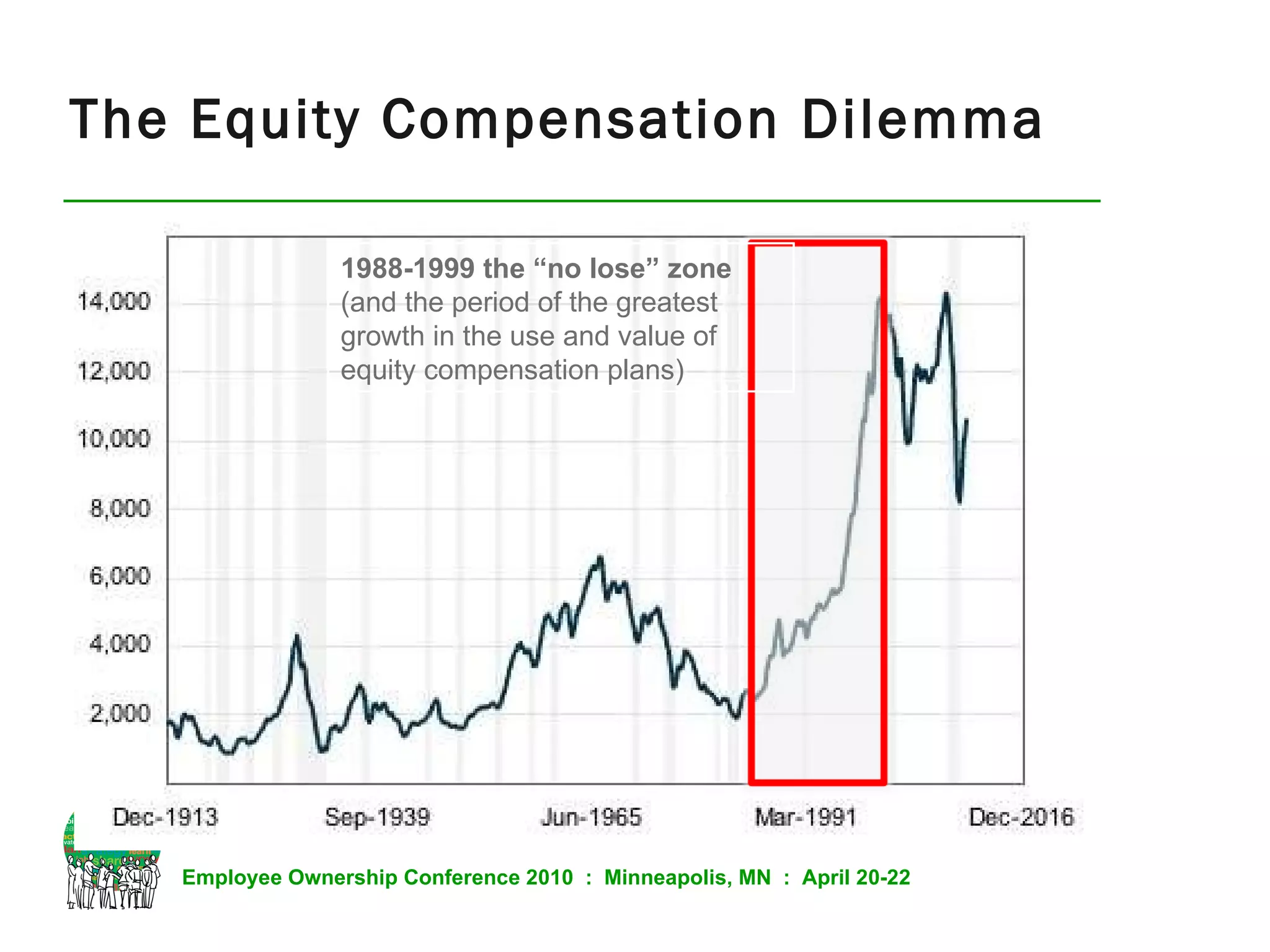
The Equity Compensation Dilemma 1988-1999 the “no lose” zone  (and the period of the greatest   growth in the use and value of equity compensation plans)
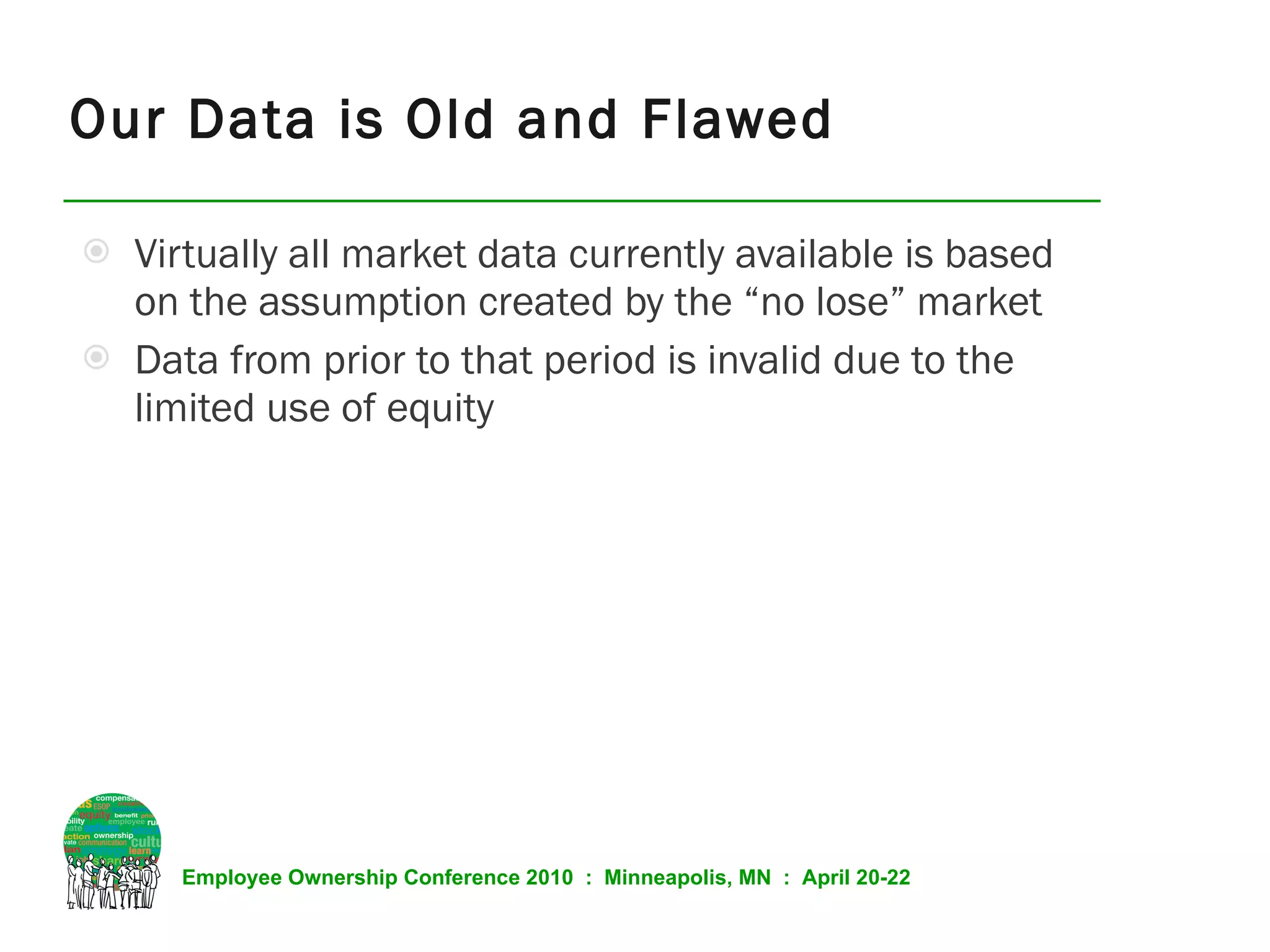
Virtually all market data currently available is based on the assumption created by the “no lose” market Data from prior to that period is invalid due to the limited use of equity Our Data is Old and Flawed
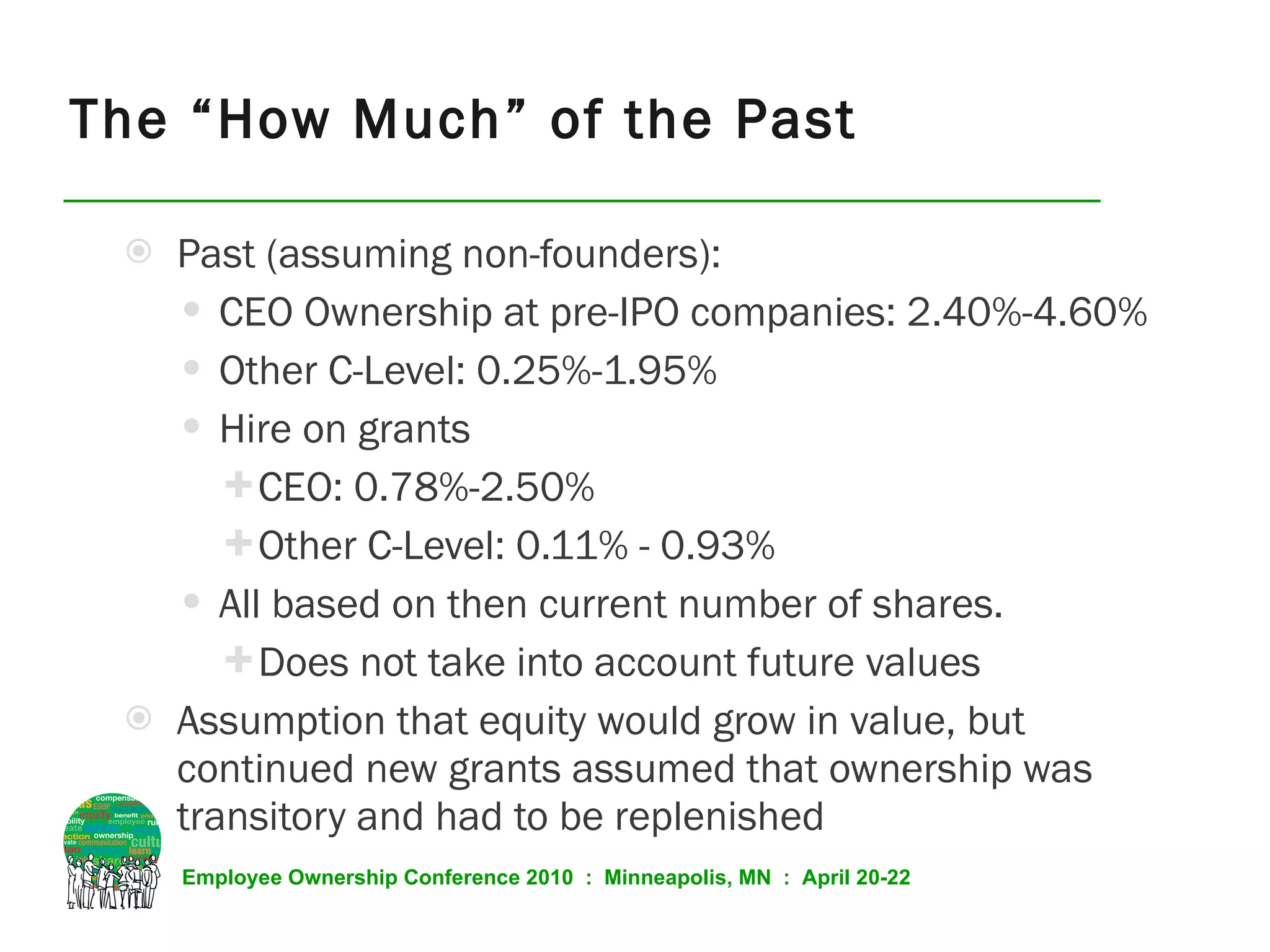
Past (assuming non-founders):  CEO Ownership at pre-IPO companies: 2.40%-4.60% Other C-Level: 0.25%-1.95% Hire on grants CEO: 0.78%-2.50% Other C-Level: 0.11% - 0.93% All based on then current number of shares. Does not take into account future values Assumption that equity would grow in value, but continued new grants assumed that ownership was transitory and had to be replenished The “How Much” of the Past
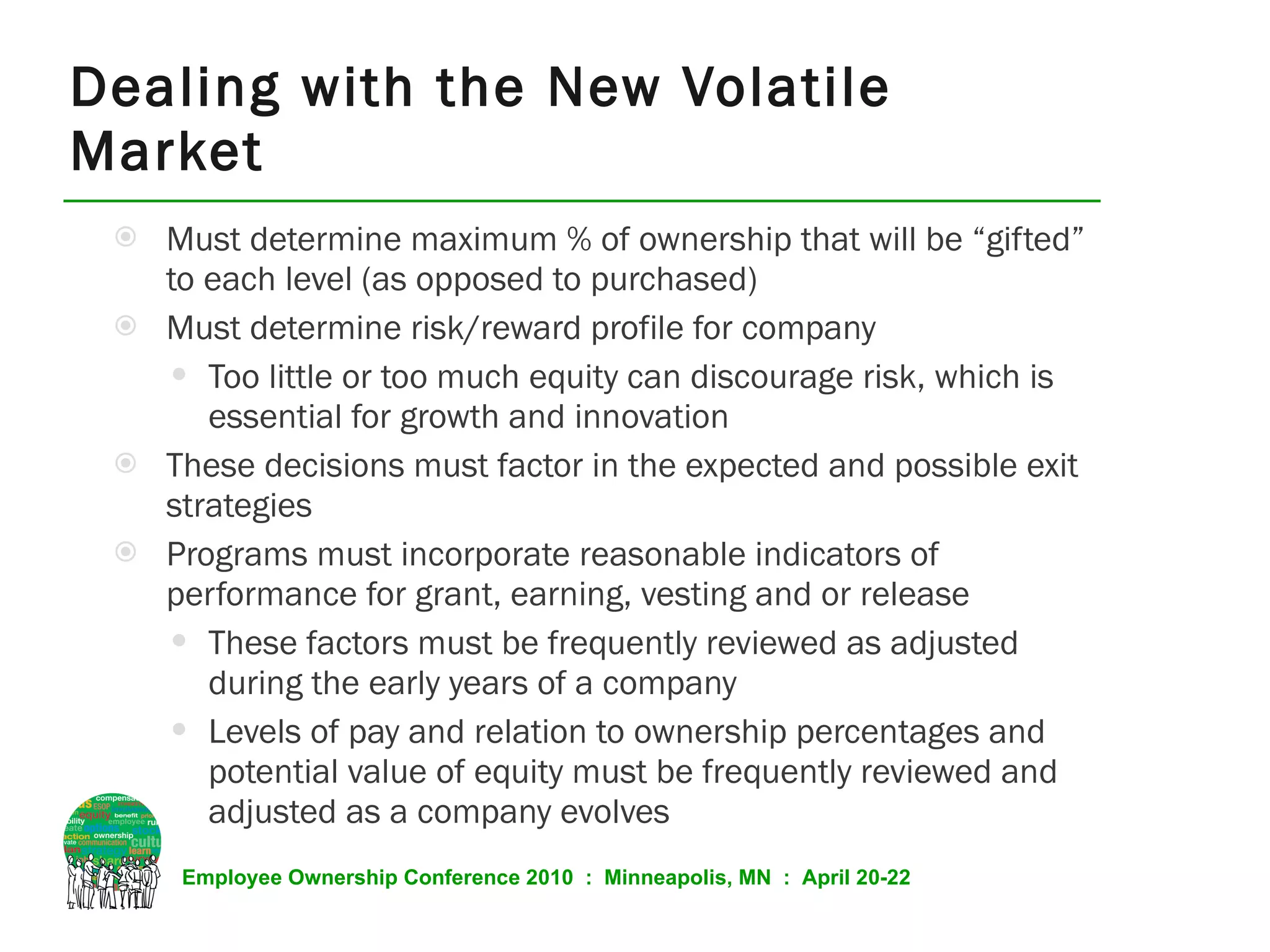
Must determine maximum % of ownership that will be “gifted” to each level (as opposed to purchased) Must determine risk/reward profile for company Too little or too much equity can discourage risk, which is essential for growth and innovation These decisions must factor in the expected and possible exit strategies Programs must incorporate reasonable indicators of performance for grant, earning, vesting and or release These factors must be frequently reviewed as adjusted during the early years of a company Levels of pay and relation to ownership percentages and potential value of equity must be frequently reviewed and adjusted as a company evolves Dealing with the New Volatile Market
More emphasis being put on linking equity explicitly or implicitly to financial, operational, team an individual performance. Not always “performance-based equity” Often “justification-based equity” Multiple studies link better corporate performance with higher levels of management ownership Studies commonly show a link between broad-based ownership and improved corporate performance Companies are starting to come off the euphoria and false conclusions caused to the “no lose” decade  and starting to accept the combined impact of expensing, a volatile market, equity programs failures and increased shareholder activism Equity Evolution
Focus first on your corporate goals, before you focus on market data Design plans based on “just” compensation levels, rather than “fair” compensation levels Today’s answers may not be valid a year or two from now, so don’t write too much in stone The 10 commandments are short and so is the US Constitution.  Your Rules should define and guide, not dictate and control Planning for Equity Compensation Success
Questions  Contact Us. John H. Brown, President Business Enterprise Institute, Inc. 888-206-3009 jbrown@exitplanning.com  Contact Us. Dan Walter, President and CEO Performensation 877-803-9255 x. 700 [email_address] Skype: performensation Twitter: @performensation www.performensation.com

Equity Comp - Who and How much to give

  • 1.
    John Brown Attorneyand Founder of BEI Employee Ownership Conference Minneapolis, MN : April 20-22, 2010 Dan Walter President and CEO Performensation
  • 2.
    Introduction Exit Planningand Equity Compensation Basic Question: Why should I consider incentive equity compensation for my company? Advantages of equity as an incentive. Advantages of cash as an incentive.
  • 3.
    Overview: Equity BasedCompensation Design Considerations Who How much When Why How to measure, basis for award, performance standard.
  • 4.
    Exit Planning PerspectiveOwner-managed companies in transition. Baby Boomer business owners. Most want to exit . Need management team and other key employees motivated to stay after owner leaves and to grow value. Size of Company: 15 employees – 500 or so. What does it take for an owner to be able to exit – via ESOP or any other path?
  • 5.
    Seven Step ExitPlanning Process Step 1 – Identify Owner Exit Objectives Step 2 – Quantify Business and Personal Financial Resources Step 3 – Maximize and Protect Business Value Step 4 – Ownership Transfer to Third Parties Step 5 – Ownership Transfer to Insiders Step 6 – Business Continuity Step 7 – Personal Wealth and Estate Planning
  • 6.
    ESOP Perspective: ShouldESOP Trustees approach equity ownership decisions in same way as owners interested in exiting their businesses? ESOP Trustees represent ownership and much like departing owners may not be actively involved in the day to day business. ESOPS want management and key employees to: Stay through owner’s exit; To have the same incentive to grow business as does ownership. To grow business value long term & continually.
  • 7.
    Advantages of EquityBased Incentive Compensation. More effective than cash in motivating or retaining the key employee. It is part of the owner’s exit strategy to transfer ownership to key employee(s). It is cashless. It is in anticipation of a third party sale and the owner wishes to benefit selected employees with capital gains treatment.
  • 8.
    Advantages of cashbased incentive compensation More effective than stock in motivating and keeping key employees. If they have to pay for equity, most employees prefer cash to ownership. Owner’s do not want more owners. More Flexible. Owner’s exit path is third party sale or transfer to family.
  • 9.
    Benefit Formulas Performancebased. Usually calculated annually. Performance standard benefits the owners. Subject to “vesting”. Usually long term goal is to grow value to a certain level or over a certain time based on owner’s exit objectives.
  • 10.
    What do wemean by “Who should get how much”? Who are the stakeholders? Is Equity Fair and/or Just? Is How much defined as: Amount in “money” Amount in “shares” Amount in “ownership percentage” The Other Side of Equity
  • 11.
    What is meantby “Equity” eq·ui·ty, n. pl. eq·ui·ties 1. The state, quality, or ideal of being just, impartial, and fair . 2. Something that is just, impartial, and fair. 3. Law a. Justice applied in circumstances covered by law yet influenced by principles of ethics and fairness; b. A system of jurisprudence supplementing and serving to modify the rigor of common law; c. An equitable right or claim; d. Equity of redemption. 4. The residual value of a business or property beyond any mortgage thereon and liability therein. 5. a. The market value of securities less any debt incurred; b. Common stock and preferred stock. 6. Funds provided to a business by the sale of stock. Source: www.freedictionary.com
  • 12.
    Is Equity Compensationtruly “Fair”? Fair, adj. 1 . free from discrimination , dishonesty, etc.; just; impartial 2. in conformity with rules or standards; legitimate a fair fight 3. (of the hair or complexion) light in colour 4. beautiful or lovely to look at 5. moderately or quite good a fair piece of work 6. unblemished; untainted Source: freedictionary.com
  • 13.
    Can Equity Compensationbe “Just”? Just, adj. 1. Honorable and fair in one's dealings and actions: a just ruler. 2. Consistent with what is morally right; righteous: a just cause. 3. Properly due or merited : just deserts. 4. Law Valid within the law; lawful: just claims. 5. Suitable or proper in nature ; fitting: a just touch of solemnity. 6. Based on fact or sound reason ; well-founded: a just appraisal. Source: freedictionary.com
  • 14.
    Common Reasons forEquity Compensation Private Co. Someday go public Someday get acquired Focus is extended period growth Ensure strong shareholder support if there are other investors Not planning to go public Public Co. Attract, Motivate and Retain high quality staff Align staff with management and shareholders Provide wealth-building potential Create owners, especially among those who may not otherwise buy stock Provide upside potential commensurate with growth in company stock price / market Any Co. Drive and reward success of stakeholders
  • 15.
    Define the stakeholdersDefine corporate goals Understand impact of equity plans on each type of goal Define acceptable risk/reward profiles for immediate needs and projected against “success” Determine market pay requirements Determine best case and worst case scenarios Document plan for at least three paths Acceptable growth Shrinkage Outperform Determining Who and How Much
  • 16.
    Performance was alwaysthe stated “reason” for offering equity. “ We want people to share in the success and growth of the company” NOTE: Very little mention of failure and demise of the company Is performance simply stock price? Total Shareholder Return? When does the progression of stock price no longer provide a reasonable link to pay? Linking Equity to Performance
  • 17.
    The Equity CompensationDilemma 1988-1999 the “no lose” zone (and the period of the greatest growth in the use and value of equity compensation plans)
  • 18.
    Virtually all marketdata currently available is based on the assumption created by the “no lose” market Data from prior to that period is invalid due to the limited use of equity Our Data is Old and Flawed
  • 19.
    Past (assuming non-founders): CEO Ownership at pre-IPO companies: 2.40%-4.60% Other C-Level: 0.25%-1.95% Hire on grants CEO: 0.78%-2.50% Other C-Level: 0.11% - 0.93% All based on then current number of shares. Does not take into account future values Assumption that equity would grow in value, but continued new grants assumed that ownership was transitory and had to be replenished The “How Much” of the Past
  • 20.
    Must determine maximum% of ownership that will be “gifted” to each level (as opposed to purchased) Must determine risk/reward profile for company Too little or too much equity can discourage risk, which is essential for growth and innovation These decisions must factor in the expected and possible exit strategies Programs must incorporate reasonable indicators of performance for grant, earning, vesting and or release These factors must be frequently reviewed as adjusted during the early years of a company Levels of pay and relation to ownership percentages and potential value of equity must be frequently reviewed and adjusted as a company evolves Dealing with the New Volatile Market
  • 21.
    More emphasis beingput on linking equity explicitly or implicitly to financial, operational, team an individual performance. Not always “performance-based equity” Often “justification-based equity” Multiple studies link better corporate performance with higher levels of management ownership Studies commonly show a link between broad-based ownership and improved corporate performance Companies are starting to come off the euphoria and false conclusions caused to the “no lose” decade and starting to accept the combined impact of expensing, a volatile market, equity programs failures and increased shareholder activism Equity Evolution
  • 22.
    Focus first onyour corporate goals, before you focus on market data Design plans based on “just” compensation levels, rather than “fair” compensation levels Today’s answers may not be valid a year or two from now, so don’t write too much in stone The 10 commandments are short and so is the US Constitution. Your Rules should define and guide, not dictate and control Planning for Equity Compensation Success
  • 23.
    Questions ContactUs. John H. Brown, President Business Enterprise Institute, Inc. 888-206-3009 jbrown@exitplanning.com Contact Us. Dan Walter, President and CEO Performensation 877-803-9255 x. 700 [email_address] Skype: performensation Twitter: @performensation www.performensation.com