
Employee Equity Incentives
          Presented by Bart Greenberg
          Haynes and Boone, LLP

          Tech Coast Venture Network
          Monthly Workshop Series
          May 5, 2011


© 2010 Haynes and Boone, LLP
What Considerations Typically
      Influence Plan Design?


June 3, 2010                   Employee Equity Incentives
© 2010 Haynes and Boone, LLP
Business Purpose for the Plan
                  Recruit and retain scarce talent
                  Motivate employees to perform
                  Align employee interests with owners
                  Create a compensation “fill-gap”
                  Facilitate succession planning


June 3, 2010                      Employee Equity Incentives
© 2010 Haynes and Boone, LLP
Ownership and Management
               What is the current ownership structure of the
                Company?
               Are these owners willing to dilute their
                ownership position?
               Is voting control an issue?
               How will the extension of equity be viewed by
                the existing management?


June 3, 2010                     Employee Equity Incentives
© 2010 Haynes and Boone, LLP
Legal Form of the Company
               Sole Proprietorship
               Partnership
                  General
                  Limited
               Corporation
                  S Corporation
                  C Corporation
               Limited Liability Company
               Limited Liability Partnership
               Professional Businesses

June 3, 2010                       Employee Equity Incentives
© 2010 Haynes and Boone, LLP
Capital Needs of the Company

                      Does the Company need capital?
                      Will the Company be seeking outside
                       investors?
                      How would prospective investors view the
                       plan?


June 3, 2010                         Employee Equity Incentives
© 2010 Haynes and Boone, LLP
Company’s Financial Situation

           What is the financial condition of the Company?
              Is the Company generating profits?
              What is the cash position of the Company?
           Will it be cost effective for the Company to
            implement and administer the plan?
              What are the costs to the Company?
              What are the costs to the employee?
           How will the proposed plan affect the Company’s
            financial statements?


June 3, 2010                   Employee Equity Incentives
© 2010 Haynes and Boone, LLP
Future Growth Plans
                  What is the growth projection for the
                   Company?
                     Start-up with great growth potential
                     Mature company with slower growth
                  How will liquidity of the investment be
                   obtained?
                     Cash award or redemption
                     Liquidity event of Company


June 3, 2010                      Employee Equity Incentives
© 2010 Haynes and Boone, LLP
Company Culture
                 What is the Company’s culture?
                    Individual-based compensation approach;
                     or
                    Broad-based compensation approach
                 How will the plan be perceived by employees?
                    Is it designed to reinforce the Company
                     culture?
                    Will it be perceived by employees as being
                     fair?


June 3, 2010                      Employee Equity Incentives
© 2010 Haynes and Boone, LLP
Industry Norms

                     Employee desires, expectations and needs
                     What is the competitive landscape?


June 3, 2010                        Employee Equity Incentives
© 2010 Haynes and Boone, LLP
Tax Considerations
                   What are the available tax incentives for the
                    Company?
                      Deductibility of the award
                      Obligation to withhold
                   What are the available tax incentives for the
                    Employee?
                      Will there be recognition of income?
                      Capacity to pay withholding obligations
                      Compensation income vs. capital gains


June 3, 2010                        Employee Equity Incentives
© 2010 Haynes and Boone, LLP
Tax Considerations                 (cont.)


              Pitfalls to avoid
                 Deferred compensation taxation (Section 409A)
                 Parachute payment taxation (Section 280G)


June 3, 2010                   Employee Equity Incentives
© 2010 Haynes and Boone, LLP
Specific Plan Design Issues


June 3, 2010                   Employee Equity Incentives
© 2010 Haynes and Boone, LLP
Types of Plans

                   Direct Stock Purchases
                   Stock Options
                   Phantom Stock and Share Appreciation Rights


June 3, 2010                        Employee Equity Incentives
© 2010 Haynes and Boone, LLP
Direct Stock Purchases


June 3, 2010                    Employee Equity Incentives
© 2010 Haynes and Boone, LLP
Eligibility and Participation

                 Typically, individual-based approach
                 Potentially, broad-based approach via stock
                  purchase plan


June 3, 2010                      Employee Equity Incentives
© 2010 Haynes and Boone, LLP
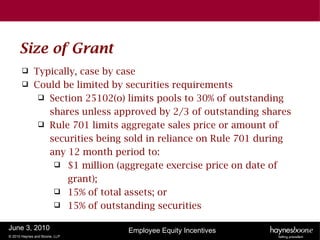
Size of Grant
        Typically, case by case
        Could be limited by securities requirements
           Section 25102(o) limits pools to 30% of outstanding
            shares unless approved by 2/3 of outstanding shares
           Rule 701 limits aggregate sales price or amount of
            securities being sold in reliance on Rule 701 during
            any 12 month period to:
              $1 million (aggregate exercise price on date of
                grant);
              15% of total assets; or
              15% of outstanding securities


June 3, 2010                   Employee Equity Incentives
© 2010 Haynes and Boone, LLP
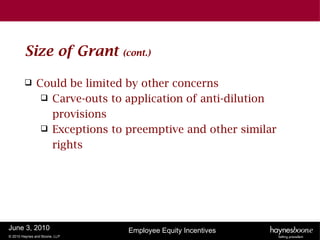
Size of Grant          (cont.)


              Could be limited by other concerns
                 Carve-outs to application of anti-dilution
                  provisions
                 Exceptions to preemptive and other similar
                  rights


June 3, 2010                    Employee Equity Incentives
© 2010 Haynes and Boone, LLP
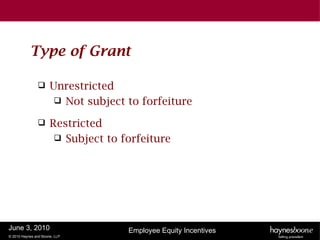
Type of Grant

                     Unrestricted
                        Not subject to forfeiture

                     Restricted
                        Subject to forfeiture


June 3, 2010                         Employee Equity Incentives
© 2010 Haynes and Boone, LLP
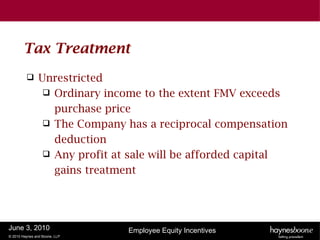
Tax Treatment
               Unrestricted
                  Ordinary income to the extent FMV exceeds
                   purchase price
                  The Company has a reciprocal compensation
                   deduction
                  Any profit at sale will be afforded capital
                   gains treatment


June 3, 2010                    Employee Equity Incentives
© 2010 Haynes and Boone, LLP
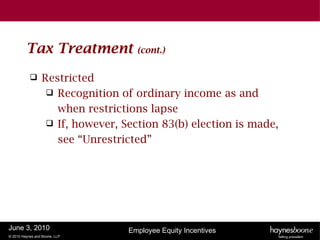
Tax Treatment               (cont.)


                 Restricted
                    Recognition of ordinary income as and
                     when restrictions lapse
                    If, however, Section 83(b) election is made,
                     see “Unrestricted”


June 3, 2010                       Employee Equity Incentives
© 2010 Haynes and Boone, LLP
Payment of Purchase Price
               All cash
               All note
                  If permitted pursuant to a stock purchase
                   plan; or
                  If adequately secured by collateral other than
                   shares
                  Sarbanes-Oxley prohibition on loans to top-
                   level officers should be considered


June 3, 2010                     Employee Equity Incentives
© 2010 Haynes and Boone, LLP
Payment of Purchase Price                            (cont.)


              Combination of any of the above
              Other types of legal consideration
                 Labor or Services Actually Rendered
                 Debts or Securities Cancelled
                 Tangible or Intangible Property
                 Section 83(b) election may be challenged if
                  significant portion of payment (typically 80%
                  or more) consists of a nonrecourse note


June 3, 2010                    Employee Equity Incentives
© 2010 Haynes and Boone, LLP
Vesting
                     Passage of Time
                     Performance Based
                        Individual Performance
                        Company Performance
                     Combination of Time and Performance Vesting
                     Acceleration of Vesting
                        Determination of Triggers
                        Accounting Considerations


June 3, 2010                       Employee Equity Incentives
© 2010 Haynes and Boone, LLP
Purchase Price

               Subject to securities requirements and tax issues,
                no restrictions


June 3, 2010                     Employee Equity Incentives
© 2010 Haynes and Boone, LLP
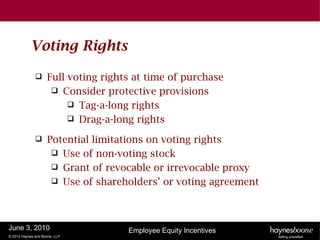
Voting Rights

                   Full voting rights at time of purchase
                      Consider protective provisions
                          Tag-a-long rights
                          Drag-a-long rights

                   Potential limitations on voting rights
                      Use of non-voting stock
                      Grant of revocable or irrevocable proxy
                      Use of shareholders’ or voting agreement


June 3, 2010                         Employee Equity Incentives
© 2010 Haynes and Boone, LLP
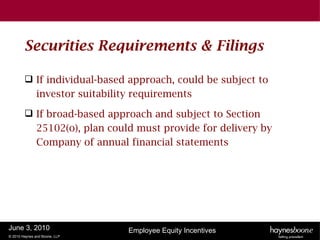
Securities Requirements & Filings

         If individual-based approach, could be subject to
          investor suitability requirements

         If broad-based approach and subject to Section
          25102(o), plan could must provide for delivery by
          Company of annual financial statements


June 3, 2010                   Employee Equity Incentives
© 2010 Haynes and Boone, LLP
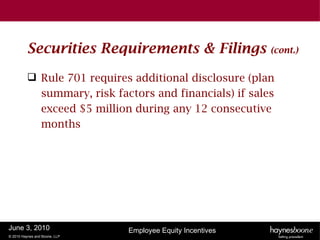
Securities Requirements & Filings                  (cont.)


           Rule 701 requires additional disclosure (plan
            summary, risk factors and financials) if sales
            exceed $5 million during any 12 consecutive
            months


June 3, 2010                   Employee Equity Incentives
© 2010 Haynes and Boone, LLP
Stock Options


June 3, 2010                      Employee Equity Incentives
© 2010 Haynes and Boone, LLP
Eligibility and Participation
            A broad-based approach through use of plan

            Potentially, individual-based approach through:

                     Limited grants of options under plan
                     Grant of options outside of any plan


June 3, 2010                       Employee Equity Incentives
© 2010 Haynes and Boone, LLP
Size of Option Pool
              Typically, case by case
              Could be limited by securities requirements
                 Section 25102(o) limits pools to 30% of outstanding
                  shares unless approved by 2/3 of outstanding
                  shares
                 Rule 701 limits aggregate sales price or amount of
                  securities being sold in reliance on Rule 701 during
                  any 12 month period to:
                    $1 million (aggregate exercise price on date of
                       grant);
                    15% of total assets; or
                    15% of outstanding securities

June 3, 2010                      Employee Equity Incentives
© 2010 Haynes and Boone, LLP
Size of Option Pool            (cont.)


              Could be limited by other concerns
                 Carve-outs to application of anti-dilution
                  provisions
                 Exceptions to preemptive and other similar
                  rights


June 3, 2010                   Employee Equity Incentives
© 2010 Haynes and Boone, LLP
Size of Option Grant
           Typically, left to the discretion of the board


June 3, 2010                   Employee Equity Incentives
© 2010 Haynes and Boone, LLP
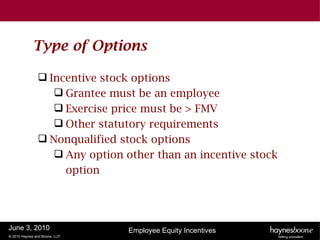
Type of Options

                Incentive stock options
                   Grantee must be an employee
                   Exercise price must be > FMV
                   Other statutory requirements
                Nonqualified stock options
                   Any option other than an incentive stock
                    option


June 3, 2010                    Employee Equity Incentives
© 2010 Haynes and Boone, LLP
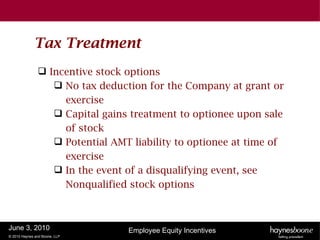
Tax Treatment
                Incentive stock options
                   No tax deduction for the Company at grant or
                    exercise
                   Capital gains treatment to optionee upon sale
                    of stock
                   Potential AMT liability to optionee at time of
                    exercise
                   In the event of a disqualifying event, see
                    Nonqualified stock options


June 3, 2010                     Employee Equity Incentives
© 2010 Haynes and Boone, LLP
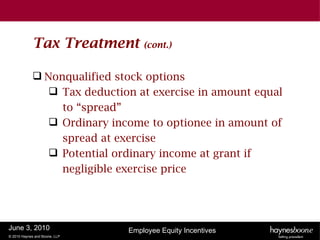
Tax Treatment          (cont.)


              Nonqualified stock options
                 Tax deduction at exercise in amount equal
                  to “spread”
                 Ordinary income to optionee in amount of
                  spread at exercise
                 Potential ordinary income at grant if
                  negligible exercise price


June 3, 2010                   Employee Equity Incentives
© 2010 Haynes and Boone, LLP
Tax Treatment          (cont.)


              [Potentially] subject to deferred compensation
               taxation (accelerated taxation, interest charge
               and 20% excise tax) if exercise price < FMV


June 3, 2010                   Employee Equity Incentives
© 2010 Haynes and Boone, LLP
Exercise Price

               Incentive stock option
                  Must be FMV at time of grant (110% if 10%
                   shareholder)

               Nonqualified stock option
                  For tax purposes, no restriction (however, may
                   be subject to deferred compensation taxation
                   under Section 409A if < FMV)


June 3, 2010                     Employee Equity Incentives
© 2010 Haynes and Boone, LLP
Vesting
               Passage of Time
                  Performance Based
                  Individual Performance
                  Company Performance


June 3, 2010                    Employee Equity Incentives
© 2010 Haynes and Boone, LLP
Vesting           (cont.)

                Combination of Time and Performance Vesting

                Acceleration of Vesting
                   Definition of Triggers
                   Accounting Considerations


June 3, 2010                             Employee Equity Incentives
© 2010 Haynes and Boone, LLP
Term and Termination
            Incentive stock options
               No option may be granted after 10th
                anniversary of Plan
               Limitations on periods after termination of
                employment by which option must be
                exercised
            Nonqualified stock options
               Section 25102(o) provides that no option may
                be granted after 10th anniversary of Plan
               Section 25102(o) limits periods of time by
                which option must be exercised

June 3, 2010                   Employee Equity Incentives
© 2010 Haynes and Boone, LLP
Payment of Shares
               All cash
               All note
                  If permitted pursuant to a stock option
                   plan; or
                  If adequately secured by collateral other
                   than shares
                  Sarbanes-Oxley prohibition on loans to top-
                   level officers should be considered


June 3, 2010                   Employee Equity Incentives
© 2010 Haynes and Boone, LLP
Payment of Shares              (cont.)


              Other types of legal consideration
                Labor or Services Actually Rendered
                Debts or Securities Cancelled
                Surrender of Option Shares
                Tangible or Intangible Property


June 3, 2010                   Employee Equity Incentives
© 2010 Haynes and Boone, LLP
Voting Rights

                Full voting rights at time of purchase

                Consider protective provisions
                  Tag-a-long rights
                  Drag-a-long rights

                Potential limitations on voting rights
                   Use of non-voting stock
                   Grant of revocable or irrevocable proxy
                   Use of shareholders’ or voting agreement


June 3, 2010                       Employee Equity Incentives
© 2010 Haynes and Boone, LLP
Securities Requirements & Filings

        If individual-based approach, could be subject to
         investor suitability requirements
        If broad-based approach and subject to Section 25102(o),
         plan must provide for delivery by Company of annual
         financial statements


June 3, 2010                   Employee Equity Incentives
© 2010 Haynes and Boone, LLP
Securities Requirements & Filings                     (cont.)


            Rule 701 requires additional disclosure (plan
             summary, risk factors and financials) if sales
             exceed $5 million during any 12 consecutive
             months

            The number of option holders should be closely
             watched so that the company does not trigger
             reporting requirements when the exercises occur.


June 3, 2010                   Employee Equity Incentives
© 2010 Haynes and Boone, LLP
Phantom Stock and
                  Share Appreciation Rights


June 3, 2010                   Employee Equity Incentives
© 2010 Haynes and Boone, LLP
Eligibility and Participation

           Typically, individual-based approach

           Potentially, broad-based approach through plan


June 3, 2010                   Employee Equity Incentives
© 2010 Haynes and Boone, LLP
Size of Grant

              No restrictions


June 3, 2010                     Employee Equity Incentives
© 2010 Haynes and Boone, LLP
Tax Treatment
            Company has tax deduction on date of
             payment in amount equal to appreciation
            Ordinary income to employee at time of
             payment
            Deferred compensation taxation (accelerated
             taxation, interest charge and 20% excise tax)
             may apply


June 3, 2010                   Employee Equity Incentives
© 2010 Haynes and Boone, LLP
Accounting Treatment

            Benefits must be entered as an expense and
             book liability for accounting purposes when
             and as accrued


June 3, 2010                   Employee Equity Incentives
© 2010 Haynes and Boone, LLP
“Exercise Price”
               No restrictions


June 3, 2010                      Employee Equity Incentives
© 2010 Haynes and Boone, LLP
“Payment for Shares”
              No actual payment is made

              Employee receives cash award equal to
               difference between unit value and FMV


June 3, 2010                   Employee Equity Incentives
© 2010 Haynes and Boone, LLP
Voting Rights

               None


June 3, 2010                   Employee Equity Incentives
© 2010 Haynes and Boone, LLP
Securities Requirements & Filings

               In general, as no equity is involved, securities
                laws are not applicable

               However, there is a new trend to settle with
                shares, not cash, which raises security law
                issues


June 3, 2010                    Employee Equity Incentives
© 2010 Haynes and Boone, LLP
Questions?


June 3, 2010                     Employee Equity Incentives
© 2010 Haynes and Boone, LLP
Thank you!


    Bart Greenberg
    Haynes and Boone, LLP
    (949) 202-3037
    bart.greenberg@haynesboone.com

June 3, 2010                     Employee Equity Incentives
© 2010 Haynes and Boone, LLP

Employee equity incentives

  • 1.
    Employee Equity Incentives Presented by Bart Greenberg Haynes and Boone, LLP Tech Coast Venture Network Monthly Workshop Series May 5, 2011 © 2010 Haynes and Boone, LLP
  • 2.
    What Considerations Typically Influence Plan Design? June 3, 2010 Employee Equity Incentives © 2010 Haynes and Boone, LLP
  • 3.
    Business Purpose forthe Plan  Recruit and retain scarce talent  Motivate employees to perform  Align employee interests with owners  Create a compensation “fill-gap”  Facilitate succession planning June 3, 2010 Employee Equity Incentives © 2010 Haynes and Boone, LLP
  • 4.
    Ownership and Management  What is the current ownership structure of the Company?  Are these owners willing to dilute their ownership position?  Is voting control an issue?  How will the extension of equity be viewed by the existing management? June 3, 2010 Employee Equity Incentives © 2010 Haynes and Boone, LLP
  • 5.
    Legal Form ofthe Company  Sole Proprietorship  Partnership  General  Limited  Corporation  S Corporation  C Corporation  Limited Liability Company  Limited Liability Partnership  Professional Businesses June 3, 2010 Employee Equity Incentives © 2010 Haynes and Boone, LLP
  • 6.
    Capital Needs ofthe Company  Does the Company need capital?  Will the Company be seeking outside investors?  How would prospective investors view the plan? June 3, 2010 Employee Equity Incentives © 2010 Haynes and Boone, LLP
  • 7.
    Company’s Financial Situation  What is the financial condition of the Company?  Is the Company generating profits?  What is the cash position of the Company?  Will it be cost effective for the Company to implement and administer the plan?  What are the costs to the Company?  What are the costs to the employee?  How will the proposed plan affect the Company’s financial statements? June 3, 2010 Employee Equity Incentives © 2010 Haynes and Boone, LLP
  • 8.
    Future Growth Plans  What is the growth projection for the Company?  Start-up with great growth potential  Mature company with slower growth  How will liquidity of the investment be obtained?  Cash award or redemption  Liquidity event of Company June 3, 2010 Employee Equity Incentives © 2010 Haynes and Boone, LLP
  • 9.
    Company Culture  What is the Company’s culture?  Individual-based compensation approach; or  Broad-based compensation approach  How will the plan be perceived by employees?  Is it designed to reinforce the Company culture?  Will it be perceived by employees as being fair? June 3, 2010 Employee Equity Incentives © 2010 Haynes and Boone, LLP
  • 10.
    Industry Norms  Employee desires, expectations and needs  What is the competitive landscape? June 3, 2010 Employee Equity Incentives © 2010 Haynes and Boone, LLP
  • 11.
    Tax Considerations  What are the available tax incentives for the Company?  Deductibility of the award  Obligation to withhold  What are the available tax incentives for the Employee?  Will there be recognition of income?  Capacity to pay withholding obligations  Compensation income vs. capital gains June 3, 2010 Employee Equity Incentives © 2010 Haynes and Boone, LLP
  • 12.
    Tax Considerations (cont.)  Pitfalls to avoid  Deferred compensation taxation (Section 409A)  Parachute payment taxation (Section 280G) June 3, 2010 Employee Equity Incentives © 2010 Haynes and Boone, LLP
  • 13.
    Specific Plan DesignIssues June 3, 2010 Employee Equity Incentives © 2010 Haynes and Boone, LLP
  • 14.
    Types of Plans  Direct Stock Purchases  Stock Options  Phantom Stock and Share Appreciation Rights June 3, 2010 Employee Equity Incentives © 2010 Haynes and Boone, LLP
  • 15.
    Direct Stock Purchases June3, 2010 Employee Equity Incentives © 2010 Haynes and Boone, LLP
  • 16.
    Eligibility and Participation  Typically, individual-based approach  Potentially, broad-based approach via stock purchase plan June 3, 2010 Employee Equity Incentives © 2010 Haynes and Boone, LLP
  • 17.
    Size of Grant  Typically, case by case  Could be limited by securities requirements  Section 25102(o) limits pools to 30% of outstanding shares unless approved by 2/3 of outstanding shares  Rule 701 limits aggregate sales price or amount of securities being sold in reliance on Rule 701 during any 12 month period to:  $1 million (aggregate exercise price on date of grant);  15% of total assets; or  15% of outstanding securities June 3, 2010 Employee Equity Incentives © 2010 Haynes and Boone, LLP
  • 18.
    Size of Grant (cont.)  Could be limited by other concerns  Carve-outs to application of anti-dilution provisions  Exceptions to preemptive and other similar rights June 3, 2010 Employee Equity Incentives © 2010 Haynes and Boone, LLP
  • 19.
    Type of Grant  Unrestricted  Not subject to forfeiture  Restricted  Subject to forfeiture June 3, 2010 Employee Equity Incentives © 2010 Haynes and Boone, LLP
  • 20.
    Tax Treatment  Unrestricted  Ordinary income to the extent FMV exceeds purchase price  The Company has a reciprocal compensation deduction  Any profit at sale will be afforded capital gains treatment June 3, 2010 Employee Equity Incentives © 2010 Haynes and Boone, LLP
  • 21.
    Tax Treatment (cont.)  Restricted  Recognition of ordinary income as and when restrictions lapse  If, however, Section 83(b) election is made, see “Unrestricted” June 3, 2010 Employee Equity Incentives © 2010 Haynes and Boone, LLP
  • 22.
    Payment of PurchasePrice  All cash  All note  If permitted pursuant to a stock purchase plan; or  If adequately secured by collateral other than shares  Sarbanes-Oxley prohibition on loans to top- level officers should be considered June 3, 2010 Employee Equity Incentives © 2010 Haynes and Boone, LLP
  • 23.
    Payment of PurchasePrice (cont.)  Combination of any of the above  Other types of legal consideration  Labor or Services Actually Rendered  Debts or Securities Cancelled  Tangible or Intangible Property  Section 83(b) election may be challenged if significant portion of payment (typically 80% or more) consists of a nonrecourse note June 3, 2010 Employee Equity Incentives © 2010 Haynes and Boone, LLP
  • 24.
    Vesting  Passage of Time  Performance Based  Individual Performance  Company Performance  Combination of Time and Performance Vesting  Acceleration of Vesting  Determination of Triggers  Accounting Considerations June 3, 2010 Employee Equity Incentives © 2010 Haynes and Boone, LLP
  • 25.
    Purchase Price  Subject to securities requirements and tax issues, no restrictions June 3, 2010 Employee Equity Incentives © 2010 Haynes and Boone, LLP
  • 26.
    Voting Rights  Full voting rights at time of purchase  Consider protective provisions  Tag-a-long rights  Drag-a-long rights  Potential limitations on voting rights  Use of non-voting stock  Grant of revocable or irrevocable proxy  Use of shareholders’ or voting agreement June 3, 2010 Employee Equity Incentives © 2010 Haynes and Boone, LLP
  • 27.
    Securities Requirements &Filings  If individual-based approach, could be subject to investor suitability requirements  If broad-based approach and subject to Section 25102(o), plan could must provide for delivery by Company of annual financial statements June 3, 2010 Employee Equity Incentives © 2010 Haynes and Boone, LLP
  • 28.
    Securities Requirements &Filings (cont.)  Rule 701 requires additional disclosure (plan summary, risk factors and financials) if sales exceed $5 million during any 12 consecutive months June 3, 2010 Employee Equity Incentives © 2010 Haynes and Boone, LLP
  • 29.
    Stock Options June 3,2010 Employee Equity Incentives © 2010 Haynes and Boone, LLP
  • 30.
    Eligibility and Participation  A broad-based approach through use of plan  Potentially, individual-based approach through:  Limited grants of options under plan  Grant of options outside of any plan June 3, 2010 Employee Equity Incentives © 2010 Haynes and Boone, LLP
  • 31.
    Size of OptionPool  Typically, case by case  Could be limited by securities requirements  Section 25102(o) limits pools to 30% of outstanding shares unless approved by 2/3 of outstanding shares  Rule 701 limits aggregate sales price or amount of securities being sold in reliance on Rule 701 during any 12 month period to:  $1 million (aggregate exercise price on date of grant);  15% of total assets; or  15% of outstanding securities June 3, 2010 Employee Equity Incentives © 2010 Haynes and Boone, LLP
  • 32.
    Size of OptionPool (cont.)  Could be limited by other concerns  Carve-outs to application of anti-dilution provisions  Exceptions to preemptive and other similar rights June 3, 2010 Employee Equity Incentives © 2010 Haynes and Boone, LLP
  • 33.
    Size of OptionGrant  Typically, left to the discretion of the board June 3, 2010 Employee Equity Incentives © 2010 Haynes and Boone, LLP
  • 34.
    Type of Options  Incentive stock options  Grantee must be an employee  Exercise price must be > FMV  Other statutory requirements  Nonqualified stock options  Any option other than an incentive stock option June 3, 2010 Employee Equity Incentives © 2010 Haynes and Boone, LLP
  • 35.
    Tax Treatment  Incentive stock options  No tax deduction for the Company at grant or exercise  Capital gains treatment to optionee upon sale of stock  Potential AMT liability to optionee at time of exercise  In the event of a disqualifying event, see Nonqualified stock options June 3, 2010 Employee Equity Incentives © 2010 Haynes and Boone, LLP
  • 36.
    Tax Treatment (cont.)  Nonqualified stock options  Tax deduction at exercise in amount equal to “spread”  Ordinary income to optionee in amount of spread at exercise  Potential ordinary income at grant if negligible exercise price June 3, 2010 Employee Equity Incentives © 2010 Haynes and Boone, LLP
  • 37.
    Tax Treatment (cont.)  [Potentially] subject to deferred compensation taxation (accelerated taxation, interest charge and 20% excise tax) if exercise price < FMV June 3, 2010 Employee Equity Incentives © 2010 Haynes and Boone, LLP
  • 38.
    Exercise Price  Incentive stock option  Must be FMV at time of grant (110% if 10% shareholder)  Nonqualified stock option  For tax purposes, no restriction (however, may be subject to deferred compensation taxation under Section 409A if < FMV) June 3, 2010 Employee Equity Incentives © 2010 Haynes and Boone, LLP
  • 39.
    Vesting  Passage of Time  Performance Based  Individual Performance  Company Performance June 3, 2010 Employee Equity Incentives © 2010 Haynes and Boone, LLP
  • 40.
    Vesting (cont.)  Combination of Time and Performance Vesting  Acceleration of Vesting  Definition of Triggers  Accounting Considerations June 3, 2010 Employee Equity Incentives © 2010 Haynes and Boone, LLP
  • 41.
    Term and Termination  Incentive stock options  No option may be granted after 10th anniversary of Plan  Limitations on periods after termination of employment by which option must be exercised  Nonqualified stock options  Section 25102(o) provides that no option may be granted after 10th anniversary of Plan  Section 25102(o) limits periods of time by which option must be exercised June 3, 2010 Employee Equity Incentives © 2010 Haynes and Boone, LLP
  • 42.
    Payment of Shares  All cash  All note  If permitted pursuant to a stock option plan; or  If adequately secured by collateral other than shares  Sarbanes-Oxley prohibition on loans to top- level officers should be considered June 3, 2010 Employee Equity Incentives © 2010 Haynes and Boone, LLP
  • 43.
    Payment of Shares (cont.)  Other types of legal consideration  Labor or Services Actually Rendered  Debts or Securities Cancelled  Surrender of Option Shares  Tangible or Intangible Property June 3, 2010 Employee Equity Incentives © 2010 Haynes and Boone, LLP
  • 44.
    Voting Rights  Full voting rights at time of purchase  Consider protective provisions  Tag-a-long rights  Drag-a-long rights  Potential limitations on voting rights  Use of non-voting stock  Grant of revocable or irrevocable proxy  Use of shareholders’ or voting agreement June 3, 2010 Employee Equity Incentives © 2010 Haynes and Boone, LLP
  • 45.
    Securities Requirements &Filings  If individual-based approach, could be subject to investor suitability requirements  If broad-based approach and subject to Section 25102(o), plan must provide for delivery by Company of annual financial statements June 3, 2010 Employee Equity Incentives © 2010 Haynes and Boone, LLP
  • 46.
    Securities Requirements &Filings (cont.)  Rule 701 requires additional disclosure (plan summary, risk factors and financials) if sales exceed $5 million during any 12 consecutive months  The number of option holders should be closely watched so that the company does not trigger reporting requirements when the exercises occur. June 3, 2010 Employee Equity Incentives © 2010 Haynes and Boone, LLP
  • 47.
    Phantom Stock and Share Appreciation Rights June 3, 2010 Employee Equity Incentives © 2010 Haynes and Boone, LLP
  • 48.
    Eligibility and Participation  Typically, individual-based approach  Potentially, broad-based approach through plan June 3, 2010 Employee Equity Incentives © 2010 Haynes and Boone, LLP
  • 49.
    Size of Grant  No restrictions June 3, 2010 Employee Equity Incentives © 2010 Haynes and Boone, LLP
  • 50.
    Tax Treatment  Company has tax deduction on date of payment in amount equal to appreciation  Ordinary income to employee at time of payment  Deferred compensation taxation (accelerated taxation, interest charge and 20% excise tax) may apply June 3, 2010 Employee Equity Incentives © 2010 Haynes and Boone, LLP
  • 51.
    Accounting Treatment  Benefits must be entered as an expense and book liability for accounting purposes when and as accrued June 3, 2010 Employee Equity Incentives © 2010 Haynes and Boone, LLP
  • 52.
    “Exercise Price”  No restrictions June 3, 2010 Employee Equity Incentives © 2010 Haynes and Boone, LLP
  • 53.
    “Payment for Shares”  No actual payment is made  Employee receives cash award equal to difference between unit value and FMV June 3, 2010 Employee Equity Incentives © 2010 Haynes and Boone, LLP
  • 54.
    Voting Rights  None June 3, 2010 Employee Equity Incentives © 2010 Haynes and Boone, LLP
  • 55.
    Securities Requirements &Filings  In general, as no equity is involved, securities laws are not applicable  However, there is a new trend to settle with shares, not cash, which raises security law issues June 3, 2010 Employee Equity Incentives © 2010 Haynes and Boone, LLP
  • 56.
    Questions? June 3, 2010 Employee Equity Incentives © 2010 Haynes and Boone, LLP
  • 57.
    Thank you! Bart Greenberg Haynes and Boone, LLP (949) 202-3037 bart.greenberg@haynesboone.com June 3, 2010 Employee Equity Incentives © 2010 Haynes and Boone, LLP