



Common Entrepreneur Mistakes
          Presented by Bart Greenberg
          Haynes and Boone, LLP

          Lloyd Greif Center for Entrepreneurial Studies
          Marshall School of Business, USC
          May 25, 2011


© 2010 Haynes and Boone, LLP
The Wrong Business Structure


© 2010 Haynes and Boone, LLP
The “De Facto” Partnership

      What is it?
      Problems:
              • Ownership of IP
              • Vicarious Liability


© 2010 Haynes and Boone, LLP
The “Wrong” State of Formation
      California vs. Delaware
              • California is shareholder friendly
              • Delaware is management friendly
      Special Case of the So-Called Quasi-
       California Corporation
      Why You DON’T Necessarily Want to
       Be in Nevada
              • You will most likely pay taxes
              • The law is not as well defined
© 2010 Haynes and Boone, LLP
Failing to Make the “S Election”
      Consequences of Subchapter S Election
              • Pass-Through of Income
              • Pass-Through of Losses
                       —Pros
                       —Cons
      DON’T Miss Filing Deadline
              • RU Dead in the water?
              • Retroactive S Election?

© 2010 Haynes and Boone, LLP
Keep it Simple!
      Don’t Over-Build at Start-Up. Avoid the
       Following:
              • Multiple operating companies or special
                business units (Subs)
              • Related party engineering, development or
                service companies
      Restructuring Can Be Expensive and
       Involve Negative Tax Consequences

© 2010 Haynes and Boone, LLP
The Wrong Team


© 2010 Haynes and Boone, LLP
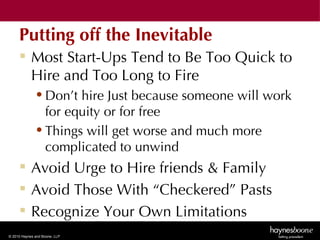
Putting off the Inevitable
      Most Start-Ups Tend to Be Too Quick to
       Hire and Too Long to Fire
              • Don’t hire Just because someone will work
                for equity or for free
              • Things will get worse and much more
                complicated to unwind
      Avoid Urge to Hire friends & Family
      Avoid Those With “Checkered” Pasts
      Recognize Your Own Limitations
© 2010 Haynes and Boone, LLP
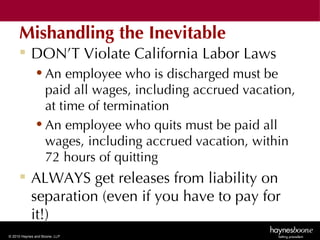
Mishandling the Inevitable
      DON’T Violate California Labor Laws
              • An employee who is discharged must be
                paid all wages, including accrued vacation,
                at time of termination
              • An employee who quits must be paid all
                wages, including accrued vacation, within
                72 hours of quitting
      ALWAYS get releases from liability on
       separation (even if you have to pay for
       it!)
© 2010 Haynes and Boone, LLP
Failing to Protect the IP


© 2010 Haynes and Boone, LLP
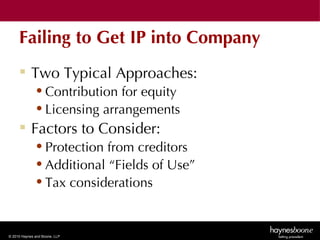
Failing to Get IP into Company
      Two Typical Approaches:
              • Contribution for equity
              • Licensing arrangements
      Factors to Consider:
              • Protection from creditors
              • Additional “Fields of Use”
              • Tax considerations


© 2010 Haynes and Boone, LLP
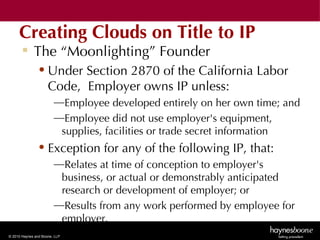
Creating Clouds on Title to IP
        The “Moonlighting” Founder
               • Under Section 2870 of the California Labor
                 Code, Employer owns IP unless:
                        —Employee developed entirely on her own time; and
                        —Employee did not use employer's equipment,
                         supplies, facilities or trade secret information
               • Exception for any of the following IP, that:
                        —Relates at time of conception to employer's
                         business, or actual or demonstrably anticipated
                         research or development of employer; or
                        —Results from any work performed by employee for
                         employer.
© 2010 Haynes and Boone, LLP
Creating Clouds on Title to IP (cont.)
 Other Employment Related Issues:
        • Get employment agreement in place before
          employee starts work
                 —Obligations to execute assignments and to
                  reasonably cooperate
                 —Non-solicitation of employees, customers and
                  vendors
        • Check for pre-existing duties of confidentiality to
          former employer
        • Ask to see employment agreement from former
          employer
© 2010 Haynes and Boone, LLP
Creating Clouds on Title to IP (cont.)
      Issues Relating to “Work for Hire” (i.e.,
       Contractors)
              • GET consulting agreement in place BEFORE
                consultant starts work
              • Without a suitable agreement, you may
                “own” nothing more than a limited license
                to use what was developed, even though
                you paid for the work!
              • Negotiate for ownership UP FRONT, before
                a deal is pending
© 2010 Haynes and Boone, LLP
Treating Stock Like Water


© 2010 Haynes and Boone, LLP
Oral Promises of Equity
      Oral Agreements ARE Enforceable
      The Problems with Oral Agreements are:
              • Terms are never well defined or fully thought
                out
              • Difficult for employer to disprove claimed
                existence of such an arrangement
      “Sleeping Dogs” Tend to Wake Up When
       Exit is imminent

© 2010 Haynes and Boone, LLP
Using Equity as Cheap Currency
      Know What is Market. How Much is
       Too Much?
      Keep an Accurate Capitalization Table
      Look for Alternative Ways to Finance the
       Business: Bootstrap!
      DON’T Forget About Compliance with
       Applicable Securities Laws

© 2010 Haynes and Boone, LLP
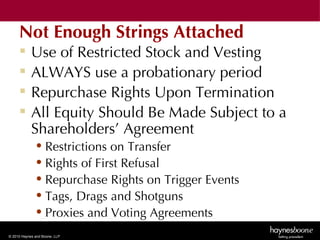
Not Enough Strings Attached
           Use of Restricted Stock and Vesting
           ALWAYS use a probationary period
           Repurchase Rights Upon Termination
           All Equity Should Be Made Subject to a
            Shareholders’ Agreement
              • Restrictions on Transfer
              • Rights of First Refusal
              • Repurchase Rights on Trigger Events
              • Tags, Drags and Shotguns
              • Proxies and Voting Agreements
© 2010 Haynes and Boone, LLP
Failure to Maintain Corporate
    Formalities


© 2010 Haynes and Boone, LLP
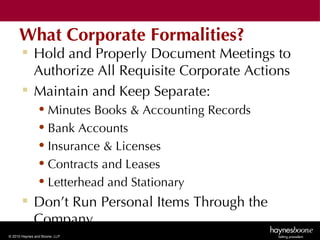
What Corporate Formalities?
        Hold and Properly Document Meetings to
         Authorize All Requisite Corporate Actions
        Maintain and Keep Separate:
               • Minutes Books & Accounting Records
               • Bank Accounts
               • Insurance & Licenses
               • Contracts and Leases
               • Letterhead and Stationary
        Don’t Run Personal Items Through the
         Company
© 2010 Haynes and Boone, LLP
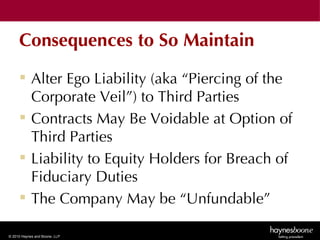
Consequences to So Maintain

      Alter Ego Liability (aka “Piercing of the
       Corporate Veil”) to Third Parties
      Contracts May Be Voidable at Option of
       Third Parties
      Liability to Equity Holders for Breach of
       Fiduciary Duties
      The Company May be “Unfundable”

© 2010 Haynes and Boone, LLP
Not Leaving Enough Runway


© 2010 Haynes and Boone, LLP
Underestimating Capital Requirements
      Make Sure Your Projections Are Sound
       (Then Double Your Cash Requirements!)
      Make Sure Your Capital Sources are For
       Real – Get it in Writing!
      Think Long and Hard About Quitting
       Your Day Job


© 2010 Haynes and Boone, LLP
Seeking Capital Too Early
      Build the Business First, Then Seek
       Capital
      DON’T Lose Focus and Permit the
       Business to Suffer While You Seek
       Capital
      Only Seek Capital From Appropriate
       Sources

© 2010 Haynes and Boone, LLP
Wasting Time by Spinning Wheels
      GET Educated; Learn What is Market
      Network with Appropriate Referral
       Sources
      DON’T Work with Finders Unless You
       Have a Referral from a Trusted Source
              • They will gladly take your money
              • They could waste precious time

© 2010 Haynes and Boone, LLP
No Contingency Plan in Place

      ALWAYS Have a Back-Up Plan
      Pull the Trigger BEFORE it is Too Late


© 2010 Haynes and Boone, LLP
Questions?


© 2010 Haynes and Boone, LLP
Common Entrepreneur Mistakes
                                       Thank you!

                                  Presented by Bart Greenberg
                                     Haynes and Boone, LLP
                                         (949) 202-3037
                               bart.greenberg@haynesboone.com

© 2010 Haynes and Boone, LLP

Common Entrepreneur Mistakes

  • 1.
    Common Entrepreneur Mistakes Presented by Bart Greenberg Haynes and Boone, LLP Lloyd Greif Center for Entrepreneurial Studies Marshall School of Business, USC May 25, 2011 © 2010 Haynes and Boone, LLP
  • 2.
    The Wrong BusinessStructure © 2010 Haynes and Boone, LLP
  • 3.
    The “De Facto”Partnership  What is it?  Problems: • Ownership of IP • Vicarious Liability © 2010 Haynes and Boone, LLP
  • 4.
    The “Wrong” Stateof Formation  California vs. Delaware • California is shareholder friendly • Delaware is management friendly  Special Case of the So-Called Quasi- California Corporation  Why You DON’T Necessarily Want to Be in Nevada • You will most likely pay taxes • The law is not as well defined © 2010 Haynes and Boone, LLP
  • 5.
    Failing to Makethe “S Election”  Consequences of Subchapter S Election • Pass-Through of Income • Pass-Through of Losses —Pros —Cons  DON’T Miss Filing Deadline • RU Dead in the water? • Retroactive S Election? © 2010 Haynes and Boone, LLP
  • 6.
    Keep it Simple!  Don’t Over-Build at Start-Up. Avoid the Following: • Multiple operating companies or special business units (Subs) • Related party engineering, development or service companies  Restructuring Can Be Expensive and Involve Negative Tax Consequences © 2010 Haynes and Boone, LLP
  • 7.
    The Wrong Team ©2010 Haynes and Boone, LLP
  • 8.
    Putting off theInevitable  Most Start-Ups Tend to Be Too Quick to Hire and Too Long to Fire • Don’t hire Just because someone will work for equity or for free • Things will get worse and much more complicated to unwind  Avoid Urge to Hire friends & Family  Avoid Those With “Checkered” Pasts  Recognize Your Own Limitations © 2010 Haynes and Boone, LLP
  • 9.
    Mishandling the Inevitable  DON’T Violate California Labor Laws • An employee who is discharged must be paid all wages, including accrued vacation, at time of termination • An employee who quits must be paid all wages, including accrued vacation, within 72 hours of quitting  ALWAYS get releases from liability on separation (even if you have to pay for it!) © 2010 Haynes and Boone, LLP
  • 10.
    Failing to Protectthe IP © 2010 Haynes and Boone, LLP
  • 11.
    Failing to GetIP into Company  Two Typical Approaches: • Contribution for equity • Licensing arrangements  Factors to Consider: • Protection from creditors • Additional “Fields of Use” • Tax considerations © 2010 Haynes and Boone, LLP
  • 12.
    Creating Clouds onTitle to IP  The “Moonlighting” Founder • Under Section 2870 of the California Labor Code, Employer owns IP unless: —Employee developed entirely on her own time; and —Employee did not use employer's equipment, supplies, facilities or trade secret information • Exception for any of the following IP, that: —Relates at time of conception to employer's business, or actual or demonstrably anticipated research or development of employer; or —Results from any work performed by employee for employer. © 2010 Haynes and Boone, LLP
  • 13.
    Creating Clouds onTitle to IP (cont.)  Other Employment Related Issues: • Get employment agreement in place before employee starts work —Obligations to execute assignments and to reasonably cooperate —Non-solicitation of employees, customers and vendors • Check for pre-existing duties of confidentiality to former employer • Ask to see employment agreement from former employer © 2010 Haynes and Boone, LLP
  • 14.
    Creating Clouds onTitle to IP (cont.)  Issues Relating to “Work for Hire” (i.e., Contractors) • GET consulting agreement in place BEFORE consultant starts work • Without a suitable agreement, you may “own” nothing more than a limited license to use what was developed, even though you paid for the work! • Negotiate for ownership UP FRONT, before a deal is pending © 2010 Haynes and Boone, LLP
  • 15.
    Treating Stock LikeWater © 2010 Haynes and Boone, LLP
  • 16.
    Oral Promises ofEquity  Oral Agreements ARE Enforceable  The Problems with Oral Agreements are: • Terms are never well defined or fully thought out • Difficult for employer to disprove claimed existence of such an arrangement  “Sleeping Dogs” Tend to Wake Up When Exit is imminent © 2010 Haynes and Boone, LLP
  • 17.
    Using Equity asCheap Currency  Know What is Market. How Much is Too Much?  Keep an Accurate Capitalization Table  Look for Alternative Ways to Finance the Business: Bootstrap!  DON’T Forget About Compliance with Applicable Securities Laws © 2010 Haynes and Boone, LLP
  • 18.
    Not Enough StringsAttached  Use of Restricted Stock and Vesting  ALWAYS use a probationary period  Repurchase Rights Upon Termination  All Equity Should Be Made Subject to a Shareholders’ Agreement • Restrictions on Transfer • Rights of First Refusal • Repurchase Rights on Trigger Events • Tags, Drags and Shotguns • Proxies and Voting Agreements © 2010 Haynes and Boone, LLP
  • 19.
    Failure to MaintainCorporate Formalities © 2010 Haynes and Boone, LLP
  • 20.
    What Corporate Formalities?  Hold and Properly Document Meetings to Authorize All Requisite Corporate Actions  Maintain and Keep Separate: • Minutes Books & Accounting Records • Bank Accounts • Insurance & Licenses • Contracts and Leases • Letterhead and Stationary  Don’t Run Personal Items Through the Company © 2010 Haynes and Boone, LLP
  • 21.
    Consequences to SoMaintain  Alter Ego Liability (aka “Piercing of the Corporate Veil”) to Third Parties  Contracts May Be Voidable at Option of Third Parties  Liability to Equity Holders for Breach of Fiduciary Duties  The Company May be “Unfundable” © 2010 Haynes and Boone, LLP
  • 22.
    Not Leaving EnoughRunway © 2010 Haynes and Boone, LLP
  • 23.
    Underestimating Capital Requirements  Make Sure Your Projections Are Sound (Then Double Your Cash Requirements!)  Make Sure Your Capital Sources are For Real – Get it in Writing!  Think Long and Hard About Quitting Your Day Job © 2010 Haynes and Boone, LLP
  • 24.
    Seeking Capital TooEarly  Build the Business First, Then Seek Capital  DON’T Lose Focus and Permit the Business to Suffer While You Seek Capital  Only Seek Capital From Appropriate Sources © 2010 Haynes and Boone, LLP
  • 25.
    Wasting Time bySpinning Wheels  GET Educated; Learn What is Market  Network with Appropriate Referral Sources  DON’T Work with Finders Unless You Have a Referral from a Trusted Source • They will gladly take your money • They could waste precious time © 2010 Haynes and Boone, LLP
  • 26.
    No Contingency Planin Place  ALWAYS Have a Back-Up Plan  Pull the Trigger BEFORE it is Too Late © 2010 Haynes and Boone, LLP
  • 27.
  • 28.
    Common Entrepreneur Mistakes Thank you! Presented by Bart Greenberg Haynes and Boone, LLP (949) 202-3037 bart.greenberg@haynesboone.com © 2010 Haynes and Boone, LLP