© Copyright 2013. Compensation Venture Group, Inc. All rights reserved.© Copyright 2013. Compensation Venture Group, Inc. All rights reserved.
Trends in Compensation:
Schrödinger’s Cat is Alive (and Dead)
14th Annual Venture Capital Financing Conference
26-April-2013
Compensation Venture Group, Inc.
www.compensationventuregroup.com
fred@compensationventuregroup.com
© Copyright 2013. Compensation Venture Group, Inc. All rights reserved.
About the Speaker
Fred Whittlesey is the founder and Principal Consultant of Compensation Venture Group (CVG), a West Coast
consulting firm specializing in compensation strategy, director and executive compensation, equity-based
compensation, and incentive design with a primary focus on entrepreneurial growth companies.
Fred’s consulting experience includes positions with Mercer, KPMG, Buck Consultants, and Hay Group. His
corporate compensation experience includes the role of Director of Global Compensation for Amazon.com and
Broadcom, and Chief Compensation Officer of Payscale.com.
Fred is co-founder and past Board member of the not-for-profit Global Equity Organization (GEO), a Founding
Member of the National Association of Stock Plan Professionals (NASPP), past President of the NASPP Orange
County chapter, past member of the NASPP Advisory Board, and a current member of the Advisory Board of
CompensationStandards.com. He also is past Chair of the Advisory Board for the Certified Equity Professional
(CEP) Institute at Santa Clara University.
Fred was a top-rated faculty member and certification course developer for 13 years for WorldatWork's
"Accounting and Finance for HR Professionals" as well as the basic and advanced executive compensation
courses, delivering instruction both in the classroom and online.
He has authored dozens of articles in major compensation periodicals and has presented his ideas at
compensation conferences around the world. His published works include “Say on Pay’s Impact on Equity Plan
Design: Horse or Camel?” in GEOnomics 2012; “The Governance Ups and Downs of Performance Plans” in
GEOnomics 2011; “Understanding Executive Pay Equity and Fairness: Ratios and Rationality” in WorldatWork
Journal; “Behavioral Economics and Equity Compensation” in GEOnomics2009; and “Measuring the ROI of
Compensation Expenditures” in The Compensation Handbook.
Fred received his MBA with Distinction from UCLA and a BA in industrial/organizational psychology from San
Diego State University where he graduated Magna Cum Laude and Phi Beta Kappa. He has earned the
Certified Equity Professional (CEP), Certified Executive Compensation Professional (CECP) and Certified
Compensation Professional (CCP) designations.
© Copyright 2013. Compensation Venture Group, Inc. All rights reserved.© Copyright 2011. Compensation Venture Group, Inc. All rights reserved.
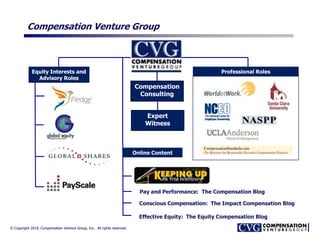
Compensation Venture Group
Equity Interests and
Advisory Roles
Professional Roles
Online Content
Pay and Performance: The Compensation Blog
Conscious Compensation: The Impact Compensation Blog
Effective Equity: The Equity Compensation Blog
Compensation
Consulting
3
Expert
Witness
© Copyright 2013. Compensation Venture Group, Inc. All rights reserved.
Presentation Outline
 What you need to know as an…
 Entrepreneur
 Investor
 Board Member (Compensation Committee)
 Trends in Long-Term Incentive Compensation
 Acceleration for Founders and Employees
 Trends in Cash Compensation
 Base Salary
 Cash Bonuses
 Schrödinger’s Cat and Compensation
4
© Copyright 2013. Compensation Venture Group, Inc. All rights reserved.
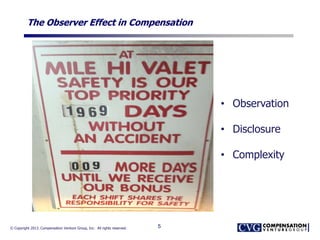
The Observer Effect in Compensation
• Observation
• Disclosure
• Complexity
5
© Copyright 2013. Compensation Venture Group, Inc. All rights reserved.
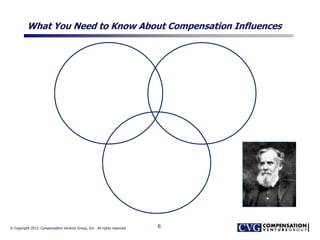
What You Need to Know About Compensation Influences
6
© Copyright 2013. Compensation Venture Group, Inc. All rights reserved.
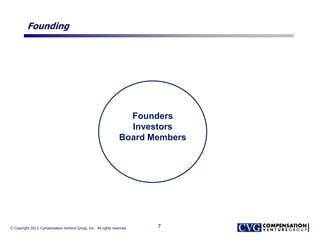
Founding
7
Investors
Founders
Board Members
© Copyright 2013. Compensation Venture Group, Inc. All rights reserved.
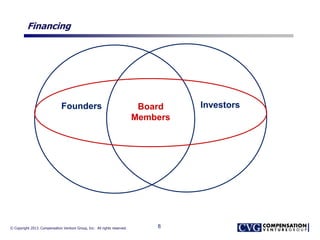
Financing
8
Founders InvestorsBoard
Members
© Copyright 2013. Compensation Venture Group, Inc. All rights reserved.
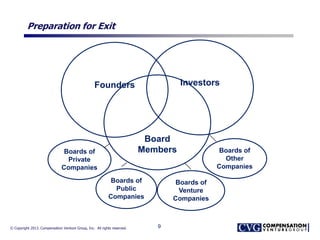
Preparation for Exit
9
Founders Investors
Board
MembersBoards of
Private
Companies
Boards of
Public
Companies
Boards of
Venture
Companies
Boards of
Other
Companies
© Copyright 2013. Compensation Venture Group, Inc. All rights reserved.
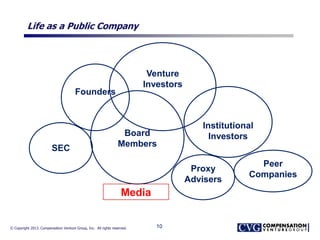
Life as a Public Company
10
Founders
Venture
Investors
Board
Members
Proxy
Advisers
Institutional
Investors
SEC
Media
Peer
Companies
© Copyright 2013. Compensation Venture Group, Inc. All rights reserved.
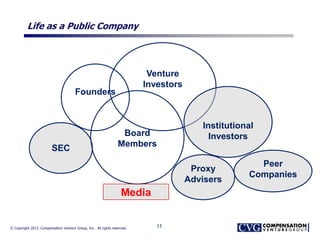
Life as a Public Company
11
Founders
Venture
Investors
Board
Members
Proxy
Advisers
Institutional
Investors
SEC
Media
Peer
Companies
© Copyright 2013. Compensation Venture Group, Inc. All rights reserved.
What You Need to Know About Compensation
 Converging forces are affecting, and will continue to affect, the
compensation culture and compensation design at emerging
companies as they grow and mature – public company spillover
 External forces are increasingly influencing companies’
compensation design, sometimes overweighted vs. strategy
 Changes outside the US are quickly influencing US
compensation in public companies
 Also driven by external governance organizations with
sociopolitical views influencing corporate governance ideas
(e.g., excessive CEO pay, caps on banker bonuses)
 Compliance and conformance are occupying the majority of
compensation design discussions at the Board level
12
© Copyright 2013. Compensation Venture Group, Inc. All rights reserved.
What You Need to Know as an Entrepreneur
 Exit is more likely as M&A than IPO
 Acqui-hire prevalence
 S-1s filed as “for sale” signs
 Need to re-forecast compensation potential
 “No exit” is more likely than an exit
 Implications for equity compensation design
 Employee exits are most likely of all
 Liquidity event is likely much further in the future than vesting
schedules’ duration
 Consider status of equity upon termination
 Must decide on sharing with former employees vs.
retention focus
13
© Copyright 2013. Compensation Venture Group, Inc. All rights reserved.
What You Need to Know as an Investor
 Market norms are diverging from long-term patterns of
compensation for emerging companies
 Changes in the form of equity: options-only to RSUs
 Not exit-contingent – employee liquidity in later rounds
 Not value-increase contingent
 Changes in the permanence of equity
 Vest-and-leave to termination-buybacks
 Performance-based option cancellations
 Shareholder/proxy adviser influence continuing to change
executive pay and employee pay
 Dilution a bigger issue than executive pay
 Anti-stock option attitude
 Institutional shareholder/proxy adviser view: 1/3/5-year TSR
14
© Copyright 2013. Compensation Venture Group, Inc. All rights reserved.
What You Need to Know as a Board (CC) Member
 Pressure exists to make activist-compliant compensation
decisions that may contradict business strategy, finance
strategy, and business judgment
 Say-on-pay and related litigation is personally targeting
Committee members over:
 Say-on-pay outcomes
 Proxy statement disclosures
 Section 162(m) (“million dollar cap”) policy and practice
 Change-in-control arrangements
 Litigation risk is driving risk-avoidance decision-making in plan
design:
 Proxy adviser good/bad lists
 Peer group norms
 “Best practice” mentality
15
© Copyright 2013. Compensation Venture Group, Inc. All rights reserved.
Trends in Long-Term Incentive Compensation
 Continued backlash on dilution from employee stock plans
 ESPPs still excluded from scrutiny - opportunity
 Stock options not considered “performance-based pay” by ISS
 Companies being “encouraged” to add performance conditions
to both full-value awards and stock options for executives
 Pre-transaction companies increasing use of RSUs due to
 Market volatility
 Section 409A concerns
 Employee perceptions of value
 Increased interim liquidity offered by alternative investors
 The most creative LTI programs are “under the radar” and
never reported in surveys or proxy statements
16
© Copyright 2013. Compensation Venture Group, Inc. All rights reserved.
Trends in Long-Term Incentive Compensation
 Performance conditions on full-value shares (RSUPRSU)
 Primarily for executives though being extended lower
 Performance conditions on stock options
 Stock ownership guidelines and holding periods
 Often quietly coupled with a “special” RSU grant
 “Portfolio approach” to long-term incentives
 Options + RSUs + PRSUs + Cash LTI
 Year-to-year changes in mix and performance measures
17
© Copyright 2013. Compensation Venture Group, Inc. All rights reserved.
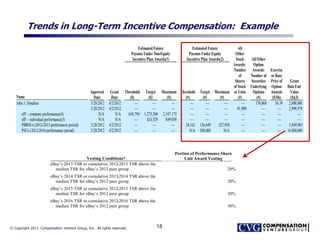
Trends in Long-Term Incentive Compensation: Example
18
Name
Approval
Date
Grant
Date
Estimated Future
Payouts Under Non-Equity
Incentive Plan Awards(1)
Estimated Future
Payouts Under Equity
Incentive Plan Awards(2)
All
Other
Stock
Awards:
Number
of
Shares
of Stock
or Units
(#)
All Other
Option
Awards:
Number of
Securities
Underlying
Options
(#)
Exercise
or Base
Price of
Option
Awards
($/Sh)
Grant
DateFair
Value
($)(3)
Threshold
($)
Target
($)
Maximum
($)
Threshold
(#)
Target
(#)
Maximum
(#)
John J. Donahoe 3/28/2012 4/2/2012 — — — — — — — 170,068 36.59 2,000,000
3/28/2012 4/2/2012 — — — — — — 81,989 — — 2,999,978
eIP – company performance(4) N/A N/A 636,794 1,273,588 2,547,175 — — — — — — —
eIP – individual performance(5) N/A N/A — 424,529 849,058 — — — — — — —
PBRSUs (2012-2013 performance period) 3/28/2012 4/2/2012 — — — 34,162 136,649 327,958 — — — 5,849,985
PSUs (2012-2016 performance period) 3/28/2012 4/2/2012 — — — N/A 500,000 N/A — — — 14,880,000
Vesting Conditions*
Portion of Performance Share
Unit Award Vesting
eBay’s 2013 TSR or cumulative 2012-2013 TSR above the
median TSR for eBay’s 2012 peer group 20%
eBay’s 2014 TSR or cumulative 2012-2014 TSR above the
median TSR for eBay’s 2012 peer group 20%
eBay’s 2015 TSR or cumulative 2012-2015 TSR above the
median TSR for eBay’s 2012 peer group 30%
eBay’s 2016 TSR or cumulative 2012-2016 TSR above the
median TSR for eBay’s 2012 peer group 30%
© Copyright 2013. Compensation Venture Group, Inc. All rights reserved.
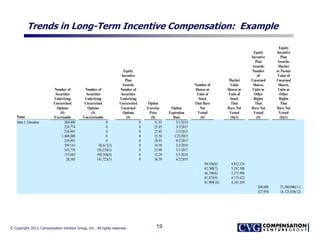
Trends in Long-Term Incentive Compensation: Example
19
Name
Number of
Securities
Underlying
Unexercised
Options
(#)
Exercisable
Number of
Securities
Underlying
Unexercised
Options
(#)
Unexercisable
Equity
Incentive
Plan
Awards:
Number of
Securities
Underlying
Unexercised
Unearned
Options
(#)
Option
Exercise
Price
($)
Option
Expiration
Date
Number of
Shares or
Units of
Stock
That Have
Not
Vested
(#)
Market
Value
Shares or
Units of
Stock
That
Have Not
Vested
($)(1)
Equity
Incentive
Plan
Awards:
Number
of
Unearned
Shares,
Units or
Other
Rights
That
Have Not
Vested
(#)
Equity
Incentive
Plan
Awards:
Market
or Payout
Value of
Unearned
Shares,
Units or
Other
Rights
That
Have Not
Vested
($)(1)
John J. Donahoe 260,400 0 0 31.93 3/1/2014
226,774 0 0 25.85 3/3/2015
258,891 0 0 25.85 3/3/2015
1,000,000 0 0 35.50 3/25/2015
258,891 0 0 24.93 9/1/2015
399,163 36,611(2) 0 10.50 3/2/2016
343,750 156,250(3) 0 23.88 3/1/2017
155,083 199,394(4) 0 32.29 3/1/2018
28,345 141,723(5) 0 36.59 4/2/2019
94,356(6) 4,812,156
62,500(7) 3,187,500
66,196(8) 3,375,996
81,875(9) 4,175,625
81,989(10) 4,181,439
500,000 25,500,000(11)
327,958 16,725,858(12)
© Copyright 2013. Compensation Venture Group, Inc. All rights reserved.
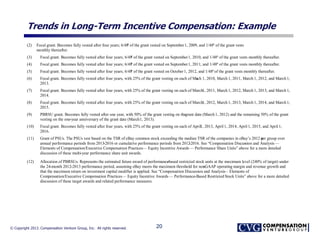
Trends in Long-Term Incentive Compensation: Example
20
(2) Focal grant. Becomes fully vested after four years; 6/48th
of the grant vested on September1, 2009, and 1/48th
of the grant vests
monthly thereafter.
(3) Focal grant. Becomes fully vested after four years; 6/48th
of the grant vested on September1, 2010, and 1/48th
of the grant vests monthly thereafter.
(4) Focal grant. Becomes fully vested after four years; 6/48th
of the grant vested on September1, 2011, and 1/48th
of the grant vests monthly thereafter.
(5) Focal grant. Becomes fully vested after four years; 6/48th
of the grant vested on October1, 2012, and 1/48th
of the grant vests monthly thereafter.
(6) Focal grant. Becomes fully vested after four years, with 25% of the grant vesting on each of March 1, 2010, March 1, 2011, March 1, 2012, and March 1,
2013.
(7) Focal grant. Becomes fully vested after four years, with 25% of the grant vesting on each of March1, 2011, March 1, 2012, March 1, 2013, and March 1,
2014.
(8) Focal grant. Becomes fully vested after four years, with 25% of the grant vesting on each of March1, 2012, March 1, 2013, March 1, 2014, and March 1,
2015.
(9) PBRSU grant. Becomes fully vested after one year, with 50% of the grant vesting on thegrant date (March 1, 2012) and the remaining 50% of the grant
vesting on the one-year anniversary of the grant date (March1, 2013).
(10) Focal grant. Becomes fully vested after four years, with 25% of the grant vesting on each of April1, 2013, April 1, 2014, April 1, 2015, and April 1,
2016.
(11) Grant of PSUs. The PSUs vest based on the TSR of eBay common stock exceeding the median TSR of the companies in eBay’s 2012 peer group over
annual performance periods from 2013-2016 or cumulative performance periods from 2012-2016. See ―Compensation Discussion and Analysis —
Elements of Compensation/Executive Compensation Practices— Equity Incentive Awards— Performance Share Units‖ above for a more detailed
discussion of these multi-year performance share unit awards.
(12) Allocation of PBRSUs. Represents the estimated future award of performance-based restricted stock units at the maximum level (240% of target) under
the 24-month 2012-2013 performance period, assuming eBay meets the maximum threshold for non-GAAP operating margin and revenue growth and
that the maximum return on investment capital modifier is applied. See ―Compensation Discussion and Analysis— Elements of
Compensation/Executive Compensation Practices— Equity Incentive Awards— Performance-Based Restricted Stock Units‖ above for a more detailed
discussion of these target awards and related performance measures.
© Copyright 2013. Compensation Venture Group, Inc. All rights reserved.
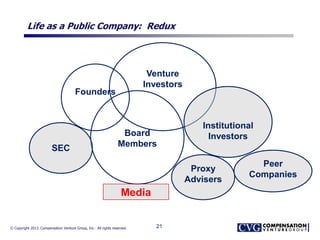
Life as a Public Company: Redux
21
Founders
Venture
Investors
Board
Members
Proxy
Advisers
Institutional
Investors
SEC
Media
Peer
Companies
© Copyright 2013. Compensation Venture Group, Inc. All rights reserved.
Acceleration for Founders and Employees
 Single trigger CIC provision has long been a potential
deterrent for M&A
 One school of thought highlights the fairness of this vs.
accelerating vesting for those fired
 Now a “bad list” item for proxy advisers
 Full acceleration – even double trigger – increasingly being
questioned
 One year of additional vesting increasing in prevalence
 With M&A and acqui-hire transactions, some outstanding
awards are converted and vesting time added: deceleration
22
© Copyright 2013. Compensation Venture Group, Inc. All rights reserved.
Trends in Cash Compensation
 Base salary levels continue to grow faster than represented by
surveys of “merit increases”
 One-off adjustments unreported
 “Promotions” not included
 High turnover rates with increases not captured
 Staying competitive on base salary requires more competitive
intelligence than offered by surveys
 Annual cash incentives/bonuses continue to evolve
 Backlash from financial crisis about “risk incentives”
 Proxy adviser/investor pressure against discretion
 Non-GAAP measures
 Mandatory deferral
 Payment in restricted stock/units
23
© Copyright 2013. Compensation Venture Group, Inc. All rights reserved.
Schrödinger’s Cat and Compensation
 Compensation practices have more observers than ever before
 Observers have increased influence due to both technology
(sec.gov) and the shareholder democracy movement
 Corporate governance is disproportionately focused on
executive and equity compensation and observers have
become de facto plan designers
 Recent research indicates that purported “good governance”
practices of executive compensation observers are associated
with shareholder value destruction, not creation
 Current corporate governance concepts are in conflict with
fundamental venture financing principles but creative design
opportunities exist – no observers yet!
24
© Copyright 2013. Compensation Venture Group, Inc. All rights reserved.
Contact Information
Fred Whittlesey, CEP, CCP, CECP
fred@compensationventuregroup.com
www.compensationventuregroup.com
Compensation Blog: payandperformance.blogspot.com
Impact Compensation Blog: consciouscompensation.blogspot.com
Equity Compensation Blog: effectiveequity.blogspot.com
Twitter: @FredWhittlesey
25

Schrodinger's Cat And Compensation

  • 1.
    © Copyright 2013.Compensation Venture Group, Inc. All rights reserved.© Copyright 2013. Compensation Venture Group, Inc. All rights reserved. Trends in Compensation: Schrödinger’s Cat is Alive (and Dead) 14th Annual Venture Capital Financing Conference 26-April-2013 Compensation Venture Group, Inc. www.compensationventuregroup.com fred@compensationventuregroup.com
  • 2.
    © Copyright 2013.Compensation Venture Group, Inc. All rights reserved. About the Speaker Fred Whittlesey is the founder and Principal Consultant of Compensation Venture Group (CVG), a West Coast consulting firm specializing in compensation strategy, director and executive compensation, equity-based compensation, and incentive design with a primary focus on entrepreneurial growth companies. Fred’s consulting experience includes positions with Mercer, KPMG, Buck Consultants, and Hay Group. His corporate compensation experience includes the role of Director of Global Compensation for Amazon.com and Broadcom, and Chief Compensation Officer of Payscale.com. Fred is co-founder and past Board member of the not-for-profit Global Equity Organization (GEO), a Founding Member of the National Association of Stock Plan Professionals (NASPP), past President of the NASPP Orange County chapter, past member of the NASPP Advisory Board, and a current member of the Advisory Board of CompensationStandards.com. He also is past Chair of the Advisory Board for the Certified Equity Professional (CEP) Institute at Santa Clara University. Fred was a top-rated faculty member and certification course developer for 13 years for WorldatWork's "Accounting and Finance for HR Professionals" as well as the basic and advanced executive compensation courses, delivering instruction both in the classroom and online. He has authored dozens of articles in major compensation periodicals and has presented his ideas at compensation conferences around the world. His published works include “Say on Pay’s Impact on Equity Plan Design: Horse or Camel?” in GEOnomics 2012; “The Governance Ups and Downs of Performance Plans” in GEOnomics 2011; “Understanding Executive Pay Equity and Fairness: Ratios and Rationality” in WorldatWork Journal; “Behavioral Economics and Equity Compensation” in GEOnomics2009; and “Measuring the ROI of Compensation Expenditures” in The Compensation Handbook. Fred received his MBA with Distinction from UCLA and a BA in industrial/organizational psychology from San Diego State University where he graduated Magna Cum Laude and Phi Beta Kappa. He has earned the Certified Equity Professional (CEP), Certified Executive Compensation Professional (CECP) and Certified Compensation Professional (CCP) designations.
  • 3.
    © Copyright 2013.Compensation Venture Group, Inc. All rights reserved.© Copyright 2011. Compensation Venture Group, Inc. All rights reserved. Compensation Venture Group Equity Interests and Advisory Roles Professional Roles Online Content Pay and Performance: The Compensation Blog Conscious Compensation: The Impact Compensation Blog Effective Equity: The Equity Compensation Blog Compensation Consulting 3 Expert Witness
  • 4.
    © Copyright 2013.Compensation Venture Group, Inc. All rights reserved. Presentation Outline  What you need to know as an…  Entrepreneur  Investor  Board Member (Compensation Committee)  Trends in Long-Term Incentive Compensation  Acceleration for Founders and Employees  Trends in Cash Compensation  Base Salary  Cash Bonuses  Schrödinger’s Cat and Compensation 4
  • 5.
    © Copyright 2013.Compensation Venture Group, Inc. All rights reserved. The Observer Effect in Compensation • Observation • Disclosure • Complexity 5
  • 6.
    © Copyright 2013.Compensation Venture Group, Inc. All rights reserved. What You Need to Know About Compensation Influences 6
  • 7.
    © Copyright 2013.Compensation Venture Group, Inc. All rights reserved. Founding 7 Investors Founders Board Members
  • 8.
    © Copyright 2013.Compensation Venture Group, Inc. All rights reserved. Financing 8 Founders InvestorsBoard Members
  • 9.
    © Copyright 2013.Compensation Venture Group, Inc. All rights reserved. Preparation for Exit 9 Founders Investors Board MembersBoards of Private Companies Boards of Public Companies Boards of Venture Companies Boards of Other Companies
  • 10.
    © Copyright 2013.Compensation Venture Group, Inc. All rights reserved. Life as a Public Company 10 Founders Venture Investors Board Members Proxy Advisers Institutional Investors SEC Media Peer Companies
  • 11.
    © Copyright 2013.Compensation Venture Group, Inc. All rights reserved. Life as a Public Company 11 Founders Venture Investors Board Members Proxy Advisers Institutional Investors SEC Media Peer Companies
  • 12.
    © Copyright 2013.Compensation Venture Group, Inc. All rights reserved. What You Need to Know About Compensation  Converging forces are affecting, and will continue to affect, the compensation culture and compensation design at emerging companies as they grow and mature – public company spillover  External forces are increasingly influencing companies’ compensation design, sometimes overweighted vs. strategy  Changes outside the US are quickly influencing US compensation in public companies  Also driven by external governance organizations with sociopolitical views influencing corporate governance ideas (e.g., excessive CEO pay, caps on banker bonuses)  Compliance and conformance are occupying the majority of compensation design discussions at the Board level 12
  • 13.
    © Copyright 2013.Compensation Venture Group, Inc. All rights reserved. What You Need to Know as an Entrepreneur  Exit is more likely as M&A than IPO  Acqui-hire prevalence  S-1s filed as “for sale” signs  Need to re-forecast compensation potential  “No exit” is more likely than an exit  Implications for equity compensation design  Employee exits are most likely of all  Liquidity event is likely much further in the future than vesting schedules’ duration  Consider status of equity upon termination  Must decide on sharing with former employees vs. retention focus 13
  • 14.
    © Copyright 2013.Compensation Venture Group, Inc. All rights reserved. What You Need to Know as an Investor  Market norms are diverging from long-term patterns of compensation for emerging companies  Changes in the form of equity: options-only to RSUs  Not exit-contingent – employee liquidity in later rounds  Not value-increase contingent  Changes in the permanence of equity  Vest-and-leave to termination-buybacks  Performance-based option cancellations  Shareholder/proxy adviser influence continuing to change executive pay and employee pay  Dilution a bigger issue than executive pay  Anti-stock option attitude  Institutional shareholder/proxy adviser view: 1/3/5-year TSR 14
  • 15.
    © Copyright 2013.Compensation Venture Group, Inc. All rights reserved. What You Need to Know as a Board (CC) Member  Pressure exists to make activist-compliant compensation decisions that may contradict business strategy, finance strategy, and business judgment  Say-on-pay and related litigation is personally targeting Committee members over:  Say-on-pay outcomes  Proxy statement disclosures  Section 162(m) (“million dollar cap”) policy and practice  Change-in-control arrangements  Litigation risk is driving risk-avoidance decision-making in plan design:  Proxy adviser good/bad lists  Peer group norms  “Best practice” mentality 15
  • 16.
    © Copyright 2013.Compensation Venture Group, Inc. All rights reserved. Trends in Long-Term Incentive Compensation  Continued backlash on dilution from employee stock plans  ESPPs still excluded from scrutiny - opportunity  Stock options not considered “performance-based pay” by ISS  Companies being “encouraged” to add performance conditions to both full-value awards and stock options for executives  Pre-transaction companies increasing use of RSUs due to  Market volatility  Section 409A concerns  Employee perceptions of value  Increased interim liquidity offered by alternative investors  The most creative LTI programs are “under the radar” and never reported in surveys or proxy statements 16
  • 17.
    © Copyright 2013.Compensation Venture Group, Inc. All rights reserved. Trends in Long-Term Incentive Compensation  Performance conditions on full-value shares (RSUPRSU)  Primarily for executives though being extended lower  Performance conditions on stock options  Stock ownership guidelines and holding periods  Often quietly coupled with a “special” RSU grant  “Portfolio approach” to long-term incentives  Options + RSUs + PRSUs + Cash LTI  Year-to-year changes in mix and performance measures 17
  • 18.
    © Copyright 2013.Compensation Venture Group, Inc. All rights reserved. Trends in Long-Term Incentive Compensation: Example 18 Name Approval Date Grant Date Estimated Future Payouts Under Non-Equity Incentive Plan Awards(1) Estimated Future Payouts Under Equity Incentive Plan Awards(2) All Other Stock Awards: Number of Shares of Stock or Units (#) All Other Option Awards: Number of Securities Underlying Options (#) Exercise or Base Price of Option Awards ($/Sh) Grant DateFair Value ($)(3) Threshold ($) Target ($) Maximum ($) Threshold (#) Target (#) Maximum (#) John J. Donahoe 3/28/2012 4/2/2012 — — — — — — — 170,068 36.59 2,000,000 3/28/2012 4/2/2012 — — — — — — 81,989 — — 2,999,978 eIP – company performance(4) N/A N/A 636,794 1,273,588 2,547,175 — — — — — — — eIP – individual performance(5) N/A N/A — 424,529 849,058 — — — — — — — PBRSUs (2012-2013 performance period) 3/28/2012 4/2/2012 — — — 34,162 136,649 327,958 — — — 5,849,985 PSUs (2012-2016 performance period) 3/28/2012 4/2/2012 — — — N/A 500,000 N/A — — — 14,880,000 Vesting Conditions* Portion of Performance Share Unit Award Vesting eBay’s 2013 TSR or cumulative 2012-2013 TSR above the median TSR for eBay’s 2012 peer group 20% eBay’s 2014 TSR or cumulative 2012-2014 TSR above the median TSR for eBay’s 2012 peer group 20% eBay’s 2015 TSR or cumulative 2012-2015 TSR above the median TSR for eBay’s 2012 peer group 30% eBay’s 2016 TSR or cumulative 2012-2016 TSR above the median TSR for eBay’s 2012 peer group 30%
  • 19.
    © Copyright 2013.Compensation Venture Group, Inc. All rights reserved. Trends in Long-Term Incentive Compensation: Example 19 Name Number of Securities Underlying Unexercised Options (#) Exercisable Number of Securities Underlying Unexercised Options (#) Unexercisable Equity Incentive Plan Awards: Number of Securities Underlying Unexercised Unearned Options (#) Option Exercise Price ($) Option Expiration Date Number of Shares or Units of Stock That Have Not Vested (#) Market Value Shares or Units of Stock That Have Not Vested ($)(1) Equity Incentive Plan Awards: Number of Unearned Shares, Units or Other Rights That Have Not Vested (#) Equity Incentive Plan Awards: Market or Payout Value of Unearned Shares, Units or Other Rights That Have Not Vested ($)(1) John J. Donahoe 260,400 0 0 31.93 3/1/2014 226,774 0 0 25.85 3/3/2015 258,891 0 0 25.85 3/3/2015 1,000,000 0 0 35.50 3/25/2015 258,891 0 0 24.93 9/1/2015 399,163 36,611(2) 0 10.50 3/2/2016 343,750 156,250(3) 0 23.88 3/1/2017 155,083 199,394(4) 0 32.29 3/1/2018 28,345 141,723(5) 0 36.59 4/2/2019 94,356(6) 4,812,156 62,500(7) 3,187,500 66,196(8) 3,375,996 81,875(9) 4,175,625 81,989(10) 4,181,439 500,000 25,500,000(11) 327,958 16,725,858(12)
  • 20.
    © Copyright 2013.Compensation Venture Group, Inc. All rights reserved. Trends in Long-Term Incentive Compensation: Example 20 (2) Focal grant. Becomes fully vested after four years; 6/48th of the grant vested on September1, 2009, and 1/48th of the grant vests monthly thereafter. (3) Focal grant. Becomes fully vested after four years; 6/48th of the grant vested on September1, 2010, and 1/48th of the grant vests monthly thereafter. (4) Focal grant. Becomes fully vested after four years; 6/48th of the grant vested on September1, 2011, and 1/48th of the grant vests monthly thereafter. (5) Focal grant. Becomes fully vested after four years; 6/48th of the grant vested on October1, 2012, and 1/48th of the grant vests monthly thereafter. (6) Focal grant. Becomes fully vested after four years, with 25% of the grant vesting on each of March 1, 2010, March 1, 2011, March 1, 2012, and March 1, 2013. (7) Focal grant. Becomes fully vested after four years, with 25% of the grant vesting on each of March1, 2011, March 1, 2012, March 1, 2013, and March 1, 2014. (8) Focal grant. Becomes fully vested after four years, with 25% of the grant vesting on each of March1, 2012, March 1, 2013, March 1, 2014, and March 1, 2015. (9) PBRSU grant. Becomes fully vested after one year, with 50% of the grant vesting on thegrant date (March 1, 2012) and the remaining 50% of the grant vesting on the one-year anniversary of the grant date (March1, 2013). (10) Focal grant. Becomes fully vested after four years, with 25% of the grant vesting on each of April1, 2013, April 1, 2014, April 1, 2015, and April 1, 2016. (11) Grant of PSUs. The PSUs vest based on the TSR of eBay common stock exceeding the median TSR of the companies in eBay’s 2012 peer group over annual performance periods from 2013-2016 or cumulative performance periods from 2012-2016. See ―Compensation Discussion and Analysis — Elements of Compensation/Executive Compensation Practices— Equity Incentive Awards— Performance Share Units‖ above for a more detailed discussion of these multi-year performance share unit awards. (12) Allocation of PBRSUs. Represents the estimated future award of performance-based restricted stock units at the maximum level (240% of target) under the 24-month 2012-2013 performance period, assuming eBay meets the maximum threshold for non-GAAP operating margin and revenue growth and that the maximum return on investment capital modifier is applied. See ―Compensation Discussion and Analysis— Elements of Compensation/Executive Compensation Practices— Equity Incentive Awards— Performance-Based Restricted Stock Units‖ above for a more detailed discussion of these target awards and related performance measures.
  • 21.
    © Copyright 2013.Compensation Venture Group, Inc. All rights reserved. Life as a Public Company: Redux 21 Founders Venture Investors Board Members Proxy Advisers Institutional Investors SEC Media Peer Companies
  • 22.
    © Copyright 2013.Compensation Venture Group, Inc. All rights reserved. Acceleration for Founders and Employees  Single trigger CIC provision has long been a potential deterrent for M&A  One school of thought highlights the fairness of this vs. accelerating vesting for those fired  Now a “bad list” item for proxy advisers  Full acceleration – even double trigger – increasingly being questioned  One year of additional vesting increasing in prevalence  With M&A and acqui-hire transactions, some outstanding awards are converted and vesting time added: deceleration 22
  • 23.
    © Copyright 2013.Compensation Venture Group, Inc. All rights reserved. Trends in Cash Compensation  Base salary levels continue to grow faster than represented by surveys of “merit increases”  One-off adjustments unreported  “Promotions” not included  High turnover rates with increases not captured  Staying competitive on base salary requires more competitive intelligence than offered by surveys  Annual cash incentives/bonuses continue to evolve  Backlash from financial crisis about “risk incentives”  Proxy adviser/investor pressure against discretion  Non-GAAP measures  Mandatory deferral  Payment in restricted stock/units 23
  • 24.
    © Copyright 2013.Compensation Venture Group, Inc. All rights reserved. Schrödinger’s Cat and Compensation  Compensation practices have more observers than ever before  Observers have increased influence due to both technology (sec.gov) and the shareholder democracy movement  Corporate governance is disproportionately focused on executive and equity compensation and observers have become de facto plan designers  Recent research indicates that purported “good governance” practices of executive compensation observers are associated with shareholder value destruction, not creation  Current corporate governance concepts are in conflict with fundamental venture financing principles but creative design opportunities exist – no observers yet! 24
  • 25.
    © Copyright 2013.Compensation Venture Group, Inc. All rights reserved. Contact Information Fred Whittlesey, CEP, CCP, CECP fred@compensationventuregroup.com www.compensationventuregroup.com Compensation Blog: payandperformance.blogspot.com Impact Compensation Blog: consciouscompensation.blogspot.com Equity Compensation Blog: effectiveequity.blogspot.com Twitter: @FredWhittlesey 25