PRACTICAL
RESEARCH 2
Nature of Inquiry and
Research
LEARNING COMPETENCIES
describe characteristics, strengths, weaknesses,
and kinds of quantitative research ;
illustrate the importance of quantitative
research across fields ; and
differentiate kinds of research variables and
their uses .
At the end of the discussion, the learner should be able
to:
INQUIRY VS RESEARCH
INQUIRY VS RESEARCH
INQUIRY RESEARCH
DEFINITION
refers to the process of asking
questions to gain information,
clarify doubts, or explore a topic.
It is often the initial stage of
investigation where curiosity
leads to questioning.
is a systematic and methodical
process of investigating a specific
question, problem, or hypothesis.
It involves collecting, analyzing,
and interpreting data to draw
conclusions.
PURPOSE
is to gather basic information or
understanding. It can be informal
and may not necessarily follow a
structured method.
is to generate new knowledge,
validate theories, or solve specific
problems. Research is usually
more formal and structured,
often leading to documented
findings or publications.
INQUIRY VS RESEARCH
INQUIRY RESEARCH
SCOPE
is broader and less structured,
often involving open-ended
questions. It can be done on a
personal level, in everyday
situations, or as a preliminary
step in a larger investigation.
more focused and structured,
often following a specific
methodology. It typically involves
a clear objective, detailed
planning, and rigorous analysis.
EXAMPLES
Asking questions in a classroom
to understand a concept, seeking
information from a professional,
or exploring a new topic out of
curiosity.
Conducting experiments in a
laboratory, writing an academic
paper, or performing a market
analysis for a business.
RESEARCH
ETYMOLOGY: “research” was coined from French word
“cerhier” which means “seek” . The prefix “re”
means to repeat.
 Research is to repeat looking or seeking for something.
 A natural day-to-day activity of gathering information.
QUALITATIVE RESEARCH
seeks to answer questions about why and how people behave in
the way that they do. It provides in-depth information about
human behaviour.
QUANTITATIVE RESEARCH
is “explaining phenomena by collecting numerical data that are
analysed using mathematically based methods (in particular
statistics).”
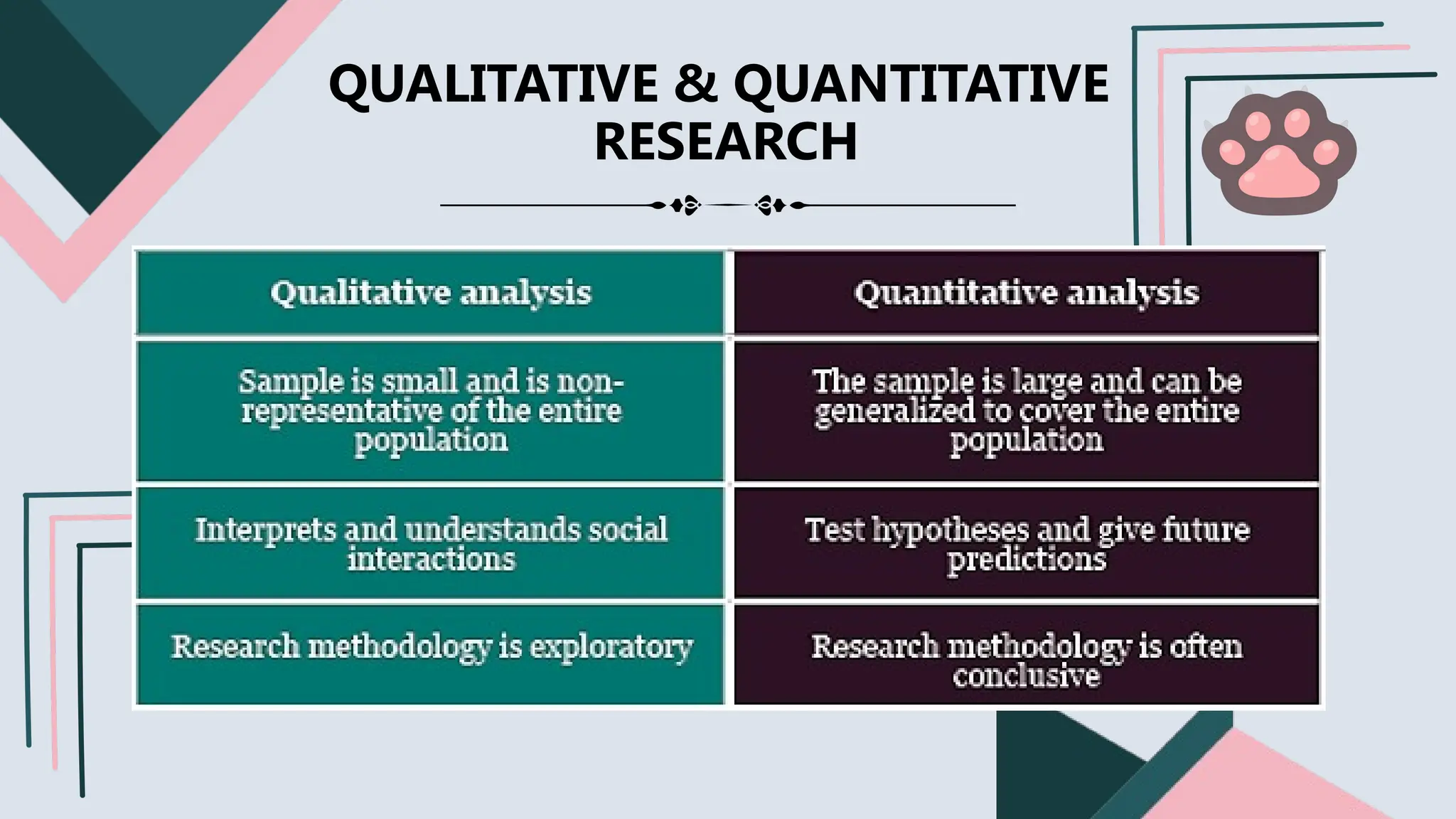
QUALITATIVE & QUANTITATIVE
RESEARCH
QUALITATIVE & QUANTITATIVE
RESEARCH
LESSON 1
CHARACTERISTICS STRENGTHS WEAKNESSES
COMPREHENSION CHECK
Determine whether INQUIRY or RESEARCH is applicable to the
given situations.
1.A person wants to know the occupant of one
condominium.
2.A student wants to know the medicinal effects of guava
leaves.
3.Mr. Cruz wants to know the technique to make his electric
fan function instantly.
4.Aling Rosa wants to know the reason behind the decrease
of her sales for the day.
5.Prof. Gomez wants to discover the impact of social
QUANTITATIVE RESEARCH
• an objective, systematic empirical investigation of
observable phenomena through the use of
computational techniques.
• concerned with numbers and its relationship with
events .
• suggests that the data concerned can be analyzed
in terms of numbers .
CHARACTERISTICS OF
QUANTITATIVE RESEARCH
CHARACTERISTICS OF
QUANTITATIVE RESEARCH
1. Seeks accurate
measurement and
analysis
of target concepts. The
truth cannot be falsify.
Objective
CHARACTERISTICS OF
QUANTITATIVE RESEARCH
2. The researcher has a clearly
defined research question to which
objective
answers are sought. Researchers
know in advance what they are looking
Clearly Defined Research
Questions
CHARACTERISTICS OF
QUANTITATIVE RESEARCH
3. The data are usually
gathered using
more structured
instrument to collect
measurable data.
Standardized Research
Instruments
CHARACTERISTICS OF
QUANTITATIVE RESEARCH
4. Data are in the
form
of numbers and
statistics.
Numerical Data
CHARACTERISTICS OF
QUANTITATIVE RESEARCH
5. The results are
based on larger
samples sizes that are
representative of
the population
Large Sample Sizes
CHARACTERISTICS OF
QUANTITATIVE RESEARCH
6. The research
study
can usually be
replicated or
repeated, give its
Replication
CHARACTERISTICS OF
QUANTITATIVE RESEARCH
7. Project can be used
generalize concepts
more widely, predict
future results, or
investigate causal
Future Outcomes
GROUP WORK:
Formulate quantitative research questions about the following
topics:
1. Food at the school canteen
2. Philippine transportation system
3. Communication media
4. Social networking sites
5. After school
6. Vocabulary
7. Video Game
8. Coping Mechanism
9. Reading Comprehension
STRENGTHS AND WEAKNESSES OF
QUANTITATIVE RESEARCH
STRENGTHS:
1.It is objective.
2.Uses statistical techniques.
3.Quick and easy analysis of data.
4.Quantitative research design is
the most reliable and valid way of
concluding results.
5.Quantitative studies are
replicable.
WEAKNESSES:
1.It requires a large number of
respondents.
2.It is costly.
3.The information and contextual factors
to help interpret the results or to explain
variations are usually ignored.
4.Many information are difficult to gather
using structured research instruments.
5.If not done seriously and correctly, data
from questionnaires may be incomplete
and inaccurate.
LESSON 2
IMPORTANCE OF QUANTITATIVE RESEARCH
ACROSS FIELDS
Field Contribution/Application Example
Social Science
• Effects of intervention to
group behavior
• Understanding cultural or
racial
conflicts
• Human satisfaction and
stressors
The effects of
pandemic on
social behavior
and economic
stability
Natural and
Physical
Sciences
• Investigate the effectiveness of
a product or treatment to
illnesses
• Finding or enhancing
alternative energy sources
• Advancement in material
science
Antidiabetic
properties of
common
Philippine herbs
Field Contribution/Application Example
Agriculture and
Fisheries
• Increase the yield crops
• Prevention and cure for crops
and livestock diseases
The effectiveness
of organic and
inorganic fertilizer
to vegetable
production
Sports • Enhance athletic performance
Diet and exercise
techniques for
different kinds of
sports
Business • Device marketing strategies
• Improve marketability
The effectiveness
of facebook ads
on sales
Field Contribution/Application Example
Arts and
Design
• Relationship between color
and architectural space
• Multimedia use and
adaptation for recreation,
business marketing and
lifestyle changes
The effects of
music on
learning and
behavior
Environmental
Science
• Causes and effects of
climate change
The
environmental
factor affecting
natural
calamities
LESSON 3
KINDS OF QUANTITATIVE RESEARCH DESIGN

NATURE - OF - QUANTITATIVE - RESEARCH.pptx

  • 1.
    PRACTICAL RESEARCH 2 Nature ofInquiry and Research
  • 2.
    LEARNING COMPETENCIES describe characteristics,strengths, weaknesses, and kinds of quantitative research ; illustrate the importance of quantitative research across fields ; and differentiate kinds of research variables and their uses . At the end of the discussion, the learner should be able to:
  • 3.
  • 4.
    INQUIRY VS RESEARCH INQUIRYRESEARCH DEFINITION refers to the process of asking questions to gain information, clarify doubts, or explore a topic. It is often the initial stage of investigation where curiosity leads to questioning. is a systematic and methodical process of investigating a specific question, problem, or hypothesis. It involves collecting, analyzing, and interpreting data to draw conclusions. PURPOSE is to gather basic information or understanding. It can be informal and may not necessarily follow a structured method. is to generate new knowledge, validate theories, or solve specific problems. Research is usually more formal and structured, often leading to documented findings or publications.
  • 5.
    INQUIRY VS RESEARCH INQUIRYRESEARCH SCOPE is broader and less structured, often involving open-ended questions. It can be done on a personal level, in everyday situations, or as a preliminary step in a larger investigation. more focused and structured, often following a specific methodology. It typically involves a clear objective, detailed planning, and rigorous analysis. EXAMPLES Asking questions in a classroom to understand a concept, seeking information from a professional, or exploring a new topic out of curiosity. Conducting experiments in a laboratory, writing an academic paper, or performing a market analysis for a business.
  • 6.
    RESEARCH ETYMOLOGY: “research” wascoined from French word “cerhier” which means “seek” . The prefix “re” means to repeat.  Research is to repeat looking or seeking for something.  A natural day-to-day activity of gathering information. QUALITATIVE RESEARCH seeks to answer questions about why and how people behave in the way that they do. It provides in-depth information about human behaviour. QUANTITATIVE RESEARCH is “explaining phenomena by collecting numerical data that are analysed using mathematically based methods (in particular statistics).”
  • 7.
  • 8.
  • 9.
  • 10.
    COMPREHENSION CHECK Determine whetherINQUIRY or RESEARCH is applicable to the given situations. 1.A person wants to know the occupant of one condominium. 2.A student wants to know the medicinal effects of guava leaves. 3.Mr. Cruz wants to know the technique to make his electric fan function instantly. 4.Aling Rosa wants to know the reason behind the decrease of her sales for the day. 5.Prof. Gomez wants to discover the impact of social
  • 11.
    QUANTITATIVE RESEARCH • anobjective, systematic empirical investigation of observable phenomena through the use of computational techniques. • concerned with numbers and its relationship with events . • suggests that the data concerned can be analyzed in terms of numbers .
  • 12.
  • 13.
    CHARACTERISTICS OF QUANTITATIVE RESEARCH 1.Seeks accurate measurement and analysis of target concepts. The truth cannot be falsify. Objective
  • 14.
    CHARACTERISTICS OF QUANTITATIVE RESEARCH 2.The researcher has a clearly defined research question to which objective answers are sought. Researchers know in advance what they are looking Clearly Defined Research Questions
  • 15.
    CHARACTERISTICS OF QUANTITATIVE RESEARCH 3.The data are usually gathered using more structured instrument to collect measurable data. Standardized Research Instruments
  • 16.
    CHARACTERISTICS OF QUANTITATIVE RESEARCH 4.Data are in the form of numbers and statistics. Numerical Data
  • 17.
    CHARACTERISTICS OF QUANTITATIVE RESEARCH 5.The results are based on larger samples sizes that are representative of the population Large Sample Sizes
  • 18.
    CHARACTERISTICS OF QUANTITATIVE RESEARCH 6.The research study can usually be replicated or repeated, give its Replication
  • 19.
    CHARACTERISTICS OF QUANTITATIVE RESEARCH 7.Project can be used generalize concepts more widely, predict future results, or investigate causal Future Outcomes
  • 20.
    GROUP WORK: Formulate quantitativeresearch questions about the following topics: 1. Food at the school canteen 2. Philippine transportation system 3. Communication media 4. Social networking sites 5. After school 6. Vocabulary 7. Video Game 8. Coping Mechanism 9. Reading Comprehension
  • 21.
    STRENGTHS AND WEAKNESSESOF QUANTITATIVE RESEARCH
  • 22.
    STRENGTHS: 1.It is objective. 2.Usesstatistical techniques. 3.Quick and easy analysis of data. 4.Quantitative research design is the most reliable and valid way of concluding results. 5.Quantitative studies are replicable.
  • 23.
    WEAKNESSES: 1.It requires alarge number of respondents. 2.It is costly. 3.The information and contextual factors to help interpret the results or to explain variations are usually ignored. 4.Many information are difficult to gather using structured research instruments. 5.If not done seriously and correctly, data from questionnaires may be incomplete and inaccurate.
  • 24.
    LESSON 2 IMPORTANCE OFQUANTITATIVE RESEARCH ACROSS FIELDS
  • 25.
    Field Contribution/Application Example SocialScience • Effects of intervention to group behavior • Understanding cultural or racial conflicts • Human satisfaction and stressors The effects of pandemic on social behavior and economic stability Natural and Physical Sciences • Investigate the effectiveness of a product or treatment to illnesses • Finding or enhancing alternative energy sources • Advancement in material science Antidiabetic properties of common Philippine herbs
  • 26.
    Field Contribution/Application Example Agricultureand Fisheries • Increase the yield crops • Prevention and cure for crops and livestock diseases The effectiveness of organic and inorganic fertilizer to vegetable production Sports • Enhance athletic performance Diet and exercise techniques for different kinds of sports Business • Device marketing strategies • Improve marketability The effectiveness of facebook ads on sales
  • 27.
    Field Contribution/Application Example Artsand Design • Relationship between color and architectural space • Multimedia use and adaptation for recreation, business marketing and lifestyle changes The effects of music on learning and behavior Environmental Science • Causes and effects of climate change The environmental factor affecting natural calamities
  • 28.
    LESSON 3 KINDS OFQUANTITATIVE RESEARCH DESIGN
  • 30.
    KINDS OF QUANTITATIVERESEARCH DESIGN
  • 31.
    KINDS OF QUANTITATIVERESEARCH DESIGN
  • 32.
    KINDS OF QUANTITATIVERESEARCH DESIGN
  • 33.
    KINDS OF QUANTITATIVERESEARCH DESIGN
  • 34.
    KINDS OF QUANTITATIVERESEARCH DESIGN
  • 35.
    KINDS OF QUANTITATIVERESEARCH DESIGN
  • 36.
    KINDS OF QUANTITATIVERESEARCH DESIGN
  • 37.
    KINDS OF QUANTITATIVERESEARCH DESIGN
  • 38.
    KINDS OF QUANTITATIVERESEARCH DESIGN
  • 39.
    KINDS OF QUANTITATIVERESEARCH DESIGN
  • 40.
    KINDS OF QUANTITATIVERESEARCH DESIGN