By Chetan Bohra
     X-C
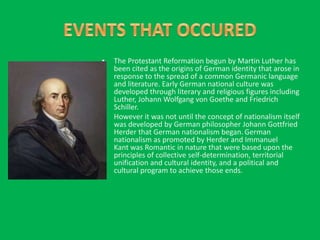
•   The Protestant Reformation begun by Martin Luther has
    been cited as the origins of German identity that arose in
    response to the spread of a common Germanic language
    and literature. Early German national culture was
    developed through literary and religious figures including
    Luther, Johann Wolfgang von Goethe and Friedrich
    Schiller.
•   However it was not until the concept of nationalism itself
    was developed by German philosopher Johann Gottfried
    Herder that German nationalism began. German
    nationalism as promoted by Herder and Immanuel
    Kant was Romantic in nature that were based upon the
    principles of collective self-determination, territorial
    unification and cultural identity, and a political and
    cultural program to achieve those ends.
• The German Romantic nationalism of Herder and
  Kant derived from the Enlightenment era
  philosopher Jean Jacques Rousseau's and French
  Revolutionary philosopher Emmanuel-Joseph
  Sieyès' ideas of naturalism and that legitimate
  nations must have been conceived in the state of
  nature.
• This emphasis on the naturalness of ethno-
  linguistic nations continued to be upheld by the
  early 19th century Romantic German
  nationalists Johann Gottlieb Fichte, Ernst Moritz
  Arndt, and Friedrich Ludwig Jahn who all were
  proponents of Pan- Germanism.
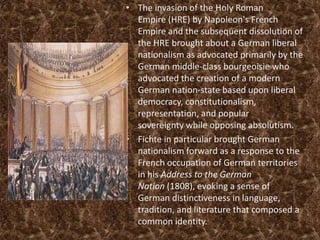
• The invasion of the Holy Roman
  Empire (HRE) by Napoleon's French
  Empire and the subsequent dissolution of
  the HRE brought about a German liberal
  nationalism as advocated primarily by the
  German middle-class bourgeoisie who
  advocated the creation of a modern
  German nation-state based upon liberal
  democracy, constitutionalism,
  representation, and popular
  sovereignty while opposing absolutism.
• Fichte in particular brought German
  nationalism forward as a response to the
  French occupation of German territories
  in his Address to the German
  Nation (1808), evoking a sense of
  German distinctiveness in language,
  tradition, and literature that composed a
  common identity.
• After the defeat of France in the Napoleonic
  Wars at the Congress of Vienna, German
  nationalists tried but failed to establish
  Germany as a nation-state, instead
  the German Confederation was created that
  was a loose collection of independent
  German states that lacked strong federal
  institutions.
• Economic integration between the German
  states was achieved by the creation of
  the Zollverein ("Custom Union") of Germany
  in 1818 that existed until 1866.
• The move to create the Zollverein was led
  by Prussia and the Zollverein was dominated
  by Prussia, causing resentment and tension
  between Austria and Prussia
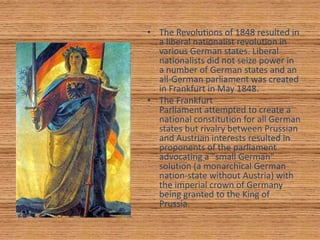
• The Revolutions of 1848 resulted in
  a liberal nationalist revolution in
  various German states. Liberal
  nationalists did not seize power in
  a number of German states and an
  all-German parliament was created
  in Frankfurt in May 1848.
• The Frankfurt
  Parliament attempted to create a
  national constitution for all German
  states but rivalry between Prussian
  and Austrian interests resulted in
  proponents of the parliament
  advocating a "small German"
  solution (a monarchical German
  nation-state without Austria) with
  the imperial crown of Germany
  being granted to the King of
  Prussia.
• The King of Prussia refused the offer and efforts to
  create a liberal German nation-state faltered and
  collapsed.
• In the aftermath of the failed attempt to establish a
  liberal German nation-state, rivalry between Prussia
  and Austria intensified under the agenda of
  Prussian Chancellor Otto von Bismarck who blocked
  all attempts by Austria to join the Zollverein.
• A division developed amongst German nationalists,
  with one group led by the Prussians that supported
  a "Lesser Germany" that excluded Austria and
  another group that supported a "Greater Germany"
  that included Austria.
• The Prussians sought a Lesser
  Germany to allow Prussia to assert
  hegemony over Germany that
  would not be guaranteed in a
  Greater Germany.
• Prussia achieved hegemony over
  Germany in the "wars of
  unification": the Second Schleswig
  War (1864), the Austro-Prussian
  War (1866), and the Franco-
  Prussian War (1870).
• A German nation-state was
  founded in 1871 called the German
  Empire as a Lesser Germany with
  the King of Prussia inheriting the
  throne of German
  Emperor (Deutscher Kaiser) and
Nationalism in germany

Nationalism in germany

  • 1.
  • 2.
    The Protestant Reformation begun by Martin Luther has been cited as the origins of German identity that arose in response to the spread of a common Germanic language and literature. Early German national culture was developed through literary and religious figures including Luther, Johann Wolfgang von Goethe and Friedrich Schiller. • However it was not until the concept of nationalism itself was developed by German philosopher Johann Gottfried Herder that German nationalism began. German nationalism as promoted by Herder and Immanuel Kant was Romantic in nature that were based upon the principles of collective self-determination, territorial unification and cultural identity, and a political and cultural program to achieve those ends.
  • 3.
    • The GermanRomantic nationalism of Herder and Kant derived from the Enlightenment era philosopher Jean Jacques Rousseau's and French Revolutionary philosopher Emmanuel-Joseph Sieyès' ideas of naturalism and that legitimate nations must have been conceived in the state of nature. • This emphasis on the naturalness of ethno- linguistic nations continued to be upheld by the early 19th century Romantic German nationalists Johann Gottlieb Fichte, Ernst Moritz Arndt, and Friedrich Ludwig Jahn who all were proponents of Pan- Germanism.
  • 4.
    • The invasionof the Holy Roman Empire (HRE) by Napoleon's French Empire and the subsequent dissolution of the HRE brought about a German liberal nationalism as advocated primarily by the German middle-class bourgeoisie who advocated the creation of a modern German nation-state based upon liberal democracy, constitutionalism, representation, and popular sovereignty while opposing absolutism. • Fichte in particular brought German nationalism forward as a response to the French occupation of German territories in his Address to the German Nation (1808), evoking a sense of German distinctiveness in language, tradition, and literature that composed a common identity.
  • 5.
    • After thedefeat of France in the Napoleonic Wars at the Congress of Vienna, German nationalists tried but failed to establish Germany as a nation-state, instead the German Confederation was created that was a loose collection of independent German states that lacked strong federal institutions. • Economic integration between the German states was achieved by the creation of the Zollverein ("Custom Union") of Germany in 1818 that existed until 1866. • The move to create the Zollverein was led by Prussia and the Zollverein was dominated by Prussia, causing resentment and tension between Austria and Prussia
  • 6.
    • The Revolutionsof 1848 resulted in a liberal nationalist revolution in various German states. Liberal nationalists did not seize power in a number of German states and an all-German parliament was created in Frankfurt in May 1848. • The Frankfurt Parliament attempted to create a national constitution for all German states but rivalry between Prussian and Austrian interests resulted in proponents of the parliament advocating a "small German" solution (a monarchical German nation-state without Austria) with the imperial crown of Germany being granted to the King of Prussia.
  • 7.
    • The Kingof Prussia refused the offer and efforts to create a liberal German nation-state faltered and collapsed. • In the aftermath of the failed attempt to establish a liberal German nation-state, rivalry between Prussia and Austria intensified under the agenda of Prussian Chancellor Otto von Bismarck who blocked all attempts by Austria to join the Zollverein. • A division developed amongst German nationalists, with one group led by the Prussians that supported a "Lesser Germany" that excluded Austria and another group that supported a "Greater Germany" that included Austria.
  • 8.
    • The Prussianssought a Lesser Germany to allow Prussia to assert hegemony over Germany that would not be guaranteed in a Greater Germany. • Prussia achieved hegemony over Germany in the "wars of unification": the Second Schleswig War (1864), the Austro-Prussian War (1866), and the Franco- Prussian War (1870). • A German nation-state was founded in 1871 called the German Empire as a Lesser Germany with the King of Prussia inheriting the throne of German Emperor (Deutscher Kaiser) and